보 문
한강물로부터 분리된 방사선 내성 세균들의 계통학적 다양성 및 UV 내성 분석
이재진1 ・ 주은선1 ・ 이도희1 ・ 정희영2 ・ 김명겸1*
1서울여자대학교 자연과학대학 생명환경공학과, 2경북대학교 농업생명과학대학 응용생명과학부
Phylogenetic diversity and UV resistance analysis of radiation-resistant bacteria isolated from the water in Han River
Jae-Jin Lee1, Eun Sun Joo1, Do Hee Lee1, Hee-Young Jung2, and Myung Kyum Kim1*
1Department of Bio & Environmental Technology, College of Natural Science, Seoul Women’s University, Seoul 01797, Republic of Korea
2College of Agricultural and Life Sciences, Kyungpook National University, Daegu 41566, Republic of Korea
(Received March 4, 2016; Revised March 21, 2016; Accepted March 22, 2016)
ABSTRACT: The aim of this study was to investigate the UV-resistance of radiation-resistant bacteria isolated from the water of Han River, South Korea. The water sample was irradiated with 3 kGy gamma radiation prior to isolation. Radiation-resistant bacterial strains were isolated by standard serial dilution method on R2A and 1/10 diluted R2A agar. The resulting purely isolated 60 cultures of bacteria were analysed for UV resistance and used in further studies. Based on the comparative analyses of 16S rRNA gene sequences, the bacterial isolates were divided into 3 phyla (4 genera): the phylum Deinococcus-Thermus (the genus Deinococcus) was 61.7%, Bacteroidetes (Hymenobacter and Spirosoma) was 23.4%, and Firmicutes (Exiguobacterium) was 15%. The results suggested that twenty-nine isolates are candidates new species belonging to Deinococcus, Hymenobacter, and Spirosoma, or other new genera. Nine bacterial strains were selected among the novel candidates and the UV-resistance analysis was conducted. All the candidate bacterial strains showed high UV resistance, similar to that of D. radiodurans R1.
Key words: 16S rDNA, Han River, phylogenetic tree, radiation-resistant bacteria, UV resistance analysis, water
*For correspondence.
E-mail: [email protected];
Tel.: +82-2-970-5667; Fax: +82-2-970-5974
Deinococcus radiodurans 균주(Brooks and Murray, 1981) 가 처음으로 발견되면서 방사선 내성 미생물에 대한 관심이 생기게 되었다. 이들이 가지고 있는 DNA 복구 효소의 활성 원 리를 응용한 노화방지 연구, 암세포의 방사선 내성 감소를 위 한 내성 유전자 연구, 방사선 내성 생물체 개발을 통한 오염된 환경의 생물학적 정화 등과 같은 가능성들이 밝혀지게 되면서 (Cox and Battista, 2005; Servinsky and Julin, 2007; Kwon and Seo, 2010), 이러한 방사선 내성 연구를 위한 방사선 내성 미생 물 자원 확보가 더 많이 요구되고 있는 추세이다.
Deinococcus와 Rubrobater 가 대표적으로 방사선 내성이 강한 속(genus)으로 알려져 있으며, 이보다 방사선 내성이 약 한 속으로는 Acinetobacter, Chroococcidiopsis, Hymenobacter,
Kineococcus, Kocuria, Methylobacterium, Pyrococcus, Ther-
mococcus 이 있는 것으로 밝혀졌다(Rainey et al., 2005; Yu et
al., 2015). 최근에는 Spirosoma 속이 Deinococcus 만큼의 강
한 내성을 보이며(Lee et al., 2014; Lee et al., 2015), 계속 새로
운 다양한 방사선 내성 미생물이 밝혀지고 있는 중이다. 그리
고 이들은 방사선뿐만이 아니라 UV와 건조한 환경에도 잘 견
디는 것으로 밝혀 졌다(Mattimore and Battista, 1996; de Groot
et al., 2005). 방사선 내성 미생물은 남극, 북극, 사막, 방사선에
오염된 토양과 같은 극한 환경에서 얻는 경우가 많으며(Hirsch
et al., 1998; 2004; Yuan et al., 2009; Wang et al., 2010), 그 외
에도 공기, 강물, 토양, 실험실, 나무, 바다고기, 목재 섭식 흰개
미 등 다양한 환경에서 분리되었다(Lai et al., 2006; Zhang et
al., 2007; Im et al., 2008; Shashidhar and Bandekar, 2009; Yoo
et al., 2010; Cha et al., 2014).
이렇게 방사선 내성 균주가 분리되었던 다양한 환경들 중 에서 물에서 분리된 방사선 내성 미생물의 보고가 상당 수 이 루어 짐에 따라(Im et al., 2008; Kämpfer et al., 2008; Asker et al., 2009; 2011), 우리나라 서울 한강물에서 방사선 내성을 가 지는 것으로 추측되는 미생물을 분리 및 탐색 하고, 16S rDNA 유전자 염기서열을 비교하여 한강에서의 방사선 내성 미생물 의 계통수를 분석하고자 하였다. 또한 2016년 2월 현재까지 우 리나라 한강물에서 분리되어 신종으로 보고된 균주들은 Bre- vibacillus fluminis CJ71
T, Chryseobacterium rigui CJ16
T, Paenibacillus aestuarii CJ25
T등 총 3건(Suresh et al., 2004;
Bae et al., 2010; Choi et al., 2010; Park et al., 2013)으로 더 많 은 신종 미생물 보고를 위하여 신종 연구가 가능한 것으로 추 정되는 신종 예상 균주를 파악하여 UV 내성 추가 실험을 통해 UV 내성 여부를 분석하고 방사선 내성 연구에 필요로 하는 유 용미생물 자원을 확보하고자 하였다.
재료 및 방법
한강물 채집, 농축, 방사선 조사 및 세균의 분리
2016년 1월에 여의도 공원 근처의 한강 상층수를 멸균된 병 에 1 L 담아서 채집한 후, Hydrophilic membrane filter (Mixed Cellulose ester 02047A, 0.20 μm, Hyundai Micro.)로 여과하 여 10 ml 증류수에 여과된 필터지를 넣어 균질화 하였다. 균질 화된 시료에 3 kGy의 감마선(gamma-ray)을 조사하고 연속희 석법으로 희석한 후, 현탁액을 R2A agar (Difco) 및 1/10로 희 석된 R2A agar (Difco) 배지에 각각 도말하여 25°C에 7일간 배 양하였다. 3 kGy 방사선에 견디고 자라난 군락(colony)을 군 락의 모양, 크기, 색깔 등에 따라 선별하여 처음에 도말했던 평 판배지에 계대 배양하여 순수분리 하였다. 분리된 미생물은 20% (v/v) glycerol 에 현탁하여 초저온 냉동고(-80°C)에 동결 보관하였다.
Genomic DNA 추출, 16S rDNA 유전자 증폭 및 염기서열 분석
Genomic DNA는 InstaGene™Matrix (Bio-Rad) 시약을 사 용하여 분리하였다. 먼저 평판배지에 균주를 접종하여 배양 후 colony를 취하여 마이크로 튜브 안 1 ml 증류수에 용해시킨 후 원심분리(10,000–12,000 rpm, 1분)해서 상등액을 제거하 고, InstaGene™Matrix를 50 μl 첨가 후 56°C에서 15분간 반응 시켰다. 튜브를 10초 동안 빠른 속도로 vortexing하고 10분 동 안 100°C에 끓인 후, 다시 튜브를 10초 동안 빠른 속도로
vortexing 하고 원심분리(10,000–12,000 rpm, 3분)하여 16S rRNA 유전자 분석을 위한 genomic DNA를 추출하였다. 16S rRNA 유전자를 증폭하기 위해 27F (5′-AGAGTTTGATCM TGGCTCAG-3′) primer와 1492R (5′-TACGGYTACCTTG TTACGACTT-3 ′) primer를 사용하였고, MJ Research 사의 PTC-225 Peltier Thermal Cycler를 사용하여 PCR 반응은 초 기변성(95°C, 5분), 변성(95°C, 1분), 냉각(55°C, 1분), 신장 (72°C, 1분)을 35회 반복한 후 마지막 신장(72°C, 5분)을 실시 하였다. Applied Biosystems 사의 ABI 3730XL DNA analyzer 를 이용하여 유전자 염기서열 결과를 얻었다. 이러한 유전자 염기서열 분석은 ㈜마크로젠(Macrogen)을 통해 이루어졌다.
계통학적 분석
분석된 염기서열은 EzBioCloud의 database (http://www.
ezbiocloud.net/eztaxon/) 를 이용해서 GenBank로부터 유사성 이 높은 염기서열을 비교하여 가장 가까운 종으로 나타나는 서열을 확인하였다. 본 연구에 선택된 균주들의 16S rRNA 염 기서열 alignment는 BioEdit (Hall, 1999)으로 수집, Clustal_X (Thompson et al., 1997) 를 이용하여 정렬 한 후에 MEGA 5.0 software (Molecular Evolutionary Gnetics Analysis; Tamura et al., 2011)을 이용하여 neighbor-joining 방법(Saitou and Nei, 1987)에 의해 계통수를 추론하였다.
Ultra-Violet 내성 실험
배양된 균주를 0.85% NaCl에 연속희석 후, 희석된 균체를 R2A agar에 10 μl씩 접종하였다. Negative control로는 Escheri- chia coli K-12 (=KCTC 1116) (Kämpfer et al., 2008), Positive control 로는 Deinococcus radiodurans R1
T(=DSM 20539
T) (Brooks and Murray, 1981; White et al., 1999) 을 사용하였다.
접종된 R2A agar plate의 뚜껑을 열고 UVC ultraviolet cross- linker (UVP, CX-2000)를 사용하여 254 nm의 파장으로 UV를 조사하였다. 선량률(dose rate)는 50 J/m
2/sec이며, 노출 시간 을 조정함에 따라 전체 UV 조사량이 달라진다. UV 조사 후, 25°C에서 3일간 배양한 다음 colony를 계수하였다.
결과 및 고찰
배지에 따른 세균수 및 분리 균주의 균주수
방사선 조사된 한강수 샘플로부터 평판배양법으로 세균
수를 측정한 결과, 평균적으로 R2A 평판배지에서 분리한 방
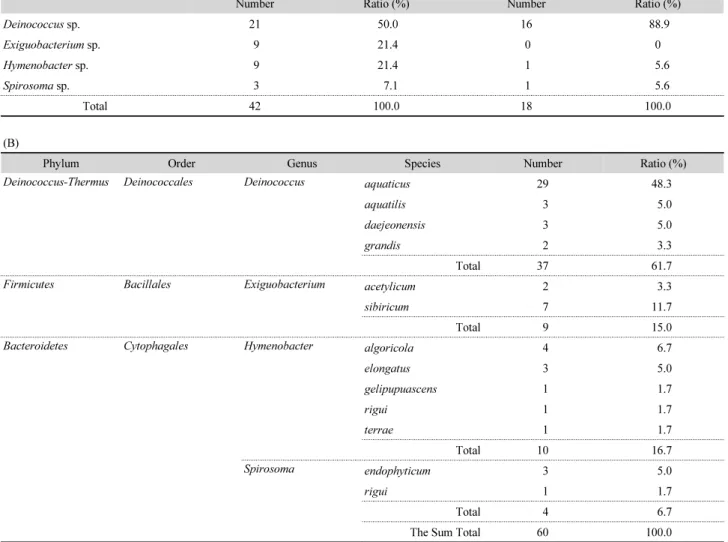
Table 1. Diversity of cultivable bacteria from the gamma-radiated water sample of Han River in Seoul (total isolates = 60)
(A) Genera of bacterial isolates on (1) R2A and (2) 1/10 R2A media from the water of Han River. (B) Diversity of bacterial isolates of the gamma-radiated water of Han River.
(A)
Genus (1) Medium : R2A (2) Medium : 1/10 R2A
Number Ratio (%) Number Ratio (%)
Deinococcus sp. 21 50.0 16 88.9
Exiguobacterium sp. 9 21.4 0 0
Hymenobacter sp. 9 21.4 1 5.6
Spirosoma sp. 3 7.1 1 5.6
Total 42 100.0 18 100.0
(B)
Phylum Order Genus Species Number Ratio (%)
Deinococcus-Thermus Deinococcales Deinococcus aquaticus 29 48.3
aquatilis 3 5.0
daejeonensis 3 5.0
grandis 2 3.3
Total 37 61.7
Firmicutes Bacillales Exiguobacterium acetylicum 2 3.3
sibiricum 7 11.7
Total 9 15.0
Bacteroidetes Cytophagales Hymenobacter algoricola 4 6.7
elongatus 3 5.0
gelipupuascens 1 1.7
rigui 1 1.7
terrae 1 1.7
Total 10 16.7
Spirosoma endophyticum 3 5.0
rigui 1 1.7
Total 4 6.7
The Sum Total 60 100.0
사선 내성 세균은 6.7 × 10
5CFU/ml 였고, 1/10 R2A 평판배지 에서는 1.4 × 10
5CFU/ml의 세균수가 관찰되었다. R2A 보다 1/10 R2A 배지에서 세균수가 낮게 계수되었다. 이렇게 해서 방사선이 조사된 한강물로부터 순수 분리한 균주는 총 60개 였고, 각 배지 별로 얻어진 균주수를 살펴보면, R2A 평판배 지에서 42개, 1/10 R2A 평판배지에서 18개 균주를 얻었다 (Table 1A).
염기서열 분석 및 계통학적 분석
방사선이 조사된 한강물에서 순수 분리된 60개 균주의 16S rRNA 유전자 염기서열을 가지고 EzbioCloud를 이용하여 계 통학적 다양성을 분석해 본 결과, Deinococcus-Thermus 문
(Deinococcus 속), Firmicutes 문(Exiguobacterium 속), Bacter- oidetes 문(Hymenobacter, Spirosoma 속)의 3개의 문, 4개의 속, 13개의 종으로 동정되었다. 이 중 Deinococcus-Thermus 문이 총 37개(61.7%) 균주로 가장 많이 나타났고, 그 다음은 Bacteroidetes (14 개; 23.4%), Firmicutes (9개; 15%) 문의 순으 로 분포하였다(Table 1B).
R2A 평판배지에서 생장한 42개 균주 중 Deinococcus spp.
은 21개(50%)로 절반을 차지하였고, Exiguobacterium spp.와
Hymenobacter spp. 은 각 9개씩(각 21.4%), Spirosoma spp.은 3
개(7.1%)였다. 1/10 R2A 평판배지에서는 Deinococcus spp.가
16개(88.9%)로 대부분을 차지하였다(Table 1A). 각 배지에서
분리된 Deinococcus spp.의 수가 큰 차이가 없는 것으로 보아
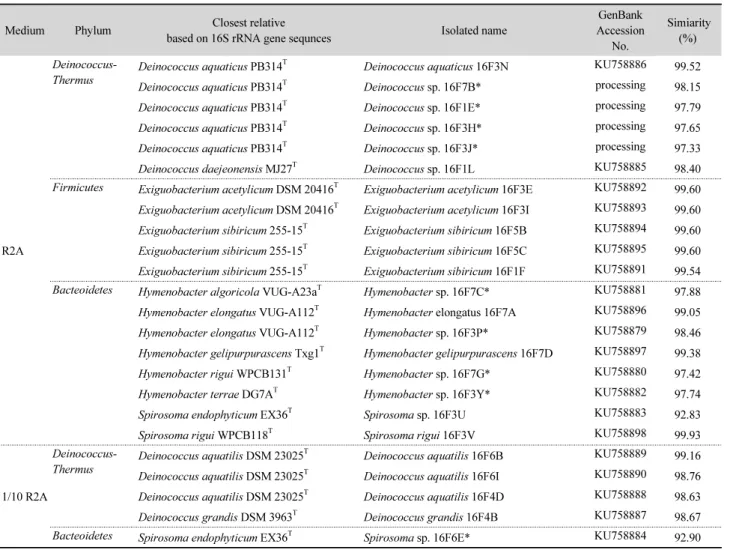
Table 2. Identification of radiation-resistant bacteria isolated from the waters of Han River in Seoul
Medium Phylum Closest relative
based on 16S rRNA gene sequnces Isolated name
GenBank Accession
No.
Simiarity (%)
R2A
Deinococcus- Thermus
Deinococcus aquaticus PB314
TDeinococcus aquaticus 16F3N KU758886 99.52
Deinococcus aquaticus PB314
TDeinococcus sp. 16F7B* processing 98.15
Deinococcus aquaticus PB314
TDeinococcus sp. 16F1E* processing 97.79
Deinococcus aquaticus PB314
TDeinococcus sp. 16F3H* processing 97.65
Deinococcus aquaticus PB314
TDeinococcus sp. 16F3J* processing 97.33
Deinococcus daejeonensis MJ27
TDeinococcus sp. 16F1L KU758885 98.40
Firmicutes Exiguobacterium acetylicum DSM 20416
TExiguobacterium acetylicum 16F3E KU758892 99.60 Exiguobacterium acetylicum DSM 20416
TExiguobacterium acetylicum 16F3I KU758893 99.60 Exiguobacterium sibiricum 255-15
TExiguobacterium sibiricum 16F5B KU758894 99.60 Exiguobacterium sibiricum 255-15
TExiguobacterium sibiricum 16F5C KU758895 99.60 Exiguobacterium sibiricum 255-15
TExiguobacterium sibiricum 16F1F KU758891 99.54 Bacteoidetes Hymenobacter algoricola VUG-A23a
THymenobacter sp. 16F7C* KU758881 97.88 Hymenobacter elongatus VUG-A112
THymenobacter elongatus 16F7A KU758896 99.05 Hymenobacter elongatus VUG-A112
THymenobacter sp. 16F3P* KU758879 98.46 Hymenobacter gelipurpurascens Txg1
THymenobacter gelipurpurascens 16F7D KU758897 99.38
Hymenobacter rigui WPCB131
THymenobacter sp. 16F7G* KU758880 97.42
Hymenobacter terrae DG7A
THymenobacter sp. 16F3Y* KU758882 97.74
Spirosoma endophyticum EX36
TSpirosoma sp. 16F3U KU758883 92.83
Spirosoma rigui WPCB118
TSpirosoma rigui 16F3V KU758898 99.93
1/10 R2A
Deinococcus- Thermus
Deinococcus aquatilis DSM 23025
TDeinococcus aquatilis 16F6B KU758889 99.16 Deinococcus aquatilis DSM 23025
TDeinococcus aquatilis 16F6I KU758890 98.76 Deinococcus aquatilis DSM 23025
TDeinococcus aquatilis 16F4D KU758888 98.63 Deinococcus grandis DSM 3963
TDeinococcus grandis 16F4B KU758887 98.67
Bacteoidetes Spirosoma endophyticum EX36
TSpirosoma sp. 16F6E* KU758884 92.90
* UV-radiation resistance test were done (Fig. 2)
저영양 배지인 1/10 R2A에서 방사선 내성이 높다고 알려진 Deinococcus 균주를 분리하기가 더욱 용이함을 알 수 있었고, Deinococcus 이외의 다른 속에 속한 종들을 얻고자 할 때에는 R2A 배지가 1/10 R2A 배지보다 더 용이하였다.
16S rRNA 유전자 염기서열 분석에 따르면 Deinococcus- Thermus 문인 Deinococcus 속에 속하는 균주는 기존의 염기 서열과 97.2–99.5%의 상동성을 나타내었고, D. aquaticus PB314
T, D. aquatilis DSM 23025
T, D. daejeonensis MJ27
T, D.
grandis DSM 3963
T와 각각 97.2–99.5, 98.6–99.2, 98.4–99.2, 98.7-99.0% 의 유사성을 보여주었다. Firmicutes 문인 Exiguo- bacterium 속에 속해 있는 균주는 대부분 기존 종의 표준균주 염기서열과 99.1–99.7%의 높은 상동성을 보여주었으며, 16F3E, 16F3I는 E. acetylicum DSM 20416
T과 99.6%, 16F1F, 16F5B, 16F5C 는 E. sibiricum 255-15
T와 99.5–99.6%의 높은 유사도 를 나타내었다(Table 2). 그리고 Bacteroidetes 문에 속하는 균
주는 기존 종의 표준균주 염기서열과 92.8–99.9%의 상동성을 보여주었는데, Bacteroidetes 문의 Spirosoma 속에 속하는 16F3U, 16F6E는 S. endophyticum EX36
T와 92.8–92.9%의 낮 은 염기서열 유사도를 보여주었고, 163V는 Spirosoma rigui WPCB118
T와 99.9%의 높은 유사도를 나타내었다(Table 2).
Bacteroidetes 문의 Hymenobacter 속 분리균주들은 H. algori- cola VUG-A23a
T, H. elongatus VUG-A112
T, H. gelipurpuras- cens Txg1
T, H. rigui WPCB131
T, H. terrae DG7A
T와 각각 97.2 –98.1%, 98.5–99.4%, 99.4%, 97.4%, 97.7%의 상동성이 확인되었다. 이와 같이 16S rRNA 유전자 염기서열 비교를 통 해 분리된 60개 균주 중 26개 균주는 기존 종의 표준균주와 97–
98.5% 상동성을 보여 추후 신종 실험에 의해 신종 가능성을 보
이며, 3개 균주는 92.8–93.0%의 상동성을 보여 신종 실험을 통
해 새로운 속과 종으로서의 가능성이 있다고 판단됨으로 추가
적인 신종 연구를 필요로 한다(Woo et al., 2008). 이러한 연구
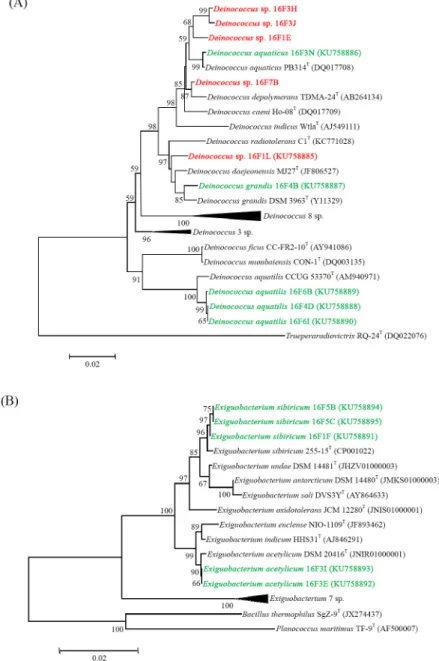
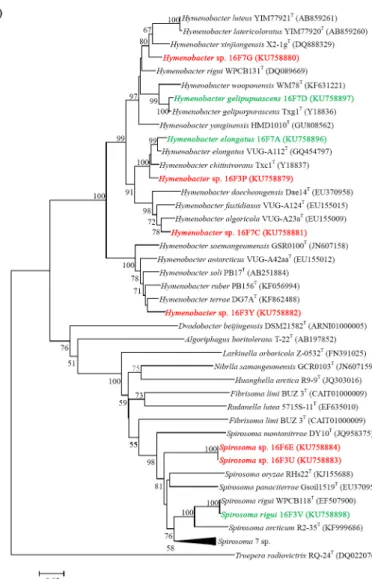
Fig. 1. Phylogenetic Neighbor-joining tree based on comparison of the 16S rRNA gene sequences of bacteria isolated from the gamma-radiated water sample of Han River and representatives of three phylum (A, Deinococcus-Thermus; B, Firmicutes; C, Bacteoidetes). Boostrap values (>50%) based on 1,000 replications are shown. Bar 0.02 nucleotide substitutions per nucleotide position. Red color, novel species; Green color, already known species.
를 통해 지금까지 한강물에서 밝혀지지 않았던 다수의 신속 및 신종 미생물 연구를 진행할 수 있을 것으로 기대된다. 이렇 게 분리된 균주(60개) 중에서 신종 가능성이 있는 균주(29개 중에서) 11개(Fig. 1-붉은색)와 기존에 밝혀진 종과 유사도가 높은 균주(31개 중에서) 13개(Fig. 1-녹색)를 선정하여, 이들 총 24개 균주를 NCBI의 GenBank에 등록하고(Table 2), 계통 학적 분석을 통하여 계통수를 작성한 결과 Fig. 1과 같다.
본 연구에서 분리된 균주들과 상동성이 높은 표준균주 Deinococcus aquaticus PB314
T, Deinococcus aquatilis DSM
23025
T등은 강물이나 산업지역 물(industry water)에서 분리
되었고 gamma선과 UV에 내성을 가지고 있는 것으로 나타났
다(Im et al., 2008; Kämpfer et al., 2008). 또한 Exiguo-
bacterium sibiricum 255-15
T은 시베리안의 영구 동토(perma-
frost) 에서 분리되었고(Rodrigues et al., 2006), Hymenobacter
elongatus VUG-A112
T는 빅토리아 빙하에서 분리되었으며
(Klassen and Fought, 2011), Spirosoma rigui WPCB118
T는 우
포 늪의 물에서 분리되었다(Baik et al., 2007). 이러한 결과로
보아 한강에서 분리된 균주들과 유전적 상동성이 높은 표준균
Fig. 1. Continued.
주 대부분은 물이나 극한지의 빙하와 관련된 시료로부터 얻어 진 것을 알 수 있었다.
Ultra-Violet 내성 분석
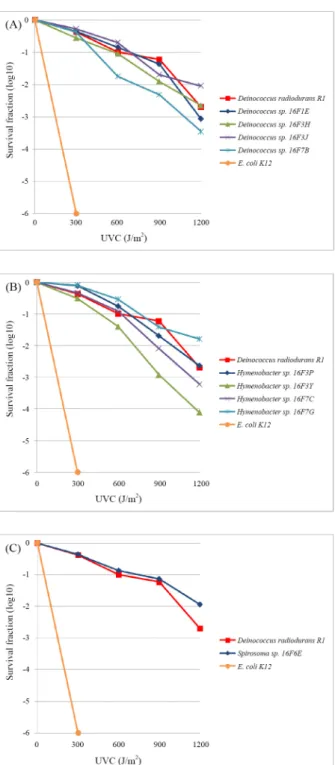
신종 가능성을 가지는 분리 균주들 중에서 9개의 신종 균주 들을 선정하여 실제 UV 세기에 따른 생장여부를 확인하기 위 해서 UV 내성 실험을 진행하였다. Deinococcus 속에 속하는 신종 후보 균주인 16F1E, 16F3H, 16F3J 등 3균주는 D
10값(미 생물의 개체수가 10분의 1로 줄어들 때 방사선 조사량)이 600 J/m
2이하이며, 이 균주들은 방사선 내성이 높다고 알려진 positive control 로 사용한 Deinococcus radiodurans R1
T균주 만큼 높은 UV 내성 결과를 보였고, 16F7B 균주는 D
10값이 300 J/m
2이하로 나타났다. Hymenobactr 신종의 경우, 3개의 16F3P, 16F7C, 16F7G 균주는 D
10값이 600 J/m
2이하이며, 이 균주들
도 D. radiodurans R1
T균주와 비슷하게 높은 UV 내성 결과를 보였고, 그 중 16F7G 균주는 전체적인 그래프가 D. radiodurans R1
T균주보다 더 높은 UV 내성 결과를 보였다. 16F3Y 균주는 D
10값이 500 J/m
2이하로 나타났다. Spirosoma 신종 균주 16F6E 는 D
10값이 900 J/m
2이하이며 D. radiodurans R1
T균주보다 전체적으로 더 높은 UV 내성 결과를 보였다(Fig. 2). 결론적으 로, 9개의 신종 균주 모두 UV 내성을 가지는 것으로 나타났고, 대부분은 방사선 내성이 높다고 알려진 D. radiodurans R1
T균주만큼 높은 UV 내성 결과를 보였고, Hymenobacter sp.
16F7G 와 Spirosoma sp. 16F6E 균주는 D. radiodurans R1
T보 다 더 높은 내성을 보이기도 하였다.
본 연구를 통하여 분리된 균주들 중에서 Deinococcus 균주
가 절반 이상을 차지하는 결과와 현재까지 밝혀진 방사선 내
성 표준 균주들이 물에서 분리된 경우가 많은 것으로 볼 때
Fig. 2. Survival rates of (A) Deinococcus sp. 4 strains (16F1E, 16F3H, 16F3J, 16F7B), (B) Hymenobacter sp. 4 strains (16F3P, 16F3Y, 16F7C, 16F7B), (C) Spirosoma sp. strain 16F6E after irradiation with UVC radiation at 254 nm. Deinococcus radiodurans R1 (positive control), and Escherichia coli strain K12 (negative control) served as positive and negative control, respectively. The y-axis shows survival on a logarithmic scale.
(Gabani and Singh, 2013), 한강물에서도 방사선 내성 균주가 많이 존재할 가능성이 있다고 보여진다. 그리고 본 연구에서
신종균주는 아니었지만 분리 균주인 Firmicutes 문에 속한 Exiguobacterium 속의 균주는 아직까지 방사선 내성 연구 보 고가 되어 있지 않아서 이에 대한 연구가 더욱 필요하며, 특히 우리나라의 한강물에 서식하는 세균의 군집구조에 관한 보고 는 거의 없기 때문에 이에 관한 연구가 필요한 실정이다.
적 요
이 논문은 서울 한강물에서 분리한 방사선 내성 세균군집 과 분리된 신종 세균의 UV 내성 특성에 관한 내용이다. 세균은 R2A agar 와 1/10 R2A agar를 사용하여 3 kGy가 조사된 한강 물에서 분리되었다. 그 결과 방사선에 내성을 가지는 것으로 추측되는 균주를 60주 분리하였고, 본 연구 분석 자료로 사용 하였다. 16S rRNA 유전자 염기서열 분석을 통해 분리균주 60 개의 계통수를 파악한 결과, 3개의 문(4개의 속)이 확인되었 고, Deinococcus-Thermus (Deinococcus)가 61.7%, Firmicutes (Exiguobacterium)는 15%, Bacteroidetes (Hymenobacter, Spiro- soma)는 23.4%의 비중을 나타냈다. 분리균주 중 29개 균주가 Deinococcus, Hymenobacter, Spirosoma 에 속하는 신종 또는 다른 신속으로 분류될 가능성을 보였으며, 앞으로 추가적인 신종 실험이 진행될 예정이다. 그리고 신종 예상균주를 9개 선정하여 UV 내성 실험을 진행한 결과, 9개 균주 모두 D.
radiodurans R1
T균주 만큼 높은 UV 내성을 가지는 것으로 나 타났다. 또한 분리된 Firmicutes (Exiguobacterium) 균주는 아 직까지 방사선 내성 연구 보고가 되어 있지 않아서 추가적인 방사선 내성 연구가 필요하다.
감사의 말
이 논문은 2016학년도 서울여자대학교 교내학술연구비의 지원을 받았음.
References