• 검색 결과가 없습니다.

Synthesis of IZTO(Indium Zinc Tin Oxide) particle by spray pyrolysis and post-heat treatment and characterization of deposited IZTO film

N/A
N/A
Protected

Academic year: 2021

Share "Synthesis of IZTO(Indium Zinc Tin Oxide) particle by spray pyrolysis and post-heat treatment and characterization of deposited IZTO film"

Copied!
7
0
0

로드 중.... (전체 텍스트 보기)

전체 글

(1)

http://dx.doi.org/10.12925/jkocs.2016.33.4.734

Synthesis of IZTO(Indium Zinc Tin Oxide) particle by spray pyrolysis and post-heat treatment and characterization of

deposited IZTO film

Seong Taek Lim․Sang Hern Kim

Department of Chemical & Biological Engineering, Hanbat National University San 16-1, Duckmyung-dong, Yuseong-gu, Daejeon, Republic of Korea, 34158 (Received November 18, 2016; Revised December 7, 2016; Accepted December 23, 2016)

Abstract : The micron-sized indium zinc tin oxide (IZTO) particles were prepared by spray pyrolysis from aqueous precursor solution for indium, zinc, and tin and organic additives such as citric acid (CA) and ethylene glycol (EG) were added to aqueous precursor solution for indium, zinc, and tin. The obtained IZTO particles prepared by spray pyrolysis from the aqueous solution without organic additives had spherical and filled morphologies, whereas the IZTO particles obtained with organic additives had more hollow and porous morphologies. The micron-sized IZTO particles with organic additives were changed fully to nano-sized IZTO particles, whereas the micron-sized IZTO particles without organic additives were not changed fully to nano-sized IZTO particle after post-treatment at 700

o

C for 2 hours and wet-ball milling for 24 hours.

Surface resistances of micron-sized IZTO’s before post-heat treatment and wet-ball milling were much higher than those of nano-sized IZTO’s after post-heat treatment and wet-ball milling.

From IZTO with composition of 80 wt. % In

2

O

3

, 10 wt. % ZnO, and 10 wt. % SnO

2

which showed a smallest surface resistance IZTO after post-heat treatment and wet-ball milling, thin films were deposited on glass substrates by pulsed DC magnetron sputtering, and the electrical and optical properties were investigated.

Keywords : IZTO(Indium Zinc Tin Oxide), spray pyrolysis, post-heat treatment, organic additives, transmittance, Transparent Conducting Oxide(TCO)

1. Introduction

Indium tin oxide (ITO) as a transparent conducting oxide (TCO) has been widely used in transparent electrode applications, such as,



Corresponding author (E-mail: [email protected])

touch screen panels and thin film solar cells

[1-3]. However, depletion of ITO may become

the main hindrance for the growth of those

transparent electrode applications in the near

future. In order to solve these problems, many

efforts have been focused on reducing the

indium content in TCO. Such efforts include

the preparation of IZTO (Indium Zinc Tin

Oxide) materials [4–16]. The need to reduce

(2)

the high dependence on ITO in TCO applications has encouraged many researchers to develop alternative materials. IZTO as a multi-component oxide is considered possible alternative materials, with the advantages of high electrical conductivity and optical transparency, good chemical stability, and low temperature deposition capability [11,12]. In this study micron-sized IZTO particles were obtained by spray pyrolysis with organic additives such as citric acid (CA) and ethylene glycol (EG), were heated at 750

o

C and ball-milled under wet condition. After post-heat treatment and wet-ball milling nano-sized IZTO was obtained. By using nano-sized IZTO, IZTO films were deposited on glass substrates by pulsed DC magnetron sputtering. The electrical and optical properties of IZTO films were investigated.

2. Experimental 2.1. Materials

Indium nitrate (24 wt. % aqueous solution) was supplied from ANP Co., Ltd.. Tin(IV) chloride pentahydrate (SnCl

4

·5H

2

O, 98 %), and zinc nitrate hexahydrate (Zn(NO

3

)

2

·6H

2

O, 99

%) and citric acid (CA, 99.5 %), and ethylene glycol (EG, extra pure) were purchased from Sigma Aldrich. Distilled water was used in all our experiments.

Characterization Size and shape of the IZTO synthesized in the present work were studied using SEM. SEM images were obtained with JEOL JSM 6300 instrument. For structural analysis XRD patterns were recorded in the range from 20

o

to 80

o

with a scanning step of 0.01

o

using the Rigaku-D/max-2500/PC with Cu-Ka radiation. Surface resistances of IZTO were measured by 4-point probe analyzer (Mitsubishi, Loresta-GP MCP-T610). The transmittance was investigated at the wavelength 550 nm using a UV–visible spectrometer(Varian, UV-VIS-NIR Spectro- photometer Cary 5000). The film thickness

was measured by surface profile inspector (KMAC, ST-4000 ).

2.2. Spray Pyrolysis

A 1.7 MHz ultrasonic spray generator with six vibrators was used to generate a large amount of droplets, which are carried into the high-temperature tubular reactor by a carrier gas. The liquid droplets were evaporated, decomposed, and/or crystallized in the quartz reactor. The length and diameter of the quartz reactor are 1200 and 50 mm, respectively. The reactor temperature was maintained at 900

o

C.

The flow rate of the air used as the carrier gas was fixed to 20 L/min. The precursor solution was prepared by dissolving indium nitrate, tin(IV) chloride pentahydrate (SnCl

4

·5H

2

O,), and zinc nitrate hexahydrate (Zn(NO

3

)

2

·6H

2

O) salts in distilled water. The overall solution concentration of indium, zinc and tin components was 0.5 M. Organic additives such as CA and EG were introduced to control the spherical morphology, porosity, and hollowness of micron sized precursor particles in spray pyrolysis. The concentrations of CA and EG were both 0.1 M.

2.3. IZTO synthesis by spray pyrolysis and post-heat treatment

The IZTO's compositions for each spray pyrolysis are tabulated in Table 1. Post-heat treatment at 700

o

C for 2 hours was done to the obtained IZTO from spray pyrolysis. After post-heat treatment the obtained IZTO was ball-milled in the methanol for 24 hours using zirconia ball and dried.

2.4. Fabrication of IZTO film

IZTO thin films with a thickness of 1600,

and 2400Å were deposited on Corning 1737

glass substrate at room temperature by pulsed

DC magnetron sputtering with a sintered

target of IZTO (80 wt. % In

2

O

3

, 10 wt. %

ZnO, and 10 wt. % SnO

2

) using DC

sputter(VTS, DaON-100S). The plasma power

and working pressure were 150 W and 6

(3)

Fig. 1. SEM images of IZTO without organic additives such as EG and CA.

Ingredients Sample No.

In

2

O

3

(wt. %) SnO

2

(wt. %) ZnO

(wt. %) CA

(M) EG

(M)

# 1 85 10 5 - -

# 2 80 10 10 - -

# 3 80 15 5 - -

# 4 85 10 5 0.1 0.1

# 5 80 10 10 0.1 0.1

# 6 80 15 5 0.1 0.1

Table 1. IZTO's compositions for each spray pyrolysis

mTorr, respectively. During film deposition, the sputtering gas was a mixture of argon and oxygen, and the oxygen partial pressure (O

2

/(Ar+O

2

)) was fixed at 2 %.

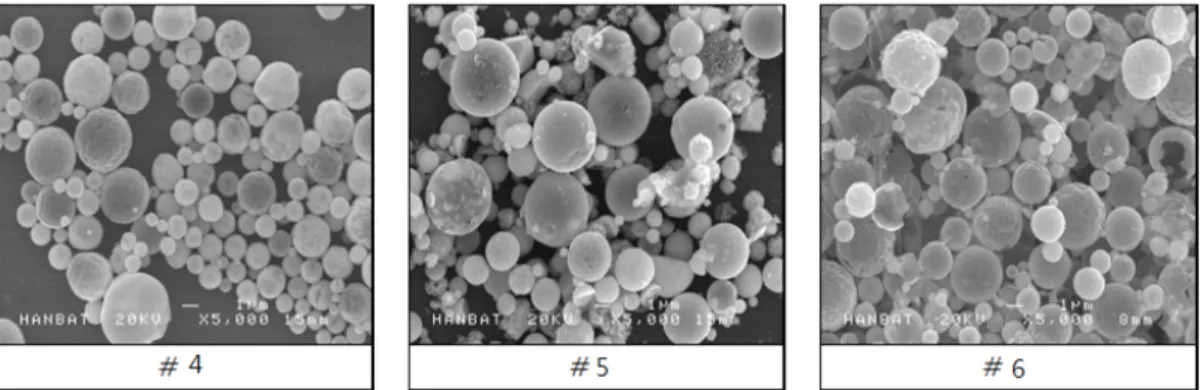
3. Results and Discussion The SEM image of IZTO without organic additives such as EG and CA was shown Fig.

1. IZTO without organic additives had spherical in shape, micron-sized particles with filled morphologies. IZTO had undergone post-heat treatment at 700

o

C for 2 hours from spray pyrolysis and ball-milling in the methanol for 24 hours using zirconia ball and dried. Fig. 2 showed that effective wet-ball

milling did not occur because most ball-milled

IZTO had maintained micron size. This

indicated that IZTO’s from spray pyrolysis

without organic additives were micron-sized

particles with filled morphologies. The SEM

images of IZTO’s with organic additives such

as EG and CA were shown Fig. 3. Compared

with SEM images for IZTO’s without organic

additives, the IZTO’s with organic additives

were non-spherical in shape, micro-sized

particles with more porosity and hollow

morphologies. Fig. 4 showed that effective

wet-ball milling occurred because most

micron-sized IZTO’s had changed fully to

nano-sized IZTO particles. This indicated that

IZTO’s from spray pyrolysis with organic

additives were non-spherical in shape,

(4)

Fig. 2. SEM images of IZTO without organic additives such as EG and CA after heat treatment at 700

o

C for 2 hours and wet-ball milling.

Fig. 3. SEM images of IZTO with organic additives such as EG and CA.(The concentrations of CA and EG were both 0.1 M.)

Fig. 4. SEM images of IZTO with organic additives such as EG and CA after heat treatment at

700

o

C for 2 hours and wet-ball milling. (The concentrations of CA and EG were both

0.1 M.)

(5)

Sample Condition

and No.

Property

Before post-heat treatment and

wet-ball milling After post-heat treatment and wet-ball milling

# 4 # 5 # 6 # 4 # 5 # 6

Surface Resistance

(  □) 82.7 40.9 25.3 7.10 4.06 5.13

Table 2. Surface resistances of IZTO before and post-heat treatment and wet-ball milling Fig. 5. X-ray diffraction patterns of IZTO

without organic additives such as EG and CA after heat treatment at 700

o

C for 2 hours and wet-ball milling.

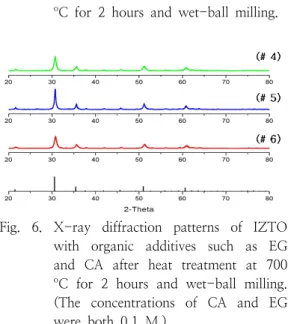
Fig. 6. X-ray diffraction patterns of IZTO with organic additives such as EG and CA after heat treatment at 700

o

C for 2 hours and wet-ball milling.

(The concentrations of CA and EG were both 0.1 M.)

micro-sized particles with more porosity and hollow morphologies so that micron-sized IZTO’s had changed easily to the nano-sized IZTO’s after the post-heat treatment and

wet-ball milling. The powder X-ray diffraction (XRD) patterns of IZTO particles without organic additives (Fig. 5) and with organic additives (Fig. 6) did not have any difference compared with standard XRD patterns for ITZO particle.

Surface resistances for IZTO before and after post-heat treatment and wet-ball milling were tabulated in Table 2. Surface resistances of micron-sized IZTO’s before post-heat treatment and wet-ball milling were much higher than those of nano-sized IZTO’s after post-heat treatment and wet-ball milling.

Among the nano-sized IZTO’s after post-heat treatment and wet-ball milling, #5 IZTO (80 wt. % In

2

O

3

, 10 wt. % ZnO, and 10 wt. % SnO

2

) was adopted as targeted material because it showed a smallest surface resistance after post-heat treatment and wet-ball milling.

IZTO films were deposited by pulsed DC magnetron sputter at room temperature onto glass substrate and the electrical and optical properties of deposited IZTO film were investigated. Sputtering conditions for IZTO film from IZTO target with composition of # 5 were summarized in Table 3.

The IZTO films deposited at optimal oxygen

partial pressure of 2.0 % in sputtering process

showed the best properties, such as low

surface resistance and high optical

transmittance of <103.5 Ω/ and >84.8 % in

the visible wavelength at 550 nm, respectively

(Table 4).

(6)

Sputtering Conditions Sample #

DC power (W)

Sputtering Rate (sec)

Film Sintering Condition (hours at 250

o

C)

Film A 150 200 1 hour

Film B 150 200 -

Film C 150 300 1 hour

Film D 150 300 -

Table 3. Sputtering conditions for IZTO film from IZTO target with composition of # 5

Table 4. Sputtering conditions for IZTO film from IZTO target with composition of # 5 Properties

Sample #

Transmittance at 550nm

(%)

Surface Resistance (Ω/)

Thickness of Sputtered IZTO Film

(Å)

Film A 93.0 73.84 1600

Film B 90.1 103.5 1600

Film C 85.2 64.75 2400

Film D 84.8 86.06 2400

Film A and C which were sintered for 1 hour at 250℃ showed much higher transmittance and lower surface resistance than film B and D without sintering. As the film thickness increased, film C and D showed lower transmittance and surface resistance than film A and B.

4. Conclusions

The obtained IZTO particles prepared by spray pyrolysis from the aqueous solution without organic additives had spherical and filled morphologies whereas the obtained IZTO particles with organic additives had more hollow and porous morphologies. The micron-sized IZTO particle with organic additives was changed fully to nano-sized IZTO particle whereas the micron-sized IZTO particle without organic additives was not changed fully to nano-sized IZTO particle after post-treatment at 700

o

C for 2 hours

and wet-ball milling for 24 hours. Surface resistances of micron-sized IZTO’s before post-heat treatment and wet-ball milling were much higher than those of nano-sized IZTO’s after post-heat treatment and wet-ball milling.

From IZTO with composition of 80 wt. % In

2

O

3

, 10 wt. % ZnO, and 10 wt. % SnO

2

which showed a smallest surface resistance, IZTO thin films were deposited on glass substrates by pulsed DC magnetron sputtering.

The IZTO film deposited at optimal oxygen partial pressure of 2.0 % in sputtering process showed the best properties, such as low surface resistance and high optical transmittance of <103.5 Ω/ and >84.8 % in the visible wavelength at 550 nm, respectively.

References

1. Tadatsugu Minami, "Present status of

transparent conducting oxide thin-film

development for Indium-Tin-Oxide (ITO)

(7)

substitutes", Thin Solid Films , 516, 5822(2008).

2. Tadatsugu Minami, H. Nanto, and S.

Takata, "Highly Conductive and Transparent Aluminum Doped Zinc Oxide Thin Films Prepared by RF Magnetron Sputtering", Jpn. J. Appl. Phys ., 24, L280(1984).

3. Tadatsugu Minami, "Transparent and conductive multicomponent oxide films prepared by magnetron sputtering", J. Vac.

Sci. Technol. , A 17 , 1765(1999.)

4. Toru Hara, Takashi Ishiguro, Naoki Wakiya, and Kazuo Shinozaki, "Oxygen Sensing Properties of SrTiO

3

Thin Films", J. Appl. Phys . 47, 7486(2008).

5. Tadatsugu Minami, Satoshi Ida, and Toshihiro Miyata, "High rate deposition of transparent conducting oxide thin films by vacuum arc plasma evaporation", Thin Solid Films , 416, 92(2002).

6. F. Kurdesau, G. Khripunov, A. F. da Cunha, M. Kaelin, and A. N. Tiwari,

"Comparative study of ITO layers deposited by DC and RF magnetron sputtering at room temperature", J.

Non-Cryst. Solids , 352, 1466(2006).

7. Sung-Jei Hong, Duck Joo Yang, Seung Jae Cha, Jae-Yong Lee, and Jeong-In Han,

"Feasibility of Indium Tin Oxide (ITO) Swarf Particles to Transparent Conductive Oxide (TCO)", Current Photovoltaic Research , 3, 50(2015).

8. Mi-Yeon Lee, Jeong-Soo Kim, and Jun-Ho Seo, "Radio-frequency thermal plasma synthesis of nano-sized indium zinc tin oxide powders with reduced indium content", Thin Solid Films , 521, 60(2012).

9. M. Putri, C. Y. Koo, J. A. Lee, J. J. Kim, and H. Y. Lee, "Transparent conducting indium zinc tin oxide thin films with low indium content deposited by radio frequency magnetron sputtering", Thin Solid Films , 559, 44(2014).

10. Jin-Woo Seo, Yang-Hee Joung, and Seong-Jun Kang, "Effect of RF power on the Electrical, Optical, and Structural Properties of ITZO (In-Sn-Zn-O) Thin Films", Journal of the Korea Institute of Information and Communication Engineering , 18, 394(2014).

11. C. W. Ow-Yang, Y. Shigesato, and D. C.

Paine, "Fabrication of transparent conducting amorphous Zn–Sn–In–O thin films by direct current magnetron sputtering", Thin Solid Films , 516, 3105(2008).

12. Chul Ho Kim, You Seung Rim, and Hyun Jae Kim, "Chemical Stability and Electrical Performance of Dual Active Layered Zinc Tin Oxide/Indium Gallium Zinc Oxide Thin Film Transistors Using a Solution Process", ACS Appl. Mater. Interfaces , 5, 6108(2013).

13. Cathleen A. Hoel, D. Bruce Buchholz, Robert P.H. Chang, and Kenneth R.

Poeppelmeier, "Pulsed-laser deposition of heteroepitaxial corundum-type ZITO:

cor-In

2−2x

Zn

x

Sn

x

O

3

",⁎ Thin Solid Films , 520, 2938(2012).

14. Steven P. Harvey, Kenneth R. Poeppelmeier, and Thomas O. Mason, "Subsolidus Phase Relationships in the ZnO–In

2

O

3

– SnO

2

System", J. Am. Ceram. Soc . 91(11), 3683(2008).

15. N. Naghavi, A. Rougier, C. Marcel, C.

Guery, J. B. Leriche, and J. M. Tarascon,

‘‘Characterization of Indium Zinc Oxide Thin Films Prepared by Pulsed Laser Deposition Using a Zn

3

In

2

O

6

Target,’’

Thin Solid Films , 360, 233(2000).

16. Hong Chan Ma, Damisih, Maryane Putri,

Jong Hoon Cheon, Jae Hong Kim, and

Hee Young Lee, "The Effect of

Post-annealing Treatment on the

Characteristics of a Dye-sensitized Solar

Cell with an Indium Zinc Tin Oxide

Electrode", Journal of the Korean Physical

Society , 61 1994(2012)

수치

Fig.  1.  SEM  images  of  IZTO  without  organic  additives  such  as  EG  and  CA.      IngredientsSample  No.In2O3(wt
Fig.  3.  SEM  images  of  IZTO  with  organic  additives  such  as  EG  and  CA.(The  concentrations  of  CA  and  EG  were  both  0.1  M.)
Fig.  6.  X-ray  diffraction  patterns  of  IZTO  with  organic  additives  such  as  EG  and  CA  after  heat  treatment  at  700
Table  3.  Sputtering  conditions  for  IZTO  film  from  IZTO  target  with  composition  of  #  5

참조

관련 문서

95 Effects of the heat treatment of the substrate on residual stress distributions for the case of the deposition of multiple lines and layers

In order to simulate a thermo-mechanical behavior in the vicinity of the deposited region by a LENS process, a finite element (FE) model with a moving heat flux is developed

The polarization-voltage (P-V) characteristics showed the typical hysteresis loop of PZT thin films after a post-CMP cleaning process with the optimized conditions

본 실험에서는 불소이온의 흡착능력을 증대시키기 위하여 대나무 탄화물 제조를 다르게 하였다. Effect of temperature of heat treatment on the adsorption of F - by

The average tensile strength value before heat treatment of PLA output was 9.67 N/㎟, and the average tensile strength value after heat treatment was 24.17 N/㎟, which

They suggested that vaporization of a thin layer of liquid between the growing bubble and the heating surface caused removal of heat from the surface, thus lowing

Lee, “Effective Ag Doping by He-Ne Laser Exposure to Improve the Electrical and the Optical Properties of CdTe Thin Films for Heterostructured Thin Film

The structure and film optical properties were investigated by X-ray diffraction(XRD), the particle size and thickness were investigated by scanning