• 검색 결과가 없습니다.

Dye-Sensitized Metal Oxide Nanostructures and Their Photoelectrochemical Properties

N/A
N/A
Protected

Academic year: 2021

Share "Dye-Sensitized Metal Oxide Nanostructures and Their Photoelectrochemical Properties"

Copied!
9
0
0

로드 중.... (전체 텍스트 보기)

전체 글

(1)

− 10 −

Dye-Sensitized Metal Oxide Nanostructures and Their Photoelectrochemical Properties

Nam-Gyu Park*

School of Chemical Engineering, Sungkyunkwan University, Suwon 440-746, Korea (Received February 2, 2010 : Accepted February 16, 2010)

Abstract : Nanostructured metal oxides have been widely used in the research fields of pho- toelectrochemistry, photochemistry and opto-electronics. Dye-sensitized solar cell is a typical example because it is based on nanostructured TiO

2

. Since the discovery of dye-sensitized solar cell in 1991, it has been considered as a promising photovoltaic solar cell because of low-cost, colorful and semitransparent characteristics. Unlike p-n junction type solar cell, dye-sensitized solar cell is photoelectrochemical type and is usually composed of the dye-adsorbed nanocrystalline metal oxide, the iodide/tri-iodide redox electrolyte and the Pt and/or carbon counter electrode. Among the studied issues to improve efficiency of dye-sensitized solar cell, nanoengineering technologies of metal oxide particle and film have been reviewed in terms of improving optical property, electron transport and electron life time.

Keywords : Dye sensitized, Solar cell, Nano structure, Panchromatic

1. Introduction

According to the speech by Richard Smalley, the Nobel Prize winner in Chemistry in 1996, the most important issue will be the energy among the top ten most pressing problems that humanity must solve in next 50 years.

1)

He cited predictions that the world would require 30- 60 terawatts in the year 2050 and most of this energy will be supplied by renewable energies. He also expected that usages of fossil fuels such as petroleum will decline because of not only carbon dioxide emission accelerating global warming but also shortage. Therefore, it is urgently required to replace the fossil fuels with renewable ener- gies such as solar powered electricity.

In recent year, a strong demand for the solar powered electricity leads to increase in solar cell production and shipment. World solar photovoltaic market grew to 5.95 Gigawatts in 2008, representing growth of 110% over the previous year, according to the Solarbuzz (www.

solarbuzz.com) report. As a result, the PV industry gen- erated $37.1 billion in global revenues in 2008. So far, the solar cell market is mainly composed of bulk silicon wafer-based solar cells. However, the critical issue in

this conventional silicon-based solar cell is still on the expensive electricity rate with 2-3 US $/Wp that should be reduced to less than 1 US $/Wp. Therefore, scientists have been interested in discovering low-cost solar cells.

In 1991, a low-cost photovoltaic solar cell with con- version efficiency of 7% was discovered by O’regan and Gratzel, based on TiO

2

nanoparticle and visible light sensitizing material.

2)

The cost of this dye-sen- sitized solar cell (DSSC) was estimated to be 70-80%

lower than that of bulk silicon solar cell, indicating that DSSC is the cost-effective technology. Recently, the conversion efficiency has been improved to 10-11%.

3-6)

In this paper, nanoengineering technologies of metal oxide particle and film have been reviewed in terms of improving optical property, associated with light harvest- ing efficiency, and electron transport and life time. Selec- tive positioning of different dyes in a nanostructured TiO

2

film is also introduced.

2. Types of Solar Cells

Solar cell is an electricity generator that converts directly solar light to electricity. Active material com- prising solar cell absorbs light, which leads to electron excitation from valence band (or ground state) to con-

*E-mail: [email protected]

Review

(2)

duction band (or excited state). Electron-hole charge is separated and then collected at transparent conductive or metallic charge collector. This consecutive process is the basic working principle of solar cell. To separate electron and hole, junction of n-type material (electron acceptor) and p-type material (hole acceptor) is required.

From the viewpoint of solar cell materials, there are two types: solid/solid pn junction and liquid/solid pn junction.

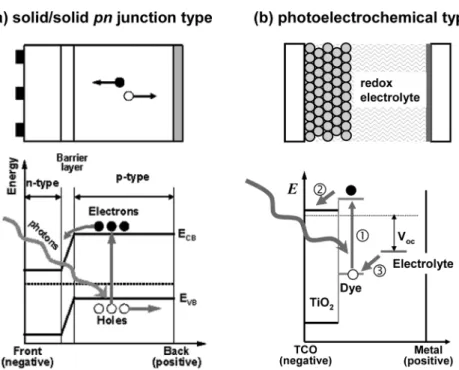
Silicon, Copper Indium Selenide (CIS), CdTe, organic bulk heterojunction solar cells belong to solid/solid pn junction type. Dye-sensitized solar cell can be categorized as a liquid/solid junction type solar cell that is often referred to as photoelectrochemical cell. Fig. 1 shows the structures and energetics of solid/solid pn junction type and photoelectrochemical type solar cells.

2.1. Dye-Sensitized Solar Cell (DSSC) Struc- ture and Working Principle

Fig. 2 shows the structure and the energy position of each component in DSSC. DSSC consists of the photo- anode comprising the dye-adsorbed mesoporous metal oxide (usually TiO

2

) film deposited on a transparent con- ductive oxide (TCO) substrate, the counter electrode com- posed of a platinum-coated TCO and the iodide/triiodide redox electrolyte. DSSC works as follows. When dye ab-

Fig. 1. Structures and energetics of solar cells having (a) solid/solid pn junction and (b) liquid/solid pn junction showing electron flow.

Fig. 2. (Top) DSSC structure consisting of nanoparticulate TiO

2

film, dye, redox electrolyte and Pt counter electrode.

(Bottom) Energetics of DSSC and working principle showing

electron excitation, electron injection, charge transport and

dye regeration.

(3)

sorbs photons being equal to or greater than the HOMO- LUMO gap energy, electrons on the HOMO (or ground state) are excited to the LUMO (or excited state) and photo-excited electrons are injected in the conduction band of TiO

2

within pico- to femto-second. The photo- injected electrons are collected at TCO via the porous TiO

2

network by diffusion process with rate of about micro- to mili-second. The oxidized dyes are regenerated by oxidation of iodide within nano-second time scale.

Photovoltage is generally determined by the energy differ- ence between the Fermi level of TiO

2

and redox electro- lyte potential. Photo-injected electrons can be lost by recombination process through surface states of TiO

2

, which has an influence on open-circuit voltage because of tuning of the Fermi energy level.

In DSSC, as mentioned previously, photo-injected electrons are transported by diffusion process since there is no electric filed in the entire TiO

2

film. Under the con- dition of constant generation of photocharge and removal at the TCO contact, the Fermi energy level decreases in the direction of the back contact (charge collector), especially at short-circuit condition. However, at open- circuit condition the Fermi energy level is constant across the entire film.

7)

The photovoltaic action in DSSC is quite different from the conventional solid/solid pn junction solar cell,

8)

where no significant space charge region id found in DSSC and thereby electric field is not important.

Moreover, carrier of only one type is presented in the oxide semiconductor in DSSC compared with coexist- ence of electron and hole in p-type semiconductor in solid/solid pn junction solar cell.

Solar-to-electrical conversion efficiency ( η) of DSSC is dependent on short-circuit photocurrent density ( J

SC

), open-circuit voltage ( V

OC

) and fill factor ( FF). J

SC

is resulted form the collective measure of light harvesting efficiency, charge separation efficiency and charge collec- tion efficiency, which depends on materials and nano- structures comprising DSSC.

2.2. Materials for DSSC

Main components for DSSC are nanocrystalline oxide semiconductor, sensitizer, redox electrolyte, counter elec- trode and transparent conducting oxide. For nanocrystal- line metal oxide semiconducting materials, crystallinity, morphology, conduction band energy edge position, nano- particulate film structure, film porosity and surface area should be taken into carefully consideration. Sensitizer will be better in case that it exhibits panchromatic absorp- tion characteristics with high extinction coefficient. In

addition, sensitizer should have a functional group to have chemical bonding on the surface of metal oxide semiconductor. Redox electrolyte is in general composed of I

3

and I

ions in non viscous and non volatile solvent.

There are numerous materials as I

source, while iodine (I

2

) is the only chemical for I

3

source. Since TiO

2

con- duction band edge is sensitive toward physico-chemical property of electrolyte such as pH, counter cations and additives, formulation of electrolyte is one of important tasks to achieve high efficiency DSSC. Nevertheless, the primary material is metal oxide layer in DSSC because amount of dye adsorption and electrolyte pene- tration are strongly dependent on nanostructured metal oxide film quality.

3. Metal Oxides for Photoanode in DSSC

3.1. Anatase and rutile TiO

2

When considering metal oxides in order to be applied to photoelectrodes in DSSC, their conduction band ener- gies should be first considered. The conduction band of metal oxide should be lower than the LUMO energy level of sensitizer in order for photo-excited electrons to be injected from dye to metal oxide. For the given Ru-based sensitizer, N719, and iodide/triiodide elec- trolyte, some of materials can be used as a photoanode material such as ZnO, SnO

2

and Nb

2

O

5

. Because con- duction band edge energies of those materials are lower than the LUMO of N719 and higher than the redox elec- trolyte potential. Among the several candidates, anatase TiO

2

has demonstrated the best photovoltaic perfor- mance with conversion efficiency of more than 10%.

For the case of anatase TiO

2

, it was reported that the

best efficiency could be achieved from exposing nanoc-

rystalline anatase TiO

2

electrodes to a diluted aqueous

TiCl

4

solution.

9)

Post-treated film was usually heated at

500

o

C. It was therefore assumed that the material

formed by TiCl

4

post treatment would be anatase TiO

2

phase because anatase was believed to be stable phase

at temperature of about 500

o

C. However, the phase was

confirmed to be rutile afterward, where detailed examina-

tion was performed on the influence of annealing temper-

ature on the crystal structure, particle size, and particle

morphology of TiO

2

films deposited onto SnO

2

con-

ducting glass from the ambient hydrolysis of TiCl

4

.

10)

The rutile TiO

2

particles produced by the ambient hydrol-

ysis of TiCl

4

showed rod-like shape which was different

from the spherical anatase TiO

2

formed by hydrothermal

treatment at around 230

o

C. It was therefore interested

(4)

to draw a comparison between rutile and anatase TiO

2

in terms of morphology-dependent photovoltaic property.

Fig. 3 shows SEM micrographs of the TiCl

4

-produced rutile TiO

2

film and the anatase TiO

2

film prepared by autoclaving at 230

o

C using titanium tetra-isopropoxide.

The rutile TiO

2

films consists of rod-shaped particles and the typical size of the particles (diameter × length) is about 20 × 80 nm, while anatase TiO

2

shows spherical shape with diameter of about 20 nm. The detailed syn- thesis was reported elsewhere.

11)

As can be seen in Fig. 3, the J-V characteristics of dye-sensitized rutile and ana- tase films (11.5 µm) are compared. Their open-circuit voltages are about the same (730 mV), and J

SC

of the rutile-based solar cell (10.6 mA/cm

2

) is about 30% less than that of the anatase-based cell (14 mA/cm

2

). As a result, the energy conversion efficiencies of the rutile- and anatase-based cells are 5.6% and 7.1%. Based on SEM study along with porosity, the surface area of the rutile film is estimated to be at least 25% lower than that of the anatase film. This result suggests that the differ- ence in J

SC

between rutile- and anatase-based cells is due to difference in surface area, i.e., the amount of dye adsorbed. In addition, the particle packing density is found to have an effect on the electron transport rate.

As plotted in Fig. 3, the effective electron diffusion coefficient D

n

for the rutile film is about one order of

magnitude lower than that of the anatase film, which underlines that electron transport is slower in the rutile layer than in the anatase layer. The difference in the elec- tron transport rate in these materials could be related to two possible factors, i.e., the number of surface states or the extent of interparticle connectivity per unit film volume. The transport of electrons through the nano- structured film is generally accepted to be slowed by multiple trapping events, involving principally surface states.

12-14)

The number of surface states is usually in direct proportion to the surface area of a film. If the number of surface states is most important cause in the difference in the rate of electron transport, then it is ex- pected that the surface area of the rutile film would be substantially larger than that of anatase. However, sur- face area of the rutile film was determined to be smaller than that of the anatase film. Thus, it can be said that the difference in electron transport rate in the rutile and the anatase films is not closely related to the absolute number of surface states. The second possible factor limiting electron transport involves the relative number of interparticle connections. From the cross-sectional morphology of the rutile and the anatase films in Fig. 3, rutile particles are found to be loosely packed, whereas anatase particles are packed closely per unit volume.

This implies that the rutile films have a lower number

Fig. 3. (Left) Plain-view and cross sectional SEM micrographs of anatase and rutile TiO

2

films. (Right) J-V curves and

electron diffusion coefficients of anatase and rutile TiO

2

films.

(5)

of interparticle connections per unit film volume than that of the anatase film. Therefore, it is expected that the number of pathways encountered by an individual electron on the way to the charge collector is smaller for a rutile film than for an anatase film. Limiting the num- ber of conductive pathways through the metal oxide par- ticle network is expected to slown electron transport through the rutile film and lower the electron diffusion coefficient. This indicates that film porosity is important to control the electron transport rate in DSSC. The poros- ity dependence of electron transport behavior was studied in detail.

15)

3.2. Metal Oxide Particle Size for Light Scattering As investigated previously, the dye-adsorbed TiO

2

film plays an important role because it serves as a path- way for photo-injected electrons. It is no doubt that the nanocrystalline TiO

2

film with high surface area is able to utilize more photons due to large quantity of the adsorbed dye. However, increase in the surface area by simply increasing the nanocrystalline TiO

2

film thick- ness is restricted since the increased surface states induced by the increased surface area could act as recombination centers of photo-injected electrons.

16,17)

Instead of using only nanocrystalline TiO

2

particle films, it has been pro- posed that a double layer structure consisting of light scattering over layer with sub-micron sized particles and nanocrystalline semitransparent TiO

2

under layer. This bi-layer structure can improve photocurrent density be- cause of the improved light scattering effect.

18,19)

Even- tually, the scattering effect from the large TiO

2

particles enhances the photocurrent density and thereby overall

conversion efficiency. The scattering effect is known to depend on size,

20)

refractive index

19)

and position

21)

of the scattering particles. Therefore, the findings of the correlation between the scattering effect and properties of the scattering particles are important to maximize the scattering efficiency. The scattering efficiency in DSSCs

22,23,24-26)

has been investigated theoretically, in which it is proposed that the scattering is largest when the particle diameter is about kλ, where k is a constant and λ is the wavelength, that is, light scattering efficiency correlates with the size of the scattering particle. Recently, the size-dependent scattering efficiency in dye-sensitized solar cell has been investigated using a bi-layer film structure.

27)

Two kinds of large scattering particles with rutile phase, G1 and G2 (Showa Denko, Japan), were compared, where particle size of G1 and G2 was about 0.3 µm and 0.5 µm, respectively. The conversion effi- ciency of 7.55% for the 7 µm-thick TiO

2

film composed of only nanocrystalline TiO

2

was improved to 8.94%

and 8.78% after introduction of the scattering layers com- prising G1 and G2 particles, respectively. The relatively smaller sized G1 showed higher conversion efficiency than the larger G2 and the improved efficiency was mainly caused by the increase in photocurrent density.

Fig. 4(a) shows the IPCE spectra as a function of wave- length. The bi-layer structured film having G1 over layer shows better IPCE than G2 one in the entire wave- length. Fig. 4(b) shows the UV-VIS reflectance of the G1 and G2 particle films. G1 and G2 scattering particles exhibit reflectance as high as 70-80% in the 400- 800 nm. The reflectance of the G1 particle film is higher than that of the G2 particle in the 400-700 nm range. On

Fig. 4. (a) IPCE spectra of C1- and G2-contained nanocrystalline TiO2 film, along with pure nanocrystalline TiO2 film.

(b) Reflectance spectra of G1 and G2 films.

(6)

the other hand, G2 has higher reflectance above 700 nm.

Therefore, the higher IPCE for the G1 particle over layer than the G2 particle one is ascribed to better reflectance ability of the G1 particle film. Scattering efficiency (h

S

) was calculated from the relation h

S

= ( T

ML

) × ( R

SL

) × (IPCE at under-layer), where T

ML

and R

SL

represent transmittance of the under layer and reflectance of the scattering layer, respectively, and each value were taken from the UV-VIS and the reflectance data. The IPCE data without scattering layer were used for the IPCE at the under layer. The calculated scattering efficiency was found to be maximized at around 600 nm, from which scattering efficiency is expected to be maximized when particle size approaches l/2.

3.3. Bi-Functional Metal Oxide

The size of the scattering particle should be large enough to scatter the incident light efficiently since small- size (10-30 nm) nanocrystalline particles cause Rayleigh scattering that is too weak to scatter the light back- ward.

28)

Large TiO

2

particles with spherical shapes or flat surfaces are normally used as the particles for scattering over layer. However, except for their role in scattering of light, electron generation is hardly expected from such a scattering particle with flat surface because of poor dye adsorption property due to the decreased surface area. Therefore, a new functional material is required, which is able to offer both light-scattering and electricity-generation properties. Nano-embossed hollow spherical TiO

2

(NeHS TiO

2

) was developed for use in

high-efficiency dye-sensitized solar cells.

5)

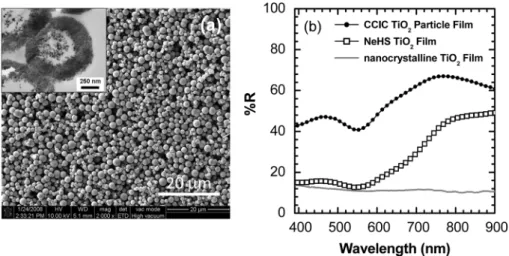
NeHS TiO

2

can be synthesized in basic media. Fig. 5(a) shows SEM images of the as-synthesized NeHS TiO

2

particles.

The diameter of the spheres is in the range of 1-3 µm.

TEM image shows a hollow-sphere structure with a wall thickness of about 0.25 µm. The surface of NeHS TiO2 is made up of TiO

2

nanoparticles with an average diameter of about 18 nm. To study the bi-functionality of NeHS TiO

2

, the NeHS TiO

2

layer was deposited on the nanocrystalline TiO

2

under layer. After introduction of NeHS TiO

2

as an over layer (1L-NeHS), the conver- sion efficiency was improved by about 21% from 7.79%

to 9.43%. When comparing the photovoltaic perfor- mance of 1L-NeHS and 1L-CCIC (flat surface scatter- ing particle), 1L-NeHS showed higher J

SC

and similar V

OC

, resulting in better conversion efficiency. The higher J

SC

was probably related to either the amount of ad- sorbed dye or light scattering or both. The amount of adsorbed dye for the NeHS particles was about 0.58 × 10

−7

mol/cm

2

, which was about 5 times larger than the amount of 0.12 × 10

−7

mol/cm

2

for the CCIC particles.

Therefore, the higher J

SC

observed for 1L-NeHS than 1L-CCIC was attributed to the larger quantity of dye on the NeHS particles. In Fig. 5(b), the UV-VIS reflec- tance spectrum of the dye-adsorbed NeHS TiO

2

film was compared with those of the dye-adsorbed CCIC TiO

2

one, along with the dye-adsorbed nanocrystalline TiO

2

film. In the short wavelength ranging from 400 to 600 nm, the reflectance of the NeHS TiO

2

film is close to that of the nanocrystalline TiO

2

film, which is mainly

Fig. 5. (a) SEM image of nano-embossed hallow spherical (NeHS) TiO

2

. Inset shows TEM image of individual NeHS

particle sliced by microtome. (b) Reflectance of the conventional light scattering particle (CCIC) with flat surface and the

NeHS particle, along with pure TiO

2

film

(7)

due to light absorption by the dye molecules. On the other hand, the CCIC TiO

2

film still shows a high reflect- ance at 400-600 nm because of low dye adsorption.

In the long wavelength region, the dye-adsorbed NeHS film exhibits a substantially higher reflectance than the dye adsorbed nanocrystalline TiO

2

film and its reflec- tivity is close to that of the CCIC film. Therefore, the improved J

SC

is caused by both bi-functionality of light scattering and charge generation.

3.4. Nanoengineering for Panchromatic Absorption Typically, single dye has been used in DSSC. How- ever, sequential adsorption of several dyes in a single TiO

2

mesoporous film is an ideal design to extend the range of light absorption. We developed a new method for selective positioning of organic dye molecules with different absorption ranges in a mesoporous TiO

2

film.

29)

The key technology in this method was how to desorb selectively the adsorbed dye, which was started from a simple idea mimicking column chromatography. The polystyrene-filled mesoporous TiO

2

film was explored for use as a stationary phase and a Bronstead base-con- tained polymer solution was developed for use as a mobile phase for selective desorption of the adsorbed dye. Dye solution and NaOH aqueous solution mixed with polypropylene glycol (PPG) were used as mobile phases for selective adsorption and desorption, respec- tively. Three dyes used for the experiment were 2-cyano- 3-(5-(4-ethoxyphenyl)thiophen-2-yl)acrylic acid (referred to as P5, yellow colour), cis-bis (isothiocyanato) bis (2,2'-bipyridyl-4,4'-dicarboxylic acid) ruthenium(II) (referred to as N719, red colour) and tri(isothiocyanato) (2,2';6',2''-terpyridyl-4,4',4''-tricarboxylic acid) ruthenium (II) (referred to as N749, green colour). Adsorption-des- orption procedure was first tested with N719 and N749, which was as follows. N719 dye was first adsorbed on an annealed TiO

2

film, and then polystyrene was formed inside the TiO

2

film to decrease the pore size by means of polymerization of styrene oligomer adsorbed on TiO

2

surface. For selective desorption to remove N719 from the upper region of the TiO

2

film, the desorption solution was prepared by mixing NaOH aqueous solution and poly(propylene glycol) (PPG). The use of PPG was to slow down the penetration rate of NaOH aqueous solu- tion and thereby the thickness of desorbed layer was controlled. N749 dye was adsorbed on the N719-des- orbed region. After completion of the selective adsorption, polystyrene was removed by ethyl acetate solution. The developed method realized the selective positioning of

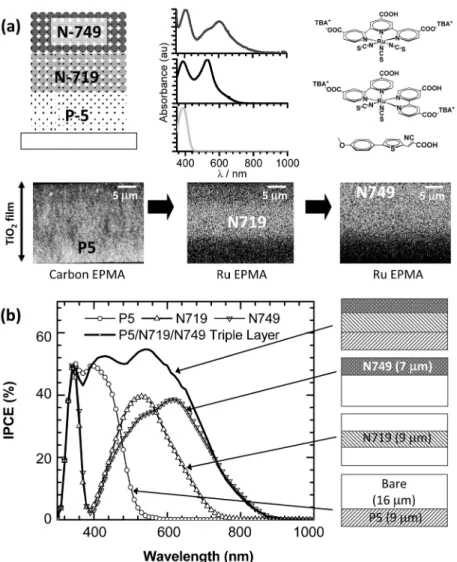
three dyes with different absorbance characteristics, P5 (yellow), N719 (red), and N749 (green). Since the longer wavelength light can reach the TiO

2

layer far away from the FTO substrate, the dye alignment was designed to be the following order: FTO/P5/N719/N749. In Fig. 6, EPMA measurements confirm the formation of P5 dye on the bottom of the TiO

2

film, N719 in the middle and N749 on the top. The IPCE spectral shape of the resulting three dyed cell shows well superimposition of each IPCE spectrum from a single dyed cell, as can be seen in Fig. 6.

From the J-V measurement, all of the four samples, P5-, N719-, N749- and (P5/N719/N749)-sensitized cells, did not exhibit the same photovoltage. When considering that V

OC

is determined by the difference between the Fermi energy level of TiO

2

and the redox potential of electrolyte, one might expect that there was little difference in V

OC

since the same TiO

2

and electrolyte were used for each single dyed cell and three dyed one. Contrary to the expectation, however, all the measured voltages were different. This suggested that the Fermi energy level of TiO

2

was varied with dye when assuming that the redox potential was not changed. We measured electrical impe- dance spectra. From the second semicircle of the Nyquist plots in electrochemical impedance spectra that has been usually known to be attributed to the back reaction of injected electron transfer at the TiO

2

/dye/electrolyte inter- face,

30,31)

it is generally accepted that an increase (or a decrease) in the frequency at the maximum imaginary resistance of the second semicircle ( ω

max

) is related to a decreased (or an increased) V

OC

, which is due to the accelerated (or retarded) back reaction at open-circuit conditions under illumination. Under the same TiO

2

film thickness and the same electrolyte composition, the V

OC

will depend logarithmically on reciprocal back reaction constant 1/k

b

.

32)

Considering that the ω

max

is same as the back reaction constant ( k

b

),

33)

the V

OC

will depend logarithmically on the 1/ ω

max

. We found that the observed V

OC

was proportional to ln(1/ ω

max

), which suggests that the open-circuit voltage of the solar cell with selectively aligned three different dyes was related to the inter- facial charge transfer rate.

4. Summary

Dye-sensitized nanostructured TiO

2

films were investi-

gated. Light scattering method was found to a useful way

to utilize long wavelength light, which was dependent on

the size of scattering particle, associated with reflectance

of scattering particle. Nano-embossed hallow sphere was

(8)

one of good candidates for dual functions of both efficient light scattering and charge generation. To cover wide range of incoming light, method of selective positioning of dyes with different absorption characteristics was developed. Selective desorption was realized by control- ling retention time of desorption solutions by means of downsizing pore of TiO

2

film and exploring viscous NaOH solution. Panchromatic absorption was realized by this selective positioning of organic sensitizers in a mesoporous inorganic film. This review informed us that nanostructured metal oxide film was prima- rily important for high efficiency dye-sensitized solar cell.

Acknowledgements

This work was supported by the National Research Foundation of Korea (NRF) grant funded by the Korea government (MEST) (No. 2009-0092950).

References

1. http://en.wikipedia.org/wiki/Richard_Smalley.

2. B. O’Regan and M. Gratzel, ‘A low-cost, high-efficiency solar cell based on dye-sensitized colloidal TiO

2

films’

Nature, 353, 737 (1991).

3. M. Gratzel, ‘Solar energy conversion by dye-sensitized photovoltaic cells’ Inorg. Chem., 44, 6841 (2005).

Fig. 6. (a) Selective positioning of three different dyes in a mesoporous TiO

2

film, UV-VIS spectra of P5, N719 and N749

dyes along with their molecular structures and electron probe micro analyzer (EPMA) images during selective

positioning of P5, N719 and N749. (b) IPCE spectra of three dyes TiO

2

film along with each dyed TiO

2

film.

(9)

4. Y. Chiba, A. Islam, Y. Watanabe, R. Komiya, N. Koide, and L. Han, ‘Dye-Sensitized solar cells with conversion efficiency of 11.1%’ Jpn. J. Appl. Phys. Part 2, 45, L638 (2006).

5. H. -J. Koo, Y. J. Kim, Y. H. Lee, W. I. Lee, K. Kim, and N. -G. Park, ‘Nano-embossed hollow spherical TiO

2

as bifunctional material for high-efficiency dye-sensitized solar cells’ Adv. Mater., 20, 195, (2008).

6. N. -G. Park and K. Kim, ‘Transparent solar cells based on dye-sensitized nanocrystalline semiconductors’ Phys. Stat.

Sol. (a), 205, 1895 (2008).

7. J. van de Lagemaat, N. -G. Park, and A. J. Frank, ‘Influence of electrical potential distribution, charge transport, and recombination on the photopotential and photocurrent con- version efficiency of dye-sensitized nanocrystalline TiO

2

solar cells: A study by electrical impedance and optical modulation techniques’ J. Phys. Chem. B, 104, 2044 (2000).

8. D. Cahen, G. Hodes, M. Gratzel, J. F. Guillemoles, and I.

Riess, ‘Nature of photovoltaic action in dye-sensitized solar cells’ J. Phys. Chem. B, 104, 2053 (2000).

9. C. J. Barbe, F. Arendse, P. Comte, M. Jirousek, F.

Lenzmann, V. Shklover, and M. Gratzel, ‘Nanocrystalline titanium oxide electrodes for photovoltaic applications’ J.

Am. Ceram., Soc., 80, 3157 (1997).

10. N. -G. Park, G. Schlichthorl, J. van de Lagemaat, H. M.

Cheong, A. Mascarenhas, and A. J. Frank, ‘Dye-sensitized TiO

2

solar cells: Structural and photoelectrochemical characterization of nanocrystalline electrodes formed from the hydrolysis of TiCl

4

’ J. Phys. Chem. B, 103, 3308 (1999).

11. N.-G. Park, J. van de Lagemaat and A. J. Frank, ‘Com- parison of dye-sensitized rutile- and anatase-based TiO2 solar cells’ J. Phys. Chem. B, 104, 8989 (2000).

12. P. E. de Jongh and D. Vanmaekelbergh, ‘Investigation of the electronic transport properties of nanocrystalline particulate TiO

2

electrodes by intensity-modulated photocurrent spectro- scopy’ J. Phys. Chem. B, 101, 2716 (1997).

13. N. Kopidakis, E. A. Schiff, N.-G. Park, J. van de Lagemaat, and A. J. Frank, ‘Ambipolar diffusion of photocarriers in electrolyte-filled, nanoporous TiO

2

’ J. Phys. Chem. B, 104, 3930 (2000).

14. J. Nelson, ‘Continuous-time random-walk model of electron transport in nanocrystalline TiO

2

electrodes’ Phys. Rev. B, 59, 15374 (1999).

15. K. D. Benkstein, N. Kopidakis, J. van de Lagemaat, and A. J. Frank, ‘InfluenInflthe percolation network geometry on electron transport in dye-sensitized titanium dioxide solar cells’ J. Phys. Chem. B, 107, 7759 (2003).

16. S. Ito, T. Kitamura, Y. Wada, and S. Yanagida, ‘Facile fabrication of mesoporous TiO

2

electrodes for dye solar cells: chemical modification and repetitive coating’ Sol.

Energy Mater. Sol. Cells, 76, 3 (2003).

17. J. Nissfolk, K. Fredin, A. Hagfeldt and G. Boschloo,

‘Recombination and transport processes in dye-sensitized solar cells investigated under working conditions’ J. Phys.

Chem. B, 110, 17715 (2006).

18. S. Ito, S. M. Zakeerudiin, R. Humphry-Baker, P. Liska, P.

Charvet, P. Comte, M. K. Nazeeruddin, P. Pechy, M. Takata, H. Miura, S. Uchida, and M. Gratzel, ‘High-efficiency organic- dye-sensitized solar cells controlled by nanocrystalline-TiO

2

electrode thickness’ Adv. Mater., 18, 1202 (2006).

19. S. Hore, C. Vetter, R. Kern, H. Smit, and A. Hinsch,

‘Influence of scattering layers on efficiency of dye-sensitized solar cells’ Sol. Energy Mater. Sol. Cells, 90, 1176 (2006).

20. W. E. Vargas, ‘Optimization of the diffuse reflectance of pigmented coatings taking into account multiple scattering’

J. Appl. Phys., 88, 4079 (2000).

21. Z. -S. Wang, H. Kawauchi, T. Kashima, and H. Arakawa,

‘Significant influence of TiO

2

photoelectrode morphology on the energy conversion efficiency of N719 dye-sensitized solar cell’ Coord. Chem. Rev., 248, 1381 (2004).

22. A. Usami, ‘Theoretical study of application of multiple scattering of light to a dye-sensitized nanocrystalline photo- electrochemical cell’ Chem. Phys. Lett., 277, 105 (1997).

23. A. Usami, ‘Theoretical simulations of optical confinement in dye-sensitized nanocrystalline solar cells’ Sol. Energy Mater. Sol. Cells, 64, 73 (2000).

24. J. Ferber and J. Luther, ‘Computer simulations of light scattering and absorption in dye-sensitized solar cells’ Sol.

Energy Mater. Sol. Cells, 54, 265 (1998).

25. A. Usami, ‘Rigorous solutions of light scattering of neigh- boring TiO

2

particles in nanocrystalline films’ Solar Energy Mater. Sol. Cells, 59, 163 (1999).

26. W. E. Vargas and G. A. Niklasson, ‘Optical properties of nano-structured dye-sensitized solar cells’ Sol. Energy Mater.

Sol. Cells, 69, 147 (2001).

27. H. -J. Koo, J. Park, B. Yoo, K. Yoo, K. Kim, and N.-G. Park,

‘Size-dependent scattering efficiency in dye-sensitized solar cell’ Inorg. Chim. Acta, 361, 677 (2008).

28. S. Hore, P. Nitz, C. Vetter, C. Prahl, M. Niggemann, and R. Kern, ‘Scattering spherical voids in nanocrystalline TiO2- enhancement of efficiency in dye-sensitized solar cells’

Chem. Commun., 15, 2011 (2005).

29. K. Lee, S. W. Park, M. J. Ko, K. Kim, and N. -G. Park,

‘Selective positioning of organic dyes in a mesoporous inorganic oxide film’ Nature Mater., 8, 665 (2009).

30. R. Kern, R. Sastrawan, J. Ferber, R. Stangl, and J. Luther,

‘Modeling and interpretation of electrical impedance spectra of dye solar cells operated under open-circuit conditions’

Electrochim. Acta, 47, 4213 (2002).

31. F. Fabregat-Santiago, J. Bisquert, G. Garcia-Belmonte, G.

Boschloo, and A. Hagfeldt, ‘Influence of electrolyte in transport and recombination in dye-sensitized solar cells studied by impedance spectroscopy’ Sol. Energy Mater.

Sol. Cells, 87, 117 (2005).

32. Q. Wang, J. -E. Moser, and M. Gratzel, ‘Electrochemical impedance spectroscopic analysis of dye-sensitized solar cells’ J. Phys. Chem. B, 109, 14945 (2005).

33. M. Adachi, M. Sakamoto, J. Jiu, Y. Ogata, and S. Isoda,

‘Determination of parameters of electron transport in dye-

sensitized solar cells using electrochemical impedance

spectroscopy’ J. Phys. Chem. B, 110, 13872 (2006).

수치

Fig. 1. Structures and energetics of solar cells having (a) solid/solid pn junction and (b) liquid/solid pn junction showing electron flow.
Fig. 3 shows SEM micrographs of the TiCl 4 -produced rutile TiO 2  film and the anatase TiO 2  film prepared by autoclaving at 230 o C using titanium tetra-isopropoxide.
Fig. 4. (a) IPCE spectra of C1- and G2-contained nanocrystalline TiO2 film, along with pure nanocrystalline TiO2 film.
Fig. 5. (a) SEM image of nano-embossed hallow spherical (NeHS) TiO 2 . Inset shows TEM image of individual NeHS particle sliced by microtome
+2

참조

관련 문서