Changes of Soil Properties and Temperature by Green Manure under Rice-based Cropping System
Weon-Tai Jeon†, Min-Tae Kim, Ki-Yeong Seong, Jong-Ki Lee, In Seok-Oh, and Sung-Tae Park National Institute of Crop Science, RDA, Suwon 441-857, Republic of Korea
413
†Corresponding author: (Phone) +82-31-290-6783
(E-mail) [email protected] <Received September 2, 2008>
한작지(Korean J. Crop Sci.), 53(4): 413~416(2008)
ABSTRACT The cultivation of green manure crop is con- sidered as a good management practice by increasing soil organic matter and fertility levels. This experiment was conducted to improve the soil environment under rice-based cropping system at paddy soil (fine loamy, mixed, nonacid, mesic, family of Aeric Fluventic Haplaquepts) in National Institute of Crop Science (NICS), Korea in 2006 to 2007.
The variation of soil temperature in green manure plots was lower than without green manure (control) during spring season (April to May). The temperature variation of no tillage plot (broadcast before rice harvest) was the lowest among treatments. After green manure cropping, the soil bulk density and porosity ratio were improved at the top soil. The production of green manure was the highest at hairy vetch and barley mixture plot by partial tillage. How- ever, mixture treatment had no improvement on soil organic matter. After rice cropping with green manure application, soil quality was improved such as soil physical properties except mixture treatment. Therefore, we suggest that soil quality should be improved by green manure cultivation under rice-based cropping system.
Keywords : green manure, rice, soil temperature, soil properties, cropping system
The
cultivation of green manure crops plays an important role in agricultural system for soil quality and sustainability.Recently we have interest on rice products developed by environment- friendly management. The incorporation of green manure crops is able to produce rice without chemical fertilizer at paddy. Especially legume crops convert nitrogen gas in the atmosphere into soil nitrogen that plants can use.
The inclusion of leguminous crops into rice-based cropping patterns may contribute toward improving the prospects of soil bulk density, soil porosity and soil organic matters,
primarily because legumes are able to fix atmospheric nitro- gen by rhizobium and stabilize soil such as mycorrhizae (Clark et al., 2007; Schulz et al., 1999). In Korea, the intensity of cropping in major rice ecosystems has increased over four decades and spectacular product and yield in- creases have been achieved. However, there was decrease in soil quality, especially soil organic matter (Hur, 1982;
Jung et al., 2001). Also, little is known about the main reason of soil improvement and the effect of different tillage and green manure crops.
Therefore, the objective of this study was to evaluate the effect of soil properties improvement and crops yield by different tillage system and green manure crops under rice- based cropping system at paddy soil.
MATERIALS AND METHODS
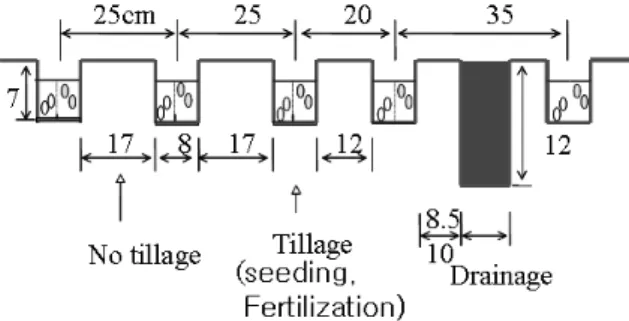
The experiment was conducted to improve the soil environ- ment after rice harvest at paddy soil (fine loamy, mixed, nonacid, mesic, family of Aeric Fluventic Haplaquepts) in National Institute of Crop Science (NICS), Korea from September 2006 to Oct. 2007. Treatments consisted of con- ventional practice (CP, no green manure), partial tillage mix- ture (PTM), partial tillage hairy vetch (PTHV), and no tillage hairy vetch (NTHV). Hairy vetch were broadcasted before rice harvest at NTHV plots. After rice harvest, rice straw was mulched. Hairy vetch (Vicia villosa) and barley (Hordeum vulgare) were seeded by partial tillage (Fig. 1) at PTHA and PTM plots. After green manure application, rice(cv.
Pungmibyeo) cultivation was practiced by no fertilization and herbicide in June 2007. The chemical fertilizers of 90 kg N, 45 kg P2O5, and 57 K2O ha-1 were applied. The soil chemical and physical properties were measured with standard methods of Rural Development Administration (RDA, 1988), Korea. Soil samples were collected in May (before green
한작지(KOREAN J. CROP SCI.), 53(4), 2008 414
Fig. 1. Layout of partial tillage seeding (left) and seeder (right).
Item CP1) PTHV2) PTM3) NTHV4)
Average(℃) 12.3 11.2 11.7 10.6
Standard error 6.19 4.23 5.02 3.66
CV 50.5 37.7 42.9 34.6
Fig. 2. The soil temperature according to cultivation method of green manure in spring season (April to May). Temperature was measured every 30 min. at 3 cm soil depth (Thermo Recorder, TR-71U/TR-72U). 1) CP: Conventional Practice, 2) PTHV:
Partial Tillage Hairy Vetch 3) PTM: Partial Tillage Mixture, 4) NTHV: No Tillage Hairy Vetch (broadcast before rice harvest).
manure application) and October 2007 (after rice harvest).
Both topsoil (0-10 cm) depth) and subsurface soils (10-20 cm) were taken from each plot. Bulk density and soil poro- sity were measured by taking cores (100 cm3) of known volume from the undisturbed field soils, the cores were then oven-dried and weighed. Soil particle density was taken as 2.65 Mg m-3. Soil porosity were calculated from the sum of soil liquid and air phase. Soil organic matter was analyzed by an automated Dumas instrument, CNS2000 (LECO, USA).
RESULTS AND DISCUSSION
Soil temperature
Soil temperature (3 cm depth) of control plot without green manure crop varied from 0.3 to 30.6℃ (average 11.7℃).
All of the green manure cultivation treatment decreased soil temperature (Fig. 2). Specially, NTHV plot dramatically decreased as mean temperature 10.6℃ (1.4 to 21.7℃). Low temperature serves as growth promotion for hairy vetch because it has been adopted to cool season. Also the varia-
Soil Changes under Green Manure-Rice-Cropping System 415
Table 1. Effect of green manure on bulk density (Mg m-3) of soil under rice-based cropping system Treatments
Before green manure application After rice harvest
Soil depth (cm) Soil depth (cm)
(0-10) (10-20) (0-10) (10-20)
CP1) 1.24a 1.39a 1.19a 1.34a
PTHV2) 1.19b 1.39a 1.06c 1.19b
PTM3) 1.16b 1.39a 1.10b 1.19b
NTHV4) 1.23a 1.33b 1.13b 1.17b
1), 2), 3) and 4) are the same with Fig. 1. Different letters indicate statistical significance at the p = 0.05 level.
Table 2. Effect of green manure on porosity (%) of soil under rice-based cropping system Treatments
Before green manure application After rice harvest
Soil depth (cm) Soil depth (cm)
(0-10) (10-20) (0-10) (10-20)
CP1) 53.3b 47.6b 55.1d 49.5b
PTHV2) 55.2a 47.7b 60.0a 55.1a
PTM3) 56.1a 47.5b 58.4b 55.3a
NTHV4) 53.4b 49.9a 57.2c 55.8a
1), 2), 3) and 4) are the same with Fig. 1. Different letters indicate statistical significance at the p = 0.05 level.
tion of soil temperature was the lowest among treatments because of effect of straw mulching after rice harvest. These results indicated that cultivation of green manure crops might be influencing soil carbon build-up by decreasing soil tem- perature.
Soil bulk density and porosity
Bulk density of 0-10 cm soil depth was less than that of 10-20 cm soil depth. Green manure cultivation resulted in a reduction of soil bulk density in 0-10 soil depths (Table 1). However, bulk density decreased only at NTHV plot in 10-20 cm soil depth. After rice practice with green manure application, bulk density showed a reduction in both 0 - 10 and 10 - 20 cm soil depth. The porosity of soil was same trends compare with bulk density of soil (Table 2). Incorpo- ration of green plant materials improved the soil physical properties was evident from values of bulk density and porosity of soil in hairy vetch plot (Table 1, 2). Leguminous crops into rice cropping may contribute toward improving the prospects of soil bulk density, soil porosity and soil organic matters, primarily because legumes are able to fix atmospheric nitrogen by rhizobium and stabilize soil such
as mycorrhizae (Wright and Upadhyaya, 1996). Mycorrhizae, arbuscular mycorrhizal, fungi produce copious amounts of an insoluble glue-like substance, glomalin, on hyphae (Wright et al., 2007). Glomalin is an abundant component of soil organic matter and has been linked to aggregate stability (Wright and Upadhyaya, 1996; Wright et al., 2007). There- fore we inferred that soil physical properties (bulk density etc) may be improved by hairy vetch.
Soil organic matter
Incorporation of green plant material increased a little bit content of soil organic matter except PTM plot (Fig. 3).
Organic matter concentration was reduced in all PTM treat- ments possibly due to the decomposition of barley plant.
Green manure and rice yield
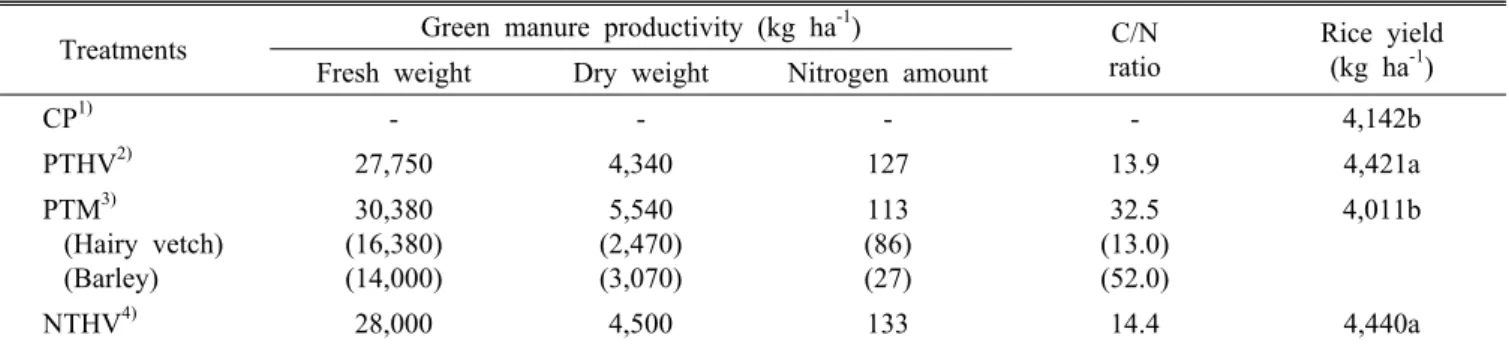
There was no significant between no-tillage and partial- tillage methods for hairy vetch production (table 3). The production of green manure was the highest (fresh weight 30,380, dry weight 5,540 kg ha-1) at hairy vetch and barley mixture plot by partial tillage. Mixture treatment had synergy effect on growth of green manure. Rice yield had no dif-
한작지(KOREAN J. CROP SCI.), 53(4), 2008 416
Table 3. Yield of green manure crops and rice under rice-based cropping system
Treatments Green manure productivity (kg ha-1) C/N
ratio
Rice yield (kg ha-1) Fresh weight Dry weight Nitrogen amount
CP1) - - - - 4,142b
PTHV2) 27,750 4,340 127 13.9 4,421a
PTM3)
(Hairy vetch) (Barley)
30,380 (16,380) (14,000)
5,540 (2,470) (3,070)
113 (86) (27)
32.5 (13.0) (52.0)
4,011b
NTHV4) 28,000 4,500 133 14.4 4,440a
1), 2), 3) and 4) are the same with Fig. 1. Different letters indicate statistical significance at the p = 0.05 level.
Fig. 3. Effect of green manure on organic matter (g kg-1) of soil under rice-based cropping system. 1), 2), 3) and 4) are the same with Fig. 1. Error bar represents standard deviation.
ference in green manure application plot compare with con- ventional practice except PTM plot. The reduced yield of rice may result from a N immobilization of barley plant (high C/N) in PTM treatment. In contrast, hairy vetch incorporation had positive effect on soil properties (Table 1, 2 and Fig.
1.) and rice yield (Table 3). These results indicated that rice yield should be produced by the nutrition supply and soil improvement of hairy vetch incorporation without chemical fertilizer. Rice growth and yield could be promoted by the extension of rice root system. These results may be come
from the improvement of soil bulk density and aggregate stability.
REFERENCES
Clark Andy. 2007. Managing cover crops profitably (third edition).
Sustainable agriculture network. MD, USA.
Hur, B. R. 1982. Annual research report 24 : 260-271 (NIAS).
RDA, Suwon, Korea.
Jung, B. G., G. H. Cho, E. S. Yun, J. H. Yoon, and Y. H.
Kim. 2001. Monitoring on chemical properties of bench marked paddy soils on Korea. J. Korea Soc. Soil Sci. Fert.
31 : 246-252.
RDA (Rural Development Administration). 1988. Methods of soil chemical analysis. National Institute of Agricultural Science and Technology, RDA, Suwon Korea.
Schulz, S., J. D. H. Keatinge, and G. J. Wells. 1999. Pro- ductivity and residual effects of legumes in rice-based cropping systems in a warm - temperate environment I. Legume biomass production and N fixation. Field Crops Research 61 : 23-35.
Wright, S. F. and A. Upadhyaya. 1996. Extraction of an abundant and unusual protein from soil and comparison with hyphal protein of arbuscular mycorrhizal fungl. Soil science 161(9) : 575-586.
Wright, S. F., V. S. Green., and M. A. Cavigelli. 2007. Glomalin in aggregate size classes from three different farming systems.
Soil & Tillage Research 94 : 546-549.