- 1731 -
패킷 손실을 고려한 네트워크 제어 시스템의 안정성 분석
김재만*, 박진배*, 최윤호**
연세대학교*, 경기대학교**
Stability Analysis of Networked Control Systems with Packet Dropouts
Jae Man Kim*, Jin Bae Park*, Yoon Ho Choi**
Yonsei University*, Kyonggi University**
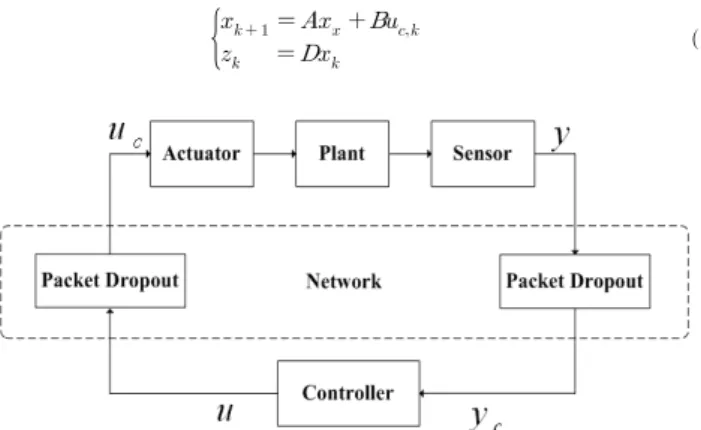
Fig. 1. Structure of NCS with packet dropouts Abstract - This paper presents a stability analysis of networked control systems with packet dropouts. The packet dropouts are modeled as a linear function of the stochastic variable satisfying Bernoulli random binary distribution and weighted moving average (WMA). The observer based controller scheme is designed to exponentially mean square stabilize the NCS. Simulation results is provided to show the applicability of the proposed method.
1. Introduction
Networked control systems (NCS) are feedback loop systems in which a number of intelligent devices and control systems are connected over local or global communication networks. In NCS, networks are used to transmit a control signal and a information between plant and controller. Due to various advantages (low cost, reduced weight, etc.), the NCS have wide application in the robot, vehicle, and smart space. However, one of the major problem about the NCS is the packet dropouts, which occur when the data are transmitted between plant and controller. Packet dropouts may make systems unstable and they are occasionally a cause of poor performance. Therefore, many researches study the effect of packet dropouts in NCS, and investigate the stability of the system.
The Bernoulli distributed white sequence is the most popular method to deal with the packet dropouts in NCS. It takes on values of zero or one with certain probability. In [1]-[3], the random packet dropouts are models as a linear function of the stochastic variable and observer based controller is designed by linear matrix inequality (LMI) approach. These papers represent the measured output as
, that is if the output experiences a packet drop, the measured output substitutes the present output values with the previous output value.
In this paper, we take the weighted moving average (WMA) method to deal with the measured output. For the case of packet dropout, the measured output is represented as the WMA of previous three measured output.
2. Problem Formulation
Consider the continuous-time NCS given by Fig. 1.
(1)
where ∈, ∈ and ∈ are the state, the control input and the controlled output, respectively. and are known constant matrices with appropriate dimensions. The measured output with packet dropouts is described by
′ (2) where the stochastic variable ∈ is a Bernoulli distributed white sequence with
(3)
(4) and is the known constant matrix with appropriate dimension, and
∈ is the measured output, ∈ is the output, and ′ is the WMA of the last three output
′ (5) where are the weight parameters.
The observer based control scheme for (1) described by
Observer: (6) Controller: (7) where ∈ is the observer state, ∈ is the observer output, ∈ × and ∈ × are the observer gain and controller gain, respectively. The stochastic variable ∈ is also a Bernoulli distributed white sequence with expected value .
Let the estimation error be
(8) The closed-loop systems is obtained as follows:
(9) We rewrite (9) in a compact form as follows:
(10) 2009년도 대한전기학회 하계학술대회 논문집 2009. 7. 14 - 17
- 1732 -
where,
Theorem 1. Given the controller gain matrix K and the observer gain matrix L. Then closed-loop system (10) is exponentially mean-square stable if there exist positive definite matrices
satisfying (11), where ,
.
proof: Define a Lyapunov functional as follows:
(12)
where, ⋯ are positive definite matrices.
⋯⋯
(13)
By Schur complement, (13) implied that . From the equation (11),
⋯⋯
≤
(14)
Therefore, the closed-loop system (10) is exponentially mean square stable. ■
3. Simulation Results Consider the NCS as follows:
(15)
Using the LMI toolbox, we obtain the controller as follows:
(16) 4. Conclusion
In this note, an observer based control scheme has been designed for NCS with packet dropouts. The packet dropouts are modelled by Bernoulli binary distribution and WMA method. The closed-loop NCS was exponentially mean square stable and simulation results has shown the NCS with the packet dropouts can be effectively stabilized by the proposed observer based control scheme.
[Reference]
[1] Z. Wang, F. Yang, D. W. C. Ho and X. Liu, “Robust ∞ Control for Networked Systems with Random Packet Losses”, IEEE Trans. on Sys., Man, and Cyber. Part B: Cyber., vol. 37, no. 4, pp. 916-924, 2007
[2] X. Fang, and J. Wang, “Stochastic Observer-based Guaranteed Cost Control for Networked Control Systems with Packet Dropouts”, IET Control Theory and Applications, vol. 2, no. 11, pp. 980-989, 2008
[3] F. Yang, Z. Wang, Y. S. Hung, and M. Gani, “∞ Control for Networked Systems with Random Communication Delays”, IEEE Trans. on Automatic Control, vol. 51, no. 3, pp. 511-518, 2006
∗∗∗ ∗∗∗ ∗∗∗∗ ∗∗∗∗∗ ∗∗∗∗∗∗ ∗∗∗∗∗∗∗
(11)