Shear Strength Characteristics of Unsaturated Dredged Soils by Triaxial Compression Tests
삼축압축실험에 의한 불포화 준설토의 전단강도 특성
Kang, Jongbeom
*․ Bae, Wooseok
**․ Lee, Bongjik
✝*강종범*․배우석**․이봉직✝
Abstract
In this study, modified triaxial compression tests were carried out to investigate the characteristics of shear strength of unsaturated dredged soils. The variation of shear strength generally depends on more matric suction than drained conditions, and then is gradually converged in matric suction 100kPa. It indicates that the effective angle of internal friction and effective cohesion in unsaturated conditions increase due to degree of saturation, namely, matric suction than those of saturated conditions. Therefore, it shows that apparent friction angle, φ
bdue to the variation of matric suction to evaluate reasonable shear strength parameters in unsaturated soils should be considered.
Keywords : Unsaturated soils, Matric suction, Soil-water characteristic curve, Apparent friction angle
요 지
일반적으로 흡수력은 불포화 흐름과 전단강도상의 거동을 평가하기 위한 중요한 인자가 되며, 불포화토의 부 간극수압은 흙의 구조와 포화도에 의해 영향을 받는다. 본 연구에서는 불포화 준설토의 전단강도 특성을 조사하기 위해 수정된 삼축압축시험이 수행되었다. 실험결과로서 전단강도의 변화는 배수조건보다 흡수력에 더 영향을 받고 있음을 알 수 있었고 점차적으로 흡수력 100 kPa에 수렴되고 있음을 보여준다. 이것은 흙의 불포화 상태에서 내부마찰각과 점착력이 포화상태에 비하여 흡수력에 기인하 여 증가하고 있음을 나타내며, 불포화토에서 합리적인 지반강도정수의 산정을 위해서는 흡수력의 변화에 따른 겉보기 마찰각 φ
b이 고려되어야 함을 알 수 있다.
주요어 : 불포화토, 흡수력, 함수특성곡선, 겉보기마찰각
*
member, Ph. D. Candidate, Dept. of Civil & Environmental Engineering, Colorado State University
** member, Full-time lecture, Dept. of Civil and Environmental Engineering, Cheongju University
✝
member, Professor, Dept. of Construction&Urban Engineering., Chung-ju National University, [email protected]
한국지반환경공학회 논문집 제 7권 제5호 2006년 10월 pp. 31~39
1. Introduction
Soil-water characteristic is an important component to analyze the behavior of unsaturated soils. Soil-water characteristic is a ground parameter that must be considered to examine the flow of ground water, the stability of slope by rainfall, consolidation characteristic including gas in unsaturated soils, and so on. Recently, the movement and diffusion of oil infiltrated in soil are common interesting issues. The pollution of soil and ground water under oil storage tank is involved with complicated interaction. Also, it will become a basic problem that firstly examines soil-water characteristic curve per soils to treat soil and ground water.
Therefore, the soils used in this study was selected from the dredged soils deposited in the western sea and the soil-water characteristic curve of the dredged soils was presented. Shear strength characteristics of unsaturated dredged soils were estimated by carry out the triaxial compression tests. Matric suction in unsaturated soils should be considered to evaluate the reasonable shear strength parameters for vadose zone located to the upper of ground water level from ground surface. Toll (1990) expressed that the shear strength parameter for laterite gravels of Kenya indicates the difference of shear strength due to the degree of saturation under unsaturated condition.
Mirata (1991) reported the variation of shear strength at a large strain by shear tests for gravel and clay under unsaturated condition. Pappin et al. (1991) examined the influence on repeated load in unsaturated sandy soils. Tadepall and Fredlund (1991) expressed that the compacted clay is collapsed in saturated condition, and this pattern occurred by reduction of matric suction. Campos et al. (1991) investigated problems of hardening and yield function based on experimental result by applying the constitutive equation suggested by Alonso et al (1990).
2. Laboratory Test Apparatus
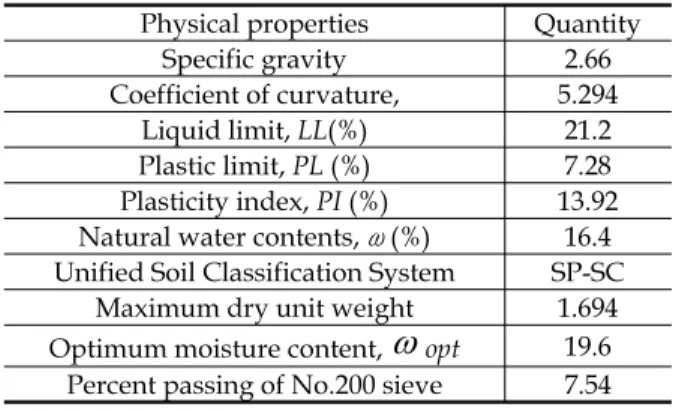
Dredged soils were sampled from the western sea of the Korean peninsula for this study. The physical properties of dredged soil used in this experiment are tabulated in Table 1. Triaxial compression equipment was modified to determine the shear strength characteristics of unsaturated soils. Air and water pressures were given at the upper and lower part of the specimen to reproduce the matric suction. A high air entry disk having 3 bar capacity was set to control the movement of water and air.
Physical properties Quantity
Specific gravity 2.66
Coefficient of curvature, 5.294
Liquid limit, LL(%) 21.2
Plastic limit, PL (%) 7.28 Plasticity index, PI (%) 13.92 Natural water contents, ω (%) 16.4 Unified Soil Classification System SP-SC
Maximum dry unit weight 1.694 Optimum moisture content, ω opt 19.6
Percent passing of No.200 sieve 7.54
Table 1. Physical properties of dredged soilsFig. 1. Dredged soils used in testing
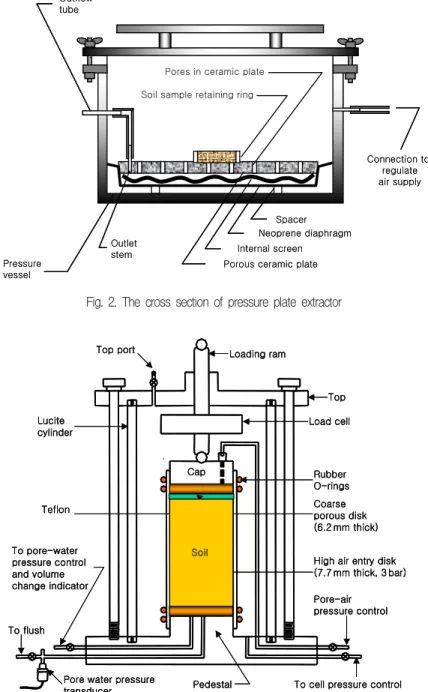
Fig. 2 shows the cross section of pressure plate
extractor. The measurement range of pressure plate
extractor is 100 kPa∼1500 kPa, and performed by
depending on pressure plate test (ASTM D2325). The
saturated effective shear strength parameters that
indicate an effective cohesion,
c'and an effective angle
of internal friction, φ
'can be obtained from the
consolidated undrained tests on the saturated specimens,
whereas the failure envelope on the shear strength
Connection to regulate air supply Soil sample retaining ring
Pores in ceramic plate
Spacer Neoprene diaphragm Internal screen Porous ceramic plate Pressure
vessel
Outflow tube
Outlet stem
Connection to regulate air supply Soil sample retaining ring
Pores in ceramic plate
Spacer Neoprene diaphragm Internal screen Porous ceramic plate Pressure
vessel
Outflow tube
Outlet stem
Fig. 2. The cross section of pressure plate extractor
Loading ram Top port
Top Load cell Lucite
cylinder
Rubber O-rings Cap
Coarse porous disk (6.2 mm thick)
High air entry disk (7.7 mm thick, 3 bar)
Pore-air pressure control
To cell pressure control Pedestal
Pore water pressure transducer To flush
To pore-water pressure control and volume change indicator
Teflon
Soil
Loading ram Top port
Top Load cell Lucite
cylinder
Rubber O-rings Cap
Coarse porous disk (6.2 mm thick)
High air entry disk (7.7 mm thick, 3 bar)
Pore-air pressure control
To cell pressure control Pedestal
Pore water pressure transducer To flush
To pore-water pressure control and volume change indicator
Teflon
Soil
Fig. 3. The schematic of modified triaxial compression apparatus for testing of unsaturated soils
versus matric suction plane is used to obtain the apparent friction angle, φ
bthat is, an angle indicating the rate of increase in shear strength related to matric suction. Fig. 3 shows a modified triaxial compression equipment used for this study.
The confining pressure in the chamber was applied by an air and water during the triaxial compression tests. In case of using air pressure, the pressure is applied directly, and keeps constant values. In case of using water pressure, it can be applied by an air
pressure by passing through the water tank. The
stress, strain, pore water pressure, and volume change
for a given soil can be measured during the triaxial
compression tests. Fig. 4 shows a teflon manufactured
for triaxial compression tests in unsaturated condition
to reduce the friction of cutting section part. Ceramic
plate used in the tests has 3 bar high air entry
capacity. Fig. 5 shows an apparatus for measurement
of volume change manufactured by double acrylic tube
to measure the void water and an air volume.
Fig. 4. Ceramics, porous disks, teflons, and O-rings used for unsaturated soil tests
Fig. 5. An apparatus used for measurement of volume change
3. Laboratory Test Procedure
A high air entry disk is fixed on the bottom of the modified triaxial compression cell, and then the air is not passed through a high air entry disk due to air entry capacity. Specimen was slowly sheared as keeps the constant degree of saturation, namely constant matric suction by applying air pressures in a specimen. Dredged soils were remolded to 90 % compaction based on γ
dmax, and then set by the
membrane on triaxial compression cell.
Matric suction ( u
a− u
w) was controlled to apply constant net confining pressure in specimen, and to give constant air pressure ( u
a) at the upper part and constant water pressure ( u
w) at the lower part.
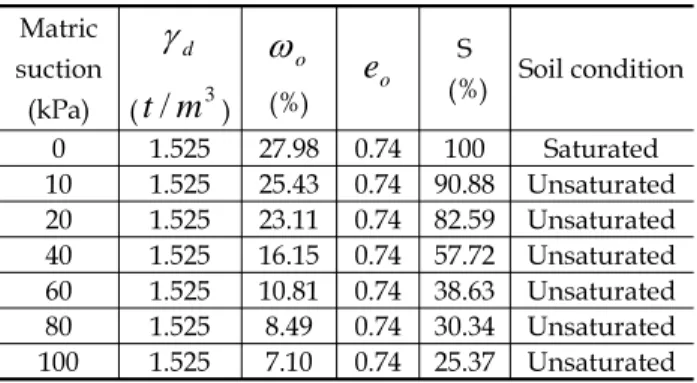
The relationship of stress and strain was obtained by the shear tests of the specimen when was equilibrated by given net confining pressure and matric suction condition. The initial conditions of specimens used to this experiment such as dry density, initial water content, initial void ratio, and degree of saturation are given in Table 2.
Matric suction (kPa)
γ
d( t / m
3)
ω
o(%)
oe S
(%) Soil condition 0 1.525 27.98 0.74 100 Saturated 10 1.525 25.43 0.74 90.88 Unsaturated 20 1.525 23.11 0.74 82.59 Unsaturated 40 1.525 16.15 0.74 57.72 Unsaturated 60 1.525 10.81 0.74 38.63 Unsaturated 80 1.525 8.49 0.74 30.34 Unsaturated 100 1.525 7.10 0.74 25.37 Unsaturated
Table 2. Initial conditions of samples tested in dredged soilsAxis translation technique is commonly used in the laboratory testing of unsaturated soils in order to prevent having to measure pore-water pressures less than zero. The procedure involves a translation of pore-air pressure, and the pore-water pressure can be referenced to a positive air pressure. Shear tests were carried out when applied matric suction conditions were equilibrated by upper pore-air pressure and lower pore-water pressure. This experiment was performed under the CU and CW test conditions for dredged soils.
The soil specimen in consolidated undrained test (CU) with pore pressure measurements is first consolidated following the procedure for the consolidated drained test.
After equilibrium conditions have been established under
the applied pressure, the soil specimen is sheared under
undrained conditions with the air and water phases. The initial consolidation process in constant water content test (CW) is carried out in the same procedure for the consolidated drain test. When equilibrium conditions have been achieved under the applied pressures, the soil specimen is sheared under drained conditions for the pore-air phase and undrained conditions for pore-water phase.
Consolidation pressure was given by demanded stress conditions to specimen. Deviator stress ( σ
1−σ
3) was added when the specimen was fully consolidated.
Air volume change (
∆V) was measured under the undrained condition in case of CU test, and by opening upper valve in case of CW test. Shear tests were carried out under the condition that matric suction is constant, and then deviator stress and volume change were measured.
Matric suction was varied by 0, 10, 20, 40, 60, 80, and 100 kPa, and the characteristic of shear strength was compared and analyzed by different drained conditions, CU and CW tests. The method to control the strain was adopted the constant strain velocity (0.1 mm/min) under net confining pressure of 100, 200, and 300 kPa because this method has the merit that can grasp the behavior of soil specimen after collapsing. It was adopted the multistage experiment method that a specimen can keep the homogeneous condition, and carry out the several matric suction stages for a specimen. Shear strength characteristics under unsaturated conditions were compared and analyzed due to the degree of saturated conditions.
4. Test Results and Discussion
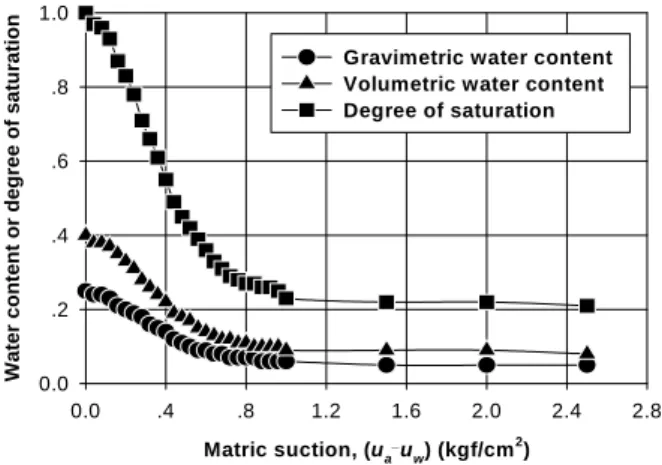
Fig. 6 shows the soil-water characteristic curve indicating best-fit curves based on the experimental data of a dredged soil using different representations of water contents.
Fig. 7 shows the soil-water characteristic curve of
Matric suction, (ua_uw) (kgf/cm2)
0.0 .4 .8 1.2 1.6 2.0 2.4 2.8
Water content or degree of saturation
0.0 .2 .4 .6 .8 1.0
Gravimetric water content Volumetric water content Degree of saturation
Fig. 6. Best-fit curves to experimental data of a dredged soil using different representations of the water contents
Matric suction, (ua_uw) (kgf/cm2)
0.0 .4 .8 1.2 1.6 2.0 2.4 2.8
Volumetric water contents, (Vw / V) 0.0
.1 .2 .3 .4 .5
R=100% (e=0.570) R= 95% (e=0.653) R= 90% (e=0.744)
Fig. 7. Volumetric water content versus matric suction for dredged soils
dredged soil plotted by matric suction and volume
water content for degree of compaction 90 %, 95 %,
and 100 %, respectively and it is compared matric
suction and volumetric water content. Matric suction
in the figure indicates nonlinear variation due to the
increase and the decrease of water content. Matric
suction range of dredged soils in these tests was
selected in the range of 0 kPa∼100 kPa that the
variation of volumetric water content was distinct in
the soil-water characteristic curve. Consolidated
undrained test (CU) was performed under drained
condition after the soil specimen was consolidated
until water volume change finished through drainage
by applying hydrostatic stress in specimen. Deviator
stress and pore water pressure for axial strain were
measured, simultaneously.
Axial strain, εy (%)
0 5 10 15 20 25 30 35 40 45 50
Deviator stress (kPa)
0 50 100 150 200 250 300 350 400
Stage 1
Stage 2
Stage 3 Matric suction : 0 kPa (σ3-ua )=300 kPa
(σ3-ua )=100 kPa
(σ3-ua )=200 kPa Consolidated undrained test
Fig. 8. Stress versus strain curves for dredged specimens due to matric suction 0 kPa in CU tests
Consolidated undrained test (CU)
Net confining stress, (σ3 _ua)(kPa)
0 50 100 150 200 250 300 350
Ultimate deviator stress (kPa)
0 200 400 600 800 1000
0 kPa 10 kPa 20 kPa 40 kPa 60 kPa 80 kPa 100 kPa Matric suction
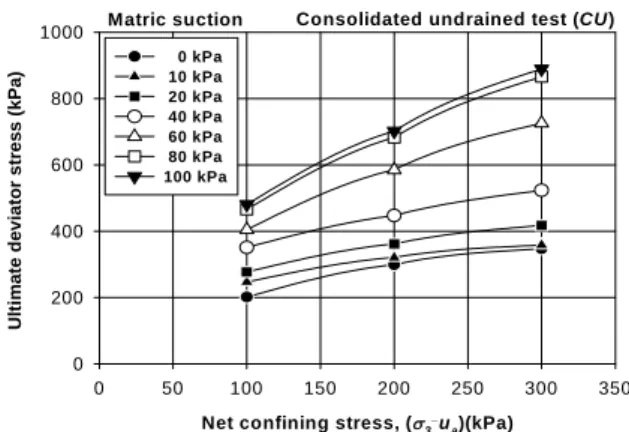
Fig. 10. Ultimate deviator stress of compacted dredged soils due to matric suction
Axial strain, εy (%)
0 5 10 15 20 25 30
Deviator stress (kPa)
0 200 400 600 800 1000
Stage 1
Stage 2
Stage 3 Matric suction : 100 kPa
(σ3-ua )=300 kPa
(σ3-ua )=100 kPa
(σ3-ua )=200 kPa Consolidated undrained test
Fig. 9. Stress versus strain curves for dredged specimens due to matric suction 100 kPa in CU tests
Consolidated undrained test (CU)
Matric suction, (ua_uw)(kPa)
0 20 40 60 80 100
Ultimate deviator stress (kPa)
0 200 400 600 800 1000
(σ3-ua)=100 kPa (σ3-ua)=200 kPa (σ3-ua)=300 kPa
Fig. 11. Ultimate deviator stress of compacted dredged soils due to net confining stress
Fig. 8 and Fig. 9 show the deviator stress versus axial strain curve that net confining pressure was applied by 100 kPa, 200 kPa, and 300 kPa with matric suction 0 kPa and 100 kPa. From these figures, the ultimate deviator stress increases as matric suction increases. These ultimate deviator stresses reduce gradually the rate of increase as net confining stress increases. The collapse in a specimen with matric suction gradually is occurred to small strain with stress-strain relation as matric suction is added in a specimen. Generally, shear strength is varied by depending on the net confining stress with stress-strain relation. The strains in collapsed points indicate between 11 % and 19 % in case net confining stress relatively is low conditions, and between 3 % and 6 % in case net confining stress
relatively is high conditions.
Fig. 10 shows that ultimate deviator stress increases
linearly due to the net confining stress. The rate of
increase of the ultimate deviator stress in matric suction
0 kPa and 10 kPa is insignificant, whereas that in
matric suction 60 kPa and 80 kPa is distinguished. The
rate of increase of the ultimate deviator stress in matric
suction 100 kPa is somewhat converged. Fig. 11 shows
that ultimate deviator stress increases non-linearly due
to matric suction, and the rate of increase of ultimate
deviator stress is increased due to net normal stress. It
can be analogized that the effect of net normal stress
on the shear strength of unsaturated soils is
independently evaluated in terms of the stress state
variables such as the net normal stress and the matric
suction.
Fig. 12 shows the results of ultimate deviator stress due to matric suction in dredged soils are synthetically compared in consolidated undrained test and constant water content test. Soil volume diminishes as air volume is exhausted at shear tests in the range of matric suction of 20 kPa∼40 kPa, and it indicates that shear strength is gradually diminished as the area of water increase interiorly. It shows that the rate of shear strength and water content variation is diminished as matric suction increases in CU and CW test. Fig. 13 shows the variation of the effective angle of internal friction due to drain conditions is nonlinear. The effective angle of internal friction is higher in constant water content test than that of consolidated undrained test in lower matric suction. It
Constant water content test (CW)
Matric suction, (ua_uw)(kPa)
0 20 40 60 80 100
Ultimate deviator stress (kPa)
0 200 400 600 800 1000
(σ3-ua):100kPa Consolidated undrained test (CU)
(σ3-ua):200kPa (σ3-ua):300kPa
Fig. 12. Ultimate deviator stress of compacted dredged soils due to net confining stress by CU and CW tests
Constant water content test (CW)
Matric suction, (ua-uw)(kPa)
0 20 40 60 80 100
Friction angle (deg.)
0 5 10 15 20 25 30 35
Consolidated undrained test (CU)
Fig. 13. Variation of friction angle versus matric suction in CU and CW tests
indicates that the difference of the effective angle of internal friction can be occurred as the interlocking of soils by volume change due to drain conditions.
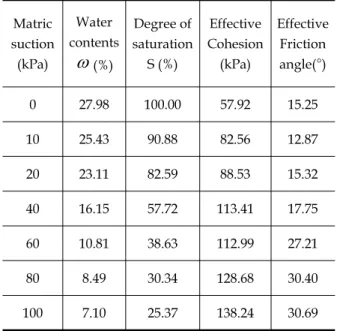
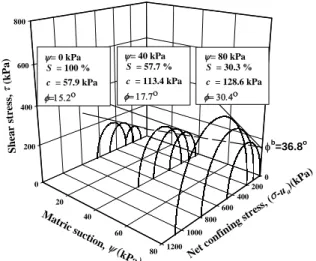
Fig. 14 shows three dimensional plane plot for Mohr circle at failure in CU tests. The results tabulated in Table 3 shows that effective cohesions (
c') are 57.9 kPa, 113.4 kPa, 128.6 kPa, and effective angle of internal frictions ( φ
') are 15.2 °, 17.7 °, 30.4
° with corresponding to the matric suction of 0 kPa, 40 kPa, 80 kPa respectively. Fig. 15 shows the variation of shear strength parameter due to drain conditions. The apparent friction angle indicates that is 36.8° in consolidated undrained test whereas 45.6°
in constant water content test. It shows that the increment of shear strength is distinct as matric suction increases and indicates the fact that effective cohesions and shear strengths increase as matric suction of soils was varied by a drying course in saturation condition. Also, it can be inferred that soil particles form a single-grained structure and then behave like coarse grained soils as matric suction increases.
Matric suction (kPa)
Water contents
ω (%)
Degree of saturation
S (%)
Effective Cohesion (kPa)
Effective Friction angle(°)
0 27.98 100.00 57.92 15.25
10 25.43 90.88 82.56 12.87
20 23.11 82.59 88.53 15.32
40 16.15 57.72 113.41 17.75
60 10.81 38.63 112.99 27.21
80 8.49 30.34 128.68 30.40
100 7.10 25.37 138.24 30.69
Table 3. Results of shear strength parameters in CU triaxial compression tests for dredged soils
0 200 400 600 800
0 200 400 600 800 1000 1200 20
40 60
80
Shear stress, τ (kPa)
Net confining stress, (σ-ua)(k Pa)
Matric s uction, ψ(k
Pa)
ψ= 80 kPa S = 30.3 % c = 128.6 kPa φ= 30.4ο ψ= 40 kPa
S = 57.7 % c = 113.4 kPa φ= 17.7ο ψ= 0 kPa
S = 100 % c = 57.9 kPa φ=15.2ο
φb=36.8o
Fig. 14. A 3D plot for Mohr circle at failure conditions in CU tests
Constant water content test (CW)
Matric suction, (ua_uw)(kPa)
0 25 50 75 100 125 150 175 200 225
Shear stress, τ (kPa)
50 75 100 125 150 175 200
c' = 57.80 kPa
φb=42.6 o Consolidated undrained test (CU)
φb=36.8 o
c' = 57.92 kPa
Fig. 15. Intersection line between the failure envelope and the
τ
versus (
u
a− u
w) plane at zero net normal stress for dredged soilsTherefore, the apparent friction angle due to matric suction in unsaturated soil fields that is, vadose zone should be considered to evaluate reasonable shear strength parameters from the increase of shear strength due to matric suction.
5. Summary and Conclusion
In this study, a series of triaxial compression tests in unsaturated conditions were carried out to investigate the characteristics of the shear strength of unsaturated dredged soils widely deposited in western sea of Korea. Based on the results of the soil-water characteristic tests and modified triaxial compression tests, the following conclusions are drawn.
In the result of extractor test, volumetric water content of dredged soils was 39.5 % and residual saturation was 20.7 %. The factors of influence on shear strength characteristics of dredged soils are net confining stress and matric suction. The rate of increase deviator stress was decreased as the net confining stress and matric suction become larger, and increased in accordance with the matric suction.
It shows that deviator stress and shear stress increase linearly for net confining stress, and increase non-linearly for matric suction. The variation of shear strength generally depends on more matric suction than drain conditions, and then is gradually converged in matric suction 100 kPa. It indicates that the effective angle of internal frictions and effective cohesions in unsaturated conditions increase due to degree of saturation, namely, matric suction than those of saturated conditions.
Therefore, it shows that apparent friction angle,
φbdepending on the variation of matric suction should be considered to evaluate reasonable shear strength parameters in unsaturated soils.
(접수일 : 2006. 3. 28 심사일 : 2006. 6. 30 심사완료일 : 2006. 9. 20)