1. 서 론
시설물은 「시설물의 안전 및 유지관리에 관한 특별법」에 따라 제1종시설물, 제2종시설물, 제3종시설물로 구분되어 관 리되고 있으며, 2020년 12월말 기준으로 시설물통합정보관 리시스템(www.fms.or.kr)에 등록되어 있는 건축물 중 제1종 시설물은 2,896개소, 제2종시설물은 68,639개소가 있다. 이 중 철근콘크리트구조는 61,296개소로 가장 많으며 전체의 85.7%를 차지하고 있다.
제1종시설물은 「시설물의 안전 및 유지관리에 관한 특별 법」에 따라 정밀안전점검 및 정밀안전진단을 실시하여야 하 고, 제2종시설물은 정밀안전점검을 실시하여야한다. 건축물 에 대한 정밀안전점검 및 정밀안전진단을 실시하는 경우 해 당 시설물의 상태(내구성), 기울기 및 침하와 안전성을 지침
과 세부지침(KISTEC, 2019)의 기준과 방법에 따라 평가한 후 그 결과를 종합하여 안전등급(A∼E)을 지정하고, 지정된 등 급에 따라 점검 및 진단 주기가 결정된다. 따라서 건축물의 평 가 등급이 좋지 않을수록 점검 및 진단 주기는 짧아지고, 이에 따른 유지관리 비용은 증가하게 되므로 건축물의 상태 및 안 전성을 평가하는 방법은 명확하여야 한다.
이를 위해 현재 사용하고 있는 평가기준, 평가방법 및 평가 프로그램은 2004년도에 건축물의 정량적인 평가를 위해 국토안 전관리원에서 개발하여 보급하였으며(KISTEC, 1999; KISTEC, 2002a; KISTEC, 2002b), 평가프로그램은 2007년도에 보완 및 기능 개선하여 재보급(KISTEC, 2007) 하였다. 상태평가는 현장육안조사와 시험한 결과를 통해 등급을 판정하고 3단계 의 절차에 따라 실시하며 1단계는 부재단위 평가, 2단계는 층 단위 평가, 마지막 3단계는 1, 2단계 및 각 층의 중요도를 고려 하여 종합평가로 이루어져 있다. 안정성평가 또한 상태평가 와 동일한 3단계의 절차로 이루어져 있으며, 부재의 내력비를 부재별, 층별로 평가하는 것으로 이루어져 있다.
건축물은 철근콘크리트구조, 철골구조, 조적조, 철골·철근 콘크리트구조, 프리캐스트콘크리트조 등 구조 형식이 다양하 지만 상태평가는 크게 철근콘크리트구조와 철골구조로 나누 어 평가항목과 기준을 구분 지을 수 있다.
Journal of the Korea Institute for Structural Maintenance and Inspection Vol. 25, No. 3, June 2021, pp.85-91
https://doi.org/10.11112/jksmi.2021.25.3.85 pISSN 2234-6937
eISSN 2287-6979
철근콘크리트 건축물의 상태평가 중 부재평가방법 개선에 관한 연구
우혜성1, 이원호2*, 황경란3, 이관형4
A Study on the Improvement of Member Evaluation Method in the Condition Evaluation of Reinforced Concrete Buildings
Hye-Sung Woo1, Waon-Ho Yi2*, Kyung-Ran Hwang3, Kwan-Hyeong Lee4
Abstract: Type 1 and type 2 buildings must regularly conduct precise safety inspections and precise safety diagnosis for the safety and maintenance of facilities, and the safety grade of the building is determined according to the results of the implementation. In addition, the cycle of inspection and diagnosis is determined according to the safety grade of the building. In order to determine the safety grade of the building, a precise safety inspection conducts condition evaluation, and a precise safety diagnosis conducts condition evaluation and safety evaluation. Therefore, since the inspection and diagnosis cycle is determined according to the safety grade of the building, the condition evaluation and safety evaluation must be precise. However, in the case of member unit evaluation, which is the first step in evaluating the current condition, the evaluation grade is determined by using the representative value of the measurement result, and this may result in an error in the evaluation grade. To solve this problem, this study analyzed evaluation criteria for each evaluation item and presented evaluation criteria using inequalities to respond to measurement results and evaluation scores.
In addition, we present a functional formula that can reflect performance scores for each evaluation item.
Keywords: Condition evaluation, Member evaluation, Evaluation method, Precision safety inspection, Precision safety diagnosis
1정회원, 광운대학교 건축공학과 박사과정
2정회원, 광운대학교 건축공학과 교수, 교신저자
3정회원, 국토안전관리원 시설성능연구소 기술개발실 책임연구원
4정회원, 시설안전미더(주) 기술부 팀장
*Corresponding author: [email protected]
Department of Architecture Engineering, Kwangwoon University, Seoul, 01897, Korea
∙본 논문에 대한 토의를 2021년 7월 31일까지 학회로 보내주시면 2021년 8월 호에 토론결과를 게재하겠습니다.
Copyright Ⓒ 2021 by The Korea Institute for Structural Maintenance and Inspection. This is an Open Access article distributed under the terms of the Creative Commons Attribution Non-Commercial License (http://creativecommons.org/licenses/by-nc/3.0)which permits unrestricted non-commercial use, distribution, and reproduction in any medium,
본 연구는 건축물 구조형식 중 가장 많이 차지하고 있는 철 근콘크리트구조를 중심으로 상태평가를 실시하는 단계 중 첫 번째 단계인 부재단위 평가에 대한 현재 평가방법을 분석 하여 문제점을 도출하고, 이를 개선하기 위한 방법에 대해 연 구를 진행하였다.
2. 상태평가 방법 고찰
2.1 상태평가 항목 및 판정 절차
철근콘크리트구조 건축물을 부재별, 층별로 상태평가하기 위한 항목은 6가지로 콘크리트 강도(DS), 균열(CR), 콘크리 트 탄산화(CA), 콘크리트 염화물 함유량(CL), 철근부식(Co), 표면노후(SD)가 있으며, 이중 표면노후는 콘크리트 박리, 콘 크리트 박락 및 층분리, 누수 및 백태, 철근노출과 같이 4가지 로 세부 분류하여 평가한다.
철근콘크리트 구조의 상태평가 판정 절차는 Table 1과 같 고, 평가체계는 Fig. 1과 같이 이루어져 있다.
건축물의 상태평가시 정밀안전진단을 하는 경우는 Fig. 1 과 같이 6가지 상태평가 항목 모두가 적용되며, 정밀안전점검
을 하는 경우에는 염화물함유량과 철근부식은 제외한 나머지 4 가지 평가항목만 적용된다. Table 1과 같이 부재단위별로 평가 를 실시한 후 층단위로 평가·종합하여 건축물 전체에 대해 평 가하는 방법과 절차는 합리적으로 적용된 것으로 판단된다.
2.2 상태평가 항목별 점수 산정방법 분석
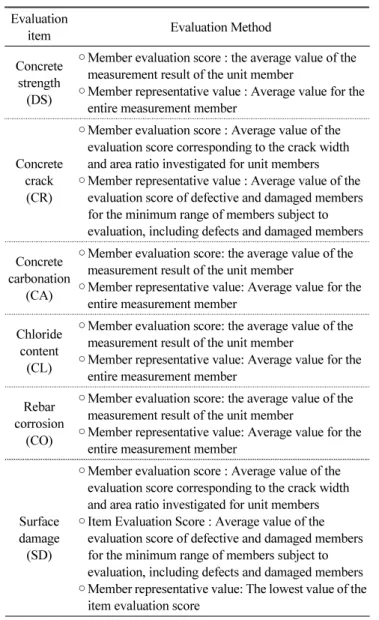
시설물의 안전 및 유지관리 실시 세부지침(KISTEC, 2019) 에 따라 철근콘크리트구조 건축물의 상태평가 항목별 점수 산정방법은 Table 2와 같다.
Table 2의 부재별 점수 산정방법을 예를 들어 계산해본다 면, 철근콘크리트구조 건축물의 단위부재 평가시 보 부재의 탄산화 측정결과가 0.3D와 0.6D라 할 때 각각의 측정결과 값 을 Table 3의 콘크리트 탄산화에 대한 상태평가 기준을 적용 하여 판정하면 평가점수는 3점과 5점이 나온다. 각각의 평가
Fig. 1 Condition evaluation system of reinforced concrete structure Evaluation
stage Evaluation Method
Member unit
◦Evaluation points are given for members according to the degree of defects
◦Reflects the importance of evaluation items for individual members
◦The result is determined after synthesizing the evaluation scores for each evaluation item by member unit (wall, column, beam, slab, etc.)
Floor unit ◦Considering the importance of each evaluation item and member, the result is judged by synthesizing the evaluation scores for each floor
Building Condition Evaluation
◦Considering the above steps 1 and 2 and the importance of each floor, the result is determined by synthesizing the evaluation scores of the entire building
Table 1 Judgment procedure for condition evaluation(KISTEC,2019)
Evaluation
item Evaluation Method
Concrete strength
(DS)
◦Member evaluation score : the average value of the measurement result of the unit member
◦Member representative value : Average value for the entire measurement member
Concrete crack (CR)
◦Member evaluation score : Average value of the evaluation score corresponding to the crack width and area ratio investigated for unit members
◦Member representative value : Average value of the evaluation score of defective and damaged members for the minimum range of members subject to evaluation, including defects and damaged members Concrete
carbonation (CA)
◦Member evaluation score: the average value of the measurement result of the unit member
◦Member representative value: Average value for the entire measurement member
Chloride content
(CL)
◦Member evaluation score: the average value of the measurement result of the unit member
◦Member representative value: Average value for the entire measurement member
Rebar corrosion
(CO)
◦Member evaluation score: the average value of the measurement result of the unit member
◦Member representative value: Average value for the entire measurement member
Surface damage
(SD)
◦Member evaluation score : Average value of the evaluation score corresponding to the crack width and area ratio investigated for unit members
◦Item Evaluation Score : Average value of the evaluation score of defective and damaged members for the minimum range of members subject to evaluation, including defects and damaged members
◦Member representative value: The lowest value of the item evaluation score
Table 2 Method for calculating status evaluation results and scores for each item(KISTEC,2019)
점수의 평균값은 4점이 나오고 이를 다시 대푯값으로 평가하 면 5점으로 조사한 부재는 c등급으로 판정된다. 그러나 이를 대푯값으로 산정하지 않고 측정결과에 비례하는 점수로 환산 하여 평가를 진행한다면 각각의 측정결과는 2.4점과 4.8점이 고 평균값은 3.6점으로 조사한 부재는 b등급으로 판정되고 이 는 Table 4와 같이 나타낼 수 있다.
이는 상태평가 점수를 대푯값으로 산정하는 경우 실제 측
정된 결과보다 낮게 평가되거나 높게 평가될 수 있다는 것으 로 현재 상태평가 중 부재평가방법이 정밀하지 않다는 것을 보여준다. 평가점수가 낮게 판정되는 경우 건축물의 등급이 낮아질 수 있고 이는 점검 및 진단 주기에 영향을 미치므로 부 재평가방법에 개선이 필요하다는 것을 보여준다.
2.3 현재 상태평가항목별 평가기준 분석
철근콘크리트구조 건축물의 내구성은 평가부재는 콘크리 트 강도, 균열, 콘크리트 탄산화, 콘크리트 염화물 함유량, 철 근부식, 콘크리트 박리, 콘크리트 박락 및 층분리, 누수 및 백 태, 철근노출 총 9가지 항목이며 세부지침에 제시된 각각의 평가기준과 평가내용, 평가점수를 대응하여 정리하면 Table 5 Evaluation criteria Evaluation contents Evaluation Score
(R.V)***
a Ct* ≤ 0.25D** 1
b 0.25D < Ct ≤ 0.5D 3
c 0.5D < Ct ≤ 0.75D 5
d 0.75D < Ct ≤ D 7
e D < Ct 9
* Ct : Concrete carbonation depth(cm)
** D : Concrete coverage(cm)
*** R.V : Representative value
Table 3 Condition evaluation criteria for concrete carbonation (KISTEC, 2019)
Division Evaluation Score
Representative value Proportion value
Measurement result 1 3 2.4
Measurement result 2 5 4.8
Average 4 3.6
judgment grade c b
Table 4 Comparison of evaluation score results for concrete carbornatiion
Evaluation criteria
Evaluation contents Evaluation Score (R.V) Concrete strength Concrete crack
a 100% ≤ αc Cw < 0.1 0 ≤ E.S < 2 (1)
b 100% ≤ αc
(Minor damage) 0.1 ≤ Cw < 0.2 2 ≤ E.S < 4 (3) c 85% ≤ αc < 100% 0.2 ≤ Cw < 0.3 4 ≤ E.S < 6
(5) d 70% ≤ αc < 85% 0.3 ≤ Cw < 0.5 6 ≤ E.S < 8
(7)
e αc < 70% 0.5 ≤ Cw 8 ≤ E.S ≤ 10
(9)
* αc = (measured strength ÷ design criterion strength)×100%
** Cw = Concrete crack(㎜)
Table 5 Condition evaluation criteria for concrete strength and cracks (KISTEC, 2019)
Evaluation criteria
Evaluation contents
Evaluation Score (R.V) Concrete
carbonation Chloride content
a Ct* ≤ 0.25D** cL*** ≤ 0.15 0 ≤ E.S < 2 (1) b 0.25D < Ct ≤ 0.5D 0.15 < cL ≤ 0.3 2 ≤ E.S < 4
(3) c 0.5D < Ct ≤ 0.75D 0.3 < cL ≤ 0.6 4 ≤ E.S < 6
(5) d 0.75D < Ct ≤ D 0.6 < cL ≤ 1.2 6 ≤ E.S < 8
(7)
e D < Ct 1.2 < cL 8 ≤ E.S ≤ 10
(9)
* Ct : Concrete carbonation depth(cm)
** D : Concrete coverage(cm)
***cL : Chloride content(㎏/㎥)
Table 6 Condition evaluation criteria for concrete carbonation and chloride content(KISTEC, 2019)
Evaluation criteria
Evaluation contents Evaluation Score (R.V) Rebar corrosion Scaling depth
a E*>0 sc** = 0 0 ≤ E.S < 2
(1) b -200<E≤0 0 < sc < 0.5 2 ≤ E.S < 4
(3) c -350<E≤-200 0.5 ≤ sc < 1.0 4 ≤ E.S < 6
(5) d -500<E≤-350 1.0 ≤ sc < 25 6 ≤ E.S < 8
(7)
e E≤-500 25 ≤ sc 8 ≤ E.S ≤ 10
(9)
* E : Rebar corrosion(㎷)
** sc : Scaling depth(㎜)
Table 7 Condition evaluation criteria for concrete rebar corrosion and scaling depth(KISTEC, 2019)
∼Table 9와 같다(KISTEC, 2019).
Table 4에서 예를 들었던 부재평가점수 비교결과와 같이 평가점수 범위 내에서 측정결과의 실제점수를 환산하기 위해 서는 평가항목의 평가기준이 평가점수의 범위와 같이 5단계 의 구간과 동등한 평가범위로 구분되어 있어야 한다. 그러나 Table 5∼Table 9에 표현된 항목별 평가내용은 상한 값과 하 한 값이 없어 평가점수와 비례관계를 설정할 수 없는 부분이 있고, 계량적으로 평가하는 방식과 일부는 계량적 평가를 하 고 나머지는 정성적 평가를 하는 방식이 혼용되어 있는 부분 이 있다. 또한 박리, 박락ㆍ층분리, 철근노출과 같이 평가내용 의 하한 값이 0으로 명시되거나, 콘크리트 강도와 같이 측정
결과가 100%이상으로 a등급과 b등급이 동일하지만 추가 결 함을 포함하여 평가점수가 상이해지는 항목도 존재한다. 이 는 측정결과의 실제점수를 환산하기 위해서는 평가내용에 대 한 개선도 필요하다는 것을 보여준다.
3. 상태평가항목별 부재평가방법 개선
3.1 상태평가항목별 평가기준 개선
상태평가항목별 부재평가 방법을 현장조사 및 측정결과의 실제점수로 반영하기 위해서는 평가점수 범위가 부등식이므 로 평가내용의 조사결과 및 측정결과 범위도 부등식으로 표 현되어야 하나 상한 값과 하한 값이 없는 현재 평가내용에서 는 a등급의 점수는 1점, e등급의 점수는 9점으로 표현되어 평 가내용의 최대 상한값과 최소 하한값을 설정하여야 한다 (KALIS, 2020). 본 연구에서는 평가항목별 최대 상한값과 최 소 하한값을 Table 10과 같이 가정하여 평가내용 범위를 정의 하였다.
또한 콘크리트 강도항목의 측정결과가 100%이지만 경미 한 손상이 발생하여 b등급으로 판정되는 경우는 계량적인 평 Evaluation
criteria
Evaluation contents
Evaluation Score (R.V) Spalling/
Delamination Rebar exposure
a sd* = 0 ra** = 0 0 ≤ E.S < 2
(1) b 0 < sd < 15 0 < ra < 1.0% 2 ≤ E.S < 4
(3) c 15 ≤ sd < 20 1.0 ≤ ra < 3.0% 4 ≤ E.S < 6
(5) d 20 ≤ sd < 25 3.0 ≤ ra < 5.0% 6 ≤ E.S < 8
(7)
e 25 ≤ sd
(or Loss of coarse
aggregate) 5.0% ≤ ra 8 ≤ E.S ≤ 10 (9)
* sd : Spalling/Delamination(㎜)
** ra : Rebar exposure(%)
Table 8 Condition evaluation criteria for concrete spalling /delamination and rebar exposure(KISTEC, 2019)
Evaluation item Minimun lower
limit value Maximum upper limit value
Concrete strength 0 150 %
Concrete crack 0 1.0 ㎜
Concrete carbonation 0 1.25 ㎝
Chloride content 0 2.4 ㎏/㎥
leakage and efflorescence 0 40 %
Rebar exposure 0 10 %
Spalling / Delamination 0 30 ㎜
Scaling depth 0 30 ㎜
Rebar corrosion -650 200 ㎷
*Out of the minmum and maximum values, the score is 0 or 10 Table 10 Assume the minimum lower limit and maximum upper limit for each condition evaluation item
Evaluation criteria
Evaluation contents
Evaluation Score Concrete strength Concrete crack
a 100% ≤αc≤ 150% 0 ≤ Cw < 0.1 0 ≤ E.S < 2 b 92.5% ≤αc< 100% 0.1 ≤ Cw < 0.2 2 ≤ E.S < 4 c 85% ≤ αc < 92.5% 0.2 ≤ Cw < 0.3 4 ≤ E.S < 6 d 70% ≤ αc < 85% 0.3 ≤ Cw < 0.5 6 ≤ E.S < 8 e 0% ≤ αc < 70% 0.5 ≤ Cw ≤ 1.0 8 ≤ E.S ≤ 10 Table 11 Establishment of condition evaluation criteria for concrete strength and cracks
Evaluation criteria
Evaluation contents Evaluation Score (R.V) leakage and efflorescence
a No leakage and efflorescence 0 ≤ E.S < 2 (1)
b ‘Minor leaking traces when the leaked area is dry’ or ‘Less than 5% area rate
of efflorescence’
2 ≤ E.S < 4 (3)
c ‘Significant leakage traces when the leakage site is wet’ or 5%≤area rate of efflorescencesce<10%
4 ≤ E.S < 6 (5)
d Leakage progress can be observed, 10%≤area rate of efflorescencesce<20%
6 ≤ E.S < 8 (7)
e ‘Leakage in progress’ or ‘More than
20% of the area rate of efflorescence’ 8 ≤ E.S ≤ 10 (9) Table 9 Condition evaluation criteria for concrete leakage and efflorescence(KISTEC, 2019)
가를 위해 측정결과 85%∼100% 구간을 등분하여 b등급은 92.5%≤ ac < 100%, c등급은 85%≤ ac < 92.5%로 가정한다.
또한 박리깊이, 박락ㆍ층분리, 철근노출, 누수백태는 a등급이 최소 하한값인 0으로 명기되어 평가범위가 없고 b등급부터 평가범위가 설정되는 경우는 콘크리트 강도항목과 같이 a등 급과 b등급의 구간을 등분하여 조사결과 구간을 가정한다.
상기의 내용을 반영하여 평가항목별 상태평가 기준의 평가내 용을 재설정하면 Table 11∼Table 15와 같이 표현할 수 있다.
3.2 상태평가항목별 성능점수 산정방법 개선
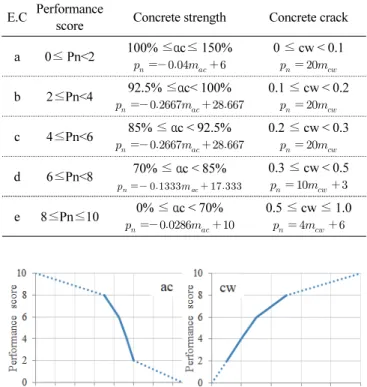
상태평가항목별로 평가내용을 5단계의 등급별 구간마다 조사 및 측정결과 범위로 정하고 있으므로, 평가점수와 비례 관계가 성립된다. 이를 통해 조사 및 측정결과별로 성능점수 를 산정할 수 있는 함수식을 식 (1)과 같이 도출할 수 있다.
측정결과 상수 (1)
상태평가항목별 성능점수 산정 함수식과 성능점수 범위를 5단계 등급별로 표기한 것은 Table 16∼Table 20과 같고, Fig.
2∼Fig. 6은 이 함수식을 그래프로 나타낸 것이다. Fig. 2∼
Fig. 6에서 점선으로 나타난 선은 조사 및 측정결과의 최대 상 한 값과 최소 하한 값을 Table 10과 같이 가정하여 설정한 부 분을 나타낸 것이다.
E.C Performance score Concrete strength Concrete crack
a 0≤ Pn<2 100% ≤αc≤ 150%
0 ≤ cw < 0.1
b 2≤Pn<4 92.5% ≤αc< 100%
0.1 ≤ cw < 0.2
c 4≤Pn<6 85% ≤ αc < 92.5%
0.2 ≤ cw < 0.3
d 6≤Pn<8 70% ≤ αc < 85%
0.3 ≤ cw < 0.5
e 8≤Pn≤10 0% ≤ αc < 70%
0.5 ≤ cw ≤ 1.0
Table 16 Condition evaluation function for concrete strength and cracks
Fig. 2 Condition evaluation function graph for concrete strength and cracks Evaluation
criteria
Evaluation contents
Evaluation Score Concrete
carbonation Chloride content
a 0D ≤ Ct ≤ 0.25D 0 ≤ cL ≤ 0.15 0 ≤ E.S < 2 b 0.25D < Ct ≤ 0.5D 0.15 < cL ≤ 0.3 2 ≤ E.S < 4 c 0.5D < Ct ≤ 0.75D 0.3 < cL ≤ 0.6 4 ≤ E.S < 6 d 0.75D < Ct ≤ 1.0D 0.6 < cL ≤ 1.2 6 ≤ E.S < 8 e 1.0D < Ct ≤ 1.25D 1.2 < cL ≤ 2.4 8 ≤ E.S ≤ 10 Table 12 Establishment of condition evaluation criteria for concrete carbonation and chloride content
Evaluation criteria
Evaluation contents
Evaluation Score Spalling/
Delamination Rebar exposure
a 0 ≤ sd < 7 0 ≤ ra < 0.5% 0 ≤ E.S < 2 b 7 ≤ sd < 15 0.5 ≤ ra < 1.0% 2 ≤ E.S < 4 c 15 ≤ sd < 20 1.0 ≤ ra < 3.0% 4 ≤ E.S < 6 d 20 ≤ sd < 25 3.0 ≤ ra < 5.0% 6 ≤ E.S < 8 e 25 ≤ sd ≤ 30 5.0 ≤ ra ≤ 10% 8 ≤ E.S ≤ 10 Table 14 Establishment of condition evaluation criteria for concrete spalling /delamination and rebar exposure
Evaluation criteria
Evaluation contents Evaluation Score leakage and efflorescence
a 0 ≤ lw < 2.5% 0 ≤ E.S < 2
b 2.5 ≤ lw < 5% 2 ≤ E.S < 4
c 5 ≤ lw < 10% 4 ≤ E.S < 6
d 10 ≤ lw < 20% 6 ≤ E.S < 8
e 20 ≤ lw ≤ 40% 8 ≤ E.S ≤ 10
Table 15 Establishment of condition evaluation criteria for concrete leakage and efflorescence
Evaluation criteria
Evaluation contents
Evaluation Score Rebar corrosion Scaling depth
a 0<E≤200 0 ≤ sc < 0.25 0 ≤ E.S < 2 b -200<E≤0 0.25 ≤ sc < 0.5 2 ≤ E.S < 4 c -350<E≤-200 0.5 ≤ sc < 1.0 4 ≤ E.S < 6 d -500<E≤-350 1.0 ≤ sc < 25 6 ≤ E.S < 8 e -650≤E≤-500 25 ≤ sc ≤ 30 8 ≤ E.S ≤ 10 Table 13 Establishment of condition evaluation criteria for concrete rebar corrosion and scaling depth
E.C Performance score Concrete carbonation Chloride content
a 0≤ Pn<2 0D ≤ Ct ≤ 0.25D
0 ≤ cL ≤ 0.15
b 2≤Pn<4 0.25D < Ct ≤ 0.5D
0.15 < cL ≤ 0.3
c 4≤Pn<6 0.5D < Ct ≤ 0.75D
0.3 < cL ≤ 0.6
d 6≤Pn<8 0.75D < Ct ≤ 1.0D
0.6 < cL ≤ 1.2
e 8≤Pn≤10 1.0D < Ct ≤ 1.25D
1.2 < cL ≤ 2.4
Table 17 Condition evaluation function for concrete carbonation and chloride content
E.C Performance score Rebar corrosion Scaling depth
a 0≤ Pn<2 0<E≤200
0 ≤ sc < 0.25
b 2≤Pn<4 -200<E≤0
0.25 ≤ sc < 0.5
c 4≤Pn<6 -350<E≤-200
0.5 ≤ sc < 1.0
d 6≤Pn<8 -500<E≤-350
1.0 ≤ sc < 25
e 8≤Pn≤10 -650≤E≤-500
25 ≤ sc ≤ 30
Table 18 Condition evaluation function for rebar corrosion and scaling depth
Fig. 3 Condition evaluation function graph for concrete carbonation and chloride content
Fig. 4 Condition evaluation function graph for rebar corrosion and scaling depth
E.C Performance score Spalling/Delamination Rebar exposure a 0≤ Pn <2 0 ≤ sd < 7
0 ≤ ra < 0.5%
b 2≤ Pn <4 7 ≤ sd < 15
0.5 ≤ ra < 1.0%
c 4≤ Pn <6 15 ≤ sd < 20
1.0 ≤ ra < 3.0%
d 6≤ Pn <8 20 ≤ sd < 25
3.0 ≤ ra < 5.0%
e 8≤ Pn ≤10 25 ≤ sd ≤ 30
5.0 ≤ ra ≤ 10%
Table 19 Condition evaluation function for spalling /delamination and rebar exposure
E.C Performance score leakage and efflorescence a 0≤ Pn <2 0 ≤ lw < 2.5%
b 2≤ Pn <4 2.5 ≤ lw < 5%
c 4≤ Pn <6 5 ≤ lw < 10%
d 6≤ Pn <8 10 ≤ lw < 20%
e 8≤ Pn ≤10 20 ≤ lw ≤ 40%
Table 20 Condition evaluation function for leakage and efflorescence
Fig. 5 Condition evaluation function graph for spalling /delamination and rebar exposure
Fig. 6 Condition evaluation function graph for leakage and efflorescence
4. 결 론
본 연구에서는 건축물의 상태평가 중 부재평가방법을 개선 하고자 철근콘크리트구조 건축물의 상태평가 항목을 중심으
로 평가 절차와 항목별 점수 산정방법 및 평가기준에 대해 고 찰 및 분석하였으며, 이를 통해 실제 조사 및 측정결과와 부합 하는 함수식을 도출하였다. 본 연구의 결론을 정리하면 다음 과 같다.
철근콘크리트구조 건축물의 상태평가를 위한 평가항목과 부재별 평가와 층별 평가후 종합적으로 평가하는 절차는 합 리적으로 적용된 것으로 판단된다.
그러나 현장조사 및 측정 결과를 상태평가 항목별로 점수 산정하는 방법은 대푯값을 사용하고 있어 실제 상태의 성능 보다 과하게 평가되는 경우가 발생되어 부정확한 결과가 도 출될 수 있다. 또한, 상태평가항목별 평가기준은 계량평가와 정성적 평가가 혼용되는 부분과, 평가기준의 상ㆍ하한 값이 없는 항목들이 있어 실제 조사 및 측정한 결과를 명확히 도출 하기 어렵다.
이를 개선하기 위해 항목별 평가기준을 현재 적용하는 평 가점수 구간과 상응하는 상ㆍ하한 값이 있는 구간으로 정의 하여 조사 및 측정값에 대응하는 결과를 표현할 수 있는 함수 식을 도출하였으며, 이 함수식을 통해 도출한 결과는 현재 평 가방법으로 도출된 결과보다 현장에서 조사 및 측정한 부재 의 명확한 성능점수를 반영할 것으로 사료된다.
철근콘크리트구조 건축물뿐만 아니라 철골구조, 철골ㆍ철 근콘크리트구조, 조적조 건축물 또한 유사한 평가방법과 기 준을 갖고 있으므로 명확한 상태평가 결과를 얻기 위한 추가 적인 연구가 필요할 것으로 사료된다.
감사의 글
본 연구는 국토안전관리원 기본연구사업(건축물의 구조특 성을 반영한 기존 종합평가기법 개선)의 지원 및 2021년도 광 운대학교 우수연구자 지원 사업으로 수행되었습니다.
References
1. KISTEC (2019), Guidelines for safety and maintenance of facilities, Jinju, South Koea, 60-75
2. KISTEC (1999), Development of aging type classification and evaluation method of building structural materials, Jinju, South Koea, 383-384
3. KISTEC (2002a), A Study on the Establishment of the Condition Evaluation Criteria for the Building, Jinju, South Koea, 5-46 4. KISTEC (2002b), Development of a comprehensive performance
evaluation model for existing buildings, Jinju, South Koea, 127-146 5. KISTEC (2007), Improvement of condition evaluation program for
building precision safety diagnosis, Jinju, South Koea.
6. KALIS (2020), Improvement of the existing comprehensive evaluation technique reflecting the structural characteristics of the building(annual report), Jinju, South Koea, 74-85
Received : 03/30/2021 Revised : 04/22/2021 Accepted : 05/06/2021
요 지 : 건축시설물 중 제1종 시설물과 제2종 시설물은 유지관리를 위해 정기적으로 정밀안전점검과 정밀안전진단을 실시한다. 건축물의
점검 및 진단을 실시하는 경우 상태평가, 기울기 및 침하, 안전성평가를 종합하여 건축물의 등급이 결정된다. 그리고 평가등급은 점검 및 진단 의 주기를 결정한다. 평가 등급이 좋지 않다면 점검 및 진단 주기는 짧아지고, 이로 인한 유지관리 비용은 증가하게 된다. 따라서 건축물을 평가 하는 방법은 명확하여야 한다. 상태평가는 부재단위 평가, 층단위 평가, 종합 평가로 이루어진다. 이 중 부재단위 평가는 현장조사와 시험 결과 를 통해 등급을 판정한다. 본 연구에서는 상태평가의 첫 번째 단계인 부재단위 평가에 대해 평가방법과 평가기준을 분석하여 개선점을 도출하 였으며, 이를 개선하여 현재 부재의 상태점수를 반영할 수 있는 함수식을 제시하였다.
핵심용어 : 상태평가, 부재평가, 평가기준, 정밀안전점검, 정밀안전진단