≪ Research Paper ≫
생태독성평가를 위한 Soil Extracts, Soil Elutriates, Soil Suspensions 추출기법
남선화·안윤주*
건국대학교 보건환경과학과
Review of the Extraction Methods of Soil Extracts, Soil Elutriates, and Soil Suspensions for Ecotoxicity Assessments
Sun-Hwa Nam·Youn-Joo An*
Department of Environmental Health Science, Konkuk University
ABSTRACT
Soil pollution has been recognized as a serious problem because it causes groundwater pollution through medium contacts.
Although concentration of individual chemical could be more easily measured by physico-chemical analysis, it is not easy to consider the bioavailability of edaphic receptors living in soil or groundwater. To measure the toxicity of soil, the soil extracts (soil elutriates or soil suspensions in the other words) are often used due to the difficulties of extracting soil pore water. In this study, we reviewed 15 toxicity test methods found in literature to analyze the detail of each extraction method and to recommend the most frequently used extraction methods. The identified most commonly used extraction methods are as following: The 1 : 4 soil:water ratio, 24 hours shaking time, room temperature, dark, and separation of supernatant using a 0.45µm pore size filter.
Key words : Soil elutriates, Soil extracts, Soil suspensions, Ecotoxicity assessment
1. 서 론
토양 오염은 토양 자체의 오염 뿐 아니라 매체 접근성 으로 인해 지하수 오염과도 밀접한 연관을 갖고 있으므로 환경적으로 중요한 문제로 대두되고 있다. 토양 및 지하 수 내 오염물질의 개별농도는 물리화학적 분석 방법을 통 해 파악할 수 있으나, 분해 과정을 통한 대사산물 등의 매체 내 가변적 오염물질까지 모두 파악하는데 한계가 있 다. 따라서 토양 및 지하수 내 총체적 오염물질에 대한 생물이용성(Bioavailability)을 적용한 생태독성평가를 활용 할 필요가 있다(Loureiro et al., 2005).
기존 생태독성평가는 토양 오염물질의 이차원적 오염 매체로서 토양공극수(Soil pore water, soil solutions, soil water, 또는 leachate solutions)나 토양추출액(Soil elutriates, soil extracts, 또는 soil suspensions)을 적용한
것으로 보고된 바 있다(Cook et al., 2002; Maderova et al., 2011; Tiensing et al., 2001; Romkens et al., 1999;
Shen and Shen, 2001; Arnold et al., 2003; Power and de Pomerai, 1999; Anbalagan et al., 2012, 2013;
Thomas et al., 1990; Hammel et al., 1998; Baun et al., 2002; Aruoja et al., 2004; Robidoux et al., 2004;
Antunes et al., 2010; Maisto et al., 2011; Marques et al., 2011; Bowers et al., 1997; Ronnpagel et al., 1998;
Loureiro et al., 2005; Ore et al., 2010; Miranda et al., 2011). 토양공극수는 토양 입자 간 공극에 존재하는 수분 으로, 인위적으로 수분이 공급되지 않은 상태를 지칭하며, 토양추출액은 인위적인 수분 공급을 통해 토양공극수가 희석된 상태를 지칭한다. 단, 기존 생태독성평가 시 토양 공극수는 흡인법(Cook et al., 2002; Maderova et al., 2011; Tiensing et al., 2001)이나 원심분리법(Romkens
*Corresponding author : [email protected]
Received : 2013. 10. 7 Reviewed : 2014. 3. 26 Accepted : 2014. 3. 26 Discussion until : 2014. 8. 31
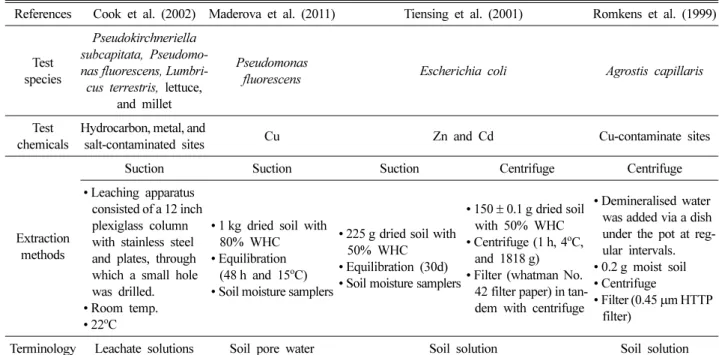
et al., 1999; Tiensing et al., 2001; Shen and Shen, 2001; Power and de Pomerai, 1999; Anbalagan et al., 2012, 2013)을 적용한 바 있으나, Cook et al.(2002)을 제외하고 실험 토양의 50~85% 보수력(Water holding capacity, WHC or Moisture holding capacity, MHC)을 유지한 상태로 soil moisture sampler를 이용한 흡인법이 나 원심분리법을 적용하여 토양 공극수를 추출한 것으로 나타났다(Table 1). 따라서 인위적인 수분 공급 없이 가공 되지 않은 토양공극수 자체를 추출하여 생태독성평가를 한 사례는 거의 미비하고, 시간 또는 비용 측면에서 토양 공극수의 추출이 용이하지 않기 때문에, 토양공극수를 이 용한 오염물질의 생물에의 영향을 상대적으로 용이하게 평가하기 위해 토양추출액을 이용한 사례를 심층 분석할
필요가 있다.
한편 국제표준시험법 중 미국재료시험학회(American Society for Testing and Materials, ASTM)에서 유일하 게 1996년 이래로 오염 토양 및 퇴적물 추출액에서의 발 광 박테리아의 생태독성평가 방법을 제시한 바 있으나 (ASTM, 2009), 이를 활용한 토양추출액 생태독성연구는 미비하였다. 특히 토양추출액은 토양추출액 추출 방법 관 련 주요 인자(예. 첨가된 수분의 종류, 토양 대 수분의 비 율, 수분 첨가 후 혼합 방법, 시간, 온도, 광주기, 토양추출 액 분리 방법, 속도, 시간, 온도, 여과지의 공극 등)에 따라 토양추출액의 특성(예. 오염물질, 유기물, 이온 등의 농도) 이 상이하기 때문에 생태독성평가 방법의 표준화를 위해 토양추출액의 추출 방법에 대한 표준화 과정이 필요하다.
Table 1. Ecotoxicity test methods utilized soil pore water without adding additional liquids from literature review
References Cook et al. (2002) Maderova et al. (2011) Tiensing et al. (2001) Romkens et al. (1999)
Test species
Pseudokirchneriella subcapitata, Pseudomo- nas fluorescens, Lumbri- cus terrestris, lettuce,
and millet
Pseudomonas
fluorescens Escherichia coli Agrostis capillaris
Test chemicals
Hydrocarbon, metal, and
salt-contaminated sites Cu Zn and Cd Cu-contaminate sites
Extraction methods
Suction Suction Suction Centrifuge Centrifuge
• Leaching apparatus consisted of a 12 inch plexiglass column with stainless steel and plates, through which a small hole was drilled.
• Room temp.
• 22oC
• 1 kg dried soil with 80% WHC
• Equilibration (48 h and 15oC)
• Soil moisture samplers
• 225 g dried soil with 50% WHC
• Equilibration (30d)
• Soil moisture samplers
• 150± 0.1 g dried soil with 50% WHC
• Centrifuge (1 h, 4oC, and 1818 g)
• Filter (whatman No.
42 filter paper) in tan- dem with centrifuge
• Demineralised water was added via a dish under the pot at reg- ular intervals.
• 0.2 g moist soil
• Centrifuge
• Filter (0.45µm HTTP filter)
Terminology Leachate solutions Soil pore water Soil solution Soil solution
Table 1. Ecotoxicity test methods utilized soil pore water without adding additional liquids from literature review (continued) References Shen et al. (2001) Power and Pomerai (1999) Anbalagan et al. (2011) Anbalagan et al. (2012) Test species Phaseolus aures Caenorhabditis elegans Caenorhabditis elegans Caenorhabditis elegans
Test chemicals Al Cd Mine site Mine site
Extraction methods
Centrifuge Centrifuge Centrifuge Centrifuge
• 800 g dried soil with 85%
WHC
• Incubation (8 weeks and 25oC)
• Centrifuge
• Filter (0.45µm filter)
• Soil with 50% MHC
• Centrifuge (1 h and 1500 g)
• 60 g dried soil with 50%
MHC (15 mL of ultrapure water)
• Equilibration (overnight and 4oC)
• Centrifuge (10 min, room temp., and 4500 g)
• 60 g dried soil with 50%
MHC (15 mL of ultrapure water)
• Equilibration (overnight and 4oC)
• Centrifuge (10 min, room temp., and 4500 g)
Terminology Soil solution Soil water Soil pore water Soil pore water
따라서 본 연구에서는 생태독성평가를 위한 토양추출액 의 추출 방법을 마련하기 위해 토양추출액을 이용한 생태 독성평가 연구사례를 중심으로 생태독성시험종, 시험물질, 토양추출액 추출 방법(예. 토양의 종류, 토양 숙성 시 기 간, 온도, 광주기, 수분의 종류, 토양 대 수분의 비율, 수 분 첨가 후 혼합 방법, 시간, 온도, 광주기, 토양추출액 분리 방법, 속도, 시간, 온도, 여과지의 공극 등)에 초점을 맞춰 분석하였으며, 이를 바탕으로 생태독성평가를 위한 토양추출액의 추출 방법을 제안하였다.
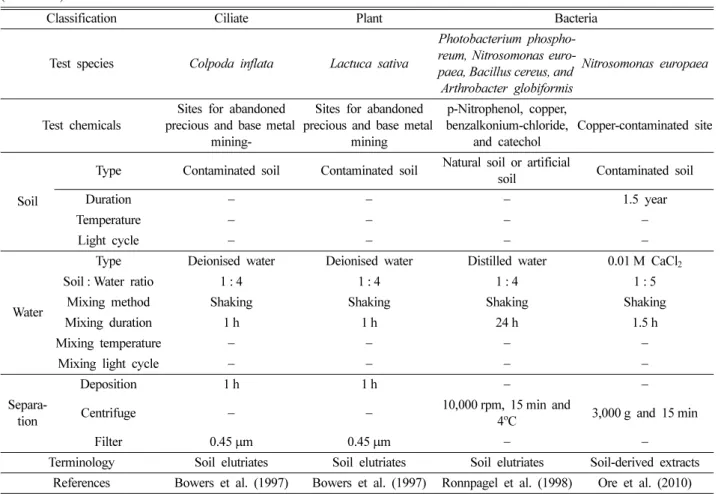
2. 토양추출액을 이용한 생태독성 연구사례 인위적인 수분 공급을 통해 토양공극수가 희석된 토양 추출액을 이용한 생태독성 연구사례 중 1990년부터 2011 년까지 총 15건의 연구를 수집 및 분석하였으며, 조류, 식물류, 섬모충류, 박테리아류, 물벼룩류 등의 독성시험종 에 대한 연구가 이에 해당된다(Table 2).
2.1. 토양추출액을 이용한 조류 독성 연구사례
조류를 대상으로 한 토양추출액에서의 생태독성영향은 1990년부터 2011년까지 총 8건의 연구가 수집되었다 (Thomas et al., 1990; Hammel et al., 1998; Baun et al., 2002; Aruoja et al., 2004; Robidoux et al., 2004;
Antunes et al., 2010; Maisto et al., 2011; Marques et al., 2011). Thomas et al.(1990)은 Pseudokirchneriella subcapitata(=Selenastrum carpricornutum)를 대상으로 Roundup, Arsenal(2 Ib), Garlon 4, Tordon 101 M, Velpar L, Velpar ULW 등 제초제 6종으로 1 h, 5일, 10일 동안 오염된 토양추출액에서의 성장저해영향을 평가하였다. 토 양추출액은 토양과 물을 1 : 4 비율로 48 h 동안 20oC에 서 진탕시킨 후, 침전(5분), 원심분리(10분, 10,000 rpm, 4oC), 여과[0.7 µm 비멸균 유리섬유 여과지(Whatman GF/F), 0.45µm 비멸균 MSI nylon(9 cm), 0.45 µm 멸균 MSI nylon(47 mm)] 단계를 거쳐 채취하였다. 독성 실험 은 4일 동안 24 ± 2oC에서 수행되었으며, 제초제에 의한 Table 2. Ecotoxicity test methods utilized soil extracts (soil elutriates or soil suspension in the other words) from literature review
Classification Algae
Test species Pseudokirchneriella subcapitata
Chlorococcum infu- sionum and Scenedesmus
subspicatus
Pseudokirchneriella subcapitata
Pseudokirchneriella subcapitata
Test chemicals
Roundup, arsenal (2 Ib), garlon 4, tordon 101M, velpar L, and velpar ULW
Antimony
Polycyclic Aromatic Hydrocarbons-contami-
nated site
Cadmium, lead, and zinc-contaminated site
Soil
Type Natural soil Natural soil Contaminated soil Contaminated soil
Duration 1 h, 5, and 10 days 6 months − −
Temperature − 6oC − −
Light cycle − Dark − −
Water
Type Double-deionized water Distilled water ISO medium MilliQ water
Soil:Water ratio 1 : 4 1 : 2.5 1 : 4 1 : 99
Mixing method Shaking − Sonication Shaking Shaking
Mixing duration 48 h − 5 min 24h 24h
Mixing temperature 20oC − - 15oC Room temp.
Mixing light cycle − − - - −
Separa- tion
Deposition 5 min − - −
Centrifuge 10,000 rpm and 10 min − 2,900 g and 10 min (for
soil elutriates) −
Filter
0.7µm GF/F → 0.45 µm MSI nylon → 0.45 µm
sterile MSI nylon
− − 0.45µm GF
Terminology Soil elutriates Soil elutriates Soil elutriates or soil
suspension Soil suspension References Thomas et al. (1990) Hammel et al. (1998) Baun et al. (2002) Aruoja et al. (2004)
조류 세포 수의 감소 현상이 나타났다. 단, Roundup의 경우 10일 동안 오염된 토양추출액의 10%, 50%, 80%
처리군에서 대조군 대비 성장 촉진 현상이 나타났으며, Arsenal(2 Ib)의 경우 5일 동안 오염된 토양추출액의 50%, 80% 처리군에서, 10일 동안 오염된 토양추출액의 80% 처리군에서 대조군 대비 성장 촉진 현상이 나타났다.
Hammel et al.(1998)은 Chlorococcum infusionum, Scene- desmus subspicatus를 대상으로 1000 mg/kg SbO/K tartrate로 6달 동안 6oC의 암조건에서 오염된 토양추출액 에서의 성장저해영향을 평가하였다. 토양추출액은 토양과 물을 1 : 2.5 비율로 혼합하였으며, 이외 기타 세부 사항은 문헌 상 보고하지 않았다. 독성 실험은 DIN 38412/9에 따라 수행되었으며, 안티몬에 의한 조류 성장 저해 현상
이 나타났다. 안티몬에 대한 C. infusionum과 S. sub- spicatus의 반수영향농도(Median effective concentration, EC50)은 각각 43 mg/L와 59 mg/L이며, C. infusionum이 S. subspicatus보다 민감한 것으로 평가되었다. Baun et al.(2002)는 P. subcapitata를 대상으로 34~2960 mg/kg 다방향족탄화수소(Polycyclic Aromatic Hydrocarbons, PAH)로 지역적으로 오염된 7군데 토양추출액에서의 성장 저해영향을 평가하였다. 토양추출액은 원심분리 유무에 따 라 soil elutriates와 soil suspensions으로 나누어 채취하 였다. soil elutriates는 토양과 ISO medium을 1 : 4 비율 로 혼합하여 5분 간 음파처리(sonication)하였으며, 24 h 동안 15oC에서 진탕시킨 후 원심분리(10분, 2,900 g) 단 계를 거쳐 채취하였으며, soil suspensions은 토양과 ISO Table 2. Ecotoxicity test methods utilized soil extracts (soil elutriates or soil suspension in the other words) from literature review (Continued)
Classification Algae
Test species Pseudokirchneriella subcapitata
Pseudokirchneriella subcapitata
Pseudokirchneriella subcapitata
Pseudokirchneriella subcap- itata and Chlorella vulgaris
Test chemicals
2,4,6-Trinitrotoluene (TNT), 1,3,5-trinitro- 1,3,5-triazine (RDX), 1,3,5,7-tetranitro-1,3,5,7- tetrazacyclooctane (HMX) and its by-prod-
ucts-contaminated site
Chlorpyrifos, endosul- fan, glyphosate, and vinclozolin-contami-
nated site
Chromium, copper, nickel, and lead-contam-
inated site
Sites for canal reach cross- ing a protected wetland upstream, canal reach sur- rounded by rice fields, and
rice paddy
Soil
Type Contaminated soil Contaminated soil Contaminated soil Contaminated soil
Duration − − − −
Temperature − − − −
Light cycle − − − −
Water
Type Deionised water Woods Hole MBL
medium Deionised water Woods Hole MBL
medium
Soil:Water ratio
a small quantity of soil (ca. 7 g fresh wt) with deionized water adjusted
to pH 4.5± 0.1
1 : 4 1 : 4 1 : 4
Mixing method Shaking Shaking Stirring Shaking
Mixing duration 18± 2 h 12 h 30 min 2 h
Mixing temperature 22± 3oC Room temp. − −
Mixing light cycle − − − −
Separa- tion
Deposition − 12 h 24 h and 4oC Overnight
Centrifuge − − − 5,000 rpm, 15 min, and
4oC
Filter 0.22µm nitrogen 1.2µm GF/C − GF/C
Terminology Soil elutriates Soil elutriates Soil elutriates or soil
suspension Soil elutriates References Robidoux et al. (2004) Antunes et al. (2010) Maisto et al. (2011) Marques et al. (2011)
Table 2. Ecotoxicity test methods utilized soil extracts (soil elutriates or soil suspension in the other words) from literature review (Continued)
Classification Ciliate Plant Bacteria
Test species Colpoda inflata Lactuca sativa
Photobacterium phospho- reum, Nitrosomonas euro- paea, Bacillus cereus, and Arthrobacter globiformis
Nitrosomonas europaea
Test chemicals
Sites for abandoned precious and base metal
mining-
Sites for abandoned precious and base metal
mining
p-Nitrophenol, copper, benzalkonium-chloride,
and catechol
Copper-contaminated site
Soil
Type Contaminated soil Contaminated soil Natural soil or artificial
soil Contaminated soil
Duration − − − 1.5 year
Temperature − − − −
Light cycle − − − −
Water
Type Deionised water Deionised water Distilled water 0.01 M CaCl2
Soil : Water ratio 1 : 4 1 : 4 1 : 4 1 : 5
Mixing method Shaking Shaking Shaking Shaking
Mixing duration 1 h 1 h 24 h 1.5 h
Mixing temperature − − − −
Mixing light cycle − − − −
Separa- tion
Deposition 1 h 1 h − −
Centrifuge − − 10,000 rpm, 15 min and
4oC 3,000 g and 15 min
Filter 0.45µm 0.45µm − −
Terminology Soil elutriates Soil elutriates Soil elutriates Soil-derived extracts References Bowers et al. (1997) Bowers et al. (1997) Ronnpagel et al. (1998) Ore et al. (2010) Table 2. Ecotoxicity test methods utilized soil extracts (soil elutriates or soil suspension in the other words) from literature review (Continued)
Classification Bacteria Waterflea
Test species Vibrio fischeri Daphnia magna Daphnia magna
Test chemicals Sites for abandoned mine Site for chlor-alkali industry Sites for abandoned mine
Soil
Type Contaminated soil Natural soil Contaminated soil
Duration − 1, 7, 14, and 30 days −
Temperature − − −
Light cycle − − −
Water
Type Distilled water or Microtox
extraction solution Deionised water Distilled water
Soil:Water ratio 1 : 2 and 1 : 4 1 : 10 1 : 2
Mixing method Shaking Shaking Shaking
Mixing duration 24 h 24 h 24 h
Mixing temperature − − −
Mixing light cycle Dark Dark Dark
Separa- tion
Deposition − 4 h −
Centrifuge 10,000 g and 20 min − 10,000 g and 20 min
Filter 1.2µm (GF/C) − 1.2µm (GF/C)
Terminology Soil elutriates Soil elutriates Soil elutriates
References Loureiro et al. (2005) Miranda et al. (2011) Loureiro et al. (2005)
medium을 1 : 4 비율로 혼합하여 5분 간 음파처리 (sonication)하여 24 h 동안 15oC에서 진탕시킨 후 채취하 였다. 독성 실험은 2일 동안 21 ± 2oC에서 수행되었으며, 조류 광합성 색소의 형광(ex 420, em 671 nm) 감소를 통해 PAH에 의한 조류 성장 저해 현상이 나타났다.
Aruoja et al.(2004)은 P. subcapitata를 대상으로 카드뮴, 납, 아연 등 중금속으로 지역적으로 오염된 11군데 토양 추출액에서의 성장저해영향을 평가하였다. 토양추출액은 토양과 물을 1 : 99 비율로 24 h 동안 실온에서 진탕시킨 후, 여과(0.45 µm 유리섬유 여과지) 단계를 거쳐 채취하 였다. 독성 실험은 3일 동안 23 ± 2oC에서 수행되었으며, 조류 광합성 색소의 형광(ex 440, em 670 nm) 감소를 통해 중금속에 의한 조류 성장 저해 현상이 나타났다.
Robidoux et al.(2004)는 P. subcapitata를 대상으로 2,4,6- Trinitrotoluene(TNT), 1,3,5-Trinitro-1,3,5-triazine(RDX), 1,3,5,7-Tetranitro-1,3,5,7-tetrazacyclooctane(HMX) 및 그 부산물로 지역적으로 오염된 8군데 토양추출액에서의 성 장저해영향을 평가하였다. 토양추출액은 토양 7 g의 pH가 4.5± 0.1이 되도록 탈이온수를 첨가하여 18 ± 2 h 동안 22± 3oC에서 진탕(30 ± 2 rpm)시킨 후 40% nitric과 60%
sulfurin acid로 pH를 재보정하였으며, 수분 함량 20%가 되도록 물을 첨가한 후 여과(0.22 µm 질소 여과지) 단계 를 거쳐 채취하였다. 독성 실험은 4일 동안 25 ± 1oC에서 수행되었으며, 조류 세포 수의 감소 현상이 나타났다.
Antunes et al.(2010)은 P. subcapitata를 대상으로 Chlor- pyrifos, Endosulfan, Glyphosate, Vinclozolin 등 농약류 로 오염된 토양추출액에서의 성장저해영향을 평가하였다.
토양추출액은 토양과 Woods Hole MBL medium을 1 : 4 비율로 12 h 동안 실온에서 진탕시킨 후, 침전(12 h) 및 여과(1.2 µm GF/C 여과지) 단계를 거쳐 채취하였다.
독성 실험은 20 ± 2oC에서 수행되었으며, 조류 흡광(440 nm)을 통해 조류 성장 영향을 측정하였다. 단, Endosulfan 및 Vinclozolin으로 오염된 토양추출액의 12.5% 처리군에 서 성장 저해가 나타난 반면, 이외 토양추출액 처리군에 서는 성장 촉진이 야기되었다. Maisto et al.(2011)은 P.
subcapitata를 대상으로 크롬, 구리, 니켈, 납 등 중금속으 로 지역적으로 오염된 토양추출액에서의 성장저해영향을 평가하였다. 토양추출액은 토양과 물을 1 : 4 비율로 30분 동안 교반시킨 후, 24 h 동안 4oC에서 보관하였으며, 이외 기타 세부 사항은 문헌 상 보고하지 않았다. 독성 실험은 4일 동안 24oC에서 수행되었으며, 조류 세포 수의 감소를 통해 도심 및 산업 지역에서 중금속에 의한 조류 성장 저 해 현상이 나타났다. Marques et al.(2011)은 P. subcapitata
및 Chlorella vulgaris를 대상으로 습지대, 운하, 논 지역 토양추출액에서의 성장저해영향을 평가하였다. 토양추출 액은 토양과 Woods Hole MBL medium을 1 : 4 비율로 2 h 동안 진탕(200 rpm)시킨 후, 침전(overnight), 원심분 리(15분, 5,000 rpm, 4oC), 여과(GF/C 여과지) 단계를 거 쳐 채취하였다. 독성 실험은 4일 동안 수행되었으며, 조류 세포 수의 감소를 통해 조류 성장 저해 현상이 확인되었 다. P. subcapitata는 습지대 및 운하 토양추출액의 전농 도 처리군과 논 토양추출액의 100% 처리군에서 성장 저 해가 발생하였으며, C. vulgaris는 P. subcapitata와 반대 로 논 토양추출액 처리군이 습지대 및 운하 토양추출액 처리군보다 성장 저해 영향이 두드러진 것으로 나타났다 (Table 2).
2.2. 토양추출액을 이용한 식물류 독성 연구사례 식물류를 대상으로 한 토양추출액에서의 생태독성영향 은 1997년 1건의 연구가 수집되었다(Bowers et al., 1997). 상추 Lactuca sativa를 대상으로 폐광 지역의 토 양추출액에서의 종자 발아 영향을 평가하였다. 토양추출 액은 토양과 물을 1 : 4 비율로 1 h 동안 진탕시킨 후, 침 전(1 h), 여과(0.45 µm 여과지) 단계를 거쳐 채취하였다.
독성 실험은 5일 동안 수행되었으며, 종자 발아의 감소하 거나 종자 발아 현상이 발생하지 않는 것으로 나타났다 (Table 2).
2.3. 토양추출액을 이용한 섬모충류 독성 연구사례 섬모충류를 대상으로 한 토양추출액에서의 생태독성영 향은 Bowers et al.(1997)의 연구가 유일하며, Colpoda inflata를 대상으로 폐광 지역의 토양추출액에서의 성장 저 해 영향을 평가하였다. 토양추출액은 토양과 물을 1 : 4 비 율로 1 h 동안 진탕시킨 후, 침전(1 h), 여과(0.45 µm 여 과지) 단계를 거쳐 채취하였다. 독성 실험은 24 h 동안 수행되었으며, 세포 수의 감소를 통해 성장 저해 영향을 확인하였다(Table 2).
2.4. 토양추출액을 이용한 박테리아류 독성 연구사례 박테리아류를 대상으로 한 토양추출액에서의 생태독성 영향은 1998년, 2005년, 2010년 3건의 연구가 수집되었 다(Ronnpagel et al., 1998; Loureiro et al., 2005; Ore et al., 2010). Ronnpagel et al.(1998)은 Photobacterium phosphoreum, Nitrosomonas europaea, Bacillus cereus, Arthrobacter globiformis를 대상으로 p-Nitrophenol, Copper, Benzalkonium-chloride, Catechol로 오염된 토양추출액에
서의 성장저해영향을 평가하였다. 토양추출액은 토양과 물 을 1 : 3 비율로 24 h 동안 진탕시킨 후, 원심분리(15분, 10,000 rpm) 단계를 거쳐 채취하였다. 독성 실험은 4주 동안 수행되었으며, Copper로 오염된 토양추출액에서 N.
europaea가, Benzalkonium-chloride 또는 p-Nitrophenol 로 오염된 토양추출액에서 B. cereus가, Catechol로 오염 된 토양추출액에서 P. phosphoreum가 가장 민감한 성장 저해 현상이 나타났다. 또한 Loureiro et al.(2005)는 발 광 박테리아 Vibrio fischeri를 대상으로 폐광 지역의 토 양추출액에서의 생물발광 저해 영향을 평가하였다. 토양 추출액은 토양과 물을 1 : 2, 1 : 4 비율로, 토양과 Microtox extraction solution을 1 : 4 비율로 각각 24 h 동안 암조 건에서 진탕시킨 후, 원심분리(20분, 10,000 g), 여과 (1.2µm GF/C 여과지) 단계를 거쳐 채취하였다. 독성 실 험은 5, 15분 동안 수행되었으며, 생물발광 저해 영향이 확인되었다. 한편 Ore et al.(2010)는 아질산균 Nitrosomonas europaea를 대상으로 구리로 1.5년 동안 오염된 토양추출 액에서의 성장 저해 영향을 평가하였다. 토양추출액은 토 양과 0.01 M CaCl2를 1 : 5 비율로 1.5 h 동안 진탕시킨 후, 원심분리(15분, 3,000 g) 단계를 거쳐 채취하였다. 독 성 실험은 1.5 h 동안 20oC에서 수행되었으며, 시험 농도 범위 내에서 생물발광 측정에 의한 성장 저해 감소는 확 인되지 않았다(Table 2).
2.5. 토양추출액을 이용한 물벼룩류 독성 연구사례 물벼룩류를 대상으로 한 토양추출액에서의 생태독성영 향은 2005년과 2011년 2건의 연구가 수집되었다(Loureiro et al., 2005; Miranda et al., 2011). Loureiro et al.
(2005)는 Daphnia magna를 대상으로 폐광 지역의 토양 추출액에서의 유영장애 및 생식저해 영향을 평가하였다.
토양추출액은 토양과 물을 1 : 2 비율로 24 h 동안 암조건 에서 진탕시킨 후, 원심분리(20분, 10,000 g), 여과(1.2 µm GF/C 여과지) 단계를 거쳐 채취하였다. 독성 실험은 48 h 및 21일 동안 OECD guidelines(OECD, 1998)에 따라 수행되었으며, 24, 48 h 후 유영장애 영향이 관찰되었으며, 21일 후 토양추출액의 16% 처리군에서 체장 감소 영향이, 토양추출액의 8, 16% 처리군에서 첫번째 배(brood) 시기 의 감소 영향이 확인되었다. 또한 Miranda et al.(2011)은 Daphnia magna를 대상으로 chlor-alkali 산업 폐기물로 오염된 1, 7, 14, 30일 동안 오염된 토양추출액에서의 유 영장애 영향을 평가하였다. 토양추출액은 토양과 물을 1 : 10 비율로 24 h 동안 상온에서 진탕시킨 후, 침전(4 h), 여과(1.2 µm GF/C 여과지) 단계를 거쳐 채취하였다. 독성
실험은 48 h 동안 20 ± 1oC에서 수행되었으며, 토양의 숙 성 기간이 긴 토양추출액일수록 유영장애 영향에 민감한 것으로 나타났다(Table 2).
3. 생태독성평가를 위한 토양추출액 연구사례 비교 분석
3.1. 생물분류군별 토양추출액 연구사례 비교
생태독성평가를 위한 토양추출액 연구사례는 1990년부 터 2011년까지 총 15건으로, 조류, 식물류, 섬모충류, 박 테리아류, 물벼룩류 등의 독성시험종을 대상으로 수행된 연구이다. 생물분류군별로 살펴보면, 조류를 대상으로 한 토양추출액에서의 생태독성영향은 총 8건으로(Thomas et al., 1990; Hammel et al., 1998; Baun et al., 2002;
Aruoja et al., 2004; Robidoux et al., 2004; Antunes et al., 2010; Maisto et al., 2011; Marques et al., 2011), Chlorococcum infusionum을 이용한 Hammel et al.
(1998)을 제외하고 7건의 연구 모두 국제적인 표준시험종 인 Pseudokirchneriella subcapitata를 대상으로 수행되었 다. 시험매체인 토양추출액은 soil extracts, soil elutriates, soil suspensions의 세 가지 용어를 혼용하고 있었으며, soil elutriates란 용어를 주로 사용하고 있다. 시험물질은 제초제, 살충제, 중금속, 다방향족탄화수소(Polycyclic aromatic hydrocarbons, PAHs) 등을 대상으로 평가되었고, 주로 이러한 시험물질로 오염된 지역의 토양을 채취하여 사용하였으며, Thomas et al.(1990), Hammel et al.
(1998), Ronnpagel et al.(1998), Miranda et al.(2011)의 경우에만 자연토양과 시험물질을 인위적으로 혼합하여 사 용하였으며, Ronnpagel et al.(1998)의 경우 인공토양도 사용한 바 있다. 또한 식물류와 섬모충류를 대상으로 한 토양추출액에서의 생태독성영향은 각각 1건으로(Bowers et al., 1997), 상추 Lactuca sativa와 colpoda inflata를 대상으로 수행되었으며, 조류와 마찬가지로 soil elutriates 란 용어로 제시되었다. 다음으로 박테리아류를 대상으로 한 토양추출액에서의 생태독성영향은 3건으로(Ronnpagel et al., 1998; Loureiro et al., 2005; Ore et al., 2010), Ronnpagel et al.(1998)의 경우 Photobacterium phos- phoreum, Nitrosomonas europaea, Bacillus cereus, Arthrobacter globiformis를 대상으로, Loureiro et al.
(2005)의 경우 발광 박테리아 Vibrio fischeri를 대상으로, Ore et al.(2010)의 경우 아질산균 Nitrosomonas europaea 를 대상으로 수행되었다. Ronnpagel et al.(1998)와 Loureiro et al.(2005)의 경우 조류, 식물류, 섬모충류와 마찬가지로
soil elutriates란 용어로 제시되었으며, Ore et al.(2010)의 경우 soil-derived extracts란 용어로 제시되었다. 마지막으 로 물벼룩류를 대상으로 한 토양추출액에서의 생태독성영 향은 2건으로(Loureiro et al., 2005; Miranda et al., 2011), Daphnia magna를 대상으로 수행되었다. 조류, 식물류, 섬 모충류, 일부 박테리아류와 마찬가지로 soil elutriates란 용어로 제시되었다.
3.2. 토양추출액 추출 방법 관련 주요 인자
한편 토양추출액 추출 방법 관련 주요 인자는 토양의 종류, 토양 숙성 시 기간, 온도, 광주기, 수분의 종류, 토 양 대 수분의 비율, 수분 첨가 후 혼합 방법, 시간, 온도, 광주기, 토양추출액 분리 방법, 속도, 시간, 온도, 여과지 의 공극 등으로 분류할 수 있다. 먼저 연구자에 의한 인 위적인 토양 숙성 시 그 기간은 3개의 연구에서 1시간, 5일, 7일, 10일, 14일, 30일, 6달 등 다양하게 적용되었으 며, Hammel et al.(1998)의 경우에만 토양 숙성 시 6oC 및 암조건을 적용한 바 있다. 수분의 종류는 Deionised water가 가장 많이 적용되었으며, 이외 Distilled water, Woods Hole MBL medium, ISO medium, 0.01 M CaCl2, Microtox extraction solution이 적용되었다. 토양 대 수분의 비율은 1 : 4가 가장 많이 적용되었으며, 이외 1 : 2, 1 : 2.5, 1 : 5, 1 : 10, 1 : 99 등 다양하게 적용되었다.
수분 첨가 후 혼합 방법은 진탕(shaking), 음파처리 (sonication), 교반(stirring) 등의 방법을 적용하였으며, 이 중 진탕 방법을 가장 많이 적용하였다. 특히 Baun et al.(2002)의 연구에서는 음파처리와 진탕 방법을 모두 적 용한 바 있다. 그리고 진탕 시 진탕 시간은 1 h, 1.5 h, 2 h, 12 h, 18± 2 h, 24 h, 48 h 등 다양하게 적용되었으 며, 이 중 24 h이 가장 많이 적용되었다. 이외 음파처리 시간은 5분, 교반 시간은 30분 간 적용되었다. 또한 혼합 시 온도는 15oC, 20oC, 22± 3oC, 실온 등 15~25oC 범 위 내에서 적용되었으며, 혼합 시 광주기는 암조건에서 수 행된 사례가 대부분이었다. 토양추출액 분리 방법은 침전, 원심분리, 여과 등의 방법을 적용하였으며, 단일 또는 복 합 분리 방법을 적용하였다. 단일 분리 방법은 원심분리 또는 여과 방법을 적용하였으며, 복합 분리 방법은 침전+
여과, 원심분리 + 여과, 침전 + 원심분리 + 여과 방법을 적 용하였으며, 각 분리 방법을 종합하면 여과 방법을 가장 많이 적용한 것으로 나타났다. 침전 시 분리 시간은 5분, 1 h, 4 h, 12 h 등이 적용되었고, 원심분리 시 분리 시간은 10분, 15분, 20분 등이 적용되었으며, 분리 속도는 2,900 g, 3,000 g, 10,000 g, 5,000 rpm, 10,000 rpm 등이 적용되었
다. 여과 시 여과지는 유리 섬유 여과지를 주로 사용하였 으며, 이외 질소 여과지, MSI 나일론 여과지도 사용한 바 있다. 여과지의 공극은 0.22, 0.45, 0.7, 1.2 µm 등 다양 하게 적용되었고, 주로 0.45 µm 사용 빈도가 높았으며, Thomas et al.(1990)의 경우 0.7 µm 비멸균 유리섬유 여 과지(Whatman GF/F), 0.45 µm 비멸균 MSI nylon(9 cm), 0.45µm 멸균 MSI nylon(47 mm)을 이용한 삼중 여과 단계를 거친 바 있다.
4. 생태독성평가를 위한 적정 토양추출액 추출 방법 제안
생태독성평가를 위한 토양추출액 연구사례를 바탕으로 생태독성평가를 위한 적정 토양추출액 추출 방법을 다음 과 같이 제안하고자 한다. 토양의 종류, 토양 숙성 시 기 간, 온도, 광주기는 연구자의 노출 목적에 따라 가변성을 적용하며, 수분의 종류, 토양 대 수분의 비율, 수분 첨가 후 혼합 방법, 시간, 온도, 광주기, 토양추출액 분리 방법, 속도, 시간, 온도, 여과지의 공극 등은 일률적으로 적용하 는 것이 합리적인 것으로 사료된다. 수분의 종류는 기존 사례에서 Deionised water를 가장 많이 사용한 바 있으나, 비오염토양의 토양추출액을 대조군의 노출용액으로 사용 할 경우 시험종의 대조군에서의 원활한 성장을 위해 성장 배지를 이용하여 수분을 첨가하는 것이 바람직할 것으로 사료된다. 이외 토양추출액 추출 방법 관련 주요 인자는 기존 사례에서 가장 많이 적용한 사례를 바탕으로, 토양 대 수분의 비율은 1 : 4, 수분 첨가 후 혼합 방법은 진탕, 진탕 시간은 24 h, 진탕 온도는 실온, 진탕 광주기는 암조 건, 토양추출액 분리 방법은 여과를 적용한다. 단, 여과지 는 여과 시간을 단축하기 위해 1차 여과 시 정성여과지 (11µm 미만)를 적용하되, 토양 침전물에 대한 여과지의 유약성을 감안하여 2겹의 정성여과지를 적용하며, 2차 여 과 시 0.45 µm 유리섬유 여과지를 적용하는 것이 합리적 인 것으로 사료된다(Fig. 1).
한편 본 연구에서 생태독성평가를 위한 적정 토양추출 액 추출 방법은 기존 사례의 사용빈도가 높은 인자를 중 심으로 제안되었으나, 인위적인 수분 첨가를 통한 토양추 출액 추출은 자연적인 토양 공극수 추출과는 오염물질의 농도, 유기물 함량, 토양입자 등이 상이하므로 토양 오염 으로 인한 지하수 오염의 공극적인 독성 실험 매체로서 간주될 수 있는 토양 공극수 추출에 대한 연구가 추진될 필요가 있다.
사 사
본 연구는 환경부 토양·지하수 오염방지 기술개발사업 (2012000540011, 2014000560001)으로 지원받은 과제임.
참 고 문 헌
Anbalagan, C., Lafayett, I., Antoniou-Kourounioti, M., Haque, M., King, J., Johnsen, B., Baillie, D., Gutierrez, C., Rodriguez Martin, J.A., and De Pomerai, D., 2012, Transgenic nematodes as biosensors for metal stress in soil pore water samples, Ecotox- icology, 21(2), 439-455.
Anbalagan, C., Lafayett, I., Antoniou-Kourounioti, M., Gutier- rez, C., Martin, J.R., Chowdhuri, D.K., and De Pomerai, D.I., 2013, Use of transgenic GFP reporter strains of the nematode Caenorhabditis elegans to investigate the patterns of stress responses induced by pesticides and by organic extracts from agricultural soils, Ecotoxicology, 22(1), 72-85.
Arnold, R.E., Hodson, M.E., Black, S., and Davies, N.A., 2003, The influence of mineral solubility and soil solution concentra- tion on the toxicity of copper to Eisenia fetida Savigny, Pedobi- ologia, 47(5-6), 622-632.
Antunes, S.C., Pereira, J.L., Cachada, A., Duarte, A.C., Gonalves, F., Sousa, J.P., and Pereira, R., 2010, Structural effects
of the bioavailable fraction of pesticides in soil Suitability of elutriate testing, J. Hazard. Mater., 184(1-3), 215-225.
Aruoja, V., Kurvet, I., Dubourguier, H.C., and Kahru, A., 2004, Toxicity testing of heavy-metal-polluted soils with algae Selena- strum a soil suspension assay, Environ. Toxicol., 19(4), 396-402.
American Society for Testing and Materials (ASTM), 2009, D5660 - 96 Standard Test Method for Assessing the Microbial Detoxification of Chemically Contaminated Water and Soil Using a Toxicity Test with a Luminescent Marine Bacterium, ASTM International, United States, p. 1-9.
Baun, A., Justesen, K.B., and Nyholm, N., 2002, Algal test with soil suspensions and elutriates.: a comparative evaluation for PAH-contaminated soils, Chemosphere, 46(2), 251-258.
Bowers, N., Pratt, J.R., Beeson, D., and Lewis, M., 1997, Com- parative evaluation of soil toxicity using lettuce seeds and soil ciliates, Environ. Tox. Chem., 16(2), 207-213.
Cook, S.V., Chu, A., and Goodman, R.H., 2002, Leachability and toxicity of hydrocarbons, metals and salt contamination from flare pit soil, Water Air and Soil Pollution, 133(1-4), 297- 314.
Hammel, W., Steubing, L., and Debus, R., 1998, Assessment of the Ecotoxic Potential of Soil Contaminants by Using a Soil- Algae Test, Ecotox. Environ. Saf., 40(1-2), 173-176.
Loureiro, S., Ferreira, A.L., Soares, A.M., and Noqueira, A.J., 2005, Evaluation of the toxicity of two soils from Jales Mine Fig. 1. The flow chart of the recommended extraction method of soil extracts for ecotoxicity assessment.
(Portugal) using aquatic bioassays, Chemosphere, 61(2), 168- 177.
Maderova, L., Watson, M., and Paton, G.I., 2011, Bioavailabil- ity and toxicity of copper in soils: integrating chemical approaches with responses of microbial biosensors, Soil Biol.
Biochem., 43(6), 1162-1168.
Maisto, G., Manzo, S., De Nicola, F., Carotenuto, R., Rocco, A., and Alfani, A., 2011, Assessment of the effects of Cr, Cu, Ni and Pb soil comtamination by ecotoxicological tests, J. Environ.
Monit., 13(11), 3049-3056.
Marques, C.R., Pereira, R., and Gon alves, F., 2011, Toxicity evaluation of natural samples from the vicinity of rice fields using two trophic levels, Environ. Monit. Assess., 180(1-4), 521- 536.
Miranda, A.F.P., Rodrigues, J.M.L., Barata, C., Riva, C., Nuge- goda, D., and Soares, A.M.V.M., 2011, The use of Daphnia magna immobilization tests and soil microcosms to evaluate the toxicity of dredged sediments, J. Soils Sediments, 11(2), 373- 381.
Ore, S., Mertens, J., Brandt, K. K. and Smolders, E., 2010, Cop- per Toxicity to Bioluminescent Nitrosomonas europaea in Soil is explained by the free metal ion activity in pore water, Envi- ron. Sci. Techol., 44(23), 9201-9206.
Organisation for Economic Co-operation and Development (OECD), 1998, OECD guidelines for the testing of chemicals, Daphnia sp., Acute immobilisation test.
Power, R.S. and de Pomerai, D.I., 1999, Effect of single and paired metal inputs in soil on a stress-inducible transgenic nem- atode, Arch. Environ. Contam., 37(4), 503-511.
Robidoux, P.Y., Gong, P., Sarrazin, M., Bardai, G., Paquet, L., Hawari, J., Dubois, C., and Sunahara, G.I., 2004, Toxicity assessment of contaminated soils from an antitank firing range, Exotoxicol. Environ. Saf., 58(3), 300-313.
Romkens, P.F., Bouwman, L.A., and Boon, G.T., 1999, Effect of plant growth on copper solubility and speciation in soil solution samples, Environ. Pollut., 106(3), 315-321.
Ronnpagel, K., Janssen, E., and Ahlf, W., 1998, Asking for the indicator function of bioassays evaluating soil contamination:
are bioassay results reasonable surrogates of effects on soil microflora?, Chemosphere, 36(6), 1291-1304.
Shen, Q.R. and Shen, Z.G., 2001, Effects of pig manure and wheat straw on growth of mung bean seedlings grown in alu- minium toxicity soil, Bioresour. Technol., 76(3), 235-240.
Thomas, M.W., Judy, B.M., Lower, W.R., Krause, G.F., and Sut- ton, W.W., 1990, Time-dependent toxicity assessment of herbi- cide contaminated soil using the green alga Selenastrum capricornutum, Plants for Toxicity Assessment, 235-254.
Tiensing, T., Preston, S., Strachan, N., and Paten, G.I., 2001, Soil solution extraction techniques for microbial ecotoxicity testing:
a comparative evaluation, J. Environ. Monit., 3(1), 91-96.
sç