Introduction
The deep sea floor could be thought as the last repository of mineral resources left for mankind. Since the 1960’s, USA and Japan have actively pushed for the development of deep-sea mineral resources in preparation for the depletion of on-land mineral resources. Especially, the development of exploration, mining and transfer tech- nologies is essential in developing deep-sea manganese nodules, of which mining technology can be distinguished by collection and lifting technologies (Chung, 1994). Yoon et al. (2010) tested the integrated the lifting and collecting technology at Hupo port of East coast of Korea. The lifting system, which conveyed manganese nodules from the
seafloor to the mining ship in deep-sea mining projects, is the most important factor. The conveying system of manganese nodules can be divided into the hydraulic pumping system and the air lift system according to the dredging method of flow, the continuous line buckets system of the mechanical type and the modular marine mining automation system (Yoon et al., 2003). The hydraulic pump lifting system, one of the lifting methods, is located between the buffer system and the lifting pipe connected to the ship. To improve the efficiency of the lifting pump, many studied have been carried using CFD code (Yoon et al., 2009; Lee et al., 2010). The lifting pump of the hydraulic pump lifting system is efficient when designed with multi-stages because it requires a high hydraulic head (Park et al., 2007). Park et al. (2009) performed numerical prediction using commercial code for four-stage lifting pump. In Japan, an 8 stage lifting pump was developed for its offshore experiment (Chung, 1994).
In the present study, concentrations of manganese nodules, sea floor sediments and slurry with seawater were
심해역 파일롯 양광시험을 위한 수력펌프설계
윤치호1)· 박종명1)* · 안병식2)
Design of the Hydraulic Pump for the Pilot Lifting Test (PLT) in Deep-sea
Chi-Ho Yoon, Jongmyung Park
*
and Byungsik Ahn(Received 3 September 2019; Final version Received 16 October 2019; Accepted 25 October 2019)
Abstract : The deep-sea hydraulic pump was designed for the pilot lifting test(PLT) after the determination of lifting distance and flow quantity. We deduced four design factors for the optimization of the hydraulic design. Four design factors are inlet/outlet angles of one blade of an impeller and inlet/outlet angles of one blade of a guided vane. Each angle has three variation of magnitude to be called three levels. For the respective factors, three levels of factors were deduced on the basis of CFD. The optimum values of four angles were determined by using design of experiments and parametric study.
Key words : Deep-sea Manganese nodules, Hydraulic design, Pilot Lifting Test, CFD, design of experiments 요 약 : 본 연구에서는 PLT를 위한 심해역 양광펌프의 설계를 위해 양정과 유량을 결정한 후 수력설계를 수행하였 다. 수력설계의 최적화를 위하여 4개의 설계인자를 추출하였다. 4개의 설계인자는 임펠라의 입구각도, 출구각도 그리 고 가이드 베인의 입구각도, 출구각도이다. 각 각도는 3수준이라 불리우는 3개의 각도크기 변화가 있다. 이렇게 추출 된 설계인자를 바탕으로 각각의 인자에 대하여 3수준의 인자를 정한 후 CFD 해석을 바탕으로 최적의 인자를 도출하 였다. 네 개의 각도에 대한 최적값은 실험계획법과 파라메트릭 연구를 통하여 결정하였다.
주요어 : 심해저 망간단괴, 수력설계, 파일롯 양광시험, 전산유체역학, 실험계획법
1) 한국지질자원연구원
2) 포스플랜트
*Corresponding Author( 박종명) E-mail; [email protected]
Address; 124, Gwahak-ro Yuseong-gu, Daejeon 34132, Korea
ISSN 2288-2790(online) Vol. 56, No. 5 (2019) pp. 529-534, https://doi.org/10.32390/ksmer.2019.56.5.529
연구논문
was set as 4.5 m/sec. When the vertical distance is 2,500 m and the horizontal distance is 100m with slurry concent- ration 12%, the required lifting distance is 640 m. The design of the mixed flow pump for this purpose was estimated to require total fourteen levels, which means 46 meters per level. In addition, flow rate was calculated 20 m
3/min. Then, inlet and outlet angles of the impeller and the guide vane were determined according to respective flow lines including the hub and the shroud. Then the four determined parameters were analyzed and optimized by giving them three levels respectively for each flow line according to the design of experiments.
Modelling of the Mining System
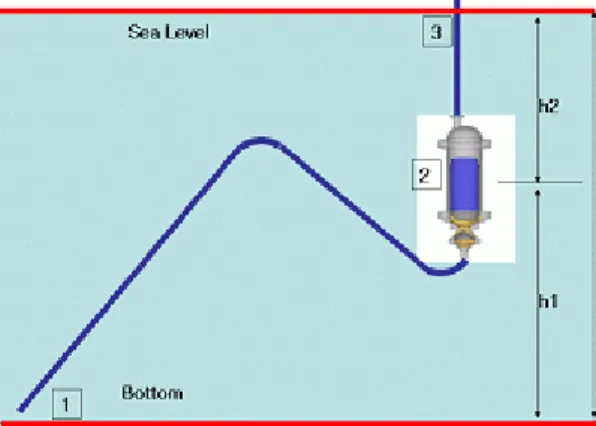
The schematics of the lifting system are shown in Fig. 1.
Especially, this lifting system is composed of flexible pipe (1), lifting pump (2), and lifting pipe (3). The lifting pump is a hydrualic pump to convey manganese nodules to a surface ship. The aim of the study is to design hydraulic pumping system of a two-phase (solid and liquid) lifting technology. The simulations were performed for two purposes: the prediction of pump efficient and the total analysis of the lifting performance. For the efficiently study of total mining system, a computational fluid analysis was performed to deduce the flow characteristic value of each part. The analytical method was employed to analyze the total system.
The pump was divided into two parts for computational numerical analysis as shown in Fig. 2. The first one is the impeller part which is rotating and the second one is the guided vane which is stationary.
Numerical Method for CFD
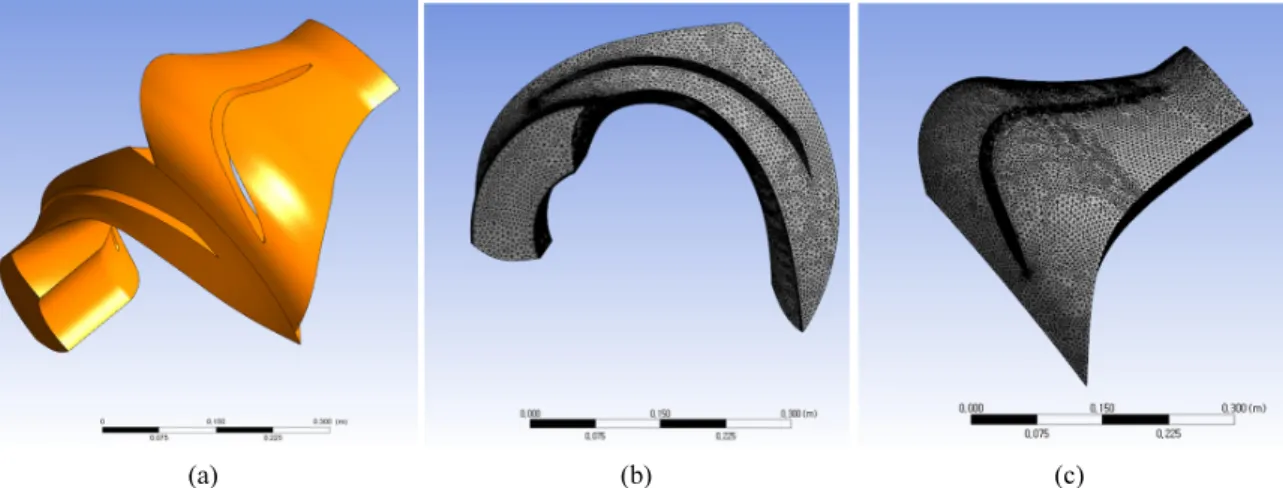
The CFD computations are conducted using the program CFX, which uses the Finite Volume Method to solve the Navier-Stokes equations to predict the flow efficiency in the pump and flexible pipes. The tetrahedral grid is employed for calculation. In the flow area, close to the wall or in the part where high gradients, are meshed with a fine grids to solve gradients with flow characteristics. In Fig. 3, the calculation grid of the pump is shown. Shear Stress Transport modeling of CFX, a kind of k-ω turbulent modeling, was employed, which is known for high adaptability to fluid mechanics analysis such as for pumps.
The numbers of grid in impeller and guided vane are 650,000 and 850,000 respectively. Fig. 4 presents the boundary conditions for CFX simulations. The mixing plane model is chosen as the rotor-stator interface model.
It is not necessary to analyze all the fourteen levels because each level is repeated including the impeller and the guide vane. Therefore, the first level analysis was performed in the present study.
Fig. 1. Flow-line of the lifting system (Yoon et al., 2009).
Fig. 2. Outline diagram for the calculation area division of the
pump.
Design of Experiments
Inlet angle (A) and outlet angle (B) of impellers, and those (C and D) of guide vanes were calculated according to each flow line as shown in Table 1 when angles calculated from initial hydraulic design results were set as Level 1.
Actually, the impeller has four blades and the guided
vane has five blades. By using periodic conditions, each one blade is employed at both impeller and guided vane.
Therefore, analysis of the first stage is performed in the present study. According to the design of experiments (Park, 1986), only the neighboring alterations such as AxB, BxC or CxD were permitted and others were excluded. Parametric studies were conducted on the basis of the design of experiments.
(a) (b) (c)
Fig. 3. Calculation grid of lifting pump. (a) Overall geometry, (b) Impeller mesh generation, and (c) Guided vane mesh generation for calculation zone.
Fig. 4. Boundary conditions for the numerical simulations.
Results and Discussion
Simulation results of lifting pump
In Fig. 5 and Fig. 6, pressure and velocity distribution of the lifting pump are given. The pressure increases when flow passes through the rotor and the stator, but velocity increases at the rotor and decreases at the stator. It can also be seen that as the flow flows from the rotor exit to the
stator, the total pressure increasing at the rotor decreases.
In Fig. 7, flow lines at the impeller and the guide vane are represented. The flow that is accelerated at the impeller does not flow out smoothly from the guide vane and shows considerably complex flow distribution. The flow line at the blade suction side can be predicted to form a recirculation area in the direction of span and hub side. The outer side velocity is considered to be faster because the discharge direction is toward the radius, and losses occur due to separation and vortex near the central axis. The water flow into the stator is interrupted by this vortex.
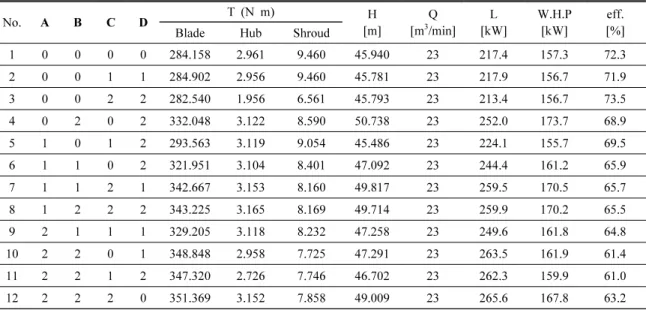
Optimized parameters for impeller and guide vane With the deduced CFD above, optimum design para- meters were deduced through the optimization process by design of experiments. As shown in Table 2, the deter- mined optimum parameter is A0B0C2D2 which is expected to be 73.5% in efficiency while the worst one is A2B2 C1D2 which is expected to be 61.0% in efficiency, which indicates that the former is better than the latter in efficiency by more than 12.5%.
Fig. 5. Pressure distribution.
Fig. 6. Velocity distribution. Fig. 7. Flow lines of the impeller & Guide Vane.
Inlet Angle [°] Outlet Angle [°] Inlet Angle [°] Outlet angle [°]
Shroud 19.139 17.530 22.570 101.106
Middle 20.321 16.774 15.538 101.897
Hub 21.503 16.018 15.413 101.862
Predicted curve of optimized parameters for A0B0 C2D2 case
For A0B0C2D2 case, predicted curves of flow quantity and lifting distance were calculated on the basis of the above deduced design parameters as shown in Fig. 8, where y-axis indicates efficiency. In the figure, it is shown that the optimum efficiency is determined at 26 m
3/min, which is 6 m
3/min right away from 20 m
3/min of the designed flow quantity.
Conclusion
Four design parameters (inlet/outlet angles of one blade of an impeller and inlet/outlet angles of one blade of a guided vane) which are deduced on the basis of the initial hydraulic design results are designed optimally by using design of experiments and CFD for hydraulic pumps to lift manganese nodules in the deep sea. CFD analyses are employed to conduct parametric studies for design optimi- zation of impellers and guided vanes. All 12 cases are determined and analyzed for parametric studies. To produce the high efficiency (73.5%), velocities, heads, flow rates are presented. The final optimal angles of rotor and stator are calculated through the numerical simulations. The results show CFD is an excellent tool to find the optimal parametric condition of a lifting pump for lifting the mineral resources on the deep-sea seabed.
Acknowledgement
The authors express appreciation for support of the
“Development of the Lifting System for Deep-sea Mineral Resources” project, funded by the Ministry of Oceans and Fisheries (MOF) of Korea.
Table 2. Optimized design Parameter
No. A B C D T (N m) H
[m]
Q [m
3/min]
L [kW]
W.H.P [kW]
eff.
Blade Hub Shroud [%]
1 0 0 0 0 284.158 2.961 9.460 45.940 23 217.4 157.3 72.3
2 0 0 1 1 284.902 2.956 9.460 45.781 23 217.9 156.7 71.9
3 0 0 2 2 282.540 1.956 6.561 45.793 23 213.4 156.7 73.5
4 0 2 0 2 332.048 3.122 8.590 50.738 23 252.0 173.7 68.9
5 1 0 1 2 293.563 3.119 9.054 45.486 23 224.1 155.7 69.5
6 1 1 0 2 321.951 3.104 8.401 47.092 23 244.4 161.2 65.9
7 1 1 2 1 342.667 3.153 8.160 49.817 23 259.5 170.5 65.7
8 1 2 2 2 343.225 3.165 8.169 49.714 23 259.9 170.2 65.5
9 2 1 1 1 329.205 3.118 8.232 47.258 23 249.6 161.8 64.8
10 2 2 0 1 348.848 2.958 7.725 47.291 23 263.5 161.9 61.4
11 2 2 1 2 347.320 2.726 7.746 46.702 23 262.3 159.9 61.0
12 2 2 2 0 351.369 3.152 7.858 49.009 23 265.6 167.8 63.2
Fig. 8. H-Q curve of the optimized lifting pump.
research. Proc. of 4th International Offshore and Polar Engineering Conference, ISOPE, Osaka, Japan, p.18-31.
Lee, J.W., Choi, Y.D., Lee, Y.H., Yoon, C.H., and Park, J.M., 2010. Internal flow analysis on a mixed flow pump for developing marine mineral resources. J. of Fluid Machinery, 13(5), 11-16.
Park, J.M., Yoon, C.H., and Kang, J.S., 2009. Numerical prediction of a lifting pump for deep-sea mining. Proc. of The 8th ISOPE Ocean Mining Symposium, ISOPE, Chennai, India, p.229-232.
Park, J.M., Yoon, C.H., Park, Y.C., Kim, Y.J., Lee, D.K. and Kwon, S.K., 2007. Three dimensional solid-liquid flow analysis for design of two-stage lifting pump. Proc. of The 7th ISOPE Ocean Mining Symposium, ISPOE, Lisbon, Portugal,
Kwon, S.K., 2009. Flow analysis by CFD model of lifting system for shallow sea test. Proc. of The 8th ISOPE Ocean Mining Symposium, ISOPE, Chennai, India, p.225- 228.
Yoon, C.H., Park, J.M., Kang, J.C., Kim, Y.J., Park, Y.C., Park, S.G., Kim C.R., Kang, S.S., Kim, S.B., Kim, W.T., Kwon, S.K., and Ahn, B.S., 2010. Integrated mining test in the shallow sea for the development of deep-sea mineral resources in korea. J. the Korean Society of Mineral and Energy Resources Engineers, 47(4), 557-565.
Yoon, C.H., Park, Y.C., Lee, D.K., Kwon, K.S., and Kwon, S.K., 2003. Hydraulic pumping test system of KIGAM for deep-sea manganese nodules. The 33
rdAnnual Conference of the Underwater Mining Institute, KORDI, Jeju, Korea, p.131-135.
윤 치 호
1982 B.S., Department of Mining &
Mineral Engineering, Hanyang University, South Korea 1988 M.S., Department of Mining &
Mineral Engineering, Hanyang University, South Korea 1995 Ph.D., Department of Mining &
Mineral Engineering, Hanyang University, South Korea Present Principal Researcher, Korea Institute of Geoscience &
Mineral Resources (E-mail; [email protected])
안 병 식
1994 B.S., Department of Mechanical Engineering, Hanyang University, South Korea
1996 M.S., Department of Mechanical Engineering, Hanyang University, South Korea
Present Posplant, Representative Director (E-mail; [email protected])
박 종 명