
1. 서 론
1)
고분자 전해질막 연료전지(polymer electrolyte membrane fuel cells, PEMFCs)는 환경 문제를 완 화하고 다양한 응용 분야에 전력원을 제공하는 환 경 친화적인 전기화학 장치이다[1]. 연료전지차 (FCV), 잠수함, 휴대용 전력 공급기 등 다양한 응 용 분야에서 PEMFC 사용이 크게 늘어난 것은 낮 은 작동 온도에서도 시동 시간이 빠르고 높은 전 력 밀도를 낼 수 있기 때문이다[2-7]. 그러나 성공 적인 상용화를 달성하기 위해서는 PEMFC의 비용 절감, 전력 밀도 개선 및 내구성 강화를 위한 광범 위한 기술 개발이 필수적이다[2].
주저자(E-mail: [email protected])
일반적인 고분자 전해질막 연료전지는 폴리머 전해질막(polymer electrolyte membrane, PEM), 촉 매층(catalyst layer, CL), 가스확산층(gas diffusion layer, GDL), microporous layer (MPL), 가스유동 채널(gas flow channels), bipolar plates를 포함하 는 막 전극 집합체(membrane electrode assembly, MEA)로 구성된다. 특히 백금/탄소(Pt/C)와 poly- mer electrolyte film으로 구성된 촉매층에서는 다 성분 물질전달 현상과 전기화학 변환이 일어나기 때문에 연료전지의 성능에 매우 중요한 요소이다 [8-11].
고분자 전해질막 연료전지에서는 폴리테트라플 루오로에틸렌(polytetrafluoroethylene, PTFE) back- bone과 극성 설폰산군으로 구성된 나피온(Nafion,
고분자 전해질막 연료전지 전극층에서의 분자동역학 연구
강 혜 수*ㆍ권 성 현*ㆍ이 승 걸*,**,†
*부산대학교 응용화학공학부, **부산대학교 유기소재시스템공학과
Molecular Dynamics Simulations on Catalyst Layers of Polymer Electrolyte Membrane Fuel Cell
Haisu Kang*, Sung Hyun Kwon*, and Seung Geol Lee*,**,†
*School of Chemcial Engineering, Pusan National University, Busan 46241, Republic of Korea
**Department of Organic Material Science and Engineering, Pusan National University, Busan 46241, Republic of Korea
Abstract: 수소 에너지는 환경 문제를 최소화하고 고갈되는 화석연료를 대체할 수 있는 에너지원으로 각광을 받고 있 다. 수소연료전지는 이러한 수소를 에너지원으로 사용하고 수소를 전기에너지로 전환하여 그 부산물로 물을 만드는 대표적인 친환경 전기화학 장치이다. 고분자 전해질막 연료전지는 수소이온교환 특성을 갖는 고분자막을 전해질로 사용하는 연료전지로 막전극집합체의 전극층은 촉매가 포함된 고분자 전해질막 연료전지의 주요 요소 중의 하나이다.
소재개발 측면에서 고분자 전해질막 연료전지 전극층 핵심 소재의 물성 발현 원리 등을 이해하고 최적화된 소재 설계 를 위해서는 원자레벨에서의 소재 설계 접근법이 필요하다. 따라서 실험적인 연구가 어려운 부분과 원자단위에서의 물질 현상에 대한 이해 그리고 연구 개발의 효율성 증진을 위해 전산재료과학(computational materials science) 기술 이 광범위하게 활용될 수 있다. 본 기고문에서는 고분자 전해질막 연료전지에서의 전극층 소재에 대한 분자동역학 기반의 전산모사 활용과 연구동향에 대하여 소개하고자 한다.
Keywords: fuel cell, PEMFC, hydrogen, catalyst layer, molecular dynamics
고분자 전해질막 연료전지 전극층에서의 분자동역학 연구
DuPont)과 같은 과불화설폰산(perfluorosulfonic acid, PFSA)이 이오노머(iomomer)로서 고분자 전 해질막에 사용되어 왔다[12]. PFSA 이오노머는 Pt/C 표면에서 두께가 약 15 nm 미만인 박막으로 사용된다. PFSA 이오노머는 촉매 입자를 탄소 지 지대에 결합하고 촉매층을 통한 양성자 및 가스 수 송을 촉진하는 필수적인 역할을 하는 것으로 알려 져 있다[13]. 그러나 Pt/C 표면의 PFSA 이오노머 의 구조는 bulk phase와는 달리 계면 영역에서 형 태학적(morphological) 변화를 수반하므로 그 구 조가 예측하기 매우 어렵고 복잡하다는 점에 유의 해야 한다[14-17].
또한 Pt/C 표면의 이오노머 필름의 구조적 특성 이 연료 전지 성능에 중요한 촉매층에서의 양성자 (proton) 및 산소 운반 특성에 큰 영향을 주는 것 으로 알려져 있다. 일례로 촉매층에서의 양성자 수송은 이오노머 필름 내부의 연속적인 물 채널의 발달 여부에 영향을 받고, 산소 수송은 백금 표면 에서의 수화된 이오노머의 패킹 구조에 영향을 받 는 것으로 알려져 있다[18]. 그러므로 고성능 연료 전지를 개발하기 위해서는 Pt/C 표면에서의 PFSA 이오노머 필름의 구조적 특성에 대한 근본적인 이 해를 하는 것이 바람직하다.
따라서 PFSA 이오노머 막의 미세 및 나노 구조 를 이해하기 위한 연구가 a quartz‐crystal micro- balance, grazing‐incidence X‐ray scattering[16], spectroscopic ellipsometry[19], attenuated total re- flection Fourier transform infrared (ATR−FTIR) spectroscopy[20,21], polarized multiple-angle in- cidence resolution spectrometry (p-MAIRS) tech- nique[22] and neutron reflectometry (NR)[23,24]
등의 다양한 기기 분석을 통하여 진행되었다. 또 한 이론적 연구도 활발하게 진행되었는데 분자동 역학(molecular dynamics, MD) 등 분자 수준의 전 산재료과학(computational materials science) 기반 의 방법은 원자레벨에서 PFSA 이오노머와 Pt/C 계 면에서의 이오노머의 구조적, 투과적 특성을 연구 하고 인터페이스에서 PFSA 이오노머 필름의 구성 요소 사이의 상호 작용과 상관관계에 대한 근본적
인 이해에 효율적이다.
재료전산모사 기법 중 분자 레벨 이하에서의 연 구는 양자역학(quantum mechanics)과 통계역학 (statistical mechanics)을 기반으로 나눌 수 있다. 예 를 들면, 전자의 거동을 기술할 수 있는 전자 레벨 계산의 밀도범함수이론(density functional theory, DFT), 분자 레벨 계산의 분자동력학(molecular dy- namics, MD), 그리고 메조 스케일의 대단위 동역 학(coarse-grained dynamics, CGD) 등이 있다[25].
밀도범함수이론은 소재의 전자 구조 및 특성을 비 교적 정확하게 예측할 수 있게 한다. 분자동역학 은 고전역학의 뉴턴 운동방정식을 기반으로 원자 들의 위치, 운동량을 추적하는 방법으로 밀도범함 수이론에 비해 훨씬 더 큰 규모의 분자시스템을 모사할 수 있다. 대단위 동역학은 원자들을 bead- ing화 하여 여러 개의 원자들을 하나의 입자로 치 환하는 방법으로 분자동역학보다 더 큰 규모의 시 스템을 모사할 수 있어 주로 소재의 모폴로지 (morphology)를 보는 목적으로 사용되고 있다.
본 고에서는 고분자 전해질막 연료전지 전극층 에서의 이오노머 및 Pt/C 계면에서의 이오노머의 특성 연구에 대한 분자동역학의 활용에 대한 최근 연구 동향 및 응용 가능성에 대하여 살펴보고자 한다.
2. 본 론
2.1. Bulk models
분자동역학을 이용한 초기 연구는 이오노머의 bulk phase model을 기반으로 진행되었다. Bulk phase는 이오노머 자체의 구조적, 투과적 특성 등 을 분석하기 위해 주로 사용되고 있으며 이오노머 의 간의 특성 비교를 위해 높은 빈도로 사용되고 있는 모델이다. Jang et al.[26]은 Nafion 117 이오 노머의 monomeric sequence를 극단적으로 조정함 으로서 nanophase-segregation 모폴로지가 조절 가 능함으로 제시하였고 이를 통해 구조적, 투과적 특 성 또한 영향을 받음을 분자동역학 연구를 통해 제 시하였다. Figure 1과 같이 monomeric sequence의
Figure 1. Two monomeric sequences of Nafion 117: (a) DR = 0.1 (more blocky) and DR = 1.1 (more dispersed).
(b) Nanophase-segregated structures of hydrated Nafion predicted from the simulations at 353.15 K. Nafion back- bone atoms have been deleted from the pictures; hence the white regions are the parts occupied by the Nafion backbone. Bright gray spheres represent sulfur atoms and dark gray spheres represent the oxygen atoms in hydronium molecules[26].
극단적 조절을 통해 블락형 이오노머와 분산형 이 오노머를 모델링 하였고, 블락형의 경우 phase-se- gregation이 분산형에 비해 약 60% 정도 크게 나 타났다. 이러한 구조 특성 변화로 인해 물 분자의 확산 계수가 분산형의 경우 블락형에 비해 약 25%
정도 낮아지는 것(0.46 × 10⁻⁵ vs 0.59 × 10⁻⁵ cm2/s at 300 K)을 발견하였다.
Brunello et al.[27,28]은 Nafion 이오노머의 대 체 소재로 sulfonated poly(ether ether ketone) (S-PEEK)를 PEMFC에 적용하기 위해 S-PEEK의
구조적, 투과적 물성을 함수율(10~20 wt%)과 온 도(298.15, 323.15, and 353.15 K) 조건 등을 변화 시켜가며 연구하였다. S-PEEK 막은 Nafion과 Dendrion 막에 비해 bulk phase에서 water phase 형 성이 작고 이로 인해 물 분자의 확산계수도 낮은 것으로 나타나 Nafion과 Dendrion 막보다 nano- phase 상 분리가 작은 것으로 나타났다(Figure 2).
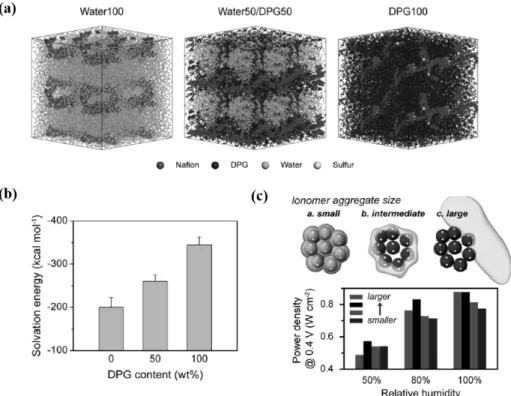
Lee et al.[29] 및 Doo et al.[30]은 Nafion 이오 노머의 용매에 따른 분산 특성을 연구하기 위해 분 자동역학을 이용하였다. 용매로 water 100%, di- propylene-glycol (DPG) 100% 그리고 DPG/water 를 1 : 1 로 혼합한 용매를 사용하여 Nafion 이오노 머의 분산 특성을 dynamic light scattering (DLS), Nafion 이오노머의 radius of gyration (Rg) 및 Nafion 이오노머의 각 용매에 대한 solvation 에너 지를 비교하였다. Nafion 이오노머의 분산성은 DPG 100%, DPG/water 1 : 1, water 100%의 순으로 분 산도가 좋았으나 실험적으로 재현된 셀의 power 성 능은 DPG/water 1 : 1 로 분산되었던 전극이 가장 높은 성능을 나타내었다. DPG의 함량이 증가할수 록 Nafion 이오노머의 분포가 더욱 균일해지지만 양성자 수송과 산소 전달 특성은 DPG/water 1 : 1 의 경우에 최적화 되는 것을 발견하였다(Figure 3).
Kwon et al.[31]은 이오노머의 사이드 체인의 종 류가 막의 구조 및 투과 특성에 미치는 영향을 연 구하기 위해 Nafion 또는 Aquivion 이오노머를 분 자동역학을 이용하여 연구를 진행하였다. Nafion 과 Aquivion 이오노머는 상온(298.15 K) 및 작동 온도(353.15 K)에서 유사한 밀도를 나타내었으며, Aquivion 이오노머 막에서 물 분자, 하이드로늄 이 온, 산소 분자의 확산 계수가 Nafion 이오노머 막 보다 근소하게 높은 것을 보고하였다. 이오노머 막 내의 solvent-volume 분석 결과, Aquivion이오노 머 막이 Nafion 이오노머 막보다 solvent-volume이 높았고 이로 인해 Aquivion 이오노머 막의 water channel 형성이 조금 더 유리한 것으로 판단된다 (Figure 4).
Figure 4와 같은 연구 결과들은 이오노머의 특 성을 최적화하고 PEMFC 및 기타 연료전지 관련
고분자 전해질막 연료전지 전극층에서의 분자동역학 연구
Figure 2. (a) S-PEEK. X and Y are 60 and 40, respectively. The DS (degree of sulfonation) is 40 by definition, DS = 100 × Y / (X + Y). (b) Water content dependency of water diffusion coefficients[27].
Figure 3. (a) Equilibrium structures of Nafion ionomer in water, water/DPG (50/50) mixture, and DPG solvent. (b) Solvation energies of the Nafion ionomers in each solvent system. (c) Suggested models in cross-sectional view to account for the ionomer distribution in the catalyst layer depending on the dimension of the ionomer aggregates in the dispersion.
The power density comparison at 0.4 V[30].
응용 연구에서 다양한 이오노머 소재를 이용한 고 분자 막 개발을 위해 유용한 정보를 제공할 수 있 을 것으로 판단된다.
2.2. Slab models
Bulk phase model의 경우 이오노머 자체의 특 성을 연구하는데 유용하나, 고분자 전해질막 연료 전지의 촉매층을 이해하고, 높은 성능의 복합소재 전해질막을 개발하는데 있어서 계면 모델을 구현 하는 데는 다른 접근 방법이 필요하다. 이에 따라 계면에서의 구조와 전달 특성을 확인할 수 있는
slab model에서의 분자동역학 연구가 진행되었다.
Jinnouchi et al.[18]은 Pt 표면 위 이오노머 필름에 서의 산소의 투과 특성을 분자동역학을 통해 제시 하였다. Figure 5와 같이 고압의 산소를 Pt 표면 위 이오노머 필름 위로 투과시킨 후 solubility와 per- meation flux, free energy barrier를 분석한 결과, 이오노머/기체 계면에서는 산소의 solubility가 en- ergy barrier에 영향을 미치는 반면, 이오노머/Pt 계 면에서는 산소의 permeation flux가 energy barrier 에 영향을 미치는 것으로 나타났다. 밀도 분석을 통해 이오노머/Pt 계면에서는 높은 밀도로 존재하
Figure 4. (a) Chemical structures of ionized Nafion (EW = 1000, left) and ionized Aquivion (EW = 830, right). (b) Distri-
bution coefficient of water, O
2, and hydronium ions in Nafion and Aquivion membranes as functions of water content (λ)
at 298.15 K and 353.15 K. (c) Isosurfaces for solvent-volume analysis about the Nafion and Aquivion membranes at various
water contents at the operating temperature (353.15 K). The values are solvent volumes per total volume of the Nafion
or Aquivion membrane[31].
고분자 전해질막 연료전지 전극층에서의 분자동역학 연구
는 이오노머 층에 의해 산소의 투과도가 제한되는 것을 확인하였다(Figure 5).
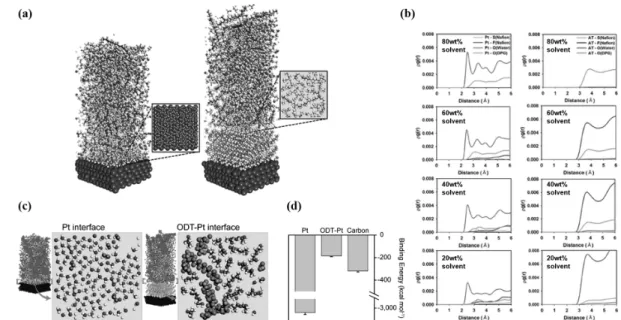
이오노머/Pt 계면에서의 산소 투과 저항을 낮추 기 위해, Lee et al.[32]과 Doo et al.[33]은 촉매층 제조 단계에서 이오노머가 분산될 수 있도록 Pt 표 면을 개질한 모델을 제시하여 실험과 함께 분자동 역학 연구를 진행하였다. Figure 6과 같이 Lee et al.[32]은 dipropylene-glycol (DPG)/water 용액에 분산시킨 이오노머 용액을 Pt 표면과 alkylthiol (AT)로 마스킹한 Pt 표면 위에 도포하여 구조 분 석을 진행하였다. 마스킹하지 않은 Pt 표면에서는 친수성의 water와 sulfonate group이 주로 존재하 는 반면, AT로 마스킹한 Pt 표면에서는 상대적으 로 소수성의 DPG과 이오노머의 backbone이 주로 존재하였다. AT 마스킹은 이오노머 도포 후 제거 가 가능하여 마스킹을 이용하여 이오노머의 Pt/C 계면에서의 분포 특성을 조절할 수 있음을 증명하 였다.
Kwon et al.[34]은 bulk model에서 서로 다른 구조 및 전달 특성을 나타내는 Nafion과 Aquivion
이오노머가 Pt 촉매 위에서 산소 투과도에 어떤 영 향을 미치는지를 분자동역학 연구를 통해 분석하 였다. Pt 촉매 위 Nafion과 Aquivion 이오노머 필 름 내부로 고압의 산소를 투과시켜 밀도를 분석해 본 결과, 산소는 주로 water 영역의 밀도가 낮은 곳에 위치하였으며, Nafion 이오노머 필름에서 산 소의 용해도가 더 높은 것으로 나타났다. 이에 따 라 산소의 투과도는 Aquivion보다 Nafion 이오노 머 필름 내부에서 더 높게 나타나는 것으로 보고 하였다. 산소의 용해 위치에 대한 정량적인 구조 분석을 진행해 본 결과, 산소 분자들은 주로 이오 노머의 부사슬 영역에 위치한다는 것을 발견하였 으며, Aquivion보다 Nafion 이오노머의 부사슬에 서 산소분자들의 배위수가 더 높아 더 큰 용해도 를 지닌다는 것을 발견하였다(Figure 7).
Kang et al.[35]은 연료전지 작동 온도 조건(353 K)에서 Pt와 carbon 각 계면에서의 이오노머 필름 의 구조와, proton 및 water의 전달 특성에 대한 근 본적인 이해를 위해 분자동역학 연구를 진행하였 다. Pt와 carbon 표면 위에서 수화도(λ)에 따른 이
Figure 5. (a) Helmholtz free energy profiles, ΔA, of O
2molecules across the Nafion/Pt interface scaled with the free energy
at gas phase. (b) O
2solubility in the Nafion thin film. (c) A snapshot of the Nafion/Pt interface at λ = 6 and density profiles
of the Nafion ionomer (shown as solid black line) and O
2molecules (shown as solid gray line). Dashed black line shows
the density of the bulk Nafion. The plane I is located at the minimal point in the O
2concentration profile nearest to the
gas phase, and the plane II was located at the position where the ionomer density becomes 10% of the bulk Nafion
density[18].
Figure 6. (a) Equilibrium structures of Nafion solutions at the Pt surface and the AT-modified surface in 40 wt% water/
DPG dispersion solvent. (b) Radial distribution functions involving the Nafion solution components, the Pt surface, and the AT-modified Pt surface at 80 wt%, 60 wt%, 40 wt%, and 20 wt% dispersion solvent[32]. (c) Cross-sectional images (top view) from the 1st atomic layer of the interface at the Pt surface and ODT adsorbed Pt surface. (d) The binding energies of the Nafion ionomer dispersion for each surface[33].
Figure 7. (a) Snapshots of equilibrated systems comprising the Pt (111) surface, hydrated Nafon and Aquivion ionomers,
and O
2molecules with λ values of 2.92, 6.15, 9.77, and 13.83. O
2(b) solubility and (c) permeability in hydrated Nafon
and Aquivion on a Pt (111) surface. (d) Molecular model with the atomic defnition for O
2location analysis using radial
distribution functions (RDFs). The first coordination number of (e) C (center) - O (O
2) and (f) O (side chain) - O (O
2)
in hydrated Nafion and Aquivion ionomers on Pt (111) surface[34].
고분자 전해질막 연료전지 전극층에서의 분자동역학 연구
오노머 필름 모델을 구축하여 구조 분석을 진행한 결과, carbon 표면 위에서는 소수성의 이오노머 backbone이 주로 존재하며, Pt 표면 위에서는 친수 성의 water와 이오노머의 sulfonate group이 주로 존재함을 보고하였다. 또한 sulfonate group과 wa- ter가 Pt계면 위에 밀도 있게 존재하여 전반적인 이오노머 필름의 두께가 carbon 표면보다 더 얇게 나타났으며, water occupied volume을 분석해본 결과 carbon 표면 위에서 더 큰 water cluster가 발 달되어 있다는 것을 발견하였다. 구조적 특징을 기 반으로 실제 water와 proton의 전달 특성을 확인 해본 결과, water와 proton의 vehicular diffusion의 경우 더 발달된 water cluster에 의해 carbon 표면 위에서 더 높았으나, proton의 hopping diffusion의 경우 Pt 계면에서 밀도 있게 존재하는 water층 내 수소결합 network를 통해 더 높게 나타난 것을 발 견하였다(Figure 8).
촉매층에 대한 연구뿐만 아니라, 연료전지 성능 을 향상시키기 위해 PFSA 복합막 개발에 있어서
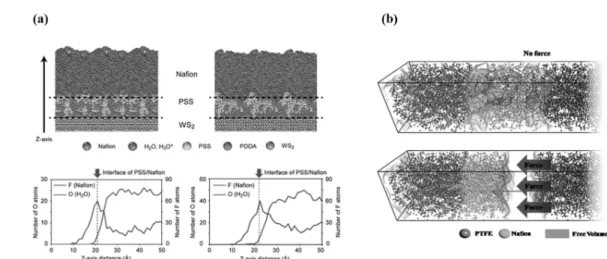
도 slab model을 통한 분자동역학 연구가 진행되 어왔다. Hyun et al.[36]은 polydiallylammonium (PDDA), polystyrene sulfonate (PSS)가 코팅된 텅 스텐 나노 튜브를 고분자 전해질 막에 분산시킨 후 정렬시킨 막을 개발하였고, Figure 9(a)와 같이 텅 스텐/PDDA/PSS/이오노머 slab 모델을 통해 분자 동역학을 이용하여 텅스텐 나노튜브 표면으로 높 은 밀도의 water channel이 발달되어 효율적인 수 소이온전달 통로를 제공한다는 것을 규명하였다.
Lee et al.[37]은 PTFE 강화 PFSA 복합막을 제조 하는데 있어 spin-drying 기법이 연료전지 성능과 안전성을 크게 향상시키는 것을 보고하였다. Figure 9(b)와 같이 PTFE/PFSA 복합막의 slab 모델을 구 축하여 분자동역학을 통해 spin-drying 시 가해지 는 원심력을 구현해 본 결과, PTFE/PFSA 복합막 내부의 free volume이 현저하게 줄어들었으며, 이 를 통해 PFSA 이오노머가 다공성 PTFE 영역으로 침투되는 정도가 커져 상분리가 용이해지면서 복 합막의 기계적 강도 증가 및 양이온 전도도가 증
Figure 8. (a) Cross sections at the interfacial region of equilibrated Nafion films at various hydration levels (λ) on Pt
surface and carbon surface. (b) Variation of water-occupied volume in Nafion film at Pt and carbon surfaces as a function
of hydration level (λ). (c) Variation of self-diffusion coefficients of the water molecule (D
w), vehicular diffusion coefficients
of proton (D
pvehicular) and hopping diffusion coefficients of proton (D
pvehicular) as a function of hydration level (λ) in the
interfacial region and in the upper Nafion phase[35].
가하는 것을 확인하였다.
이와 같은 slab model에서의 연구는 연료전지 내 계면에서 일어나는 현상에 대한 이해를 가능케 하여 연료전지 성능을 최적화하는데 있어서 중요 한 원천이 될 것으로 판단된다.
2.3. Triple phase boundary (TPB) models Pt/C 촉매층을 분자동역학으로 연구하는데 있어 서 가장 좋은 방법은 Pt nanoparticle이 carbon 입 자에 분산된 Pt/C aggregate를 직접 모델링하는 것 이나, 실제 사이즈에 맞게 모델링하는 것은 com- putational cost 측면에서 분자동역학에서는 거의 불가능에 가깝다. 하지만 최근 들어 Pt/C 촉매 시스 템을 구현하고자 하는 시도들이 진행되고 있으며, Pt/C 촉매와 이오노머 필름의 3상 계면에서의 특 성을 확인할 수 있는 triple phase boundary (TPB) model을 이용한 연구들이 보고되고 있다. 연료전 지 촉매층의 TPB model 연구 초기에는 대표적으로 Brunello et al.[38]이 Pt nanoparticle 과 연료전지 촉매층의 주요 구성성분인 water, hydronium ion, 이오노머 그리고 Pt/C 간의 힘장(force field) 파라 미터를 양자역학을 통해 개발하였고, 이를 기반으 로 Figure 10(a)와 같이 Pt/C 그리고 이오노머 필름
의 TPB model을 구축하였다. 구축된 TPB model 에서 Pt nanoparticle 표면의 ~60%에 해당하는 영 역에서 산소와의 전기화학적 반응이 가능하다는 것을 발견하였으며, 산소의 diffusion을 계산해 본 결과 bulk model에서보다 더 높은 diffusion을 지 닌다는 것을 발견하였다[Figure 10(b)].
Kwon et al.[39]은 고온형 연료전지에서 Pt/C 촉매와 PTFE 바인더로 구성된 TPB model을 구축 하여 binder 함량에 따른 분자동역학적 연구를 진 행하였다. PTFE 바인더의 양을 4.0에서 35.1 wt%
까지 늘려 Pt/C 촉매 위에서의 분포를 확인해 본 결과, PTFE가 저 함량일 때는 주로 Pt와 carbon 간의 영역에 우선적으로 분포하는 것을 확인하였 으며, 함량이 증가할수록 carbon 표면만 아니라 Pt particle 표면으로도 분포되는 것으로 나타났다. 특 히 PTFE 함량이 20 w%일 때 carbon 표면 위에서 PTFE의 분포가 최대치를 나타냈으며 그 이상으로 바인더 함량을 증가시켰을 때는 carbon 표면 위의 바인더의 coverage가 수렴하는 것으로 나타났다 [Figure 10(c), (d)].
이에 대한 후속 연구로 Kwon et al.[40]은 PTFE 바인더가 분포되어 있는 Pt/C 표면에 인산을 도포 시킴으로써 PTFE 바인더의 함량에 따른 상온
Figure 9. (a) Slice images of equilibrated molecular structures of pms-WS
2/Nafion model by MD simulation with 10 wt%
hydration (λ = 6.14) and 20 wt% hydration (λ = 13.84) level. Number distribution profiles of O atoms (H
2O) and F atoms
(Nafion) from WS
2surface to z-axis direction[36]. (b) The equilibrium structures of Nafion/PTFE membrane with no
centrifugal force and centrifugal force[37].
고분자 전해질막 연료전지 전극층에서의 분자동역학 연구
Figure 10. (a) Triple phase model consisting of Pt nanoparticle, Nafion, and graphite with oxygen, water, and hydronium ions and (b) mean square displacement of O
2molecules as a function of time in the triple phase model at 353 K[38]. (c) Equilibrated Pt/C-surface structures with PTFE contents. (d) Coverages of the upper and lower parts of the Pt surface with the PTFE binder on the carbon surface as a function of PTFE binder content[39].
Figure 11. (a) Analysis of the contact surface involving H
3PO
4, Pt particle, PTFE binder, and carbon surface at 298.15
and 433.15 K. Pt atoms in contact with H3PO4 and carbon surfaces in contact with H
3PO
4at PTFE binder contents of
7.7, 11.1, 14.2, 20.0, 25.0, 29.4, and 35.1 wt%. Pt atoms in contact with PTFE binders and carbon surfaces in contact
with PTFE binders at PTFE binder contents of 7.7, 11.1, 14.2, 20.0, 25.0, 29.4, and 35.1 wt%. (b) Surface coverage of
H
3PO
4-carbon surface, PTFE-carbon surface, H
3PO
4-Pt, and PTFE-Pt[40].
(298.15 K) 및 운영 온도(433.15 K)에서의 전극 층 에 대한 안정성을 연구하였다. 운영온도에서는 인 산과 Pt간의 강한 결합 에너지뿐만 아니라 PTFE 와의 miscibility로 인해 인산이 Pt와 carbon 표면 사이로 침투되고 있는 것을 확인할 수 있었으며, 침투된 인산은 Pt 표면과의 과도한 접촉을 유발하 여 인산에 대한 피독 및 carbon 표면에 대한 부식 을 발생시킬 수 있음을 확인하였다. 이를 방지하기 위해 PTFE 바인더의 함량은 20 w% 이상으로 사 용되어야 하는 것으로 제시하였으며, 더욱이 car- bon 표면에 대한 안정성은 상온 및 운영 온도에 상관없이 PTFE 바인더의 함량에 의해서만 결정되 는 것을 규명하였다(Figure 11).
3. 결 론
지구상에 존재하는 화석 에너지원은 한정적이 며 그 소모 속도가 해를 거듭할 수로 증가하고 있 다. 이로 인해 지구는 에너지 고갈 및 기후변화 문 제를 동시에 겪고 있다. 수소에너지는 인류가 당 면한 에너지와 기후변화 문제를 해소하거나 완화 시켜줄 에너지 자원으로 각광받고 있다. 수소는 지구상에서 가장 많이 존재하는 물에서 얻을 수 있고, 연료로 사용한 후에도 물로 돌아가므로 친 환경 에너지원이다. 연료전지는 수소를 이용하여 전기에너지를 생산하는 기술로 연료전지의 핵심 소재의 설계를 위하여 재료전산모사를 활용할 경 우 시간과 장비의 제약을 받지 않고 물질의 구조 와 물리적 특성을 알아냄으로써 반도체 소재, 에 너지 소재, 유기 소재 등을 포함한 다양한 소재의 설계와 발전에 기여할 수 있다. 따라서 본 고에서 소개된 분자동역학 등의 재료전산모사 기법은 연 료전지의 주요 요소 중 하나인 전해질 막과 전극 층에서의 소재 특성을 이해하는데 있어서 강력한 툴(tool)이 될 수 있다. 재료전산모사는 재료의 특 성 및 현상의 원인을 찾을 수 있는 방법과 지식을 제공하며, 더 나아가 새로운 물성을 가진 신소재 의 개발 및 예측도 가능하게 하는 기능을 할 수 있 어 향후 소재 개발 분야에서 높은 기여와 활용이
기대된다.
감 사
이 논문은 정부(과학기술정보통신부)의 재원으 로 한국연구재단(기후변화대응 기초원천기술개발 과제)의 지원을 받아 작성되었음(NRF-2020M1A- 2A2080807).
References
1. A. B. Stambouli, Fuel cells: The expectations for an environmental-friendly and sustainable source of energy, Renew. Sustain. Energy Rev., 15, 4507-4520 (2011).
2. B. C. H. Steele and A. Heinzel, Materials for fuel-cell technologies, Nature, 414, 345-352 (2001).
3. J. H. Wee, Applications of proton exchange membrane fuel cell systems, Renew. Sustain.
Energy Rev., 11, 1720-1738 (2007).
4. S. J. Peighambardoust, S. Rowshanzamir, and M. Amjadi, Review of the proton exchange membranes for fuel cell applications, Int. J.
Hydrog. Energy, 35, 9349-9384 (2010).
5. Y. Wang, K. S. Chen, J. Mishler, S. C. Cho, and X. C. Adroher, A review of polymer electrolyte membrane fuel cells: Technology, applications, and needs on fundamental re- search, Appl. Energy, 88, 981-1007 (2011).
6. M. K. Debe, Electrocatalyst approaches and challenges for automotive fuel cells, Nature, 486, 43-51 (2012).
7. A. Kraytsberg and Y. Ein-Eli, Review of ad- vanced materials for proton exchange mem- brane fuel cells, Energy Fuels, 28, 7303-7330 (2014).
8. J. Sinha, S. Lasher, Y. Yang, and P. Kopf, in Direct hydrogen PEMFC manufacturing cost
고분자 전해질막 연료전지 전극층에서의 분자동역학 연구
estimation for automotive applications: Fuel cell tech team review, Office of Energy Effi- ciency & Renewable Energy, Washington, DC (2008).
9. P. Mock and S. A. Schmid, Fuel cells for automotive powertrains-A techno-economic assessment, J. Power Sources, 190, 133-140 (2009).
10. B. D. James and J. A. Kalinoski, in Mass production cost estimation for direct H2 PEM fuel cell systems for automotive applications:
2008 Update, Office of Energy Efficiency &
Renewable Energy, Washington, DC (2009).
11. J. Zhang, PEM Fuel Cell Electrocatalysts and Catalyst Layers: Fundamentals and Applica- tions, Springer Science & Business Media (2008).
12. K. A. Mauritz and R. B. Moore, State of understanding of Nafion, Chem. Rev., 104, 4535-4585 (2004).
13. A. Kusoglu and A. Z. Weber, New insights into perfluorinated sulfonic-acid ionomers, Chem. Rev., 117, 987-1104 (2017).
14. S. K. Dishari and M. A. Hickner, Confine- ment and proton transfer in NAFION thin films, Macromolecules, 46, 413-421 (2013).
15. A. Kusoglu, T. J. Dursch, and A. Z. Weber, Nanostructure/swelling relationships of bulk and thin-film PFSA ionomers, Adv. Funct.
Mater., 26, 4961-4975 (2016).
16. A. Kusoglu, D. Kushner, D. K. Paul, K. Karan, M. A. Hickner, and A. Z. Weber, Impact of substrate and processing on confinement of Nafion thin films, Adv. Funct. Mater., 24, 4763-4774 (2014).
17. M. A. Modestino, D. K. Paul, S. Dishari, S.
A. Petrina, F. I. Allen, M. A. Hickner, K.
Karan, R. A. Segalman, and A. Z. Weber, Self-assembly and transport limitations in
confined Nafion films, Macromolecules, 46, 867-873 (2013).
18. R. Jinnouchi, K. Kudo, N. Kitano, and Y.
Morimoto, Molecular dynamics simulations on O-2 permeation through nafion ionomer on platinum surface, Electrochim. Acta, 188, 767-776 (2016).
19. D. I. Kushner, A. Kusoglu, N. J. Podraza, and M. A. Hickner, Substrate-dependent molecular and nanostructural orientation of Nafion thin films, Adv. Funct. Mater., 29, 1902699 (2019).
20. V. O. Kollath, Y. Liang, F. D. Mayer, X. Y.
Ma, C. Korzeniewski, and K. Karan, Model-ba- sed analyses of confined polymer electrolyte Nanothin films experimentally probed by polarized ATR-FTIR spectroscopy, J. Phys.
Chem. C, 122, 9578-9585 (2018).
21. T. J. Zimudzi and M. A. Hickner, Signal en- hanced FTIR analysis of alignment in NAFION thin films at SiO2 and Au interfaces, ACS Macro Lett., 5, 83-87 (2016).
22. Y. Nagao, Proton-conductivity enhancement in polymer thin films, Langmuir, 33, 12547-12558 (2017).
23. J. A. Dura, V. S. Murthi, M. Hartman, S. K.
Satija, and C. F. Majkrzak, Multilamellar in- terface structures in Nafion, Macromolecules, 42, 4769-4774 (2009).
24. D. L. Wood III, J. Chlistunoff, J. Majewski, and R. L. Borup, Nafion structural phenomena at platinum and carbon interfaces, J. Am.
Chem. Soc., 131, 18096-18104 (2009).
25. H. Kang and S. G. Lee, Recent research trend in electrodes of lithium ion battery based on computational materials science approaches, Prospectives of Industrial Chemistry, 23, 42-54 (2020).
26. S. S. Jang, V. Molinero, T. Çaǧın, and W. A.
Goddard, Nanophase-segregation and transport
in Nafion 117 from molecular dynamics simulations: effect of monomeric sequence, J.
Phys. Chem. B, 108, 3149-3157 (2004).
27. G. Brunello, S. G. Lee, S. S. Jang, and Y. Qi, A molecular dynamics simulation study of hydrated sulfonated poly(ether ether ketone) for application to polymer electrolyte mem- brane fuel cells: Effect of water content, J.
Renew. Sustain. Energy, 1, 033101 (2009).
28. G. F. Brunello, W. R. Mateker, S. G. Lee, J.
I. Choi, and S. S. Jang, Effect of temperature on structure and water transport of hydrated sulfonated poly(ether ether ketone): A mole- cular dynamics simulation approach, J. Renew.
Sustain. Energy, 3, 043111 (2011).
29. J. H. Lee, G. Doo, S. H. Kwon, S. Choi, H.
T. Kim, and S. G. Lee, Dispersion-solvent control of ionomer aggregation in a polymer electrolyte membrane fuel cell, Sci. Rep., 8, 10739 (2018).
30. G. Doo, J. H. Lee, S. Yuk, S. Choi, D. H.
Lee, D. W. Lee, H. G. Kim, S. H. Kwon, S.
G. Lee, and H. T. Kim, Tuning the ionomer distribution in the fuel cell catalyst layer with scaling the ionomer aggregate size in disper- sion, ACS Appl. Mater. Inter., 10, 17835-17841 (2018).
31. S. H. Kwon, H. Kang, J. H. Lee, S. Shim, J.
Lee, D. S. Lee, C. M. Kim, and S. G. Lee, Investigating the influence of the side-chain pendants of perfluorosulfonic acid membranes in a PEMFC by molecular dynamics simula- tions, Mater. Today Commun., 21, 100625 (2019).
32. J. H. Lee, G. Doo, S. H. Kwon, H. Kang, S.
Choi, S. D. Yim, H. T. Kim, and S. G. Lee, Controlling ionomer film morphology through altering Pt catalyst surface properties for polymer electrolyte membrane fuel cells, ACS
Appl. Polym. Mater., 2, 1807-1818 (2020).
33. G. Doo, S. Yuk, J. H. Lee, S. Choi, D. H.
Lee, D. W. Lee, J. Hyun, S. H. Kwon, S. G.
Lee, and H. T. Kim, Nano-scale control of the ionomer distribution by molecular masking of the Pt surface in PEMFCs, J. Mater. Chem.
A, 8, 13004-13013 (2020).
34. S. H. Kwon, H. Kang, Y. J. Sohn, J. Lee, S.
Shim, and S. G. Lee, Molecular dynamics simulation study on the effect of perfluorosul- fonic acid side chains on oxygen permeation in hydrated ionomers of PEMFCs, Sci. Rep., DOI: 10.1038/s41598-41021-87570-41598 (2021).
35. H. Kang, S. H. Kwon, R. Lawler, J. H. Lee, G. Doo, H. T. Kim, S. D. Yim, S. S. Jang, and S. G. Lee, Nanostructures of Nafion film at platinum/carbon surface in catalyst layer of PEMFC: Molecular dynamics simulation app- roach, J. Phys. Chem. C, 124, 21386-21395 (2020).
36. J. Hyun, G. Doo, S. Yuk, D. H. Lee, D. W.
Lee, S. Choi, J. Kwen, H. Kang, R. Tenne, S.
G. Lee, and H. T. Kim, Magnetic field-induced through-plane alignment of the proton highway in a proton exchange membrane, ACS Appl.
Energy Mater., 3, 4619-4628 (2020).
37. K. A. Lee, K. R. Yoon, S. H. Kwon, K. J.
Lee, S. Jo, J. S. Lee, K. Y. Lee, S. W. Lee, S. G. Lee, and J. Y. Kim, Post-assembly mo- dification of polymeric composite membranes using spin drying for fuel cell applications, J.
Mater. Chem. A, 7, 7380-7388 (2019).
38. G. F. Brunello, J. H. Lee, S. G. Lee, J. Il Choi, D. Harvey, and S. S. Jang, Interactions of Pt nanoparticles with molecular components in polymer electrolyte membrane fuel cells:
Multi-scale modeling approach, RSC Adv., 6, 69670-69676 (2016).
39. S. H. Kwon, S. Y. Lee, H. J. Kim, H. T. Kim,
고분자 전해질막 연료전지 전극층에서의 분자동역학 연구
and S .G. Lee, Molecular dynamics simulation to reveal effects of binder content on Pt/C ca- talyst coverage in a high-temperature polymer electrolyte membrane fuel cell, ACS Appl.
Nano Mater., 1, 3251-3258 (2018).
40. S. H. Kwon, S. Y. Lee, H. J. Kim, S. S. Jang,
and S. G. Lee, Distribution characteristics of phosphoric acid and PTFE binder on Pt/C sur- faces in high-temperature polymer electrolyte membrane fuel cells: Molecular dynamics simulation approach, Int. J. Hydrog. Energy, DOI: 10.1016/j.ijhydene.2021.1001.1218 (2021).
강 혜 수
2015~2019 부산대학교 유기소재시스템공학과 학사
2019~2021 부산대학교 응용화학공학부 석사 2021~2021 부산대학교 응용화학공학부 전임
연구원
2021~현재 University of Illinois Urbana-Cham- paign 화학공학 박사과정
이 승 걸
1997~2004 부산대학교 섬유신소재공학과 학사 2005~2007 North Carolina State University 섬
유화학 석사
2007~2011 Georgia Institute of Technology 재료공학부 박사
2011~2012 California Institute of Technology 화학⋅화공학부 박사후연구원 2012~2013 국방과학연구소 선임연구원 2013~현재 부산대학교 응용화학공학부 교수
권 성 현
2010~2016 부산대학교 유기소재시스템공학과 학사
2016~2021 부산대학교 응용화학공학부 박사 2021~현재 부산대학교 응용화학공학부 박사
후연구원

![[기획특집: In Silico 공업화학 모델링 기술] 전산모델링 기반 기능성 유리 소재 연구동향](data:image/gif;base64,R0lGODlhAQABAIAAAP///wAAACH5BAEAAAAALAAAAAABAAEAAAICRAEAOw==)