• 검색 결과가 없습니다.

Web-Based KNHANES System in Cloud Computing

N/A
N/A
Protected

Academic year: 2021

Share "Web-Based KNHANES System in Cloud Computing"

Copied!
11
0
0

로드 중.... (전체 텍스트 보기)

전체 글

(1)

Web-Based KNHANES System in Cloud Computing

Mi-Yeon Park

, Pil-Sook Park

††

, Guk-Boh Kim

†††

, Jin-Yong Park

††††

, Gu-Beom Jeong

†††††

ABSTRACT

Cloud computing is an internet-based technology, providing services to the virtualized IT environment, and allowing users to add or remove resources of hardware or software at their discretion. Since Cloud computing can construct virtually integrated environments out of multiple local computing environments, various information services can be provided by it. In addition, state organizations also strive to build the cloud computing environments due to the benefits of reduced costs to introduce the system and of reduced time to build and provide the IT services. This study suggests a web-based cloud computing system for the computing environments, to be applied for the Korean National Health and Nutrition Examination Survey (KNHANES) by the Ministry of Health and Welfare, Republic of Korea.

Key words: cloud computing, virtualization, information service, KNHANES, web-based system

※ Corresponding Author : Gu-Beom Jeong, Address : (764-711) Kyungpook National University Sangju Campus, 386 Gajangdong, Sangju, Gyeongsangbudo, Korea TEL:

+82-54-530-1294, FAX : +82-54-530-1290, E-mail : jgb

@knu.ac.kr

Receipt date : Jan. 21, 2014, Revision date : Feb. 6, 2014 Approval date : Feb. 13, 2014

†††††

Department of Food and Nutrition, Gyeongsang National University, Korea

(E-mail: [email protected])

†††††

Department of Food Science and Nutrition, Kyung- pook National University, Korea

(E-mail: [email protected])

†††††

Department of Computer Engineering, Daejin Uni- versity, Korea

(E-mail: [email protected])

†††††

Department of Microbiology, College of Medicine, Gyeongsang National University, Korea

(E-mail: [email protected])

†††††
Division of Computer Information, Kyungpook National University, Korea

※ This work has been supported by 2011 research funds from Kyungpook National University

1. INTRODUCTION

Cloud computing is a computing service that provides the IT resources of virtualized hardware, software, and networks, utilizing the internet technology. It is defined as “a model for enabling convenient, on-demand network access to a shared pool of computing resources like networks, servers,

storage, applications, and services” [1]. It supports scalability in real-time according to the amount of service load, and users only need to pay per use [2]. The application necessary for the Cloud com- puting environment can be developed by the users themselves for operation, but they can also get services from the infrastructures of Cloud computing. Cloud computing, virtualized by the IT technology, has similar characteristics as a large scale web site with various hardware, software, and networking technologies. It can provide vari- ous services according to the users' needs, regard- less of their geographical locations.

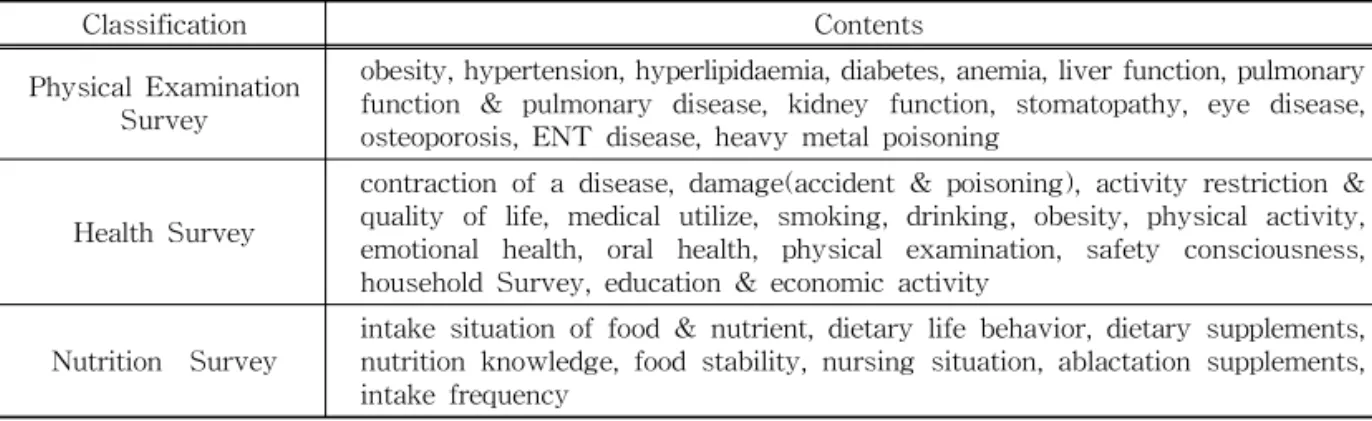
A web-based system model of Cloud computing environment is suggested by this study, which may support economically and effectively the Korean National Health and Nutrition Examination Survey (KNHANES) that the Korean government is promoting as a national project. KNHANES is to measure Korean national health and nutrition levels supervised by the Korea Centers for Disease Control and Prevention, an affiliated organization of the Ministry of Health & Welfare, of the Republic of Korea. It consists of a Physical Examination Survey, a Health Survey, and a Nutrition Survey, as shown in Table 1 [3].

The Physical Examination Survey and the

(2)

Table 1. Contents of KNHANES

Classification Contents

Physical Examination Survey

obesity, hypertension, hyperlipidaemia, diabetes, anemia, liver function, pulmonary function & pulmonary disease, kidney function, stomatopathy, eye disease, osteoporosis, ENT disease, heavy metal poisoning

Health Survey

contraction of a disease, damage(accident & poisoning), activity restriction &

quality of life, medical utilize, smoking, drinking, obesity, physical activity, emotional health, oral health, physical examination, safety consciousness, household Survey, education & economic activity

Nutrition Survey intake situation of food & nutrient, dietary life behavior, dietary supplements, nutrition knowledge, food stability, nursing situation, ablactation supplements, intake frequency

Fig. 1. SNIA Storage Virtualization Taxonomy.

Health Survey are done by the mobile physical ex- amination centers in the areas. The Nutrition Survey is done by the surveyors visiting the local families directly. Questionnaires on educational and economic status, contraction of diseases, and medical utilization in the Health Survey are done by interviewing, as well as those in the Nutrition Survey. Items in the lifestyle area, such as smoking and drinking, are examined by self-filling out of the questionnaires. The methods of direct meas- urement, observance, and sample analysis are uti- lized for the Physical Examination Survey. The examination and survey data are recorded by using the check list, and later it is put into the computer for statistics.

2. RELATED STUDY

2.1 Cloud Computing

The concept of cloud computing is depicted as a cloud. By that we mean the cloud as a hidden, complex infrastructure. Although users may not know the complexity of the cloud computing infra- structure, they can use various computing services provided by the cloud network [4].

In a cloud computing system, computer hard- ware and software are controlled by a large scale web data center. In operating a local system, the cloud computing provides various computing serv- ices, using virtualization and software technologies.

Storage virtualization is a technology that uses

software with a virtualization function and specific devices. It integrates physically heterogeneous storage devices into one logical virtualization stor- age pool. Depending on users’ needs, any of these virtualized storages may be allocated or released [5].

Since the storage virtualization technology en- hances efficiency, scalability and usability of the storage resources, the overall cost for using it may be reduced. Fig. 1 shows storage virtualization technology in the Storage Networking Industry Association(SNIA), where ‘What is created’ shows the virtualization object, ‘Where it is done,’ the vir- tualization location, and ‘How it is implemented’

shows the virtualization technique [5].

Cloud computing provides various software

services online. With the same function as the

software installed in the local computers, it pro-

vides the infrastructure and application for CPU

and storage, the platform for various utilities and

(3)

middleware, as well as software for the user-sup- portive services. In addition, cloud computing plat- forms provide easy access to a company’s high- performance computing and storage infrastructure through web services. It also reduces the costs of purchasing, operating, and managing the hardware and software [6-9]. Due to these advantages, the governments of countries such as the USA, UK, Japan, and also Korea, give efforts to build the e-Government Service Platform utilizing the cloud computing environment [10-12].

The architecture of cloud computing for these services consists mainly of three different levels:

IaaS (Infrastructure as a Service) for the hardware as well as the servers, PaaS (Platform as a Service) for the software development environ- ment, and SaaS (Software as a Service) for the ap- plications:

■ SaaS: This layer refers to API or application services provided for the users, which are through public network connections such as internet. Users can order and receive their peculiar types of soft- ware application services online from the SaaS providers to meet their actual needs. Ideally this layer provides services that are the same as local services such as E-mail, CRM, Word Processor., etc. The services run on the providers’ infra- structures and are accessed through the internet [13-16].

■ PaaS: This layer provides web application frameworks, web hosting services, various soft- ware development environment, and supports for the operating systems. Some commercially avail- able services are Google App Engine, Microsoft Azure, and Force.com. PaaS providers try to pro- duce a platform similar to software developers by utilizing common languages like C, Java, and PHP [17-18].

■ IaaS: This layer refers to the provision of in- frastructural resources on demand. It serves as servers, storage, and connectivity. When users need the services, they can use them as if it is their

own infrastructure. It does not manage or control the underlying cloud infrastructure, but has control over operating systems, storage, and deployed ap- plications [19-20].

2.2 Korean National Health and Nutrition Examination Survey

The KNHANES is a consolidation of the National Nutrition Examination Survey since 1969 and the National Health and Sense of Health Survey since 1962. The current survey was first conducted in 1998, based on the Law of National Health Development article 16 [21]. It is launched every 3 years in order to obtain statistics regarding Koreans’ health and nutritional status. The results of the survey are used as the basic data necessary for evaluating and setting the standard for Korea’s health development, and creating efficient health- promoting programs. The results also provide sta- tistics that can be used to compare Korea with oth- er OECD-member countries.

This survey is the biggest among health-related surveys in Korea, and its purposes are as shown below [21-22]:

■ The interim evaluation of the General Plan for Korean Health Promotion and modification of the standards.

■ Analyzing the interrelationship between the causes of health hazards such as smoking, drink- ing, nutrition, and major diseases.

■ Grasping the prevalence rate of major chronic diseases and management indicators (recognition rate, treatment rate, control rate, etc.).

■ Establishing a situation of using Health Care services according to the kinds and status of dis- ease and disability.

■ Producing comparable health indicators be- tween nations.

This Korean health and nutrition survey is per- formed following the procedure in Fig. 2 [21].

Surveyors visit the local families and check their

diseases, health, and nutritional condition. The re-

(4)

Fig. 2. The Diagram of KNHANES Data Processing Flow.

Fig. 3. Example of Cloud Computing Infrastruc- ture for Web-based KNHANES System.

sults are documented in paper and later-on, filed into the computer system. The data on diseases are examined and confirmed by the doctors in their specialties. The data on nutritional status are ana- lysed by using a nutrition analysis program. The KNHANES statistics, analyzed by SAS(Statistical Analysis System) or SPSS(Statistical Package for Social Science), are being utilized by many re- search papers, and applied as the nutrition and health indicators of the Korean people [23-28].

3. WEB-BASED KNHANES SYSTEM ON CLOUD COMPUTING

The KNHANES is now being conducted nation- wide. It is an important tool for gaining statistical data about the causes of health risks and the prev- alence of major chronic diseases. This data is used for setting the national health policy and develop- ing health-promoting programs. This national en- terprise began its first stage in 1998 and went through its fourth stage in 2007~2009. The fifth stage started in 2010. During its fourth stage, the survey expanded greatly in scope and breadth.

Although the quality and depth of the survey has increased, it is still lacking much in its IT aspect, as explicated below.

■ The cost of inputting data into the computer has increased under the present system: the paper- work is done first and manually entered into the database.

■ The nutrition analysis program now being used for the KNHANES is not web-based, so it doesn’t show the analyzed result immediately and therefore it is difficult to check the survey and health questionnaire with the database immediately.

■ As this enterprise expands, so is the cost of

maintaining a growing number of computer systems.

■ In order to solve these problems, we propose web-based KNHANES System using Cloud Com- puting as below.

3.1 Constructing Cloud Computing for Web- Based KNHANES System

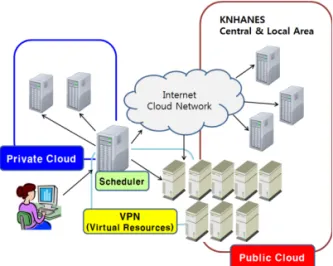
Since cloud computing infrastructure provides excellent scalability, it can provide expanded serv- ices to the users as much as they need. Such scal- ability can be applicable to both cloud developers and users. Cloud application developers can expand their service capability as much as they want. Fig.

3 shows an example of cloud Computing infra- structure that operates the web-based KNHANES system.

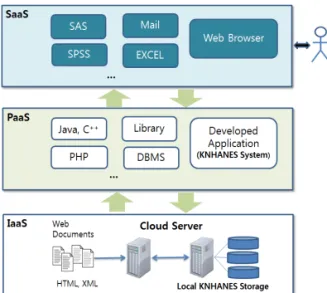
The KNHANES center in the public cloud has the computing domain that processes the data sur- veyed in different areas. The center uses a web- based KNHANES storage connected with VPN in the Cloud Computing Service Center. The storage can be expanded or released depending on users' demands. This Infrastructure is the IaaS layer as shown in Fig. 4.

The web-based KNHANES System users con-

sist of employees of Korea Centers for Disease

Control and Prevention in the Korea Ministry of

(5)

Fig. 4. Cloud Computing service Structure for Web- based KNHANES System.

Fig. 5. Data Processing & Analyzing Flow of Web- based KNHANES System.

Health & Welfare, questionnaire surveyors, health- center employees, university professors, students, doctors, or any working professionals in various fields. Since users may use the data in different ways, cloud computing provides the necessary ap- plications through the network. PaaS and SaaS layers illustrate that in Fig. 4.

The services of cloud computing for web-based KNHANES system can be summarized as below:

■ Through the IaaS layer, a cloud server and storage are provided. Users can manage the stor- age where the web documents are made in HTML and XML, and the KNHANES data are stored.

KNHANES can utilize these services, when neces- sary, and expand the system resources as needed.

■ In the PaaS layer, programmers develop ap- plications that manage the KNHANES data. With such tools, it is possible to provide services related to the SaaS layer.

■ In the SaaS layer, users can use the web- based KNHANES application developed in PaaS using the user interface of applications or web browsers.

3.2 Data Process of KNHANES

Currently the data collection for web-based

KNHANES is done in papers. The data are entered into the computer later on. In this manner, it takes as much time as the survey itself. There is also the high risk of making mistakes when surveyors and data entry clerks are not the same. Hence, it is more efficient to have internet connection at the spot of checking and surveying, and the input of data right after the survey is conducted using web-based KNHANES.

3.3 Application Structure for Web-Based KNHANES System

In the PaaS layer, programmers develop web- based applications to manage KNHANES data.

Once the data is collected, a statistic report on the concerned parts can be generated, using a statistic package in the SaaS layer. Applications are mainly composed of a health questionnaire and nutrition survey components. The Data flow management of each component is shown in Fig. 5. Users can be served with Statistic data and can also check a Health questionnaire, raw data of the Nutrition survey, and all kinds of result data, using web- based KNHANES application.

4. IMPLEMENTATION

As seen in Fig. 5, the Web-based KNHANES

system consists of a Health Interview Component,

(6)

Fig. 6. Database of Web-based KNHANES System.

a Health Behavior & Examination Survey Compo- nent, and a Nutrition Survey Component.

■ Survey procedure

The Health Interview Survey has three different types of health questionnaires for different age groups, one for adults over 19, another for adoles- cents between the ages of 12 and 19, and the last for infants and young children under 12. The trained interviewers check the subjects of the sur- vey: whether they currently suffer a disease; their health behaviors; whether they have had an obe- sity; their history of medical check-up previously;

the level of physical activities; quality of life; his- tory of using clinics and pharmacies; their educa- tional and economic level; mental health condition;

their drinking and smoking habits, and more.

The Health Behavior & Examination Survey has two parts: the Health Behavior Survey and the Health Examination Survey. The former measures subjects physically and their arterial blood pres- sure, and collects their blood. The latter includes an oral cavity test, an eye test, an ENT test, a chest X-Ray, a bone density test and an osteoarthritis test. Based on the results of the two surveys, doc- tors diagnose the subjects’ health condition.

The Nutrition Survey consists of four sub-sur- veys: Dietary Survey, Infant Dietary Survey, Food Intake Survey, and Food Intake Frequency Survey.

The Dietary Survey examines eating habits of subjects concerned, their use of dietary supple- ments (vitamins etc.), nutrition knowledge, and others. The Infant Dietary Survey of babies aged between 12 and 48 months, asks their height and weight at birth, and questions about breast feeding practices and period, and baby food. The Food Intake Survey, using the 24 hour recall method, ex- amines subjects’ daily food intake and makes an analysis of it by nutrients. The Food Intake Frequency Survey examines how frequently re- spondents aged over 12 eat grain, meat, fish, and other foods in a year.

■ IaaS layer

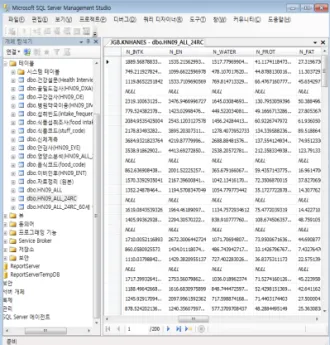
The result data of the three major surveys are all stored in a database for each component through the input programs of the Web-based KNHANES System. The database of the Web-based KNHANES System is made using MS-SQL. This database is managed in the storages of the IaaS.

The Health Interview Component consists of a health interview survey database including a data- base for the history of using pharmacies and clinics. The Health Behavior and Examination Component consists of an oral cavity test database, an eye test database, an ENT test database, a chest x-ray database, a bone density test database , and an osteoarthritis test database, as well as the health behaviour survey database.

In order to analyze the food consumed by sub- jects, by each nutrient, the database for the Nutrition Survey consists of two databases, a stuff code and a food code. In addition, there are the food intake survey database and the food intake fre- quency database. The sample of Database of Web- based KNHANES System is shown in Fig. 6.

■ PaaS layer

The application program for the Web-based

(7)

Fig. 8. Sample source of Web-based KNHANES System.

Fig. 7. The Sequence Diagram of Web-based KNHANES System.

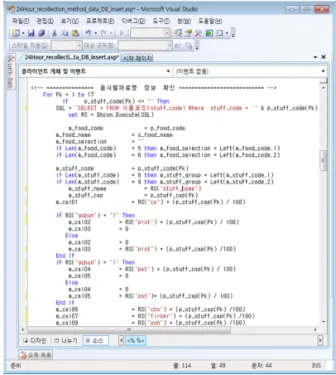
KNHANES system is developed using HTML and ASP and written in Korean. Fig. 7 shows the se- quence diagram of the web- based KNHANES system. The application program for the Health Interview Component first enters the result data of the health questionnaires into the Health Interview Database and checks whether they are coincident with disease data stored in the database for the Health Behavior & Examination Survey.

When the application program for the Health Behavior & Examination Component records sur- vey data in its database, it orders a relevant doctor to make an assessment of the health conditions of each subject.

The dietary life survey application program for the Nutrition Survey Component stores each sub- ject’s daily food intake data, obtained through the 24 hour recall method, in a database by each ingredient. The diet & nutrition analysis applica- tion program looks up food and its code using the stuff code database and food code database and an- alyzes its energy and nutrients such as carbohy- drate, protein and fat. The analyzed data are stored in the food intake database.

The Application program for the Infant Dietary Survey and Food Intake Frequency Survey, proc- esses data in a similar way as the application pro-

gram for the Dietary life

survey does. The sample source of the Web- based KNHANES System is shown in Fig. 8.

■ SaaS layer

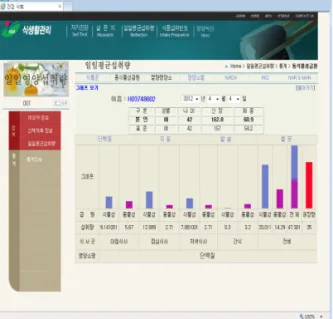
The Web-based KNHANES System users have access to the application of each component through Windows Internet Explorer. Each application pro- gram in the system has a function to look up all databases created for each survey component. The Nutrition Survey application program searches its nutrition database to provide information such as nutritional analysis of subjects’ food intake and nutrition assessment. It is shown in Fig. 9.

Statistics applications such as SAS or SPSS perform statistical processing on data in the data- base and deliver the results to users, as shown in Fig. 10.

5. CONCLUSIONS

In this paper, the model of the web-based

KNHANES System is proposed, which uses an ef-

ficiently virtualized storage of cloud computing.

(8)

Fig. 9. Example of Web-based KNHANES System

Fig. 10. Example List of Statistical Analysis.

Cloud computing is a profitable technology in eco- nomic respect, in which users can allocate and re- lease computing environment on their demand.

Because of virtualization and supporting soft- ware technology, users will be served with various computing services from an internet-based cloud computing through user interface, and they can raise the operational rate of the computers. Users

can also use many kinds of IT devices, such as personal computers or smart phones as their ter- minal units of cloud computing, which establishes flexible user environment. Moreover, users can be served by cloud computing even though they do not have any professional knowledge about infra- structure of cloud computing. Hence, virtualized, integrated environment is established through the network of cloud computing with many local com- puters, and it is considered profitable to establish the web-based KNHANES System to support the nation-wide health and nutrition survey performed all over Korea.

The characteristics of the web-based KNHANES System based on Cloud Computing are as follows:

■ Since the cloud computing environment is es- tablished as a model project promoted by the Korean government, users can easily estimate the economic efficiency and the easiness to build and extend the system.

■ Users can use the resource of the system as much as they need according to the increasing sur- vey data in the IaaS layer of the cloud computing, and easily return the system at the completion of the project. This will enable the operational bureau to optimize the cost to purchase and expand hardware.

■ Since applications of KNHANES through PaaS and SaaS layers are developed and main- tained by the Cloud Computing service company, users can enhance the usage and maintenance of the system, and easily meet their needs to change the specifications.

■ By establishing a web-based integrated da- tabase for data of the Physical Examination Survey, the Health Survey, and the Nutrition Survey, users can easily do real-time data input- ting and effective analysis in the SaaS layer, and easily interlock between databases.

The model of the web-based KNHANES

System, proposed in this paper, is constructed to

provide efficient and economic server and storage

(9)

service of Cloud Computing as an Infrastructure of the web-based KNHANES System. The model is structured for users to be served with a web-based KNHANES application in the SaaS layer, which is developed in the PaaS layer.

REFERENCES

[ 1 ] Amin Anjomshoaa and A Min Tjoa, “How the Cloud Computing Paradigm Could Shape the Future of Enterprise Information Processing,”

Proc. the 13th International Conference on Information Integration and Web-based Applications and Services, pp. 7-10, 2011.

[ 2 ] O.G. Min, H.Y. Kim, and G.H. Nam, “Trends in Technology of Cloud Computing,” Trends Analysis of Electron & Communication, Vol.

24, No. 4, pp. 1-13, 2009.

[ 3 ] CDC, 2009 National Health Statistics, 2009.

[ 4 ] Wikipedia, http://en.wikipedia.org, 2013.

[ 5 ] Rob Peglar, “Storage Virtualization I-What, Why, Where and How?,” SNIA, 2009.

[ 6 ] M. Litoiu, M. Woodside, J. Wong, Joanna Ng, and B. Iszlai, “A Business Driven Cloud Optimization Lecture,” SAC ’10, pp. 22-26, 2010.

[ 7 ] Hancheng Liao, “SaaS Business Model for Software Enterprise,” Proc. the 2nd IEEE International Conference on Information Management and Engineering, pp. 604-607, 2010.

[ 8 ] D. Kondo, B. Javadi, P. Malecot, and F.

Cappello, “Cost-Benefit Analysis of Cloud Computing versus Desktop Grids,” 2009 IEEE International Symposium on Parallel &

Distributed Processing, pp. 1-12, 2009.

[ 9 ] Jaechun Kim and Mokdong Chung, “Cloud-based Integrated Support System for the Bond Management,” Proc. the Korea Multimedia Society Conference, Vol 15, No 1, pp. 54-57, 2012.

[10] Wojciech Cellary and Sergiusz Strykowski,

“E-government based on Cloud Computing

and Service-oriented Architecture,” Proc. the 3rd International Conference on Theory and Practice of Electronic Governance, pp. 5-10, 2009.

[11] Yiying Zhou, Hao Yu, and Haiyan Wang,

“Analysis of E-government Service Platform based on Cloud Computing,” Proc. the 2nd International Conference on Information Science and Engineering, pp. 997-1000, 2010.

[12] S.Y. Sin, “Application of Cloud Computing in Domestic and Foreign to Implement Smart Gov,” Communications of the Korean Insti- tute of Information Scientists and Engineers, Vol. 28, No. 12, pp. 20-26, 2010.

[13] C. Vecchiola, S. Pandey, and R. Buyya,

"High-Performance Cloud Computing: A View of Scientific Applications," 10

th

International Symposium on Pervasive Systems, Algorithms, and Networks, pp. 14-16, 2009.

[14] Xiaoyan Jiang, Yong Zhang, and Shijun Liu,

“A Well-designed SaaS Application Platform Based on Model-driven Approach,” Proc. the Ninth International Conference on Grid and Cloud Computing, pp. 276-281, 2010.

[15] Kai Tang, Jian Ming Zhang, and Zhong Bo Jiang, “Framework for SaaS Management Platform,” Proc. the IEEE International Conference on E-Business Engineering, pp.

345-350, 2010.

[16] Hong He, “Applications Deployment on the SaaS Platform,” 2010 International Symposium on Computational Intelligence and Design, Vol. 2, pp. 232-237, 2010.

[17] G. Lawton, “Developing Software Online With Platform-as-a-Service Technology,” Com- puter, Vol. 41, Issue 6, pp. 13-15, 2008.

[18] H. Yanagisawa, “Web-Based Environment for GUI Application Development,” Proc. the 26th International Conference on Advanced Information Networking and Applications Workshops, pp. 993-998, 2012.

[19] Amel Haji, Asma Ben Letaifa, and Sami

(10)

Tabbane, “Implementation of a Virtualization Solution: SaaS on IaaS,” P roc. the 4

th

Wireless and Mobile Networking Confer- ence, pp. 1-5, 2011.

[20] D. Wiedemann, and J. Strebel, “Organizatio- nal Determinants of Corporate IaaS Usage,”

P roc. the IEEE Conference on Commerce and Enterprise Computing, pp. 191-196, 2011.

[21] Korea Centers for Disease Control and Prevention, http://knhanes.cdc.go.kr, 2013.

[22] J.S. Lee, J.Y. Park, and J.S Kim, “Dietary Factors Related to Hypertension Risk in Korean Adults-data from the Korean National Health and Nutrition Examination Survey 3,”

Nutrition Research and Practice, Vol. 5, No.

1, pp. 60-65, 2011.

[23] K.O. Cho, S.N. Nam, and Y.S. Kim, “Assess- ments of Nutrient Intake and Metabolic Profiles in Korean Adolescents According to Exercise Regularity using Data from the 2008 Korean National Health and National Examination Survey,” Nutrition Research and Practice, Vol. 5, pp. 66-72, 2011.

[24] H.A. Park, J.K. Park, S.A. Park, and J.S. Lee,

“Age, Menopause, and Cardiovascular Risk Factors among Korean Middle-aged Women, the 2005 Korea National Health and Nutrition Examination Survey,” J ournal of Women's

Health, Vol. 19, Issue 5, pp. 869-876, 2010.

[25] K. Lee, H.T. Lim, and S.M. Park, “Factors Associated with Use of Breast Cancer Screening Services by Women Aged ≥40 Years in Korea: The third Korea National Health and Nutrition Examination Survey 2005,“ BMC Cancer, Vol. 16, pp. 10-144. 2010.

[26] Y.J. Lee, Y.H. Shin, J.K. Kim, J.Y. Shim, D.R.

Kang, and H.R. Lee, “Metabolic Syndrome and Its Association with White Blood Cell Count in Children and Adolescents in Korea: The 2005 Korean National Health and Nutrition Examination Survey,” Nutrition, Metabolism, Cardiovascular Diseases, Vol. 20, Issue 3, pp.

165-172, 2010.

[27] M.J. Park, B.A. Boston, M. Oh, and S.H. Jee,

“Prevalence and Trends of Metabolic Syndrome among Korean Adolescents: from the Korean NHANES Survey, 1998-2005,” The J ournal of P ediatrics, Vol. 155, Issue 4, pp.

529-534, 2009.

[28] S. Lim, H.C. Jang, K.S. Park, H.K. Lee, H.R.

Chung, H.J. Joung, and S.I. Cho, “Changes in Metabolic Syndrome of Korean Children and Adolescents in the Period 1998 to 2001,”

J ournal of Endocrinological Investigation,

Vol. 31, Issue 4, pp. 327-333, 2008.

(11)

Mi-Yeon Park

received her MSc and Ph.D. de- gree in Food and Nutrition from Gyeongsang National University in 1984 and 1996. She has been a professor, Department of Food Science and Nutrion, Gyeong- sang National University.

Pil-Sook Park

received her MSc and Ph.D. de- gree in Food Science and Nutri- tion from Gyeongsang National University in 1985 and 1990.

And she received Ph.D. also in Public Health from Kyungpook National University.

She has been a professor, Department of Food Science and Nutrion, Kyungpook National University.

Jin-Yong Park

received his M.D. degrees in College of Medicine from Gyeongsang National Universi- ty in 2002. And he received MSc degree in College of Medicine from Gyeongsang National University in 2005. He has been a doctor, department of Internal Medicine, Incheon Sarang Hospital. And he is enrolled in a doctoral course at College of Medicine, Gyeong- sang National University.

Guk-Boh Kim

is currently a professor in the Department of Computer Engin- eering, DaeJin University at Pochon in Korea. He received the M.S degrees in Computer science from Yensei University in Seoul, Korea and the Ph.D de- gree in Computer Science from Catholic University of Daegu in Korea 1998 re- spectively. He spent three years as an Director of Central Computer Center in Korean Navy and also spend three years as an assistant professor of Computer Science Department at Pukyong National University in Korea before joining the Daejin University. He was visiting Professor at the University of a from 1999 to 2000. He was Head of computer Center in Daejin University. And He is currently vice presi- dent of Daejin University. His research interests are in the following areas: software engineering, system analysis and design, and e-Biz software system.

Gu-Beom Jeong

received his BSc degree in Computer Science from INHA University, Incheon, Korea in 1983, and his MSc degree in Computer Science from PUSAN University, Busan, Korea in 1989. And he received PhD also in Computer Science in 1999 form Catholic University of Daegu, Korea. He has been a professor, School of Computer Information, Kyungpook National University.

His research interests include Clude Computing,

Software Engineering, and Knowledge Information.

수치

Table 1. Contents of KNHANES
Fig. 3. Example of Cloud Computing Infrastruc- Infrastruc-ture for Web-based KNHANES System.
Fig. 4. Cloud Computing service Structure for Web- Web-based KNHANES System.
Fig. 6. Database of Web-based KNHANES System.
+3

참조

관련 문서

Cloud computing: 서버에 있는 SW를 인터넷과 각종 기기를 이용하여 공유하는 사용 환경.. 1.4.2

Where possible, replace Amazon EC2 workloads with AWS managed services that either don’t require you to make any capacity decisions (such as ELB, Amazon CloudFront, Amazon

We compare our method FKS-AC with Fuzzy Keyword Search over Encrypted Data in Cloud Computing (FKS) [1] and Privacy-Preserving Multi-Keyword Fuzzy Search over Encrypted Data

Relationship between Metabolic Syndrome and Mental Health in Korean adults; Using the 7th Korea National.. Health and

Study of diabetes and the nutrition education and awareness of nutrition labels in Korean adults: Using data from the fifth Korea National Health and Nutrition Examination

Factors associated with hypertension control in Korean adults: The fifth Korea National Health and Nutrition Examination Survey (KNHANES V-2).. Association of stress

Impact of age at first childbirth on glucose tolerance status in postmenopausal women: the 2008-2011 Korean National Health and Nutrition Examination

41 Developing Web Intelligence System of Construction Tacit Knowledge Based on Text