• 검색 결과가 없습니다.

Design of a set of One-to-Many Node-Disjoint and Nearly Shortest Paths on Recursive Circulant Networks

N/A
N/A
Protected

Academic year: 2021

Share "Design of a set of One-to-Many Node-Disjoint and Nearly Shortest Paths on Recursive Circulant Networks"

Copied!
8
0
0

로드 중.... (전체 텍스트 보기)

전체 글

(1)

Design of a set of One-to-Many Node-Disjoint and Nearly Shortest Paths on Recursive Circulant Networks

Ilyong Chung

ABSTRACT

The recursive circulant network G(N,d) can be widely used in the design and implementation of parallel processing architectures. It consists of N identical nodes, each node is connected through bidirectional, point-to-point communication channels to different neighbors by jumping d

i

, where 0 ≤ i ≤ ⌈log

d

N⌉−

1. In this paper, we investigate the routing of a message on G(2

m

,4), a special kind of RCN, that is key to the performance of this network. On G(2

m

,4) we would like to transmit k packets from a source node to k destination nodes simultaneously along paths on this network, the i

th

packet will be transmitted along the i

th

path, where 1≤k≤m−1, 0≤i<m−1. In order for all packets to arrive at a destination node quickly and securely, we present an O(m

4

) routing algorithm on G(2

m

,4) for generating a set of one-to-many node-disjoint and nearly shortest paths, where each path is either shortest or nearly short- est and the total length of these paths is nearly minimum since the path is mainly determined by employing the Hungarian method.

Key words: Recursive circulant network, Parallel routing algorithm, Hungarian method

※ Corresponding Author : Ilyong Chung, Address : Dept. of Computer Engineering, Chosun University, Seosoeg-Dong, Dong-Gu, Gwangju, 501-759, Korea, TEL : +82-62-230-7712, FAX : +82-62-230-7754, E-mail

: [email protected]

Receipt date : Mar. 14, 2013, Approval date : Apr. 16, 2013

Department of Computer Engineering, Chosun University

*This study wae supported by research funds from Chosun University, 2013.

1. INTRODUCTION

Research in interconnection networks has used graph-theoretic properties for its investigations and has produced various interconnection schemes.

Many of these schemes have been designed to op- timize important parameters such as degree, diam- eter, fault-tolerance, hardware cost, and to address the needs of particular applications [1,2].

The recursive circulant network (RCN) G(N,d) consists of N identical processors (nodes). Each processor, provided with its own sizable local memory, is connected through bidirectional, point- to-point communication channels to different neighbors by jumping d

i

, where 0 ≤ i ≤⌈log

d

N⌉

−1. Due to these properties, the RCN can be widely used in the design and implementation of parallel processing architectures.

G(2

m

,4), a special kind of RCN, has degree m , has maximum connectivity, and compares favor- ably with the hypercube Q

m

[3,4]. Due to the above mentioned properties, G(2

m

,4) can also be widely used in the design and implementation of parallel processing architectures.

The routing of messages is thus key to perform- ance of this network. We look for algorithms that are capable of handling multiple data items simul- taneously transmitted from a source node to k des- tination nodes (1 ≤ k < m). In order for all packets to arrive at destination nodes quickly and securely, each path must be disjoint from all other paths.

Disjoint paths can be categorized into three

classes-one-to-one, one-to- many, and many-to-

many. The first class considers the disjoint paths

from a source node to a destination node, the sec-

ond from a source node to k destination nodes and

the third from k source nodes to k destination

nodes. One-to-one disjoint paths were constructed

(2)

on several networks such as hypercubes[5], k-ary n-cubes[6] and star graphs[7]. One-to-many dis- joint paths were designed on hypercubes [8,9] and star graphs [10]. For the generation of many-to- many disjoint paths some work has been done [11,12].

In this paper, we would like to transmit k pack- ets from a source node to k destination nodes si- multaneously along paths on this network, the i

th

packet will be transmitted along the i

th

path (0 ≤ i < m−1). In order for all packets to arrive at these destination nodes quickly and securely, we should construct a set of k node-disjoint paths with a minimum total length. To accomplish this, we em- ploy the operations of nodes presented in the Cayley Graph [13] and employ the Hungarian method [14,15].

2. DESIGN OF THE SHORTEST PATH

Let A and B be any two nodes on G(2

m

,d). One of the paper’s objectives is to find an algorithm that will facilitate the transmission of data from node A to node B on this network. In order for the data to traverse from node A to node B , it must cross a number of intermediate nodes along a path in succession.

Definition 1. G(2

m

,d) is defined as follows: Let V = {0,1,2,...,2

m

−1} be a set of nodes and E = {(v, w)|v +d I = w(mod 2

m

) 0 ≤ i ≤⌈log

d

2

m

⌉−1, d ≥ 2} be a set of edges.

Research on the graph-theoretical subjects of networks and systems such as embedding and fault tolerance have been performed[16,17]. In this paper, we focus on a parallel routing algorithm on G(2

m

,4). Node A on G(2

m

,4) has an address (a

m-1

a

m-2

...a

i

...a

1

a

0

), a

i

∈ {0,1}, 0≤i≤m−1.

Therefore, possible addresses for an arbitrary node are from (00...00) to (00...01)...(11...11). This ad- dress can be described as (00...00), ( − 1 − 1... − 1 −

1)...(00...0 − 1) on (mod 2

m

) computation. A packet on any node can move to another node by perform- ing a routing operation g

i

. It is executed on only even bit of G(2

m

,4) since node v is connected to w , w = v+4

i

(mod 2

m

). The routing function is de- scribed in Definition 2.

Definition 2. The routing function of G(2

m

,4) for the i

th

bit is defined as follows: R

g±i

(A) = A ± 2

i

(mod 2

m

) 0≤i≤m−1, where i is an even number.

Node A is connected to its m neighboring nodes by performing m distinct operations. Among these m operations, operations are in a positive direc- tion, while  

 operations are in a negative direction. Employing positive operations - g

0

and g

2

on G (16,4), (0010) is connected to (0010) +2

0

and (0010)+2

2

, respectively. (0010) is connected to (0010) − 2

0

and (0010) − 2

2

employing negative op- erations - g

-0

and g

-2

, respectively. Let us consider routing operations for an odd bit. The routing for the ( i + 1)

th

bit can be described using the routing function for the i

th

bit in Definition 2, that is R

g±i

(R

g±i

(A)) = A ± 2

i

± 2

i

(mod 2

m

). For example, we would like to send a packet from (0000) to (1000).

The routing for the 3

rd

bit should be performed.

R

g2

( R

g2

(0000)), this means that the packet is trans- mitted from (0000) to (0100) by executing g

2

, and then to (1000) by executing the same operation.

The i

th

packet is transmitted from a source node along the i

th

path. An intermediate node in this path is obtained from the routing function described in Definition 2. To do this, the relative address of a starting node and a destination node is computed below.

Definition 3. The relative address r of nodes A and B on G(2

m

,4) is computed as the absolute value of the difference between A and B , r=|A−B|.

Definition 4. Let T (A,S) be the path of data

starting from node A to a destination node, where

(3)

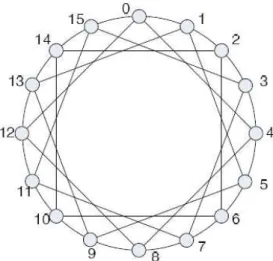
Fig. 1. The recursive circulant graph G(2

4

,4).

S is a sequence of operations, via which data can reach at a destination node. T(A,S) is determined by the order of the elements in S .

Given node A and sequence S, the next example will illustrate how to transmit to a destination node via intermediate nodes.

Example 1. Let node A and sequence S be (001101) and <g

0,

g

−2,

g

−2,

g

4

>. The traversal of the data along the path is (001101) → (001110) → (001010) → (000110) → (010110).

The final node of T(A,<g

i

,g

i

,g

i

,g

i

,>) is the same as that of T(A,<g

i +2

>). Also, the final node of T(A,<g

2

,g

−2

,g

4

>) is the same as that of T(A,<g

4

>). A packet move to A+2

2

by performing g

2

and then move to A +2

2

− 2

2

by performing g

−2

. It means that a packet comes back to the original node A . By applying operations obtained from this se- quence, data can arrive at the destination node. By reordering the operations involved in the shortest path from node A to node B, various other paths may be constructed. Since this paper’s objective is to find algorithms that will facilitate the fast trans- mission of data from a starting node to a destina- tion node, these operations which are appropriate for this objective are defined in Definition 5.

Definition 5. Let h

k

be the shortest distance be- tween (r

m-1

r

m−2

...00...r

1

r

0

) and (r

m−1

r

m−2

...r

2k+1

r

2k

...

r

1

r

0

), where h

k

is the number of operations consist- ing of g

2k

and g

−2k

. h

k

, S

k

, h

k+1

and S

k+1

are de- termined as follows:

(r

m−1

r

m−2

...00...r

1

r

0

) → (r

m−1

r

m−2

...00...r

1

r

0

):

S

k

= <>, h

k

=0;

(r

m−1

r

m−2

...00...r

1

r

0

) → (r

m−1

r

m−2

...01...r

1

r

0

):

S

k

= <g

2k

>, h

k

=1;

If ((2k + 2) < m) then {

(r

m-1

r

m−2

...00...r

1

r

0

) → (r

m−1

r

m−2

...10...r

1

r

0

):

S

k

=<g

2k,

g

2k

>, h

k

=2

or S

k+1

=<g

2k+2

>, S

k

=<g

−2k

,g

−2k

>, h

k+1

=1, h

k

=2;

(r

m−1

r

m−2

...00...r

1

r

0

) → (r

m−1

r

m−2

...11...r

1

r

0

):

S

k+1

=<g

2k+2

>, S

k

=<g

−2k

>, h

k+1

=1, h

k

=1 }

If (m = (2k + 2)) then {

(00r

m−3

r

m−4

...r

1

r

0

) → (10r

m−3

r

m−4

...r

1

r

0

):

S

k

=<g

2k

,g

2k

>, h

k

=2 ;

(00r

m−3

r

m−4

...r

1

r

0

) → (11r

m−3

r

m−4

...r

1

r

0

):

S

k

=<g

−2k

>, h

k

=1 }

If (m = (2k + 2)) then {

(0r

m−2

r

m−3

...r

1

r

0

) → (0r

m−2

r

m−3

...r

1

r

0

):

S

k

=<>; h

k

=0;

(0r

m−2

r

m−3

...r

1

r

0

) → (1r

m−2

r

m−3

...r

1

r

0

):

S

k

=<g

2k

>, h

k

=1; }

If the address of a source node is greater than that of a destination node, a sequence of operations are performed in the reverse direction. Let the source node and the destination node be (11000010) and (00000001). Then the relative address of these nodes and the sequence of operations are (11000001) and <g

0

,g

−6

>. Since the address of the source node is greater, the sequence of operations becomes <g

−0

,g

6

>. The following proposition, which is needed to compute the shortest distance between two nodes, is taken from Kim and Chung[7].

Proposition 1. The shortest distance d (A, B)

between two nodes A and B is

(4)

d(A, B) =

  

h

k

3. Design of a set of One-to-Many Node- Disjoint and Nearly Shortest Paths on Recursive Circulant Networks

In this section, we would like to construct a set of k node-disjoint and nearly shortest paths on G(2

m

,4) in order to transmit k packets securely and quickly, where 1≤k<m. First, these packets resid- ing at a starting node are sent to its k neighboring nodes by employing k different operations. Then these packets are transmitted to k destination no- des along k node-disjoint paths employing the Hungarian method, where the i

th

packet is trans- mitted to the i

th

destination node. The Hungarian method is a combinatorial optimization algorithm which solves the assignment problem in cubic time O(m

3

). In this paper, this method models an as- signment problem as an (k×k) communication cost matrix, each element of which represents the cost of communicating a packet from one node to an- other node. Here, communication cost means the distance between two nodes on G(2

m

,4).

We now transmit seven packets from node 0 to nodes 3, 5, 6, 7, 8, 9 and 64 on G(2

8

, 4). First, these packets are sent to node 0’s 7 neighboring nodes by employing seven distinct operations - g

−4

,g

−2

,g

−0

,g

0

,g

2

,g

4

,g

6

and then reach at nodes 240,252,255, 1,4,16 and 64. To find a set of seven node-disjoint and nearly shortest paths from these intermediate nodes to seven destination nodes, the assignment problem will be employed. Since the 7

th

packet reaches at the 7

th

destination node by a single hop, a (6×6) communication cost matrix M

0

is con- structed by computing a shortest distance from a neighboring node to a destination node, where M

0

= (m



). Employing the Hungarian method, M

1

is obtained.

M

0

=

 

 

     

     

     

     

     

     

M

1

=

 

 

     

     

     

     

     

     

For example, m



= 3 means that the distance of the path from the 0

th

neighboring node to the 0

th

destination node is 3. The relative address of these nodes is (11101101) and the sequence of op- erations is <g

−0

,g

2

,g

4

>. For m



, the relative ad- dress of these nodes is (11110111) and the sequence of operations is <g

0

,g

2

,g

2

>. So, the path is ”node 252 → node 253 → node 1 → node 5” However, this path crosses with Path 3 at node 1. In order not to meet at node 1, operation g

−6

is performed at node 253. At last step, operation g

6

will be per- formed to reach at node 5. So, the sequence of op- erations is <g

0

,g

−6

,g

2

,g

2

,g

6

> and the path is ”node 252 → node 253 → node 189 → node 193 → node 197 → node 5” Therefore, m



is 5, not 3. Applying the Hungarian method, we select the zeros from column numbers 4,5,0,1,2 and 3, respectively. This means that packets are transmitted from nodes 240,252,255,1,4 and 16 to nodes 8,9,3,5,6 and 7, respectively. To reach at the destination nodes, op- erations described in Definition 5 should be performed. Operations for path 0, path 1, path 2, path 3, path 4, path 5, and path 6 are <g

2

,g

2

,g

4

>,

<g

−6

,g

−2

,g

0

,g

4

,g

6

>, <g

2

>, <g

2

>, <g

−6

,g

0

,g

0

,g

6

>, and < g

−2

,g

−6

,g

−2

,g

−0

,g

6

>, respectively. If the first op- eration is g

i

, then the order of operations per- formed next is from the lowest to the highest.

Suppose that the first operation is g

2

and the se-

quence is <g

6

,g

2

,g

−0

,g

−4

>. Then the orders of op-

erations is <g

2

,g

−4

,g

−0

,g

2

,g

6

>. If arbitrary two

paths cross at the same node, g

−6

is performed just

before reaching at the meeting node on one of these

(5)

paths to avoid this collusion, and then g

6

is per- formed at the last step to reach at a destination node. Given the first operation and a sequence of operations obtained from the communication cost matrix M

1

, the transmission paths from a starting node are constructed below.

Path 0: node 0 → node 240 → node 244 → node 248 → node 8.

Path 1: node 0 → node 252 → node 188 → node 184 → node 185 → node 201 → node 9.

Path 2: node 0 → node 255 → node 3.

Path 3: node 0 → node 1 → node 5.

Path 4: node 0 → node 4 → node 196 → node 197

→ node 198 → node 6.

Path 5: node 0 → node 16 → node 12 → node 204

→ node 200 → node 199 → node 7.

Path 6: node 0 → node 64.

The process to find a set of node-disjoint and nearly shortest paths is described above. We now propose an one-to-many parallel routing algorithm on G(2

m

,4). In this paper, we will use the term

”distance” between two nodes to refer to the num- ber of routing steps (also called the hopcount) needed to send a message from one node to another.

OTM −RCN −Routing A ← a starting node

N

i

← the i

th

neighboring node of node A (0≤i<m

−1)

D

i

← the i

th

destination node (0≤i<m−1)

begin

(1) Send k packets from A to its k neighboring nodes by performing k distinct

operations (1≤k<m).

(2) Check that N

i

is equal to D

j

. If so, then the i

th

path is determined.

(3) If the number of paths to be determined is k , then given k neighboring nodes and k destination nodes, a (k×k) communication cost matrix M can

be constructed. m

ij

is the length of the path re- quired for transmitting the i

th

packet from the i

th

neighboring node to the j

th

destination node under the condition that the path should not meet at N

a

, one of neighboring nodes. If an intermediate node on this path is N

a

, this path should be detoured not to reach at N

a

. To do this, g

−6

is performed just before reaching at N

a

and g

6

is performed at the last step to reach at a destination node. The distance of the path is the number of operations described in Definition 5.

(4) In order to design a set of node-disjoint and nearly shortest paths, the Hungarian method is ap- plied to the communication cost matrix.

(5) From the cost matrix, we obtain the length of a path between a neighboring node to a destina- tion node, which is the number of operations in the sequence, the order of which is from the lowest to the highest. If arbitrary two paths P

i

, P

j

cross at the same node, then operations <g

l

,g

−l

> are per- formed to P

j

to avoid this occurrence. On Path P

j

, g

−l

is performed just before reaching at the meet- ing node and g

l

is performed at the last step to reach at a destination node, where if m is even, then l = m− 2, otherwise l = m− 1 .

(6) We transmit a packet from a starting node to a destination node via the corresponding neigh- boring node by performing the sequence of operations.

end.

Execution of OMT −RCN −Routing is thus fairly straightforward. The time involved in per- forming Steps (1), (2) and (6) is small compared to the remaining steps. The first, second, and the sixth steps of this algorithm do not, therefore, con- tribute to an objectionable overhead.

Theorem 1. OMT −RCN −Routing can be performed in O(m

4

).

Proof. There are three important steps for de-

termining the time complexity requisite for the

(6)

Algorithm. The first is to construct a communica- tion cost matrix, which requires O(m

2

) in Step (3) of the Algorithm. The second is to execute the Hungarian method in Step (4), which can be com- puted in O(m

3

). The final is to construct a set of k node-disjoint paths in Step (5), which requires O(m

4

). Therefore, the time complexity of the Algorithm is O(m

4

).

The paper’s objective is to design a set of k node-disjoint paths from a single source node to k destination nodes (1≤k<m). The major topo- logical characteristics of G(2

m

,4) are considered and the requisite properties of k paths obtained from the Algorithm are proven below.

Theorem 2. The k transmission paths produced by OTM−RCN−Routing are node-disjoint and nearly shortest.

Proof. Let S

i

and S

j

be two sequences of oper- ations for sending two packets ets from starting node A to two destination nodes, where S

i

=<g

1i

, g

2i

,...,g

ti

,g

(t+1)i

,...,g

xi

>, S

j

=<g

1j

,g

2j

,...,g

tj

,g

(t+1)j

,...,g

yj

>, 1i<1j. <g

2i

,...,g

ti

,g

(t+1)i

,...,g

xi

> and <g

2j

,...,g

tj

,g

(t+1)j

,..., g

yj

> are ordered sequences from the lowest to highest. Suppose that two packets arrive at the same node. In order for this case to occur, S

ti

= S

wj

, where S

ti

and S

wj

are the subsequences of oper- ations performed until time t and time w , re- spectively, where S

ti

= <g

1i

,g

2i

,,...,g

(t−1)i

, g

ti

>, S

wj

=

<g

1j

,g

2j

,...,g

(w−1)j

,g

wj

>, t≤x, w≤y. However, these sequences do not appear. To prove it, we consider four cases.

Case 1: Suppose that g

−l

∉ S

ti

and g

−l

∉ S

wj

. Intuitively, S

ti

is not S

wj

since S

ti

−g

1i

and S

wj

−g

1j

are ascending-ordered and the length of S

i

and S

j

obtained from a communication cost matrix is ei- ther shortest or nearly shortest. However, if S

ti

=S

wj

, then g

−l

and g

l

are added to S

i

to avoid this occur- rence, where g

−l

is added between g

(t−1)i

and g

ti

, and g

l

is added after g

xi

in S

i

, where if m is even,

then l = m−2 , otherwise l = m−1 . So, S

ti

is

<g

1i

,g

2i

,...,g

(t−1)i

,g

−l

>. It is contradiction since g

−l

∈ S

ti

.

Case 2: Suppose that g

−l

∈ S

ti

and g

−l

∉ S

wj

. If g

−l

∉ S

t′i

(t′ < t), then this case is the same as Case 1. Otherwise, S

ti

is not S

wj

since g

−l

is an element of S

ti

.

Case 3: Suppose that g

−l

∉ S

ti

and g

−l

∈ S

wj

. If g

−l

∉ S

w′j

(w′ < w), then this case is the same as Case 1. Otherwise, Sti is not S

wj

since g

−l

is an element of S

wj

.

Case 4: Suppose that g

−l

∈ S

ti

and g

−l

∈ S

wj

. If g

−l

∉ S

t′i

or g

−l

∉ S

w′j

(t′ < t, w′ < w), then this case is the same as one of three cases above. Otherwise, S

ti

is not S

wj

since S

t′i

≠S

w′j

, S

ti

− S

(t′+1)i

and S

wj

−S

(w′+1)j

are ascending-or- dered and two packets arrive at the two distinct nodes when performing S

i

−g

xi

and S

j

−g

yj

. It means that the two paths generated by performing S

i

−g

xi

and S

j

−g

yj

are node-disjoint just before ar- riving at the corresponding destination nodes and the final operations g

xi

and g

yj

are performed, where g

l

=g

xi

=g

yj

.

The total length of these paths is minimal at most cases since the number of operations is ob- tained by employing the Hungarian method.

However, depending on selecting which elements in the modified cost matrix(see M

1

in Section 3), two arbitrary paths may cross at the same node.

It causes these paths not to be node-disjoint. So, one of these paths should be detoured to avoid this occurrence, which makes the total length of them longer. Therefore, the Algorithm constructs a set of k node-disjoint and nearly shortest paths.

4. CONCLUSION

In this paper, we present an algorithm that gen-

erates a set of k nearly shortest and node-disjoint

paths on G(2

m

,4) from a source node to k destina-

tion nodes employing the Hungarian method. There

(7)

are three important steps for determining the time complexity requisite for the Algorithm. The first is to construct a communication cost matrix, which requires O(m

2

). The second is to execute the Hungarian method, which can be computed in O(m

3

). The final is to construct a set of k node-dis- joint paths, which requires O(m

4

). Therefore, we can create an O(m

4

) parallel routing algorithm for constructing a set of k node-disjoint and nearly shortest paths. For further researches, we will ex- tend this algorithm to design a set of one-to-many node-disjoint paths on arbitrary recursive circulant networks and on other networks. Also we will look into the construction of a set of many-to-many node-disjoint paths on G(2

m

,4).

REFERENCES

[ 1 ] J. Park, H. Kim, and H. Lim, “Many-to-Many Disjoint Path Covers in the Presence of Faulty Elements,” IEEE Trans. Comput., Vol. 58, No 4, pp. 528-540, 2009.

[ 2 ] Q. Zhu, J. Xu, and M. Xu, “Reliability of the Folded Hypercubes,” Info. Sci., Vol. 177, No.

5, pp. 1782- 1788, 2007.

[ 3 ] J. Park, ”Panconnectivity and Edge-Pancy- clicity of Faulty Recursive Circulant G (2

m

, 4),”

Theoret. Comput. Sci., Vol. 390, No. 1, pp.

70-80, 2008.

[ 4 ] S. Tang, Y. Wang, and C. Yi, “Genneralized recursive circulant graphs,” IEEE Trans.

Parall. Distr. Syst., Vol. 23, No. 1, pp. 87-93, 2012.

[ 5 ] I. Chung, “Application of the Special Latin Squares to the Parallel Routing Algorithm on Hypercube,” J. of Korea Info. Sci. Soc., Vol.

19, No. 5, pp. 569-578, 1992.

[ 6 ] Y. Shih and S. Kao, ”One-to-one Disjoint Path Covers on K-ary N-cubes,” Theoret.

Comput. Sci., Vol. 412, No. 1, pp. 4513-4530, 2011.

[ 7 ] K. Day and A. Tripathi, “A Comparative Study of Topological Properties of Hyper- cubes and Star Graphs,” IEEE Trans. Parall.

Distr. Syst., Vol. 5, No. 1, pp. 31-38, 1994.

[ 8 ] S. Gao, B. Novick, and K. Qiu, “From Hall’

Matching Theorem to Optimal Routing on Hypercubes,” J. Combinatorial Theory, Series B 74, pp. 291-301, 1998.

[ 9 ] C. Lai, “Two Conditions for Reducing the Maximal Length of Node-Disjoint Paths in Hypercubes,” Theoret. Comput. Sci., Vol. 418, No. 1, pp. 82-91, 2012.

[10] C. Chen and J. Chen, “Nearly Optimal One-to- Many Parallel Routing in Star Networks,”

IEEE Trans. Parall. Distr. Syst., Vol. 8, No.

12, pp. 1196-1202, 1997.

[11] Q. Gu and S. Peng, “Cluster Fault-Tolerant Routing in Star Graph,” Networks, Vol. 35, No. 1, pp. 83-90, 2000.

[12] S. Madhavapeddy and I. Sudborough, “A Topogical Property of Hypercubes: Node Disjoint Paths,” IEEE Symp. Parall. Distr.

Process., pp. 532- 539, 1997.

[13] H.S. Stone, Discrete Mathematical Structures and Their Applications , SRA, Chicago, IL., 1973.

[14] Y. Chen, S. Promparmote, and F. Maire,

“MDSM: Microarray Database Schema Matching using the Hungarian Method,” Info.

Sci., Vol. 176, No. 19, pp. 2771-2790, 2006.

[15] H. Kuhn, “The Hungarian Method for the Assignment Problem,” Naval Res. Logist.

Quart., Vol. 2, No. 1-2, pp. 83-97, 1955.

[16] T. Jeon and C. Kim, "A Real-time Embedded Task Scheduler Considering Falut-tolerant,"

J. of Korean Multimedia Society, Vol. 12, No.

7, pp. 940-948, 2011.

[17] J. Park and K. Chwa, ”Recursive Circulants and Their Embedding Among Hypercubes,”

Theoret. Comput. Sci., Vol. 244, No. 1-2, pp.

35-62, 2000.

(8)

Ilyong Chung

received the B.E. degree from Hanyang University, Seoul, Korea, in 1983 and the M.S. and Ph.D. degrees in Computer Science from City University of New York, in 1987 and 1991, respectively. From 1991 to 1994, he was a senior technical staff of Electronic and Telecommunication Research Institute (ETRI), Dajeon, Korea. Since 1994, he has been a Professor in Department of Computer Science, Gwangju, Korea.

His research interests are in computer networking, se-

curity systems and coding theory.

수치

Fig. 1. The recursive circulant graph G(2 4 ,4).

참조

관련 문서

Piattelli M, Scarano A, Paolantonio M, lezzi G, Petrone G, Piattelli A : Bone response to machines and resorbable blast material titanium implants: An experimental stydy

Degree Centrality The counts of how many connections a node has Popularity or influence of a node (e.g., word, person) in the network Betweenness Centrality The extent to which

The reduction of power series ( , m→ ∞) to polynomials (m is finite) is a great advantage.. because then we have solutions for all x,

I rejected a notion of a one-to-one signifier and signified form of representation for, to me, such a convention reveals nothing and can often mislead.

 In order to handle sequence of random numbers for a certain particle simulation, it is required to set a seed number to a prescribed value. Especially, this adjustment is

Consider the motion of a particle of mass m which is constrained to move on the surface of a cone of half-angle α and which is subject to a gravitational force g. Let the

 Rule #1: Express currents in terms of node voltages: Count the number of unknown node voltages and the required number of KCL equations to solve..  Rule #2: If a node

Regarding block-generating nodes, CTO claimed that &#34; The DApp representative will play a representative role as a node, rather than in the form of a block producer