J Intell Inform Syst 2014 June: 20(2): 19~38 http://dx.doi.org/10.13088/jiis.2014.20.2.019
Towards the Virtuous Circle in Virtual Community through Knowledge Seeking and Sharing
Jae Kyung Kim
Department of MIS, Hannam University ([email protected])
․․․․․․․․․․․․․․․․․․․․․․․․․․․․․․․․․․․․․․․․․․․․․․․․․․․․․․․․․․․․․․․․․․․․․․․․․․․․․․․․․․․․․․
This study focused on the role of active knowledge seeking (knowledge browsing and knowledge searching) in the context of virtual community of interest. Knowledge seeking is rarely studied as an antecedent in knowledge management (KM) research. Active knowledge seeking is considered as antecedents of sense of virtual community which mediates to knowledge sharing intention and virtual community promotion. Research hypotheses are tested by applying structure equation modeling with survey data from virtual community members in South Korea. Active knowledge seeking behavior was found to be the strong predictor of sense of virtual community, which, in turn, positively affects knowledge sharing intention and virtual community promotion. Implication to practitioners is to understand and accommodate the members’ knowledge seeking efforts, who are potential contributors and promoters of the virtual community. Knowledge seeking, knowledge sharing and promoting virtual community are more of human activities than technology and this study extends the understanding of such human activities. By providing a mechanism of how knowledge seeking and sharing could work harmoniously, a virtuous circle with win-win situation could be achieved in virtual communities.
Keyword : Knowledge searching, knowledge browsing, sense of virtual community, knowledge sharing, virtual community promotion
․․․․․․․․․․․․․․․․․․․․․․․․․․․․․․․․․․․․․․․․․․․․․․․․․․․․․․․․․․․․․․․․․․․․․․․․․․․․․․․․․․․․․․
Received: March 25, 2014 Revised : May 20, 2014 Accepted : May 22, 2014 Type of Submission: General-track Corresponding Author: Jae Kyung Kim
* This research was supported by Hannam University Research Fund in 2014.
1. Introduction
The number of online users to seek information is ever increasing today. Individuals interact with each other around shared interests in virtual communities (i.e., virtual communities of interests; VCoIs). As the growth of virtual
communities becomes phenomenal, research on VC also proliferates. Previous research on KM mainly focuses on the success factors of virtual communities, and knowledge sharing becomes the center of research interests since the value of the virtual community depends on how much members contribute their knowledge to VC (Wang and Noe,
2010). This phenomenon in VC research is predicted by Grover and Davenport (2001) who argued that knowledge seeking, acquisition and creation that occur earlier in the knowledge management process are ignored and most studies have focused on knowledge sharing behavior.
However, virtual communities (VC) essentially involve member participation in terms of knowledge seeking and sharing and a lack of either one of these activities would result in the knowledge management process incomplete and ineffective, resulting that participants of such VC would eventually avoid the community (Phang et al, 2009). Therefore, this gap in KM theory and practice must be addressed clearly in urgent matter (Lai and Grahm, 2009).
From the socio-technical perspective, the role of the human agent in information systems is of critical importance and the peak performance of information systems is achieved by optimizing both the social and technical systems (Pasmore, 1995; Mumford, 2000). The people involved ultimately determine the success or failure of knowledge management system (i.e., virtual communities) due to their willingness to use the system by searching, creating, and sharing knowledge. If adequate attention is not equally given to the importance of each KM process in virtual communities, and only certain behavior is considered as critical, the entirety of KM research may not be fulfilled.
However, as a KM process that interacts with other KM processes (e.g., knowledge sharing), knowledge seeking behavior is obviously
under-theorized in the KM literature (King et al, 2008; Lai and Graham, 2009). Lottering and Dick (2012) raised significant concerns that existing KM models and frameworks failed to recognize or overlook users’ knowledge seeking behavior. One should not overlook knowledge seeking in KM models and have to investigate how it interacts with other KM processes (Lai and Grahm, 2009).
Therefore, this study addresses two shortcomings in the KM literature that have received little attention; (1) the role of knowledge seeking behavior in VC context and (2) the relationship between knowledge seeking and sharing behavior.
2. Literature Review
2.1. Virtual Community
Virtual communities (VC) are one type of online places or structures that allow internet users or members to communicate and collaborate (Xu et al., 2012). As its concept was first discussed by Rheingold (1993), virtual community became one of main subject of information systems study and various studies brought varying definitions. Table 2.4 summarizes some of most influential definitions of VC (Wang et al., 2011). Despite its variety, virtual space and the interaction of emotion and interest through information technology are common elements of VC.
2.2. Sense of Virtual Community
As opposed to other online groups, virtual
Researcher Definitions Components Rheingold (1993)
Social aggregations when enough people carry on those public discussions long enough, with sufficient human feeling, to form webs of personal relationship in cyberspace
People, public discussions, feelings, personal relationship Hagel and
Amstrong (1997)
Computer mediated space where there is an integration of content and communication with an emphasis on the member-generated content
Member, member-generated content, communication, space
Balasubramanian and Mahajan (2001)
A virtual place with (1) an aggregation of people, (2) rational members (3) interaction in cyberspace without physical collocations, (4) Social exchange process, and (5) a shared objective, property/identity, or interest between members
People, member,
interaction, shared objective (e.g., interest), identity
Wasko and Faraj (2005)
A special case of the broader concept of networks of practice where the sharing of practice-related knowledge occurs primarily through computer-based communication technologies.
Tightly knit goup of members, sharing of knowledge
Chiu et al. (2006)
“An online social network in which people with common interests, goals, or practices interact to share information and knowledge and engage in social interactions”
People, common interests or goals, knowledge sharing, social interaction
<Table 1> Definitions of Virtual Communities communities are believed to be particularly
important because they are self-sustaining social systems in which members engage and connect with each other (Rheingold, 1993; Schuler, 1996).
Sense of virtual community (SOVC) is one distinguishing feature of virtual communities from other online groups. SOVC is a very important feature to understand knowledge behavior in VC because it shows members’ feelings towards the community which influence members’ knowledge behavior.
To understand SOVC, one should first understand the concept of sense of community (SOC) which is defined as “the feeling of the relationship an individual holds for his or her community” (Heller et al., 1984) or “a feeling that members (of a group) have of belonging, a feeling that members matter to one another and to the group, and a shared faith the members’ needs will be met through their commitment to be together”
(McMillan and Chavis, 1986, p.9). The original concept of SOC (McMillan and Chavis, 1986) is composed of four dimensions; feelings of membership (feelings of belonging to, and identifying with, the community), feelings of influence (feelings of having influence on, and being influenced by, the community), integration and fulfillment of needs (feelings of being supported by others in the community while also supporting them), and shared emotional connection (feelings of relationships, shared history, and community spirit). Based on the previous study of SOC, in this study, sense of virtual community (SOVC) is defined as the feeling that individual members have of belonging to a virtual community.
In this study, knowledge seeking is considered as an antecedent of the SOVC. VC members are attracted to the contents and will build certain types of SOVC while they are seeking and acquiring knowledge in the VC. VC
members also identify certain useful postings or persons who provide the information, and build a certain level of interpersonal trust with them. The detailed activities of knowledge seeking and sharing in virtual communities are discussed in the following section.
2.3. Knowledge Seeking and Sharing in Virtual Communities
Butler (2001) argued that the sustainability of online Social structure depends on the dynamics of the benefits provided by the structure compared with the costs incurred to members in maintaining the structure of the community. As the membership size increases, benefits such as knowledge and emotional support through members may increase.
However, this also depends on how well such resources are to be converted into valued benefits.
In the virtual community setting, such conversion is realized mainly through communication activities through members’ postings and interactions (e.g., email exchanges and chatting). Without such activities of seeking and sharing knowledge, virtual communities will fail to provide benefits valued by members, lose membership attraction, and eventually become extinguished, because they provide negative net benefits (Moreland and Levine, 2003).
Members who are interested in certain subject matters are the main strength of the virtual community since they represent the availability of resources. In terms of knowledge-related behavior, the role of VC members can be categorized as knowledge seekers and sharers.
2.3.1. Types of Knowledge Seeking
Knowledge seeking behavior can characterize much of one’s existence as people seek and pursue immaterial objects such as information and knowledge as well as material objects for one’s survival. Knowledge seeking can be defined as a process in which a person purposefully engages in order to change his/her state of knowledge through various seeking modes. Bates (2002) identified four information seeking modes based on the extent to which the individual is active or passive and to which the search was directed or undirected: searching, browsing, monitoring and being aware (see Figure 1).
<Figure 1> Modes of Information Seeking (Bates 2002)
Active Passive
Directed Searching Monitoring
Undirected Browsing Being Aware
Directed information seeking occurs when an individual seeks out specific information to some degree, while undirected occurs when information is acquired through random exposure.
An individual can actively acquire information or passively absorb information without seeking it out. Searching is an active process to answer questions or develop understanding around particular subject matters. Monitoring involves directed, but passive efforts of information seeking. We may have a specific topic or question
Model Process Feeling
Constructivist Learning Theory
Model
Reflective Thinking (Dewey, 1933)
Suggestion, intellectualization,
hypothesis, reasoning, testing Uncertainty, doubt Personal Construction
Theory Kelly, 1955)
Encountering, hypothesizing, observation and experiment, theory
Anxiety, threat, guilt, aggression, hostility
Interpretive Process of Construction (Bruner,
1973)
Perception, selection, inference,
prediction, action Anxiety, boredom, uncertainty
ISP Model (Kuhlthau, 2004)
Initiation, selection, exploration, formulation, collection, presentation,
assessment
Uncertainty, confusion, frustration, doubt, clarity, sense
of direction, confidence
<Table 2> Representations of Three CLT Models and ISP Model
to answer in our mind, but will not actively seek to answer it, instead wait until relevant information comes along. When browsing, an individual collects samples from a pool of possibilities, then selects among them. However, we collect enormous information even when we do not have specific interests as we are simply aware of our social, cultural, and physical environments (Bates, 2002).
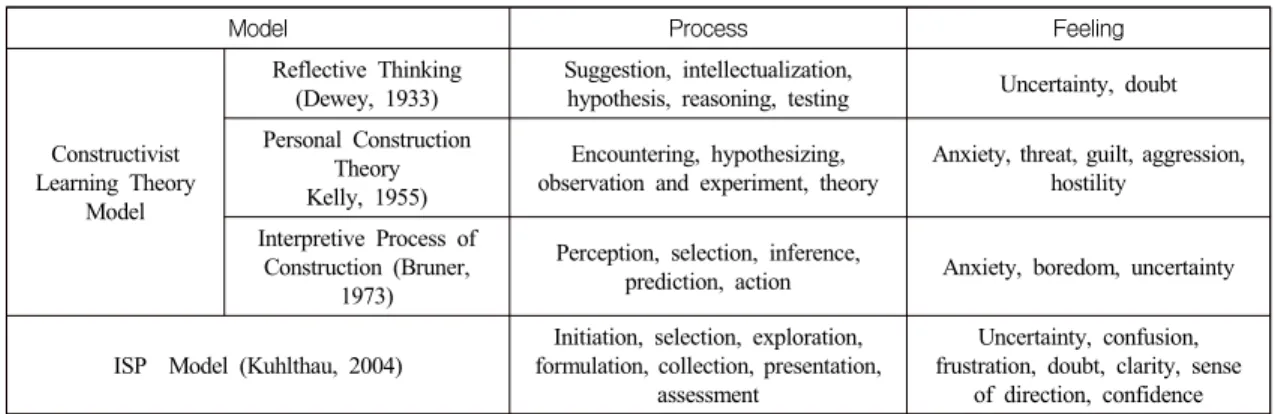
2.3.2. Active Knowledge Seeking Behavior Constructivist learning theory (CLT) deals with an individual’s active information seeking behavior in the process of learning (Malhotra, 2002).
According to the theory, individuals interpret new information by referencing it with their existing system of construct when they encounter or seek it. During the information seeking process, individuals resolve the discrepancy between the new experience and their existing constructs through accommodation and assimilation. The initial stage of construction is generally marked by
"confusion, doubt, frustration, and threat" as they
accommodate or assimilate the new experience to internalize it into their constructs. Dewey (1933) proposed five phases of reflective thinking process to explain how individuals learn through the process of acting and reflecting. Similarly, Personal Construction Theory (Kelly, 1955) also emphasizes the individual’s active role in the construction process of meaning with regards to the anticipation of future events, and suggests a process model similar to the ISP model. Bruner’s (1973) interpretative process of construction also incorporates feelings in the process of learning.
Table 2 summarizes the process and feeling aspect of ISP and CLT models.
2.4 Knowledge Sharing Intention and Virtual Community Promotion
2.4.1. Knowledge Sharing Intention
When individuals construct sense of virtual community from their knowledge seeking efforts, there are two possible positive outcomes for a virtual community itself: members’ knowledge
Study Theory / Perspective Antecedents Chiu et al. (2006) Social cognitive theory, Social
capital theory
Social interaction ties, trust, norm of reciprocity, identification, shared language, shared vision Kim (2006; 2013) Theory of altruism, theory of
reciprocity Social ties, reciprocity, altruism.
Kollock (1998) Design principles identity persistence, coherent sense of space, sophisticated set of rituals
Kim (2000), Williams
and Cothrel (2000) Social perspective
clear purposes or vision, flexible and small-scale places, members' roles, leadership of community moderators,
on-line/off-line events Hsu et al. (2007) Social capital theory Trust, self-efficacy, outcome expectation
<Table 3>. Knowledge Sharing in Virtual Community Research
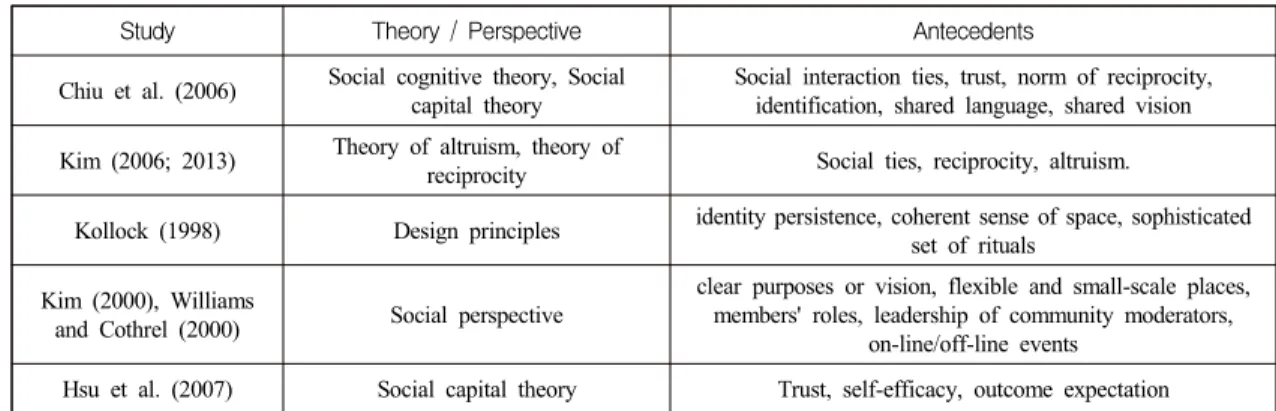
contribution to the virtual community and their promotion of virtual community to others. Lee et al. (2006) defined knowledge sharing intention as a user’s intention to share knowledge. Knowledge sharing intention is a crucial variable for virtual community service providers in seeking to maintain or gain the main source (Lin, 2006). As mentioned above, knowledge sharing behavior received most attentions among KM processes and several studies identify the motivations underlying the knowledge sharing behavior in VC. For example, Kim (2006; 2013) identified shared knowledge in a VC as public goods and knowledge sharing can be occurred from two different sources: cooperators and reciprocators. Theory of altruism and theory of reciprocity explain that cooperators always contribute towards public goods regardless of other’s behavior, while reciprocators who take the most portion of VC contribute no more than others contribute to them.
Table 3 summarizes the virtual community research on knowledge sharing.
2.4.2. Virtual Community Promotion Promotion intention of virtual community is another desirable outcome of virtual communities and members’ promotion intention of the virtual community is an important measure for sustaining the community. Members’ positive feelings about the relationship in the community allow them to promote the community to others. People who have a good experience with specific products or services usually recommend to others. This phenomenon is called the word-of-mouth effect. In the Marketing discipline, Word-of-Mouth (WOM) intentions, is a common topic in the area of computer-mediated communication (Sun et al., 2006), which is defined as the extent to which a person (a client) expresses willingness to recommend a certain service provider to others (Price and Arnould, 1999).
3. Research Model and Hypotheses
In this study, knowledge sharing intention
and virtual community promotion is viewed as the desired outcomes of VC. Among many antecedents affecting these outcomes, member’s sense of virtual community was chosen to accommodate the hypothesized relationship between knowledge seeking and sharing behavior. Only active knowledge seeking behavior is considered as the behavior is cognitively identified. The overall research model of this study is shown in Fig. 2.
<Figure 2> Research Model
H4 H3
H2
Knowledge H1
Searching
Knowledge Browsing
Sense of Virtual Community
Knowledge Sharing Intention
Virtual Community
Promotion
<Figure 2> Research Model
3.1 Effects of Knowledge Seeking on Sense of Virtual Community
VC members attracted to the contents will build a certain level of SOVC while they are seeking and acquiring subject knowledge. In their study on sense of community, Zaff and Devlin (1998) found that interaction of community members with components of the physical environment is positively related to SOC. In a virtual setting in which knowledge postings in the Web site replace the physical environment, the degree of SOVC will be increased as VC members
interact more. VC members also identify certain useful postings or persons who post knowledge, and build a certain level of interpersonal trust on them. The results of knowledge seeking behavior as the SOVC process would include member identification and trust building. Blanchard and Markus (2004) found that recognizing others and building relationships with other members were important antecedents to SOVC.
The literature on SOVC identifies that two inputs are required in building SOVC; antecedents and processes. To reflect the construction of SOVC dimensions, Blanchard and Markus (2004) identified three processes of SOVC: exchanging support, creating and making identification, and producing interpersonal trust through naturalistic inquiry method on an established virtual community. Based upon these processes, Ellonen et al. (2007) added three antecedents of SOVC construction as needs, perceived similarity, and impersonal trust. During the knowledge seeking, members search and inquire the targeted information in deliberate and intentional ways.
This process may involve integration among members through reading relevant posts and posting a series of questions. Based upon the search results, they may also feel frustration, clarity, and a sense of direction (Kuhlthau, 2004).
These interactions and their feedbacks create a sense of belongingness to the community (community feelings) and they feel themselves as a part of the community (membership feelings).
These exchanges from other members through their postings also lead to a certain personal relationship
and mutual trust as they identify each other. Thus, following hypotheses are proposed.
H1. Knowledge searching is positively related to the level of SOVC.
H2. Knowledge browsing is positively related to the level of SOVC
3.2. Effects of Sense of Virtual Community on Knowledge Sharing Intention and Virtual Community Promotion
Virtual communities provide an ample chance of identifying and connecting people with similar interests than real-world social circles since they are bound by common problems or interests (Hagel and Armstrong, 1997; McKenna and Green, 2002). During the knowledge seeking process, knowledge seekers try to search or browse the existing postings including directly matched postings. However, they also encounter some postings which are not directly related to their target knowledge, but draw their attention (e.g., questions, help request and emotional frustrations noticed in posting titles). If seekers had similar experiences, problems or feelings of frustration, they may remind their own past experience. As a community member perceives similarity with other members, s/he is likely to trust them and to return to them (Blanchard and Horan, 1998; McKenna and Green, 2002). This feeling of empathy, similarity, and affection comes from sense of virtual community. Thus, the following hypothesis is developed.
H3. Sense of virtual community is positively related to knowledge sharing intention
3.3. Effects of Sense of Virtual Community on Virtual Community Promotion Many empirical studies have investigated the antecedents of positive word of mouth (WOM) typically from the perspective of consumers’
satisfaction and dissatisfaction with previous experiences, consumer’s commitment (devotion), consumer identification, and Internet social connection (Brown et al., 2005; Sun et al., 2006).
Sun et al. (2006) argued that social ties within a virtual community would be an important motive to transmit opinions. Brown et al. (2005) also found that consumer commitment is positively related to positive WOM. Considering the fact that SOVC is composed of four elements (membership, influence, needs and emotion connection), members with a higher degree of SOVC will experience deeper feelings of belonging to the community (membership), will more likely feel that they can make a difference in their community (influence), will more likely to believe that the community has resources (needs fulfillment).
Therefore, existing virtual community members with higher SOVC will be more likely to invite their friends and relatives to visit the community.
Thus, the following hypothesis is suggested.
H4. Sense of virtual community is positively related to virtual community promotion
Demographic information Category Frequency (N=169)
Percentage (%)
Gender Male
Female
160 9
94.7 5.3
Age 20s
30s 40s 50s and over
126 21 17 5
74.6 12.4 10.1
Education College students 3
College degree Graduate students
Graduate degree
102 57 7 3
60.4 33.7 4.1
Occupation Students 1.8
White-collars Self-employed
Professionals Sales Educators
Others
96 42 18 5 1 5 2
56.8 24.9 10.7 3 0.6
3 Usage duration of Virtual 1.2
Community
Less than 1 year More than 1 More than 2 More than 3 More than 4 More than 5
59 53 34 8 10
5
34.9 31.4 20.1 4.7 5.9 3
<Table 4> Description of Samples
4. Research Methodology
4.1. Measures, Sample and Data Collection Survey questions on sense of virtual community, knowledge sharing intention and virtual community promotion are adopted from the previous literature and three items were adapted to assess the components of each construct. To capture the concept from human cognition, the construct should at least involve one’s willingness and intention. Therefore, in this study, only knowledge searching and browsing behavior are considered since they involve activeness in seeking. Four items are created to assess knowledge searching and browsing based on the literature on knowledge seeking. A pilot test was conducted to finalize the survey questions and the
questionnaire was distributed to 30 undergraduate students who were active members of virtual community. Based on the results of the pilot test, survey questions were refined and issues were addressed before finalizing the questionnaire. The survey questionnaire was divided into two sections.
The first section included items related to the respondent’s perception of the variables. A 7-point Likert-type scale was utilized: 1 = strongly disagree, 2 = disagree, 3 = somewhat disagree, 4
= neutral, 5 = somewhat agree, 6 = agree, and 7
= strongly agree). The second section included demographic information such as gender, age, education, tenure of virtual community experiences and so on. The final survey questionnaire is presented in Appendix A.
The unit of analysis for this study is
Factor Item Std.Reg.
Weight S.E. t-Value p-Value CR AVE Cronbach’s α
Knowledge Browsing
KB1 0.808 0.057 13.095 ***
0.893 0.775 0.889
KB2 .0.930 - - -
KB3 0.831 0.062 13.619 ***
Knowledge Searching
KS1 0.810 0.107 10.794- -
0.866 0.736 0.865
KS2 0.871 0.104 11.183 ***
KS3 0.797 ***
Sense of Virtual Community
SOVC1 0.866 - - -
0.912 0.775 0.911
SOVC2 0.903 0.065 15.215 ***
SOVC3 0.869 0.066 15.310 ***
Knowledge Sharing Intention
KSI1 0.957 - - -
0.939 0.794 0.935
KSI2 0.976 0.035 30.528 ***
KSI3 0.837 0.066 14.840 ***
Virtual Community
Promotion
VCL1 0.954 - - -
0.924 0.803 0.921
VCL2 0.894 .044 18.577 ***
VCL3 0.831 .054 16.131 ***
<Table 5> Validity and Reliability Table individual users of a virtual community. Five
virtual communities in the Republic of Korea were randomly contacted by e-mail. In order to recruit participants from virtual communities, approval from each virtual community was required as per Institutional Review Board (IRB) policy. A virtual community granted permission for the investigator to collect data in its website. The respondents included members and visitors with varying ages and membership duration.
An online survey was administered to members of the virtual community. In total, 253 members participated and 169 members completed the survey, while 69 members abandoned and 15 members saved partially, but never completed during the time frame. This renders a response rate of 66.7%. This sample size is deemed satisfactory in social science research (Pinsonneault and Kraemer, 1993) and meets the requirement of structure equation modeling. Table 4 provides
demographic information of respondents.
4.2. Data Analysis
4.2.1. Measurement Model
As this study used a survey method to collect data for analysis, random error and systemic error could falsify the study (Rosenthal and Rosnow, 2008, p385). Reliability and validity analyses are used to evaluate these two errors.
Reliability is the degree to which a variable or concept is measured consistently, while validity is the degree to which the intended variables are actually measured. Reliability and validity were examined by utilizing Cronbach's α and factor analysis. The desired lower limit for Cronbach's α is .7 (Nunnally and Berbstein, 1994). Thus, the internal consistency of the measurement scales is verified as shown in Table 5.
As reliability tests look only at the items in
SOVC Knowledge Browsing
Knowledge Searching
Virtual Community
Promotion
Knowledge Sharing Intention
SOVC 0.880
Knowledge Browsing 0.253 0.858
Knowledge Searching 0.191 0.044 0.827
VC Promotion 0.206 0.241 0.059 0.896
Knowledge Sharing Intention 0.349 0.237 0.177 0.253 0.891
<Table 7> Results of Path Analysis
Hypotheses Path
Coefficient t-Value p-Value Decision
H1 (Knowledge Searching à SOVC) 0.251 2.224 0.026 Accept
H2 (Knowledge Browsing à SOVC) 0.214 3.084 0.002 Accept
H3 (SOVC à Knowledge Sharing Intention) 0.207 2.090 0.037 Accept
H4 (SOVC à Virtual Community Promotion) 0.238 4.500 *** Accept
<Table 6> Factor Correlation Matrix with Square Root of the AVE on the Diagonal the scale and do not compare across constructs, a
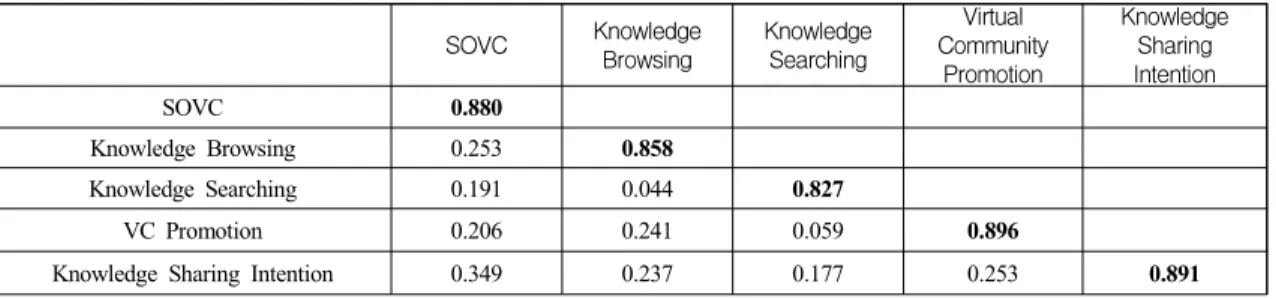
validity test should be performed to compare one variable with others. This study employs construct, convergent and discriminant validity for this objective. Confirmatory factor analysis was performed to establish factorial validity in SEM (Gefen and Straub, 2005). Convergent validity adopts the measure of average variance extracted (AVE) to gauge the percentage of explained variance by indicators relative to measurement errors. To establish convergent validity, AVE should be greater than 0.5 as suggested by Fornell and Larcker (1981). Table 5 lists Cronbach’s α and AVEs for all latent variables.
The way to establish discriminant validity is to compare the square root of the AVE of each construct to the correlations of this construct to all other constructs. Fornell and Larcker (1981) suggest that the square root of AVE should be
greater than the corresponding correlations among the latent variables. The results shown in Table 6 demonstrate all latent variables exhibit high discriminant validity.
4.2.2. Structure Model
The structure model investigates the strength and direction of the relationships among theoretical latent factors. The structural model and hypotheses are tested by examining the path coefficients.
Based on the research model (Figure 1), four hypotheses are tested and found to be supported.
Table 7 and Figure 3 show the results of the structure model. The path coefficients indicate the strength of paths. The t-values were used to determine if the hypothesized relationships were significant. Knowledge searching and browsing behaviors had significant impacts on members’
gain on SOVC, which, in turn, affected members’
knowledge sharing intention and promotion intention of virtual community.
0.207***
0.238***
0.214***
0.251***
Knowledge Searching
Knowledge Browsing
Sense of Virtual Community
Knowledge Sharing Intention
Virtual Community
Promotion
<Figure 3> Research Result
4.2.3. Goodness of Fit of the Research Model
There are several indexes for goodness of model fit. In this study, chi-square, GFI, AGFI, NFI, and RMSEA were used to test the goodness of fit of the research model as recommended by Kline (2004). As shown in Table x, the overall fitness of the proposed research model is satisfactory on several measures for goodness of fit.
<Table 8> Model Fit Indices
Index c2(p) c2/DF GFI AGFI NFI RMSEA
Value 116.221(0.06) 1.236 .923 .888 .946 0.038
5. Discussion and Conclusion, Limitation and Future Research
5.1. Summary of Results
This study dealt with knowledge seeking
and sharing behavior in the virtual community.
In general, virtual community members take either active or passive knowledge seeking mode when they seek knowledge. Knowledge searching and browsing behaviors are active seeking mode.
Active seeking mode implies that community members actually make an effort. Members of virtual community engage in knowledge searching when they know what they look for. When they actively seek the knowledge in the virtual community without knowing exactly what they look for, knowledge browsing behavior is occurred. Knowledge searching and browsing behaviors show positive influence on gains of sense of virtual community and knowledge searching shows stronger influence on members’
sense of community than knowledge browsing does. The relationships between the gains from the virtual community (subject knowledge and SOVC) and the attitude towards virtual community (knowledge sharing intention and promotion intention of virtual community) were strongly supported.
5.2. Theoretical Contribution
The findings of this study expand the existing KM literature in several ways. First, this study empirically investigated the details of knowledge seeking behavior by reviewing two subcategories of seeking behavior categorized by directedness and active/passive dimensions. Knowledge seeking behavior has usually been recognized as single behavior, and only conceptually categorized.
In this study, knowledge searching (active/directed) and knowledge browsing (active/undirected) are constructed through analyses of the measurement model. The other theoretical contribution was achieved by identifying the indirect positive relationship between knowledge seeking and knowledge sharing that is inducted from the sharing intention. KM process is composed of varying activities such as knowledge seeking, acquiring, storing, sharing and utilization, and the relationships among these activities had been unexplored. Even among existing literature on knowledge sharing, few studies have investigated from the knowledge seeking perspective, to the author’s knowledge.
5.3. Implication for Practitioners
On the practical side, this study provides a better understanding of knowledge behavior for virtual community operators in detail, and for KM managers of organizations at large. While managers and operators have clear understanding why community members visit virtual communities (i.e., seeking valuable subject knowledge), and directives of the virtual community (providing valuable subject knowledge with critical mass of the traffic), the way to achieve these directives are not to be found easily. This study provides one of many mechanisms why members are tend to share knowledge, and to promote the virtual community, resulting in traffic increase (ultimately achieving critical mass of continuous operation of the virtual community). Practical contribution comes from the
relevance of research constructs. Knowledge is the main concern of a virtual community, which drives interactions among members. This study uses knowledge seeking behavior and knowledge sharing intention. The former is the representation of a main concern of virtual community members, and the latter is the main concern of virtual community operators. By providing a mechanism how these two contrasting concerns could work harmoniously, a virtuous circle with win-win situation could be achieved. Members gain valuable subject knowledge from other members as well as the operator of the virtual community.
With limited resources and scope of interest, top-down approach in the management of the virtual community could cause inefficiency and eventually members’ abandonment of the community.
Base on the result, operators might provide some attractive features to knowledge browsers who might not have enough knowledge yet, but have high potential to the sustainability of virtual communities. Such features might include cognitive map or other overview of subject matter the virtual community carries for undirected knowledge browsers, and daily update of new postings of knowledge to promote their involvement in the virtual community.
In summary, the operators of virtual communities should understand the importance of knowledge seeking behavior, and how all aspects of members’ seeking strategy would lead to sustaining and growing virtual community through voluntary knowledge sharing and high sense of
Factor Questions Source
Knowledge Searching
I find the information quickly and frequently using the keyword.
I directly go to a specific topic board to find any news, opinion, knowledge related to the topic.
I ask questions on specific topics.
Factor from exploratory factor analysis
Knowledge Browsing
In general, I just click and read messages posted in the virtual community without realizing what I am looking for.
I routinely go to topic boards to find any interesting news, opinions, information, or events.
I ask questions on general topics to find more information on SUBJECT1.
Factor from exploratory factor analysis
Sense of Virtual Community
I feel at home in this virtual community.
If there is a problem in this virtual community, there are members here who can resolve it.
I’ve gotten support from this virtual community.
Blanchard (2007)
Knowledge Sharing Intention
I intend to share my knowledge in the community.
I intend to share my experience knowledge in the community.
I plan to share my opinion frequently.
Bock et al.
(2005) Promotion
Intention of Virtual Community
I invite my close acquaintances to join our virtual community I often talk to people about benefits of our virtual community I often introduce my peers or friends to our virtual community
Koh and Kim (2004)
Appendix A. Survey Questionnaires virtual community.
5.4. Limitations and Future Research The most obvious limitation of this study is that only a single community with male-dominated demographics were source of data for this analysis, which limits the generalizability of the study result. To overcome this limitation, future research may survey from a several virtual communities with varying shared interests. Comparing female-dominated virtual communities with male-dominated ones could be another suggestion for further study. As a core construct of virtual community, SOVC is still evolving, and the unique SOC an individual may build with each community. The literature of virtual communities provides mostly descriptive and even diverse
interpretations of SOVC (Ellonen et al., 2007).
Moreover, the virtual communities vary in type (Moore and Serva, 2007; Ellonen et al., 2007), which results in individuals who experience different levels of SOVC through varying community activities and SOVC processes (Blanchard and Markus, 2004). Therefore, future study may extend the understanding of the nature of SOVC by focus on identifying underlying structure of SOVC. Finally, more theoretical consideration of knowledge seeking behavior could be made in the future research. In this research, the positive relationship between knowledge seeking behavior and the gain of subject knowledge is identified. However, the details on the type of knowledge seeking behavior and characteristics of knowledge could be worth pursuing. For example, one type of knowledge
seeking behavior would be preferred to others when people seek highly structured knowledge compared to unstructured and conceptual knowledge
References
Balasubramanian, S. and V. Mahajan, “The Economic Leverage of the Virtual Community,”
International Journal of Electronic Commerce, Vol.5, No.3(2001), 103~138.
Bates, M. J., “Toward an integrated model of information seeking and searching,” Keynote Address, Fourth international Conference on Information Needs, Seeking and Use in Different Contexts, (2002).
Blanchard, A., “Developing a Sense of Virtual Community Measure,” CyberPsychology &
Behavior, Vol.10(2007), 827~830.
Blanchard, A. and T. Horan, “Virtual Communities and Social Capital,” Social Science Computer Review, Vol.16, No.3(1998), 293~307.
Blanchard, A. and M. L. Markus, “The Experienced “Sense” of a Virtual Community:
Characteristics and Processes,” The DATA BASE for Advances in Information Systems, Vol.35, No.1(2004), 64~71.
Bock, G. W., R. W. Zmud, Y. G. Kim, and J.-N.
Lee, “Behavioral Intention Formation in Knowledge Sharing: Examining the Roles of Extrinsic Motivators, Social-psychological Forces, and Organizational climate,” MIS Quarterly, Vol.29(2005), 87~111.
Brown, T. J., T. E. Barry, P. A. Dacin, and R. F.
Gunst, “Spreading the Word: Investigating Antecedents Of Consumers' Positive Word-
of-Mouth Intentions and Behaviors in a Retailing Context,” Journal of the Academy of Marketing Science, Vol.33, No.2(2005), 123~138.
Bruner, J., Beyond the Information Given: Studies in Psychology of Knowing, W.W. Norton &
Co., New York, 1973.
Butler, B. S., “Membership Size, Communication Activity, and Sustainability: A Resource- Based Model of Online Social Structures,”
Information Systems Research, Vol.12, No.4 (2001), 346~336.
Chiu, C.-M., M.-H. Hsu, and E. T. G. Wang,
“Understanding Knowledge Sharing in Virtual Communities: an Integration of Social Capital and Social Cognitive Theories,”
Decision Support Systems, Vol.42, No.3 (2006), 1872~1888.
Dewey, J., How We Think, Heath and Company, Boston, MA, 1933.
Ellonen, H. K., M. Kosonen, and K. Henttonen,
“The Development of a Sense of Virtual Community,” International Journal of Web-Based Communities, Vol.3, No.1(2007), 114~130.
Fornell, C. and D. F. Larcker, “Evaluating Structural Equation Models with Unobservable Variables and Measurement Error,” Journal of Marketing Research, Vol.48(1981), 39~50.
Gefen, D. and D. Straub, “A Practical Guide to Factorial Validity Using PLS-Graph: Tutorial and Annotated Example,” Communications of the Association for Information Systems, Vol.16(2005), 91~109.
Grover, V. and T. H. Davenport, “General Perspectives on Knowledge Management:
Fostering a Research Agenda,” Journal of Management Information Systems, Vol.18,
No.1(2001), 5~21.
Hagel, H. and A. Armstrong, Net Gain: Expanding Markets through Virtual Communities, Harvard Business School Press, Boston, MA, 1997.
Heller, K., R. H. Price, S. Reinharz, S. Riger, A.
Wandersman, and T. A. D’Aunno, Psychology and Community Change: Challenges of the Future, Brooks Cole, Pacific Grove, CA, 1984.
Hsu, M. H., T. L. Ju, C. H. Yen, and C. M.
Chang, “Knowledge Sharing Behavior in Virtual Communities: The Relationship between Trust, Self-Efficacy, and Outcome Expectations,” International Journal of Human- Computer Studies, Vol.65, No.2(2007), 153~169.
Kelly, G. A., Principles of Personal Construct Psychology, W.W. Norton & Co., New York, 1955.
Kim, A. J., Community Building on the Web, Peachpit Press, Berkeley, CA, 2000.
Kim, J. K., S. M. Lee, and D. Olson, "Knowledge Sharing: Effects of Cooperative Type and Reciprocity Level," International Journal of Knowledge Management, Vol.2, No.4(2006), 1~12.
Kim, J. K., “Promoting Knowledge Sharing in Virtual Communities of Practice: Effects of the Cooperative Type and Tie Strength,”
Korea IT Service Journal, Vol.12, No.2 (2013), 119~129.
King, W., T. Chung, and M. Haney, “Knowledge Management and Organizational Learning,”
The International Journal of Information Science, Vol.8, No.2(2008), 19~35.
Kline, R. B., Principles and Practices of Structural
Equation Modeling, Guilford, New York, 2004.
Koh, J. and Y.-G, Kim, “Knowledge Sharing in Virtual Communities: An E-Business Perspective,” Expert Systems with Application, Vol.26(2004), 155~166.
Kollock, P., “Design Principles for Online Communities,” PC Update, Vol.15, No.5 (1998), 58~60.
Kuhlthau, C. C., Seeking Meaning: A Process Approach to Library and Information Services, Libraries Unlimited, Westport, CT, 2004.
Lai, H. and M. Graham, “Knowledge Seeking in KM–Towards an Adapted KM Cycle”, Proceedings of 10th European Conference on Knowledge Management, (2009).
Lee, M. K. O., C. M. K. Cheung, K. H. Lim, and C. L. Sia, “Understanding Customer Knowledge Sharing in Web-Based Discussion Boards: An Exploratory Study,” Internet Research, Vol.16, No.3(2006), 289~303.
Lin, H. F. “Impact of Organizational Support on Organizational Intention to Facilitate Knowledge Sharing,” Knowledge Management Research and Practice, Vol.4, No.1(2006), 26~35.
Lottering, F. and A. L. Dick, “Integrating Knowledge Seeking into Knowledge Management Models and Frameworks,” SA Journal of Information Management, Vol.14 (2012), 515~523.
Malhotra, Y. “Information Ecology and Knowledge Management: Toward Knowledge Ecology for Hyperturbulent Organizational Environments,”
in Tschangho John Kim (Ed.) Encyclopedia of Life Support Systems, Eolss Publishers, Oxford, UK, 2002.
McKenna, K. Y. A. and A. S. Green, “Virtual Group Dynamics,” Group Dynamics: Theory, Research and Practice, Vol.6(2002), 116~127.
McMillan, D. W. and D. M. Chavis, “Sense of Community: A Definition and Theory,”
Journal of Community Psychology, Vol.14, No.1(1986), 6~23.
Moore, T. D. and M. A. Serva, “Understanding member motivation for contributing to different types of virtual communities: A proposed framework,” Proceedings of the 2007 ACM SIGMIS Computer Personnel Research Conference: The Global Information Technology Workforce, (2007), 153~158.
Moreland, R.L. and J.M. Levine, J.M. “Group Composition: Explaining Similarities and Differences among Group Members,” in Michael A. Hogg and Joel M. Cooper (Eds.) Sage Handbook of Social Psychology, London: Sage, 367~380, 2003.
Mumford, E., “Socio Technical Design: An Unfulfilled Promise or a Future Opportunity,”
The International Federation for Information Processing, Vol.41(2000), 33~46.
Nunnally, J. C. and I. H. Berstein, Psychometric Theory, McGraw-Hill, New York, 1994.
Pasmore, W. A. “Social Science Transformed: The Socio-Technical Perspective,” Human Relations, Vol.48, No.1(1995), 1~21.
Phang, C. W., A. Kankanhalli, and R. Sabherwal,
“Usability and Sociability in Online Communities: A Comparative Study of Knowledge Seeking and Contribution,”
Journal of the Association for Information Systems, Vol.10, No.10(2009), 96~114.
Pinsonneault, A. and K. L. Kraemer, “Survey Research Methodology in Management
Information Systems: An Assessment,” Journalt of Management Information Systems, Vol.10(1993), 75~105.
Price, L. L. and E. J. Arnould, “Commercial Friendships: Service Provider-Client Relationships in Social Context,” Journal of Marketing, Vol.63(1999), 38~56.
Rheingold, H., The Virtual Community: Homsteading on the Electronic Frontier, Addison-Wesley, Boston, 1993.
Rosenthal, R. and R. L. Rosnow, Essentials of Behavioral Research: Methods and Data Analysis, McGraw-Hill, New York, 2008.
Schuler, D., New Community Networks - Wired for Change, Addison-Wesley, New York, 1996.
Sun, T., S. Youn, G. Wu, and M. Kuntaraporn,
“Online Word-of-Mouth (or Mouse): An Exploration of Its Antecedents and Consequences,” Journal of Computer-Mediated Communication, Vol.11(2006), 1104~1127.
Wang, C.-C., I.-P. Chiang, and C.-F. Chuang,
“Recent Development of the Virtual Community Research: A Citation and Co- Citation Analysis,” International Proceedings of Economics Development and Research, Vol.3(2011), 107~111.
Wang, S. and R. A. Noe, “Knowledge Sharing: A Review and Directions for Future Research,”
Human Resource Management Review, Vol.20(2010), 115~131.
Wasko, M. M. and S. Faraj, “Why Should I Share? Examining Social Capital and Knowledge Contribution in Electronic Networks of Practice,” MIS Quarterly, Vol.29(2005), 35~57.
Williams, R. L. and J. Cothrel, “Four Smart Ways
To Run Online Communities,” Sloan Management Review, Vol.41(2000), 81~94.
Xu, B., D. LI, and B. Shao, “Knowledge Sharing in Virtual Communities: A Study of Citizenship Behavior and Its Social-Relational Antecedents,” International Journal of
Human-Computer Interaction, Vol.28(2012), 347~359.
Zaff, J. and A. S., Devlin, “Sense of Community in Housing for the Elderly,” Journal of Community Psychology, Vol.26, No.4(1998), 381~398.
국문요약
가상공동체의 지식선순환을 위한 지식탐색과 공유에 관한 연구
1)김재경*
본 연구는 지식경영연구에서 비교적 적은 관심을 받아온 지식탐색행동인 지식브라우징 (knowledge browsing)과 지식검색 (knowledge seeking)의 역할을 가상공동체 환경에서 조사하였다. 지 식탐색행동이 가상공동체의식을 매개요인으로 지식공유의도와 가상공동체홍보에 양의 영향을 끼치는 선행요인으로 고려되었다. 연구가설들은 한 가상공동체의 회원들을 대상으로 한 설문조사를 기반으로 구조방정식모델을 사용하여 검증한 결과, 능동적 지식탐색행동은 가상공동체의식에 양의 관계를 보였 고, 가상공동체의식은 지식공유의도와 공동체홍보에 양의 관계를 보였다. 실무자들은 본 연구를 통해 회원들의 지식탐색행동이 가상공동체의식을 함양하는 효과가 있고 결국, 지식공유활성화와 가상공동 체 홍보로 이어질 수 있음을 이해할 수 있다. 따라서, 이러한 지식탐색행동을 보다 효과적으로 도울 수 있는 방안을 마련함으로써, 회원들이 가상공동체로부터 지식을 얻고, 다시 지식을 가상공동체에 공 유하고 다른 사람들에게 공동체를 홍보하게 되는 가상공동체의 선순환적 발전을 꾀할 수 있다.
주제어 : 지식탐색, 지식브라우징, 가상공동체의식, 지식공유, 가상공동체홍보
* Corresponding Author: Jae Kyung Kim
Department of Management Information Systems, Hannam University 70 Hannam-ro, Daedeok-gu, Daejeon 306--791, Korea
Tel: +82-42-629-7684, Fax: +82-42-629-8416, E-mail: [email protected]
저 자 소 개
김재경(Jae Kyung Kim)
미국 Ohio주 Miami Unviersity에서 경영정보학 석사(MBA)를 하고, University of Nebraska-Lincoln에서 지식경영 연구로 경영학 박사(Ph.D.)를 받았다. 현재 한남대학교 경 영정보학과 교수로 재직 중이며 주요 관심분야로 지식경영, 소셜미디어, 미디어중독 등 이며, Omega, Decision Support Systems, Int. J. of Electronic Commerce, Service business 등에 다수 논문을 실었다.