VOL.25 NO.2 : 185-199 (2012)
월경전증후군과 관련된 한방적 치료방법에 대한 연구동향 고찰
1 동국대학교 한의과대학 한방부인과학교실, 2 동국대학교 한의과대학 침구학교실 장수희 1 , 이은솔 2 , 김동일 1
ABSTRACT
Review on the Treatment Methods of Korean Oriental Medicine for PMS Su-Hee Jang 1 , Eun-Sol Lee 2 , Dong-Il Kim 1
1 Dept. of Oriental Gynecology, College of Oriental Medicine, Dong-Guk University
2 Dept. of Acupuncture & Moxibustion, College of Oriental Medicine, Dong-Guk University
Objectives: This study aimed to review the effects and treatment of Korean, Oriental, Chinese medicine for premenstrual syndrome(PMS) as preceding research in order to further research the effective Korean Medicine treatment for PMS.
Methods: Databases from Jan., 2002 through Feb., 2012 were searched through Pubmed for international journals; Korean studies information service system(KISS), National Discovery for Science Leaders(NDSL), Journal of Korean Acumoxa, J of Oriental Obstetrics and Gynecology, J of Meridian and Acupoint, and J of Korean Oriental Medicine for Korean journals were searched for national journals.
The following search terms were used: acupuncture premenstrual syndrome, alternative medicine premenstrual syndrome, traditional Chinese medicine(TCM), premenstrual syndrome for Pubmed, premenstrual syndrome(in Korean and English) for the remaining search.
Results: Twenty four studies were included in this review.
Conclusions: Alternative medicinal intervention such as acupuncture and herb medicine may be effective treatment method in controlling premenstrual syndrome and premenstrual dysphoric disorder(PMDD).
Key Words: premenstrual syndrome, acupuncture, herb medicine, TCM, PMS, PMDD
14)
교신저자(김동일) : 경기도 고양시 일산동구 식사동 814번지 동국대학교 일산한방병원 한방여성의학과 전화 : 031-961-9062 이메일 : [email protected]
Ⅰ. 서 론
월경전증후군(PMS)은 후기 황체기에 나타나는 반복적인 심신장애로서 주로 생리가 시작하기 4~7일 전에 신경성 긴 장, 안절부절 못함, 체중증가, 부종, 두 통, 유방통, 불쾌감 등이 나타난다 1) . 이 는 주기적으로 나타나는 현상으로 월경 의 시작과 함께 해소된다 2) .
1931년 Frank 3) 는 월경전 7~10일에 정신적긴장, 민감성, 우울증 및 두통이 정상인보다 신경증적인 사람에서 훨씬 많다고 보고 하였고, 1953년 Greene과 Dalton 4) 이 처음으로 월경전증후군을 정 의하였으며, 1994년에는 DSM-IV-R에서 이를 월경전불쾌장애라 명명하며 그 기 준을 제시하였다 5) . 이는 모든 가임기 여 성의 약 40%에서 나타나며, 중증은 10%
미만에서 나타난다 6) .
월경전증후군은 인종별간에 유의한 차 이를 보이지만 7,8) , 2008년 1000명의 15 세~49세 미만의 한국 가임기 여성을 대상 으로 실시한 설문조사에 따르면, ICD-10, ACOG와 DSM-IV에 의거한 월경전증후 군의 유병율은 각각 98.6%, 32.1%, 2.8%
로 집계되었다. 통계적으로 유의하게 PMS 에 영향을 미치는 여러 가지 요소들은 카페인 섭취량, 피임약 복용 유무, 가족 관계, 연소득, 직업유무, 운동유무, 스트 레스, 비만도, 출산 경험, 월경색, 월경통 정도, 월경통 양상 등으로 나타났다 9) .
이 증후군의 신체증상 및 기분증상은 여러 가지 양상의 패턴을 보이나 가장 빈번한 증상으로는 근육-관절관련 요통, 안절부절 못하는 증상, 하복부 통증으로 조사되었다 10) . 월경전 불쾌 증상을 겪는
여성들은 신체증상과 기분증상을 모두 경험하거나 이중 불쾌감이 한쪽으로 치 우치기도 한다 11) .
월경전증후군에 대한 원인, 증상, 진단 에 대한 연구는 지난 80년간 이루어져왔 으나 아직 정확한 진단에 미치지 못하였 고 치료에 있어서 비약물 치료로 대체요 법인 칼슘, 마그네슘, 비타민 B 6 , 비타민 E, 오메가-3 지방산, 체이스트베리, St.
John's wart, 은행나무와 같은 보충제가 부작용이 없이 효과적으로 증상을 경감 시켰다는 보고가 있으나 명백하게 입증 되진 않았다 12-15) . 월경전증후군으로 생 활에 불편감을 호소하는 여성들 중 김 9) 등의 연구에 따르면 PMS의 정도가 심 한 사람들이 한방적 치료의 필요성을 호 소하였다. 위에서 언급된 비약물치료 중 한방치료에 대해 현재 월경통과 동일한 주제로 연구되어 PMS만 독자적으로 연 구된 바는 많지 않으며 이중에도 PMS 의 증상 중 어떤 증상에 한방치료가 효 과적인지에 대한 연구가 없어 이에 대하 여 알아볼 필요가 있다고 생각되었다.
이 연구는 월경전증후군에서 한방적 치료에 효과적인 반응이 있었던 증상들 및 이에 대한 치료방법을 알아보고 PMS 치료의 근거를 확립하기 위해 기획되었 다. 이에 국내외의 논문 검색을 통하여 한방적 치료의 동향을 정리하여 발표하 고자 한다.
Ⅱ. 연구방법
1. 대 상 1) 선정기준
국내․외에서 월경전증후군과 관련된
한방치료 중 침구, 기공, 한약재를 이용 한 임상시험 및 임상치료에 대한 치료 및 치료효과와 관련된 논문을 선정하였다.
2) 제외기준
국․내외의 월경전증후군과 관련된 논 문이나 양방적 치료, 대체요법, 동종요법 등과 관련된 논문은 배제하였고, 월경전 증후군에 대한 원인과 역학 등 기초 이 론 연구 논문 또한 제외하였다.
2. 검색방법
전자검색은 국내․외 논문의 원문 및 서지사항을 제공하는 데이터베이스 중 국외논문검색으로는 PubMed를 이용하 였고, 국내논문검색으로는 한국학술정보 (KISS, Korean studies information service system), ND SL(national discovery for science leaders), 대한한방부인과학회지, 대한침구학학회지, 대한한의학회지, 대한 경락경혈학회지 논문검색을 이용하였다.
국외논문을 검색할 때에 언어는 영어 로 하였고, 국내논문은 영어 및 한국어 로 하여 2002년 1월부터 2012년 2월까지 발간된 논문을 대상으로 검색하였다. PubMed 에서의 검색어는 ‘acupuncture premenstrual syndrome', ‘alternative medicine premenstrual syndrome', ‘herb medicine premenstrual syndrome', ‘TCM premenstrual syndrome' 으로 지정하였고, 연령제한은 13~44세 여성으로 한정하여 논문을 검색하였다.
국내논문에서의 검색어는 ‘월경전증후군’
과 ‘premenstrual syndrome'으로 지정하 여 검색하였다.
3. 연구방법
데이터베이스로 선정된 27편의 논문을 살펴보고 비교하여 월경전증후군의 한방
치료에 대한 방법과 그 효과는 월경전증 후군을 VAS, MDQ, MSSL 등으로 측정 된 결과를 비교하고 기술하였다.
1) 월경전증후군 통증 측정(VAS) 논문에서 월경전증후군의 통증의 측정 은 통증을 단일개념으로 측정하는 도구 인 Cline 16) 등의 시각적 상사척도(VAS, Visual Analogue Scale)를 사용하였다.
2) 월경전증후군의 통증 측도(MDQ) 17) 월경전증후군의 통증에 대한 평가를 측 정하는 지표로 많이 사용되는 방법 중 하나 인 MDQ(menstrual distress questionnaire) 가 사용된 논문이 있다. MDQ는 47개의 항목을 8문항으로 분류되어 있는데 그 중 6개의 문항은 부정적인 소견(통증, 집중력저하, 행동의 변화, 자동적 반응, 부종, 이상반응)을 측정하는 문항이고, 제7 문항은 긍정적인 변화, 제8 문항은 월경전증후군의 증상 중 제어는 가능하 지만 빈번하게 호소하는 증상을 측정하 는 문항이다.
3) Likert-type scale
Likert-type scale은 통증의 척도를 1 에서 4까지 하여 1을 통증이 없는 상태 로 설정하고 4를 최고로 아픈 정도로 설 정하여 측정하는 방법이다.
4) MSSL 18)
Menstrual Symptom Severity List는 33개의 항목에 대하여 통증의 척도를 1 에서 5까지 하여 최고로 아픈 정도를 5 로 설정하여 평가하는 측정법이다.
5) SDPTG
Second Derivative of Photoplethysmogram 으로 혈관유형을 검색하는 비침습적 맥 파 분석법이다.
6) 자료 분석방법
수집된 자료는 Excel 2007 For Windows
버전을 사용하였으며 논문을 찾을 수 없 었던 경우에는 영문초록을 참고 하였다.
월경전증후군에 대한 치료방법, 치료전 과 후의 통증정도 차이, 호전된 구체적 인 증상에 대하여 유의성 있는 결과를 토대로 분석하였다.
Ⅲ. 결 과
1. 검색결과
총 124편의 논문이 초기 검색되었고, 이들의 제목 및 초록 검색을 통해 24편 의 논문이 최종 선정되었다.
Pubmed에서 acupuncture premenstrual syndrome으로 검색된 논문은 5편, alternative medicine premenstrual syndrome에서 40 편, herb medicine premenstrual syndrome 에서 0편, TCM premenstrual syndrome 에서 1편이 검색되었다. KISS에서는 premenstrual syndrome으로 6편, 월경전 증후군으로 19편의 논문이 검색되었다.
NDSL에서는 premenstrual syndrome으로 34편, 월경전증후군으로 14편이 검색되었 다. 대한한방부인과학회지에서는 premenstrual syndrome에서 0편, 월경전증후군으로는 3편의 논문이 검색되었다. 대한침구학회 지에서는 premenstrual syndrome에서 1 편, 월경전증후군으로는 0편이 검색되었 다. 대한한의학회지 및 대한경락경혈학 회지에서는 premenstrual syndrome 및 월경전증후군으로 검색된 논문이 없었다.
이 연구에서는 국외논문 48편과 국내 논문 76편으로 총 124편의 논문이 검색 되었다. 이 중 중복으로 검색된 37편의 논문은 제외되었다.
중복된 논문을 제외한 87편의 논문 중
한방적인 치료법 이외의 치료에 대한 논 문 23편은 제외되었다. 기타 치료법으로 는 호르몬제, 동종요법, 인지행동적 치 료, 미술치료, 유산소운동, 발 반사 마사 지, 명상 등이 포함되었다. 7편의 논문은 현재 월경전증후군의 실태조사와 관련된 논문으로 제외되었다. 식생활습관 및 심 리상태 등과 관련된 실태조사가 포함되 었다. 또한 27편의 논문은 월경전증후군 에 관한 연구였으나 한방치료 이외의 논 문으로 배제되었다. 이중에는 월경전증 후군의 유병률 및 심리적인 특성과 관련 된 연구가 포함되었다. 총 123편의 논문 중 중복으로 검색된 37편의 논문, 한방 이외의 치료법에 대한 논문 23편, 실태 조사와 관련된 논문 7편, 기타 월경전증 후군과 관련된 연구논문 27편을 제외하 였고 논문을 분석하는 과정에서 침치료 에 대한 논문 5편 및 한약관련 논문 1편 은 정확도가 떨어지거나 논문 전문을 얻 을 수 없어 이를 제외하여 한방적 치료 및 효능에 대한 논문 총 24편을 이 연구 대상으로 삼았다.
최종으로 선정된 24편의 논문 중 5편
은 국내 논문으로 동의생리병리학회지,
대한침구과학회지, 경락경혈학회지에 기
재된 논문 3편이 포함되었고 나머지 19
편은 국외 저널에 실린 월경전증후군의
한방적 치료와 관련된 논문이다. 이 중 5
논문은 침치료와 관련된 논문이고, 14편
의 논문은 한약치료, 3편은 기공치료, 1
편은 포괄적인 한방치료에 대한 연구이
며 1편은 침구치료에 대한 Systematic
review 및 Meta-analysis 논문이었다.
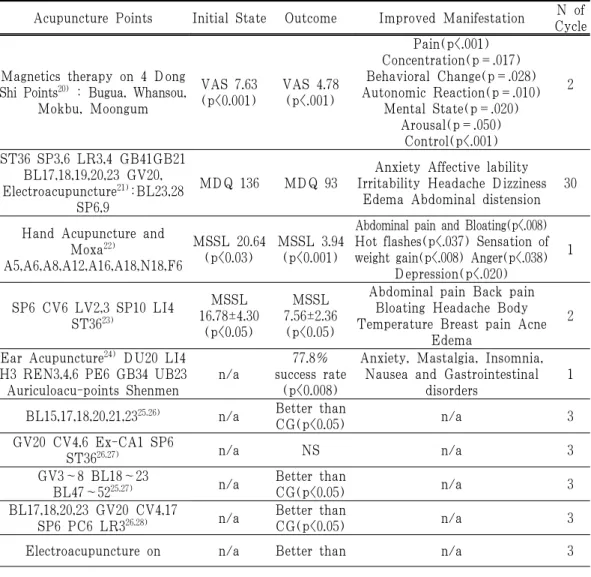
Acupuncture Points Initial State Outcome Improved Manifestation N of Cycle
Magnetics therapy on 4 Dong Shi Points
20)
: Bugua, Whansou,Mokbu, Moongum
VAS 7.63 (p<0.001)
VAS 4.78 (p<.001)
Pain(p<.001) Concentration(p=.017) Behavioral Change(p=.028) Autonomic Reaction(p=.010)
Mental State(p=.020) Arousal(p=.050)
Control(p<.001)
2
ST36 SP3,6 LR3,4 GB41GB21 BL17,18,19,20,23 GV20, Electroacupuncture
21)
:BL23,28SP6,9
MDQ 136 MDQ 93
Anxiety Affective lability Irritability Headache Dizziness
Edema Abdominal distension 30
Hand Acupuncture and Moxa
22)
A5,A6,A8,A12,A16,A18,N18,F6
MSSL 20.64 (p<0.03)
MSSL 3.94 (p<0.001)
Abdominal pain and Bloating(p<.008) Hot flashes(p<.037) Sensation of weight gain(p<.008) Anger(p<.038)
Depression(p<.020)
1
SP6 CV6 LV2,3 SP10 LI4 ST36
23)
MSSL 16.78±4.30
(p<0.05)
MSSL 7.56±2.36 (p<0.05)
Abdominal pain Back pain Bloating Headache Body Temperature Breast pain Acne
Edema
2
Ear Acupuncture
24)
DU20 LI4 H3 REN3,4,6 PE6 GB34 UB23Auriculoacu-points Shenmen
n/a
77.8%
success rate (p<0.008)
Anxiety, Mastalgia, Insomnia, Nausea and Gastrointestinal
disorders
1
BL15,17,18,20,21,23
25,26)
n/a Better thanCG(p<0.05) n/a 3
GV20 CV4,6 Ex-CA1 SP6
ST36
26,27)
n/a NS n/a 3GV3~8 BL18~23
BL47~52
25,27)
n/a Better thanCG(p<0.05) n/a 3
BL17,18,20,23 GV20 CV4,17
SP6 PC6 LR3
26,28)
n/a Better thanCG(p<0.05) n/a 3
Electroacupuncture on n/a Better than n/a 3
Table 1. Therapeutic Effect of Acupuncture on Premenstrual Syndrome 2. 평가결과
월경전증후군의 침구치료에 대한 7편 의 논문 중 자기요법(磁氣療法)에 대한 치료 1편, 일반침을 이용한 논문 5편과 수지침을 이용한 치료 1편이 있었다.
자기요법에서는 동씨침 중에서 부과, 환소, 목부, 문금혈을 이용하여 18세에서 25세의 여성 27명과 30명의 대조군으로 나누어 치료를 해본 결과 초기에 평균적 으로 VAS 7.63이였던 통증이 치료 후 4.78 로 감소된 것으로 나타났으나 자율신경
계 반응에는 유의한 차이는 없었다 20) . 침치료를 이용한 5편의 논문에서는 통 증이 개선된 것으로 나타났고 PMS 이 외에 PMDD에도 유의성 있는 효과가 나타난 것으로 보고되었다.
침치료에 전침을 동반한 논문에서는 PMDD 증상이 소실된 것으로 나타났다
21) . 삼음교, 기해, 태충에 다른 경혈을 조
합한 치료에서는 50%의 통증 개선을 보
였고 혈액순환 불균형을 감소시킨 것으
로 나타났다 23) .
Scalp
26,29)
MS1,5 +MS2,3,4 CG(p<0.05)
GV20 Ex-HN3,5 SP6,10 + LR3 CV17 LR14 Ex-CA1 CV4 SP9 ST36 CV6 PC6 HT7 BL23 GV4 KI3
26,30)
n/a Better than
CG(p<0.05) n/a 3
*n/a : not available, NS : not significantly different between groups, CG : control group.
Acu-Tx plus Herb Decoction Initial State Outcome Symptoms N of MC LI3 ST36 PC6 CV12,13
Boshangtangkamibang, Insamyangyukamibang, Hangsalukgunjatang 31)
vomit count
20 times no vomit vomit 5 LR3 CV4,6 SP6 GV24 +
Jiaweixiaoyaosan 25,32) Better than CG
(p<0.05) 3
*MC : Menstrual Cycle.
Table 2. The Outcome of Combinational Treatment of Acupuncture and Herb Decoction for Premenstrual Syndrome
Intervention Initial State Outcome Symptoms N of MC
Qi Therapy 33)
Pain 25.6±17.4*(p<0.05)
Anxiety 21.1±17.2(p<0.01)
Depression 17.6±13.2(p<0.05)
Pain 12.4±13.1(p<0.05) Anxiety 12.8±10.0(p<0.01) Depression 8.9±9.4(p<0.01)
Pain Anxiety Depression 1
Qi Therapy 34)
Total premense Score 68.87±13.40
(p<0.001)
53.07±8.98(p<0.001)
Negative Feeling Pain Autonomic nervous reaction Water retention Behavioral hange
3
Hatha Yoga 35)
HR † 90.61±8.46 SBP 122.5±11.52 DBP 83.53±8.26 EMG 5.79±2.75 EDG 13.14±6.54
RR 19.13±3.76 T 93.43±5.29
HR 75.58±10.11(p<0.0001) SBP 114.53±9.70(p<0.0001)
DBP 77.46±8.68(p<0.0001) EMG 2.56±1.77(p<0.0001) EDG 10.64±5.72(p<0.0001) RR 16.13±3.76(p<0.0001)
T 93.49±5.28(p<0.0001)
n/a 1
*Pain score by 0-100 VAS scale with 0 as no pain.
†HR : heart rate(HR/min), SBP : systolic(mmHg), DBP : diastolic blood pressure(mmHg), EMG : electromyogram(mV), EDG : electrodermal galvanic activity(microv), RR : respiratory rate(/min), T : peripheral temperature(degrees F).
Table 3. The Effect of Qi-Therapy for Premenstrual Syndrome
Intervention Initial State M Outcome Manifestation N of MC
Xiao Yao San or Dan Zhi Xiao Yao San
36)
Pysical MDQ Psychological MDQ BDI ANX ANG PSS
diagnosed as PMS(p<0.005)
Pysical MDQ 68.9% reduction Psychological MDQ 74.8%
reduction BDI 43.1% reduction ANX 23.8% reduction ANG 39.3% reduction PSS 16.4% reduction(p<0.001)
Anxiety Mood swings Irritability Breast
tenderness
3
Hypericum erforatum (St.John's Wort)
37)
Anxiety 41.15±9.74 Crying 20.52±11.73 Depression 29.26±7.49
Craving 22.01±11.03 Hydration 36.13±8.50
Anxiety 23.08±14.78(p=0.223) Crying 5.87±10.23(p=0.001, 71% reduction) Depression 13.82±6.48(p<0.001, 52%
reduction) Craving 17.26±7.41(p<0.001) Hydration 26.10±10.18
(p<0.090)
Anxiety(mood swings, anxiety, or nervous tension/irritability)
Hydration(breast tenderness, swelling of extremities, weight gain)
Depression(depression, crying, forgetfulness, insomnia) Craving(increased appetite,
headache, fatigue) 2
Odor of Crocus sativus(saffron)
38)
C(FP,LP): 0.168g/dl, 0.129g/dl(p<0.0051) T: 67.097 pg/ml, 59.768
pg/ml(p<0.0022) E: 5.229 pg/ml, 7.145
pg/ml(p<0.0185)
C declined in both FP, LP(F1,82 = 8.28, P <
0.0051). T declined in FP, increased in LP. E increased in FP, LP(F1,86
= 5.28, P < 0.0240).
STAI score declined in FP, LP(F1,84 = 9.51,
P < 0.0028).
Anxiety state 1
Vitex agnus castus
39)
PMSD sum score 29.38±7.63(p=0.752)PMSD sum score 14.66±0.52(p=0.000)
Aches Pains(p = 0.001)).
Depression-sadness Headache Crying spells
Tension-irritability Backache Anger-aggression-shorttemper
Anxiety-nervousness 3
St.John's Wort
tablets 900mg
40)
DSR score in LP 12.6DSR score 5.80(F [1, 30]
= 4.82; p = 0.04; partial Z2 = 0.14)
Physical and Behavioral symptoms(p < 0.05). 2
(1)Elsholtzia splendens (2)Cirsium japonicum
41)
BDI(1) 33.50±5.82 BDI(2) 33.60±8.8 STAI(1) 58.40±7.30 STAI(2) 50.90±9.50 PAF(1) 270.20±82.61 PAF(2) 257.30±74.81
BDI(1) 23.60±4.79(p<0.01) BDI(2) 30.40±5.40 STAI(1) 48.10±5.20(p<0.05)
STAI(2) 52.00±6.18 PAF(1) 176.7±61.33(p=0.530)
PAF(2) 185.6±53.65
(1) is effective for Depression Anxiety Instability 3
Ginkgo biloba L.
42)
Overall Score 34.80(p=0.930) Severity of Psychologic Symptoms
38.41(p=0.899)
Overall Score 11.11(p<0.001) Severity of
Psychologic Symptoms 10.89(p<0.001)
Physical and Psychologic Symptoms though
more effective on Psychological Symptoms
2
Vitex agnus castus
43)
PMSD 29.13±7.88(p=0.4017)
PMTS 26.17±4.79(p=0.1649)
PMSD 6.41±7.94(p < 0.0001) PMTS 9.92±9.01(p < 0.05)
Depression Aggression Expressed Irritability Unstable nervous system Performance Impairment
3
(1)Keishibukuryogan, Rikkunshito (2)Tokishakuyakusan,
Goreisan
(3)Tokishakuyakusan, Anchusan
44)
(1)(2)(3) scores n/a Diagnoised as PMS
(1) no more depression, lighter dysmenorrhea
(2) Headache improved, no more Nausea
(3) Relief of PMS
(1) Depressed mood Edema Car sickness Distention (2) Migraine headache Nausea (3) Nausea Head heaviness
Abdominal fullness Irritability Loss of Energy
(1) 6 (2) 3 (3) 10
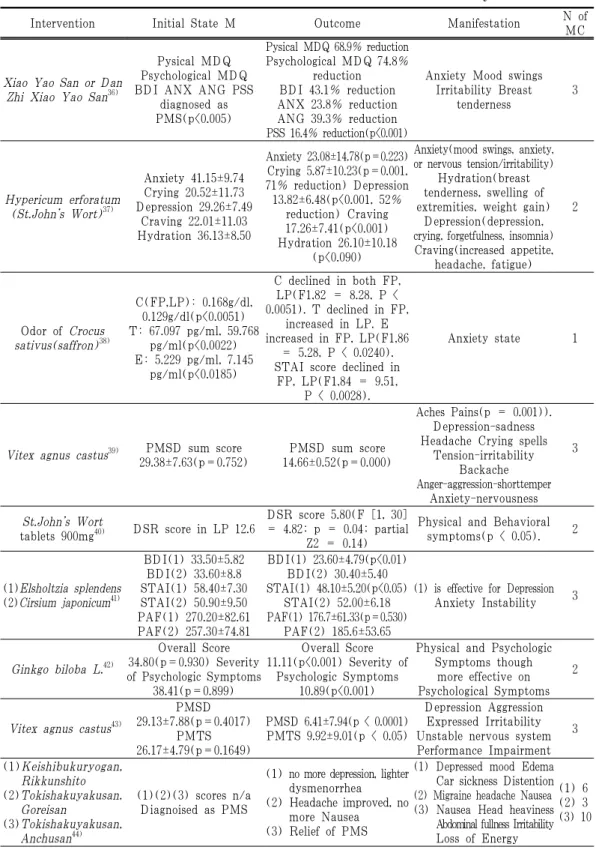
Table 4. The Effect of Herb or Herb Decoction for Premenstrual Syndrome
Saffron (Crocus ativus)
45)
DSR < 50 PMS diagnosed by HDRS
50% reduction in severity of symptoms by DSR and
HDRS. (P < 0.001)
Depression General premenstrual symptoms 4
Kamishoyosan
46)
SDPTG -0.24±0.08
†
PMS diagnosed byTOMRASS
SDPTG -0.19±0.07 (p<0.01) TOMRASS score
improved w/ VA-age>0 (p<0.01) VA-age>0
‡
y=0.18x+4.09 w/ SEE =6.03 years Improved VA, reduced the d/a ratio w/o
the b/a ratio change.
Irritability Fatigue Mood swings Depression
Wanting to lie down 3
St.John's Wort
47)
MD score 326.33§
MD score 230.28(p≤0.007) Anxiety Hydration Craving Depression 2 St.John's Wort48)
n/amuch improved.
Symptoms did not reoccur for 5 menstrual cycles
Depressed mood
(PMDD symptoms) n/a
Vitex agnus castus extract
49)
DSR 171.758.1(p>0.05) HAM-D 15.24.7(p>0.05)
CGI-SI 4.11.4(p>0.05)
DSR 82.849.5(p>0.01) HAM-D 7.64.3(p>0.01) CGI-I 1.20.7(p>0.01)
Five symptoms diminished 50% or more.
Physical symptoms:
Irritability Breast tenderness Swelling Food
cravings Cramps 2
*M : Measurement, BDI : Beck Depression Inventory, ANX : state-anxiety, ANG : state-anger(ANX, ANG were measured with the Spielberger State Trait Personality Inventory, PSS : percieved stress scale, C : Cortisol level, T : Testosterone level, E : Estradiol level, FP : follicular phase, LP : luteal phase, STAI : the State-Trait Anxiety Inventory(psychological test), PMSD : Premenstrual Syndrome Diary, DSR : Daily Symptom Report, PAF : Premenstrual Assessment Form, PMSD : Premenstrual Syndrome Diary (four-point rating scale), PMTS : The Premenstrual Tension Syndrome Self-Rating Scale, HDRS : Hamilton Depression Rating Scale(17-item), SDPTG : second derivative of the fingertip photoplethysmogram, TOMRASS : Tokyo Women’s Medical University Oriental Medicine Research Active Support System(0 to 4 with 0 as no pain of 5 chief complaints), VA : vascular age, SEE : Standard error of estimate), MD : Menstrual Diary(made up of 25 symptoms).
†The SDPTG waveform, the values(waves, a,b,c,d in systole, and the e wave in diastole) divided by the height of the a wave are used.
‡Three indices b/a, d/a, VA were evaluated with VA as 45.5(b-c-d-e)/a+65.9 years old. Evaluation of VA done by the differences between the VA and chronological age(VA-Age).
§1330 as the maximum score.