The use of Thermodynamics and Phase Equilibria for Prediction of the Behavior of High Temperature Corrosion of
Alloy 617 in Impure Helium Environment
Dong-Jin Kim†, Gyeong-Geun Lee, Sung Woo Kim, and Hong Pyo Kim
Nuclear Materials Research Division, Korea Atomic Energy Research Institute(KAERI), P. O. Box 105, Yuseong, Daejeon, 305-353, Korea
(Received May 26, 2010; Revised July 22, 2010; Accepted July 23, 2010)
Thermodynamic consideration was performed for Alloy 617 exposed to an impure helium (H2 20pa, H2O 0.5pa, CH4 2pa and CO 5pa) at 950 ℃. Oxidation power was decreased in the order Al > Ti > Si >
Cr > Mn. Decarburization and carburization reactions were available leading to carbon activity decrease and increase, respectively, depending on carbon and Cr activities. The thermodynamic prediction was compared with the experimental results obtained in similar conditions ((H2 20pa, H2O 0.05pa, CH4 5pa and CO 2pa) and 950 ℃) by others for Alloy 617. The driving force for oxidation of Al, Ti and Si is very large to be oxidized at a given impure helium and the environment is actually carburizing towards the structural alloy, which is consistent with this work.
Keywords : impure helium, high temperature corrosion, thermodynamics, alloy 617
†Corresponding author: [email protected]
1. Introduction
Helium is considered as a coolant in a very high temper- ature reactor (VHTR) among generation IV nuclear power plants due to its advantages of inert gas, high thermal con- ductivity, low neutron absorption and etc. Impurities such as hydrogen, water, methane and carbon monoxide are in- evitably introduced in the helium coolant, which is related to the reactions with graphite in the core.1) Compositional changes of these impurities change the surface reactions available on the material exposed to impure helium envi- ronment. Very high temperature above 850 ℃ for VHTR facilitates the surface reaction rate. In particular, surface reaction on the materials for intermediate heat exchanger (IHX) and reactor core which are exposed to very high temperature helium should be paid great attention.
A stable oxidation prevents material degradation, an in- ternal oxidation lessens mechanical resistance, carburiza- tion embrittles material and decarburization makes materi- al weak.2) Moreover long term integrity of protective oxide should be achieved without a significant spallation of ox- ide for a long term operation of nuclear power plants.
A review of the thermodynamics gives us which reactions
are available on the surface of materials among oxidation, carburization and decarburization but it does not give us kinetic preference. This kinetic preference can induce oc- currence of another reaction in the restricted area, kinetic irreversibility and long term material instability leading to material degradation.
Therefore a finding of an impurity range where material is stable will give a very important information for long term coolant chemistry guide line through a combination of thermodynamics and kinetics. In this work, surface re- actions for Alloy 617 as a candidate for IHX exposed to an impure helium at 950 ℃ were investigated in view of thermodynamics. The thermodynamic prediction was com- pared with the experimental results which were obtained in similar gas composition (H2 20pa, H2O 0.05pa, CH4
5pa and CO 2pa) and at 950 ℃ for Alloy 617.
2. Method
Table 1 shows chemical composition for Alloy 617.
Alloy 617 strengthened by Mo and Co as the alloying elements of substitutional solid solution and by C and B as the alloying elements of interstitial solid solution is known as the most promising IHX material due to the high creep resistance.1) Gas composition of H2 20Pa, H2O 0.5Pa, CH4 2Pa and CO 5Pa was considered, based on
Table 1. Chemical compositions of Alloy 617, wt.%.
Chemical Analysis
C Mn Fe S Si Cu Ni Cr Al Ti Co Mo P B
Alloy 617 0.08 0.11 1.49 0.001 0.06 0.08 53.16 22.16 1.12 0.35 11.58 9.80 0.003 0.002
previous reports.1)-5)
Thermodynamic considerations for the reactions were performed by using HSC Chemistry 6.0 as software for thermodynamic database.6)
3. Results and discussion
Gas/gas reaction is not considered because of very dilute and flowing condition where there is an extremely low collision probability. From this, steady state rather than thermodynamic equilibrium is assumed.3)
Regarding the impurities in helium coolant of VHTR, water and hydrogen are introduced inevitably due to out- gassing, air ingress and in-leakage. Consequently methane and carbon monoxide are formed by reactions (1) and (2), respectively, with graphite in the core.
C + 2H2 = CH4 (1)
C + H2O = CO + H2 (2)
Moreover oxygen can react with graphite to form CO.
The equilibrium partial pressure of oxygen for this reaction at 950 ℃ is very low to be about 10-23 atm indicating that any introduction of oxygen can cause CO formation.
Driving force for CO formation is larger than CO2 for- mation and reduction of CO2 to CO is available indicating that the presence of CO2 as an impurity in the helium is much less probable.
At a given gas composition, the equilibrium partial pres- sure of oxygen for the reaction (3) at 950 ℃ is about 10-19 atm which is very low value but higher than the equili- brium partial pressure of oxygen for CO formation reaction.
H2 + 1/2O2 = H2O (3)
Surface reactions on material used for IHX depend on material composition, helium impurity ratio, impurity con- centration, temperature, time, kinetics and etc, which affect material corrosion and material degradation. This is why surface reaction should be predicted and a sample surface after high temperature experiment should be analyzed.
Reactions (4) ~ (13) can be considered for chromium.
Reaction (4) represents oxidation of Cr. Reactions (5) and
(6) imply carbide decomposition following decarburiza- tion, respectively. By reactions with methane, oxide reduc- tion and carburization, followed by carbide formation can be considered as shown for reactions (7) ~ (9). CO can react with Cr to form oxide and carbide like reactions (10) and (11). Reactions (12) and (13) show carbide formation reactions.
3H2O + 2Cr = Cr2O3 + 3H2 (4)
6H2O + Cr23C6 = 23Cr + 6CO + 6H2 (5) (H2O + C(s) = CO + H2)
3H2O + Cr7C3 = 7Cr + 3CO + 3H2 (6) (H2O + C(s) = CO + H2)
3CH4 + Cr2O3 = 3CO + 2Cr + 6H2 (7) 6CH4 + 23Cr = Cr23C6 + 12H2 (8) 3CH4 + 7Cr = Cr7C3 + 6H2 (9) 6CO + 27Cr = 2Cr2O3 + Cr23C6 (10) 3CO + 9Cr = Cr2O3 + Cr7C3 (11)
3C + 7Cr = Cr7C3 (12)
6C + 23Cr = Cr23C6 (13)
Moreover minor elements should be considered for sur- face reactions. It should be noted that the water tends to oxidize and decarburize the material, the methane tends to reduce and carburize the material and the carbon mon- oxide tends to oxidize and carburize the material. As men- tioned above, a stable oxidation prevents material degrada- tion under well balanced environment while an internal oxidation and/or non adherent oxide leads to mechanical weakening and spallation, carburization embrittles material and decarburization lessens high temperature creep strength.2) Therefore the well balanced environment should be de- termined and confirmed experimentally.
In particular, direction of reaction by CO (reactions (10) and (11), more generally reaction (14)) depends on CO
gas composition and activities of carbon and metallic ele- ment in the solid. Direction of this reaction called as mi- croclimate reaction2) is deeply related with the stability of metal under impure He. The physical size of the zone within which the processes occur is extremely small and probably at least an order of magnitude less than the thick- ness of the oxide - hence the term "microclimate".4)
MO + C = CO + M (14)
As CO content is lower than a critical concentration, oxide and carbon in the alloy cannot coexist but forward reaction occurs to form CO until one of oxide or carbon disappears without a help of any gaseous species.1) At this time, oxide is reduced and carbon is dissolved into material to be embrittled if CH4 content is relatively higher than H2O content. However metal is oxidized and decarburized to be less creep resistant if H2O content is relatively higher than CH4 content. Oxide is reduced again to form CO which makes surface layer porous. Therefore the CH4/H2O ratio is also important to prevent material degradation.
According to reaction (14), equilibrium constant K = aM․pCO / aC, where aM, pCO and aC represent the activity of metal, the partial pressure of CO and the carbon activity, respectively.
Let us consider the surface reaction (14) during oxida- tion, decarburization and carburization. First, during the oxidation, Cr activity will decrease at oxide/metal interface causing an increase of CO partial pressure. Secondly, car- bon activity will decrease leading to CO partial pressure decrease and carbide decomposition during decarburization.
Finally, carburization induces carbon activity increase with the time causing the pCO increase and carbide formation.
Activity and partial pressure change with the time accord- ing to surface reaction (14) indicating that a determination of a protective range of pCO rather than a finding of de- terministic pCO is a key to prevent a material from degra- dation.
Moreover carbide stabilizing element Mo and Mo6C for- mation will also decrease carbon activity leading to pCO decrease.3) Carbide formation and oxidation of minor ele- ments will affect pCO, pO2 and aC. According to the pre- vious reports,3)-5) carbon and Cr activities are not a unique value but 0.0015~0.004 and 0.35~0.77, respectively.
Uncertainty of the carbon activity and Cr activity will change CO partial pressure. Consequently, an optimum range of gas composition in the operating temperature range should be found, based on thermodynamic pre- diction and experimental results.
Fig. 1 shows the standard free energy, ΔGo for oxidation (oxidation 1) of various metals composing Alloy 617 by
0 200 400 600 800 1000
-120 -100 -80 -60 -40 -20 0 20
ΔGo / Kcal/mol
Temperature / oC
3Fe+4H2O(g)=Fe3O4+4H2(g) Ni+H2O(g)=NiO+H2(g) Ti+2H2O(g) = TiO2 + 2H2(g) Mo+2H2O(g) = MoO2 + 2H2(g) Mn+H2O(g) = MnO+H2(g) Si+2H2O(g) = SiO2+2H2(g) 2Al+3H2O(g) = Al2O3+3H2(g) 2Cr+3H2O(g) = Cr2O3+3H2(g)
per oxide
Fig. 1. Standard free energy, ΔGo for oxidation (oxidation 1) of various metals composing Alloy 617 by the reaction with H2O as a function of the temperature.
0 200 400 600 800 1000
-300 -280 -260 -240 -220 -200 -180 -160 -140 -120 -100 -80 -60 -40 -20
ΔGo / Kcal/mol
Temperature / oC
2Al+3CO(g) = Al2O3+3C Ti+2CO(g)=TiO2+2C Si +2CO(g) = SiO2+2C 2Cr+3CO(g) = Cr2O3+3C Mn+CO(g) = MnO+C
Fig. 2. Standard free energy, ΔGo for oxidation (oxidation 2) of various metals composing Alloy 617 by the reaction with CO as a function of the temperature.
the reaction with H2O as a function of the temperature.
Positive slope and negative value at 0 oK represent the entropy decrease, caused by decrease of number of moles and exothermic reaction of oxidation, respectively. Oxida- tion power was Al > Ti > Si > Cr > Mn. Ni and Fe do not react with H2O to be oxidized spontaneously.
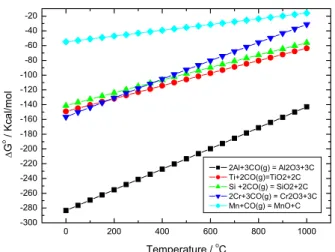
Fig. 2 shows the standard free energy, ΔGo for oxidation (oxidation 2) of various metals composing Alloy 617 by the reaction with CO as a function of the temperature.
ΔGo for oxidation 2 was larger than ΔGo for oxidation 1 at the standard state. The slope was more positive, which is caused by removal of gaseous CO. Oxidation power was also Al > Ti > Si > Cr > Mn.
Table 2 represents the driving force for oxide formation through oxidation 1 and oxidation 2 at a given gas compo-
Table 3. Driving force for the decarburization reaction, the combined reaction (reaction 1, M-C + H2O = M + CO + H2) of the decarburization reaction (C + H2O = CO + H2) and the carbide decomposition reaction (reaction 2, M-C = M + C) and the carbide decomposition reaction (M-C = M + C) at a given gas composition and 950 ℃.
Formula Reaction 1
(cal/mol)
Reaction 2
(cal/mol) Activity Remark
Decarburization -11,133 -11,133 0.004 Decarburization from matrix is available
TiC +2,805 +13,614 0.0035 Strong carbide bonding E
Cr7C3 -31,080 +2,319 0.72 Depending on carbon activity
Cr23C6 -66,611 +188 0.72 Depending on carbon activity
Mo2C -22,158 -11,024 0.1 Not easy carbide formation
SiC -23,153 -12,020 0.004 Not easy carbide formation
Table 2. Represents the driving force for oxide formation through oxidation 1 and oxidation 2 at a given gas composition and 950 ℃.
Oxide Oxidation 1(cal/mol)
Oxidation 2(cal/mol)
Metal
activity Remark Cr2O3 -37,132 -3,732 0.72 ΔG for rxn 2 +, - Al2O3 -133,298 -49,949 0.024
SiO2 -47,793 -25,526 0.004 TiO2 -55,301 -33,035 0.004 MnO -18,380
-1,593
-7,247 +9,540
1 0.001
ΔG for rxn 2 +, -as aMn~0.1
sition and 950 ℃. Driving force for oxidation 1 was larger than that for oxidation 2 unlike the results of the standard free energy. Oxidation power was Al > Ti > Si > Cr >
Mn. Cr can be oxidized or reduced depending on pCO, which is consistent with microclimate reaction at critical CO concentration (critical temperature, TA, the critical concentration increases with the temperature). Moreover Mn can be also oxidized or reduced depending on pCO. Fig. 3 shows the standard free energy, ΔGo for de- carburization of carbide forming metals among metals composing Alloy 617 as a function of the temperature.
Standard free energy, ΔGo for the combined reaction of the decarburization reaction, C + H2O = CO + H2 and the carbide decomposition reaction, M-C = M + C was plotted together. Negative slope and positive value at 0
oK represent the entropy increase, caused by increase of number of moles and endothermic reaction of decarburiza- tion, respectively. This decarburization reaction does not occur spontaneously at standard state. For this reaction, carbide formation tendency should be also considered.
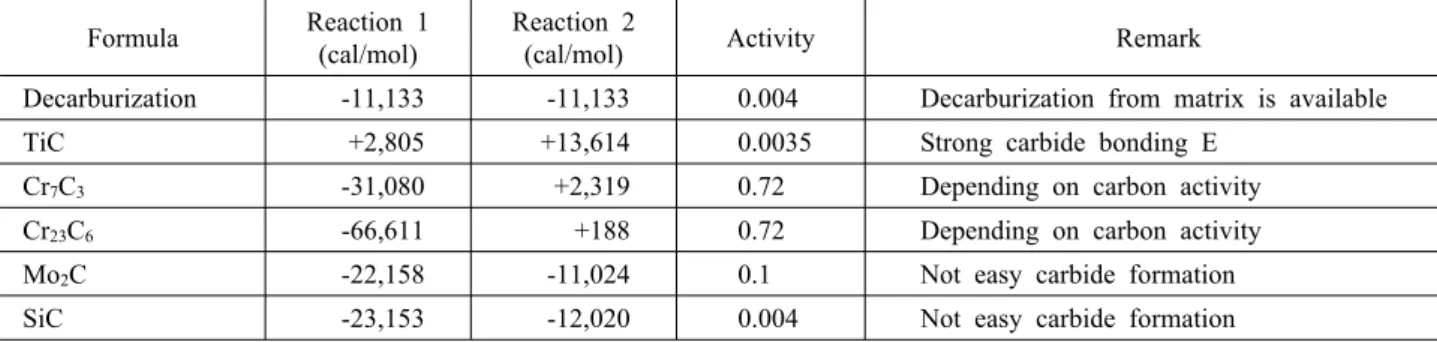
Table 3 represents the driving force for the decarburiza- tion reaction, the combined reaction (reaction 1, M-C + H2O = M + CO + H2) of the decarburization reaction (C + H2O = CO + H2) and the carbide decomposition reaction
0 200 400 600 800 1000
-20 0 20 40 60 80 100 120 140 160 180 200 220 240
ΔGo / Kcal/mol
Temperature / oC C+H2O(g) = CO(g)+H2(g) H2O(g) + TiC = Ti+CO(g)+H2(g) 3H2O(g) + Cr7C3 = 7Cr + 3CO(g) + 3H2(g) 6H2O(g) + Cr23C6 = 23Cr + 6CO(g) + 6H2(g) Mo2C+H2O(g)=2Mo+CO(g)+H2(g) H2O(g) + SiC = Si+CO(g)+H2(g)
Fig. 3. Standard free energy, ΔGo for decarburization of carbide forming metals among metals composing Alloy 617 as a function of the temperature.
(M-C = M + C) and the carbide decomposition reaction (reaction 2, M-C = M + C) at a given gas composition and 950 ℃. Decarburization reaction is available leading to carbon activity decrease. Cr carbide can be decomposed depending on carbon and Cr activities. However driving force for TiC formation is too strong to be decomposed.
Driving force for Mo2C and SiC formation was very weak to form carbides. Power for the combined reaction of the decarburization reaction and the carbide decomposition re- action was Cr23C6 > Cr7C3.
Fig. 4 shows the standard free energy, ΔGo for the car- burization and the carbide formation of carbide forming metals among metals composing Alloy 617 as a function of the temperature. Negative slope and positive value at 0oK for the carburization reaction CH4 = C + 2H2 represent the entropy increase, caused by increase of number of mo- les and endothermic reaction of carburization, respectively.
At standard state, carbide formation power was Cr23C6 >
Cr7C3 > TiC > SiC > Mo2C.
Table 4. Driving force for the carburization reaction, the combined reaction (reaction 1) of the carburization reaction (reaction 2) and the carbide formation reaction and the carbide formation reaction at a given gas composition and 950 ℃.
Formula Reaction 1
(cal/mol)
Reaction 2
(cal/mol) Activity Remark
Derburization -38,914 -38,914 0.004 Carburization to matrix is available
TiC -52,528 -13,614 0.0035 Carbide formation
Cr7C3 -119,061 -2,319 0.72 Carbide formation
Cr23C6 -233,672 -188 0.72 Carbide formation
Mo2C -27,890 +11,024 0.1 Difficult to form carbide
SiC -26,894 +12,020 0.004 Difficult to form carbide
0 200 400 600 800 1000
-100 -80 -60 -40 -20 0 20
ΔGo / Kcal/mol
Temperature / oC
CH4(g) = C + 2H2(g) Ti+C=TiC 3C + 7Cr = Cr7C3 6C + 23Cr = Cr23C6 2Mo +C =Mo2C Si + C = SiC
Carburization, Carbide formation
Fig. 4. Standard free energy, ΔGo for the carburization and the carbide formation of carbide forming metals among metals composing Alloy 617 as a function of the temperature.
0 200 400 600 800 1000
-180 -160 -140 -120 -100 -80 -60 -40 -20 0 20
ΔGo / Kcal/mol
Temperature / oC
CH4(g) = C + 2H2(g) CH4(g) + Ti =TiC + 2H2(g) 3CH4(g)+7Cr=Cr7C3+6H2(g) 6CH4(g)+23Cr=Cr23C6+12H2(g) CH4(g) + Mo =Mo2C+H2(g) Si + CH4(g) = SiC + 2H2(g)
Carburization + carbide formation
Fig. 5. Standard free energy, ΔGo for the carburization and the combined reaction (reaction 1, CH4 + M = M-C + 2H2) of the carburization reaction (CH4 = C + 2H2) and the carbide formation (reaction 2, M + C = M-C) of carbide forming metals among metals composing Alloy 617 as a function of the temperature.
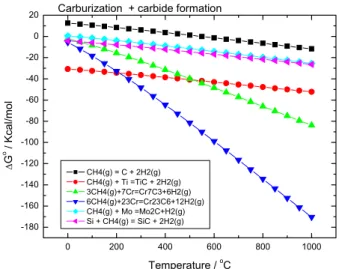
Fig. 5 shows the standard free energy, ΔGo for the car- burization (CH4 = C + 2H2) and the combined reaction (reaction 1, CH4 + M = M-C + 2H2) of the carburization reaction (CH4 = C + 2H2) and the carbide formation (reaction 2, M + C = M-C) of carbide forming metals among metals composing Alloy 617 as a function of the temperature. Power for the combined reaction of the carbu- rization reaction and the carbide formation reaction was Cr23C6 > Cr7C3 > TiC > SiC > Mo2C.
Table 4 represents the driving force for the carburization reaction, the combined reaction of the carburization re- action and the carbide formation reaction and the carbide formation reaction at a given gas composition and 950 ℃.
Carburization reaction is available leading to carbon ac- tivity increase. Cr carbide can be formed depending on carbon and Cr activities. However driving force for TiC formation is very strong. Mo2C and SiC formation is not available even though the combined reaction seems to be available. Power for the combined reaction of the carburi- zation reaction and the carbide formation reaction was Cr23C6 > Cr7C3 > TiC.
According to the previous report,1) Alloy 617 was tested under gas composition of H2 20pa, H2O 0.05pa, CH4 5pa and CO 2pa at 950 ℃. Long duration test in this impure helium showed that specimens still exhibit a surface oxide after 5000 h. This means that oxidation is a sustainable behavior for at least 5000 h. The surface chromia also contains titanium and some internal oxides containing Al, Ti or Si are also evident close to the oxide/alloy interface.
Cr23C6 following the carburization was mainly observed.
Mo rich M6C was also observed. Beneath the growing ox- ide scale, a carbide free zone develops. However surface scale was changed with the change of gas composition.
These results were compared with the results predicted in this work.
According to this work, driving force for oxidation of Al, Ti and Si is very large to be oxidized at a given impure helium, consistent with the results of the previous report.
The environment is actually carburizing towards the struc- tural alloy according to the prediction of this work but the formation of the surface oxide effectively can minimize the carburization by forming a barrier between the gas and the metal.
Regarding carbide, driving force for the combined re- action of carbide formation and the carburization is larger for Cr23C6 than Cr7C3 while the driving force for carbide formation is larger for Cr7C3 than Cr23C6 from the table 4 indicating that the main carbide would be Cr23C6, which is consistent with the experimental result. However ther- modynamic data for Mo rich M6C was not available un- fortunately from the HSC Chemistry 6.0 database, based on numerous thermodynamic data.
There is a review article for Alloy 617.7) With the an- nealing condition, two carbides are developed and ob- served along the grain boundary of Alloy 617. During the solution treatment at a minimum of 1150 ℃, M6C carbide is stable and at an ageing temperature below 1000 ℃ fol- lowing the solution treatment, M23C6 starts to form at the expense of the M6C, based on THERMOCALCⓇ calculation. This calculation predicts which carbides at the as solution annealed state and the aged state are stable, respectively.
M23C6 and M6C are thought to be the most and the sec- ond abundant carbide forms in Alloy 617, respectively, according to many experimental results. M23C6 is observed in the ageing temperature range of 400~1000 ℃, irre- spective of ageing time while M6C is not observed after long time ageing at temperatures below 900 ℃, which is different from the result by THERMOCALCⓇ calcu- lation which predicts a presence of M6C below 900 ℃ even though the amount of M6C is decreased with the temperature. In spite of discrepancy between the calcu- lation and the experimental results, the main carbide devel- oped with the high temperature ageing in the report7) is Cr23C6, which is well agreement with this work.
From this, it is expected that the carbide can be formed and developed variously during the alloy manufacturing and the ageing with the time and environment implying that the kinetics as well as thermodynamics should be con- sidered together in order to understand accurately the ma- terial degradation behavior under a high temperature heli- um environment.
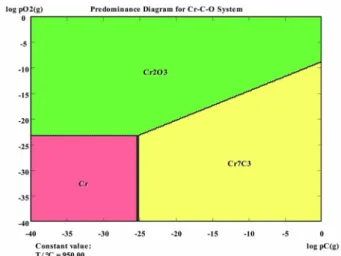
According to phase equilibrium diagram,6) Cr oxide is more stable in relatively high oxygen partial pressure and Cr carbide is more stable in relatively high carbon partial pressure, as shown in Fig. 6. It should be noted that Cr7C3
rather than Cr23C6 is the most stable form considering only the carbide stability. At a given gas composition (equilibrium oxygen and carbon partial pressures), Cr is oxidized and
Fig. 6. Phase equilibrium diagram for Cr-C-O at 950 ℃.
carbon as the forms of methane and carbon monoxide is moved into material through the oxide leading to carbide formation. This carburization, followed by carbide for- mation can embrittle the materials. When the oxide is very protective and (or) carbon activity is not high, the carburi- zation, followed by carbide formation can be retarded and the carbide developed internally during the alloy manu- facturing itself can affect the surface reactions such as the oxidation behavior under an impure helium environment.
This indicates that the selection of an optimum gas compo- sition is important for a given system.
Development of a carbide free zone is caused by chro- mium activity decrease due to the oxidation as mentioned above.
From this, it was confirmed that the experimental results were fairly well agreed with the thermodynamic prediction of this work. However, a further study on long term stabil- ity and kinetic preference through the combination of ki- netic and thermodynamic results is still needed under vari- ous gas compositions and variable gas composition.
4. Summary
Driving forces for many surface reactions available on Alloy 617 were investigated for gas composition of H2
20Pa, H2O 0.5Pa, CH4 2Pa and CO 5Pa at 950 ℃. Oxida- tion power was decreased in the order Al > Ti > Si >
Cr > Mn. Decarburization and carburization reactions were available leading to carbon activity decrease and increase, respectively, depending on carbon and Cr activities. Both powers for the combined reaction of the decarburization reaction and the carbide decomposition reaction and the combined reaction of the carburization reaction and the carbide formation reaction were Cr23C6 > Cr7C3. The thermodynamic prediction was consistent with the
experimental results obtained in similar conditions ((H2
20pa, H2O 0.05pa, CH4 5pa and CO 2pa) and 950 ℃) by others for Alloy 617.
An optimum impurity range as well as impurity ratio needs to be found, based on thermodynamics and kinetics in the future.
Acknowledgement
This work was funded by Korea Ministry of Education, Science and Technology.
References
1. C. Cabet and F. Rouillard, J. Nuclear Materials, 392, 235 (2009).
2. K. G. E. Brenner and L. W. Graham, Nucl. Technol.
66, 404 (1984).
3. W. J. Quadakkers, Werkstoffe und Korrosion, 36, 335 (1985).
4. M. R. Warren, High Temperature Technology, 4, 119 (1986).
5. C. Cabet, J. Chapovaloff, F. Rouillard, G. Girardin, D.
Kaczorowski, K. Wolski, and M. Pijolat, J. Nuclear Materials, 375, 173 (2008).
6. HSC Chemistry, 6.0.
7. W. Ren and R. Swimdeman, J. Pressure Vessel Technol., 131, 024002 (2009).