서 론
한국 사회의 급속한 고령화와 서구식 생활양식의 일반화로 인해 심뇌혈관 질환의 유병 인구가 증가하고 있으며 이 때문에 지출되는 사회경제적 비용도 빠른 속도로 증가하고 있다. 심혈관계 질환은 심 장과 주요 동맥에서 발생하는 질환을 말하며 통상적으로 뇌혈관 질
환과 허혈성 심질환을 의미하는데, 이 두 가지 질병은 우리나라 인구 의 사망 원인 중 큰 부분을 차지하며 특히 2014년에는 24,486명이 뇌 혈관 질환으로 사망하여 사망률이 인구 10만 명당 48.2명이었다. 허 혈성 심질환 역시 2014년에 14,184명이 사망하여 10만 명당 사망률은 27.9명이었다. 따라서 2014년 심혈관계 질환 사망률은 10만 명당 76.1 명으로 전체 사망의 약 14.4%를 차지하였다.1)
Original Article
중년 남성에서 혈청 Ferritin과 Atherosclerotic Cardio Vascular Disease Risk Estimator를 이용한 심혈관계 질환 발생
위험도와의 관련성
김경민, 박선기*, 김동휘, 신성군
동의병원 가정의학과
The Relationship between Serum Ferritin Level and Cardiovascular Disease Risk Calculated by Atherosclerotic Cardio Vascular Disease Risk Estimator in Middle-Aged Men in Korea
Kyung-Min Kim, Seon-Ki Park*, Dong-Hui Kim, Seong-Gun Shin
Department of Family Medicine, Dong-Eui Hospital, Busan, KoreaBackground: Body iron stores are associated with lipid oxidation, which influences cardiovascular disease via inflammation. The purpose of this study was to evaluate the relationship between serum ferritin level and cardiovascular disease risk calculated by the atherosclerotic cardio vascular disease (ASCVD) Risk Estimator.
Methods: The data of 2,252 men aged 40–59 years, from the fifth Korean National Health and Nutrition Examination Survey, were used. Data were collected by using a self-reported questionnaire, a blood test, and measurement of blood pressure, height, and weight. Serum ferritin, glucose, hemoglobin A1c (HbA1c), total cholesterol, high density lipoprotein cholesterol, and triglyceride levels were measured in the fasting state. The ASCVD Risk Estimator, which consists of pooled cohort equations, was used to calculate cardiovascular disease risk in the next 10 years.
Results: The serum ferritin level was significantly and positively correlated with body mass index, glucose, HbA1c, and triglyceride levels, and diastolic blood pressure. The significant differences of age, total cholesterol, diabetes and smoking were seen according to the quartile of serum ferritin. The 10 year ASCVD risk was higher in the fourth quartile of ferritin than in the second quartile (P=0.01).
Conclusion: Elevated serum ferritin concentration is associated with an increased risk of cardiovascular disease in middle-aged men.
Keywords: Middle Aged; Ferritins; Atherosclerosis; Cardiovascular Diseases
http://dx.doi.org/10.21215/kjfp.2016.6.2.79 pISSN 2233-9019 · eISSN 2233-9116 Korean J Fam Pract. 2016;6(2):79-83KJFP
Korean Journal of Family PracticeReceived February 17, 2016 Accepted March 11, 2016 Corresponding author Seon-Ki Park
Tel: +82-51-850-8763, Fax: +82-51-850-8965 E-mail: [email protected]
Copyright © 2016 The Korean Academy of Family Medicine
This is an open-access article distributed under the terms of the Creative Commons At- tribution Non-Commercial License (http://creativecommons.org/licenses/by-nc/4.0) which permits unrestricted noncommercial use, distribution, and reproduction in any medium, provided the original work is properly cited.
Kyung-Min Kim, et al. Relationship between Serum Ferritin Level and Cardiovascular Disease Risk
Korean Journal of Family Practice
KJFP
철은 DNA 합성, 에너지 생성, 전자 전달, 기질의 산화 같은 기본적 인 세포 기능에 관여하여 세포의 생존과 복제에 필수적이나,2) 반면 에 oxidative stress에 의해 활동성 산소기의 생성을 초래하는 것으로 알려져 있다.3) 철의 정상인 체내 총량은 3–4 g 정도이며 분포는 he- moglobin (67%), 저장 철(27%), myoglobin (4%), enzyme (0.2%), transfer- rin (0.1%) 순으로 되어있다.
Ferritin은 iron-free apoferritin과 철이 결합한 철 저장 단백으로 대 부분 간, 비장의 실질 세포, 식세포, 골격근, 골수의 조직구등에서 발 견되며 혈청에서는 극미량만 존재한다.4) 저장 철의 약 2/3가 ferritin 과 결합되어 있으므로 건강한 성인에서 혈청 ferritin의 양은 체내 이 용 가능한 철 저장량을 직접적으로 표시하는 지표가 된다. 체내 저 장된 철은 관상동맥 심장질환 발생과 관련 있다고 알려져 왔는데,5) 체내 저장된 철이 oxidative stress를 통하여 지질의 산화에 중요한 역 할을 하며 산화된 지질이 혈관 내 염증을 유발하여 심혈관 질환을 유발하는 것으로 보고되었다.6-10)
혈청 ferritin과 심혈관계 위험 인자와의 관련 연구에서 혈청 ferri- tin은 심혈관계 위험 인자인 고혈압, 지질, 혈당 등과 관련이 있다고 알려져 있다.11-13)
Halil 등14)은 프래밍햄 위험 점수(Framingham risk score)가 높은 그 룹에서 낮은 그룹에 비해 혈청 ferritin이 증가했음을 통해 혈청 ferri- tin과 심혈관계 질환 발생 위험도와의 관련성을 보고하였다.
프래밍햄 위험 점수는 관상동맥 심장질환 발생을 10년 절대 위험 도로 추정하는 다변량 모형으로,15) 심혈관계 질환의 위험도를 평가 하고 위험 인자를 관리하기 위한 전통적인 지침이다. 그러나 이 점수 에는 몇 가지 제한점이 발견되었는데, 고지혈증이 아닌 정상 군에서 상당수의 심혈관계 질환이 발생하면서 프래밍햄 위험 점수의 위험 인자들이 모든 심혈관계 질환의 발생을 예측할 수 없다는 점,16) 미국 에서 조사된 자료를 바탕으로 만들어졌기 때문에 심혈관계 질환 사 망률이 미국보다 낮은 집단에서는 관상동맥 질환의 위험을 과대평 가할 수 있다는 점이다.17)
2013년 미국심장협회와 미국심장학회 치료지침에서 이용했던 pooled cohort equations인 Atherosclerotic CardioVascular Disease (AS- CVD) Risk Estimator는 Framingham (Original and Offspring) Study cohorts, ARIC (Atherosclerosis Risk In Communities study), CARDIA (Coronary Artery Risk Development In young Adults), and CHS (Car- diovascular Health Study)를 포함한 National Heart, Lung, Blood Insti- tutes (NHLBI) cohort study에 근거를 두고 있으며 프래밍햄 위험 점수 보다 더 포괄적으로 심혈관계 질환의 10년 절대 위험도를 예측한 다.18)
이에 본 연구는 ASCVD Risk Estimator를 이용하여 한국 중년 남
성을 대상으로 혈청 ferritin과 심혈관계 질환 발생 위험도와의 관련 성에 대해 알아보고자 한다.
방 법
1. 연구대상
본 연구는 국민건강영양조사 제5기(2010–2012년) 자료를 토대로 이루어졌다. 이 조사는 시ㆍ도, 동ㆍ읍ㆍ면, 주택 유형을 기준으로 층 화 후 576개 표본 조사구를 추출하고 표본 조사구 내에서는 계통추 출방법으로 조사구 당 20개의 최종 조사 대상 가구를 추출하여 전 국 약 11,500가구, 만 1세 이상 가구원 전체를 조사대상으로 2010년 1 월부터 2012년 12월까지 시행되었다.19)
본 연구대상은 제5기 전체 참여자 25,533명 중 40–59세 성인남성 3,161명에서 악성종양, 신부전, 간경변, B형간염, C형간염의 병력을 가 진 경우, B형 표면 항원이 양성인 경우, 헤모글로빈 수치가 13 g/dL 미 만인 경우, 혈청 ferritin이 500 ng/mL 초과이거나 10 ng/mL 미만인 경 우, 간 효소 수치인 aspartate transaminase (AST)와 alanine transami- nase (ALT)가 분석 기기에서 제시한 참고치 기준(AST <40 IU/L, ALT
<40 IU/L)보다 2배 초과하여 높은 경우, creatinine 수치가 증가한 경 우(>1.5 mg/dL), 백혈구가 3,000개/μL 미만이거나 11,000개/μL 초과인 경우, 해당 조사(설문, 검진)에 대한 결측값이나 무응답인 경우를 제 외한 총 2,252명이었다.
2. 연구방법
검진 조사에서 신체 계측을 통해 혈압, 체중과 신장을 측정하였 고, 혈액검사를 통해 공복 혈당, 당화혈색소, 혈중 지질 농도, ferritin 을 측정하였다. 혈액 채취는 공복 상태(8시간 이상)에서 시행하였고 공복 혈당과 혈중 지질 농도는 Hitachi Automatic Analyzer 7600 (Hit- achi, Tokyo, Japan)을, 당화혈색소는 HLC-723G7 (Tosoh, Tokyo, Japan) 을, ferritin은 1470 WIZARD gamma-Counter (PerkinElmer, Turku, Finland)를 이용하여 측정하였다. 체질량지수는 측정한 체중을 신장 의 제곱으로 나누어 계산하였으며, 혈압은 수은혈압계인 Bau- manometer Desk model 0320 (Baum, Methuen, MA, USA)을 이용하여 대상자가 편안히 의자에 등을 기대고 앉게 한 후에 측정 매뉴얼에 기 술된 방법으로 측정되었고 3번 측정치 중 2회와 3회째 측정치의 평균 치를 사용하였다.
건강 설문조사는 면접조사 및 자기 기입 방법으로 진행되었으며, 이를 통해 나이, 과거 병력, 현재 질환 및 약물 복용 여부, 흡연 상태를 조사하였다. 흡연 상태는 현재 흡연군과 현재 흡연하지 않는 군(비흡 연, 과거 흡연)으로 나누어 현재 흡연의 여부로 하였다.
김경민 외. 혈청 페리틴과 심혈관계 질환 발생 위험도와의 관련성 Korean Journal of Family Practice
KJFP
3. ASCVD Risk Estimator
나이, 총콜레스테롤, high density lipoprotein (HDL) 콜레스테롤, 수 축기 혈압 및 고혈압 치료 여부, 현재 당뇨 유무, 현재 흡연 여부로 구 성된 항목을 이용한 pooled cohort equations로 향후 10년간 심혈관계 질환의 절대 위험도(10-year ASCVD risk)를 예측한다.
4. 통계 분석
대상자들의 일반적 특성을 알아보기 위하여 연속형 변수는 평균
±표준오차로 제시하였고, 범주형 변수는 해당 대상 수(%)로 제시하 였다. 또한, 혈청 ferritin과 나이, 체질량지수, 수축기 혈압, 이완기 혈 압, 그리고 공복 혈당, 당화혈색소, 총콜레스테롤, 중성지방, HDL 콜 레스테롤, 10-year ASCVD risk와의 관계는 Pearson 상관분석으로, 혈 청 ferritin 사분위에 따른 ASCVD Risk Estimator의 구성요소 및 10- year ASCVD risk의 비교는 분산분석(analysis of variance, ANOVA)과 카이 제곱 검정을 이용하였다. 모든 통계 분석은 IBM SPSS Statistics version 22.0 (IBM Co., Armonk, NY, USA)을 사용하여 분석하였으며, P값이 0.05 미만인 경우를 통계적으로 유의한 것으로 정의하였다.
결 과
1. 연구 대상자들의 일반적 특성
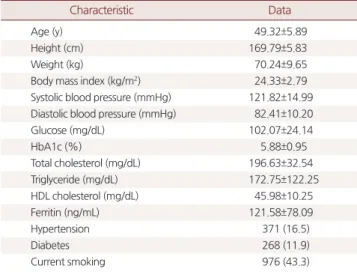
전체 대상자는 2,252명이며, 대상자들의 나이는 49.32±5.89세, 체질 량지수는 24.33±2.79 kg/m2였다. 대상자 중 고혈압은 371명(16.5%), 당 뇨는 268명(11.9%), 현재 흡연 군은 976명(43.3%)으로 나타났으며, 혈청 ferritin 수치는 121.58±78.09 ng/mL였다(Table 1).
2. 혈청 ferritin과 심혈관계 위험 인자 및 심혈관계 질환 발생 위험도와의 연관성
혈청 ferritin과 10-year ASCVD risk (r=0.080, P<0.001)는 유의한 양 의 상관관계를 가진다. 체질량지수(r=0.152, P<0.001), 공복 혈당 (r=0.175, P<0.001), 당화혈색소(r=0.124, P<0.001), 중성지방(r=0.200, P<0.001), 이완기 혈압(r=0.051, P=0.015) 또한 유의한 양의 상관관계를 가지며 HDL 콜레스테롤(r=-0.044, P=0.035)과는 유의한 음의 상관관 계를 가진다(Table 2).
3. 혈청 ferritin 수준에 따른 심혈관계 질환 발생 위험도
혈청 ferritin 사분위에 따른 연구 대상자들의 10-year ASCVD risk 는 6.29±5.29%, 6.09±4.84%, 6.77±5.51%, 7.04±5.57%로 혈청 ferritin 수 준이 증가함에 따라 10-year ASCVD risk는 통계적으로 유의한 차이 가 있었다(P=0.01). ASCVD Risk Estimator의 구성 요소 중에서는 나 이, 총콜레스테롤, 당뇨, 흡연이 혈청 ferritin과 유의한 관련성을 보였 으나, HDL 콜레스테롤, 수축기 혈압은 유의한 차이를 보이지 않았다 (Table 3).고 찰
본 연구는 국민건강영양조사 5기를 대상으로 ASCVD Risk Esti- mator로 측정된 10년간 심혈관계 질환 발생 위험도를 이용하여 심혈 관계 질환 발생 위험도와 혈청 ferritin과의 관련성을 알아보기 위해 수행되었다.
본 연구에서, 한국 중년 남성의 혈청 ferritin 수치 증가와 10년간 심 혈관계 질환 발생 위험도 증가는 유의한 관련성이 있는 것으로 나타 났다.
체내 철 저장량의 증가가 관상동맥 질환과 연관성이 있다는 연구
Table 2. Correlation of serum ferritin with cardiovascular risk factor and 10-year ASCVD risk
Variable r P-value
Age -0.027 0.193
Systolic blood pressure 0.025 0.237
Diastolic blood pressure 0.051 0.015
Body mass index 0.152 <0.001
Glucose 0.175 <0.001
HbA1c 0.124 <0.001
Total cholesterol 0.040 0.061
Triglyceride 0.200 <0.001
HDL cholesterol -0.044 0.035
10-year ASCVD risk 0.080 <0.001
P-values were obtained by Pearson’s correlation analyses.
ASCVD, atherosclerotic cardio vascular disease.
Table 1. Baseline characteristics of the subjects (n=2,252)
Characteristic Data
Age (y) 49.32±5.89
Height (cm) 169.79±5.83
Weight (kg) 70.24±9.65
Body mass index (kg/m2) 24.33±2.79
Systolic blood pressure (mmHg) 121.82±14.99 Diastolic blood pressure (mmHg) 82.41±10.20
Glucose (mg/dL) 102.07±24.14
HbA1c (%) 5.88±0.95
Total cholesterol (mg/dL) 196.63±32.54
Triglyceride (mg/dL) 172.75±122.25
HDL cholesterol (mg/dL) 45.98±10.25
Ferritin (ng/mL) 121.58±78.09
Hypertension 371 (16.5)
Diabetes 268 (11.9)
Current smoking 976 (43.3)
Values are presented as mean±standard deviation or number of subjects (%).
HbA1c, hemoglobin A1c; HDL, high density lipoprotein.
Kyung-Min Kim, et al. Relationship between Serum Ferritin Level and Cardiovascular Disease Risk
Korean Journal of Family Practice
KJFP
결과가 제시된 이후5) 이와 관련된 많은 연구가 있었다. 핀란드의 Kuopio Ischemic Heart Disease Risk Factor Study에서 핀란드인을 대상 으로 시행한 연구에서 혈청 ferritin 농도가 200 ng/mL 이상인 환자군 이 200 ng/mL 미만인 환자군보다 심근경색의 위험성이 2.2배 높은 것 으로 보고하였으며,20) Italian Bruneck Study에서는 40–59세 성인에서 혈청 ferritin 농도의 상승이 5년간의 경동맥 초음파 추적 관찰에 의 한 동맥경화증의 진행과 연관성이 있음을 보고하였다.21) 동물을 이 용한 실험에서도 과량의 철분이 동맥경화 형성을 증가시켰다.22)
본 연구에서는 혈청 ferritin과 심혈관계 위험 인자인 체질량지수, 공복 혈당, 당화혈색소, 중성지방, 이완기 혈압은 유의한 양의 상관관 계를 보였으며 이는 이전 연구 결과들과 유사하였다.12,20) 그리고 혈청 ferritin 사분위에 따라 나이, 총콜레스테롤, 당뇨, 흡연이 유의한 차이 를 보였으며, 10-year ASCVD risk도 2사분위에 비해 4사분위에서 통 계적으로 유의하게 더 높았다.
체내 증가된 저장 철이 심혈관계 질환 발생의 위험을 높이는 기전 으로, 혈청 철의 증가는 superoxide나 hydroxyl radical과 같은 반응성 산소종의 생성을 초래하여 low density lipoprotein (LDL) 콜레스테롤 의 산화를 촉진시키고, 산화된 LDL 콜레스테롤이 대식세포에 섭취 되어 포말 세포를 만들며 염증반응을 유발하여 혈관 내피세포의 기 능 부전을 일으키는 것으로 알려져 있다.3,8,23) 또한, 심근 세포에서도 허혈성 손상을 유발하는 것으로 알려져 있다.20) 이와 같은 직접적인 영향 이외에도 혈청 철의 증가가 췌장에서 인슐린 합성과 배설에 영 향을 주고 인슐린 저항성을 증가시켜,24,25) ASCVD Risk Estimator의 구성 요소이자 심혈관계 위험 인자인 당뇨 발생에 영향을 미쳐 간접 적으로 심혈관계 질환 발생의 위험을 증가시키는 것으로 생각된다.
본 연구의 제한점으로는 첫 번째, 단면 연구이기 때문에 혈청 ferri- tin 수치와 심혈관계 질환 발생 위험도 간에 직접적인 인과 관계를 확 인할 수 없다는 점이다. 두 번째, 혈청 ferritin 수치가 체내 철 저장량 과 상관없이 변화가 생길 수 있는 경우를 배제하기 위해 병력과 혈액
검사 항목을 최대한 참조하였으나 검사 및 설문 항목이 제한적이어 서 C-reactive protein, 자가 면역 질환 병력 등의 다양한 지표를 참고 할 수 없어 ferritin 수치에 영향을 미칠 수 있는 모든 혼란 변수를 배 제하지 못하였다는 점이다. 세 번째, 2013년 미국심장협회와 미국심 장학회 치료지침이 아시아인을 대상으로 한 연구를 포함시키지 않 았다는 것을 고려했을 때 ASCVD Risk Estimator가 아시아인에서 과 대평가될 수 있다는 점이다.
이러한 제한점에도 불구하고, 국민건강영양조사라는 대표성 있 는 집단을 대상으로 했으며 혈청 ferritin에 영향을 주는 인자들을 배 제하기 위해 혈청 ferritin이 500 ng/mL 초과인 경우뿐만 아니라 10 ng/mL 미만인 경우도 같이 제외하여 정상 ferritin 수치에서의 심혈관 계 질환 발생 위험도와 연관성을 연구하려고 했다는 것에 이 연구의 의의가 있다.
결론적으로, 한국 중년 남성에서 혈청 ferritin은 심혈관계 위험인 자와 유의한 양의 상관관계를 보였으며, 10년간 심혈관계 질환 발생 위험도와도 유의한 관련성을 보였다. 앞으로, 혈청 ferritin과 심혈관 계 질환 발생 위험도 간에 선행 관계를 더 정확히 규명하기 위해서는 대규모 전향적 연구가 필요할 것으로 생각된다. 이를 통해 체내 저장 철의 수치를 관리하는 것이 심혈관계 질환 발생 예방에 기여할 수 있 을지에 관한 연구 또한 필요할 것으로 생각되는 바이다.
요 약
연구배경:
체내 저장된 철은 지질의 산화에 중요한 역할을 하며 산 화된 지질이 혈관 내 염증을 유발하여 심혈관계 질환을 유발시키는 것으로 생각되고 있다. 본 연구에서는 체내 철 저장 상태를 반영하는 혈청 ferritin과 ASCVD Risk Estimator를 이용한 심혈관계 질환 발생 위험도와의 관련성을 알아보고자 한다.방법:
국민건강영양조사 제5기에 참여한 40–59세 성인 남성 2,252명 Table 3. Ten-year ASCVD risk and components of ASCVD Risk Estimator by quartiles of serum ferritinQuartile of serum ferritin
Q1 Q2 Q3 Q4 P-value
Age (y) 50.03±5.83 49.14±5.87 49.06±5.83 49.05±6.01 0.012
Total cholesterol (mg/dL) 193.12±31.20 196.36±31.45 198.74±33.12 198.32±34.07 0.015
HDL cholesterol (mg/dL) 46.48±10.66 45.95±9.59 46.09±10.49 45.39±10.22 0.350
Systolic blood pressure (mmHg) 121.91±15.56 120.80±15.13 121.92±14.90 122.66±14.31 0.219
Hypertension treatment 83 (14.7) 74 (13.1) 82 (14.6) 92 (16.3) 0.511
Diabetes 47 (8.3) 57 (10.1) 70 (12.4) 94 (16.7) <0.001
Current smoking 218 (38.7) 232 (41.2) 263 (46.7) 263 (46.7) 0.011
10-year ASCVD risk (%) 6.29±5.29 6.09±4.84 6.77±5.51 7.04±5.57 0.010
Values are presented as mean±standard deviation or number of subjects (%). P-values were obtained by analysis of variance (ANOVA) and chi-square test.
ASCVD, atherosclerotic cardio vascular disease.
김경민 외. 혈청 페리틴과 심혈관계 질환 발생 위험도와의 관련성 Korean Journal of Family Practice
KJFP
에서 설문조사, 신체계측, 혈압측정 및 혈액검사를 통해 측정된 수축 기 혈압, 이완기 혈압, 체질량지수, 공복 혈당, 당화혈색소, 총콜레스 테롤, HDL 콜레스테롤, 중성지방, 혈청 ferritin을 이용하여 심혈관계 위험인자, ASCVD Risk Estimator의 구성 요소 및 심혈관계 질환 발생 위험도와 혈청 ferritin과의 관계를 분석하였다.
결과:
혈청 ferritin과 심혈관계 위험인자인 체질량지수, 공복 혈당, 당 화혈색소, 중성지방, 이완기 혈압은 유의한 양의 상관관계를 보였으 며 혈청 ferritin 사분위에 따라 나이, 총콜레스테롤, 당뇨, 흡연이 유 의한 차이를 보였으며, 10-year ASCVD risk도 2사분위에 비해 4사분 위에서 통계적으로 유의하게 더 높았다.결론:
한국 중년 남성에서 혈청 ferritin수치가 증가하는 것과 10년간 심혈관계 질환 발생 위험도가 증가하는 것은 유의한 관련성이 있었다.중심단어:
중년; 페리틴; 죽상경화증; 심혈관계 질환REFERENCES
1. Korean Statistical Information Service. The number of death and mortality by cause of death in 2014 [Internet]. Daejeon: Statistics Korea; 2015. [cited 2015 Nov 25]. Available from: http://kosis.kr.
2. Walker BL, Tiong JW, Jefferies WA. Iron metabolism in mammalian cells.
Int Rev Cytol 2001; 211: 241-78.
3. Richardson DR, Ponka P. The molecular mechanisms of the metabolism and transport of iron in normal and neoplastic cells. Biochim Biophys Acta 1997; 1331: 1-40.
4. Worwood M. Serum ferritin. CRC Crit Rev Clin Lab Sci 1979; 10: 171-204.
5. Sullivan JL. Iron and the sex difference in heart disease risk. Lancet 1981; 1:
1293-4.
6. de Valk B, Marx JJ. Iron, atherosclerosis, and ischemic heart disease. Arch In- tern Med 1999; 159: 1542-8.
7. Minotti G, Aust SD. Redox cycling of iron and lipid peroxidation. Lipids 1992; 27: 219-26.
8. Esterbauer H, Wag G, Puhl H. Lipid peroxidation and its role in atheroscle- rosis. Br Med Bull 1993; 49: 566-76.
9. Rehema A, Zilmer M, Zilmer K, Kullisaar T, Vihalemm T. Could long-term alimentary iron overload have an impact on the parameters of oxidative stress? A study on the basis of a village in southern Estonia. Ann Nutr Metab 1998; 42: 40-3.
10. Day SM, Duquaine D, Mundada LV, Menon RG, Khan BV, Rajagopalan S, et al. Chronic iron administration increases vascular oxidative stress and ac- celerates arterial thrombosis. Circulation 2003; 107: 2601-6.
11. Piperno A, Trombini P, Gelosa M, Mauri V, Pecci V, Vergani A, et al. Increased
serum ferritin is common in men with essential hypertension. J Hypertens 2002; 20: 1513-8.
12. Halle M, Konig D, Berg A, Keul J, Baumstark MW. Relationship of serum ferritin concentrations with metabolic cardiovascular risk factors in men without evidence for coronary artery disease. Atherosclerosis 1997; 128:
235-40.
13. Tuomainen TP, Nyyssonen K, Salonen R, Tervahauta A, Korpela H, Lakka T, et al. Body iron stores are associated with serum insulin and blood glucose concentrations. Population study in 1,013 eastern Finnish men. Diabetes Care 1997; 20: 426-8.
14. Halil M, Yavuz B, Yavuz BB, Cankurtaran M, Dede DS, Ulger Z, et al. Novel cardiovascular risk factors in the elderly and their correlation with the Framingham risk score. J Cardiovasc Med 2008; 9: 683-7.
15. Expert Panel on Detection, Evaluation, and Treatment of High Blood Cho- lesterol in Adults. Executive summary of the third report of the National Cholesterol Education Program (NCEP) expert panel on detection, evalua- tion, and treatment of high blood cholesterol in adults (adult treatment panel lll). JAMA 2001; 285: 2486-97.
16. Pearson TA. New tools for coronary risk assessment: what are their advan- tages and limitations? Circulation 2002; 105: 886-92.
17. Menotti A, Puddu PE, Lanti M. Comparison of the Framingham risk func- tion-based coronary chart with risk function from an Italian population study. Eur Heart j 2000; 21: 365-70.
18. Stone NJ, Robinson JG, Lichtenstein AH, Bairey Merz CN, Blum CB, Eckel RH, et al. 2013 ACC/AHA guideline on the treatment of blood cholesterol to reduce atherosclerotic cardiovascular risk in adults: a report of the Amer- ican College of Cardiology/American Heart Association Task Force on Practice Guidelines. Circulation 2014; 129(25 Suppl 2): S1-45.
19. Korea Centers for Disease Control and Prevention. Guidelines for using the fifth National Healthy and Nutrition Examination Survey (KNHANES V), 2010. Cheongju: Korea Centers for Disease Control and Prevention; 2011.
20. Salonen JT, Nyyssonen K, Korpela H, Tuomilehto J, Seppanen R, Salonen R.
High stored iron levels are associated with excess risk of myocardial infarc- tion in eastern Finnish men. Circulation 1992; 86: 803-11.
21. Kiechl S, Willeit J, Egger G, Poewe W, Oberhollenzer F. Body iron stores and the risk of carotid atherosclerosis: prospective results from the Bruneck study. Circulation 1997; 96: 3300-7.
22. Araujo JA, Romano EL, Brito BE, Parthe V, Romano M, Bracho M, et al. Iron overload augments the development of atherosclerotic lesions in rabbits.
Arteruiscer Thromb Vasc Biol 1995; 15: 1172-80.
23. Libby P, Ridker PM, Maseri A. Inflammation and atherosclerosis. Circula- tion 2002; 105: 1135-43.
24. Wilson JG, Lindquist JH, Grambow SC, Crook ED, Maher JF. Potential role of increased iron stores in diabetes. Am J Med Sci 2003; 325: 332-9.
25. Wolff SP. Diabetes mellitus and free radicals. free radicals, transition metals and oxidative stress in the aetiology of diabetes mellitus and complications.
Br Med Bull 1993; 49: 642-52.