• 검색 결과가 없습니다.

Porcine Dermal Collagen (Permacol) for Sternal ReconstructionKwang Hyoung Lee, M.D., Kwang Taik Kim, M.D., Ho Sung Son, M.D., Jae Seung Jung, M.D., Jong Ho Cho, M.D.

N/A
N/A
Protected

Academic year: 2021

Share "Porcine Dermal Collagen (Permacol) for Sternal ReconstructionKwang Hyoung Lee, M.D., Kwang Taik Kim, M.D., Ho Sung Son, M.D., Jae Seung Jung, M.D., Jong Ho Cho, M.D."

Copied!
4
0
0

로드 중.... (전체 텍스트 보기)

전체 글

(1)

Korean J Thorac Cardiovasc Surg 2013;46:312-315 □ Case Report □ http://dx.doi.org/10.5090/kjtcs.2013.46.4.312 ISSN: 2233-601X (Print) ISSN: 2093-6516 (Online)

− 312 −

Department of Thoracic and Cardiovascular Surgery, Korea University College of Medicine Received: August 20, 2012, Revised: February 7, 2013, Accepted: March 7, 2013

Corresponding author: Kwang Taik Kim, Department of Thoracic and Cardiovascular Surgery, Korea University College of Medicine, 73 Inchon-ro, Seongbuk-gu, Seoul 136-705, Korea

(Tel) 82-2-920-5369 (Fax) 82-2-928-5678 (E-mail) [email protected]

C

The Korean Society for Thoracic and Cardiovascular Surgery. 2013. All right reserved.

CC
This is an open access article distributed under the terms of the Creative Commons Attribution Non-Commercial License (http://creative- commons.org/licenses/by-nc/3.0) which permits unrestricted non-commercial use, distribution, and reproduction in any medium, provided the original work is properly cited.

Porcine Dermal Collagen (Permacol) for Sternal Reconstruction

Kwang Hyoung Lee, M.D., Kwang Taik Kim, M.D., Ho Sung Son, M.D., Jae Seung Jung, M.D., Jong Ho Cho, M.D.

In chest wall reconstruction after wide chest wall resection, the use of a musculocutaneous flap or prosthetic mate- rials is inevitable for maintaining thoracic movement and a closed pleural cavity. We report a case of a 63-year-old male with a large invasive thymic carcinoma in the anterior mediastinum. The mass measured 6.8 cm and involved the sternum, left side of the parasternal area, ribs, and intercostal muscles. The patient underwent subtotal sternectomy, radical thymectomy, and reconstruction with biological mesh (Permacol). Successful chest wall reconstruction without any other complications was achieved, demonstrating the effectiveness of Permacol.

Key words: 1. Mediastinal neoplsms 2. Thymectomy

3. Sternum 4. Surgical material

CASE REPORT

A 63-year-old male visited the hospital for chest pain. A simple chest radiologic examination suggested an anterior me- diastinum tumor. Other than the chest pain, the patient did not show myasthenia gravis or any other notable symptoms on physical examination. A chest computed tomography (CT) showed a 6.8 cm tumor at the anterior mediastinum (Fig. 1).

The tumor seemed to cover the left innominate vein and in- vade the thoracic wall. This tumor had invaded the sternum, left side of the parasternal area, ribs, and intercostal muscles.

Based on the positron emission tomography--CT results, hy- permetabolic uptake lesions were noted at the main mass and lymph nodes of the 3rd and 4th left costal bones and para- tracheal area. Accordingly, preoperative percutaneous needle biopsy was executed for the main mass, and the result came out as thymic carcinoma with the possibility of squamous cell

carcinoma.

Five cycles of neoadjuvant chemotherapy (paclitaxel+cispla- tin) were followed. After chemotherapy for three months, the tumor size seemed to have increased, but did not show any other metastasis according to the other test results.

Considering the patient and disease status, surgical treatment was planned.

After general anesthesia, a single-lumen endotracheal tube

was inserted and the operation proceeded in the supine

position. After a median skin incision, the mass invading the

chest wall was observed. Thus, undermining of both subcuta-

neous layers and muscle layers was performed in order to de-

termine the invasion range. In addition, extensive resection

procuring the tumor margin was performed at the sternal

body and 2nd through 5th intercostal rib cartilages using an

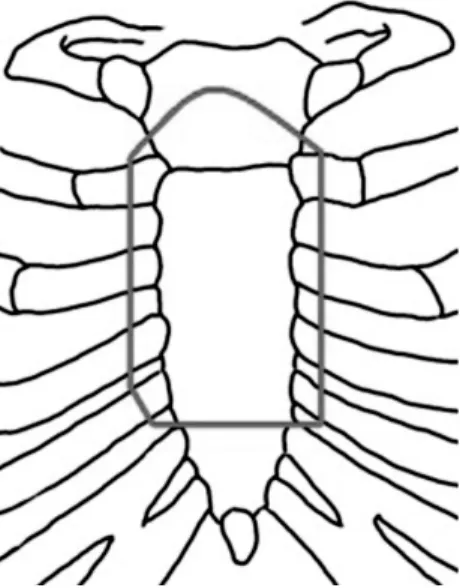
oscillating saw and rib cutter (Fig. 2). The tumor not only

had invaded the sternum and both chest walls, but had also

(2)

Sternal Reconstruction

− 313 − Fig. 1. Chest computed tomography shows an anterior mediastinal mass invading chest wall and costal cartilage, abutting the aortic arch and parietal pericardium.

Fig. 2. Upper 2/3 of sternal body with lower half of manubrium and 2nd through 5th intercostal rib cartilages at both sides were resected.

invaded the left jugular vein and the brachiocephalic vein, which were shrunken due to the tumor and had adhered to the left upper lobe. Hence, after saving and detachment of the left phrenic nerve, division at the superior vena cava-in- nominate vein junction and left jugular vein proximal area was performed by vascular endo-GIA. Despite the obstruction of the innominate vein and left jugular vein, symptoms such as left arm and facial swelling did not appear preoperatively.

Therefore, only vascular resection without reconstruction was done, and no such symptoms were noted postoperatively.

Tumor invasion to both lungs was also found. Therefore, both pleurae were opened, and wedge resections of the right and left upper lobes were performed using GIA staplers.

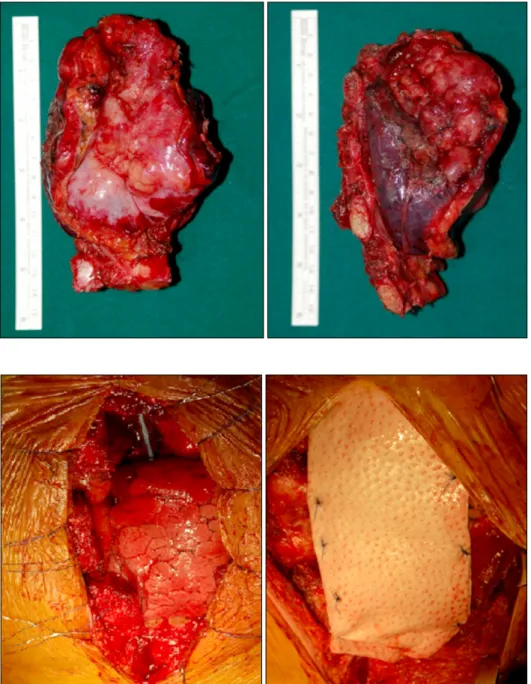
Since the tumor was also abutting the aortic arch, the parietal pericardium was opened and the tumor was cautiously de- tached and removed from the aortic wall (Fig. 3).

The sternum and chest wall defect was wide and chest wall reconstruction using a Permacol patch (20×15 cm) was planned. The margin of the defect was calculated as stated in Fig. 2, and was tailored based on the shape of the defect.

Using steel wire for the upper margin, suture of the manu- brium and a tailored patch were performed. The tailored patch was anchored at the lateral margins of the bilateral ribs and the lower margin with multiple intermittent sutures using 1/0 polypropylene. Finally, the chest wall reconstruction was completed (Fig. 4).

Postoperative pathological examination confirmed that the

tumor was thymic carcinoma (large-cell neuroendocrine carci- noma). Despite a normal appearance on intraoperative gross examination, the resection margins of the superior, medial, and lateral areas showed tumor involvement. In addition, metastasis to one lymph node (LN11) was confirmed.

The patient was transferred to the intensive care unit after the surgery, was extubated after 20 hours, and was transferred to the general ward on day 2 postoperatively. The mediastinal chest tube was removed on postoperative day 5, the peri- cardial Hemovac drain was removed on day 10 post- operatively, and the patient was discharged on postoperative day 19 without showing any other complications.

Considering R1 resection at the surgical margins, post- operative chemoradiation (chemotherapy, low-dose cisplatin: 7 cycles, radiotherapy, total 6,300 cGy/34F) was applied begin- ning from day 29 after surgery. Based on chest CT results taken 6 months after surgery, no signs of tumor relapse were observed and the patient did not show any abnormal signs or symptoms (Fig. 5).

DISCUSSION

Thymic carcinoma is a rare type of cancer among thymic

gland cancers, and chest pain, chest discomfort, cough, and

(3)

Kwang Hyoung Lee, et al

− 314 −

Fig. 3. Specimen consists of ster- num, rib, sternal mass and wedge resected lung.

Fig. 4. Permacol sewn into place with 1-0 polypropylene intermittent sutures.

sputum are some of the well-known symptoms. Thymic carci- noma often has progressed locally or metastasized remotely when observed. As a result, complete removal is often impos- sible and remote metastasis or local relapse is frequent, which results in a poor prognosis [1,2]. Complete resection is known to be the most effective treatment for thymic carcinoma. It is also reported to be the most important factor for determining the patient’s prognosis. Since single treatment methods such as anticancer chemotherapy or radiotherapy have their limits, multimodality treatment is suggested.

In this case, sternal invasion was verified and re- construction was necessary for the large defect after wide resection. The key aspects in chest wall reconstruction are protection of the internal organs, conservation of the thorax mobility range, and closure of the pleural cavity. Flail chest, paradoxical movement, pneumonia, pleural effusion, thoracic instability, infection, hematoma, and seroma are some of the most well-known complications [3].

Soft tissue reconstruction using a musculocutaneous flap

was frequently used in the past for chest wall reconstruction

(4)

Sternal Reconstruction

− 315 − Fig. 5. Therefore only vascular resection without reconstruction was done and no such symptoms were noted postoperatively.

of small defects. However, due to its limitation in repairable size and movement range, it has not been found to be suit- able for large defect reconstruction, and also had a high risk of wound dehiscence when vascularity worsened. Starting from the 1980s, prosthetic materials were used as an alter- native for chest wall reconstruction. However, side effects such as dislocation, infection, fistula, dense scarring, erosion, cracking, and bleeding are still a concern, and they cannot be used when infection is in progress.

Thus, bioprosthetic patches with a low infection risk are now being used. AlloDerm (LifeCell Co., Branchburg, NJ, USA), Dermamatrix (Musculoskeletal Transplant Foundation, Edison, NJ, USA), Surgisis (Cook Surgical, Bloomington, IN, USA), and Permacol (Tissue Sciences Laboratories plc, Aldershot, UK) are some of the commonly used biologic meshes. AlloDerm and Dermamatrix are freeze-dried human dermal tissue without inflammatory substances and cells, which show less rejection and shortened skin tissue re- generation time, and prevent burn scar contracture of the joint. However, as a tissue obtained from a corpse, it is high- ly probable that damaged elastin is included. As a result, the infection risk is also high as well as the risk of being ab- sorbed or adhered after transplant. Surgisis, on the other hand, is a tissue obtained from pig intestinal submucosal col-

lagen, which does not include elastin, while being strong due to collagen and is useful for transplanting tissues with high elasticity [4].

Permacol is an acellular sheet of porcine dermal collagen and its constituent elastin fibers are said to maintain their original three dimensional forms with the collagen fibers cross-linked using diisocyanate. This cross-linking with lysine and hydroxylysine residues within the collagen fibers of Permacol imparts a higher resistance to collagenases, a prop- erty which may account for its long-term durability [5].

In chest wall reconstruction after wide chest wall resection, the use of a musculocutaneous flap or prosthetic materials is inevitable for maintaining thoracic movement and closed pleural cavity. In this case, a successful chest wall re- construction using a biological mesh named Permacol was verified. Considering its low infection risk and high strength and durability, it can be applied to large chest wall defects.

Accordingly, it is thought to be applicable to the re- construction of other chest or abdominal wall defect reconstruction.

CONFLICT OF INTEREST

No potential conflict of interest relevant to this article was reported.

REFERENCES

1. Detterbeck FC, Parsons AM. Thymic tumors. Ann Thorac Surg 2004;77:1860-9.

2. Kondo K, Monden Y. Therapy for thymic epithelial tumors:

a clinical study of 1,320 patients from Japan. Ann Thorac Surg 2003;76:878-84.

3. Mansour KA, Thourani VH, Losken A, et al. Chest wall re- sections and reconstruction: a 25-year experience. Ann Thorac Surg 2002;73:1720-5.

4. Gaertner WB, Bonsack ME, Delaney JP. Experimental evalu- ation of four biologic prostheses for ventral hernia repair. J Gastrointest Surg 2007;11:1275-85.

5. Karpelowsky JS, Millar AJ. Porcine dermal collagen (Per-

macol) for chest and abdominal wall reconstruction in thor-

aco-omphalopagus conjoined twin separation. Pediatr Surg

Int 2010;26:315-8.

수치

Fig. 2. Upper 2/3 of sternal body with lower half of manubrium  and 2nd through 5th intercostal rib cartilages at both sides were  resected.
Fig. 3. Specimen consists of ster- ster-num, rib, sternal mass and wedge  resected lung.

참조

관련 문서