http://dx.doi.org/10.5090/kjtcs.2013.46.1.41 ISSN: 2233-601X (Print) ISSN: 2093-6516 (Online)
Department of Thoracic and Cardiovascular Surgery, Seoul National University Hospital, Seoul National University College of Medicine
†This manuscript has been presented at the 12th Asian Society for Vascular Surgery, Taipei, Taiwan, September 29 to October 2, 2011.
Received: December 18, 2012, Revised: December 31, 2012, Accepted: January 2, 2013
Corresponding author: Kyung-Hwan Kim, Department of Thoracic and Cardiovascular Surgery, Seoul National University Hospital, Seoul National University College of Medicine, 101 Daehak-ro, Jongno-gu, Seoul 110-744, Korea
(Tel) 82-2-2072-3971 (Fax) 82-2-765-7117 (E-mail) [email protected]
C
The Korean Society for Thoracic and Cardiovascular Surgery. 2013. All right reserved.
CC
This is an open access article distributed under the terms of the Creative Commons Attribution Non-Commercial License (http://creative- commons.org/licenses/by-nc/3.0) which permits unrestricted non-commercial use, distribution, and reproduction in any medium, provided the original work is properly cited.
Clinical Outcomes of Thromboendarterectomy for Chronic Thromboembolic Pulmonary Hypertension: 12-Year Experience
Se Jin Oh, M.D., Jin San Bok, M.D., Ho Young Hwang, M.D., Ph.D., Kyung-Hwan Kim, M.D., Ph.D., Ki Bong Kim, M.D., Ph.D., Hyuk Ahn, M.D., Ph.D.
Background: We present our 12-year experience of pulmonary thromboendarterectomy in patients with chronic thromboembolic pulmonary hypertension. Materials and Methods: Between January 1999 and March 2011, 16 pa- tients underwent pulmonary thromboendarterectomy. Eleven patients (69%) were classified as functional class III or IV based on the New York Heart Association (NYHA) classification. Seven patients had a history of inferior vena cava filter insertion, and 5 patients showed coagulation disorders. Pulmonary thromboendarterectomy was performed during total circulatory arrest with deep hypothermia in 14 patients. Results: In-hospital mortality and late death oc- curred in 2 patients (12.5%) and 1 patient (6.3%), respectively. Extracorporeal membrane oxygenation support was required in 4 patients who developed severe hypoxemia after surgery. Thirteen of the 14 survivors have been fol- lowed up for 54 months (range, 2 to 141 months). The pulmonary arterial systolic pressure and cardiothoracic ratio on chest radiography was significantly decreased after surgery (76±26 mmHg vs. 41±17 mmHg, p=0.001; 55%±8%
vs. 48%±3%, p=0.003). Tricuspid regurgitation was reduced from 2.1±1.1 to 0.7±0.6 (p=0.007), and the NYHA functional class was also improved to I or II in 13 patients (81%). These symptomatic and hemodynamic improve- ments maintained during the late follow-up period. Conclusion: Pulmonary thromboendarterectomy for chronic throm- boembolic pulmonary hypertension shows good clinical outcomes with acceptable early and long term mortality.
Key words: 1. Pulmonary arteries 2. Thromboembolism 3. Endarterectomy 4. Tricuspid valve
INTRODUCTION
Chronic thromboembolic pulmonary hypertension, caused by fibrotic stenosis or complete occlusion of the pulmonary arteries after single or recurrent episodes of acute pulmonary embolism, is rare, but induces right heart dilatation and dys- function over time [1]. Pulmonary thromboendarterectomy is recognized as the standard treatment for most patients with
chronic thromboembolic pulmonary hypertension because
medical therapies are only supportive, resulting in secondary
right heart failure caused by gradually increased pulmonary
hypertension [1-5]. In Korea, there is a lack of clinical stud-
ies on the early and long term clinical outcomes, including
symptoms and changes of various hemodynamic indices as
well as surgical considerations of pulmonary thromboendarter-
ectomy for severe, complicated thromboembolic pulmonary
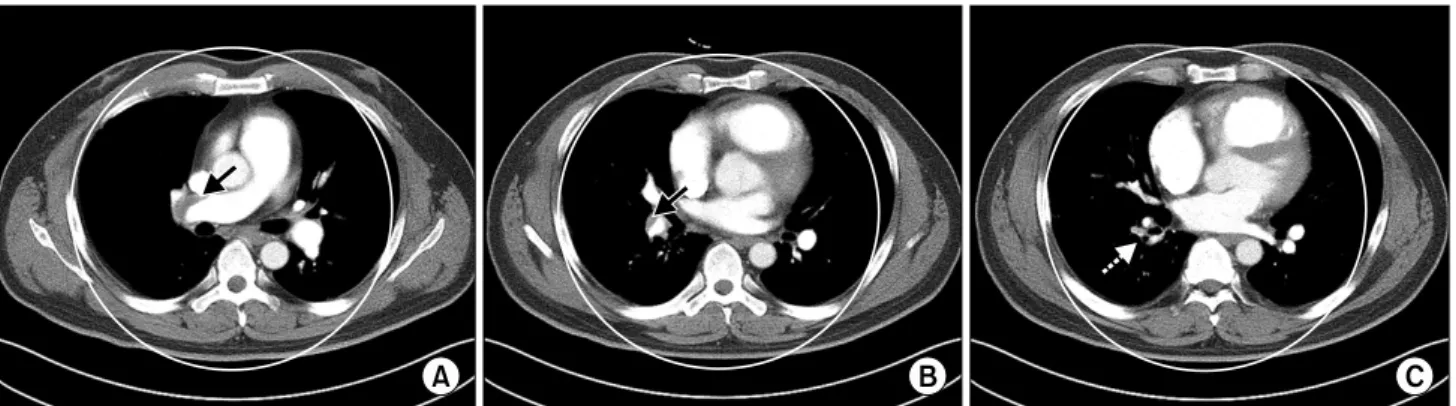
Fig. 1. Chest computed tomography (CT) angiogram shows thrombus (arrow) in the right pulmonary artery (A) and the right lower pulmo- nary artery (B). Irregularity of the pulmonary arterial wall or filling defect of the vessel lumen (dotted arrow) in the segmental and sub- segmental arteries was shown (C).
hypertension. In this study, we present our 12-year clinical experience of pulmonary thromboendarterectomy in patients with chronic thromboembolic pulmonary hypertension.
MATERIALS AND METHODS
This retrospective study was approved by the institutional review board of Seoul National University Hospital, and the requirement for informed consent was waived.
1) Patients and diagnostic workup
Between January 1999 and March 2011, 16 patients who underwent pulmonary thromboendarterectomy for chronic thromboembolic pulmonary hypertension were identified in Seoul National University Hospital, and the medical records of these patients were reviewed. The clinical symptoms in- cluded dyspnea, nonspecific chest pain, syncope, and exercise intolerance. Chest radiography was routinely performed to find several radiographic abnormalities including car- diomegaly with right heart dilatation, peripheral lung opac- ities, and dilation of the central pulmonary arteries, and to measure the cardiothoracic ratio. Transthoracic echocardiog- raphy, lung perfusion scans, and computed tomography (CT) angiograms were used for the preoperative diagnosis. Severity of tricuspid regurgitation (TR) on echocardiography was grad- ed on a 5-point scale (0 indicating no TR; 1, trivial TR; 2, mild TR; 3, moderate TR; and 4, severe TR). The CT an- giography findings compatible with chronic thromboembolism
were thrombus and/or irregularity of the vessel wall in the main and lobar pulmonary artery and filling defects of the vessel lumen in the segmental arteries (Fig. 1). Right heart catheterization for measuring several hemodynamic data, in- cluding pulmonary arterial pressure and pulmonary vascular resistance, was selectively performed in patients with ex- tremely severe pulmonary hypertension on echocardiography.
Pulmonary angiography was combined with right heart catheterization. Pulmonary thromboendarterectomy was in- dicated for the symptomatic patients with characteristic find- ings of chronic thromboembolic pulmonary hypertension based on the diagnostic work-up. The patients with mild symptoms, the presence of hemodynamic compromise, CT angiography findings, or a history of deep vein thrombosis and/or coagulation disorders were important for determining the need for surgery.
The predisposing factors of pulmonary thromboembolism were a history of inferior vena cava (IVC) filter insertion due to deep vein thrombosis in 7 patients and coagulation dis- orders in 5 patients, including protein C, S deficiency, or an- tithrombin III deficiency.
2) Surgical procedure
The surgical procedures used were median sternotomy with
cardiopulmonary bypass (CPB) in all of the patients. In the
early period, before 2002, the operation was performed under
CPB and aortic cross-clamp (ACC) with deep hypothermia,
without total circulatory arrest (TCA), in all of the patients
(n=2). Since 2002, however, intermittent TCA under deep systemic hypothermia had been performed for complete thromboendarterectomy. After the patient was cooled to less than 20
oC and TCA was initiated, pulmonary arteriotomy was extended from the pulmonary artery bifurcation site to the right lateral portion of the superior vena cava, and throm- boendarterectomy in the right pulmonary artery was then performed. The intimal peel was dissected carefully using a Jamieson sucker, which was a long miniature sucker with a rounded tip [6], and removed using gentle traction with DeBakey forceps. Thromboendarterectomy was performed up to the segmental and subsegmental pulmonary arteries. The same procedures were repeated for the left pulmonary artery.
Left-sided pulmonary arteriotomy was extended laterally to the pericardial reflection. After the completion of bilateral pulmonary thromboendarterectomy, CPB was resumed and re- warming was commenced.
3) Statistical analysis
Statistical analysis was performed with SPSS ver. 12.0 (SPSS Inc., Chicago, IL, USA). Continuous variables were expressed as the mean±standard deviation, median and rang- es, or proportions. Changes in the hemodynamic variables in- cluding mean TR grade and mean pulmonary artery systolic pressure after surgery were analyzed using the repeated meas- ured analysis of variance with Greenhouse Geisser correction.
Postoperative changes in the other continuous variables were compared using paired t-test. The survival rates were esti- mated using the Kaplan-Meier method. All of the statistical tests were two-tailed, and all p-values less than 0.05 were considered statistically significant.
RESULTS 1) Patient characteristics
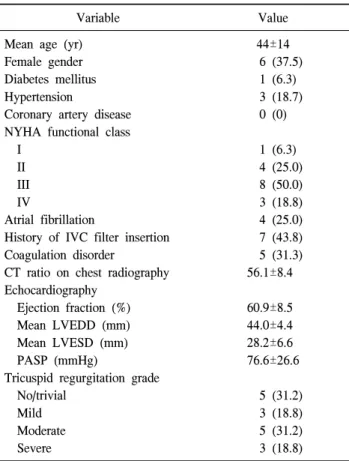
The patients’ mean age was 44±14 years (range, 23 to 74 years), and there were 6 female patients (37.5%). Eleven pa- tients (69%) were classified as the New York Heart Association (NYHA) functional class III or IV, and the other 5 patients (31%) had no or mild dyspnea on effort (NYHA functional class I or II). The cardiothoracic ratio on chest ra- diography was 56.1±8.4. In the preoperative echocardiog-
raphy, the mean left ventricle ejection fraction and pulmonary artery systolic pressure were 60.9%±8.5% and 76.6±26.6 mmHg (range, 35 to 110 mmHg), respectively. One patient with mild pulmonary hypertension had a history of deep vein thrombosis and complained of a sudden onset of dyspnea. An IVC filter was inserted preoperatively, and pulmonary throm- boendarterectomy was performed for a large amount of pul- monary thromboembolism in both pulmonary arteries that was not resolved by anticoagulation therapy. Six patients had an extremely high pulmonary artery systolic pressure, more than 100 mmHg, before surgery. A total of 8 patients (50%) showed more than a moderate degree of TR, and the mean TR grade was 2.1±1.1 degrees. Moreover, right ventricular dysfunction was identified on echocardiography in 13 pa- tients, and severely depressed contractility of the right ven- tricle, regardless of the presence of TR, was found in 3 patients. The baseline patient characteristics are presented in Table 1.
2) Surgery
Most of the patients had type I (n=4, 25%) or II (n=10, 62.5%) pulmonary thromboembolism, and 2 patients (12.5%) had type III (Fig. 2). The mean CPB and ACC time were 242.1±78.2 and 80.8±51.7 minutes, respectively. In 14 pa- tients who underwent TCA, the mean TCA time was 37.0±20.3 minutes (range, 11 to 77 minutes) and the lowest body temperature was 16.2
oC. Four patients underwent a con- comitant procedure including the Cox Maze IV procedure for paroxysmal atrial fibrillation, ligation of coronary arterio- venous fistula, tricuspid annuloplasty with valve repair, or patent foramen ovale (PFO) closure. Only 1 patient under- went tricuspid valve surgery for more than a moderate degree of TR. Only one patient underwent a combined surgery of tricuspid annuloplasty with MC3 ring (Edwards LifeScience, Irvine, CA, USA) and tricuspid valve repair, which was ob- literation of the posteroseptal commissure, for severe TR caused by chordae rupture. Detailed information of the oper- ative procedures performed is described in Table 2.
3) Postoperative management
Mechanical ventilation with a positive end expiratory pres-
sure level of 5 to 8 mmHg was routinely administered during
Fig. 2. A specimen of bilateral type II pulmonary thromboendar- terectomy. Intimal thickening and fibrosis with thrombus extending to the segmental arteries.
Table 1. Patient characteristics (n=16)
Variable Value
Mean age (yr) Female gender Diabetes mellitus Hypertension
Coronary artery disease NYHA functional class I
II III IV
Atrial fibrillation
History of IVC filter insertion Coagulation disorder
CT ratio on chest radiography Echocardiography
Ejection fraction (%) Mean LVEDD (mm) Mean LVESD (mm) PASP (mmHg)
Tricuspid regurgitation grade No/trivial
Mild Moderate Severe
44±14 6 (37.5) 1 (6.3) 3 (18.7) 0 (0)
1 (6.3) 4 (25.0) 8 (50.0) 3 (18.8) 4 (25.0) 7 (43.8) 5 (31.3) 56.1±8.4
60.9±8.5 44.0±4.4 28.2±6.6 76.6±26.6
5 (31.2) 3 (18.8) 5 (31.2) 3 (18.8) Values are presented as mean±standard deviation or number (%).
NYHA, New York Heart Association; IVC, inferior vena cava;
CT ratio, cardiothoracic ratio; LVEDD, left ventricular end dia- stolic dimension; LVESD, left ventricular end systolic di- mension; PASP, pulmonary artery systolic pressure.
Table 2. Operative information (n=16)
Variable Value
Mean CPB time (min) Mean ACC time (min) Mean TCA time (min) Use of TCA
ECMO use IABP use
Type of pulmonary thromboembolism I
II III
Combined operation TVP/TAP Maze procedure PFO closure
Ligation of coronary AVF
242.1±78.2 80.8±51.7 37.0±20.3 14 (87.5)
4 (25) 1 (6.3)
4 (25) 10 (62.5)
2 (12.5) 4 (25) 1 (6.3) 1 (6.3) 1 (6.3) 1 (6.3) Values are presented as mean±standard deviation or number (%).
CPB, cardiopulmonary bypass; ACC, aortic cross clamp; TCA, total circulatory arrest; ECMO, extracorporeal membrane oxy- genator; IABP, intraaortic balloon pump; TVP, tricuspid valvu- loplasty; TAP, tricuspid annuloplasty; PFO, patent foramen ovale; AVF, arteriovenous fistula.
the early postoperative period. Aggressive diuresis was re- quired in all of the patients to decrease the incidence of pul- monary and cerebral edema that resulted from the prolonged bypass and circulatory arrest with deep hypothermia. Inhalation of a 10 to 40 ppm dose of nitric oxide was required in 11 pa- tients with residual or persistent pulmonary hypertension. In addition, inhalation of iloprost [7,8] was selectively used in patients with severe, persistent pulmonary hypertension that was unsolved by a high-dose of inhaled nitric oxide or other agents. Inotropic support, such as dobutamine and epinephrine, and pulmonary vasodilating agents, such as milrinone, were usually necessary for the majority of the patients.
4) Early postoperative morbidity and mortality In-hospital mortality was 12.5% (2 of 16 patients). One pa-
tient had extremely high pulmonary hypertension before surgery. The patient’s pulmonary artery systolic pressure was 110 mmHg on echocardiography, and the pulmonary vascular resistance was 1,600 dynes on right heart catheterization.
Moreover, incomplete thromboendarterectomy was performed
because of a poor operative view. After the weaning of CPB,
the patient did not recover from persistent severe pulmonary
hypertension. The patient died on postoperative day 5 due to
biventricular failure with intractable ventricular arrhythmias,
Fig. 3. Kaplan-Meier overall survival curve of all the patients who underwent pulmonary thromboendarterectomy for chronic throm- boembolic pulmonary hypertension.
despite the use of an extracorporeal membrane oxygenator (ECMO). Another patient also had a high level of residual pulmonary hypertension with right ventricular dysfunction af- ter surgery, and showed reperfusion pulmonary edema with a persistent pulmonary hemorrhage. The patient died of septic shock with multi-organ failure on postoperative day 41, de- spite the long term use of ECMO. The mean length of stay in the intensive care unit was 15.6±16.4 days (range, 2 to 47 days), and the mean length of hospital stay was 29.1±22.2 days (range, 5 to 66 days). Postoperative complications in- cluded prolonged ventilation (n=9), reperfusion pulmonary edema (n=5), persistent pulmonary hypertension (n=5), new onset of atrial fibrillation (n=3), bleeding requiring reopera- tion (n=2), pulmonary hemorrhage (n=2), acute renal failure (n=2), prolonged pleural effusion (n=1), and heart failure re- quiring an intra-aortic balloon pump (IABP) (n=1). ECMO support was required in 4 patients who developed severe hy- poxemia caused by tracheal bleeding, acute respiratory dis- tress syndrome (ARDS), or heart failure.
5) Late follow-up and survival
Thirteen of the 14 survivors have been followed up for 54 months (range, 2 to 141 months) after discharge. During that period, late death occurred in one (6.3%) patient. The patient died suddenly of unknown cause at 44 months postoperatively.
All of the patients were anticoagulated with coumadin at the international normalized ratio of 2 to 3. None of the patients showed recurred symptoms or anticoagulation-related compli- cations during the follow-up periods. The mean survival of all the patients was 47.6±46.2 months (range, 0.2 to 141 months), and the 1-, 5-, and 10-year survival rates were 87.1%, 76.2%, and 76.2%, respectively (Fig. 3).
6) Clinical outcomes
The mean NYHA functional class improvement was from 2.7 to 1.2 (p=0.001), and 13 patients (81%) showed a sig- nificant improvement to functional class I or II. Moreover, the cardiothoracic ratio on chest radiography was decreased from 56.1±8.4 to 48.1±2.9 (p=0.003), during the mean 27 months after surgery. Arterial oxygen pressure on arterial blood gas analysis (ABGA) was improved from 66.1±10.3 to 93.0±32.2 mmHg (p=0.016), postoperatively.
7) Postoperative echocardiography
In the early postoperative period, echocardiography was per- formed in 11 patients before discharge. Pulmonary arterial sys- tolic pressure was significantly decreased from 76.6±26.6 mmHg to 40.6±17.2 mmHg (p=0.001), and the TR grade was also reduced from 2.1±1.1 to 0.7±0.6 degrees (p=0.007). On the late follow-up echocardiography during the mean 15 month period, the mean pulmonary arterial systolic pressure was slightly decreased to 38.8±13.6 mmHg, and the mean TR grade was changed to 0.8±0.6 degrees. However, there was no significant difference compared with the early postoperative data. The early and late postoperative symptom changes, arte- rial blood oxygenation, and various hemodynamic indices are presented in Table 3. In 4 patients who underwent a combined cardiac procedure, the abnormal coronary flow from the left circumflex coronary artery to the pulmonary artery via the ar- teriovenous fistula had disappeared, and atrial fibrillation was converted to a normal sinus rhythm, postoperatively. Severe TR was reduced to trivial regurgitation, and there was no re- sidual shunt flow via PFO after closure.
DISCUSSION
The incidence of chronic thromboembolic pulmonary hy- pertension is rare, and has been known to occur in 2% to 4%
of patients with acute pulmonary embolism [9,10]. Because
Table 3. Early and late postoperative changes of symptom, oxygenation, and hemodynamic indices
Variable Preoperative data Early postoperative data Last follow-up data p-value CT ratio (%)
Mean NYHA Fc PaO
2on ABGA Mean TR grade PASP (mmHg)
56.1±8.4 2.7±0.8 66.1±10.3
2.1±1.1 76.6±26.6
- - 93.0±32.2
0.7±0.6 40.6±17.2
48.1±2.9 1.2±0.4
- 0.8±0.6
a)38.8±13.6
a)0.003 0.001 0.016 0.007 0.005 Values are presented as mean±standard deviation.
CT ratio, cardiothoracic ratio; NYHA Fc, New York Heart Association functional class; PaO
2, arterial oxygen pressure; ABGA, arte- rial blood gas analysis; TR, tricuspid regurgitation; PASP, pulmonary artery systolic pressure.
a)