D I A B E T E S & M E T A B O L I S M J O U R N A L
This is an Open Access article distributed under the terms of the Creative Commons Attribution Non-Commercial License (http://creativecommons.org/licenses/by-nc/4.0/) which permits unrestricted non-commercial use, distribution, and reproduction in any medium, provided the original work is properly cited.
Soluble Dipeptidyl Peptidase-4 Levels Are Associated with Decreased Renal Function in Patients with Type 2 Diabetes Mellitus
Eun-Hee Cho, Sang-Wook Kim
Department of Internal Medicine, Kangwon National University School of Medicine, Chuncheon, Korea
Background: Dipeptidyl peptidase-4 (DPP-4) is strongly expressed in the kidney, and soluble levels of this protein are used as a marker in various chronic inflammatory diseases, including diabetes, coronary artery disease, and cancer. This study examined the association between the serum soluble DPP-4 levels and renal function or cardiovascular risk in patients with type 2 diabetes mellitus.
Methods: In this retrospective analysis, soluble DPP-4 levels were measured in preserved sera from 140 patients with type 2 dia- betes mellitus who had participated in our previous coronary artery calcium (CAC) score study.
Results: The mean±standard deviation soluble DPP-4 levels in our study sample were 645±152 ng/mL. Univariate analyses re- vealed significant correlations of soluble DPP-4 levels with the total cholesterol (r=0.214, P=0.019) and serum creatinine levels (r=–0.315, P<0.001) and the estimated glomerular filtration rate (eGFR; estimated using the modification of diet in renal disease equation) (r=0.303, P=0.001). The associations of soluble DPP-4 levels with serum creatinine and GFR remained significant after adjusting for age, body mass index, and duration of diabetes. However, no associations were observed between soluble DPP-4 lev- els and the body mass index, waist circumference, or CAC score.
Conclusion: These data suggest the potential use of serum soluble DPP-4 levels as a future biomarker of deteriorated renal func- tion in patients with type 2 diabetes mellitus.
Keywords: Diabetes mellitus, type 2; Dipeptidyl peptidase 4; Glomerular filtration rate; Kidney
Corresponding author: Sang-Wook Kim https://orcid.org/0000-0001-7445-3860 Department of Internal Medicine, Kangwon National University School of Medicine, 1 Gangwondaehak-gil, Chuncheon 24341, Korea
E-mail: [email protected]
INTRODUCTION
Dipeptidyl peptidase-4 (DPP-4), a 110-kDa integral mem- brane glycoprotein with peptidase activity [1], was initially dis- covered by Hopsu-Havu and Glenner in 1966 and reported as CD26 [2]. The broad expression of DPP-4 in the kidney, small intestine, brain, lung, liver, and heart [3,4] suggests that this protein exhibits pleiotropic biological activities. DPP-4 mainly targets glucagon-like peptide, which regulates glucose metabo- lism and is particularly responsible for reducing glucose con- centrations in the context of type 2 diabetes mellitus (T2DM)
[1]. It also regulates stromal cell-derived factor-1 (SDF-1), known as C-X-C motif chemokine ligand 12 (CXCL12) [5,6], C-X-C chemokine 10 (known as interferon γ-induced pro- tein-10) [6], peptide YY [7], and vascular endothelial growth factor (VEGF) [8]. Specifically, DPP-4 truncates many bioac- tive peptides of various medically important proteins and thus mediates important alterations in chemokine activities and re- ceptor specificities [1]. The particularly strong expression of DPP-4 in the kidney [4], as well as in vascular endothelial cells and immune cells, suggests that this protein may play a role in renal and cardiovascular function [9].
https://doi.org/10.4093/dmj.2018.0030 pISSN 2233-6079 · eISSN 2233-6087
The soluble form of DPP-4 is cleaved from the membranes of human adipocytes and smooth muscle cells and released to the plasma and other body fluids [1,10,11]. In humans, ap- proximately 95% of serum DPP-4 activity is associated with a relatively high serum concentration of soluble DPP-4 (sDPP-4) [11,12], leading to the designation of this soluble bioactive molecule as a new adipokine [10,13]. Other researchers have suggested the potential use of sDPP-4 as a diagnostic or prog- nostic marker of diabetes, coronary artery disease, depression, osteoporosis, and bronchial inflammation [14-18]. For exam- ple, the development of diabetic nephropathy is associated with inflammatory cytokines such as interleukin 1 (IL-1), IL-6, tumor necrosis factor-α [19-21], SDF-1 (CXCL12) [22], VEGF [23], and oxidative stress [21]. Various proinflammatory cyto- kines, SDF-1 (CXCL12), and VEGF contain DPP-4 truncation sites, suggesting a role for sDPP-4 in diabetic nephropathy.
DPP-4 also appears to play a role in normal renal function.
Within the kidney, DPP-4 is expressed predominantly in the glomeruli and S1 to S3 segments of the proximal tubules and, to a lesser extent, in other segments [24-26], where it facilitates the absorption of cleaved dipeptides and regulates the function of sodium/hydrogen exchanger-3 in the proximal tubules. Ad- ditionally, sDPP-4 exerts non-enzymatic functions via binding to newly recognized receptors such as the mannose-6-phos- phate/insulin-like growth factor 2 receptor (M6P/IGF2-R) or protease-activated receptor 2 to initiate signal transduction [27]. Despite the evidence linking DPP-4 with renal function, only a few studies have investigated this role of sDPP-4 in the context of diabetes. Previous studies demonstrated a strong correlation of the serum sCD26 levels with circulating DPP-4 activity in humans [28,29], suggesting that serum sCD26 may reflect DPP-4 activity. In this study, we investigated the endog- enous association of serum sDPP-4 levels with renal function or cardiovascular risk in patients with T2DM.
METHODS
Study subjects
For this retrospective study, we obtained data and sera collect- ed from 140 patients with T2DM who visited the diabetes clin- ic at Kangwon National University Hospital [30] and partici- pated in subset of a study performed from March to June 2007.
DPP-4 inhibitors were introduced to the Korean market in 2008; accordingly, none of the study subjects had been exposed to these drugs.
The subject exclusion criterion was the presence of typical symptoms of ischemic heart disease or a history of previous coronary angiography or cardiovascular intervention. We also excluded patients with chronic illnesses such as chronic liver disease, chronic kidney disease (serum creatinine levels >1.4 mg/dL), and chronic obstructive pulmonary disease. This study was approved by the Institutional Review Board at Kangwon National University Hospital (IRB number 2012-08-001-001).
Written informed consent was obtained from each individual.
Laboratory measurements
Blood samples were collected after an 8-hour fast and subject- ed to general chemistry, serum lipid, microalbuminuria, and high-sensitivity C-reactive protein (hs-CRP) analyses. For hs- CRP testing, we used a latex agglutination method that could detect levels as low as 0.01 mg/dL. Serum sDPP-4 levels in samples that had been frozen at −80°C before use were mea- sured using a human DPP-4/CD26 immunoassay kit (R&D Systems, Minneapolis, MN, USA) according to the manufac- turer’s instructions. The intra-assay coefficient of variation (CV) for the DPP-4 control sample for the assay was 5.8%
(mean, 8.97 absorbance units [AU]; standard deviation [SD], 0.549). The inter-assay CV for the DPP-4 control sample was 8.6% (mean, 8.95 AU; SD, 0.761).
The estimated glomerular filtration rate (eGFR) for each pa- tient was calculated using the modification of diet in renal dis- ease (MDRD) equation and given values. For patients affected by acute episodes, the laboratory results for at least 1 month following the complete resolution of the episode were excluded from the data collection.
Statistical analyses
Descriptive statistics for subject characteristics are presented as mean±SD for continuous variables or count (percentage) for categorical variables.
The chi-square test was used to compare categorical variables such as smoking history and medications used at enrollment.
The serum sDPP-4 levels were a normally distributed variable, and Pearson correlation coefficients were calculated to analyze the relationships between serum sDPP-4 levels and clinical pa- rameters. Statistical analyses were performed using SPSS ver- sion 21.0 (IBM Co., Armonk, NY, USA). All P values were two- tailed, and P<0.05 was considered statistically significant.
RESULTS
Participant characteristics
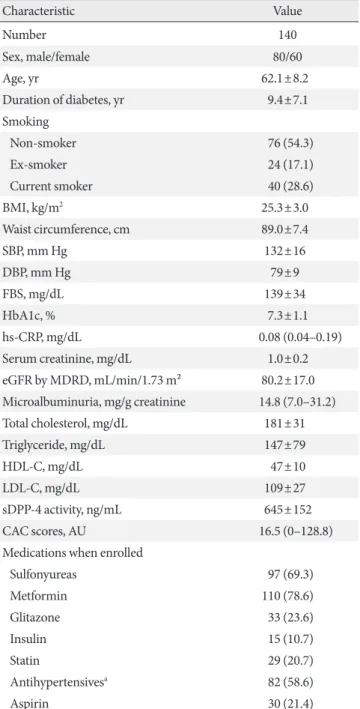
The study sample comprised 80 male and 60 female patients with a mean±SD age of 62.1±8.2 years and mean duration of diabetes of 9.4±7.1 years. The mean body mass index (BMI) was 25.3±3.0 kg/m2, and the mean waist circumference was 89.0± 7.4 cm. Regarding laboratory parameters, the mean gly- cosylated hemoglobin levels, mean serum creatinine levels, and mean eGFR were 7.3%±1.1%, 1.0±0.2 mg/dL, and 80.2±17.0 mL/min/1.73 m2, respectively. The mean sDPP-4 levels were 645±152 ng/mL. Detailed characteristics of the subjects are shown in Table 1.
Associations of DPP-4 levels with clinical parameters Univariate analyses revealed significant correlations of sDPP-4 levels with the total cholesterol (r=0.214, P=0.019) and serum creatinine levels (r= –0.315, P<0.001) and the eGFR (r=0.303, Table 1. Baseline characteristics of whole study subjects
Characteristic Value
Number 140
Sex, male/female 80/60
Age, yr 62.1±8.2
Duration of diabetes, yr 9.4±7.1
Smoking
Non-smoker 76 (54.3)
Ex-smoker 24 (17.1)
Current smoker 40 (28.6)
BMI, kg/m2 25.3±3.0
Waist circumference, cm 89.0±7.4
SBP, mm Hg 132±16
DBP, mm Hg 79±9
FBS, mg/dL 139±34
HbA1c, % 7.3±1.1
hs-CRP, mg/dL 0.08 (0.04–0.19)
Serum creatinine, mg/dL 1.0±0.2
eGFR by MDRD, mL/min/1.73 m² 80.2±17.0 Microalbuminuria, mg/g creatinine 14.8 (7.0–31.2)
Total cholesterol, mg/dL 181±31
Triglyceride, mg/dL 147±79
HDL-C, mg/dL 47±10
LDL-C, mg/dL 109±27
sDPP-4 activity, ng/mL 645±152
CAC scores, AU 16.5 (0–128.8)
Medications when enrolled
Sulfonyureas 97 (69.3)
Metformin 110 (78.6)
Glitazone 33 (23.6)
Insulin 15 (10.7)
Statin 29 (20.7)
Antihypertensivesa 82 (58.6)
Aspirin 30 (21.4)
Values are presented as mean±standard deviation, number (%), or median (interquartile range).
BMI, body mass index; SBP, systolic blood pressure; DBP, diastolic blood pressure; FBS, fasting blood sugar; HbA1c, glycosylated hemo- globin; hs-CRP, high-sensitivity C-reactive protein; eGFR, estimated glomerular filtration rate; MDRD, modification of diet in renal dis- ease; HDL-C, high density lipoprotein cholesterol; LDL-C, low densi- ty lipoprotein cholesterol; sDPP-4, soluble dipeptidyl peptidase-4;
CAC, coronary artery calcium; AU, absorbance unit.
aAntihypertensives included angiotensin-converting enzyme (ACE) inhibitor, angiotensin II receptor blocker (ARB), calcium-channel blocker, and thiazides.
Table 2. Univariate correlation between soluble dipeptidyl peptidase-4 levels and clinical and biochemical variables
Variable Correlation
coefficient P value
Age 0.012 0.898
BMI 0.103 0.263
Waist circumference 0.046 0.628
Duration of diabetes –0.051 0.579
SBP 0.127 0.168
DBP 0.129 0.162
HbA1c –0.124 0.178
hs-CRP –0.030 0.743
Serum creatinine –0.315 <0.001
eGFR by MDRD equation 0.303 0.001
Urinary albumin-creatinine ratio –0.118 0.200
Total cholesterol 0.214 0.019
LDL-C 0.173 0.058
HDL-C 0.074 0.423
Triglycerides 0.044 0.637
Log (CACs+1) –0.121 0.186
BMI, body mass index; SBP, systolic blood pressure; DBP, diastolic blood pressure; HbA1c, glycosylated hemoglobin; hs-CRP, high-sen- sitivity C-reactive protein; eGFR, estimated glomerular filtration rate;
MDRD, modification of diet in renal disease; LDL-C, low density li- poprotein cholesterol; HDL-C, high density lipoprotein cholesterol;
CAC, coronary artery calcium.
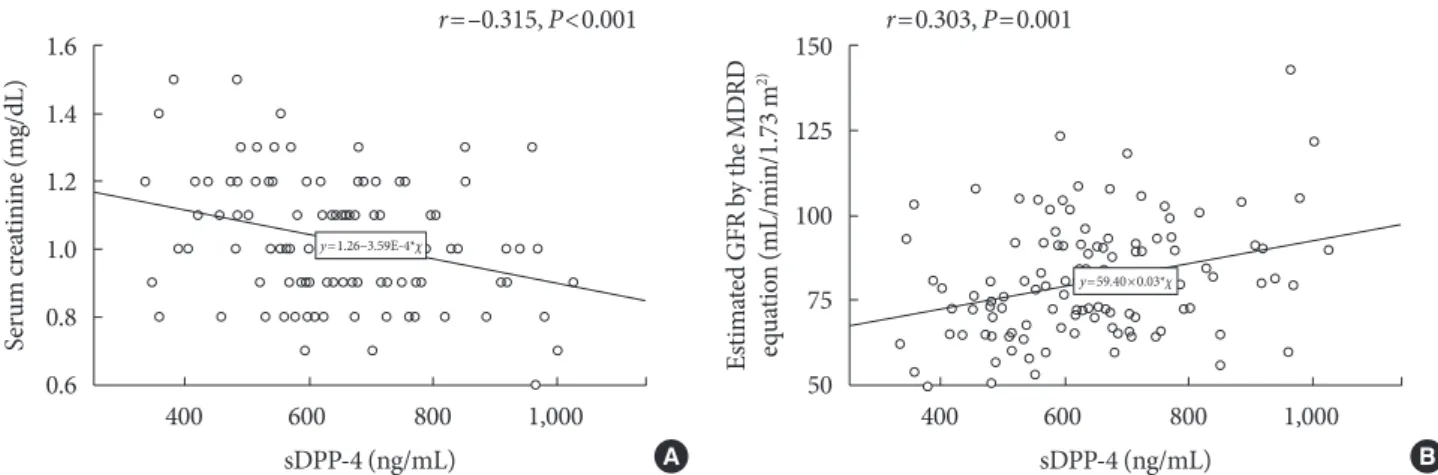
P=0.001), as shown in Table 2 and Fig. 1. We analyzed the as- sociation between baseline sDPP-4 levels and follow-up creati- nine and eGFR with mean follow-up duration of 9.5 years (range, 2.8 to 11.0 years). There was negative correlation be- tween baseline sDPP-4 levels and follow-up creatinine (r=
–0.278, P=0.003) but there was no correlation between base- line sDPP-4 levels and follow-up eGFR (r=0.138, P=0.142).
Associations of DPP-4 levels with renal function in patients with type 2 diabetes mellitus
In the enter-method multiple linear regression models, sex and sDPP-4 levels remained significantly associated with serum creatinine levels and eGFR (MDRD equation) after adjusting for age, BMI, and duration of diabetes (Tables 3 and 4). How- ever, the urinary albumin-to-creatinine ratio was not found to Table 3. Multiple linear regression analysis of variables influencing serum creatinine levels
Unstandardized coefficients Standardized coefficients
P value
B Standard error β
Age 0.003 0.002 0.129 0.060
Sex 0.214 0.024 0.612 <0.001
BMI 0.001 0.004 0.024 0.730
Duration of diabetes 0.001 0.002 0.047 0.495
sDPP-4 0.000 0.000 –0.181 0.010
BMI, body mass index; sDPP-4, soluble dipeptidyl peptidase-4.
Table 4. Multiple linear regression analysis of variables influencing estimated glomerular filtration rate by the MDRD equation (mL/min/1.73 m2)
Unstandardized coefficients Standardized coefficients
P value
B Standard error β
Age –0.437 0.156 –0.184 0.006
Sex –20.821 2.289 –0.620 <0.001
BMI 0.111 0.374 0.020 0.767
Duration of diabetes 0.005 0.174 0.002 0.975
sDPP-4 0.018 0.007 0.167 0.014
MDRD, modification of diet in renal disease; BMI, body mass index; sDPP-4, soluble dipeptidyl peptidase-4.
Fig. 1. Correlation between serum soluble dipeptidyl peptidase-4 (sDPP-4) levels and (A) serum creatinine or (B) estimated glo- merular filtration rate (GFR) calculated by modification of diet in renal disease (MDRD) equation.
1.6 1.4 1.2 1.0 0.8 0.6
Serum creatinine (mg/dL)
400 600 800 1,000 sDPP-4 (ng/mL)
r=–0.315, P<0.001
y=1.26–3.59E-4*χ
A
150 125 100 75 Estimated GFR by the MDRD 2)equation (mL/min/1.73 m 50
400 600 800 1,000 sDPP-4 (ng/mL)
r=0.303, P=0.001
y=59.40×0.03*χ
B
correlate with the sDPP-4 levels.
Association of DPP-4 levels with cardiovascular risk factors in diabetes
No associations were observed between sDPP-4 levels and variables related to cardiovascular risk factors such as the BMI, waist circumference, or coronary artery calcium score.
DISCUSSION
With this study, we aimed to clarify the clinical role of serum sDPP-4 levels as markers of renal function or cardiovascular risk in patients with T2DM. In this era, however, DPP-4 inhib- itors are widely prescribed to patients with diabetes. Therefore, we evaluated data and sera collected from a sample of subjects in 2007, before the introduction of DPP-4 inhibitors to the Ko- rean market, to ensure that the subjects had not ever been ex- posed to these drugs. Our analysis revealed that the levels of endogenous serum sDPP-4 correlated inversely with the se- rum creatinine levels and positively with the eGFR in this sam- ple of patients with diabetes.
Diabetic nephropathy is the most common cause of end- stage kidney disease requiring hemodialysis or kidney trans- plantation and is associated with increased mortality in pa- tients with T2DM. Although albuminuria has been recognized as an early marker of diabetic nephropathy, significant glomer- ular injury occurs before the manifestation of this marker [31].
A previous report described a significant category of patients with diabetic nephropathy and advanced chronic kidney dis- ease unaccompanied by albuminuria [32], and found that these patients had a higher prevalence of cardiovascular dis- ease relative to those with a preserved eGFR [33]. Therefore, many investigators seek new biomarkers in an attempt to over- come the limitations of current detection and diagnostic tools for early diabetic nephropathy.
In this study, we observed a negative association of serum sDPP-4 levels with serum creatinine levels, which suggests the potential usefulness of sDPP-4 as an early diagnostic marker of renal dysfunction in patients with T2DM without chronic kid- ney disease. Moreover, our regression analysis demonstrated that this inverse association of sDPP-4 with serum creatinine levels was independent of age, BMI, and the duration of diabe- tes. These findings further support the relevance of the serum sDPP-4 levels as a new diagnostic marker of early renal dys- function in diabetes.
A recent study identified the reno-protective effects of DPP- 4 inhibitors against diabetic nephropathy [30] and suggested that these effects are mediated by a reduction in DPP-4 activity.
In other recent studies, the sDPP-4 levels were suggested as a marker of metabolic syndrome [13], a predictor of new-onset hyperglycemia in Chinese patients [34], an indicator of new onset microalbuminuria in nondiabetic Chinese patients [35], and an early diagnostic marker of gastric cancer [36]. More specifically, Zheng et al. [37] suggested that an increase in plas- ma DPP-4 activity correlated with diabetic nephropathy in Chinese T2DM. However, our results oppose these earlier findings, as we observed an association of higher serum sDPP- 4 levels with better renal function in our sample of diabetic pa- tients. This discrepancy indicates that the mechanism by which increased sDPP-4 levels are associated with better renal func- tion in patients with diabetes remains poorly understood. Ac- tually, there are few papers dealing with the role of sDPP-4 lev- els or activity in diabetes and further studies to be required to evaluate the role of sDPP-4 levels and their relationship with usage of DPP-4 inhibitors in diabetes in the future.
In a previous study, diabetic patients with normoalbumin- uria exhibited a significant increase in urine microvesicle- bound DPP-4 activity when compared with controls, suggest- ing that urinary DPP-4 levels may serve as a biomarker of dia- betic kidney disease [38]. We hypothesize that urinary DPP-4 secretion from tubular epithelial cells might increase following renal damage. Such damage is known to cause the leakage of endogenous endothelial DPP-4 from the kidney, which is re- sponsible for the decreased sDPP-4 levels measured in patients with diabetes and deteriorated renal function. Furthermore, the DPP-4-mediated cleavage of regulatory peptides on lym- phocytes, macrophages, or fibroblasts affects the biological in- activation of circulating hormones or chemokines and neuro- peptides in the renal system [4]. Interestingly, a previous study observed significantly decreased plasma levels of DPP-4/CD26 in rheumatoid arthritis patients, compared to osteoarthritis patients, and noted that the negatively association of circulat- ing DPP-4 levels with C-reactive protein levels suggested a role for the former as a negative acute phase protein [28]. Another study found an association of increased serum sDPP-4 levels with decreased disease activity in patients with systemic lupus erythematosus [29]. Moreover, people with normal renal func- tion will fully express DPP-4 in their renal tissues. In a rat model, extraordinarily high concentrations of DPP-4 (up to 14,000 nmol/min/g) were detected in the kidney relative to
other tissues [4]. We believe that people with impaired renal function may exhibit reduced DPP-4 activity consequent to a decreased renal functional mass. However, the importance of DPP-4-mediated chemokine cleavage for modified inflamma- tory responses in diabetic kidney disease is far less clearly es- tablished and remains a topic for future research.
The endogenous sDPP-4 levels observed in our study may not reflect the DPP-4 activities in the context of DPP-4 inhibi- tors or in tissues such as adipose or kidney tissue. Therefore, we cannot extrapolate our findings to determine the potential effects of DPP-4 inhibitors on renal function in diabetes. Previ- ous studies observed significant associations of plasma endog- enous DPP-4 activity with race [39] and DPP-4 polymor- phisms in Malaysian subjects [40], suggesting that endogenous sDPP-4 levels may be affected by genetic background. Further- more, it is important to establish main tissue sources of sDPP- 4, other than bone marrow and endothelial cells, and to estab- lish which circumstances or diseases can provoke abnormally elevated sDPP-4 concentrations if this protein is to be validated as a clinical marker or therapeutic target.
This study was designed to determine the relationship of se- rum sDPP-4 levels with renal function and cardiovascular risk factors in patients with T2DM, using an analysis in which po- tential confounders were well controlled. However, several im- portant limitations of our study must also be considered. The patient sample was relatively small and recruited at a single center, and patients with advanced chronic kidney disease were excluded. Furthermore, the use of angiotensin II receptor blocker (ARB) or angiotensin-converting enzyme (ACE) in- hibitors may have influenced the relationship between sDPP-4 levels and renal function. Serum levels of sDPP-4 were only measured at a single time point. Accordingly, it remains un- known whether changes in DPP-4 over time are associated with changes in renal function. Additionally, we did not com- pare serum sDPP-4 levels with total DPP-4 protein levels. Fi- nally, we failed to demonstrate a mechanistic role of sDPP-4 in the pathogenesis of nephropathy.
In conclusion, we demonstrated associations of increased serum sDPP-4 levels with low serum creatinine levels and an increased glomerular filtration rate in subjects with T2DM.
However, further studies are needed to clarify the regulatory role of sDPP-4/CD26 in the renal function of patients with dia- betes.
CONFLICTS OF INTEREST
No potential conflict of interest relevant to this article was re- ported.
REFERENCES
1. Lambeir AM, Durinx C, Scharpe S, De Meester I. Dipeptidyl- peptidase IV from bench to bedside: an update on structural properties, functions, and clinical aspects of the enzyme DPP IV. Crit Rev Clin Lab Sci 2003;40:209-94.
2. Hopsu-Havu VK, Glenner GG. A new dipeptide naphthylami- dase hydrolyzing glycyl-prolyl-beta-naphthylamide. Histoche- mie 1966;7:197-201.
3. Deacon CF. What do we know about the secretion and degra- dation of incretin hormones? Regul Pept 2005;128:117-24.
4. Mentlein R. Dipeptidyl-peptidase IV (CD26): role in the inacti- vation of regulatory peptides. Regul Pept 1999;85:9-24.
5. Jungraithmayr W, De Meester I, Matheeussen V, Baerts L, Arni S, Weder W. CD26/DPP-4 inhibition recruits regenerative stem cells via stromal cell-derived factor-1 and beneficially influenc- es ischaemia-reperfusion injury in mouse lung transplantation.
Eur J Cardiothorac Surg 2012;41:1166-73.
6. Lambeir AM, Proost P, Durinx C, Bal G, Senten K, Augustyns K, Scharpe S, Van Damme J, De Meester I. Kinetic investiga- tion of chemokine truncation by CD26/dipeptidyl peptidase IV reveals a striking selectivity within the chemokine family. J Biol Chem 2001;276:29839-45.
7. Reinehr T, Roth CL, Enriori PJ, Masur K. Changes of dipeptidyl peptidase IV (DPP-IV) in obese children with weight loss: rela- tionships to peptide YY, pancreatic peptide, and insulin sensi- tivity. J Pediatr Endocrinol Metab 2010;23:101-8.
8. Shi S, Srivastava SP, Kanasaki M, He J, Kitada M, Nagai T, Nitta K, Takagi S, Kanasaki K, Koya D. Interactions of DPP-4 and in- tegrin β1 influences endothelial-to-mesenchymal transition.
Kidney Int 2015;88:479-89.
9. Zhong J, Rao X, Rajagopalan S. An emerging role of dipeptidyl peptidase 4 (DPP-4) beyond glucose control: potential implica- tions in cardiovascular disease. Atherosclerosis 2013;226:305- 14.
10. Rohrborn D, Eckel J, Sell H. Shedding of dipeptidyl peptidase 4 is mediated by metalloproteases and up-regulated by hypoxia in human adipocytes and smooth muscle cells. FEBS Lett 2014;
588:3870-7.
11. Durinx C, Lambeir AM, Bosmans E, Falmagne JB, Berghmans
R, Haemers A, Scharpe S, De Meester I. Molecular character- ization of dipeptidyl peptidase activity in serum: soluble CD26/
dipeptidyl peptidase IV is responsible for the release of X-Pro dipeptides. Eur J Biochem 2000;267:5608-13.
12. Cordero OJ, Salgado FJ, Nogueira M. On the origin of serum CD26 and its altered concentration in cancer patients. Cancer Immunol Immunother 2009;58:1723-47.
13. Lamers D, Famulla S, Wronkowitz N, Hartwig S, Lehr S, Ouw- ens DM, Eckardt K, Kaufman JM, Ryden M, Muller S, Hanisch FG, Ruige J, Arner P, Sell H, Eckel J. Dipeptidyl peptidase 4 is a novel adipokine potentially linking obesity to the metabolic syndrome. Diabetes 2011;60:1917-25.
14. Duvnjak L, Blaslov K, Vucic Lovrencic M, Knezevic Cuca J.
Persons with latent autoimmune diabetes in adults express higher dipeptidyl peptidase-4 activity compared to persons with type 2 and type 1 diabetes. Diabetes Res Clin Pract 2016;
121:119-26.
15. Yang G, Li Y, Cui L, Jiang H, Li X, Jin C, Jin D, Zhao G, Jin J, Sun R, Piao L, Xu W, Fang C, Lei Y, Yuan K, Xuan C, Ding D, Cheng X. Increased plasma dipeptidyl peptidase-4 activities in patients with coronary artery disease. PLoS One 2016;11:e0163027.
16. Zheng T, Liu Y, Qin S, Liu H, Yang L, Zhang X, Li G, Li Q. In- creased dipeptidyl peptidase-4 activity is associated with high prevalence of depression in middle-aged and older adults: a cross-sectional study. J Clin Psychiatry 2016;77:e1248-55.
17. Kim SW, Cho EH. High levels of serum DPP-4 activity are as- sociated with low bone mineral density in obese postmeno- pausal women. Endocrinol Metab (Seoul) 2016;31:93-9.
18. Landis BN, Grouzmann E, Monod M, Busso N, Petak F, Spilio- poulos A, Robert JH, Szalay-Quinodoz I, Morel DR, Lacroix JS. Implication of dipeptidylpeptidase IV activity in human bronchial inflammation and in bronchoconstriction evaluated in anesthetized rabbits. Respiration 2008;75:89-97.
19. Hasegawa G, Nakano K, Sawada M, Uno K, Shibayama Y, Iena- ga K, Kondo M. Possible role of tumor necrosis factor and in- terleukin-1 in the development of diabetic nephropathy. Kid- ney Int 1991;40:1007-12.
20. Lee SH, Ihm CG, Sohn SD, Lee TW, Kim MJ, Koh G, Oh SJ, Woo JT, Kim SW, Kim JW, Kim YS, Lee BC, Kim SD, Cho BS, Lee HJ, Chung JH. Polymorphisms in interleukin-1 beta and interleukin-1 receptor antagonist genes are associated with kidney failure in Korean patients with type 2 diabetes mellitus.
Am J Nephrol 2004;24:410-4.
21. Elmarakby AA, Sullivan JC. Relationship between oxidative stress and inflammatory cytokines in diabetic nephropathy.
Cardiovasc Ther 2012;30:49-59.
22. Sayyed SG, Hagele H, Kulkarni OP, Endlich K, Segerer S, Eul- berg D, Klussmann S, Anders HJ. Podocytes produce homeo- static chemokine stromal cell-derived factor-1/CXCL12, which contributes to glomerulosclerosis, podocyte loss and albumin- uria in a mouse model of type 2 diabetes. Diabetologia 2009;52:
2445-54.
23. Lin S, Teng J, Li J, Sun F, Yuan D, Chang J. Association of chemer- in and vascular endothelial growth factor (VEGF) with diabet- ic nephropathy. Med Sci Monit 2016;22:3209-14.
24. Girardi AC, Degray BC, Nagy T, Biemesderfer D, Aronson PS.
Association of Na(+)-H(+) exchanger isoform NHE3 and di- peptidyl peptidase IV in the renal proximal tubule. J Biol Chem 2001;276:46671-7.
25. Lee JW, Chou CL, Knepper MA. Deep sequencing in microdis- sected renal tubules identifies nephron segment-specific tran- scriptomes. J Am Soc Nephrol 2015;26:2669-77.
26. Nistala R, Savin V. Diabetes, hypertension, and chronic kidney disease progression: role of DPP4. Am J Physiol Renal Physiol 2017;312:F661-70.
27. Rohrborn D, Wronkowitz N, Eckel J. DPP4 in diabetes. Front Immunol 2015;6:386.
28. Busso N, Wagtmann N, Herling C, Chobaz-Peclat V, Bischof- Delaloye A, So A, Grouzmann E. Circulating CD26 is nega- tively associated with inflammation in human and experimen- tal arthritis. Am J Pathol 2005;166:433-42.
29. Kobayashi H, Hosono O, Mimori T, Kawasaki H, Dang NH, Tanaka H, Morimoto C. Reduction of serum soluble CD26/di- peptidyl peptidase IV enzyme activity and its correlation with disease activity in systemic lupus erythematosus. J Rheumatol 2002;29:1858-66.
30. Haluzik M, Frolik J, Rychlik I. Renal effects of DPP-4 inhibitors:
a focus on microalbuminuria. Int J Endocrinol 2013;2013:
895102.
31. Barratt J, Topham P. Urine proteomics: the present and future of measuring urinary protein components in disease. CMAJ 2007;177:361-8.
32. MacIsaac RJ, Tsalamandris C, Panagiotopoulos S, Smith TJ, McNeil KJ, Jerums G. Nonalbuminuric renal insufficiency in type 2 diabetes. Diabetes Care 2004;27:195-200.
33. Lee HW, Jo AR, Yi DW, Kang YH, Son SM. Prevalent rate of nonalbuminuric renal insufficiency and its association with cardiovascular disease event in Korean type 2 diabetes. Endo- crinol Metab (Seoul) 2016;31:577-85.
34. Zheng T, Baskota A, Gao Y, Chen T, Tian H, Yang F. Increased
plasma DPP4 activities predict new-onset hyperglycemia in Chinese over a four-year period: possible associations with in- flammation. Metabolism 2015;64:498-505.
35. Zheng T, Baskota A, Gao Y, Tian H, Yang F. Increased plasma dipeptidyl peptidase 4 activities predict new-onset microalbu- minuria in association with its proinflammatory effects in Chi- nese without diabetes: a four-year prospective study. Nephrol Dial Transplant 2015;30:460-6.
36. Boccardi V, Marano L, Rossetti RR, Rizzo MR, di Martino N, Paolisso G. Serum CD26 levels in patients with gastric cancer:
a novel potential diagnostic marker. BMC Cancer 2015;15:703.
37. Zheng T, Liu Y, Qin S, Liu H, Zhang X, Zhao H. Increased plas- ma dipeptidyl peptidase-4 activities are associated with high prevalence of diabetic nephropathy in Chinese patients with
newly diagnosed type 2 diabetes: a cross-sectional study. Diab Vasc Dis Res 2016;13:127-36.
38. Sun AL, Deng JT, Guan GJ, Chen SH, Liu YT, Cheng J, Li ZW, Zhuang XH, Sun FD, Deng HP. Dipeptidyl peptidase-IV is a potential molecular biomarker in diabetic kidney disease. Diab Vasc Dis Res 2012;9:301-8.
39. Carbone LD, Buzkova P, Fink HA, Robbins JA, Bethel M, Isales CM, Hill WD. Association of DPP-4 activity with BMD, body composition, and incident hip fracture: the Cardiovascular Health Study. Osteoporos Int 2017;28:1631-40.
40. Ahmed RH, Huri HZ, Al-Hamodi Z, Salem SD, Al-Absi B, Mu- niandy S. Association of DPP4 gene polymorphisms with type 2 diabetes mellitus in Malaysian subjects. PLoS One 2016;11:
e0154369.