155
초등학교 아동의 구강보건에 관한 지식과 행동의 상관관계 연구
이혜경†·박정순·김미정
1
원광보건대학, 1전주비전대학
Interrelation Research of the Knowledge Regarding the Oral Health of the Elementary School Child and Behavior
Hye-Kyung Lee
†, Chung-Sun Park and Mi-Jeong Kim
1Department of Dental Hygiene, Wonkwang Health Science College, Iksan 570-750, Korea
1Department of Dental Hygiene, Vision University of Jeonju , Jeonju 560-760, Korea
Abstract The purpose of this study was to provide information on goal setting for elementary oral-health education. The subjects in this study were 513, fourth and sixth graders from an elementary school located in the city of Iksan, north Jeolla province. It investigated the interrelation of the knowledge regarding the oral health of the elementary school student and conduct and with afterwords it got a same conclusion.: 1. The oral health knowledge degree of the investigation object people in 14 perfect score is not high is not with 8.77, the school girl oral health knowledge degree is higher the south student and than it was visible the difference which considers. 2. Also the student one recording oral health knowledge degree which is school dental health education experience appeared highly, considers statistically the difference which it was visible. 3. Oral health behavior degree the result which it investigates at 5 Likert scales, the whole average is not high was not with 3.13, it followed considers the difference which it was visible in grade. 4. The student one recording oral health behavior degree where the oral health knowledge is high appears highly, it was visible the difference which oral health knowledge and conduct considers. 5. Oral health knowledge and oral health behavior and school dental health education experience was a just fan- shaped higher officer and the oral health knowledge degree was high and highly the possibility of knowing the burden there was also oral health behavior. 6. Relationship without the necessity of school oral health disappointment necessity and the oral healthy charge teacher was recognizing in gender and grade.
Key works
Oral health knowledge, Oral health behavior, Oral health education서 론
치아상실의주된원인은치아우식병과치주조직병이며
,
구강건강은 치아우식병과 치주조직병의 예방으로부터 가 능하다
.
우리나라초등학생의의료기관이용횟수는감기,
안과질환 다음으로 치아우식병이 많은 것으로 보고되어 있고1)
,
또한12
세 아동의 치아우식경험도는1990
년3.0, 1995
년3.1, 2003
년3.25, 2006
년2.16
개로나타나치아우식경험도가 여전히 높은 것으로 보고되었다2-5)
.
반면OECD
가입국은12
세아동의1
인평균우식경험영구치가1.6
개로 비교적 낮은 수치이며 계속 감소하고 있는 추세에있다6)
.
이러한현상은우리나라 대부분의구강보건인 력이 구강병 치료에 치중해 온 것과는 달리,
선진국에서는 국가 차원에서 치아우식병과 치주조직병등의 구강병
을 관리하고 질병치료와 함께 구강보건사업에 치중함으 로써이들 질환이지속적으로감소한것이라할수 있다
.
이러한 맥락에서 아동들에 대한 구강건강관리의 중요성 이 더욱 강조되고 있으며
,
많은 학자들이 아동들의 구강건강을 효율적으로 관리할 수 있는 공중구강보건사업에 관해 다양한 연구를 수행해왔다
.
신과 조7)는 농촌형학교구강건강관리사업으로 인한 아동들의 우식발생감소율
을
75.6%
의 소요경비 감소효과를 보고한 바 있다.
또한Lim
8)은 싱가포르에서 학교계속구강건강관리사업을 실시 한 결과 학생들의구강건강수준이 획기적으로 향상되었 다고 보고하였고, Sterritt
와Frew
9)은 아일랜드에서 학교 구강보건사업의성공적인운영사례를발표하였으며, Robert
와
Bagramiant
10)은5
세 아동의 계속구강건강관리사업으로 지역 아동들의구강상태가 최고로 유지되었다고 보고 했다
.
구강질환은한번발생하면약물요법에의한치료나자 연적치유는거의불가능하다
.
더구나치아우식증으로인한치아조직결손은재생이안되고학령기아동의건강한
†Corresponding author Tel: 063-272-7401 Fax: 063-840-1269
E-mail: [email protected]
치아의 관리와 보존은 저작기능과 정상교합을 유지하는 데 중요하며
,
혼합치열기의 영구치 우식은 성인이 된 후 영구적치아손실의결과를초래할 수있다.
이러한점에서학령기아동의구강질환의예방관리는대단히중요하다
.
초등학생을 대상으로하는학교구강보건은아동들의예 방처치를 합리적으로 관리하고
,
아동들의 구강보건지식,
태도 및 행동을 변화시켜 구강건강을 적절히 관리할 수 있는능력을배양시켜주는 계속적인 과정이다11)
.
특히 초등학교 학령기 동안에 습득된 구강보건에 관한 지식
,
태 도및실천능력은장차일생을통하여구강건강을유지해 나가는데 초석이 되므로 이 기간 동안은 올바른 칫솔질 교육과 불소용액양치사업,
치아홈메우기 및 불소도포를통한 치아우식 예방사업은 향후 국민구강건강향상에도 큰도움을줄수있다
.
그러므로 치아우식병을예방하고건강한구강상태를유 지하기위한 구강보건사업은 학교보건 분야의 주요사업 이되어야하고
,
특히초등학생은 구강보건교육은학생들과일상생활을함께하고있는담임교사가관심을가지고 실시하고있는우리나라실정을비춰볼때담임교사들에 게 올바른구강보건교육을 실시하도록 하고 전문가인 치 과의사나 치과위생사의 기술적인 지원과 자문을 받아야 한다
.
이에 본 연구는혼합치열기로 영구치 우식을 경험하게 되는
4
학년과영구치맹출이완성되는6
학년아동들을대상으로구강보건 지식과행동의 상관관계를 조사하여 초
등학생들의 구강보건사업 질적 향상을위한 방안을 제안 하고
,
더 나아가 구강보건교육 활성화에대한 기초 자료 를얻고자시행하였다.
연구대상 및 방법
1. 연구대상
본 연구는 초등학교 아동들의 구강보건지식과 행동의 상관관계를 파악하기 위해익산 지역에 거주하는 초등학 교
1
개교의4
학년, 6
학년600
명을대상으로2006
년12
월18
일부터22
일까지5
일동안조사하였다.
조사에사용된도구는 문헌고찰과 선행연구를 참고하여 연구자가 직접 작성한 구조화된 설문지를 초등학생이 자기기입식으로 작성하도록 한 후 담임교사의 협조를 얻어회수하였으며
,
자료가누락된
87
부를제외한513
부(85.5%)
를이용하였다.
2. 연구방법
본 연구의 수집된자료는 먼저
Excel
을 이용하여 데이터 베이스화 하였으며
,
그 중50
개의 입력자료를 무작위Table 1.
Reliability of measurement toolDivision Question item possibility Alpha Oral health
knowledge 14 0.55
Oral health
behavior 7 0.60
Table 2.
General quality of investigation object personDivision Frequency Percentage(%)
Gender male 250 48.7
female 263 51.3
Grade 4 grade 253 49.3
6 grade 260 50.7
Father educational background Elementary school graduation 7 1.4
Junior high school graduation 13 2.5
High school graduation 109 21.2
Above university graduating 375 73.1
Do not know 9 1.8
Mother educational background Elementary school graduation 6 1.2
Junior high school graduation 18 3.5
High school graduation 163 31.8
Above university graduating 319 62.2
Do not know 7 1.4
Religion Catholicism 47 9.2
Christianity 259 50.5
Buddhism 57 11.1
no religion 106 20.7
other 44 8.6
Family form Nuclear family 446 86.9
large family 67 13.1
Total 513 100.0
추출하여입력오차를 확인한후
SPSS(Statistical Package
for the Social Science) WIN 11.5
프로그램을 이용하여분석하였다
.
분석기법으로는 조사대상자의 일반적 특성을 파악하기 위해 빈도와 백분율을 산출하였으며
,
학생들의 구강보건지식과 행동에 대한 의견을 알아보기 위해 빈도분석
,
χ2
(Chi-square)
검증, t-test(
검증), One-way ANOVA(
일원변량분석
)
을실시하였다.
또한 구강보건지식과 구강보건행동의 상관관계를 파악
하기위해
Correlation
을실시하였다.
3. 신뢰도 검증
본 조사항목의 신뢰성을 검증하기 위하여
Cronbach-
α계수를실시한 결과
, Table 1
과 같이 구강보건지식0.55,
구강보건행동
0.60
으로본연구의측정도구는신뢰할만한 수준임을알수있었다.
결 과
1. 조사대상자의 일반적 특성
조사대상자의 일반적특성은
Table 2
와 같다.
여학생이51.3%
로남학생보다많았고, 4
학년과6
학년은각각49.3%,
50.7%
이었다.
아버지의 학력은대졸 이상이73.1%
로 대부분을 차지하였으며
,
고졸21.2%,
중졸2.5%,
초등졸1.4%
순이었다.
어머니의 학력은 대졸 이상이62.2%
로절반이상을차지하였으며
,
고졸31.8%,
중졸3.5%,
초등졸
1.2%
이었다.
종교는 기독교가50.5%
로 가장많았으며
,
불교11.1%,
천주교9.2%,
기타8.6%
순이었고,
종교가없는아동은
20.7%
이었다.
가족형태는핵가족이86.9%
로대가족
13.1%
보다많았다2. 조사대상자의 문항별 구강보건지식 수준
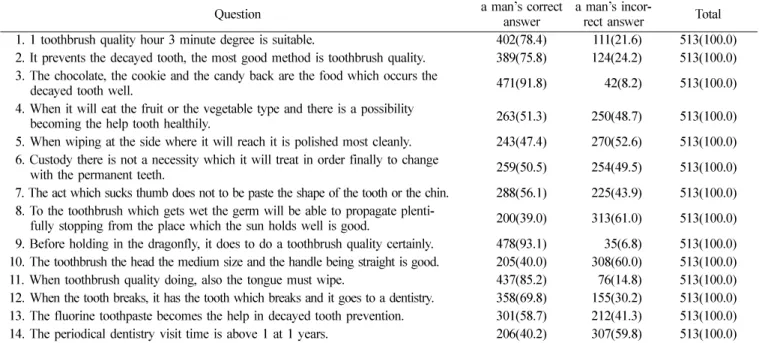
조사대상자의 문항별 구강보건지식 수준은
Table 3
과 같다.
총문항수는14
개로구성하였고,
한개문항을1
점으로하여다맞추었을경우
14
점만점으로하였다.
초등학생들이올바른구강보건지식을가지고있는경우 는
‘
잠자리에들기전에반드시칫솔질을해야한다’
였으며
93.1%
의학생이올바르게인식하고있었다.
‘
초콜렛,
과자,
사탕등은 충치를잘발생시키는 음식이다
’ 91.8%, ‘
칫솔질할때혀도닦아야한다’ 85.2%, ‘1
회의 칫솔질 시간은
3
분 정도가적당하다’ 78.4%, ‘
충치를예방하기에 가장좋은방법은 칫솔질이다
’ 75.8%
의 학생 이알고있었다.
또한
‘
젖은 칫솔에는 세균이 많이 번식할 수 있으므로햇볕이 잘 드는 곳에서 말리는 것이 좋다
’ 39.0%, ‘
칫솔은머리가중간크기이고손잡이가곧은것이좋다
’ 40.0%,
‘
정기적인치과방문시기는1
년에1
회이상이다’ 40.2%
로나타나이분야에대한교육이필요함을알수있다
.
3. 구강보건지식 수준과 학교구강보건교육 경험과의 관계
조사대상자의구강보건지식 수준은
Table 4
와같다.
구강보건지식 수준을 평가하기 위한문항은 한문항을
1
점으로하여 만점을
14
점으로하였을때,
전체평균이8.77
로 높지않았다
.
여학생이9.00
으로남학생보다 구강보건지식 수준이 높아 유의한 차이를 보였으며
(p < .05), 4
학년
8.85, 6
학년이8.69
로나타나4
학년의구강보건지식은높았으나유의한차이는없었다
.
구강보건지식수준과학교구강보건교육의관계는구강보 건교육을받은적이있는학생이그렇지않은학생보다구 강보건지식수준이높았으며유의한차이를보였다
(p < .05).
Table 3.
Question item star oral health knowledge level of investigation object person N(%)Question a man’s correct
answer a man’s incor-
rect answer Total 1. 1 toothbrush quality hour 3 minute degree is suitable. 402(78.4) 111(21.6) 513(100.0) 2. It prevents the decayed tooth, the most good method is toothbrush quality. 389(75.8) 124(24.2) 513(100.0) 3. The chocolate, the cookie and the candy back are the food which occurs the
decayed tooth well. 471(91.8) 42(8.2) 513(100.0)
4. When it will eat the fruit or the vegetable type and there is a possibility
becoming the help tooth healthily. 263(51.3) 250(48.7) 513(100.0)
5. When wiping at the side where it will reach it is polished most cleanly. 243(47.4) 270(52.6) 513(100.0) 6. Custody there is not a necessity which it will treat in order finally to change
with the permanent teeth. 259(50.5) 254(49.5) 513(100.0)
7. The act which sucks thumb does not to be paste the shape of the tooth or the chin. 288(56.1) 225(43.9) 513(100.0) 8. To the toothbrush which gets wet the germ will be able to propagate plenti-
fully stopping from the place which the sun holds well is good. 200(39.0) 313(61.0) 513(100.0) 9. Before holding in the dragonfly, it does to do a toothbrush quality certainly. 478(93.1) 35(6.8) 513(100.0) 10. The toothbrush the head the medium size and the handle being straight is good. 205(40.0) 308(60.0) 513(100.0) 11. When toothbrush quality doing, also the tongue must wipe. 437(85.2) 76(14.8) 513(100.0) 12. When the tooth breaks, it has the tooth which breaks and it goes to a dentistry. 358(69.8) 155(30.2) 513(100.0) 13. The fluorine toothpaste becomes the help in decayed tooth prevention. 301(58.7) 212(41.3) 513(100.0) 14. The periodical dentistry visit time is above 1 at 1 years. 206(40.2) 307(59.8) 513(100.0)
4. 조사대상자의 문항별 구강보건행동 수준
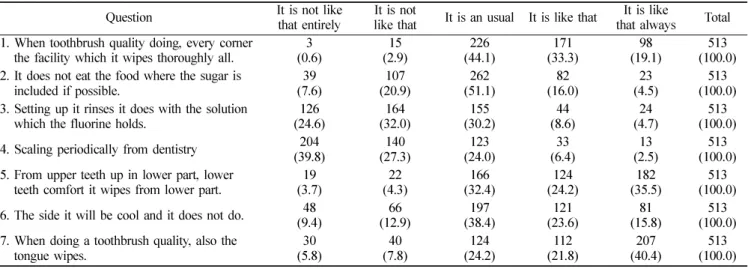
조사대상자의 문항별 구강보건행동 수준 결과는
Table
5
와같다. ‘
칫솔질할때 구석구석철저히닦는편이다’
에대해
‘
그렇다’
고인식하는학생이52.4%
로높게조사되었으며
, ‘
그렇지 않다’
라고 대답한 학생은3.5%
로 매우 적었다
. ‘
설탕이포함된음식을가급적먹지않는다’
고대답한학생이
28.5%
로‘
먹는다’
라고대답한학생20.5%
보다많았다
. ‘
불소가 함유된용액으로 입안 헹구기를 한다’
고한 학생은
13.3%
였으나, ‘
그렇지 않다’
고 대답한 학생이56.6%
로조사되었다.‘
치과에서주기적으로스켈링을한다’
고 대답한 학생은
8.9%
인 반면, ‘
하지 않는다’
는 학생은67.1%
이었다.‘
윗니는 위에서 아래로,
아랫니는 아래에서위로 닦는다
’
에 대해‘
그렇다’
고 대답한 학생이59.7%
로‘
그렇지않다’
라고대답한학생8.0%
보다많았다. ‘
편식을하지않는다
’
는학생은39.4%
로편식을하는학생22.3%
보다많았다
. ‘
칫솔질을할때혀도닦는다’
에대해‘
그렇다’
는학생이
62.2%
로‘
그렇지않다’
고대답한학생13.6%
이었다.
5. 구강보건지식과 구강보건행동의 관계
조사대상자들의 구강보건지식과 구강보건행동의 관계
는
Table 6
과같다.
구강보건행동정도는5
점Likert
척도로 조사하여
,‘
항상 그렇다’ 5
점, ‘
그렇다’ 4
점, ‘
보통이다’ 3
점, ‘
그렇지않다’ 2
점, ‘
전혀그렇지않다’
를1
점으로하였을때전체평균이
3.13
이였다.
남학생이여학생보다구강보건행동정도가높았으나유 의한 차이는 없었고
, 4
학년이6
학년에 비해 유의한 차이를 보였다
(p < .05).
구강보건지식 수준 정도가높은 학생일수록구강보건행동정도도높았으며
,
지식수준에따라유의한차이가있었다
(p < .001).
6. 구강보건지식과 구강보건행동 및 학교구강보건교 육 경험의 상관관계
조사대상자들의 구강보건지식과 구강보건행동 및 학교 구강보건교육경험의 상관관계 분석 결과는
Table 7
과 같 다.
구강보건지식과구강보건행동간에는r = .345(p < .001)
로약간 높은정
(+)
의선형상관이있어구강보건지식정 도가 높으면 구강보건행동도 높아짐을 알 수 있었으며,
구강보건지식과 학교구강보건교육 경험의 상관관계도
r = .105 (p < .001)
로 나타나 선형 상관관계가 있음을 알수있었다
.
7. 학교구강보건실 설치 필요성 의식도 조사
학교구강보건실설치필요성의식도조사결과는
Table
8
과 같다.
필요성이 있다고응답한학생이87.1%
였다.
여학생이 남학생보다
, 6
학년이4
학년보다 학교 구강보건실 설치가필요하다고인식하였으나유의한차이는없었다.
Table 4.
Oral health knowledge level and relationship of school dental health education experienceDivision N Mean SD t(F) p
Gender malefemale 250263 8.539.00 2.362.39 -2.27* 0.024
Grade 4 grade6 grade 253260 8.858.69 2.402.38 0.77 0.444
School dental health education
experience yesno 379134 8.928.35 2.432.20 2.39* 0.017
Total 513 8.77 2.39
*p < .05
Table 5.
Question item star oral health behavior level of investigation object person N(%)Question It is not like
that entirely It is not
like that It is an usual It is like that It is like
that always Total 1. When toothbrush quality doing, every corner
the facility which it wipes thoroughly all. 3
(0.6) 15
(2.9) 226
(44.1) 171
(33.3) 98
(19.1) 513
(100.0) 2. It does not eat the food where the sugar is
included if possible. 39
(7.6) 107
(20.9) 262
(51.1) 82
(16.0) 23
(4.5) 513
(100.0) 3. Setting up it rinses it does with the solution
which the fluorine holds. 126
(24.6) 164
(32.0) 155
(30.2) 44
(8.6) 24
(4.7) 513
(100.0) 4. Scaling periodically from dentistry 204
(39.8) 140
(27.3) 123
(24.0) 33
(6.4) 13
(2.5) 513
(100.0) 5. From upper teeth up in lower part, lower
teeth comfort it wipes from lower part. 19
(3.7) 22
(4.3) 166
(32.4) 124
(24.2) 182
(35.5) 513
(100.0) 6. The side it will be cool and it does not do. 48
(9.4) 66
(12.9) 197
(38.4) 121
(23.6) 81
(15.8) 513
(100.0) 7. When doing a toothbrush quality, also the
tongue wipes. 30
(5.8) 40
(7.8) 124
(24.2) 112
(21.8) 207
(40.4) 513
(100.0)
8. 구강건강을 지도해 주는 선생님의 필요성
구강건강을 지도해주는 선생님의 필요성에대한 조사결과는
Table 9
와같다.
필요하다고인식한경우가60.2%
로 높게 조사되었으며
,
필요하지 않다 라고 한 경우는7.4%
이었다.
여학생이 남학생보다 구강건강을 지도해줄 선생님이 필요하다고 한 경우가 많았으며유의한차이를 보였다(p < .05).
고 찰
학교구강보건교육은 학교에서의 구강보건 교육활동을 말하며
,
구강병예방과치료를효율적으로하고,
일생동안 구강건강을 관리하는데 필요한 구강보건지식을 교수하여 합리적인구강보건행동을육성하기위해서필요하다5).
초 등학교학령기 아동은유치가 영구치로 교환되기 시작하 며 치아우식병 발생률이높기 때문에,
이 시기의 구강보건 교육과효과적인 구강보건 관리는일생동안의 구강건 강과 직결되기 때문에 매우 중요하다
.
그래서 초등학교구강보건 교육사업은 구강보건사업 중에서 가장 중요한 사업으로인식되고있다12)
.
초등학교 구강보건교육의목적을달성하기위해서는구
강보건에 관한지식을전달할뿐아니라
,
구강보건지식을바탕으로 구강건강관리 태도를 변화시키고
,
구강건강 관 리행동을육성하는구강보건교육이필요하다13).
본 연구는 초등학교학생들의 구강보건에 관한 지식과 행동의 상관관계를 조사분석하여 구강보건 지식이 바람 직한구강보건행동에미치는영향을분석검토하였다
.
초등학교 학생들의구강보건지식 수준 정도는
14
점 만점중 전체평균이
8.77(62.6%)
로김14)의 연구와같이지식 정도가높지않았으며
,
학교에서의구강보건 교육경험(r = 0.105, p < .05)
이있는학생일수록구강보건지식이높게
(p < .01)
나타났다.
이는 구강보건교육의 중요성을 의미하며 교육이효과적으로 이뤄지기 위해서는적절한교 육내용으로 교육자와 피교육자의 반복적인 접촉이 요구 된다
.
따라서학생과접촉하는기회가많은 학교보건교사 에 대한 구강보건교육이 중요하며,
치과위생사나 치과의사같은구강보건전문인력이구강보건교육에참여한다 면더좋은결과를얻을수있을것으로생각된다
.
초등학교 학생들의 구강보건행동정도는
5
점Likert
척도로조사한결과전체평균이
3.13
으로김14)과송15)의연구와일치된결과를보였으며
,
이는 학생들의구강보건관 리가올바르게이루어지고있지않음을알수있었다.
구강보건지식 수준과 구강보건행동은 김과 이등14, 16)의
연구와 같이유의한 차이를보여
(r = 0.345, p < .00)
구강보건지식이 높을수록 구강보건행동도 높게 나타난 것으 로 보아 구강보건지식이낮으면 올바른 구강보건 행동을 실천할 수 없었다
.
그러므로 구강보건교육은 구강진료기관 및 교육기관을 통한 정확하고실천가능한 교육이이 루어져야 하며
,
구강보건교육의양과질적인강화가필요하다고생각된다
.
Table 6.
Relationship of oral health knowledge and oral health behaviorDivision N Mean SD t(F) p
Gender malefemale 250263 3.153.11 0.590.56 0.78*** 0.439
Grade 4 grade6 grade 253260 3.193.07 0.540.60 2.38*** 0.018
Oral health knowledge
level at position 278 3.26 0.56
25.12** 0.000
in position 92 3.11 0.49
under position 143 2.86 0.56
Total 513 3.13 0.57
*p < .05, **p < .001
Table 7.
Interrelation of oral health knowledge and oral health behavior and school dental health education experienceDivision Oral health knowledge p
Oral health behavior 0.345* 0.000
School dental health
education experience 0.105* 0.017
*p < .001
Table 8.
School dental health thread establishment necessity ceremony investigation N(%) Division It thinks that it is necessary It thinks that thereis not a necessity Total
χ
2 (df) pGender malefemale 213(85.2)234(89.0) 37(14.8)29(11.0) 250(48.7)263(51.3) 1.63(1) 0.202 Grade 4 grade6 grade 222(87.7)225(86.5) 31(12.3)35(13.5) 253(49.3)260(50.7) 0.17(1) 0.683
Total 447(87.1) 66(12.9) 513(100.0)
학교구강보건실의 운영에 관한 학생들의 의식조사에서
87.1%
의 학생이 필요하다고 응답하였는데 이는 최17)의연구와 일치된 결과로 나타나
,
학생들이 학교구강보건실에서 시행되는 구강보건사업이 자신들의 구강건강에 도 움이 됨을 인식하기 때문에 나타난 결과로 생각된다
.
또한
60.2%
의 학생들이구강보건담당 관리 교사가필요하다고 하였는데이는 최17)의
84%
보다는낮은 통계적 결과를나타냈으나
,
이역시학교구강보건실에전문인력이상주하면 효과적으로 이용할 수 있으리라는 기대가반영 된것으로사료된다
.
그러나 서18)는 이러한 학교구강보건실 운영에 있어서 제반 인식도와 관련하여 보다 정확하고 다각적으로 측정 될수 있는평가도구를개발할필요가있다고하였다
.
그 러므로학교구강보건실을 효과적으로 운영하기 위해서는 구강 전문가인 치과위생사를 학교에 배치시켜 학교계속 구강건강 증진사업을 확대 발전시켜나가는 것이필요하 다고생각된다.
본 연구 결과
,
학생들의 구강보건지식 수준은 높지 않 았으며행동정도도양호하지 않았다.
이는현재 우리나라의초등학교구강보건교육의교육내용 및교육자료의부 족과 실질적인 구강보건교육 담당자들의 구강보건인식의 부족등으로인하여효과적으로실시되지못하고있으며
,
구강보건교과과정도전학년에걸쳐일관성이결여된채 같은 내용이 학년별
,
교과별로 반복되어 있기 때문이라사료된다
.
그러므로
,
초등학교구강보건교육을효과적으로실시하기 위해서는 교육내용 및 교육자료들의 개발
,
학년별로 필요한 지식수준이나 이해정도에 맞춘 뚜렷한 교육목표 설정,
학년별로 연계성이 있는 체계적인 구강보건교육이 이루어지도록 새로운구강보건교육모형이 개발되어야 한 다고사료된다.
이와더불어아동들의행동강화및구강병을예방하고
,
발생한구강병을초기에발견하여치료할수있도록학교 구강보건실을 활성화하여 공중보건의사나 치과위생사를 상주시키면 많은 도움이 될 것이다
.
또 정기구강검사를통하여 구강병을 예방하고 검사결과를 가정통신문으로 보내고계속적인 관리를위하여 치료확인서를받아 계속 구강건강관리가 이루어지도록 하는 체계적인 시스템이 도입되어야한다고생각된다
.
요 약
본연구는초등학교학생들에게필요한구강보건교육목 표를설정하는데에기초자료를수집할목적으로전라북 도익산시에소재하고있는초등학교
1
개교4
학년, 6
학년513
명을대상으로하여초등학교학생의구강보건에관한 지식과행동의상관관계를조사한결과다음과같은결론 을얻었다.
1.
조사대상자들의 구강보건지식 정도는14
점 만점에8.77
로 높지 않았으며,
여학생이 남학생보다 구강보건지식정도가높았고유의한차이를보였다
(p < .05).
2.
학교구강보건교육경험이있는학생일수록 구강보건지식정도도높게나타났으며
,
통계적으로 유의한차이를 보였다(r = 0.105, p < .05).
3.
구강보건행동정도는5
점Likert
척도로조사한 결과,
전체 평균이
3.13
으로 높지 않았으며,
학년에 따른 유의한차이를보였다
(p < .05).
4.
구강보건지식이높은학생일수록 구강보건행동 정도 가 높게 나타나,
구강보건지식과 행동의 유의한 차이를보였다
(p < .001).
5.
구강보건지식과 구강보건행동 및 학교구강보건교육경험은 정
(+)
의 선형 상관이 있어 구강보건지식 정도가 높으면구강보건행동도 높아짐을 알 수있었다(r = 0.345, p < .001, p < .05).
6.
성별과학년에관계없이 학교구강보건실의필요성과 구강건강담당교사의필요성은인식하고있었다(p < .05).
참고문헌
1. Kim SJ: Relationships between Knowledge, Attitudes, and Behaviors about the Dental Health and Dental Health Condition in Elementary Students in the Pusan Area. Journal of Korean Society for Health Education and Promotion 21(1):
69-84, 2004.
2. Korean Acad Dent Health: The epidemiology investigative reporting regarding a Korean oral disease. Journal of Korean Acad Dent Health 7(3): 32-38, 1972.
3. Jeong SS, Lee HS: Perception of student’s parents on school dental inspections in Daejon, Korea. Journal of Korean Acad Dent Health 30(2): 117-129, 2006.
4. MA JK: Elementary school oral health thread oral healthy increase instance analysis. Graduate School of health
Table 9.
Oral health the map necessity of the teacher to do N(%)Division Yes No It will not
know well Total
χ
2 (df) pGender malefemale 137(54.8)172(65.4) 23(9.2)15(5.7) 90(36.0)76(28.9) 250(48.7)263(51.3) 6.50*(2) 0.039 Grade 4 grade6 grade 152(60.1)157(60.4) 15(5.9)23(8.8) 86(34.0)80(30.8) 253(49.3)260(50.7) 1.89(2) 0.389
Total 309(60.2) 38(7.4) 166(32.4) 513(100.0)
*p < .05, **p < .001
environment, Chosun University, 2004.
5. Shin JH: Oral health knowledge and behaviors of middle school children on Bukgu, Ulsan Metropolitan city, Korea.
Department of Dentistry, Graduate School of Pusan National University, 2004.
6. Preventive Medical science and public health Editorial board:
Preventive Medical science and public health, Reconstruction culture company, pp.869, 1995.
7. Shin SC, Jo EH, Seo HS: School-based comprehensive oral health care program and expending proposal in Korea. Journal of Korean Acad Dent Health 24(2): 185-204, 2000.
8. Lim KA: Dental caries status of children and youth in Singapore. Ann Acad Med Singapore 15: 275-286, 1986.
9. Sterritt GR, Frew RA: Evaluation of a school-based fluoride mouthrinsing and clinic-based sealant program on a nonfluoride island. Community Dental Oral Epidemiol 18:
288-294, 1990.
10. Robert A, Bagramiant A: 5-year school based comprehensive preventive program in Michigan. Community Dent and Oral Epidemiol 10: 234-238, 1982.
11. Song KB, Park HS, Park JY: The Effec of Fluoride Mouthrinsing program on dental health of school children.
Journal of Korean Acad Dent Health 16(1): 95-112, 1992.
12. Kim JB, Choi YJ: Preventive Dentistry, KMS, pp.9-10, 1998.
13. Jeon HJ, Song KB, Lee SK: Change of oral health knowledge tile oral hygiene capacity of management of the elementary
school student due to oral health education. Journal of Korean Society for health Education and Promotion 12(2): 226-303, 1999.
14. Kim SJ: Relationships between the Knowledge, Attitude, and Behavior about the Dental Health and the Dental Health Conditions in Elementary Student. The Graduate School of Administrative Science, Pusan National University, 2003.
15. Song KH: A study on the Elementary School children’s oral health practices. The Graduate School of Administrative Science, Yonsei University, 1999.
16. Lee CS, Lee SM: A Study on Elementary School Student’s Experience of Caries, Dental Health Condition and Knowledge of Dental Health. Bullentin Dongnam Health College 21(1): 123-131, 2003.
17. Choi SL, Kwun HS, Song KB, Lee JH: Effects of School- Based Oral Health Programs among Schoolchildren : Focus on the Oral Health Knowledge and Behaviors. J Korean Acad Dental Hygiene Education 6(4): 455-467, 2006.
18. Seo EJ: An Effect on oral health care room’s works on the oral health promotion of primary school children in Gwangju metropolitan city. Graduate School of dentistry, Chosun University, 2006.