Effects of Body Image Satisfaction and Interpersonal Relationship on Depression Among Nursing Students in Korea
Yun-Kyung Kim
1, Nam-Hyun Cha
1*1Department of Nursing, College of Natural Science, Andong National University
간호대학생의 외모만족도, 대인관계 성향이 우울에 미치는 영향
김윤경1, 차남현1*
1안동대학교 자연과학대학 간호학과
Abstract This study examined the influencing factors of depression on the physical appearance satisfaction and the trends of personal relationships in Korean nursing college students. A total of 247 subjects between 17 and 27 years of age were selected through random sampling. Data were collected using a self?reported questionnaire from November 1, 2012 to March 30, 2013. The depression acceptance differed significantly according to rank between siblings, religion, school record, socioeconomic status, cohabitation, and stress resolving methods. There was a positive correlation between depression and the appearance satisfaction and the trends of personal relationship. 26.8%
variance in depression was explained by the appearance, socioeconomic status, sympathy-acceptance, resistance-mistrust, body figure, and cohabitation. These findings may be useful for understanding depression in nursing college students and developing more specific personal interrelationship and depression programs
요 약 본 논문은 한국 간호대학생의 외모 만족도와 대인관계 성향 및 우울간의 관계를 확인하고 우울에 미치는 영향요인을 확인하고자 한다. 연구 대상자의 연령은 17세-27세 범위이며 총 247명이 편의 추출에 의해 선정되었다. 연구는 2012년 11월 1일부터 2013년 3월 30일까지 시행하였다. 우울에 유의한 변수는 형제서열순위, 종교, 학교성적, 경제적 상태, 거주상태, 스트 레스 해소방법이었다. 우울과 외모만족도, 대인관계 경향은 양의 상관관계를 가지는 것으로 나타났다. 우울에 가장 큰 영향을 미치는 것은 외형, 경제적 수준이었고, 다음으로 동정-수용적, 반항-불신적, 체형과 거주상태 순으로 모형의 수정된 결정계수 (R2)는 .268 이었다. 본 연구결과는 한국 간호대학생의 우울을 이해하고 개인간 상호관계와 우울 프로그램을 개발하는데 유 용한 연구가 될 것이다.
Keywords : Depression, Interpersonal relationship, Personal satisfaction
*Corresponding Author : Nam-Hyun Cha(Andong National Univ.) Tel: +82-54-820-7314 email: [email protected]
Received October 21, 2015 Accepted February 4, 2016
Revised (1st November 16, 2015, 2nd December 15, 2015, 3rd December 28, 2015) Published February 29, 2016
1. Introduction
Physical appearance plays a pivotal role in forming and expressing self-concept, defined as a collection of beliefs about oneself, and has a significant impact on interpersonal relationships and interactions with others
〔1〕. When people have a negative and low sense of
self-image about their appearance, they are likely to generate passive aggressive behavior〔1-3〕, or maladjusted behavior such as interpersonal uneasiness and anxiety associated with interpersonal relationships, leading to seriously damaging interpersonal relationships as a whole〔4〕. In contrast, psychologically healthy people with a positive image about their appearance
have a tendency to develop good interpersonal relationships with others, actively engage in social activities, have a sense of stability, and have a lower level of anxiety caused by interpersonal relationships.
University students, during the period of their education, are taking greater interest in decorative objects, such as jewelry, to enhance their appearance and look more attractive. The more satisfied an individual is with their own appearance, the more motivated he or she will become to get involved in social activities. Therefore, personal appearance is an important factor influencing the perception of personal relationships and consequently problems with interpersonal relationship are a contributing factor in the intensification of depression symptoms〔5〕.
Furthermore, negative emotions, especially depression among nursing students, are a burden on responsibilities of future healthcare professionals and the medical system as a whole. Depression manifests itself through a sense of inferiority, nervousness, or a lack of cooperation〔6-7〕. Therefore, it is essential to examine the degrees, correlation and main factors influencing depression among nursing students before proceeding with nursing intervention and regulatory or policy changes. The results of this study provides baseline data to help nursing students in Korea and in other countries with quality promotion in future, as well as assisting international nursing educators with quality considerations regarding the psychological ramifications of the link between body image satisfaction and interpersonal relationships on depression among nursing students. The aims of the current study were to confirm general characteristics of Korean nursing students, examine the degree of satisfaction with their body, interpersonal relationships, and level of depression among Korean nursing students, examine the differences in body image satisfaction, interpersonal realationship, and depression, examine correlations between body image satisfaction, interpersonal relationships and depression, and examine the influence of depression on the level of body image
satisfaction and interpersonal relationships.
2. Subjects and Methods
2.1 Design and sample
A descriptive cross-sectional design was adopted in the current study. The study sample comprised of nursing students from colleges located in S and G cities in Korea. After research approval from the University, study questionnaires were distributed to 280 nursing students who were willing to participate in the study. The questionnaire response rate was 88.2%. Due to incomplete responses in some questionnaires a total of 247 subjects who returned a completed survey were included in the final dataset.
Sample size adequacy (N=229) of G*Power analysis at a 95% significance level (α< 0.05), had an effect size of 0.15 in the regression analysis.
2.2 Instruments
The study questionnaire was designed to measure general characteristics, body image satisfaction, interpersonal relationships, and the presence or absence of depression in subjects.
2.2.1 Body Esteem Scale
BES (Body Esteem Scale) developed by Mendelson, White and Schliecker〔8〕was translated into Korean by Lee〔9〕, and subsequently revised by Lee and Bang〔10〕. This scale was used to measure the body type and appearance parts of body satisfaction and it consisted of eight questions using a 5-point scale with a possible score range from 8 to 40. The higher the score of the respondent, the more positive was the level of perceived body satisfaction in the subject.
Cronbach’s alpha reliability coefficient for this instrument was 0.79.
2.2.2 Interpersonal Disposition Scale
IDS (Interpersonal Disposition Scale) reconstituted
by Ahn〔11〕was used and based on the behavioral model for interpersonal traits developed by Leary and the characteristics of interpersonal responses reported by Krech〔12〕. It consisted of 84 questions using a 4-point scale with a possible score range from 84 to 336. Higher scores of the respondents indicate a more prominent interpersonal disposition in the category in which the scores fell into. Cronbach’s alpha reliability coefficient for this instrument was 0.83.
2.2.3 Symptom Check List-90-Revision SCL-90-R (Symptom Checklist-90-Revision) revised by Kim et al.〔13〕 was used to measure the depression levels among the participants. It consisted of a total of 13 questions using a 5-point scale with a possible score range from 13 to 65. Higher scores of the respondents indicated a higher level of depression.
Cronbach’s alpha reliability coefficient for this instrument was 0.89.
2.3 Data collection
The questionnaire survey data were collected between 1 November 2012 and 30 March 2013. The researcher explained the purpose of the study as well as the participation details and the instruments that were to be used.
2.4 Data Analysis
The collected data were analyzed using SPSS version 20.0. General characteristics and the major study variables were tested using descriptive statistics, t-test, Tukey post-hoc test, Pearson’s correlation coefficient and multiple regression analysis.
3. Results
3.1. General characteristics of subjects The general characteristics of the participants are shown in Table 1.
Characteristics Subcategories n(%)
Grade 1 2 3 4
70(28.3) 79(32.0) 59(23.9) 39(15.8)
Gender M
F
34(13.8) 213(86.2)
Rank between siblings
Firstborn Middle born Lastborn Only child
114(46.2) 40(16.2) 86(34.8) 7(2.8)
Religion
Catholic Buddhist Christian None
30(12.2) 28(11.5) 69(27.8) 120(48.5) Academic
record
High Middle Low
51(20.7) 158(64.0) 38(15.3) Socioeconomic
status
Middle-high Middle Middle-low
19(7.8) 181(73.3) 47(18.9)
Home residence
Dormitory (on-campus) Living alone (off-campus) Living with family (off-campus)
190(77.0) 33(13.5) 24(9.4) Frequency of
meetings with family
Daily Weekly 2-3/month 2-3/semester
26(10.7) 14(5.3) 95(38.5) 112(45.5)
Stress management
method
Sleeping Talk to someone Exercise Listen to music See movies Other
108(43.6) 55(22.4) 14(5.8) 36(14.5)
9(3.7) 25(10.0) Partnership profile
(single) Yes No
62(25.1) 185(74.9) Table 1. General Characteristics of Subjects
(N=247)
The subjects in this study showed the even distribution in school years from freshmen to seniors with the average age of 20.4 years, ranging from 17 and 27 years. Gender of the subjects showed that the majority was female students (86.2%), and birth order showed that 114 subjects or 46.2% of the subjects were the first child in their family, followed by the last child (86 subjects or 34.8%), and the middle child (40 or 16.2%), respectively. Religion showed the even proportion between those who had religion (51.5%) and those who didn't (48.5%). The most frequently perceived socioeconomic status was the middle class (181) or 73.3% of the subjects. The number of times spending with families showed that 112 subjects (45.5%) responded to see their own families two to
three times a semester, 95 subjects (38.5%) two to three times a month, 14 subjects (5.3%) once a week, and only 26 subjects (10.7%) saw their family every day. The methods of stress management included sleeping (43.6%), having chatter with people they knew (22.4%), listening to music (14.5%), doing exercises (5.8%), and seeing movies (3.7%), in order. The majority of the subjects did not have boyfriends or girl friends (74.9).
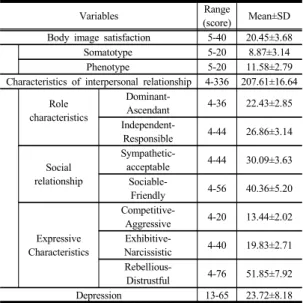
3.2 Degrees of body Image satisfaction, interpersonal relationship, and depression Means of the degrees of body image satisfaction, interpersonal relationship, and depression were 20.45, 207.61, and 23.72, respectively. The subjects scored lower than the average of depression and somewhat higher than the average of interpersonal relationship (Table 2).
Variables Range
(score) Mean±SD Body image satisfaction 5-40 20.45±3.68
Somatotype 5-20 8.87±3.14
Phenotype 5-20 11.58±2.79
Characteristics of interpersonal relationship 4-336 207.61±16.64 Role
characteristics
Dominant-
Ascendant 4-36 22.43±2.85 Independent-
Responsible 4-44 26.86±3.14
Social relationship
Sympathetic-
acceptable 4-44 30.09±3.63 Sociable-
Friendly 4-56 40.36±5.20
Expressive Characteristics
Competitive-
Aggressive 4-20 13.44±2.02 Exhibitive-
Narcissistic 4-40 19.83±2.71 Rebellious-
Distrustful 4-76 51.85±7.92
Depression 13-65 23.72±8.18
Table 2. Means, Standard Deviation, and Range of Body image Satisfaction, Interpersonal Relationship, and Depression in Subjects
3.3 Differences in Body Image Satisfaction, Interpersonal Relationship, and Depressiony Demographic Characteristics
The only item that showed a statistical significance with body image satisfaction was cigarette
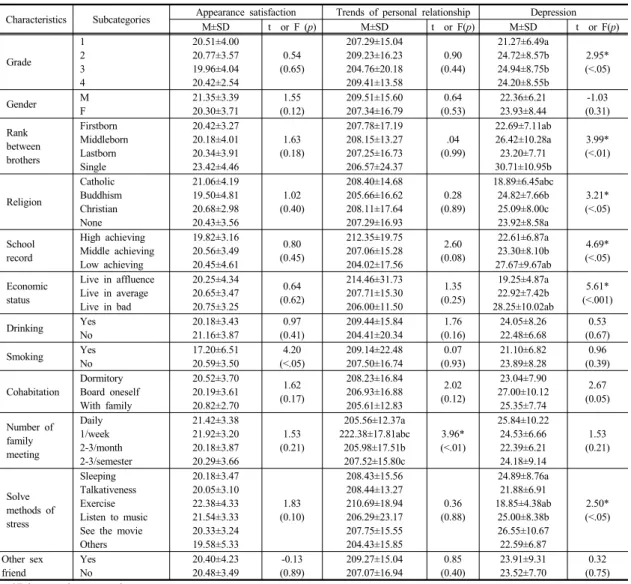
smoking(t=4.20, p<.05), indicating that the level of body image satisfaction increased as the subjects did not smoke cigarettes.
There was a significant statistical difference between the number of seeing family members and interpersonal relationships(F=3.96, p<.01), indicating that the subjects who had seen their own family once a week were more likely to have a good interpersonal relationship with others than those who had seen their families on a daily basis or who had barely seen.
Birth order(F=3.99, p<.01), religion(F=3.21, p<.05), school achievement(F=4.69, p<.05), socioeconomic status(F=5.61, p<.001), living condition(F=2.67, p<.05), and stress management methods(F=2.50, p<.05) all had statistical significant effects on depression, indicating that the subjects who were in the middle birth order or the only child were more likely to feel depressed than those who were the oldest children, while those who were christian were less likely to have depression than those who had other than christianity or no religion. The lower the school record and the lower the socioeconomic status, the higher the depression. The subjects who lived apart from their own families and who took care of room and board all by themselves were more likely to be depressed. The subjects who did exercises as a strategy for stress management were less likely to have depression than those who listened to music, or sleep to reduce stress(Table 3).
3.4 Correlations among body Image satisfaction, interpersonal relationship,
and depression
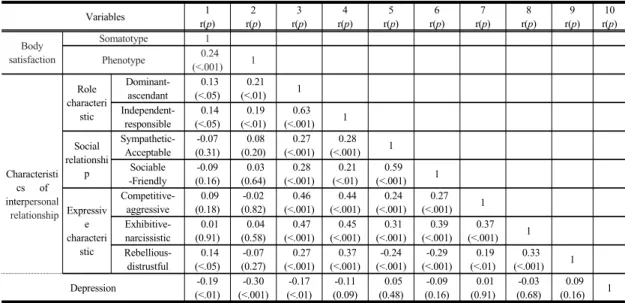
Correlation among the subjects' body image satisfaction, interpersonal relationship, and depression showed that physique or body somatotype showed positive correlations with the outward phenotype (p<.001), dominant-ascendant (p<.05) and independent- responsible (p<.05) dispositions in the dimension of role orientation as well as with rebellious-distrustful (p<.05) disposition in the dimension of expression of
Characteristics Subcategories Appearance satisfaction Trends of personal relationship Depression
M±SD t or F (p) M±SD t or F(p) M±SD t or F(p)
Grade
1 2 3 4
20.51±4.00 20.77±3.57 19.96±4.04 20.42±2.54
0.54 (0.65)
207.29±15.04 209.23±16.23 204.76±20.18 209.41±13.58
0.90 (0.44)
21.27±6.49a 24.72±8.57b 24.94±8.75b 24.20±8.55b
2.95*
(<.05)
Gender M
F
21.35±3.39 20.30±3.71
1.55 (0.12)
209.51±15.60 207.34±16.79
0.64 (0.53)
22.36±6.21 23.93±8.44
-1.03 (0.31) Rank
between brothers
Firstborn Middleborn Lastborn Single
20.42±3.27 20.18±4.01 20.34±3.91 23.42±4.46
1.63 (0.18)
207.78±17.19 208.15±13.27 207.25±16.73 206.57±24.37
.04 (0.99)
22.69±7.11ab 26.42±10.28a 23.20±7.71 30.71±10.95b
3.99*
(<.01)
Religion
Catholic Buddhism Christian None
21.06±4.19 19.50±4.81 20.68±2.98 20.43±3.56
1.02 (0.40)
208.40±14.68 205.66±16.62 208.11±17.64 207.29±16.93
0.28 (0.89)
18.89±6.45abc 24.82±7.66b 25.09±8.00c 23.92±8.58a
3.21*
(<.05)
School record
High achieving Middle achieving Low achieving
19.82±3.16 20.56±3.49 20.45±4.61
0.80 (0.45)
212.35±19.75 207.06±15.28 204.02±17.56
2.60 (0.08)
22.61±6.87a 23.30±8.10b 27.67±9.67ab
4.69*
(<.05)
Economic status
Live in affluence Live in average Live in bad
20.25±4.34 20.65±3.47 20.75±3.25
0.64 (0.62)
214.46±31.73 207.71±15.30 206.00±11.50
1.35 (0.25)
19.25±4.87a 22.92±7.42b 28.25±10.02ab
5.61*
(<.001)
Drinking Yes No
20.18±3.43 21.16±3.87
0.97 (0.41)
209.44±15.84 204.41±20.34
1.76 (0.16)
24.05±8.26 22.48±6.68
0.53 (0.67)
Smoking Yes
No
17.20±6.51 20.59±3.50
4.20 (<.05)
209.14±22.48 207.50±16.74
0.07 (0.93)
21.10±6.82 23.89±8.28
0.96 (0.39)
Cohabitation
Dormitory Board oneself With family
20.52±3.70 20.19±3.61 20.82±2.70
1.62 (0.17)
208.23±16.84 206.93±16.88 205.61±12.83
2.02 (0.12)
23.04±7.90 27.00±10.12 25.35±7.74
2.67 (0.05)
Number of family meeting
Daily 1/week 2-3/month 2-3/semester
21.42±3.38 21.92±3.20 20.18±3.87 20.29±3.66
1.53 (0.21)
205.56±12.37a 222.38±17.81abc
205.98±17.51b 207.52±15.80c
3.96*
(<.01)
25.84±10.22 24.53±6.66 22.39±6.21 24.18±9.14
1.53 (0.21)
Solve methods of stress
Sleeping Talkativeness Exercise Listen to music See the movie Others
20.18±3.47 20.05±3.10 22.38±4.33 21.54±3.33 20.33±3.24 19.58±5.33
1.83 (0.10)
208.43±15.56 208.44±13.27 210.69±18.94 206.29±23.17 207.75±15.55 204.43±15.85
0.36 (0.88)
24.89±8.76a 21.88±6.91 18.85±4.38ab
25.00±8.38b 26.55±10.67 22.59±6.87
2.50*
(<.05)
Other sex friend
Yes No
20.40±4.23 20.48±3.49
-0.13 (0.89)
209.27±15.04 207.07±16.94
0.85 (0.40)
23.91±9.31 23.52±7.70
0.32 (0.75) p *Tukey post-hoc test: a<b<c,
Table 3. Differences in Body Image Satisfaction, Interpersonal Relationship, and Depression by General Characteristics of Subjects (N= 247)
interpersonal relationship, but had a negative correlation with depression (p<.01). The outward phenotype of the subjects showed positive correlations with dominant-ascendant (p<.01) and independent-responsible (p<.01) dispositions in the dimension of role orientation of interpersonal relationship, but had a negative correlation with depression (p<.001). Depression showed a negative correlation with the outward phenotypes (p<.001), body somatotype (p<.01) and dominant-ascendant (p<.01). In addition, as the interpersonal relationship showed stronger dominant-ascendant disposition (p<.001) in the
role identification, there were positive correlations of sympathetic-acceptable (p<.001) and sociable-friendly (p<.001) dispositions in social relations with competitive-aggressive (p<.001), exhibitive-narcissistic (p<.001), and rebellious-distrustful (p<.001) dispositions in the expressive dimension. As the interpersonal relationship became more independent-responsible dispositions in role identification, there were positive correlations of sympathetic-acceptable (p<.001) and sociable-friendly (p<.01) dispositions in social relations with competitive-aggressive (p<.001), exhibitive-narcissistic
Variables 1 r(p)
2 r(p)
3 r(p)
4 r(p)
5 r(p)
6 r(p)
7 r(p)
8 r(p)
9 r(p)
10 r(p) Body
satisfaction
Somatotype 1
Phenotype 0.24
(<.001) 1
Characteristi cs of interpersonal relationship
Role characteri
stic
Dominant- ascendant
0.13 (<.05)
0.21 (<.01) 1 Independent-
responsible 0.14 (<.05)
0.19 (<.01)
0.63 (<.001) 1 Social
relationshi p
Sympathetic- Acceptable
-0.07 (0.31)
0.08 (0.20)
0.27 (<.001)
0.28 (<.001) 1 Sociable
-Friendly
-0.09 (0.16)
0.03 (0.64)
0.28 (<.001)
0.21 (<.01)
0.59 (<.001) 1
Expressiv e characteri
stic
Competitive- aggressive
0.09 (0.18)
-0.02 (0.82)
0.46 (<.001)
0.44 (<.001)
0.24 (<.001)
0.27 (<.001) 1 Exhibitive-
narcissistic 0.01 (0.91)
0.04 (0.58)
0.47 (<.001)
0.45 (<.001)
0.31 (<.001)
0.39 (<.001)
0.37 (<.001) 1 Rebellious-
distrustful 0.14 (<.05)
-0.07 (0.27)
0.27 (<.001)
0.37 (<.001)
-0.24 (<.001)
-0.29 (<.001)
0.19 (<.01)
0.33 (<.001) 1
Depression -0.19
(<.01) -0.30 (<.001)
-0.17 (<.01)
-0.11 (0.09)
0.05 (0.48)
-0.09 (0.16)
0.01 (0.91)
-0.03 (0.68)
0.09 (0.16) 1 Variables: 1. Somatotype; 2. Phenotype; 3. Dominant-asoendant; 4. Independent-Responsible; 5. Sympathetic-Acceptable; 6. Sociable-Friendly; 7.
Competitive-aggressive; 8. Exhibitive-narcissistic; 9. Rebellious-distrustful; 10. Depression
Table 4. Correlation between Depression with Body image Satisfaction and Interpersonal Relationship.
(p<.001), and rebellious-distrustful (p<.001) dispositions in expressive dimension. As the interpersonal relationship became more sympathetic-acceptable in social relations, sociable-friendly (p<.001) disposition in social relations was stronger, and there were positive correlations of sympathetic-acceptable disposition in social relations with competitive-aggressive (p<.001) and exhibitive-narcissistic (p<.001) dispositions in expressive dimension, whereas a negative correlation was present between sympathetic-acceptable disposition in social relations with rebellious-distrustful (p<.001) disposition in expressive dimension. As the interpersonal relationship became more sociable-friendly, those social relations showed positive correlations with competitive-aggressive (p<.001) and exhibitive-narcissistic (p<.001) dispositions in expressive dimension, whereas sociable-friendly disposition had a negative correlation with rebellious-distrustful (p<.001) disposition in expressive dimension. As the interpersonal relationship became more competitive-aggressive, there were positive correlations between competitive-aggressive disposition and exhibitive-narcissistic (p<.001) as well as rebellious-distrustful (p<.01) dispositions in expressive dimension. Furthermore, the subjects who expressed themselves in an exhibitive and narcissistic
way were more likely to have rebellious-distrustful disposition (p<.001) in expression (Table 4).
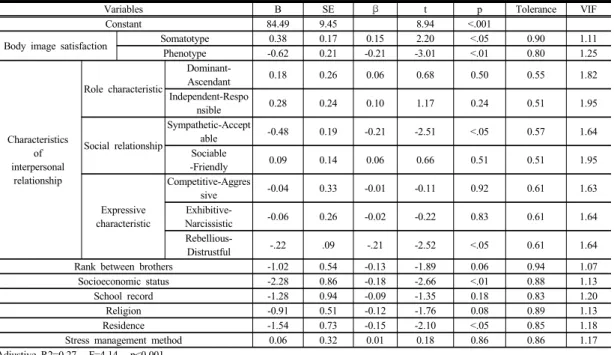
3.5 Body Image satisfaction and interpersonal relationship influencing depression As a result of regression analysis with autoregressive errors using Durbin-Waston test, depression did not have autocorrelation with the test statistic of 2.213, which was larger than 1.74.
As a result of testing multicollinearity, all the variables appeared to be suitable for multicollinearity with tolerance of less than 0.1 and VIF value of less than 10. The regression model was found statistically significant. The most powerful factor influencing depression was the outward phenotype (p<.01) and socioeconomic status (p<.01), followed by sympathetic-acceptable (p<.05) disposition in social relations, rebellious-distrustful (p<.05) disposition in expressive dimension, body somatotype (p<.05), and residential status (p<.05), with a revised coefficient of determination (R2) of 0.268(Table 5).
Variables B SE β t p Tolerance VIF
Constant 84.49 9.45 8.94 <.001
Body image satisfaction Somatotype 0.38 0.17 0.15 2.20 <.05 0.90 1.11
Phenotype -0.62 0.21 -0.21 -3.01 <.01 0.80 1.25
Characteristics of interpersonal
relationship
Role characteristic
Dominant-
Ascendant 0.18 0.26 0.06 0.68 0.50 0.55 1.82
Independent-Respo
nsible 0.28 0.24 0.10 1.17 0.24 0.51 1.95
Social relationship
Sympathetic-Accept
able -0.48 0.19 -0.21 -2.51 <.05 0.57 1.64
Sociable
-Friendly 0.09 0.14 0.06 0.66 0.51 0.51 1.95
Expressive characteristic
Competitive-Aggres
sive -0.04 0.33 -0.01 -0.11 0.92 0.61 1.63
Exhibitive-
Narcissistic -0.06 0.26 -0.02 -0.22 0.83 0.61 1.64
Rebellious-
Distrustful -.22 .09 -.21 -2.52 <.05 0.61 1.64
Rank between brothers -1.02 0.54 -0.13 -1.89 0.06 0.94 1.07
Socioeconomic status -2.28 0.86 -0.18 -2.66 <.01 0.88 1.13
School record -1.28 0.94 -0.09 -1.35 0.18 0.83 1.20
Religion -0.91 0.51 -0.12 -1.76 0.08 0.89 1.13
Residence -1.54 0.73 -0.15 -2.10 <.05 0.85 1.18
Stress management method 0.06 0.32 0.01 0.18 0.86 0.86 1.17
Adjustive R2=0.27, F=4.14, p<0.001
Table 5. Predictive Variables for Depression in Subject
4. Discussion
The results of the current study indicate that nursing students were neither satisfied nor frustrated with their overall physical appearance, combined as physique and attractiveness, placing them on an average level of body image satisfaction. When overall physical appearance was separated into two aspects, with one being physique or somatotype, and another being the look or outward phenotype, the nursing students in the current study scored lower than the average on physique and slightly higher than the average on outward phenotype. In addition, the respondents in the current study exhibited a lower level of depression and a slightly above average level of interpersonal relationship, which is consistent with results reported by Lee and Bang〔10〕for college students in general in Korea, who showed mild symptoms of depression, low level of interpersonal relationship, and low level of body image satisfaction.
Therefore, nursing students who were the subject of the current study were characterized by not being very
sociable with average looks but with low levels of depression that would not aggravate negative feelings about themselves, nor losing confidence in them.
However, a previous study reported that the higher the degree of body image satisfaction, the greater the pleasure the individuals had from communicating with others and the better the trust and friendliness they showed in social relations〔14〕. Therefore there is a need to develop a supportive program to provide practical guidelines for promoting body image satisfaction, which will lead to the development of positive self-image and confidence for future nurses.
The results of analyzing body image satisfaction, interpersonal relationship, and depression by general characteristics among Korean nursing students showed that body image satisfaction was affected most by whether or not the nursing students smoked cigarettes, indicating that the nursing students who were more likely to be satisfied with their physical appearance appeared to know harmful effects of smoking on their appearance in such a way that no sooner had people smoked a cigarette than toxic substances in the cigarette were absorbed into
the skin, including tar and nicotine, which affects the skin quality. In addition, there was a study showing that heavy smokers were more likely to be overweight than non-smokers. Considering these results that non-smoking nursing students in this study were more likely to be satisfied with their physical appearance than their counterparts, and that smoking did not affect weight control in a long run, further studies are needed to investigate the effects of smoking other than ample evidence of pathophysiological effects of smoking, such as personal and social implications of smoking as a means of weight control, wrinkle development, or skin condition.
This study showed that the Korean nursing students who had seen their own families once a week were more likely to have a good interpersonal relationship than those who had seen their own families everyday or those who had seldom seen, which was the opposite result from the common agreement that a good and frequent relationship with family members serves as establishing a good relationship with others as well, as reported in a study conducted by Chae 〔15〕, reporting that having emotional bond among family members not only played an important role in developing amicable and friendly relationships with others, but positively affected psychological adaptation in social relations. On the other hand, particularly nursing students who were at the transitional stage from adolescence to early adulthood, which is characterized by an increased independence and decreased supervision by parents in order to acquire new social roles, these findings were supported by a study done by Kwon, et al. 〔16〕, reporting that college students who were not independent of their parents during the period of early adulthood were more likely to cause inter-generational conflict with their parents, leading to an increase in anxiety and depression in the college students. Furthermore, the result of this study was consistent with another study, showing that the influence of family should be indirect rather than direct as young adults grow older, and
adequate independence and differentiation from their own family were essential for establishing a good interpersonal relationship and social roles〔17〕.
Korean nursing students who were either the only child or the middle child appeared to be more prone to developing depression than those who were the oldest child in their families. Although there was no previous study to which these findings were compared, these findings could be explained in this way that, generally speaking, in the oriental cultures, the oldest child, especially, the oldest son has to put forth a special effort to reach the expectation of their parents as the firstborn child as well as to take a heavy responsibility to take care of younger siblings. As a result, the oldest child develops a sense of responsibility and social skills a lot earlier and better than the rest of his siblings. In contrast, children in the middle birth order or the only child who is overprotected by their parents are more likely to be dependent on their parents.
Therefore, future considerations should be given to the development of adequate social roles and social skills across the birth order in nursing students. This is particularly important in the society of Korea which has been developed and stabilized into a nuclear family system. Furthermore, the nursing students who were catholic in this study were less likely to be depressed than those who did not have any religion, or those who had religion other than catholic, which indicated that religion, in general, provided the nursing students with emotional and spiritual stability and well-being. The nursing students who were poor at school achievement, had low socioeconomic status, and lived alone, were more likely to be prone to depression. These findings were consistent with existing studies. Another study done by Beck 〔18〕 reporting that depression was associated with self-deprecation, feelings of helplessness and desperation〔18〕, and Kwon〔19〕
also showed that depression was associated with the problems with having vitality to life. The methods of reducing stress in this study showed that the nursing students who did exercises when they were under stress
were less likely to be depressed than those who listened to music or slept to reduce stress. Regular practice of physical exercise was related not only to increase a more favourable self-image and self-expression, but to decrease the level of depression.
In other words, regular engagement in physical activities serves as a useful means of expressing themselves in an active way, which is consistent with an existing research study, reporting that the higher the level of self-expression, the lower the depression〔2 0〕. Through exercises, the nursing students can reduce the recurring thoughts and emotions associated with stress. Therefore, there is a need to encourage the nursing students to engage in physical activity regularly in order to lower depression and promote a more favorable body shape, which will provide more positive social feedback and recognition from peer groups, and will subsequently lead to improvement in the nursing students' self-image.
The results of analyzing the correlations among the nursing students' body image satisfaction, interpersonal relationship, and depression showed that the higher the physical somatotype and phenotype, the lower the depression among the nursing students in Korea, which is consistent with a study showing that the dissatisfaction with physique aggravated the problems with depression, causing psychological anxiety, decreased level of confidence, withdrawal from social activities, and negative attitudes〔21〕. Moreover, as the subjects were more satisfied with their physique, they were also more likely to be satisfied with their phenotype〔22〕.
In addition, both physique and phenotype were related to dominant-ascendant and independent-responsible types of role characteristics, whereas only the physique was related to rebellious-distrustful type of expression, indicating that the results of this study support outcomes of previous studies which showed that body image satisfaction affected role and expressive characteristics〔10, 22〕. In contrast, the higher the physique, body image satisfaction, and dominant-ascendant the lower the depression, which is
consistent with a study by Lee and Bang〔10〕, who reported that higher body image satisfaction results in lower depression. Work by Campbell, Assanand, Paula
〔23〕 showed that those who had a dominant-ascendant relationship with others were less likely to be depressed. These results implied that when the subjects were satisfied with their looks, they were more likely to evaluate themselves as a happy, successful and sociable person〔24〕. When individuals who had a strongly dominant-ascending disposition toward interpersonal relationship were satisfied with their outward appearance, they were less likely to be withdrawn psychologically from social relationships, which caused themselves to put in their dominant-ascending disposition toward interpersonal relationship, resulting in turn, to depression caused by loss of confidence〔25〕.
Therefore, to reduce and alleviate depression, it is important to promote positive dispositions toward interpersonal relationship by strengthening the confidence in physical appearance. In addition, the more role orientation exists in interpersonal relationships, such as dominant-ascending and independent-responsible dispositions, the more social relation, such as sympathetic-acceptable and sociable-friendly dispositions, as well as more expressive characteristics, such as competitive-aggressive, exhibitive-narcissistic, and rebellious-distrustful dispositions, are likely to be present. These findings may be explained in a way that when nursing students in the current study were at more ascending or responsible positions in interpersonal relationships, they were inclined to a more generous social behavior, so as to protect weaker individuals from being hurt, to embrace others, to show friendliness, and to empathize with others. However, at the same time, their behavioral expression would remain competitive and aggressive to maintain their role in social relationships, and have a tendency to show off their superiority, or to distrust others.
Furthermore, as the nursing students were more likely to have social relational characteristics in interpersonal relationships, such as sympathetic-acceptable and
sociable-friendly dispositions, they had stronger expressive characteristics, including competitive-aggressive or exhibitive-narcissistic, but a decreased level of expressive characteristic of rebellious-distrustful disposition. Therefore, the nursing students who had more generous and permissive attitudes towards others, and who maintained friendly and cooperative social relations, were less likely to express themselves in competitive, exhibitive, or distrustful ways.
One of the greatest challenges for young adults during their college years is to establish successful interpersonal relationships〔26〕with a wide range of people. If the college students do not establish good and wide-ranging relationships with others during this period of their life, they will experience feelings of isolation and confusion, leading to psychological and emotional maladaptation, which may contribute to future anxiety and depression〔27〕. Therefore, there is a need to introduce intervention programs to prevent college students from developing depression and to promote self-differentiation and awareness of individual social roles.
The dominant predictor influencing depression among Korean nursing students in the current study was the outward phenotype, along with somatotype, which indicated that, for Korean nursing students, physical appearance, or physical attractiveness played an important role in developing social relations, as people are sensitive to their physical appearance. Those subjects who had a high level of satisfaction with their physical appearance and positive body image were more enthusiastically and actively engaged in social activities, which would support the formation of amicable and stable interpersonal relationships and reduce depressive and negative feelings about themselves4). In addition, Gittelsohn et al.〔28〕
reported in their study that as the subjects' body mass index increased, the subjects were less likely to be satisfied with their self-image. Therefore, to minimize the development of depression in nursing students in Korea it is necessary to develop intervention programs
that assist in establishing the right body image. It is important to manage the psychological ramifications of body image along with the intervention of a healthy diet and healthy eating patterns.
A principal influencing variable for depression in the current study was the socioeconomic status of nursing students. This outcome is consistent with studies showing that the higher the socioeconomic status, the lower the risk of developing depression〔2 9〕Levine and Havighurst〔30〕stressed that within and across countries there is a high correlation between educational achievement and occupational status. They also stressed that college education is a path way for upward mobility between social classes. Therefore, education is widely believed to assist young people to move up the social ladder by achieving a higher status occupation than that of their parents. Therefore, since the current economic environment in which the nursing students were placed was something that the nursing students did not have much control over to improve, there is a need to focus on the importance of financial independence and autonomy through nursing college education that would provide a meaningful path of upward mobility from the present status to a higher socioeconomic status. Further study is needed to investigate the relationship between educational opportunity in nursing college and the level of depression in relation to the concept of social mobility among nursing students. Furthermore, the nursing students who were not sympathetic-acceptable in social relationships and rebellious-distrustful dispositions toward expressive characteristics of interpersonal relationships were more prone to depression, suggesting that when nursing students were not generous or permissive, nor magnanimous towards others, in other words, not having sympathetic-acceptable disposition in social relations, that they were more likely to distrust others. This resulted in individuals having difficulty to build positive and lasting relationships with others, or to express themselves appropriately in front of others and
could lead to social withdrawal and intense anxiety, which in turn trap individuals in a vicious circle of poor social relations, causing a further decrease in confidence and consequently an increase in depression.
In conclusion, both of the perception of outward appearance and the development of good interpersonal relationship were considered important developmental tasks during the early adulthood stage in nursing students in Korea. If interpersonal skills are not developed properly with distrustful, unsympathetic, and rejective social skills, the acquisition and maintenance of self-esteem and self-identity will be negatively affected, leading to the development of depression.
There is a strong need to develop a social support system to assist nursing students to maintain an adequate concept of physical appearance by keeping their body in good shape as well as to develop suitable skills that are required for more acceptable and stable relationships with others. As such, it is apparent that the perception of interpersonal relationships will have implications for future role identification as nurses who are required to provide high quality care for patients who need help from nurses, which is assisted through the development of a warm and positive rapport with patients. Further research is needed to investigate the relationship between self-image and interpersonal skills in relation to the actual outcomes of nursing care.
References
[1] N. S. Kang, “The effect of body satisfaction in university students on appearance management behavior and beauty consumption behavior”, The Korean Journal of Aesthetics and Cosmetology, 9(1), pp63-80, 2011.
[2] E. Bisiach, C. Luzzatti, “Unilateral neglect of representational space”, Cortex, 14(1), pp129-133, 1978.
DOI: http://dx.doi.org/10.1016/S0010-9452(78)80016-1 [3] M. Shu, M. Atsushi, A. Midori et al., “Body image of
the unilateral spatial neglect patients with self-portrait drawing”, Journal of Physical Therapy Science, 17, pp38-42, 2005.
DOI: http://doi.org/10.1589/jpts.17.39
[4] Y. N. Jung, “A study on the effect of the group counseling program by applying reality therapy on the
body image and depression of adolescent women”, Child Health Nursing Research, 7(3), pp342-358, 2000.
DOI: http://www.dbpia.co.kr/Journal/PDFView?id=NODE01170178 [5] J. E. Roberts, J. D. Kassel, I. H. Gotlib, “ Level and
stability of self-esteem as predictors of depressive symptoms”, Personality and Individual Differences, 19(2), pp217-224, 1995.
DOI: http://dx.doi.org/10.1016/0191-8869(95)00049-C [6] S. Iwai, H. Senjyu, R. Kaneda, et al., “Personality traits
of with chronic obstructive pulmonary disease who exhibit depression”, Journal of Physical Therapy Science, 22, 93-99, 2010.
DOI: http://doi.org/10.1589/jpts.22.93
[7] G. E. Jeon, N. H. Cha, S. H. Sok, “Factors influencing the dysmenorrhea among Korean adolescents in middle school”, Journal of Physical Therapy Science, 26, pp1337-1343, 2014.
DOI: http://dx.doi.org/10.1589/jpts.26.1337
[8] B. K. Mendelson, D. R. White, E. Schliecker,
“Adolescents' weight, sex, and family functioning”, The international Journal of Eating Disorders, 17(1), pp79-79, 1993.
DOI:http://dx.doi.org/10.1002/1098-108x(199501)17:1%
3C73::aid-eat2260170110%3E3.0.co;2-1 [9] J. A. Lee, “Sociocultural influences on body-appearance
satisfaction of 4th, 6th and 8th grade children”, Journal of Child Studies, 11, pp77-97, 2005.
[10] K. H. Lee, E. R. Bang, “The analysis of effects of university students' depression and self-efficiency on the trends of personal relationship”, Korean Comparative Government Review, 15(1), pp325-348, 2011.
DOI: http://dx.doi.org/10.18397/kcgr.2011.15.1.325 [11] B. H. Ahn, “Validation study for scales relating to
interpersonal relations adequacy and interpersonal relations disposition”, Humanities Research, Kangwon National University, 18(1), pp107-132, 1985.
[12] D. Krech, “Individual in society”, New York McGraw-Hill Book Co., Inc.1962.
[13] K. I. Kim, J. W. Kim, H. T. Won, “Implementational direction for checklist-90- revision (SCL-90-R)”, Seoul:
Chungang Aptitude Publishing Company, 1984.
[14] S. H. Kim, S. K. Kim, “A study on the behavior of cosmetic surgery of working women in their 20s-30s according to the degree of importance of outward appearance”, Journal of the Korean Beauty and Art, 10(1), pp5-15, 2009.
[15] Y. G. Chae, “A study on adolescents' perception on the correlation among family cohesion, family adaptability, self-esteem and interpersonal relations”, The Korea Journal of Youth Counseling, 12(2), pp136-144, 2004.
[16] M. A. Kwon, P. S. Kim, J. H. Park, T. H. Kim, “The effects of premarital adult child`s perceived self-differentiation and dynamics of emotional system between parent and child on trait anxiety”, Journal of the Korean Home Economics Association, 43(11), pp31-48, 2005.
[17] J. M. Lee, “Structural relationships among parent-adolescent communication, ego-identity, and school adjustment”, Korean Living Science Association,
18(5), pp1021-1033, 2009.
DOI: http://dx.doi.org/10.5934/KJHE.2009.18.5.1021 [18] A. T. Beck, “Depression: clinical, experimental and
theoretical aspects”, Philadelphia: University of Pensylvania Press, 1967.
[19] S. M. Kwon, “Depression: swamp of inactivity and anxious. Seoul: Harkjisa, 2000.
[20] B. G. Doenng, E. Erhan, I. Yegul, “850 assertiveness training for tension type headache”, European Journal of Pain, 10(1), ppS220-S221, 2006.
DOI: http://dx.doi.org/10.1016/S1090-3801(06)60853-7 [21] K. W. Kim, E. M. Shin, “A study on nutrition
knowledge, nutritional attitudes, dietary behavior and dietary intake by weight control attempt among middle school students” Journal of Korean Community Nutrition, 7(1), 23-31, 2002.
DOI: http://www.dbpia.co.kr/Journal/ArticleDetail/NODE06239261 [22] Y. H. Kim, Y. H. An, J. Y. Han, et al., “Effects of
physical appearance and height on wage”, Korea Review of Applied Economics, 14(1), pp1-22, 2011.
[23] D. Campbell, S. Assanand, A. Di Paula, “The structure of the self-concept and its relation to psychological adjustment”, Journal of Personality, 71,(1) pp115-140, 2003.
DOI: http://dx.doi.org/10.1111/1467-6494.t01-1-00002 [24] Y. Kim, S. J. Hwang, “Effects of socio-cultural pressure
and objectified body consciousness on the behavior of women for appearance management”, Journal of the Korean Society of Costume, 58(10), pp112-122, 2008.
[25] M. K. Choi, “Symptoms, depression, and coping behaviors of university students.”, Journal of Korean Academy of Nursing, 33(3), pp433-439, 2003.
[26] J. M. Lee, “Structural relationships among family strength, self-differentiation, interpersonal relationships and depression of university students”, Korea Journal of Counseling, 11(3), pp1271-1287, 2010.
DOI: http://dx.doi.org/10.15703/kjc.11.3.201009.1271 [27] S. J. Chang, M. H. Yon, “A study of the development
of the group counseling program based on the attachment theory and its effects”, Korea Journal of Counseling, 10(4), pp2031-2054, 2009.
DOI: http://dx.doi.org/10.15703/kjc.10.4.200912.2031 [28] J. Gittelsohn, S. B. Harris, A. L. Thorne-Lyman, et al.,
“Body image concepts differ by age and sex in an Ojibway-Cree community in Canada” Journal of Nutrition, 126(12), pp2990-3000, 1996.
[29] J. Hong, M. Knapp, A. McGuire, “Income-related inequalities in the prevalence of depression and suicidal behavior a 10-year trend following economic crisis”, World Psychology, 10(1), pp40-44, 2011.
DOI: http://dx.doi.org/10.1002/j.2051-5545.2011.tb00012.x [30] D. U. Levine, R. J. Havighurst, “Society and Education
(6th ed.)”, Boston: Allyn and Bacon, Inc. 1984.
Yun-Kyung Kim [Regular member]
•Feb. 1999 : Kyungbuk National University, Nursing, MS
•Feb. 2002 : Kyungbuk National University, Nursing, PhD
•Sept. 2005 ~ current : Andong National University, Nursing Department, Professor
<Research Interests>
Adult Nursing, Fundamental Medical Nursing
Nam-Hyun Cha [Regular member]
•Feb. 1996 : Catholic University, Occupational Nursing, MS
•Feb. 2002 : Kyunghee University, Nursing PhD
•Aug. 2012 ~ Jan. 2015 : Kangwon National University, Nursing Department, Professor
•Feb. 2005 ~ current : Andong National University, Nursing Department, Professor
<Research Interests>
Community Nursing, Oriental Nursing