Genetic Contributions to Childhood Obesity: Association of Candidate Gene Polymorphisms and Overweight/Obesity in Korean Preschool Children
This study was aimed to investigate the association of candidate gene polymorphisms and obesity or overweight in young Korean children. A total of 190 Korean preschool children (96 control, 48 overweight, and 46 obese children) were genotyped for the angiotensin converting enzyme (ACE) insertion (I)/deletion (D), angiotensin II type 2 receptor (AT2) C3123A, transforming growth factor (TGF)-β1 T869C, vascular endothelial growth factor (VEGF) T460C, and tumor necrosis factor (TNF)-α G308A polymorphisms. No differences were found among the groups with respect to age, sex, birth weight, blood pressure levels, and serum concentrations of glucose and total cholesterol. Obese children showed a higher incidence of ACE DD genotype and D allelic frequency compared to the controls (odds ratio [OR], 2.7, 95% confidence interval [CI], 1.01–7.21; OR, 2.5, 95% CI, 1.49–4.19; all P < 0.05). The frequency of TC genotype and C allele in the TGF-β1 T869C polymorphism (OR, 2.08, 95% CI, 1.01–4.27; OR, 1.93, 95% CI, 1.15–3.21) and that in the VEGF T460C polymorphism (OR, 2.5, 95% CI, 1.19–5.28; OR, 2.15, 95% CI, 1.26–3.68) was also higher in obese children than in control subjects (all P < 0.05). Overweight children exhibited a higher frequency of the A allele in the AT2 C3123A polymorphism compared to the controls (OR, 1.72, 95% CI, 1.03–2.88, P < 0.05). There were no differences in the TNF-α G308A polymorphism among the groups. The ACE I/D, AT2 C3123A, TGF-β1 T869C, and VEGF T460C polymorphisms can affect susceptibility to obesity or overweight in Korean children.
Keywords: Angiogenic Proteins; Child Obesity; Genetic Variation; Renin Angiotensin System
Kee Hwan Yoo, Hyung Eun Yim, Eun Soo Bae, and Young Sook Hong Department of Pediatrics, Korea University Ansan Hospital, Ansan, Korea
Received: 13 June 2017 Accepted: 3 September 2017 Address for Correspondence:
Hyung Eun Yim, MD, PhD
Department of Pediatrics, Korea University Ansan Hospital, 123 Jeokgeum-ro, Danwon-gu, Ansan 15355, Republic of Korea E-mail: [email protected]
Funding: This work was supported by the Basic Science Research Program through the National Research Foundation of Korea funded by the Ministry of Education, Science and Technology (20120002191).
https://doi.org/10.3346/jkms.2017.32.12.1997 • J Korean Med Sci 2017; 32: 1997-2004
INTRODUCTION
Childhood obesity has become a major health concern and is occurring at progressively younger ages (1). The rate of severe obesity in children continues to increase, particularly among young children and is expected to continue (1). Moreover, some of the complications of obesity such as type 2 diabetes, hyperten- sion, and hyperlipidemia were formerly observed only in adults but are now frequently detected in obese children in some pop- ulations (1,2). Recently, the genetic predisposition to the devel- opment of obesity has been extensively studied and polymor- phisms in candidate obesity-related genes have become the target of intensive investigation (3,4).
The renin angiotensin system (RAS) has been focused on its potential roles in obesity and several co-morbidities. In addi- tion to its traditional role in the blood pressure (BP) control, the RAS has been implicated in the metabolic regulation (5). Adi- pose mass has a positive correlation with RAS activity, and RAS gene expression shows a close relationship with the severity of obesity (5,6). The angiotensin converting enzyme (ACE) inser-
tion (I)/deletion (D) polymorphism has been widely studied among RAS polymorphisms, and associations with diabetic ne- phropathy and obesity have been shown in adults (7,8). The an- giotensin II type 2 receptor (AT2) gene is also implicated in hy- pertension or other obesity-related metabolic parameters (8).
Several studies have shown the association of the AT2 C3123A polymorphism with cardiometabolic diseases (9,10).
Growing adipocytes produce numerous angiogenic factors, which provoke neovascularization either alone or collectively during fat tissue expansion (11). Among them, transforming growth factor (TGF)-β1 is a multifunctional growth factor that controls proliferation, differentiation and other pleiotropic func- tions in various cells (12). In humans, increased TGF-β1 activity is related to body mass index (BMI) and abdominal adipose tis- sue in morbid obesity (13,14). It has been reported that the C allele of the T869C polymorphism is highly associated with se- rum TGF-β1 level and that carriers of this allele show elevated risk for obesity and type 2 diabetes (15,16). Vascular endothelial growth factor (VEGF) is also the major angiogenic factor in adi- pose tissue. It stimulates proliferation and migration of endo- ORIGINAL ARTICLE
Pediatrics
2017-03-16 https://crossmark-cdn.crossref.org/widget/v2.0/logos/CROSSMARK_Color_square.svg
thelial cells and has an impact on the reciprocal interaction be- tween endothelial cells and adipocytes (11). Serum VEGF levels are increased in obese subjects, and the manipulation of VEGF has been proposed to be a pharmacological target in the treat- ment of obesity (11,17). Genetic variations in the VEGF gene were associated with differences in VEGF expression levels and susceptibility to the obesity phenotype (18,19). Tumor necrosis factor (TNF)-α is a multifunctional pro-inflammatory cytokine produced mainly by macrophages and adipocytes (20). The TNF-α G308A polymorphism has been associated with obesity, hyperleptinemia, insulin resistance, and elevated transcription- al activity of TNF-α (21).
However, few studies have investigated the genetic polymor- phisms and the prevalence of metabolic abnormalities among young children with obesity or overweight (22). In the present study, we aimed to examine whether the ACE I/D, AT2 C3123A, TGF-β1 T869C, VEGF T460C, and TNF-α G308A polymorphisms could be indicators of genetic susceptibility for obesity or over- weight in young Korean children. Given the association between these modulators and obesity, we hypothesized that polymor- phisms of these genes might affect the risk of developing child- hood obesity or overweight.
MATERIALS AND METHODS Study population
Preschool children aged 4 months to 6 years who visited our in- stitutions for acute infections were included in this study for eval- uation of the association between genotypes and overweight or obese status. Body weight and height were measured for all chil- dren according to standard procedures at the time of admission to the hospital (23). The weight was measured to the nearest 0.1 kg, using a digital scale, with children barefoot and with hospi- tal gowns only. Height was measured to the nearest 0.1 cm, us- ing a wall-measured unit size. In infants unable to stand, length was measured in cm while lying on a solid surface with a rigid
headboard. Overweight or obese status in infants < 24 months was defined by using weight for length (WFL) measurements corresponding to age and gender. The same status in children aged between 2 to 6 years was determined using BMI (kg/m2) matched according to the age and gender. Based on a report defining obesity in young children (24), all subjects were sub- categorized into three groups as follows: control (WFL or BMI <
85th percentile), overweight (85th ≤ WFL or BMI < 95th per- centile), and obese (WFL or BMI ≥ 95th percentile). BP mea- surements were taken thrice for the subjects using a standard mercury sphygmomanometer equipped with cuff bladder of –40% width of the arm circumference of the child. To strength- en the accuracy of BP measurements, the average of 3 readings was used for data analysis. Subjects with a perinatal history of premature birth, intrauterine growth retardation, small or large birth weight (≤ 2,500 or ≥ 4,000 g) and chronic diseases were excluded from the study. After the parental informed consent of all the subjects, non-fasting blood samples were obtained for DNA analysis and for measurements of the serum levels of glu- cose and total cholesterol.
Genetic analysis
Genomic DNA was extracted from ethylenediaminetetraacetic acid (EDTA)-anticoagulated blood using a salting-out method.
Specific oligonucleotide primers were designed for ACE I/D, AT2 C3123A, TGF-β1 T869C, VEGF T460C, and TNF-α G308A polymorphisms by using previously published genomic sequen- ces (7,9,19,25). Polymerase chain reaction (PCR) amplification for each polymorphism was performed in a total reaction vol- ume of 20 μL with 2 μL of genomic DNA, 5 μL of each of the pri- mer, 250 μM dNTP, 1.5 mM MgCl2, 40 mM KCl, 10 mM Tris-HCl, and 1 U Taq DNA polymerase (Bioneer, Daejeon, Korea). Ther- mal conditions included denaturation at 94°C for 5 minutes, followed by 30 cycles at 94°C for for 30–40 seconds, annealing at 52°C–65°C for 30–35 seconds, extension at 72°C for 1 minutes, and a final extension at 72°C for 5 minutes. All PCR reactions
Fig. 1. Determination of genotypes using PCR amplification products. (A) ACE I/D polymorphism. (B) AT2 C3123A polymorphism. (C) TGF-β1 T869C polymorphism. (D) VEGF T460C polymorphism. (E) TNF-α G308A polymorphism.
PCR = polymerase chain reaction, ACE I/D = angiotensin converting enzyme insertion/deletion, AT2 = angiotensin II type 2 receptor, TGF-β1 = transforming growth factor-β1, VEGF = vascular endothelial growth factor, TNF-α = tumor necrosis factor-α, M = marker, bp = base pairs.
M CA AA CC
312 bp 215 bp 107 bp
M TC TT CC
161 bp 149 bp
M ID II DD
490 bp 190 bp
A B C
M GA AA GG
144 bp 126 bp
M TC CC TT
175 bp 155 bp
D E
were performed using a 2720 thermal cycler (Applied Biosys- tems, Grand Island, NY, USA). Then, restriction fragment length polymorphism analysis was performed by digesting the PCR product with 10 μL of an appropriate restriction enzyme at rec- ommended temperatures. The digested products were electro- phoresed on ethidium bromide-stained 2% agarose gels and detected using ultraviolet transillumination (Fig. 1). Specific details of the primer sequences and PCR conditions for each polymorphism are listed in Table 1.
Statistical analysis
Statistical analyses were performed using the SPSS program for Windows (version 18.0; SPSS Inc., Chicago, IL, USA). Continu- ous variables among the three groups were analyzed using the one-way analysis of the variance test and the Tukey-Kramer post hoc test. Gender distribution and frequencies of the geno- types and alleles among the groups were evaluated by the χ2 test or Fisher’s exact test. Odds ratio (OR) and 95% confidence intervals (CIs) were calculated to identify the association strength.
Categorical data are presented as numbers (%) and continuous data as the mean ± standard deviation. Multiple logistic regres- sion analysis was performed to determine the independent ef- fect of each risk allele on the risk of becoming obese/overweight.
Statistical significance was set at P < 0.05.
Ethics statement
The present study protocol was reviewed and approved by the Institutional Review Board of Korea University Ansan Hospital (IRB No. AS11091). Informed consent was submitted by all sub- jects when they were enrolled.
RESULTS Study groups
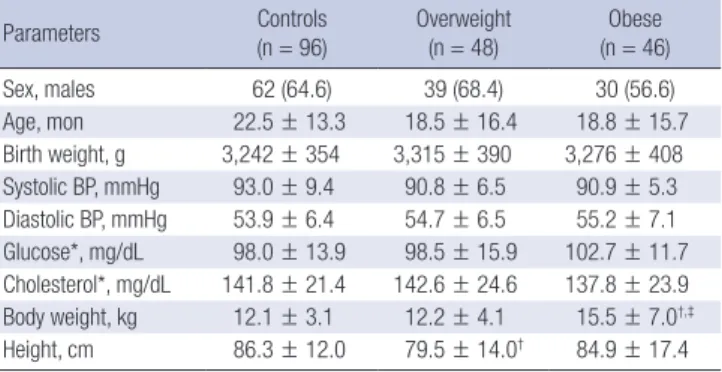
All subjects were of Korean origin. A total of 96 control, 48 over- weight, and 46 obese preschool children were genotyped for ACE, AT2, VEGF, TGF-β1, and TNF-α polymorphisms. No sig-
nificant differences among the groups were found with respect to age, sex, birth weight, BP levels, and serum concentrations of glucose and total cholesterol (Table 2).
Distribution of ACE I/D polymorphism
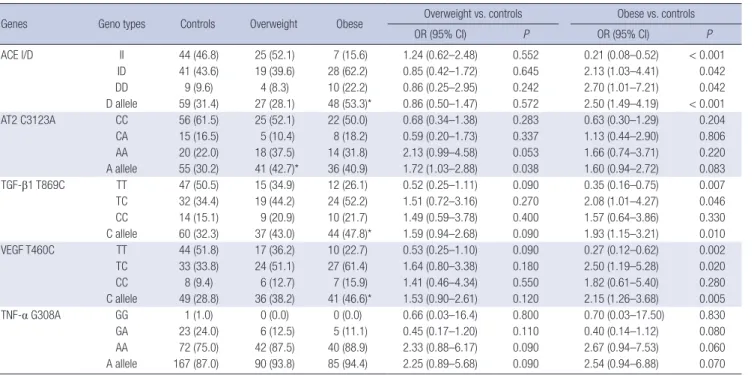
The frequencies of the D allele and the DD and ID genotypes were found to be higher in obese children compared to the con- trol (OR, 2.50, 95% CI, 1.49–4.19, P < 0.001; OR, 2.70, 95% CI, 1.01–
7.21, P = 0.042; OR, 2.13, 95% CI, 1.03–4.41, P = 0.042, respec- tively). The frequency of the II genotype was lower in the obese children compared to the controls (OR, 0.21, 95% CI, 0.08–0.52, P < 0.001, respectively) (Table 3).
Distribution of AT2 C3123A polymorphism
The frequency of the A allele was higher in overweight children (OR, 1.72, 95% CI, 1.03–2.88, P = 0.038) compared to the con- trols. The frequency of the AA genotype was higher in overweight children than in healthy controls, although the difference was not statistically significant (OR, 2.13, 95% CI, 0.99–4.58, P = 0.053).
The A allele frequency was also higher in obese children than in the controls, however, it was not significant (OR, 1.60, 95% CI, 0.94–2.72, P = 0.083) (Table 3).
Table 1. Details of primer sequence and reaction conditions used for genotyping of the polymorphisms
Poly-morphisms Primers PCR annealing
temperature, °C Restriction enzyme Alleles DNA fragment size, bp
ACE I/D F:5´-CTGGAGACCACTCCCATCCTTTCT-3´
R:5´-GATGTGGCCATCACATTCGTCAGAT-3´
58 - I
D
490 190 AT2 C3123A F: 5´-GGA TTC AGA TTC TCT TTG AA-3´
R: 5´-GCA TAG GAG TAT GAT TTA ATC-3´ 52 AluI C
A 312
215, 107 TGF-β1 T869C F:5´-TTCCCTCGAGGCCCTCCTA-3´
R:3´-GCCGCAGCTTGGACAGGATC-3´ 62 MspA1I T
C 161
149 VEGF T460C F:5´-TGTGCGTGTGGGGTTGAGCG-3´
R:5´-TACGTGCGGACAGGGCCTGA-3´
65 BstUI T
C
175 155, 20 TNF-α G308A F:5´-GAGGCAATAGGTTTTGAGGGCCAT-3´
R:3´-GGGACACACAAGCATCAAG-3´ 57 NcoI G
A 144
126, 18 ACE I/D = angiotensin converting enzyme insertion/deletion, AT2 = angiotensin type 2 receptor, TGF-β1 = transforming growth factor-β1, VEGF = vascular endothelial growth factor, TNF-α = tumor necrosis factor-α.
Table 2. Clinical characteristics among the three studied groups
Parameters Controls
(n = 96) Overweight
(n = 48) Obese
(n = 46)
Sex, males 62 (64.6) 39 (68.4) 30 (56.6)
Age, mon 22.5 ± 13.3 18.5 ± 16.4 18.8 ± 15.7
Birth weight, g 3,242 ± 354 3,315 ± 390 3,276 ± 408 Systolic BP, mmHg 93.0 ± 9.4 90.8 ± 6.5 90.9 ± 5.3 Diastolic BP, mmHg 53.9 ± 6.4 54.7 ± 6.5 55.2 ± 7.1 Glucose*, mg/dL 98.0 ± 13.9 98.5 ± 15.9 102.7 ± 11.7 Cholesterol*, mg/dL 141.8 ± 21.4 142.6 ± 24.6 137.8 ± 23.9 Body weight, kg 12.1 ± 3.1 12.2 ± 4.1 15.5 ± 7.0†,‡
Height, cm 86.3 ± 12.0 79.5 ± 14.0† 84.9 ± 17.4 Values are shown as means ± standard deviation or number (%).
BP = blood pressure, BMI = body mass index.
*These values are non-fasting levels. †P < 0.05 vs. controls. ‡P < 0.05 vs. overweight.
Distribution of TGF-β1 T869C polymorphism
The frequency of the C allele was higher in obese children com- pared to the controls (OR, 1.93, 95% CI, 1.15–3.21, P = 0.01). In the obese group the TT genotype was less frequent and the TC genotype was more frequent in the TGF-β1 T869C polymor- phism compared to the controls (OR, 0.35, 95% CI, 0.16–0.75, P = 0.007; OR, 2.08, 95% CI, 1.01–4.27, P = 0.046, respectively) (Table 3).
Distribution of VEGF T460C polymorphism
The C allele frequency was higher in obese children compared to the controls (OR, 2.15, 95% CI, 1.26–3.68, P = 0.005). The VEGF T460C polymorphism was associated with a lower frequency of the TT genotype and a higher frequency of the TC genotype in obese children compared to control subjects (OR, 0.27, 95% CI, 0.12–0.62, P = 0.002; OR, 2.5, 95% CI, 1.19–5.28, P = 0.02, respec- tively) (Table 3).
Distribution of TNF-α G308A polymorphism
There were no differences in genotypes and alleles of the TNF-α G308A polymorphism among the three groups (Table 3).
Independent effect of the high risk alleles on the obese or overweight phenotype
With multiple logistic regression analysis the D allele of the ACE I/D polymorphism and the C alleles of the TGF-β1 T869C and VEGF T460C polymorphisms showed an independent effect of risk of obesity, respectively (all P < 0.05) (Table 4). However, the association between the risk alleles and overweight was not statistically significant in multiple logistic regression analysis (data not shown).
DISCUSSION
The present study investigated genetic susceptibility to obesity in 190 prospectively recruited preschool children. Polymorphi- Table 4. Multiple logistic regression analysis of the risk alleles for prediction of obesity
Dependent variable Independent variables B β t P VIF
Obesity (constant) −0.024 - −0.254 0.800 -
ACE D allele 0.220 0.219 2.393 0.018 1.096
TGF-β1 869 C allele 0.192 0.196 2.234 0.028 1.005
VEGF 460 C allele 0.219 0.221 2.414 0.017 1.095
ACE = angiotensin converting enzyme, TGF-β1 = transforming growth factor-β1, VEGF = vascular endothelial growth factor, VIF = variance inflation factor.
Table 3. Genotype and allele frequencies of the ACE, AT2, MMP-9, TGF--β1, VEGF, and TNF-α polymorphisms among the three studied groups
Genes Geno types Controls Overweight Obese Overweight vs. controls Obese vs. controls
OR (95% CI) P OR (95% CI) P
ACE I/D II 44 (46.8) 25 (52.1) 7 (15.6) 1.24 (0.62–2.48) 0.552 0.21 (0.08–0.52) < 0.001
ID 41 (43.6) 19 (39.6) 28 (62.2) 0.85 (0.42–1.72) 0.645 2.13 (1.03–4.41) 0.042
DD 9 (9.6) 4 (8.3) 10 (22.2) 0.86 (0.25–2.95) 0.242 2.70 (1.01–7.21) 0.042
D allele 59 (31.4) 27 (28.1) 48 (53.3)* 0.86 (0.50–1.47) 0.572 2.50 (1.49–4.19) < 0.001
AT2 C3123A CC 56 (61.5) 25 (52.1) 22 (50.0) 0.68 (0.34–1.38) 0.283 0.63 (0.30–1.29) 0.204
CA 15 (16.5) 5 (10.4) 8 (18.2) 0.59 (0.20–1.73) 0.337 1.13 (0.44–2.90) 0.806
AA 20 (22.0) 18 (37.5) 14 (31.8) 2.13 (0.99–4.58) 0.053 1.66 (0.74–3.71) 0.220
A allele 55 (30.2) 41 (42.7)* 36 (40.9) 1.72 (1.03–2.88) 0.038 1.60 (0.94–2.72) 0.083
TGF-β1 T869C TT 47 (50.5) 15 (34.9) 12 (26.1) 0.52 (0.25–1.11) 0.090 0.35 (0.16–0.75) 0.007
TC 32 (34.4) 19 (44.2) 24 (52.2) 1.51 (0.72–3.16) 0.270 2.08 (1.01–4.27) 0.046
CC 14 (15.1) 9 (20.9) 10 (21.7) 1.49 (0.59–3.78) 0.400 1.57 (0.64–3.86) 0.330
C allele 60 (32.3) 37 (43.0) 44 (47.8)* 1.59 (0.94–2.68) 0.090 1.93 (1.15–3.21) 0.010
VEGF T460C TT 44 (51.8) 17 (36.2) 10 (22.7) 0.53 (0.25–1.10) 0.090 0.27 (0.12–0.62) 0.002
TC 33 (33.8) 24 (51.1) 27 (61.4) 1.64 (0.80–3.38) 0.180 2.50 (1.19–5.28) 0.020
CC 8 (9.4) 6 (12.7) 7 (15.9) 1.41 (0.46–4.34) 0.550 1.82 (0.61–5.40) 0.280
C allele 49 (28.8) 36 (38.2) 41 (46.6)* 1.53 (0.90–2.61) 0.120 2.15 (1.26–3.68) 0.005
TNF-α G308A GG 1 (1.0) 0 (0.0) 0 (0.0) 0.66 (0.03–16.4) 0.800 0.70 (0.03–17.50) 0.830
GA 23 (24.0) 6 (12.5) 5 (11.1) 0.45 (0.17–1.20) 0.110 0.40 (0.14–1.12) 0.080
AA 72 (75.0) 42 (87.5) 40 (88.9) 2.33 (0.88–6.17) 0.090 2.67 (0.94–7.53) 0.060
A allele 167 (87.0) 90 (93.8) 85 (94.4) 2.25 (0.89–5.68) 0.090 2.54 (0.94–6.88) 0.070 Values are shown as number (%) or OR (95% CI).
ACE I/D = angiotensin converting enzyme insertion/deletion, AT2 = angiotensin type 2 receptor, TGF-β1 = transforming growth factor-β1, VEGF = vascular endothelial growth factor, TNF-α = tumor necrosis factor-α, OR = odds ratio, CI = confidence interval.
*P < 0.05 vs. controls.
sms in ACE, TGF-β1, and VEGF genes were associated with the presence of obesity and genetic variation in AT2 gene was relat- ed with the incidence of overweight in young Korean children.
The D allele of ACE gene was more frequently detected in obese children compared to that in the controls. C alleles in both TGF-β1 T869C and VEGF T460C polymorphisms were more frequently found in obese children than those in control subjects. The fur- ther multiple logistic regression analysis confirmed this finding by exploring the independent effects of the risk alleles on obe- sity outcome. Overweight children had a higher frequency of the A allele of AT2 C3123A gene compared to the controls. Our findings indicate that the ACE, AT2, TGF-β1, and VEGF gene polymorphisms might affect the susceptibility of young Korean children to obesity or overweight.
ACE is an important regulatory enzyme of the RAS that may have pleiotropic effects. The ACE gene, located on chromosome 17q23, is greatly polymorphic in the promoter and coding re- gions (26). The most frequently studied ACE gene polymorphism is the 287-bp insertion (allele I) or deletion (allele D) variant in intron 16. This polymorphism is associated with almost half of the variance in circulating activity of the ACE with II, ID, and DD genotypes coupled with lower, intermediate, and higher plas- ma levels of the enzyme, respectively (27). The subjects with the DD genotype exhibited higher BP, fatness, and increased car- diovascular risks (28). In Japanese obese women, the decrease in body fat after weight loss was considerably less in the ACE DD genotype (3). In this study, the frequencies of the DD and ID genotypes were found to be higher in obese children. The D allele was significantly associated with the obesity in Korean preschool children in an agreement with the previous studies in toddlers, teenagers, and adults (8,22,29). The presence of D allele would increase the serum concentrations of the ACE, and this would increase the production of angiotensin II with its det- rimental metabolic effects.
Polymorphism in the AT2 gene was also examined in the pres- ent study. Angiotensin II is the most powerful biological prod- uct of RAS and exerts its effect via at least two distinct receptor subtypes, the AT1 and the AT2. Generally, AT2 plays a crucial role during fetal development and is highly expressed in fetal tissue (30). Angiotensin II has been shown to regulate adipocyte differentiation and fat tissue growth through AT2, so it might play a role in the pathogenesis of obesity and the regulation of body weight (31). The gene for AT2 is located on the X chromo- some (q22–23), and there have been a few studies on the rela- tionship between the AT2 gene C3123A polymorphism and car- diometabolic diseases (9,32). The A allele carriers had signifi- cantly lower high-density lipoprotein-cholesterol levels than non-A allele carriers (10). In response to low-energy diets in obese women, subjects with the AA genotype showed less im- proved levels of systolic BP, cholesterol, carbohydrate, and fat oxidation than those with the CC and CA genotypes (3). In the
present study, the A allele was found to be more frequent in over- weight children than in healthy controls, although the correla- tion became non-significant in multiple logistic regression anal- ysis. Obese children also had a higher frequency of the A allele compared to the controls, however, the difference was not sig- nificant. Small sample size can contribute to this finding which may become associated with childhood obesity in studies with larger sample sizes. Considering the inconsistent results, fur- ther studies are necessary to clearly determine the association between the AT2 C3123A polymorphism and the risk of over- weight/obesity.
The TGF-β1 gene codes a multifunctional cytokine that regu- lates cell growth, differentiation and matrix production in vari- ous cell types, including adipocyte precursor cells (12). Increased TGF-β1 expression has been associated with BMI and abdomi- nal adipose tissue in obese subjects (15). The commonly stud- ied T869C polymorphism, located in the promoter region of TGF-β1 gene, may directly influence the expression level. The C allele was highly associated with serum TGF-β1 level, and carri- ers of this allele showed elevated risk for obesity and type 2 dia- betes (15). Rosmond et al. (16) demonstrated that in 284 unre- lated, non-diabetic Swedish men, carriers for the C allele had higher BMI, abdominal obesity, insulin and glucose levels. Al- though we did not measure serum TGF-β1 level in the present study, our findings revealed that the C variant was prevalent in obese children compared to healthy controls. The frequency of the TC genotype was higher in the obese group compared to the controls. The TT genotype and T allele were significantly less frequent in obese children. In contrast, no association be- tween the TGF-β1 T869C polymorphism and obesity was found in Turkish children or adolescents (33). These conflicting results could be attributed to differences in ethnicity and age groups.
Although the importance of TGF-β1 signaling in energy homeo- stasis and pathogenesis of obesity is largely unknown, it is plau- sible that the presence of the C allele could increase serum con- centrations of TGF-β1 and its consequent detrimental metabol- ic effects.
Obesity requires neovascularization to supply nutrients and oxygen to increase the size and number of mature adipocytes (11). This process requires the activity of VEGF, which is the most important angiogenic factor involved in fat mass expansion (11). Several studies have shown an increase in serum VEGF in obese patients and have proposed that adipocytes produce an- giogenic factors that play central roles in allowing for the ex- pansion of adipose tissue (11,17). The association of VEGF with the development of obesity implies that genetic variation in the VEGF gene may affect susceptibility to this metabolic disorder (18). In the present study, we found that a genetic polymorphism in the VEGF gene could affect susceptibility for obesity in chil- dren. The frequency of the C allele and TC genotype in the VEGF T460C polymorphism was higher in the obese group compared
to the controls. Obese children exhibited a lower frequency of the TT genotype and T allele. Our findings cannot be compared to other studies because this is, to the best of our knowledge, the first study investigating the association of the VEGF T460C polymorphism with obesity. However, our findings are plausi- ble because the C allele in the VEGF T460C polymorphism is correlated with a promoter haplotype with greater activity. VEGF promoter haplotypes with the C allele have a 71% higher pro- moter activity than those that do not carry the allele (19).
TNF-α is also one of the upregulated angiogenic factors in expanding adipose tissues (11). It is a multifunctional cytokine primarily produced by macrophages within adipose tissue (20).
Obese mice deficient in either TNF-α or its receptor exhibit pro- tection against developing insulin resistance (20). The G308A polymorphism in the promoter region of the TNF-α gene has been shown to be related with obesity, hyperleptinemia, insulin resistance and elevated transcriptional activity of TNF-α (21).
The A allele in the TNF-α G308A polymorphism was associated with a two-fold greater gene expression level (34). Carriers of this allele were more frequently obese than non-carriers (35).
In contrast, other studies have revealed no association between this TNF-α mutation and obesity (36). Our present study showed no correlation between genotype and allelic differences of the TNF-α G308A polymorphism in each individual group.
Obesity may have its onset very early in life; accordingly, chil- dren comprise a large portion of this disease (1). Experimental and human studies imply the burdening role of early life obesi- ty in long-lasting cardiovascular and renal diseases (37). In the present study, there were no differences of BP levels and serum concentrations of glucose and total cholesterol in preschool children with or without obesity. Although cardio-metabolic changes were not found in this population group, particular at- tention should be paid to developing strategies for the early pre- diction and prevention of obesity-associated comorbidities. Our study suggests that the ACE, AT2, TGF-β1, and VEGF genes may be associated with the development of childhood obesity or overweight, although the mechanism of the relationships be- tween these gene polymorphisms and obesity has not yet been elucidated. Several studies have reported a genetic influence on overweight or obesity in Korean children (38,39); however, to the best of our knowledge, this is the first study on the associ- ations between genetic variants and overweight/obesity in Ko- rean preschool children.
This study has some limitations. First, the sample size was somewhat small to gain sufficient statistical power in certain genotypes. Further clarification in a larger study population is needed. Second, other environmental factors (e.g., parental obesity, breastfeeding history, physical activity, etc.) or ethnic predisposition should be also considered. There is no single factor known to cause childhood obesity, but coactions at mul- tiple aspects (e.g., genetic, cellular, physiological, psychological,
social, and cultural) contribute to outcomes (40). Finally, func- tional activity of the studied genes could not be analyzed because we did not measure serum or tissue levels of the gene products.
The mechanism of the relationship between the candidate gene polymorphisms and development of obesity should be more clearly determined. Although this was a small-scale study, the present findings suggest the association between the genetic variants of the modulators of adipogenesis and angiogenesis and childhood obesity. Having much knowledge about the ge- netic contributions to obesity will allow us to get a better under- standing for the mechanisms leading to obesity. In the end, this may help predict an individual’s risk for obesity at an early age and opens possibilities for introducing the preventive strategies into clinical practice.
Taken together, the ACE I/D, AT2 C3123A, TGF-β1 T869C, and VEGF T460C gene polymorphisms can be related to obesi- ty or overweight in young Korean children. The D allele in the ACE I/D gene and the C alleles in the TGF-β1 T869C and VEGF T460C genes were positively and independently associated with childhood obesity. The A allele in the AT2 C3123A gene showed a possible link with the susceptibility for overweight in children.
Further research is needed to identify the roles of these genes in childhood obesity. This may help develop more effective strate- gies for the prevention and treatment of the obesity epidemic.
DISCLOSURE
The authors have no potential conflicts of interest to disclose.
AUTHOR CONTRIBUTION
Conceptualization: Yoo KH, Yim HE, Hong YS. Data curation:
Yim HE, Bae ES. Formal analysis: Yim HE. Funding acquisition:
Yoo KH. Investigation: Yoo KH, Yim HE, Bae ES. Writing - origi- nal draft: Yim HE, Yoo KH. Writing - review & editing: Yoo KH, Hong YS.
ORCID
Kee Hwan Yoo https://orcid.org/0000-0001-6490-4293 Hyung Eun Yim https://orcid.org/0000-0001-9805-9278 Eun Soo Bae https://orcid.org/0000-0003-0325-2388 Young Sook Hong https://orcid.org/0000-0002-1042-3563 REFERENCES
1. Lakshman R, Elks CE, Ong KK. Childhood obesity. Circulation 2012; 126:
1770-9.
2. Dean HJ, Sellers EA. Comorbidities and microvascular complications of type 2 diabetes in children and adolescents. Pediatr Diabetes 2007; 8 Sup- pl 9: 35-41.
3. Hamada T, Kotani K, Nagai N, Tsuzaki K, Sano Y, Matsuoka Y, Fujibayashi M, Kiyohara N, Tanaka S, Yoshimura M, et al. Genetic polymorphisms of the renin-angiotensin system and obesity-related metabolic changes in response to low-energy diets in obese women. Nutrition 2011; 27: 34-9.
4. Wang HJ, Hinney A, Song JY, Scherag A, Meng XR, Grallert H, Illig T, He- bebrand J, Wang Y, Ma J. Association of common variants identified by recent genome-wide association studies with obesity in Chinese children:
a case-control study. BMC Med Genet 2016; 17: 7.
5. Mathai ML, Chen N, Cornall L, Weisinger RS. The role of angiotensin in obesity and metabolic disease. Endocr Metab Immune Disord Drug Tar- gets 2011; 11: 198-205.
6. Faloia E, Gatti C, Camilloni MA, Mariniello B, Sardu C, Garrapa GG, Man- tero F, Giacchetti G. Comparison of circulating and local adipose tissue renin-angiotensin system in normotensive and hypertensive obese sub- jects. J Endocrinol Invest 2002; 25: 309-14.
7. Hadjadj S, Belloum R, Bouhanick B, Gallois Y, Guilloteau G, Chatellier G, Alhenc-Gelas F, Marre M. Prognostic value of angiotensin-I converting enzyme I/D polymorphism for nephropathy in type 1 diabetes mellitus:
a prospective study. J Am Soc Nephrol 2001; 12: 541-9.
8. Strazzullo P, Iacone R, Iacoviello L, Russo O, Barba G, Russo P, D’Orazio A, Barbato A, Cappuccio FP, Farinaro E, et al. Genetic variation in the renin- angiotensin system and abdominal adiposity in men: the Olivetti Prospec- tive Heart Study. Ann Intern Med 2003; 138: 17-23.
9. Aoki S, Mukae S, Itoh S, Sato R, Nishio K, Iwata T, Katagiri T. The genetic factor in acute myocardial infarction with hypertension. Jpn Circ J 2001;
65: 621-6.
10. Kotani K, Sakane N, Taniguchi N. Association between angiotensin II Type 2 receptor gene A/C3123 polymorphism and high-density lipoprotein cholesterol with hypertension in asymptomatic women. Med Princ Pract 2013; 22: 65-9.
11. Cao Y. Angiogenesis modulates adipogenesis and obesity. J Clin Invest 2007; 117: 2362-8.
12. Blobe GC, Schiemann WP, Lodish HF. Role of transforming growth factor- beta in human disease. N Engl J Med 2000; 342: 1350-8.
13. Tsurutani Y, Fujimoto M, Takemoto M, Irisuna H, Koshizaka M, Onishi S, Ishikawa T, Mezawa M, He P, Honjo S, et al. The roles of transforming growth factor-β and Smad3 signaling in adipocyte differentiation and obesity.
Biochem Biophys Res Commun 2011; 407: 68-73.
14. Alessi MC, Bastelica D, Morange P, Berthet B, Leduc I, Verdier M, Geel O, Juhan-Vague I. Plasminogen activator inhibitor 1, transforming growth factor-beta1, and BMI are closely associated in human adipose tissue dur- ing morbid obesity. Diabetes 2000; 49: 1374-80.
15. Jia H, Yu L, Gao B, Ji Q. Association between the T869C polymorphism of transforming growth factor-beta 1 and diabetic nephropathy: a meta-anal- ysis. Endocrine 2011; 40: 372-8.
16. Rosmond R, Chagnon M, Bouchard C, Björntorp P. Increased abdominal obesity, insulin and glucose levels in nondiabetic subjects with a T29C polymorphism of the transforming growth factor-beta1 gene. Horm Res 2003; 59: 191-4.
17. Gómez-Ambrosi J, Catalán V, Rodríguez A, Ramírez B, Silva C, Gil MJ, Sal- vador J, Frühbeck G. Involvement of serum vascular endothelial growth factor family members in the development of obesity in mice and humans.
J Nutr Biochem 2010; 21: 774-80.
18. Belo VA, Souza-Costa DC, Luizon MR, Izidoro-Toledo TC, Lanna CM, Pinheiro LC, Tanus-Santos JE. Vascular endothelial growth factor haplo-
types associated with childhood obesity. DNA Cell Biol 2011; 30: 709-14.
19. Watson CJ, Webb NJ, Bottomley MJ, Brenchley PE. Identification of poly- morphisms within the vascular endothelial growth factor (VEGF) gene:
correlation with variation in VEGF protein production. Cytokine 2000;
12: 1232-5.
20. Nieto-Vazquez I, Fernández-Veledo S, Krämer DK, Vila-Bedmar R, Gar- cia-Guerra L, Lorenzo M. Insulin resistance associated to obesity: the link TNF-alpha. Arch Physiol Biochem 2008; 114: 183-94.
21. Ishii T, Hirose H, Saito I, Nishikai K, Maruyama H, Saruta T. Tumor necro- sis factor alpha gene G-308A polymorphism, insulin resistance, and fast- ing plasma glucose in young, older, and diabetic Japanese men. Metabo- lism 2000; 49: 1616-8.
22. Lagou V, Manios Y, Moran CN, Bailey ME, Grammatikaki E, Oikonomou E, Ioannou E, Moschonis G, Wilson RH, Pitsiladis YP. Developmental chang- es in adiposity in toddlers and preschoolers in the GENESIS study and associations with the ACE I/D polymorphism. Int J Obes 2007; 31: 1052- 60.
23. Burdette H, Zemel B, Stallings VA. Use of technical measurements in nu- tritional assessment. In: Koletzko B, editor. Pediatric Nutrition in Practice.
Basel, Karger, 2008, p17-20.
24. McCormick DP, Sarpong K, Jordan L, Ray LA, Jain S. Infant obesity: are we ready to make this diagnosis? J Pediatr 2010; 157: 15-9.
25. Yim HE, Bae IS, Yoo KH, Hong YS, Lee JW. Genetic control of VEGF and TGF-beta1 gene polymorphisms in childhood urinary tract infection and vesicoureteral reflux. Pediatr Res 2007; 62: 183-7.
26. Soubrier F, Martin S, Alonso A, Visvikis S, Tiret L, Matsuda F, Lathrop GM, Farrall M. High-resolution genetic mapping of the ACE-linked QTL influ- encing circulating ACE activity. Eur J Hum Genet 2002; 10: 553-61.
27. Rigat B, Hubert C, Alhenc-Gelas F, Cambien F, Corvol P, Soubrier F. An in- sertion/deletion polymorphism in the angiotensin I-converting enzyme gene accounting for half the variance of serum enzyme levels. J Clin In- vest 1990; 86: 1343-6.
28. Uemura K, Nakura J, Kohara K, Miki T. Association of ACE I/D polymor- phism with cardiovascular risk factors. Hum Genet 2000; 107: 239-42.
29. Moran CN, Vassilopoulos C, Tsiokanos A, Jamurtas AZ, Bailey ME, Wil- son RH, Pitsiladis YP. Effects of interaction between angiotensin I-con- verting enzyme polymorphisms and lifestyle on adiposity in adolescent Greeks. Obes Res 2005; 13: 1499-504.
30. Shanmugam S, Corvol P, Gasc JM. Angiotensin II type 2 receptor mRNA expression in the developing cardiopulmonary system of the rat. Hyper- tension 1996; 28: 91-7.
31. Yvan-Charvet L, Even P, Bloch-Faure M, Guerre-Millo M, Moustaid-Mous- sa N, Ferre P, Quignard-Boulange A. Deletion of the angiotensin type 2 receptor (AT2R) reduces adipose cell size and protects from diet-induced obesity and insulin resistance. Diabetes 2005; 54: 991-9.
32. Kotani K, Fujiwara S, Tsuzaki K, Sano Y, Matsuoka Y, Hamada T, Sakane N. An association between angiotensin II type 2 receptor gene A/C3123 polymorphism and glycemic control marker in a general Japanese popu- lation. Mol Biol Rep 2009; 36: 917-20.
33. Kanra AR, Tulgar-Kinik S, Verdi H, Ataç FB, Yazici AC, Ozbek N. Transform- ing growth factor-beta1 (509 C/T, 915 G/C, 869 T/C) polymorphisms are not related to obesity in Turkish children. Turk J Pediatr 2011; 53: 645-50.
34. Hube F, Birgel M, Lee YM, Hauner H. Expression pattern of tumour ne- crosis factor receptors in subcutaneous and omental human adipose tis- sue: role of obesity and non-insulin-dependent diabetes mellitus. Eur J
Clin Invest 1999; 29: 672-8.
35. Popko K, Górska E, Pyrzak B, Telmaszczyk-Emmel A, Wisniewska A, Ma- jcher A, Wasik M, Demkow U. Influence of proinflammatory cytokine gene polymorphism on childhood obesity. Eur J Med Res 2009; 14 Suppl 4: 59-62.
36. Walston J, Seibert M, Yen CJ, Cheskin LJ, Andersen RE. Tumor necrosis factor-alpha-238 and -308 polymorphisms do not associated with traits related to obesity and insulin resistance. Diabetes 1999; 48: 2096-8.
37. Yim HE, Ha KS, Bae IS, Yoo KH, Hong YS, Lee JW. Overweight, hyperten- sion and renal dysfunction in adulthood of neonatally overfed rats. J Nutr Biochem 2013; 24: 1324-33.
38. Yang SJ, Kim S, Park H, Kim SM, Choi KM, Lim Y, Lee M. Sex-dependent association between angiotensin-converting enzyme insertion/deletion polymorphism and obesity in relation to sodium intake in children. Nu- trition 2013; 29: 525-30.
39. Lee HJ, Kim IK, Kang JH, Ahn Y, Han BG, Lee JY, Song J. Effects of com- mon FTO gene variants associated with BMI on dietary intake and physi- cal activity in Koreans. Clin Chim Acta 2010; 411: 1716-22.
40. Dev DA, McBride BA, Fiese BH, Jones BL, Cho H; Behalf Of The Strong Kids Research Team. Risk factors for overweight/obesity in preschool chil- dren: an ecological approach. Child Obes 2013; 9: 399-408.