209
Effect of Brazilin from Caesalpinia sappan L. on the Growth of Streptococcus mutans ATCC 25175
Hyun-Jung Kwon and Man-Deuk Han
†Dept. of Biology, College of Natural Science, Soonchunhyang University, Chungnam 336-745, Korea
Abstract Somok, the heart wood of Caesalpinia sappan is used in traditional Chinese medicine. This study was performed to investigate the effect of growth and culture conditions of brazilin from C. sappan against S. mutans ATCC 25175. The bacteria were cultured in brain heart infusion (BHI) broth, and then incubated under 5% CO2 at 37oC for 18- 24 hours. The effect of brazilin against S. mutans was confirmed under the changes of the culture conditions, such as growth curve and the change of pH, protein, and total carbohydrate. The growth of S. mutans in control medium was the highest at 24 hr, while brazilin-added medium (0.3 mg/ml) showed maximum growth at 32 hr. The pH values of the control medium was 5.25 at 16 hr, but the media supplemented with brazilin (0.3 mg/ml) was 7.0 at 16 hr. The amounts of total carbohydrate of the control medium was 11 mg/ml at 8 hr, but the brazilin-added media (0.3 mg/ml) was 18 mg/
ml at 8 hr. In the protein change of the culture medium, the control culture broth and the brazilin supplemented-cultures was 2.4 mg/ml and 2.54 mg/ml at 24 hr, respectively. Polysaccharide contents of the control medium and test media were 3 mg/ml and 2 mg/ml at 8 hr, respectively. Thus, the application of C. sappan can be considered a useful and practical material for the prevention of dental caries.
Key words Bacterial growth, Caesalpinia sappan L., Culture environment, Streptococcus mutans
서 론
구강 내 대표적 질병인 치아우식증의 주요 원인균은 병 원성 미생물인 S. mutans에 의해 발생한다1). S. mutans는 그람 양성 혐기성 세균으로 자당을 대사하여 불용성 세포 외 다당류(mutan)를 생성하여 분비하며, 이 다당류는 S.
mutans의 치아 부착 및 보호막으로 작용하여 치면세균막 (dental plaque)을 형성한다. 또한 S. mutans는 다른 치면 세균막 형성 세균보다 자당을 산으로 전환과 다당류 생성 및 축적 능력이 우수하다2-3). 치아 표면의 세균막에 부착 한 S. mutans는 구강으로 섭취하는 음식물들의 여러 영양 소 중 포도당 및 과당을 이용해 유기산인 젖산을 생산하
여 치아 법랑질을 탈회시킨다. 이러한 원인균의 생육저지 와 항균효과는 치아우식증을 억제하는데 매우 기본적인 방법이 될 수 있다. 이러한 치아우식증 예방을 위해 항생 제를 대체할 수 있는 천연 물질을 이용한 항균물질의 개 발이 활발히 연구되고 있다4-5).
콩과 식물에 속하는 소목(Caesalpinia sappan L.)은 주 로 중국 남부와 서남부에 분포한다. 건조된 소목의 심재 (心材)는 오랫동안 약재로 사용되었고, 나무껍질과 열매에 는 색소가 있어서 붉은 염료로 이용되어 왔다6).지금까지 소목의 약리활성 연구로는 면역조절(immunomodulation)7), 항염증(antiinflammatory)8), 항산화(antioxidation)9), 항균 (antimicrobial)10), 항바이러스(antiviral)11), 항암(antitumor)12), 항경련(anticonvulsant)13), 항보체활성(anticomplementary)14) 등의 작용이 보고된 바 있다.
소목추출물의 항균성에 대한 연구는 몇몇의 연구자들에 의해 수행되었다. You 등15)은 소목추출물이 치아우식증 원인균의 성장을 억제하고, 균의 생리에 영향을 미쳐 산 생성을 억제하며, 치아표면에 부착 및 글루칸 합성을 억 제한다고 보고하였다. Lee16)등, Xu17)등, 그리고 Rivero-
†Corresponding author Tel: 041-530-4702 Fax: 041-530-1256 E-mail: [email protected]
Citation: 권현정 등: 소목으로부터 분리된 Brazilin이 Streptococcus mutans ATCC 25175의 생장에 미치는 효과. 치위생과학회지 12(3):
209-215, 2012.
ISSN: 1598-4478(Print), 2233-7679(Online)
Cruz18)는 소목의 에틸아세테이트 분획으로부터 분리된 brazilin이 S. mutans에 대해 강한 항균력을 나타낸다고 보고하였고, Jeon19) 등은 소목의 5-hydroxy-1,4-naphtho- quinone 유도체가 구강 내 6종의 병원성 균주의 성장을 억제하여 치아우식을 억제한다고 하였다. Jeon 등20)은 소 목추출물이 S. mutans에 대해 항균효과, 생장지연 효과가 있다고 보고하였다. 최근 Kwon 등21)은 소목에서 가장 항 균활성이 우수한 에틸아세테이트(EtOAc) 분획을 정제하 여 순도 98.48%의 순수 활성물질을 얻었으며, 질량분석 기로 분석한 결과 분자량 285 m/z인 brazilin(Fig. 1)으로 보고한 바 있다. 그러나 아직까지 소목이 치아 우식의 원 인균인 S. mutans의 생육과 관련된 배양환경에 미치는 미 생물 생리학적 연구가 미흡한 실정이다.
이에 본 연구는 소목의 에틸아세테이트(EtOAc) 분획물 로부터 분리, 추출물을 정제하여 구조가 확인된 brazilin 을 이용하여 구강 내 치아우식 원인균인 S. mutans의 대 사에 미치는 영향을 평가하기 위해 생장곡선, pH 변화, 단백질 변화, 총 탄수화물의 변화 및 다당류 생성에 미치 는 효과를 알아보았다.
재료 및 방법
1. Brazilin 추출 및 정제
실험에 사용한 소목은 경동시장에서 구입하여 Kwon
등21)과 Jeon22)의 추출방법에 따라 각 추출물을 얻었다. 또 한 유기용매 추출물 가운데 생리활성이 우수한 에틸아세 테이트 추출물로부터 brazilin을 분리 및 정제하였다. 간 략하면, 소목을 먼저 methanol(MeOH)로 추출하고 n- hexane, chloroform(CHCl3), ethyl acetate(EtOAc), n- butanol(n-BuOH) 및 H2O 분획을 얻은 후, 분획 시료 중 EtOAc 분획물에 대하여 silica gel adsorption column 및 high performance liquid chromatography로 정제하여 실 험에 사용하였다. Brazilin의 분리 및 정제는 권 등23)이 수행한 방법에 따랐다. 간략하면, 실리카 겔(Silica gel, 200~400 mesh, Merck)을 CHCl3: MeOH(15: 1, V/V)로 현탁액을 만들어 column에 충진 시킨 후, CHCl3-MeOH 용매계의 MeOH 농도를 순차적으로 증가시키는 단계별 (step-wise)로 용출하였다. 수득한 5개의 분획물 중 3번째 분획물은 Hexane : EtOAc(1:2, 1:3)을 이용하여 다시 4개의 하위 분획으로 분리하였다. 수득한 하위분획 중 2번째 하위분획을 다시 sephadex LH-20를 이용하여 col- umn chromatography한 후 다시 ethyl ether로 재결정하 였다. 재결정된 단일 peak의 활성 fraction을 C18 reversed- phase column에 MeOH-water(1: 4, V/V) 용매계에서 MeOH 농도를 증가시켜 1ml/min의 유속으로 240 nm의 UV 검출기가 장착된 HPLC (Shimadzu Co, Japan)를 이 용하여 순도를 측정하였다(Fig. 2). 순도가 확인된 물질은 NMR, Mass 등을 통해 Brazilin의 구조를 확인한 후 실험 에 활용하였다23).
2. 소목의 Brazilin이 S. mutans 배양에 미치는 영향 1) S. mutans 생장에 미치는 영향
S. mutans의 생장곡선을 알아보기 위해, 우선 균주 1 loop를 10 ml BHI 배지에 접종한 후, 5% CO2 조건하에 서 37oC, 18∼20시간 동안 전 배양하여 균을 활성화시 켰다. 활성화된 배양액 50 µl와 소목의 brazilin 50 µl를 BHI 배지 10 µl에 첨가 한 후 37oC에서 배양하며 시간별 로 시료를 얻었다. 균의 생장은 spectrophotometer를 이용 하여 540 nm에서 흡광도를 측정 하였다.
Fig. 1. The stems and heartwood of sappanwood(a), chemical structure of brazilin from C. sappan L.(b)
Fig. 2. Isolation procedure of brazilin from C. sappan L.
석하여 단계별 표준액을 만들었다. 검량선의 작성은 20µl용 시험관에 단계별 표준액 1 µl을 가하여, 여기에 80% phenol 25µl와 황산 2.5 ml을 첨가하고, 대조액에는 표준액 대신 증류수 1 ml을 가했다. 배지 내 탄수화물의 정량법은 시험관에 배양액 1 ml과 80% phenol 25 µl, 그 리고 진한 황산 2.5 ml을 첨가했다. 시험관을 잘 혼합한 후 30oC에서 20분간 반응시켜 실온으로 냉각한 다음, 표 준액 및 시험액의 흡광도를 490 nm에서 측정했다.
4) 단백질 정량 측정
배지 내 단백질 변화는 BCA kit를 이용하였다. 표준물 질로 BSA(bovine serum albumin)을 사용하였으며, BSA 를 1 mg/ml로 stock solution을 만들고, 증류수로 희석하 여 단계별 표준액을 만들었다. 검량선의 작성은 20 ml용 시험관에 BCA 혼합액(50:1)을 2 ml 가하여, 여기에 단계 별 표준액을 각각 0.1 ml씩 첨가하고, 대조액에는 표준액 대신 증류수 0.1 ml을 가했다. 배지 내 단백질 정량은 시 험관에 시간 별 채취된 배양액 0.1 ml를 넣고 BCA reagent 혼합액을 가했다. 시험관을 잘 혼합한 후 37oC에 서 30분간 반응시켜 실온에서 냉각한 다음, 표준액 및 시 험액의 흡광도를 562 nm에서 측정했다.
5) S. mutans의 다당류 생성에 미치는 영향
소목의 brazilin이 S. mutans의 glucan 생성에 미치는 영
류는 원심분리기(Beckman XL-90)로 침전시켜(15,000 × g, 10 min) 다당류를 분리하였다. 다당류의 양은 60oC에서 건조시킨 후 건중량(mg/ml)으로 측정하였다.
결 과
1. Brazilin의 분리
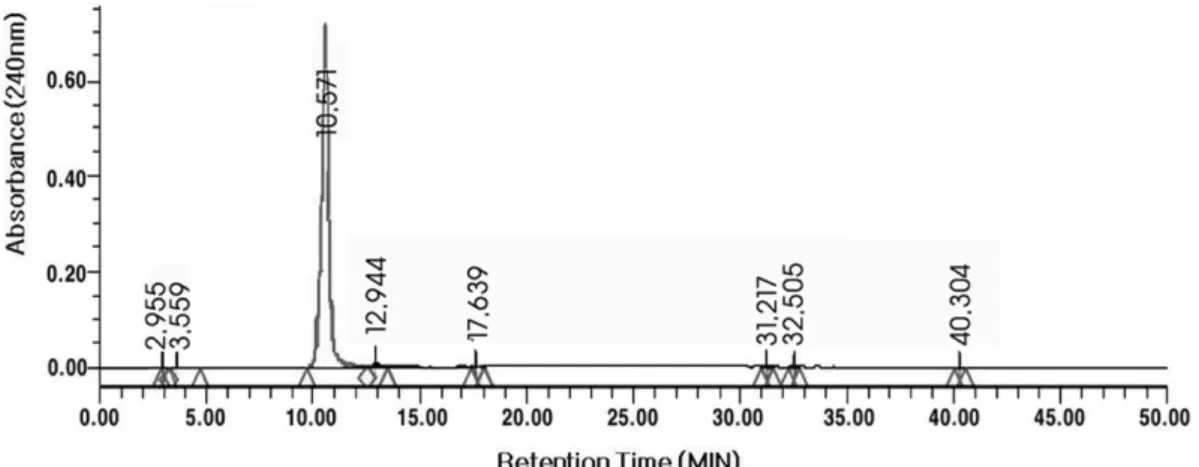
항균활성이 우수하고 수율이 가장 높은 EtOAc 분획물 (11.83 g)을 CHCl3-MeOH 용매계를 이용한 silica gel adsorption column chromatography로 용출 분획한 결과, 33% MeOH 용출 분획에서 항균활성이 나타났다. 이어 Hexane-EtOAc(1:2; 1:3) 으로 column chromatography한 2번째 활성 분획을 Sephadex LH-20를 이용하여 column chromatograph하여 분자량에 따라 분리하였다. 주요 성분 을 HPLC로 확인하여 수득한 후 ethyl ether에서 재결정 하여 단일 물질을 분리하였다. 분리된 단일물질을 HPLC 에 의한 분석 결과 retention time이 10.57분에서 주요 peak 를 나타내는 순도 98.48%의 단일물질 brazilin(350 mg)을 분리하였다(Fig. 3).
2. Brazilin이 S. mutans의 배양 환경에 미치는 효과
1) S. mutans 의 생장에 미치는 영향
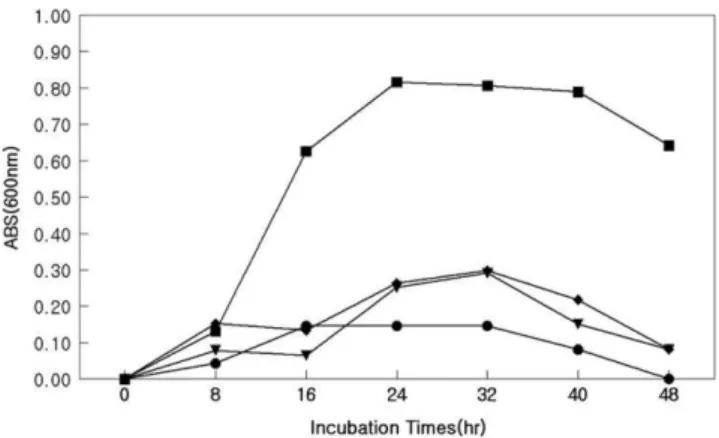
S. mutans 생장곡선은 대조군이 배양 24시간 후에 흡광
Fig. 3. HPLC chromatogram of the active substance. The active substance in the EtOAc fraction from MeOH extract of C. sappan L. was final purified by HPLC using C18 reversed-phase column with eluted fraction from silica gel absorption column
도 0.816으로 최대의 생장을 보였으나, 소목의 brazilin (0.3 mg/ml, 1 mg/ml, 3 mg/ml)을 투여한 배지에서는 생 장이 지연되어 32시간 후에 각각 흡광도가 0.298, 0.292, 0.146으로 최대의 생장을 나타냈다. 따라서 brazilin은 배 양액 내에서도 우식원인균인 S. mutans의 성장을 억제하 는 것으로 나타났다(Fig. 4).
2) 배지 내 pH에 미치는 영향
소목의 brazilin을 S. mutans 배지에 첨가하여 16시간 동 안 배양한 후 pH를 측정한 결과, 대조군은 pH 5.25 로 급격한 변화를 보였지만, 0.3 mg/ml, 1 mg/ml, 3 mg/ml 의 brazilin이 각각 투여된 배지의 경우 pH 7.00, pH 7.01, pH 6.98로 대조군에 비해 pH 변화가 거의 일어나지 않아 산 생산을 억제하였다. 구강의 pH는 정상적인 경우는 중 성이지만, 당을 많이 섭취하는 경우에는 치면세균막 내 세 균에 의해 산이 생성되어 pH가 5.5이하로 떨어지게 되면 치아우식증을 유발한다. 본 실험의 결과, 대조군은 배약 16시간에 pH 5.25까지 급격한 변화를 보인 반면 brazilin
을 첨가한 배지는 세균의 성장 억제뿐만 아니라 pH의 변 화를 억제하여 구강 내 산 발생 억제물질로 활용될 수 있 을 것으로 여겨 진다(Fig. 5).
3) 배지 내 탄수화물 변화에 미치는 영향
소목의 brazilin을 S. mutans에 첨가한 후 시간별 배양 시 배지 내의 탄수화물 변화를 알아보았다. 대조군이나 brazilin이 첨가된 배지의 초기 총 탄수화물의 양은 ml 당 22∼24 mg의 탄수화물이 정량 되었으나, 배양 시간이 경 과함에 따라 배지 내 총 탄수화물 함량은 32시간까지 지 속적으로 감소하였다. 배양 8시간까지는 대조군에 비해 brazilin이 첨가된 시험군에서 배지 내 총 탄수화물의 양 은 약간 감소되었으며, 배양 32시간까지 이러한 양태를 보였다(Fig. 6).
4) 배지 내 단백질 변화에 미치는 영향
소목의 brazilin이 첨가된 BHI 배지에 S. mutans를 배양하고 시간별 변화하는 단백질량을 측정하였다. 배양 Fig. 4. Growth curve of S. mutans by addition of brazilin
extracted from C. sappan. Brazilin concentration; 0.3 mg/ml ( ), 1 mg/ml( ), 3 mg/ml( ), and Control ( ); no addition
Fig. 5. The pH changes in S. mutans culture medium by addition of brazilin extracted from C. sappan. Brazilin concentration; 0.3 mg/ml( ), 1 mg/ml( ), 3 mg/ml ( ), and Control( ); no addition
Fig. 6. The changes of total carbohydrate in S. mutans culture medium by addition of brazilin extracted from C. sappan.
Brazilin concentration; 0.3 mg/ml( ), 1 mg/ml( ), 3 mg/ml( ), and control( ); no addition
Fig. 7. Protein changes in S. mutans culture medium by addition of brazilin. Brazilin concentration; 0.3 mg/ml( ), 1 mg/ml( ), 3 mg/ml( ), and control( ); no addition
0시간에서는 모든 배지에서 약 2.53 mg/ml의 단백질이 정 량되었다. 균체의 최대 생장량을 보인 24 시간에서는 대 조군이 2.46 mg/ml 이었으나 brazilin 3 mg/ml이 투여된 배지는 2.54 mg/ml의 단백질이 정량 되어 배지 내 단백질 의 활용이 일어나지 않은 것으로 확인되었다(Fig. 7).
5) 배지 내 다당류 생성에 미치는 영향
S. mutans의 다당류는 치아우식증에 관여하는 치면세균 막(dental plaque)을 형성하는데 가장 중요한 역할을 하는 mutan과 같은 다당류이다. 본 연구에서는 소목의 brazilin 이 S. mutans의 다당류 생성을 어느 정도 억제하는지 확 인하기 위하여 액체배지에서 시간별 다당류의 양적 변화 를 알아보았다. 대조군에서는 배양 8 시간 만에 300 mg/
100 ml의 다당류를 얻었으나, brazilin이 첨가된 배지에서 는 200 mg/100 ml의 다당류를 수확하여 약 1.5배 정도 낮 게 생성하였다(Fig. 8).
고 찰
소목(Caesalpinia sappan L.)의 주성분 가운데 약 2%
를 차지하는 염료성 화합물은 무색의 flavonoid 구조를 갖는 brazilin이며, 이는 공기 중에 산화되어 brazilein이
된다26-27). Brazilin은 Benz(b)-Indeno(2,1-d) pyran 유도체
로 주로 염료나 산 및 알칼리 지시약 또는 식품첨가물 등 으로 사용해 왔다28). 또한 한방에서 brazilin은 어혈로 인 한 타박손상, 월경통, 월경폐색, 현훈, 출산 후 각종 증상에 사용해 왔다29-32). 그 외 소목의 주요성분으로는 campes- terol, stigmasterol, β-sitosterol, hematein, sappanin, vola- tile oils, protosappanin A, B, E 등이 밝혀졌다33). 이에 본 연구는 천연물을 이용한 생리활성물질의 개발과 관련하 여 항우식제로의 가능성을 알아보기 위해 소목의 유기용 매 중 가장 우수한 항균활성이 있는 에틸아세테이트 분획 인 brazilin을 이용하여 치아우식증을 유발하는 S. mutans 균주의 대사에 미치는 영향을 평가하기 위해 생장곡선,
대조군은 pH 5.25 이었으며, brazilin이 투여된 배지는 0.3 mg/ml, 1 mg/ml, 3 mg/ml의 농도에서 각각 pH 7.00, pH 7.01, pH 6.98 로 산 생성이 거의 일어나지 않았다. 일 반적으로 구강 내에서 S. mutans의 산 생성에 의해 법랑 질 탈회가 발생하여 치아우식증의 원인이 되기도 하는데, 이 시기가 pH가 5.5로 떨어지는 시기이다. 따라서 대조군 에 비해 pH의 변화가 뚜렷하게 낮아진 것으로 보아 소목 의 brazilin은 S. mutans의 산 생성을 억제하였으며, 이것 은 구강 내 치아우식유발 감소에 기여할 수 있을 것으로 사료된다. 한편 S. mutans를 48시간 동안 배양한 후 배지 내 탄수화물 변화량을 측정한 결과 배양 시간이 지남에 따라 배지 내 총 탄수화물의 양은 배양 32시간까지 계속 감소하였으며, 대조군보다 소목의 brazilin이 투여된 배지 내의 탄수화물 감소량이 적었다. 이는 brazilin이 균의 성 장억제에 관여하여 배지 내 탄수화물 성분의 감소량이 적 은 것으로 판단된다. 또한 S. mutans를 8 시간 동안 배양 한 후 배지 내 단백질 변화량을 측정한 결과 대조군은 8.39 mg/ml 이었으며, brazilin이 투여된 배지는 12.3 mg/ml 이었다. 이 같은 결과는 기본 배지로 사용한 BHI 내 총 단백질이 대조군에서는 세균의 초기 생장에 따라 소실 되나, brazilin에서는 균의 생장 억제에 따라 단백질의 소 모가 크게 감소하지 않은 결과로 여겨진다. 그러나 시간 이 경과함에 따라 단백질의 증가는 균의 생장에 따라 균 체 외 단백질 등이 증가하여 나타난 결과로 사료된다. S.
mutans의 다당류 생성에 미치는 효과는 대조군의 경우 배 양 8 시간에 3 g/L을 생성하였으나, brazilin이 투여된 배 지에서는 2 g/L을 생성하여, 대조군에 비해 약 1.5배 정도 다당류 생성이 감소된 것으로 나타났으며, 이는 소목의 brazilin이 균의 생장을 억제하여 배지 내 다당류의 생성 이 감소된 것으로 보인다. 따라서 Brazilin이 포함된 소목 의 에틸아세테이트 분획물은 S. mutans에 대한 생장 억제 효과를 뚜렷하게 나타내어 향후 임상에서 구강 내에 항균 물질로 적용 가능성을 제시한다.
요 약
본 연구는 소목(C. sappan L.)으로부터 분리된 Brazilin 이 S. mutans의 생장 및 배양 환경 에 미치는 영향을 측 Fig. 8. The effect of brazilin on S. mutans polysaccharide
production. Brazilin concentration; 0.3 mg/ml( ), 1 mg/
ml( ), 3 mg/ml( ), and control( ); no addition
정하고 다음과 같은 결과를 얻었다.
1. Methanol에 의해 분리된 소목의 수율은 총 4.8%로 나타났으며, 여러 분획물 가운데 brazilin이 포함된 에틸 아세테이트(EtOAc) 분획물에서 3.94%로 가장 높은 수율 을 보였다.
2. 소목으로부터 분리된 brazilin의 S. mutans 생장에 대 한 효과는 대조군이 24시간에서 0.816으로 최대 생장률 을 보였으나, brazilin (0.3 mg/ml, 1 mg/ml, 3 mg/ml)을 투여한 배지는 32시간 만에 최대생장을 보였다.
3. S. mutans를 16시간 동안 배양한 후 배지 내 pH를 측정한 결과 대조군은 5.25이었으며, brazilin (0.3 mg/ml, 1 mg/ml, 3 mg/ml)을 투여한 배지는 각각 pH 7.00, pH 7.01, pH 6.98로 유지하여 산 생성을 억제하였다.
4. S. mutans를 48시간 동안 배양한 후 배지 내 탄수화 물 변화량을 측정한 결과 대조군보다 소목의 brazilin이 투여된 배지의 탄수화물의 소모량이 적었다.
5. S. mutans를 24 시간 동안 배양한 후 배지 내 단백질 변화량을 측정한 결과, 최대 생장량을 보인 24 시간에서 대조군은 2.46 mg/ml 이었으며, 소목의 brazilin이 투여된 배지는 2.54 mg/ml 이었다.
6. S. mutans의 다당류 생성에 미치는 효과는 대조군의 경우 배양 8 시간에 300 mg/100 ml을 생성하였으나, 소목 의 brazilin이 투여된 배지에서는 200 mg/100 ml을 생성 하였다.
이상의 결과를 볼 때, 소목의 EtOAc 분획에 존재하는 brazilin은 배지 내 S. mutans 균주의 생육을 억제하는 효 과가 있어, 향후 구강 내 우식원성 세균의 억제물질로 활 용을 제시한다.
참고문헌
1. Koga T et al.: Sucrose-dependent cell adherence and cariogenicity of serotype C Streptococcus mutans. J Gen Microbiol 10: 2873-2883, 1986.
2. Matsumoto M et al.: Inhibitory effects of oolong tea extract on caries-inducing properties of mutans streptococci. Caries Res 33(6): 441-445, 1999.
3. Takashio M, Okami Y: Screening of a dextransucrase inhibitor. Agric Biol Chem 46(6): 1457-1464, 1982.
4. Wong RW et al.: Antimicrobial activity of chinese medicine herbs against common bacteria in oral biofilm. A pilot study.
Int J Oral Maxillofac Surg 39(6): 599-605, 2010.
5. Tsai TH et al.: In vitro antimicrobial activities against cariogenic streptococci and their antioxidant capacities: A comparative study of green tea versus different herbs. Food Chem 110(4): 859-864, 2008.
6. Shu SH et al.: Two novel biphenyl dimers from the heartwood of Caesalpinia sappan. Fitoterapia 82(5): 762-766, 2011.
7. Zheng JX et al.: Effect of ethyl acetate extract of sappan wood on expression of myocardial GrB mRNA in rat model of allogeneic ectopic cardiac transplantation. Zhongguo Zhong Xi Yi Jie He Za Zhi 28: 537-540, 2008.
8. Hu CM et al.: Heme oxygenase-1 mediates the inhibitory actions of brazilin in Raw 264.7 macrophages stimulated with lipopolysaccharide. J Ethnopharmacol 121: 79-85, 2009.
9. Pan YM et al.: Antioxidant activities of several Chinese medicine herbs. Food Chemistry 88: 347-350, 2004.
10. Xu HX, Lee SF: The antibacterial principle of Caesalpina sappan. Phytother Res 18: 647 651, 2004.
11. Chiang LC et al.: In vitro antiviral activities of Caesalpinia pulcherrima and its related flavonoids. J Antimicrob Chemother 52: 194-198, 2003.
12. Kim EC et al.: Caesalpinia sappan induces cell death by increasing the expression of p53 and p21WAF1/CIP1 in head and neck cancer cells. Am J Chin Med 33: 405-414, 2005.
13. Baek NI et al.: Anticonvulsant compounds from the wood of Caesalpinia sappan L. Arch Pharm Res 23: 344-348, 2000.
14. Oh SR et al.: Anticomplementary activity of constituents from the heartwood of Caesalpinia sappan. Planta Med 64: 456- 458, 1998.
15. You YO et al.: Effects of Caesalpinia sappan extracts on the growth, acid production, adhesion, and insoluble glucan synthesis of Streptococcus mutans. J Korean Acad Dent Health 27(2): 277-288, 2003.
16. Lee H, Yu YU: Inhibitory effect of Caesalpinia sappan on caries-inducing properties of Streptococcus mutans and isolation of antibacterial component, brazilin. J Wonkwang Dent Res Inst 13: 63-83, 2004.
17. Xu HX, Lee SF: The antibacterial principle of Caesalpinia sappan. Phytother Res 18: 647-651, 2004.
18. Rivero-Cruz JF: Antimicrobial compounds isolated from Haematoxylon brasiletto. J Ethnopharmacol 119(1): 99-103, 2008.
19. Jeon JH et al.: Antibacterial effects of juglone and its derivatives against oral pathogens. J Korean Soc Appl Biol Chem 52(6): 720-725, 2009.
20. Jeon ES, Han MD: Effects of Lignum sappan extract on the growth of Streptococcus mutans KCTC 3065. J Dent Hyg Sci 4(3): 127-131, 2004.
21. Kwon HJ et al.: Antibacterial activities of Caesalpinia sappan L. extract and structural analysis of its related brazilin. Kor J Microbiol. Biotechnol 38(1): 105-111, 2010.
22. Jeon MA et al.: Antioxidative activities and antiproliferation effects on oral carcinoma KB cell of the brazilin from Caesalpinia sappan L. J Dent Hyg Sci 10(5): 365-372, 2010.
23. Kwon HJ et al.: Antimicrobial activities and adherence inhibition on Streptococcus mutans by ethyl acetate extract from Caesalpinia sappan L. J Dent Hyg Sci 12(2): 155-162, 2012.
24. Paek JY et al.: Effects of antibacterial and adhesive inhibition of Scutellaria baicalensis extract on Streptococcus mutans. J Dent Hyg Sci 8(4): 367-373, 2008.
25. Han MD et al.: The composition and bioactivities of ganoderan by mycelial fractionation of Ganoderma lucidum IY009. Kor J Mycol 23(4): 285-297, 1995.
26. De Oliveira et al.: Vibrational spectroscopic study of brazilin and brazilein, the main constituents of brazilwood from Brazil. Vib Spectrosc 28: 243-249, 2002.
27. Huang KC: The pharmacology of chinese herbs. America CRC Press, 266, 1993.
28. Puchtler H, Meloan SN, Waldrop FB: Application of current concepts to metal-hematein and -brazilein stains. Histochemistry 85: 353-364, 1986.
29. Baek NI et al.: Anticonvulsant compounds from the wood of