소아청소년 비만 예방의 근거: 기존 체계적 문헌고찰과 메타분석 활용
김설혜
1, 성은주
2, 유선미
3성균관대학교 의과대학 강북삼성병원 1건강의학본부, 2가정의학과, 3인제대학교 의과대학 해운대백병원 가정의학과
Evidence of Interventions for Preventing Obesity of Children and Adolescents Using Existing Systematic Reviews and Meta-Analyses
Seolhye Kim
1, Eunju Sung
2, Sunmi Yoo
31
Total Healthcare Center, Kangbuk Samsung Hospital, Sungkyunkwan University School of Medicine, Seoul, Korea
2
Department of Family Medicine, Kangbuk Samsung Hospital, Sungkyunkwan University School of Medicine, Seoul, Korea
3
Department of Family Medicine, Haeundae-Paik Hospital, Inje University School of Medicine, Busan, Korea
Background: Pediatric obesity is an important global issue in public health. However, previous efforts for child- hood obesity prevention have sporadically been implemented in Korea, neither evidence-based nor with proper evaluation. We aimed to investigate the characteristics of an effective intervention for prevention of pediatric obesity by reviewing previous systematic reviews and Meta-analyses.
Methods: PubMed was searched for articles published frombetween January 2005 to November 2015.
Inclusion criteria were as follows: (1) articles published in English; (2) child and/or adolescents (between 2 and 18 years of age) as subjects; and (3) systematic reviews or meta-analyses concerning the preventive inter- vention of pediatric/adolescent obesity. Each study was evaluated via the Assessment of Multiple Systematic Reviews for quality assessment. We conducted a quantitative analysis to evaluate the implications, strengths, and limitations of each study.
Results: Our final analysis included 35 articles, of which 15 were systematic reviews and 20 were meta-analyses.
Among these, 24 studies (69%) advocated the efficacy of preventive intervention for pediatric obesity.
Multidimensional approach including diet, exercise, and environmental factors conducted in schools with a pa- rent and community involvement wasis more effective at preventing obesity. The efficacy of intervention varied depending on the age, sex, region, and socioeconomic characteristics of participantssubjects.
Conclusions: Preventive intervention of pediatric obesity demonstrated smallminor improvements in body mass index and had positive effects on behavioral and clinical variables, which are associated with obesity. For the efficient prevention of pediatric obesity, it is necessary to consider efforts for developing various intervention programs, with active as well as the participation of school, family, and social community groups.
Korean J Health Promot 2016;16(4):231-250
Keywords: Obesity, Prevention and control, Review, Child, Adolescent
■ Received: August 28, 2016 ■ Accepted: December 22, 2016
■Corresponding author : Sunmi Yoo, MD, MPH, PhD Department of Family Medicine, Haeundae-Paik Hospital, Inje University School of Medicine, 875 Haeundae-ro, Haeundae-gu, Busan 48108, Korea
Tel: +82-51-797-3220, Fax: +82-51-797-0589 E-mail: [email protected]
■This research was supported by a fund (2015-ER6402-00) by Research of Korea Centers for Disease Control and Prevention.
Copyright ⓒ 2016 The Korean Society of Health Promotion and Disease Prevention
This is an Open Access article distributed under the terms of the Creative Commons Attribution Non-Commercial License (http://creativecommons.org/licenses/by-nc/3.0/) which permits unrestricted noncommercial use, distribution, and reproduction in any medium, provided the original work is properly cited.
서 론
소아비만은 전 세계적인 보건문제이며 많은 건강문제를 야기하기 때문에1) 세계보건기구에서는 소아비만 예방을 위해 국가 단위에서 리더십을 가지고 추세를 감시하며 각 나라에 적합한 중재를 시행하도록 권고하였다.1) 건강에 영 향을 미치는 사회적 요인을 고려하여 신체활동과 건강한 식생활을 지지하고 도와주는 포괄적이고 조화로운 중재가 소아 청소년기의 비만 예방에 효과가 있음은 잘 알려져 있 다.1) 우리나라에서도 보건복지부, 시도 교육청, 국민건강보 험공단, 보건소 등에서 산발적으로 시행된 시범사업 중심 의 비만 예방 사업(또는 프로그램)을 시행하였다. 그러나 체계적인 사업 추진체계가 마련되지 않았고, 근거에 기반 한 사업모형이나 적절한 평가 없이 비슷한 내용의 소규모 사업이 반복되고 있는 실정이다.2)
효과적인 비만 예방을 위해서는 적절하고 비용효과적인 중재의 특성을 파악하고 우선순위를 설정하고 이해관계 상 충을 최소화하고 지속성을 가지는 프로그램을 찾아내야 한 다. 2000년 이후 외국에서는 소아 및 청소년을 대상으로 비 만 예방을 위한 중재가 많이 이루어졌고 이 결과를 바탕으 로 체계적 종설이나 메타분석이 다수 발표되었다. 따라서 국내 현실에 맞는 새로운 비만 예방 중재를 기획하기 전에 기존에 출판된 체계적 문헌고찰을 활용하여 효과적인 비만 예방 중재의 특징을 파악한다면 시간이나 노력을 아끼고 연구에 관련된 방법론적 이슈를 예측할 수 있는 효율적인 접근이 될 수 있다. 본 논문의 목적은 최근에 발표된 비만 예방을 위한 체계적 종설과 메타분석을 모아 서술적으로 분석함으로써 효과적인 비만 예방을 위한 중재의 특징을 파악하는 것이다. 국내의 경우 전체 연령을 대상으로 한 비 만 예방 또는 치료 중재의 메타분석3)과 소아비만 환아를 대상으로 한 비만관리 프로그램의 메타분석 연구4)가 있었 으나, 소아비만 예방 중재만을 대상으로 하는 메타분석 또 는 체계적 고찰은 찾을 수 없었다. 따라서 국외 연구를 대 상으로 분석을 시행하였다.
방 법
1. 검색 방법
연구 대상으로 합당한 메타분석과 체계적 종설은 문헌 검색을 통해 선택하였다. 소아 및 청소년의 비만 예방 중재 또는 프로그램을 다룬 논문을 찾기 위해 2015년 11-12월에 전자저널 데이터베이스인 Pubmed에서 2005년 1월 이후부 터 2015년 11월까지 발표된 논문을 검색하였다. 검색 키워 드는 ((obese) OR (overweight)) AND ((exercise) OR (phy-
sical activity)) AND ((nutrition) OR (diet) OR (nutrition education)) AND ((childhood) OR (children) OR (adoles- cent)) AND (school) AND (intervention) AND (preven- tion)을 사용하였으며, 검색조건은 Systematic review, Meta analysis, published in the last 20 years, Humans를 적용하였 다. 또한 포함된 논문과 비슷한 주제의 종설에서 인용한 참 고문헌 목록을 점검하여 적절한 논문이 있으면 연구 대상으 로 추가하였다. 미출판논문에 대한 검색은 시행하지 않았다.
2. 연구 대상 선정기준 및 제외기준
연구 대상으로 포함된 논문의 기준은 1) 비만 예방을 위 한 중재를 대상으로 한 체계적 종설이나 메타분석일 것, 2) 2세 이상 18세 미만의 소아 및 청소년을 대상으로 한 연구 일 것, 3) 영어로 발표된 논문일 것 등이었다.
특정 질환이 있는 소아 및 청소년 대상으로 중재를 하였 거나, 비만 아동만을 대상으로 하였거나 치료를 목적으로 한 경우, 약물을 이용한 중재가 포함된 경우, 아시아인이 아닌 특정 인종만을 대상으로 하였거나, 중재 연구의 서술 적 종설이나 단순 관찰조사를 대상으로 한 종설은 제외하 였다. 문헌검색 방법이나 연구 대상의 포함기준과 제외기 준이 명시되지 않았거나 구체적인 중재 방법에 대한 언급 인 없는 경우도 대상에서 제외하였다. 대상자에 성인 연령 층이 포함되었거나 6세 미만 영유아에 국한된 연구도 제외 하였다.
위에 제시한 선정 및 제외기준에 따라 두 연구자가 데이 터베이스와 참고문헌 목록에서 독립적으로 분석 대상을 선 정하였다. 두 연구자 간에 의견이 일치하지 않을 때는 토론 을 통해 결정하거나 다른 연구자와 상의하여 결정하였다.
3. 개별 연구의 질 평가
체계적 문헌고찰의 질 평가도구인 assessment of multiple systematic reviews (AMSTAR)를 이용하여 개별 연구의 질 을 평가하였다. AMSATR는 총 11개 항목을 평가하도록 이 루어진 체크리스트 방식의 도구이며, 그 타당도가 검증되 었다.5) 두 연구자가 분석에 포함된 각 논문에 대하여 AMSTAR 항목을 평가하였고 점수에 따라 0-3점이면 낮은 질, 4-7점이면 중등도의 질, 8-11점은 높은 질로 분류하였 다. 두 연구자 간에 의견이 다를 때는 토론을 통해 의견 일 치에 도달하였다.6)
4. 데이터 합성 및 분석
한 연구자가 직접 데이터를 표로 정리하였고 다른 연구
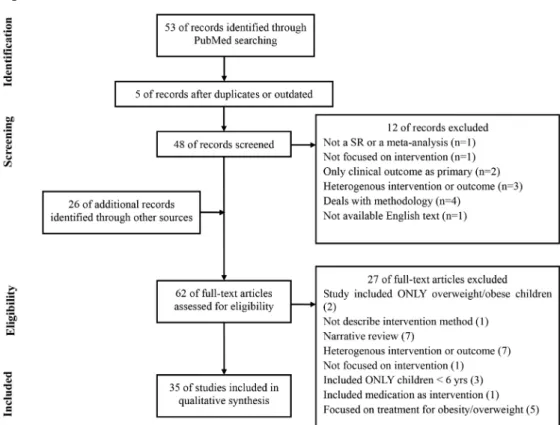
Figure 1. Flow-chart of literature search.
자가 다시 검토하였다. 본 연구에서는 포함된 연구 간의 디 자인, 대상, 중재 방법, 결과측정 방법의 이질성으로 인해 메타분석을 시행하지 않기로 결정하였고, 임상 및 연구에 적용할 점, 연구의 장점 및 제한점 등에 대한 정성분석을 시행하였다. 체계적 종설이 계획하고 실행하고 발견한 것 을 보고하는 가이드라인으로 사용되는 preferred reporting items for systematic reviews and meta-analysis (PRISMA) 에 따라 연구 내용을 요약하였다.7)
Population, Interventions, Comparators, Main outcome, Study design (PICOS) 요소를 이용하여 대상으로 선정된 논문의 특징을 요약하였다. 우선 각 논문에 포함된 개별 중 재 연구의 수, 대상자의 연령, 중재의 종류 및 지속 기간, 중재가 이루어진 환경을 파악하였다. 중재의 종류는 영양 관련 중재, 신체활동 관련 중재, 교육 관련 중재, 환경 변화 를 유발하는 중재로 구분하였고, 소비자 건강정보나 정보 통신 기술 등을 이용한 그 외 중재는 내용을 구체적으로 기술하였다. 중재가 이루어진 환경은 학교, 가정, 지역사회, 일차 의료 등으로 구분하였고, 그 외 중재환경의 특징에 대 해서는 구체적으로 기술하였다.
비만 예방의 효과를 판단하는 결과변수는 주요변수와 중 간변수로 구분하여 조사하였다. 결과변수로 사용한 인체계 측 변수를 주요변수로 보았고, 연구 대상자의 체질량지수
(body mass index, BMI), BMI Z score, 성별 연령별 BMI 백분위수, 성별 연령별 표준체중에 대한 상대체중, 허리둘 레, 피부두께, 체지방률 및 연구 집단의 비만 유병률 등 사 용된 인체계측 변수를 구체적으로 명시하였다. 인체계측 변수에 영향을 미칠 수 있는 행동적 특성이나 비만의 결과 로 나타날 수 있는 혈압, 콜레스테롤 등 임상적인 데이터는 중간변수로 분류하였다.
특정 중재 연구가 여러 종설/메타분석에 중복되어 포함 될 경우 본 연구 결과에 영향을 미칠 수 있으므로 연구 대 상 논문에 포함된 개별 중재 연구를 나열하고 각 종설/메타 분석에 몇 번이나 포함되었는지 즉, 개별 중재 연구가 얼마 나 겹치는지도 확인하였다.
각 논문에서 파악할 수 있는 효과적인 비만 예방 프로그 램의 특징은 주요 결과, 연구의 장점 및 단점, 임상 및 연구 에 미치는 영향 등으로 구분하여 요약하였다.
결 과
1. 문헌검색 결과
그림 1에 문헌 검색 및 선정 과정을 요약하였다. 53편의 논문이 검색되었고, 참고문헌 조사를 통해 추가된 26편의
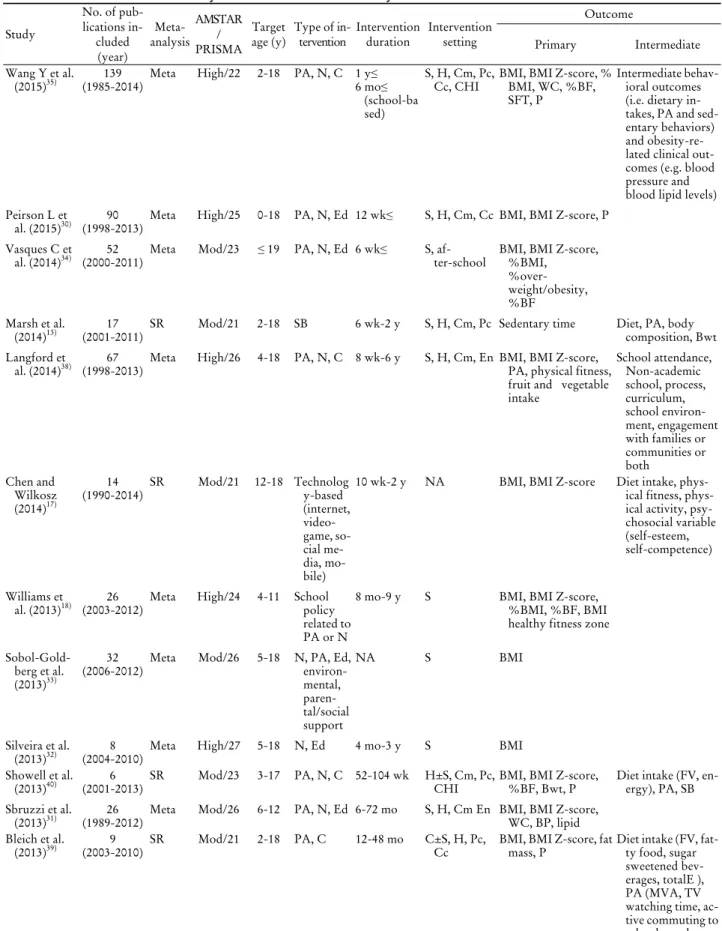
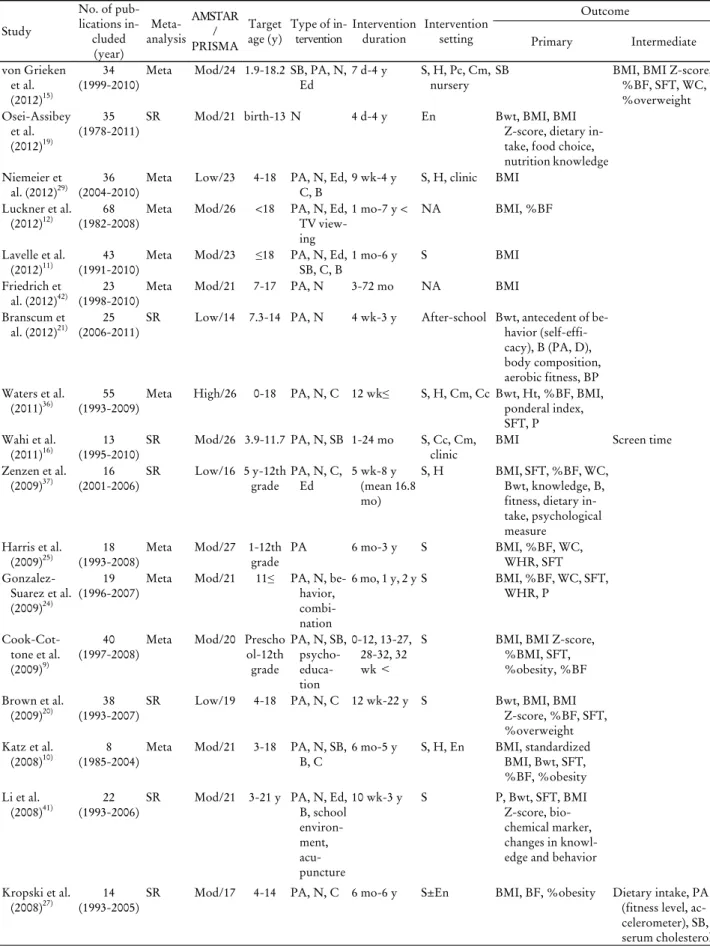
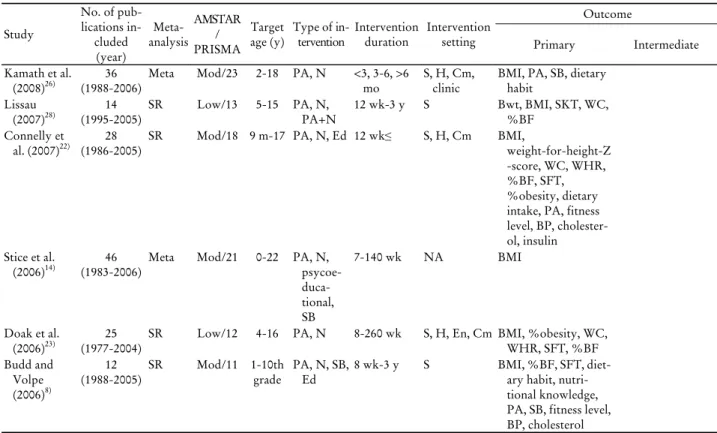
Table 1. General characteristics of systematic reviews or meta-analyses
Study
No. of pub- lications in-
cluded (year)
Meta- analysis
AMSTAR / PRISMA
Target
age (y) Type of in-
tervention Intervention
duration Intervention setting
Outcome
Primary Intermediate
Wang Y et al.
(2015)35) 139
(1985-2014) Meta High/22 2-18 PA, N, C 1 y≤
6 mo≤
(school-ba sed)
S, H, Cm, Pc,
Cc, CHI BMI, BMI Z-score, % BMI, WC, %BF, SFT, P
Intermediate behav- ioral outcomes (i.e. dietary in- takes, PA and sed- entary behaviors) and obesity-re- lated clinical out- comes (e.g. blood pressure and blood lipid levels) Peirson L et
al. (2015)30) 90
(1998-2013) Meta High/25 0-18 PA, N, Ed 12 wk≤ S, H, Cm, Cc BMI, BMI Z-score, P Vasques C et
al. (2014)34) 52
(2000-2011) Meta Mod/23 ≤ 19 PA, N, Ed 6 wk≤ S, af-
ter-school BMI, BMI Z-score,
%BMI,
%over- weight/obesity,
%BF Marsh et al.
(2014)13) 17
(2001-2011) SR Mod/21 2-18 SB 6 wk-2 y S, H, Cm, Pc Sedentary time Diet, PA, body
composition, Bwt Langford et
al. (2014)38) 67
(1998-2013) Meta High/26 4-18 PA, N, C 8 wk-6 y S, H, Cm, En BMI, BMI Z-score, PA, physical fitness, fruit and vegetable intake
School attendance, Non-academic school, process, curriculum, school environ- ment, engagement with families or communities or both
Chen and Wilkosz (2014)17)
(1990-2014)14 SR Mod/21 12-18 Technolog y-based (internet, video- game, so- cial me- dia, mo- bile)
10 wk-2 y NA BMI, BMI Z-score Diet intake, phys- ical fitness, phys- ical activity, psy- chosocial variable (self-esteem, self-competence)
Williams et
al. (2013)18) 26
(2003-2012) Meta High/24 4-11 School policy related to PA or N
8 mo-9 y S BMI, BMI Z-score,
%BMI, %BF, BMI healthy fitness zone Sobol-Gold-
berg et al.
(2013)33)
(2006-2012)32 Meta Mod/26 5-18 N, PA, Ed, environ- mental, paren- tal/social support
NA S BMI
Silveira et al.
(2013)32) 8
(2004-2010) Meta High/27 5-18 N, Ed 4 mo-3 y S BMI
Showell et al.
(2013)40) 6
(2001-2013) SR Mod/23 3-17 PA, N, C 52-104 wk H±S, Cm, Pc,
CHI BMI, BMI Z-score,
%BF, Bwt, P Diet intake (FV, en- ergy), PA, SB Sbruzzi et al.
(2013)31) 26
(1989-2012) Meta Mod/26 6-12 PA, N, Ed 6-72 mo S, H, Cm En BMI, BMI Z-score, WC, BP, lipid Bleich et al.
(2013)39) 9
(2003-2010) SR Mod/21 2-18 PA, C 12-48 mo C±S, H, Pc,
Cc BMI, BMI Z-score, fat
mass, P Diet intake (FV, fat- ty food, sugar sweetened bev- erages, totalE ), PA (MVA, TV watching time, ac- tive commuting to school, accel- erometer)
Table 1. Continued
Study
No. of pub- lications in-
cluded (year)
Meta- analysis
AMSTAR / PRISMA
Target
age (y) Type of in-
tervention Intervention
duration Intervention setting
Outcome
Primary Intermediate
von Grieken et al.
(2012)15)
34
(1999-2010) Meta Mod/24 1.9-18.2 SB, PA, N,
Ed 7 d-4 y S, H, Pc, Cm,
nursery SB BMI, BMI Z-score,
%BF, SFT, WC,
%overweight Osei-Assibey
et al.
(2012)19)
35
(1978-2011) SR Mod/21 birth-13 N 4 d-4 y En Bwt, BMI, BMI
Z-score, dietary in- take, food choice, nutrition knowledge Niemeier et
al. (2012)29) 36
(2004-2010) Meta Low/23 4-18 PA, N, Ed,
C, B 9 wk-4 y S, H, clinic BMI Luckner et al.
(2012)12) 68
(1982-2008) Meta Mod/26 <18 PA, N, Ed, TV view- ing
1 mo-7 y < NA BMI, %BF
Lavelle et al.
(2012)11) 43
(1991-2010) Meta Mod/23 ≤18 PA, N, Ed,
SB, C, B 1 mo-6 y S BMI
Friedrich et
al. (2012)42) 23
(1998-2010) Meta Mod/21 7-17 PA, N 3-72 mo NA BMI
Branscum et al. (2012)21) 25
(2006-2011) SR Low/14 7.3-14 PA, N 4 wk-3 y After-school Bwt, antecedent of be- havior (self-effi- cacy), B (PA, D), body composition, aerobic fitness, BP Waters et al.
(2011)36) 55
(1993-2009) Meta High/26 0-18 PA, N, C 12 wk≤ S, H, Cm, Cc Bwt, Ht, %BF, BMI, ponderal index, SFT, P Wahi et al.
(2011)16) 13
(1995-2010) SR Mod/26 3.9-11.7 PA, N, SB 1-24 mo S, Cc, Cm,
clinic BMI Screen time
Zenzen et al.
(2009)37) 16
(2001-2006) SR Low/16 5 y-12th
grade PA, N, C,
Ed 5 wk-8 y
(mean 16.8 mo)
S, H BMI, SFT, %BF, WC,
Bwt, knowledge, B, fitness, dietary in- take, psychological measure
Harris et al.
(2009)25) 18
(1993-2008) Meta Mod/27 1-12th
grade PA 6 mo-3 y S BMI, %BF, WC,
WHR, SFT Gonzalez-
Suarez et al.
(2009)24)
19
(1996-2007) Meta Mod/21 11≤ PA, N, be- havior, combi- nation
6 mo, 1 y, 2 y S BMI, %BF, WC, SFT, WHR, P
Cook-Cot- tone et al.
(2009)9)
40
(1997-2008) Meta Mod/20 Prescho ol-12th grade
PA, N, SB, psycho- educa- tion
0-12, 13-27, 28-32, 32 wk <
S BMI, BMI Z-score,
%BMI, SFT,
%obesity, %BF Brown et al.
(2009)20) 38
(1993-2007) SR Low/19 4-18 PA, N, C 12 wk-22 y S Bwt, BMI, BMI
Z-score, %BF, SFT,
%overweight Katz et al.
(2008)10) 8
(1985-2004) Meta Mod/21 3-18 PA, N, SB,
B, C 6 mo-5 y S, H, En BMI, standardized BMI, Bwt, SFT,
%BF, %obesity Li et al.
(2008)41) 22
(1993-2006) SR Mod/21 3-21 y PA, N, Ed, B, school environ- ment, acu- puncture
10 wk-3 y S P, Bwt, SFT, BMI
Z-score, bio- chemical marker, changes in knowl- edge and behavior Kropski et al.
(2008)27) 14
(1993-2005) SR Mod/17 4-14 PA, N, C 6 mo-6 y S±En BMI, BF, %obesity Dietary intake, PA (fitness level, ac- celerometer), SB, serum cholesterol
Table 1. Continued
Study
No. of pub- lications in-
cluded (year)
Meta- analysis
AMSTAR / PRISMA
Target
age (y) Type of in-
tervention Intervention
duration Intervention setting
Outcome
Primary Intermediate
Kamath et al.
(2008)26) 36
(1988-2006) Meta Mod/23 2-18 PA, N <3, 3-6, >6
mo S, H, Cm,
clinic BMI, PA, SB, dietary habit
Lissau
(2007)28) 14
(1995-2005) SR Low/13 5-15 PA, N,
PA+N 12 wk-3 y S Bwt, BMI, SKT, WC,
%BF Connelly et
al. (2007)22) 28
(1986-2005) SR Mod/18 9 m-17 PA, N, Ed 12 wk≤ S, H, Cm BMI,
weight-for-height-Z -score, WC, WHR,
%BF, SFT,
%obesity, dietary intake, PA, fitness level, BP, cholester- ol, insulin Stice et al.
(2006)14) 46
(1983-2006) Meta Mod/21 0-22 PA, N, psycoe- duca- tional, SB
7-140 wk NA BMI
Doak et al.
(2006)23) 25
(1977-2004) SR Low/12 4-16 PA, N 8-260 wk S, H, En, Cm BMI, %obesity, WC, WHR, SFT, %BF Budd and
Volpe (2006)8)
12
(1988-2005) SR Mod/11 1-10th
grade PA, N, SB,
Ed 8 wk-3 y S BMI, %BF, SFT, diet-
ary habit, nutri- tional knowledge, PA, SB, fitness level, BP, cholesterol
Abbreviations: AMSTAR, assessment of multiple systematic reviews; PRISMA, preferred reporting items for systematic reviews and meta-analysis; PA, physical activity; N, nutrition; C, combined nutrition and physical activity; y, year; mo, month; S, school; H, home; Cm, community; Pc, primary care; Cc, child care; CHI, consumer health informatics; BMI, body mass index; WC, waist circumference; BF, body fat; SFT, skin fold thickness; P, prevalence of obese or overweight; Ed, educational intervention; wk, week; Mod, moderate; SR, systematic re- view; SB, sedentary behavior; Bwt, body weight; En, environment; NA, not assessed; FV, fruit and vegetables; MVA, moderate to vigorous ac- tivity; B, behavior; Ht, height; WHR, waist/hip ratio.
논문을 포함하였다. 중복되거나 오래된 논문을 제외하고 본 연구의 선정기준에 맞는지 확인한 뒤 62편의 논문 전문 을 확인하였다. 제외기준에 해당되는 27편을 제외한 뒤 최 종적으로 35편의 논문이 분석에 포함되었다.
2. 개별 논문의 일반적인 특성
분석에 포함된 논문의 특성은 표 1과 같다. 각 논문은 최 소 6개에서 최대 139개의 중재 연구를 분석에 포함하였고, 포함된 중재 연구의 출판년도는 1977년부터 2014년까지 다 양하였다. 15편의 논문은 체계적 고찰, 20편은 메타분석에 해당하였다. 모든 논문은 소아청소년 비만 예방 목적의 중 재를 포함하였고, 그중 8편의 논문은 치료 목적의 중재를 포함하였다. 중재 연령은 18세 이하의 소아청소년이 포함 되었는데, 그중에서도 18세 이하의 소아청소년을 대상으 로 한 경우가 가장 많았고(48.6%) 학령기(34.3%), 소아 (11.4%), 청소년(5.7%)과 같은 제한된 연령을 대상으로 한 경우도 있었다. 중재 종류는 대부분 영양 관련 중재, 신체 활동 관련 중재 및 복합 중재를 포함하였고, 9편의 연구는
TV 시청과 같은 좌식생활에 대한 중재를 포함하였다.8-16) 특징적으로 인터넷이나 비디오게임 등의 매체를 이용한 중재의 효과를 분석한 연구17) 및 학교 정책에 대한 연구18) 가 각각 1편 있었다. 중재 기간은 최단 4일19)에서 최장 22 년20)이었다. 중재가 이루어진 환경은 학교가 가장 많았
고8-11,13,15,16,18,20-38) 학교가 주요 환경은 아니었지만 일부 중
재 연구가 학교를 대상으로 한 경우39,40)까지 포함하면 29 편(83%)이 학교를 대상으로 한 중재를 분석하였다. 가정 또는 부모가 참여한 중재는 13편,10,13,15,22,23,26,29,34-37,39,40) 지 역사회에서 시행된 중재는 10편,8,13,15,16,22,23,26,35,36,39) 환경에 대한 중재는 5편10,19,23,27,31)이었다. 대부분의 연구가 비만 예방의 효과를 평가하기 위하여 다양한 인체계측 변수를 사용하였는데, 이론적으로 비만 예방 효과를 가장 잘 반영 하는 대상 집단의 비만 유병률에 대한 중재를 포함한 연구 는 13편9,10,20,22-24,27,30,34-36,39,41)이었다. 중간변수로는 식이섭 취, 신체활동, 행동, 좌식생활, 심리학적 요인, 학업성취도, 영양 지식 외에도 혈압, 콜레스테롤 등의 임상변수가 사용 되었다.
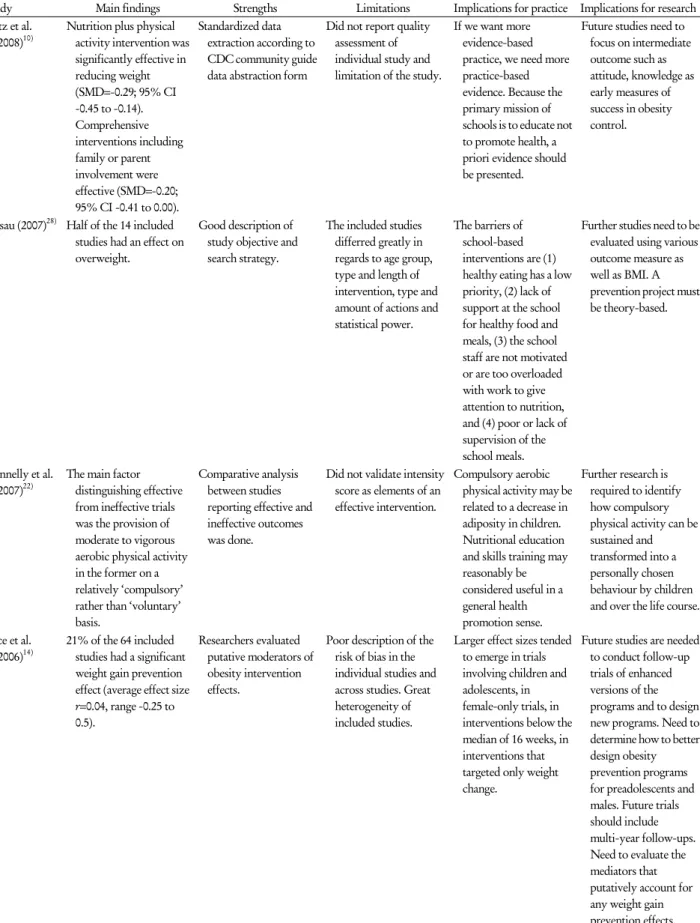
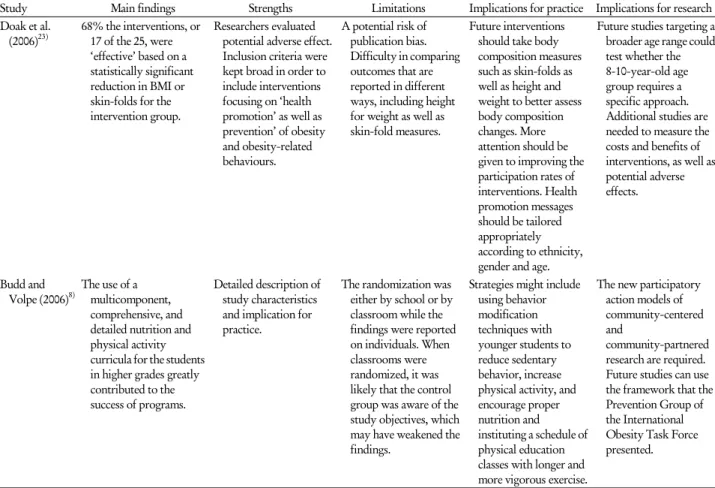
Table 2. Summary of the positive results of the systematic reviews or meta-analysis for childhood obesity prevention
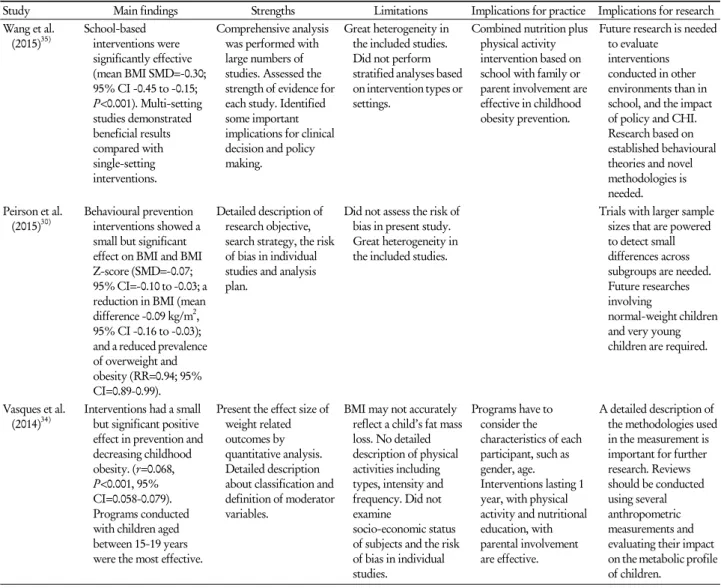
Study Main findings Strengths Limitations Implications for practice Implications for research Wang et al.(2015)35) School-based interventions were significantly effective (mean BMI SMD=-0.30;
95% CI -0.45 to -0.15;
P<0.001). Multi-setting studies demonstrated beneficial results compared with single-setting interventions.
Comprehensive analysis was performed with large numbers of studies. Assessed the strength of evidence for each study. Identified some important implications for clinical decision and policy making.
Great heterogeneity in the included studies.
Did not perform stratified analyses based on intervention types or settings.
Combined nutrition plus physical activity intervention based on school with family or parent involvement are effective in childhood obesity prevention.
Future research is needed to evaluate
interventions conducted in other environments than in school, and the impact of policy and CHI.
Research based on established behavioural theories and novel methodologies is needed.
Peirson et al.
(2015)30) Behavioural prevention interventions showed a small but significant effect on BMI and BMI Z-score (SMD=-0.07;
95% CI=-0.10 to -0.03; a reduction in BMI (mean difference -0.09 kg/m2, 95% CI -0.16 to -0.03);
and a reduced prevalence of overweight and obesity (RR=0.94; 95%
CI=0.89-0.99).
Detailed description of research objective, search strategy, the risk of bias in individual studies and analysis plan.
Did not assess the risk of bias in present study.
Great heterogeneity in the included studies.
Trials with larger sample sizes that are powered to detect small differences across subgroups are needed.
Future researches involving
normal-weight children and very young children are required.
Vasques et al.
(2014)34) Interventions had a small but significant positive effect in prevention and decreasing childhood obesity. (r=0.068, P<0.001, 95%
CI=0.058-0.079).
Programs conducted with children aged between 15-19 years were the most effective.
Present the effect size of weight related outcomes by quantitative analysis.
Detailed description about classification and definition of moderator variables.
BMI may not accurately reflect a child’s fat mass loss. No detailed description of physical activities including types, intensity and frequency. Did not examine
socio-economic status of subjects and the risk of bias in individual studies.
Programs have to consider the characteristics of each participant, such as gender, age.
Interventions lasting 1 year, with physical activity and nutritional education, with parental involvement are effective.
A detailed description of the methodologies used in the measurement is important for further research. Reviews should be conducted using several anthropometric measurements and evaluating their impact on the metabolic profile of children.
3. 개별 연구의 질 평가
AMSTAR를 이용하여 개별 연구의 질을 평가하였을 때 6편(17%)이 높은 질의 연구였고, 23편(66%)이 중등도의 질이었으며, 6편(17%)이 낮은 질이었다. 메타분석을 한 연 구는 체계적 종설에 비해 높은 질이 많고 낮은 질이 적었 다. 본 논문에 포함된 연구의 평균 PRISMA 점수는 21.4점 이었고, 최빈값 및 중앙값은 21점, 범위는 118)-27점25,32)이 었다. PRISMA 가이드라인이 발표된 2009년 이후에 출간 된 연구들의 PRISMA 점수가 높은 경향을 보였고 AMSTAR 를 이용한 연구의 질도 높았다.
4. 비만 예방 중재의 효과
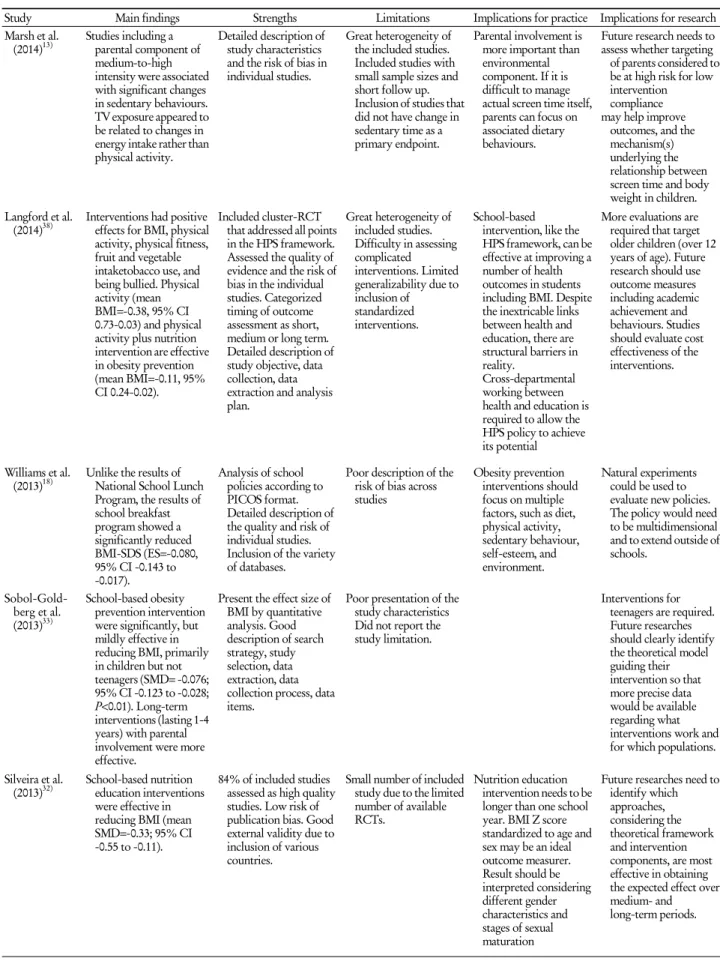
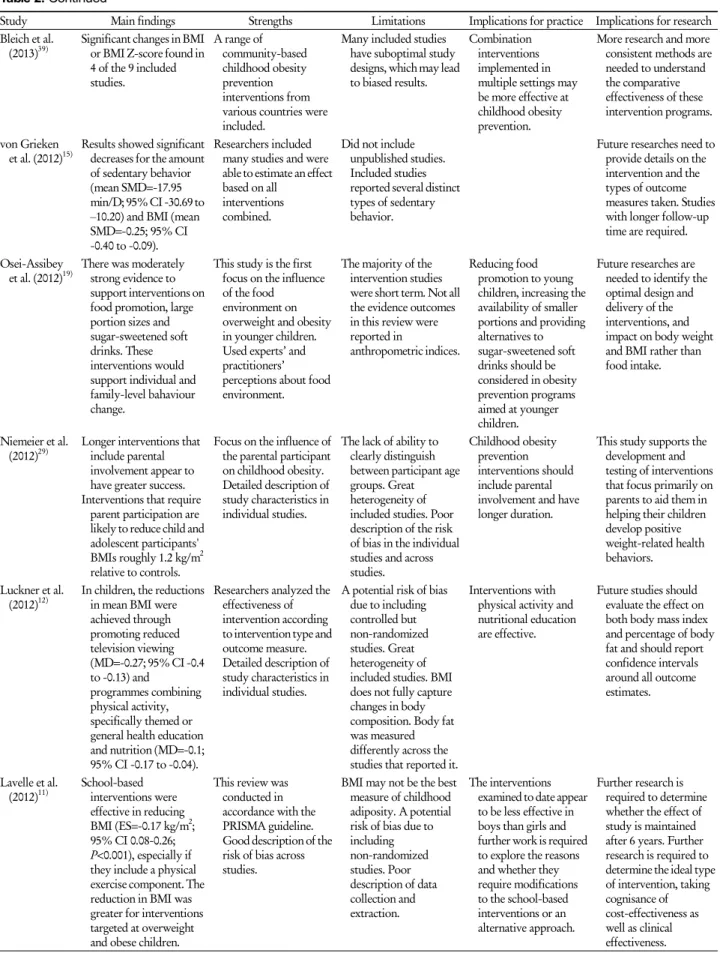
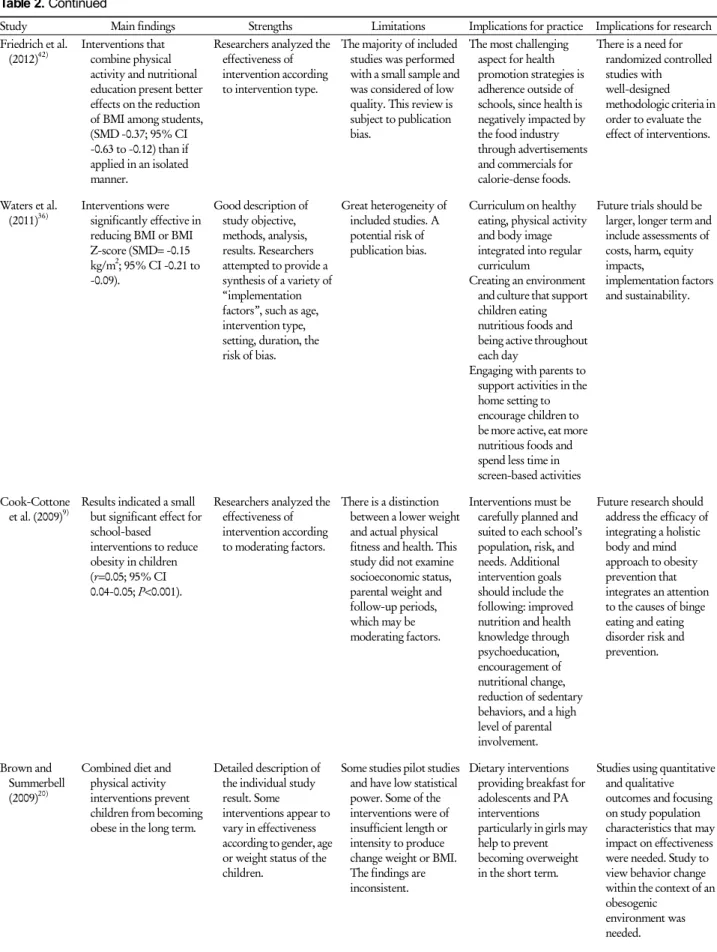
표 2와 3에서 각 논문에서 파악할 수 있는 효과적인 비만 예방 프로그램의 특징을 주요 결과, 연구의 장점 및 단점,
임상 및 연구에 적용할 점 등으로 구분하여 요약하였다. 35편의 논문 중 24편(69%)에서 소아청소년 비만 예방 중 재의 효과에 대해 긍정적으로 보고하였고 메타분석을 시행 한 21편 중 16편(76%)의 연구에서 BMI의 개선에 유의한 효과가 있다고 보고하였다. 가장 빈번하게 사용된 인체계 측 변수인 BMI의 standardized mean difference는 연구에 따라 다양하였으나 0.076에서 0.38로, BMI 감소 효과는 작 았다. BMI 외에도 좌식활동, 신체활동량, 체력, 채소 및 과 일섭취 등이 긍정적인 변화를 보였다. 인체계측 변수에 대 한 중재 효과는 부정적이었지만 중간변수인 채소 및 과일 섭취, 신체활동량, 좌식생활 등의 선행요인과 행동은 긍정 적인 변화를 보이는 연구가 있었다. 따라서 소아청소년에 대한 비만 중재는 비만의 선행요인과 비만 관련 행동 변화 에 효과적이고 대상 집단의 평균 BMI를 약간 감소시키는 효과가 있으나, 대상 집단의 비만 유병률을 감소시키는지 는 명확하지 않았다.
Table 2. Continued
Study Main findings Strengths Limitations Implications for practice Implications for research Marsh et al.
(2014)13) Studies including a parental component of medium-to-high intensity were associated with significant changes in sedentary behaviours.
TV exposure appeared to be related to changes in energy intake rather than physical activity.
Detailed description of study characteristics and the risk of bias in individual studies.
Great heterogeneity of the included studies.
Included studies with small sample sizes and short follow up.
Inclusion of studies that did not have change in sedentary time as a primary endpoint.
Parental involvement is more important than environmental component. If it is difficult to manage actual screen time itself, parents can focus on associated dietary behaviours.
Future research needs to assess whether targeting of parents considered to be at high risk for low intervention compliance may help improve
outcomes, and the mechanism(s) underlying the relationship between screen time and body weight in children.
Langford et al.
(2014)38) Interventions had positive effects for BMI, physical activity, physical fitness, fruit and vegetable intaketobacco use, and being bullied. Physical activity (mean BMI=-0.38, 95% CI 0.73-0.03) and physical activity plus nutrition intervention are effective in obesity prevention (mean BMI=-0.11, 95%
CI 0.24-0.02).
Included cluster-RCT that addressed all points in the HPS framework.
Assessed the quality of evidence and the risk of bias in the individual studies. Categorized timing of outcome assessment as short, medium or long term.
Detailed description of study objective, data collection, data extraction and analysis plan.
Great heterogeneity of included studies.
Difficulty in assessing complicated interventions. Limited generalizability due to inclusion of standardized interventions.
School-based intervention, like the HPS framework, can be effective at improving a number of health outcomes in students including BMI. Despite the inextricable links between health and education, there are structural barriers in reality.
Cross-departmental working between health and education is required to allow the HPS policy to achieve its potential
More evaluations are required that target older children (over 12 years of age). Future research should use outcome measures including academic achievement and behaviours. Studies should evaluate cost effectiveness of the interventions.
Williams et al.
(2013)18) Unlike the results of National School Lunch Program, the results of school breakfast program showed a significantly reduced BMI-SDS (ES=-0.080, 95% CI -0.143 to -0.017).
Analysis of school policies according to PICOS format.
Detailed description of the quality and risk of individual studies.
Inclusion of the variety of databases.
Poor description of the risk of bias across studies
Obesity prevention interventions should focus on multiple factors, such as diet, physical activity, sedentary behaviour, self-esteem, and environment.
Natural experiments could be used to evaluate new policies.
The policy would need to be multidimensional and to extend outside of schools.
Sobol-Gold- berg et al.
(2013)33)
School-based obesity prevention intervention were significantly, but mildly effective in reducing BMI, primarily in children but not teenagers (SMD= -0.076;
95% CI -0.123 to -0.028;
P<0.01). Long-term interventions (lasting 1-4 years) with parental involvement were more effective.
Present the effect size of BMI by quantitative analysis. Good description of search strategy, study selection, data extraction, data collection process, data items.
Poor presentation of the study characteristics Did not report the study limitation.
Interventions for teenagers are required.
Future researches should clearly identify the theoretical model guiding their intervention so that more precise data would be available regarding what interventions work and for which populations.
Silveira et al.
(2013)32) School-based nutrition education interventions were effective in reducing BMI (mean SMD=-0.33; 95% CI -0.55 to -0.11).
84% of included studies assessed as high quality studies. Low risk of publication bias. Good external validity due to inclusion of various countries.
Small number of included study due to the limited number of available RCTs.
Nutrition education intervention needs to be longer than one school year. BMI Z score standardized to age and sex may be an ideal outcome measurer.
Result should be interpreted considering different gender characteristics and stages of sexual maturation
Future researches need to identify which approaches, considering the theoretical framework and intervention components, are most effective in obtaining the expected effect over medium- and long-term periods.
Table 2. Continued
Study Main findings Strengths Limitations Implications for practice Implications for research Bleich et al.
(2013)39) Significant changes in BMI or BMI Z-score found in 4 of the 9 included studies.
A range of community-based childhood obesity prevention interventions from various countries were included.
Many included studies have suboptimal study designs, which may lead to biased results.
Combination interventions implemented in multiple settings may be more effective at childhood obesity prevention.
More research and more consistent methods are needed to understand the comparative effectiveness of these intervention programs.
von Grieken
et al. (2012)15) Results showed significant decreases for the amount of sedentary behavior (mean SMD=-17.95 min/D; 95% CI -30.69 to –10.20) and BMI (mean SMD=-0.25; 95% CI -0.40 to -0.09).
Researchers included many studies and were able to estimate an effect based on all
interventions combined.
Did not include unpublished studies.
Included studies reported several distinct types of sedentary behavior.
Future researches need to provide details on the intervention and the types of outcome measures taken. Studies with longer follow-up time are required.
Osei-Assibey
et al. (2012)19) There was moderately strong evidence to support interventions on food promotion, large portion sizes and sugar-sweetened soft drinks. These interventions would support individual and family-level bahaviour change.
This study is the first focus on the influence of the food
environment on overweight and obesity in younger children.
Used experts’ and practitioners’
perceptions about food environment.
The majority of the intervention studies were short term. Not all the evidence outcomes in this review were reported in
anthropometric indices.
Reducing food promotion to young children, increasing the availability of smaller portions and providing alternatives to sugar-sweetened soft drinks should be considered in obesity prevention programs aimed at younger children.
Future researches are needed to identify the optimal design and delivery of the interventions, and impact on body weight and BMI rather than food intake.
Niemeier et al.
(2012)29) Longer interventions that include parental involvement appear to have greater success.
Interventions that require parent participation are likely to reduce child and adolescent participants' BMIs roughly 1.2 kg/m2 relative to controls.
Focus on the influence of the parental participant on childhood obesity.
Detailed description of study characteristics in individual studies.
The lack of ability to clearly distinguish between participant age groups. Great heterogeneity of included studies. Poor description of the risk of bias in the individual studies and across studies.
Childhood obesity prevention interventions should include parental involvement and have longer duration.
This study supports the development and testing of interventions that focus primarily on parents to aid them in helping their children develop positive weight-related health behaviors.
Luckner et al.
(2012)12) In children, the reductions in mean BMI were achieved through promoting reduced television viewing (MD=-0.27; 95% CI -0.4 to -0.13) and
programmes combining physical activity, specifically themed or general health education and nutrition (MD=-0.1;
95% CI -0.17 to -0.04).
Researchers analyzed the effectiveness of intervention according to intervention type and outcome measure.
Detailed description of study characteristics in individual studies.
A potential risk of bias due to including controlled but non-randomized studies. Great heterogeneity of included studies. BMI does not fully capture changes in body composition. Body fat was measured differently across the studies that reported it.
Interventions with physical activity and nutritional education are effective.
Future studies should evaluate the effect on both body mass index and percentage of body fat and should report confidence intervals around all outcome estimates.
Lavelle et al.
(2012)11) School-based interventions were effective in reducing BMI (ES=-0.17 kg/m2; 95% CI 0.08-0.26;
P<0.001), especially if they include a physical exercise component. The reduction in BMI was greater for interventions targeted at overweight and obese children.
This review was conducted in accordance with the PRISMA guideline.
Good description of the risk of bias across studies.
BMI may not be the best measure of childhood adiposity. A potential risk of bias due to including non-randomized studies. Poor description of data collection and extraction.
The interventions examined to date appear to be less effective in boys than girls and further work is required to explore the reasons and whether they require modifications to the school-based interventions or an alternative approach.
Further research is required to determine whether the effect of study is maintained after 6 years. Further research is required to determine the ideal type of intervention, taking cognisance of cost-effectiveness as well as clinical effectiveness.
Table 2. Continued
Study Main findings Strengths Limitations Implications for practice Implications for research Friedrich et al.
(2012)42) Interventions that combine physical activity and nutritional education present better effects on the reduction of BMI among students, (SMD -0.37; 95% CI -0.63 to -0.12) than if applied in an isolated manner.
Researchers analyzed the effectiveness of intervention according to intervention type.
The majority of included studies was performed with a small sample and was considered of low quality. This review is subject to publication bias.
The most challenging aspect for health promotion strategies is adherence outside of schools, since health is negatively impacted by the food industry through advertisements and commercials for calorie-dense foods.
There is a need for randomized controlled studies with well-designed methodologic criteria in order to evaluate the effect of interventions.
Waters et al.
(2011)36) Interventions were significantly effective in reducing BMI or BMI Z-score (SMD= -0.15 kg/m2; 95% CI -0.21 to -0.09).
Good description of study objective, methods, analysis, results. Researchers attempted to provide a synthesis of a variety of
“implementation factors”, such as age, intervention type, setting, duration, the risk of bias.
Great heterogeneity of included studies. A potential risk of publication bias.
Curriculum on healthy eating, physical activity and body image integrated into regular curriculum
Creating an environment and culture that support children eating nutritious foods and being active throughout each day
Engaging with parents to support activities in the home setting to encourage children to be more active, eat more nutritious foods and spend less time in screen-based activities
Future trials should be larger, longer term and include assessments of costs, harm, equity impacts,
implementation factors and sustainability.
Cook-Cottone
et al. (2009)9) Results indicated a small but significant effect for school-based
interventions to reduce obesity in children (r=0.05; 95% CI 0.04-0.05; P<0.001).
Researchers analyzed the effectiveness of intervention according to moderating factors.
There is a distinction between a lower weight and actual physical fitness and health. This study did not examine socioeconomic status, parental weight and follow-up periods, which may be moderating factors.
Interventions must be carefully planned and suited to each school’s population, risk, and needs. Additional intervention goals should include the following: improved nutrition and health knowledge through psychoeducation, encouragement of nutritional change, reduction of sedentary behaviors, and a high level of parental involvement.
Future research should address the efficacy of integrating a holistic body and mind approach to obesity prevention that integrates an attention to the causes of binge eating and eating disorder risk and prevention.
Brown and Summerbell (2009)20)
Combined diet and physical activity interventions prevent children from becoming obese in the long term.
Detailed description of the individual study result. Some interventions appear to vary in effectiveness according to gender, age or weight status of the children.
Some studies pilot studies and have low statistical power. Some of the interventions were of insufficient length or intensity to produce change weight or BMI.
The findings are inconsistent.
Dietary interventions providing breakfast for adolescents and PA interventions particularly in girls may help to prevent becoming overweight in the short term.
Studies using quantitative and qualitative outcomes and focusing on study population characteristics that may impact on effectiveness were needed. Study to view behavior change within the context of an obesogenic
environment was needed.