Luming Nong et al.
964 Asian Spine J 2016;10(5):964-971
Vitamin D Receptor Gene, Matrix
Metalloproteinase 3 Polymorphisms and the Risk of Intervertebral Disc Degeneration
Susceptibility: Meta-Analysis
Luming Nong, Yongjing Huang, Shujie Zhao, Nanwei Xu
Department of Orthopedics, Changzhou Second Hospital, Nanjing Medical University, Changzhou, China
Several studies have evaluated the association between vitamin D receptor, matrix metalloproteinase 3 (MMP-3) polymorphisms and the risk of intervertebral disc degeneration susceptibility. The findings were inconsistent. This meta-analysis aimed to systematically assess the association between vitamin D receptor, MMP-3 polymorphisms and the risk of intervertebral disc degeneration suscep- tibility. A search of various databases was done covering all papers published until December 31th, 2014. Eight, 4, 3 studies were finally included that addressed the risk of intervertebral disc degeneration susceptibility and vitamin D receptor FokI (rs2228570), ApaI (rs7975232), and MMP-3 (rs731236) polymorphisms, respectively. FokI (f vs. F: summary odds ratio [OR], 1.13; 95% confidence interval [CI], 0.76–1.69; ff vs. FF: OR, 1.02; 95% CI, 0.59–1.77; ff vs. Ff/FF: OR, 1.05; 95% CI, 0.70–1.58), ApaI (a vs. A: OR, 0.73; 95%
CI, 0.45–1.19; aa vs. AA: OR, 0.53; 95% CI, 0.22–1.25 p=0.14; aa vs. AA/Aa: OR, 0.69; 95% CI, 0.53–0.89) in the vitamin D receptor gene and MMP3 polymorphisms (5A vs. 6A: OR, 1.92; 95% CI, 0.77–4.80; 5A5A vs. 6A6A: OR, 2.17; 95% CI, 0.75–6.24; 5A5A vs.
5A6A/6A6A: OR, 1.58; 95% CI, 0.72–3.44) were not obviously associated with risk of intervertebral disc degeneration susceptibility.
FokI, ApaI polymorphisms in the vitamin D receptor gene and MMP-3 polymorphism are not obvious risk factors for intervertebral disc degeneration susceptibility.
Keywords: Vitamin D receptor; Matrix metalloproteinase-3; Polymorphism; Meta-analysis
Copyright Ⓒ 2016 by Korean Society of Spine Surgery
This is an Open Access article distributed under the terms of the Creative Commons Attribution Non-Commercial License (http://creativecommons.org/licenses/by-nc/3.0/) which permits unrestricted non-commercial use, distribution, and reproduction in any medium, provided the original work is properly cited.
Asian Spine Journal • pISSN 1976-1902 eISSN 1976-7846 • www.asianspinejournal.org
Received Nov 23, 2015; Revised Jan 16, 2016; Accepted Jan 19, 2016 Corresponding author: Luming Nong
Department of Orthopedics, Changzhou Second Hospital, Nanjing Medical University, No.137 of Beida Street of Changzhou City, Jinagsu Province, China Changzhou 213000 China E-mail: [email protected]
ASJ A SJ
Review Article Asian Spine J 2016;10(5):964-971 • https://doi.org/10.4184/asj.2016.10.5.964
Introduction
Low back pain (LBP) is universally seen in orthopedic practices. It is one of the most influential factors affecting quality of life and exacts a significant social and economic impact worldwide. It is estimated that 50%–80% adults will experience at least one episode of back pain during their lifetime. The etiology of LBP is still not fully under- stood, although intervertebral disc degeneration (IDD) is
believed to be a major cause [1,2].
IDD has both genetic and environmental origins. En- vironmental factors include body weight, mechanical loading, physical activities and smoking may also have a role in the development of IDD. Epidemiological studies on families and twins have provided evidence that inheri- tance is the major determinant of IDD susceptibility [3,4].
Genes associated with degenerative disc disease in human include genes coding for vitamin D receptor (VDR); matrix
metalloproteinase 3 (MMP-3); collagens I, IX, and XI;
interleukin-1; aggrecan and other proteins [5].
VDR is an important factor in bone metabolism and development. Vitamin D facilitates the intestinal absorp- tion of calcium through the activated VDR, stimulates renal production of 1, 25-(OH)2-vitamin D3 and influ- ences osteoblasts, osteoclasts, and secretion of parathy- roid hormone [4]. The 100 kb VDR gene is located on human chromosome 12 (12q12–q14), and has more than 100 restriction endonuclease cutting site polymorphisms [4,6]. Select polymorphic sites that have been studied to assess the association between VDR gene polymorphism and risk of IDD susceptibility include FokI (rs2228570) and ApaI (rs7975232) restriction sites [4,7-12]. However, results have been contradictory conclusions; some stud- ies suggested an association of VDR gene polymorphism with the risk of IDD susceptibility [4,10], while others did not [8,9,12].
MMP-3 mediates disc degeneration by degrading ma- trix proteoglycans and collagens. The common MMP-3 gene polymorphism is 5A/6A (rs72520913). The polymor- phism occurs in the promoter region of the human MMP- 3 gene; one allele has a run of six adenosines (6A) and the other allele has a run of five (5A) [6,13,14]. Several recent studies that assessed the association between MMP-3 (rs731236) polymorphism and the risk of IDD suscep- tibility provided equivocal findings with an association evident in several studies [14-16]but not in another [17].
To provide more clarity, we conducted a meta-analysis.
Materials and Methods
1. Literature and Search Strategy
Searches of PubMed, Web of Science, China National Knowledge Infrastructure (CNKI) and WangFang da- tabases were done without language or publication year limitation. The last search was updated on December 31, 2014. Search terms were “vitamin D receptor’’ or “VDR’’
or ‘‘matrix metalloproteinase-3’’ or “MMP-3”, and ‘‘poly- morphisms’’ and either “intervertebral disc degeneration”
or “IDD”. The reference lists of review articles, clinical tri- als, and meta-analysis were also screened manually.
2. Inclusion and Exclusion criteria
Inclusion criteria for articles were: (1) evaluation of the
associations between VDR (FokI or ApaI) polymorphisms or MMP-3 polymorphism and the risk of IDD susceptibil- ity; (2) case-control design; (3) sufficient data for cases and controls and (4) allele distributions met Hardy–Weinberg equilibrium (HWE). The exclusion criteria were: (1) not a case-control study, (2) unavailable genotype frequency and (3) duplication of previous publication. Two investigators carefully and independently reviewed all identified studies to determine whether an individual study was eligible for inclusion in this meta-analysis.
3. Data extraction
Data were extracted independently by both two investi- gators (Y.J.H. and S.J.Z.) using a pre-designed form that contained: (1) name of the first author, (2) year of publica- tion, (3) number of genotypes in cases and controls, (4) country of origin and ethnicity of the study population, (5) source of control subjects, (6) numbers of cases and controls and (7) gender and age of enrolled subjects. Any disagreement was resolved by consensus.
4. Methodological quality assessment
The Newcastle-Ottawa Scale (NOS), which is one of the most useful tool for assessing methodological quality of non-randomized studies, was used to assess the risk of bias in the included non-randomized studies. “Selection”
(4 items), “comparability” (1 item), “exposure” (3 items) were evaluated, and each “high” quality choice was award- ed a “star”.
5. Statistical Analyses
Review Manger 5.0 software was used for data analysis.
For each study, the odds ratios (ORs) and 95% confidence intervals (CIs) were used to evaluate the association. Het- erogeneity was estimated by the I² statistic. If the value of I²>50%, the Mantel-Haenszel random-effects model (REM) was used, the source of heterogeneity was inves- tigated by a subgroup analysis and a sensitivity analysis.
Alternately, the fixed-effects model (FEM) was used to es- timate the pooled OR. Subgroup analysis was performed according to different ethnicity or age. The sensitivity analysis was performed by rejecting each article with high statistical heterogeneity [18]. A p<0.05 was defined as sta- tistically significant.
Results
1. Characteristics of studies
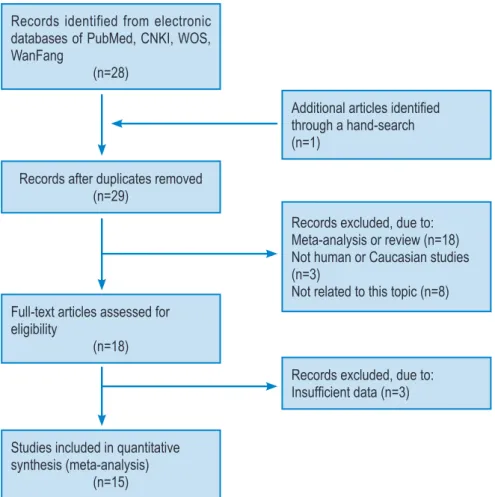
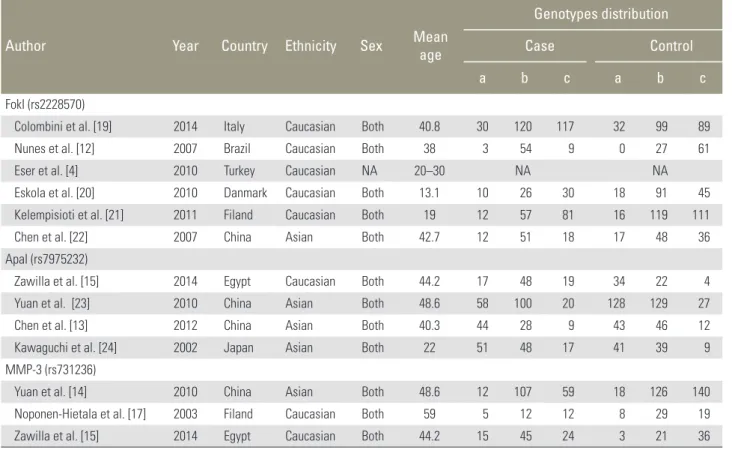
Fig. 1 presents the search results. Fifteen studies were identified involving the association between the risk of IDD susceptibility and VDR FokI (n=8), ApaI (n=4), and MMP-3 (n=3) polymorphisms. Asian populations were assessed concerning VDR FokI polymorphism in 2 studies and ApaI polymorphism in one study. The re- maining studies recruited Caucasians. For the 3 studies that assessed MMP-3 polymorphism, 2 studies evaluated Caucasians and Asians. All subjects included in the stud- ies had blood drawn for DNA extraction. One study used computed tomography (CT) for the detection of IDD [15], with magnetic resonance imaging (MRI) used in other studies. VDR FokI and ApaI polymorphism genotype distribution in control groups were in HWE [18]. The detailed characteristics of the included studies are sum- marized in Table 1.
2. Methodological quality assessment of included studies The results of the study types and NOS assessments are provided in Table 2. All of the studies were case-control studies. A range of 5–7 stars was gained by NOS, indicat- ing median to high methodological quality of the included studies.
3. Meta-analysis results
Eleven studies reported the association between the VDR (FokI, ApaI) polymorphisms and the risk of IDD suscepti- bility. Characteristics of the individual studies are summa- rized in Table 1. In the pooled analysis for the association between VDR FokI polymorphism and the risk of IDD susceptibility, the I² was 86%; the significant heterogeneity was assessed and found not to be a concern, so a random- effect approach was used to estimate ORs and CIs. No significant association between VDR FokI polymorphism and the risk of IDD susceptibility was evident (Table 3)
Records identified from electronic databases of PubMed, CNKI, WOS, WanFang
(n=28)
Records after duplicates removed (n=29)
Full-text articles assessed for eligibility
(n=18)
Additional articles identified through a hand-search (n=1)
Records excluded, due to:
Meta-analysis or review (n=18) Not human or Caucasian studies (n=3)
Not related to this topic (n=8)
Records excluded, due to:
Insufficient data (n=3)
Fig. 1. Flow chart of study selection based on the inclusion and exclusion criteria. CNKI, China Na- tional Knowledge Infrastructure; WOS, Web of Science.
Studies included in quantitative synthesis (meta-analysis)
(n=15)
(f vs. F: OR, 1.13; 95% CI, 0.76–1.69; p=0.55; ff vs. FF: OR, 1.02; 95% CI, 0.59–1.77, p=0.93; ff vs. Ff/FF: OR, 1.05;
95% CI, 0.70–1.58; p=0.81). Subgroup analysis stratified
by ethnicity and age also confirmed the above results, with no significant association evident in Caucasians (f vs. F: OR, 1.12; 95% CI, 0.70–1.78, p=0.64) or Asians Table 2. Methodological quality assessment of included studies
Studies Country Research type Newcastle-Ottawa scale
Selection Comparability Exposure
Colombini et al. [19] Italy Case-control ★★★★ ★☆ ★☆☆
Nunes et al. [12] Brazil Case-control ★★★★ ☆☆ ★☆☆
Eser et al. [4] Turkey Case-control ★★★★ ★☆ ★☆☆
Eskola et al. [20] Danmark Case-control ★★★★ ★☆ ★☆☆
Kelempisioti et al. [21] Filand Case-control ★★★★ ☆☆ ★☆☆
Chen et al. [22] China Case-control ★★★★ ★☆ ★☆☆
Zawilla et al. [15] Egypt Case-control ★★★★ ★★ ★☆☆
Yuan et al. [14] China Case-control ★★★★ ★☆ ★☆☆
Chen et al. [13] China Case-control ★★★★ ★☆ ★☆☆
Kawaguchi et al. [24] Japan Case-control ★★★★ ★☆ ★☆☆
Noponen-Hiet et al. [17] Filand Case-control ★★★★ ☆☆ ★☆☆
Table 1. Characteristics of individual studies for associations between VDR, MMP-3 polymorphisms and IDD risks
Author Year Country Ethnicity Sex Mean
age
Genotypes distribution
Case Control
a b c a b c
FokI (rs2228570)
Colombini et al. [19] 2014 Italy Caucasian Both 40.8 30 120 117 32 99 89
Nunes et al. [12] 2007 Brazil Caucasian Both 38 3 54 9 0 27 61
Eser et al. [4] 2010 Turkey Caucasian NA 20–30 NA NA
Eskola et al. [20] 2010 Danmark Caucasian Both 13.1 10 26 30 18 91 45
Kelempisioti et al. [21] 2011 Filand Caucasian Both 19 12 57 81 16 119 111
Chen et al. [22] 2007 China Asian Both 42.7 12 51 18 17 48 36
ApaI (rs7975232)
Zawilla et al. [15] 2014 Egypt Caucasian Both 44.2 17 48 19 34 22 4
Yuan et al. [23] 2010 China Asian Both 48.6 58 100 20 128 129 27
Chen et al. [13] 2012 China Asian Both 40.3 44 28 9 43 46 12
Kawaguchi et al. [24] 2002 Japan Asian Both 22 51 48 17 41 39 9
MMP-3 (rs731236)
Yuan et al. [14] 2010 China Asian Both 48.6 12 107 59 18 126 140
Noponen-Hietala et al. [17] 2003 Filand Caucasian Both 59 5 12 12 8 29 19
Zawilla et al. [15] 2014 Egypt Caucasian Both 44.2 15 45 24 3 21 36
a, b, c, represent ff, Ff, FF for FokI (rs2228570), aa, Aa, AA, for ApaI (rs7975232), and 5A5A, 6A5A, 6A6A for MMP-3 (rs731236), respectively.
VDR, vitamin D receptor; MMP-3, matrix metalloproteinase-3; IDD, intervertebral disc degeneration; NA, not available.
(f vs. F: OR, 1.26; 95% CI, 0.83–1.92). No associations were evident with age ≥40 years (f vs. F: OR, 0.95; 95% CI, 0.68–1.33; p=0.77) or age <40 years (f vs. F: OR, 1.40; 95%
CI, 0.52–3.76; p=0.50). Sensitivity analysis was performed by the sequential removal of the studies; no one study in- fluenced the results significantly.
ORs and CIs results were also estimated using a ran- dom-effect approach owing to the significant heterogene- ity (I²=83%). The pooled results indicated no association between VDR Apal polymorphism and the risk of IDD susceptibility too (Table 3) (a vs. A: OR, 0.73; 95% CI, 0.45–1.19, p=0.21; aa vs. AA: OR, 0.53; 95% CI, 0.22–1.25, p=0.14; aa vs. AA/Aa: OR, 0.69; 95% CI, 0.53–0.89, p=0.04). The sensitivity analysis confirmed the above con- clusion. As limited studies were included for the investiga- tion, subgroup analysis could not be performed.
Results of the association between MMP-3 polymor- phism and the risk of IDD susceptibility are presented in Table 2. No significant association was evident (5A vs. 6A:
OR, 1.57; 95% CI, 0.93–2.68, p=0.09; 5A5A vs. 6A6A: OR, 2.17; 95% CI, 0.75–6.24; p=0.15; 5A5A vs. 5A6A/6A6A:
OR, 1.58; 95% CI, 0.72–3.44; p=0.15). Sensitivity analysis suggested that no individual study significantly affected the overall OR. We did not perform subgroup analysis be- cause the sample size was too small.
4. Publication bias
Publication bias was not established. It was not suitable to do so because the number of included studies for each gene polymorphism was less than 10.
Discussion
IDD is a multifactorial and chronic process that alters the structure and function of intervertebral discs, which is a common multifactorial and multigenic disease [20,23]. The association between gene polymorphism and the etiology of IDD has become a hot research field in recent years.
This will bring positive significance for the prevention and treatment of IDD. Some studies have reported at least 14 genes including the VDR and MMP-3 gene that Table 3. Summary of ORs for various genetic contrasts on the associations between VDR, MMP-3 polymorphisms and the risks of IDD
Sub-group Test of association Test of heterogenecity
OR CI Statistical model I² (%) p-value FokI (rs2228570)
Caucasian 1.12 0.70–1.78 REM 88.0 0.65
Asian 1.26 0.83–1.92 FEM 0.0 0.28
≥0.4 0.95 0.68–1.33 REM 63.0 0.77
<0.4 1.40 0.52–3.76 REM 94.0 0.5
FokI (rs2228570)
f vs. F 1.13 0.76–1.69 REM 86.0 0.55
ff vs. FF 1.02 0.59–1.77 REM 56.0 0.93
ff vs. Ff/FF 1.05 0.70–1.58 REM 55.0 0.81
ApaI (rs7975232)
a vs. A 0.73 0.45–1.19 REM 83.0 0.21
aa vs. AA 0.53 0.22–1.25 REM 72.0 0.14
aa vs. AA/Aa 0.69 0.53–0.89 REM 86.0 0.004
MMP-3 (rs731236)
5A vs. 6A 1.57 0.93–2.68 REM 73.0 0.09
5A5A vs. 6A6A, 2.17 0.75–6.24 REM 61.0 0.15
5A5A vs. 6A5A/6A6A 1.58 0.72–3.44 REM 39.0 0.15
OR, odds ratio; VDR, vitamin D receptor; MMP-3, matrix metalloproteinase-3; IDD, intervertebral disc degeneration; CI, confidence interval; REM, random-effects model; FEM, fixed-effects model.
may have more important influence on the susceptibility of IDD [22,24,25]. The association between VDR gene polymorphism and IDD susceptibility has been validated in large populations of diverse ethnic backgrounds. The association between MMP-3 polymorphism and IDD susceptibility has been a hot topic in recent years, with no consensus reached. To provide clarity, we undertook the present meta-analysis.
VDR is a steroid nuclear receptor, which participates in normal bone mineralization and remodeling. The
association between VDR polymorphisms and the risk of IDD susceptibility has been investigated for long time.
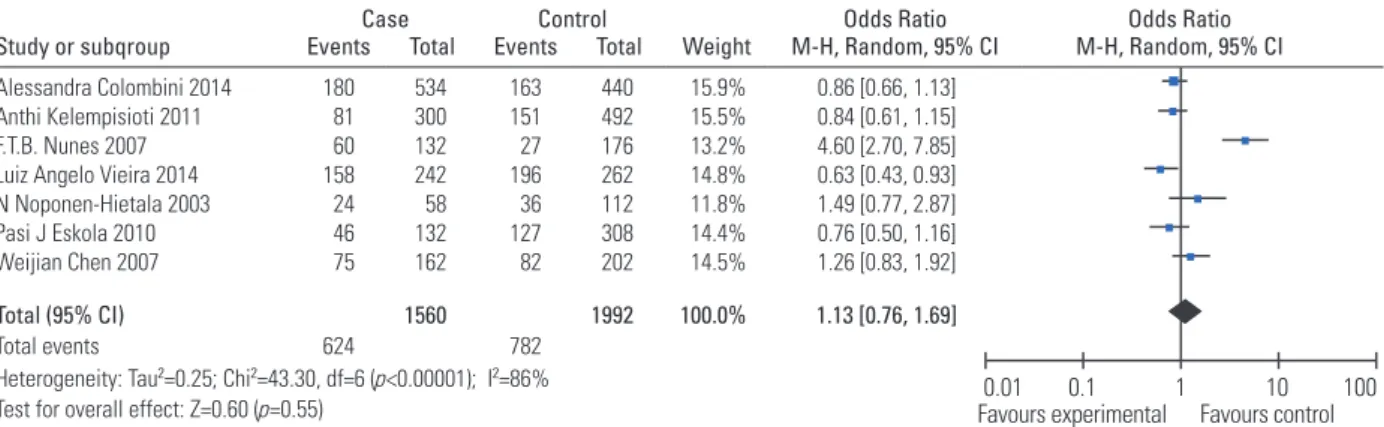
FokI (rs2228570) and ApaI (rs7975232) are two poly- morphic sites of VDR gene involved the risk of IDD sus- ceptibility. To our knowledge, only one meta-analysis has been performed, with no significant association evident between VDR polymorphism and the risk of IDD sus- ceptibility [26]. We reached the same conclusion (Figs. 2, 3). Subgroup analysis stratified by ethnicity and age also confirmed the result. Most of the included studies did
Case Control Odds Ratio Odds Ratio
Study or subqroup Events Total Events Total Weight M-H, Random, 95% CI M-H, Random, 95% CI
Alessandra Colombini 2014 180 534 163 440 15.9% 0.86 [0.66, 1.13]
Anthi Kelempisioti 2011 81 300 151 492 15.5% 0.84 [0.61, 1.15]
F.T.B. Nunes 2007 60 132 27 176 13.2% 4.60 [2.70, 7.85]
Luiz Angelo Vieira 2014 158 242 196 262 14.8% 0.63 [0.43, 0.93]
N Noponen-Hietala 2003 24 58 36 112 11.8% 1.49 [0.77, 2.87]
Pasi J Eskola 2010 46 132 127 308 14.4% 0.76 [0.50, 1.16]
Weijian Chen 2007 75 162 82 202 14.5% 1.26 [0.83, 1.92]
Total (95% CI) 1560 1992 100.0% 1.13 [0.76, 1.69]
Total events 624 782
Heterogeneity: Tau²=0.25; Chi²=43.30, df=6 (p<0.00001); I²=86%
Test for overall effect: Z=0.60 (p=0.55)
Fig. 2. Meta-analysis for VDR FokI (rs2228570) polymorphism and the risk of IDD (f vs. F). VDR, vitamin D receptor; IDD, intervertebral disc degeneration; M-H, Mantel-Haenszel; CI, confidence interval.
0.01 0.1 1 10 100 Favours experimental Favours control
Case Control Odds Ratio Odds Ratio
Study or subqroup Events Total Events Total Weight M-H, Random, 95% CI M-H, Random, 95% CI
Weijian Chen 2012 116 162 132 202 24.3% 1.34 [0.85, 2.09]
Yoshiharu Kawaguchi 2002 150 232 121 178 25.0% 0.86 [0.57, 1.30]
Yuan Han-yan 2010 216 356 385 568 27.8% 0.73 [0.56, 0.97]
Zawilla, N.H. 2014 82 168 90 120 22.8% 0.32 [0.19, 0.53]
Total (95% CI) 918 1068 100.0% 0.73 [0.45, 1.19]
Total events 564 728
Heterogeneity: Tau²=0.20; Chi²=17.66, df=3 (p=0.0005); I²=83%
Test for overall effect: Z=1.27 (p=0.21) 0.01 0.1 1 10 100 Favours experimental Favours control Fig. 3. Meta-analysis for VDR ApaI (rs7975232) polymorphism and the risk of IDD susceptibility (a vs. A). VDR, vitamin D receptor; IDD, inter- vertebral disc degeneration; M-H, Mantel-Haenszel; CI, confidence interval.
Case Control Odds Ratio Odds Ratio
Study or subqroup Events Total Events Total Weight M-H, Random, 95% CI M-H, Random, 95% CI
Hanyan-Yuan 2010 131 356 162 568 40.9% 1.46 [1.10, 1.93]
N Noponen-Hietala 2003 22 58 45 112 27.3% 0.91 [0.47, 1.74]
Zawilla, N.H. 2014 75 168 27 120 31.8% 2.78 [1.64, 4.70]
Total (95% CI) 582 800 100.0% 1.57 [0.93, 2.68]
Total events 228 234
Heterogeneity: Tau²=0.16; Chi²=7.48, df=2 (p=0.02); I²=73%
Test for overall effect: Z=1.68 (p=0.09)
Fig. 4. Meta-analysis for MMP-3 (rs731236) polymorphism and the risk of IDD susceptibility (5A vs. 6A). MMP-3, matrix metalloproteinase-3;
IDD, intervertebral disc degeneration; M-H, Mantel-Haenszel; CI, confidence interval.
0.01 0.1 1 10 100 Favours experimental Favours control
not eliminate non-genetic risk factors including obesity, smoking and heavy physical occupations, so it remains possible that a potential association was obscured by some environmental factors. Moreover, VDR polymorphisms have been reported to be significantly associated with the multilevel and severe forms of IDD [13,27]. Therefore, a conclusion still cannot be made and a large-scale and long-term study is still needed.
MMP-3 is a key enzyme that directly degrades compo- nents of the extracellular matrix including proteoglycans, laminin, fibronectin, gelatins and collagens. MMP-3 also indirectly affects degradation of the extracellular matrix by activating other latent MMPs [19,28]. This is the first meta-analysis addressing the association between MMP- 3 gene polymorphism and the risk of IDD susceptibility.
The collective results (Fig. 4) indicate no significant as- sociation. Sensitivity analysis revealed that no single study significantly influence the pooled effect. The association between MMP-3 gene polymorphism and the susceptibil- ity of IDD could not be easily excluded since only 3 re- lated studies were included in this meta-analysis; further studies were warranted for a reliable result in the future.
The meta-analysis has been recognized as an effective method to resolve a wide variety of clinical questions by summarizing and reviewing the previously published quantitative research. Still, there are several potential limi- tations of current meta-analysis. Firstly, this meta-analysis was based on unadjusted effect estimates, so a more pre- cise analysis should be conducted if individual data were available. Secondly, IDD is a multifactor disease deter- mined by the synthetic effect of environment and gene, interactions between genes and between genes and the environment and even between different polymorphic loci of the same gene. These interactions may mask or magnify the function of the involved genes. Thirdly, there are methodological limitations. Although all the included studies were case–control designed, not all controls in the studies were age or sex matched, which may have been a cause of the pronounced heterogeneity in this analysis.
The age range (teenager to aged may have been another confounding factor. Finally, the different imaging modali- ties (CT and MRI) used for the detection of IDD may have been confounding.
Conclusions
In summary, the current meta-analysis comprehensively
reviewed the association between VDR (FokI, ApaI) and MMP-3 polymorphisms and the risk of IDD susceptibil- ity. None of the polymorphisms were significantly associ- ated with the risk of IDD susceptibility. Since potential confounders could not be ruled out completely, further well-designed large studies particularly referring to gene- gene and gene-environment interactions are warranted.
Conflict of Interest
No potential conflict of interest relevant to this article was reported.
References
1. Virtanen IM, Karppinen J, Taimela S, et al. Occupa- tional and genetic risk factors associated with inter- vertebral disc disease. Spine (Phila Pa 1976) 2007;
32:1129-34.
2. Rubin DI. Epidemiology and risk factors for spine pain. Neurol Clin 2007;25:353-71.
3. Battie MC, Videman T, Gibbons LE, Fisher LD, Man- ninen H, Gill K. 1995 Volvo Award in clinical sci- ences. Determinants of lumbar disc degeneration:
a study relating lifetime exposures and magnetic resonance imaging findings in identical twins. Spine (Phila Pa 1976) 1995;20:2601-12.
4. Eser B, Cora T, Eser O, et al. Association of the polymorphisms of vitamin D receptor and aggrecan genes with degenerative disc disease. Genet Test Mol Biomarkers 2010;14:313-7.
5. Chan D, Song Y, Sham P, Cheung KM. Genetics of disc degeneration. Eur Spine J 2006;15 Suppl 3:S317- 25.
6. Cheung KM, Chan D, Karppinen J, et al. Associa- tion of the Taq I allele in vitamin D receptor with degenerative disc disease and disc bulge in a Chinese population. Spine (Phila Pa 1976) 2006;31:1143-8.
7. Sambrook PN, MacGregor AJ, Spector TD. Genetic influences on cervical and lumbar disc degeneration:
a magnetic resonance imaging study in twins. Arthri- tis Rheum 1999;42:366-72.
8. Kalb S, Martirosyan NL, Kalani MY, Broc GG, Theo- dore N. Genetics of the degenerated intervertebral disc. World Neurosurg 2012;77:491-501.
9. Videman T, Leppavuori J, Kaprio J, et al. Intragenic polymorphisms of the vitamin D receptor gene as-
sociated with intervertebral disc degeneration. Spine (Phila Pa 1976) 1998;23:2477-85.
10. Mayer JE, Iatridis JC, Chan D, Qureshi SA, Gottes- man O, Hecht AC. Genetic polymorphisms associ- ated with intervertebral disc degeneration. Spine J 2013;13:299-317.
11. Uitterlinden AG, Fang Y, Van Meurs JB, Pols HA, Van Leeuwen JP. Genetics and biology of vitamin D receptor polymorphisms. Gene 2004;338:143-56.
12. Nunes FT, Conforti-Frose ND, Negrell WF, Souza DR. Genetic and environmental factors involved on intervertebral disc degeneration. Acta Ortop Bras 2007;15:9-13.
13. Chen W, Li G, Sun H, et al. Association of vitamin D receptor gene polymorphism in Han people with lumbar degenerative disc disease. Afr J Pharm Phar- macol 2012;6:1211-5.
14. Yuan HY, Tang Y, Liang YX, et al. Matrix metallopro- teinase-3 and vitamin d receptor genetic polymor- phisms, and their interactions with occupational ex- posure in lumbar disc degeneration. J Occup Health 2010;52:23-30.
15. Zawilla NH, Darweesh H, Mansour N, et al. Matrix metalloproteinase-3, vitamin D receptor gene poly- morphisms, and occupational risk factors in lumbar disc degeneration. J Occup Rehabil 2014;24:370-81.
16. Tang Y, Yuan HY, Wang ZP, Xu JG, Lei L. The genetic polymorphisms of MMP-3 and VDR on susceptibil- ity of lumbar disc degeneration. Fudan Univ J Med Sci 2007;34:37-41.
17. Noponen-Hietala N, Kyllonen E, Mannikko M, et al.
Sequence variations in the collagen IX and XI genes are associated with degenerative lumbar spinal steno- sis. Ann Rheum Dis 2003;62:1208-14.
18. Higgins JP, Thompson SG. Quantifying heterogeneity in a meta-analysis. Stat Med 2002;21:1539-58.
19. Colombini A, Brayda-Bruno M, Lombardi G, et al.
FokI polymorphism in the vitamin D receptor gene (VDR) and its association with lumbar spine pathol- ogies in the Italian population: a case-control study.
PLoS One 2014;9:e97027.
20. Eskola PJ, Kjaer P, Sorensen JS, et al. Gender differ- ence in genetic association between IL1A variant and early lumbar disc degeneration: a three-year follow- up. Int J Mol Epidemiol Genet 2012;3:195-204.
21. Kelempisioti A, Eskola PJ, Okuloff A, et al. Genetic susceptibility of intervertebral disc degeneration among young Finnish adults. BMC Med Genet 2011;
12:153.
22. Chen WJ, Ye W, Ding Y, et al. Association of vitamin D receptor gene TruI and FokI polymorphisms with lumbar degenerative disc disease in Han nationality orthopedic. J China 2007;15:373-5.
23. Yuan HY, Tang Y, Lei L, et al. Synergistic interaction between MMP-3, VDR gene polymorphisms and oc- cupational risk factors on lumbar disc degeneration.
Zhonghua Lao Dong Wei Sheng Zhi Ye Bing Za Zhi 2010;28:334-8.
24. Kawaguchi Y, Kanamori M, Ishihara H, Ohmori K, Matsui H, Kimura T. The association of lumbar disc disease with vitamin-D receptor gene polymorphism.
J Bone Joint Surg Am 2002;84:2022-8.
25. Jones G, White C, Sambrook P, Eisman J. Allelic variation in the vitamin D receptor, lifestyle factors and lumbar spinal degenerative disease. Ann Rheum Dis 1998;57:94-9.
26. Xu G, Mei Q, Zhou D, Wu J, Han L. Vitamin D re- ceptor gene and aggrecan gene polymorphisms and the risk of intervertebral disc degeneration:a meta- analysis. PLoS One 2012;7:e50243.
27. Balmain N, Hauchecorne M, Pike JW, Cuisinier- Gleizes P, Mathieu H. Distribution and subcellular immunolocalization of 1,25-dihydroxyvitamin D3 receptors in rat epiphyseal cartilage. Cell Mol Biol (Noisy-le-grand) 1993;39:339-50.
28. Takahashi M, Haro H, Wakabayashi Y, Kawa-uchi T, Komori H, Shinomiya K. The association of degen- eration of the intervertebral disc with 5a/6a polymor- phism in the promoter of the human matrix metallo- proteinase-3 gene. J Bone Joint Surg Br 2001;83:491- 5.