151 ORIGINAL ARTICLE
DOI 10.4070 / kcj.2009.39.4.151
Print ISSN 1738-5520 / On-line ISSN 1738-5555 Copyright ⓒ 2009 The Korean Society of Cardiology
Losartan/Hydrochlorothiazide Fixed Combination Versus Amlodipine Monotherapy in Korean Patients With Mild to Moderate Hypertension
Jin-Wook Chung, MD1, Hae-Young Lee, MD1, Cheol-Ho Kim, MD1, In-Whan Seung, MD2, Yung-Woo Shin, MD3, Myung-Ho Jeong, MD4, Myeong-Chan Cho, MD5 and Byung-Hee Oh, MD1
1Division of Cardiology, Department of Internal Medicine, College of Medicine, Seoul National University, Seoul,
2Division of Cardiology, Department of Internal Medicine, College of Medicine, Chungnam National University, Daejeon,
3Division of Cardiology, Department of Internal Medicine, College of Medicine, Pusan National University, Busan,
4Division of Cardiology, Department of Internal Medicine, College of Medicine, Chonnam National University, Gwangju,
5Division of Cardiology, Department of Internal Medicine, College of Medicine, Chungbuk National University, Cheongju, Korea
ABSTRACT
Background and Objectives:The antihypertensive efficacy and tolerability of losartan (LST) in fixed combination with hydrochlorothiazide (HCTZ) has not been compared to those of amlodipine monotherapy in Asians. This is an important comparison to draw, because Asians have been suggested to respond more favorably to calcium channel blockers and less favorably to angiotensin-converting enzyme inhibitors in comparison to Westerners.
We sought to compare these two regimens in Korean patients with mild to moderate hypertension. Subjects and Methods: 174 patients were randomized to receive LST 50 mg once daily, which could be titrated to LST/HCTZ 50/12.5 mg at 4 weeks, followed by 100/25 mg at 8 weeks; or to receive amlodipine besylate 2.5 mg once daily, which could be titrated to 5 mg at 4 weeks, followed by 10 mg at 8 weeks to achieve diastolic blood pressure <90 mmHg. Results: At 12 weeks, the differences between the LST/HCTZ and amlodipine groups with regard to diastolic and systolic blood pressure were 1.2 mmHg (95% confidence interval: -1.1 to 3.4) and -0.5 mmHg (95%
confidence interval: -4.3 to 3.4), respectively. The rates of achieving systolic blood pressure <140 mmHg were 66.7% in the LST/HCTZ group and 75.9% in the amlodipine group (p=0.20). The rates of drug-related adverse events were 15.6% in the LST/HCTZ group and 11.9% in the amlodipine group (p=0.49). Conclusion:The two regimens, with a relatively higher dose of LST/HCTZ compared to that required in Westerners, produced equi- valent blood pressure reduction and were comparably well tolerated in Korean patients with mild to moderate hypertension. (Korean Circ J 2009;39:151-156)
KEY WORDS: Drug combinations; Losartan; Hydrochlorothiazide; Amlodipine; Koreans.
Introduction
In most hypertensive patients, two or more drugs are required to achieve target blood pressure goals.1) In this respect, combinations of two drugs in a single tablet (i.e., fixed combinations) carry the advantages of increased compliance and cost-effectiveness.2)3) Thus, their market share is rapidly increasing. Among the various fixed combinations of antihypertensive drugs, those of an-
giotensin II receptor blockers (ARBs) and hydrochlo- rothiazide (HCTZ) are most widely used because of their synergism in antihypertensive efficacy, as well as their counterbalance of side effects.4)5)
There have been several studies comparing the anti- hypertensive efficacy and tolerability of a fixed com- bination of losartan (LST) (the first of the ARBs) and HCTZ with those of amlodipine besylate in Wester- ners.6-9) However, these is little data in Asians, who have been suggested to respond more favorably to calcium channel blockers and less favorably to angiotensin-con- verting enzyme inhibitors compared to Westerners.10) In this study, we compared the antihypertensive efficacy and tolerability of a fixed combination of LST and HC- TZ with those of amlodipine besylate monotherapy in Korean patients with mild to moderate hypertension.
Received: December 26, 2008 Accepted: January 27, 2009
Correspondence: Byung-Hee Oh, MD, Division of Cardiology, Department of Internal Medicine, College of Medicine, Seoul National University, 101 Daehak-ro, Jongno-gu, Seoul 110-744, Korea
Tel: 82-2-2072-0698, Fax: 82-2-762-9662 E-mail: [email protected]
152·Losartan/Hydrochlorothiazide in Mild to Moderate Hypertension
Subjects and Methods
Patients and study design
This study was performed with a multi-centre, ran- domized, open-label, parallel-group design at six sites in the Republic of Korea. The study protocol was re- viewed and approved by the institutional review board at each site.
The study consisted of initial screening, a 2-week washout period, and a 12-week active treatment period.
Outpatients from 20 to 75 years of age with uncompli- cated, essential hypertension were eligible for the study.
All patients delivered informed consent before enter- ing the study. Complete medical history, physical exami- nation, and laboratory tests were evaluated during the initial screening.
After the 2-week washout period, patients whose base- line sitting diastolic blood pressure (SiDBP) was be- tween 90 and 114 mmHg were randomized to receive either LST 50 mg once daily for the LST/HCTZ group or amlodipine besylate 2.5 mg once daily for the amlo- dipine group. To achieve SiDBP <90 mmHg, regimens could be titrated to LST/HCTZ 50/12.5 mg at 4 weeks, followed by 100/25 mg at 8 weeks in the LST/HCTZ group. Similarly, in the amlodipine group, amlodipine besylate could be titrated to 5 mg at 4 weeks followed by 10 mg at 8 weeks. The treatment schedule is sum- marized in Fig. 1.
At each visit, sitting systolic blood pressure (SiSBP), SiDBP, and pulse rate were measured. Blood pressure was measured at the same time of the day, before dosing, in the same arm, and by the same investigator, at each center, with mercury sphygmomanometers manufac- tured by one company (W. A. Baum Co. Inc, New York, U.S.A.).11) At each visit, patients were asked about ad- verse events (AEs).
Efficacy and safety variables
The primary efficacy variable was the difference in the mean change of SiDBP between the two groups at 12 weeks. The secondary efficacy variables included the difference in the mean change of SiSBP; the mean change of SiDBP, SiSBP, and pulse rates; and the res- ponse rate defined as the proportion of patients whose SiSBP was <140 mmHg at 12 weeks.
Tolerability was assessed based on the incidence of overall (reported by the patients) or drug-related (ad- judicated by the investigators) AEs, expressed as the proportion of patients reporting one or more AEs. The mean change in laboratory measures at 12 weeks was also assessed, including serum uric acid levels.
Statistical analysis
For the comparison of the two groups, the prespecif- ied boundary for non-difference in the mean change of SiDBP was defined as [-6, 6] mmHg. Assuming the between-group difference in the mean change of SiDBP as 6.0 mmHg, with a standard deviation of 10 mmHg and an exclusion rate of 30%, we calculated that 88 patients per treatment group would provide 90% power to detect a statistically significant difference with a 2- sided α level of 0.05. Efficacy variables were compared using the analysis of covariance test. The pattern of serial changes in blood pressure through 4, 8, and 12 weeks was compared using the repeated measures analysis of variance test.
The efficacy measures were analyzed in two popula- tions. The intention-to-treat (ITT) population included the patients who had received at least 1 dose of the study drug after randomization, had valid baseline data, and had at least 1 valid post-baseline data. On ITT an- alysis, any missing post-randomization measures were estimated by carrying forward the last observed data.
The per-protocol (PP) population included only those patients who had completed the 12-week treatment sc- hedule and whose drug compliance was 75% or better.
Tolerability measures were analyzed in the ITT popu- lation, which included all patients who took at least 1 dose of the study drug. The incidence of AEs was com- pared between the two groups using the chi-square or Fisher’s exact test, where appropriate.
Results
Patients
After the 2-week washout period, 176 patients were randomly assigned to the LST/HCTZ group (n=90) or the amlodipine group (n=84). The baseline charac- teristics of the two groups are summarized in Table 1.
During the active treatment period, 11 patients (12.2%) in the LST/HCTZ group and 11 patients (13.1%) in the amlodipine group dropped out of the study. At 12 weeks,
-2 0 4 8 12 (Weeks)
L/H 100/25 mg L/H 50/12.5 mg
L 50 mg WO
A 2.5 mg
A 5 mg
A 10 mg
Fig. 1. The treatment schedules for the losartan/hydrochloro- thiazide group and the amlodipine group. After a 2-week washout period, eligible patients were randomized to receive losartan 50 mg once daily or amlodipine besylate 2.5 mg once daily. Doses were titrated at 4 weeks and 8 weeks to achieve a diastolic blood pressure of <90 mmHg. WO: washout period, L: losartan, H: hy- drochlorothiazide, A: amlodipine besylate.
Jin-Wook Chung, et al.·153
46 (58.2%), 19 (24.1%), and 14 (17.7%) patients in the LST/HCTZ group were treated with LST 50 mg, LST/
HCTZ 50/12.5 mg, and 100/25 mg, respectively. In the amlodipine group, 33 (45.2%), 28 (38.4%), and 12 (16.4%) patients were treated with amlodipine besylate 2.5 mg, 5 mg, and 10 mg, respectively. Fig. 2 depicts the dose titration status of the two groups at 12 weeks.
Drug compliance was comparable between the two treat- ment groups.
The number of patients whose drug compliance was 75% or better was 77 (85.6%) in the LST/HCTZ group
and 72 (85.7%) in the amlodipine group.
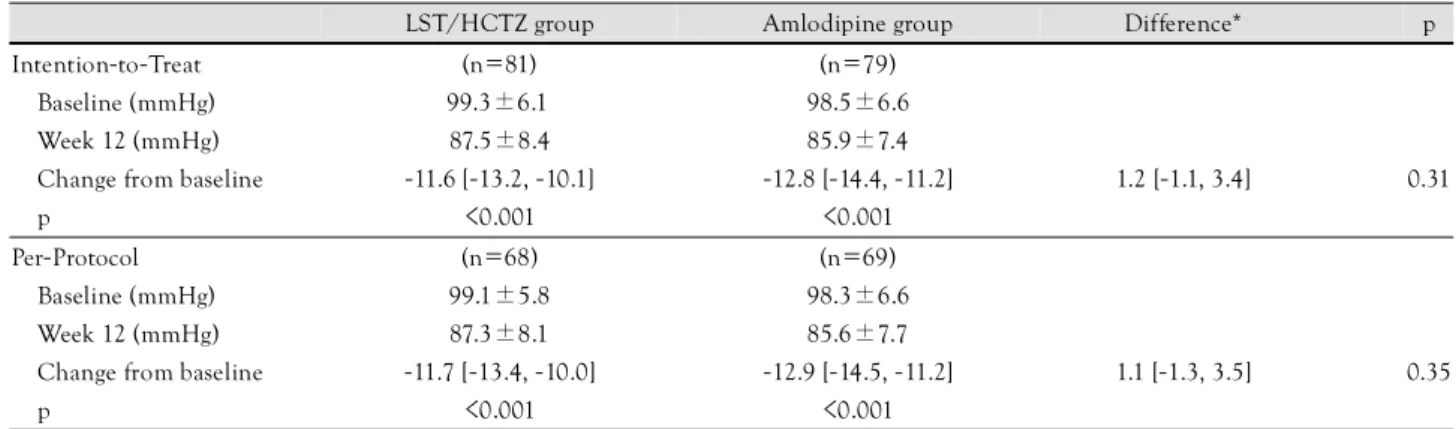
Changes in sitting diastolic blood pressure In the ITT population (n=160), SiDBP was signifi- cantly reduced at 12 weeks by 11.6 mmHg {95% con- fidence interval (CI): 10.1 to 13.2} in the LST/HCTZ group and by 12.8 mmHg (95% CI: 11.2 to 14.4) in the amlodipine group (p<0.001 for both groups). However, the difference in the mean change of SiDBP between the two groups was not significant between the two groups {1.2 mmHg (95% CI: -1.1 to 3.4), p=0.31}. In the PP population (n=137), SiDBP was also signifi- cantly reduced at 12 weeks by 11.7 mmHg (95% CI:
10.0 to 13.4) in the LST/HCTZ group and by 12.9 mmHg (95% CI: 11.2 to 14.5) in the amlodipine group (p<0.001 for both groups).
However, the difference in the mean change of SiDBP between the two groups was not significant {1.1 mmHg (95% CI: -1.3 to 3.5), p=0.35}. These results are sum- marized in Table 2.
Changes in sitting systolic blood pressure
In the ITT population, SiSBP was significantly re- duced at 12 weeks by 19.7 mmHg (95% CI: 17.0 to 22.4) in the LST/HCTZ group and by 19.2 mmHg (95% CI: 16.5 to 21.9) in the amlodipine group (p<
0.001 for both groups). However, the difference in the mean change of SiSBP between the two groups was not significant {-0.5 mmHg (95% CI: -4.3 to 3.4), p=0.82}.
In the PP population, SiSBP was also significantly re- duced at 12 weeks by 20.4 mmHg (95% CI: 17.6 to 23.2) in the LST/HCTZ group and by 19.9 mmHg (95% CI: 17.1 to 22.6) in the amlodipine group (p<
0.001 for both groups). However, the difference in the mean change of SiSBP between the two groups was not significant {-0.5 mmHg (95% CI: -4.5 to 3.4), p=0.79}.
These results are summarized in Table 3.
There was no significant difference in the response rates for the LST/HCTZ group (66.7%) and the amlo- dipine group (75.9%) (p=0.20).
Table 1. Baseline characteristics of randomized patients LST/HCTZ group
(n=90)
Amlodipine group (n=84) Male, n (%) 51 (56.7) 51 (60.7) Age (years) 54.3±9.1 54.2±8.7 SiSBP (mmHg) 155.1±12.8 151.7±11.6 SiDBP (mmHg) 99.1±6.3 98.6±6.6 Pulse rate (beats/minute) 68.4±7.6 71.8±9.3 Weight (kg) 66.7±10.2 67.5±11.2 Height (cm) 164.0±7.7 164.7±8.9 Continuous variables are expressed as means±standard deviation.
SiSBP: sitting systolic blood pressure, SiDBP: sitting diastolic blood pressure, LST/HCTZ: losartan/hydrochlorothiazide
Table 2. Effect of losartan-based regimen and amlodipine-based regimen on sitting diastolic blood pressure at 12 weeks
LST/HCTZ group Amlodipine group Difference* p Intention-to-Treat (n=81) (n=79)
Baseline (mmHg) 99.3±6.1 98.5±6.6
Week 12 (mmHg) 87.5±8.4 85.9±7.4
Change from baseline -11.6 [-13.2, -10.1] -12.8 [-14.4, -11.2] 1.2 [-1.1, 3.4] 0.31
p <0.001 <0.001
Per-Protocol (n=68) (n=69)
Baseline (mmHg) 99.1±5.8 98.3±6.6
Week 12 (mmHg) 87.3±8.1 85.6±7.7
Change from baseline -11.7 [-13.4, -10.0] -12.9 [-14.5, -11.2] 1.1 [-1.3, 3.5] 0.35
p <0.001 <0.001
All measures are expressed as means±standard deviation, or as least square means (95% confidence interval). *LST/HCTZ group-amlodi- pine group. LST/HCTZ: losartan/hydrochlorothiazide
Proportion of patients (%)
100 80 60 40 20
0
Losartan based Amlodipine based Initial dose Once titrated dose Fully titrated dose
17.7% 16.4%
24.1%
38.4%
58.2% 45.2%
Fig. 2. The proportion of patients treated with initial, once titrated, and fully titrated doses at 12 weeks in each group (sequentially from the bottom).
154·Losartan/Hydrochlorothiazide in Mild to Moderate Hypertension
Serial changes in blood pressure
Fig. 3 demonstrates the serial changes in blood pres- sure. SiDBP during the active treatment period showed no significant difference between the two groups (p=
0.17). There were also no significant differences in the SiDBP change between the two groups during any of the three 4-week intervals (p=0.11, 0.17, and 0.42 for the first, second, and third 4-week intervals, respectively).
The serial changes in SiSBP during the active treat- ment were not significantly different between the two groups (p=0.19). The SiSBP change during the first 4- week interval was greater in the LST/HCTZ group (p=0.04), but was not significantly different during the second or third 4-week intervals (p=0.49 and 0.62 for the second and third 4-week intervals, respectively).
Tolerability
The overall incidence of AEs was similar between the LST/HCTZ group (35.6%) and the amlodipine group (34.5%) (p=0.89). The difference in the incidence of
drug-related AEs was insignificant between the LST/
HCTZ group (15.6%) and the amlodipine group (11.9%) (p=0.49). The list of AEs considered to be drug-re- lated is summarized in Table 4. Dizziness and headache were the most common AEs in both treatment groups.
There were no severe AEs requiring special treatment or hospitalization. Through the three 4-week intervals, there was no significant serial increase in the incidence of AEs. The incidences of AEs were 25.6%, 23.3%, and 27.8% during the first, second, and third 4-week in- tervals in the LST/HCTZ group, and 21.4%, 23.8%, and 13.1% during the respective 4-week intervals in the amlodipine group. There were no significant changes in pulse rates or laboratory parameters from baseline,
Table 3. Effect of losartan-based regimen and amlodipine-based regimen on sitting systolic blood pressure at 12 weeks
LST/HCTZ group Amlodipine group Difference* p
Intention-to-Treat (n=81) (n=79)
Baseline (mmHg) 155.7±13.0 151.5±11.8
Week 12 (mmHg) 135.2±15.9 133.0±12.6
Change from baseline -19.7 [-22.4, -17.0] -19.2 [-21.9, -16.5] -0.5 [-4.3, 3.4] 0.82
p <0.001 <0.001
Per-Protocol (n=68) (n=69)
Baseline (mm Hg) 155.8±12.3 151.4±11.3
Week 12 (mm Hg) 134.6±14.1 132.4±13.1
Change from baseline -20.4 [-23.2, -17.6] -19.9 [-22.6, -17.1] -0.5 [-4.5, 3.4] 0.79
p <0.001 <0.001
All measures are expressed as means±standard deviation, or as least square means [95% confidence interval]. *LST/HCTZ group-amlodi- pine group. LST/HCTZ: losartan/hydrochlorothiazide.
Table 4. Incidence of overall and drug-related adverse events LST/HCTZ
group (n=90)
Amlodipine group (n=84) p Patients with one or
more AEs, n (%) 32 (35.6) 29 (34.5) 0.89 Patients with one or
more drug-related AEs, n (%)
14 (15.6) 10 (11.9) 0.49
Dizziness 6 (6.6) 5 (6.0) Headache 2 (2.2) 3 (3.6) Facial flushing 3 (3.3) 0
Cough 1 (1.1) 0
Nausea 1 (1.1) 0
Heart burn 1 (1.1) 0
Impotence 1 (1.1) 0
Skin rash 1 (1.1) 0 Fragile fingernail 1 (1.1) 0 AST/ALT increase 1 (1.1) 0 Skin eruption 0 1 (1.2)
Itching 0 1 (1.2)
Common cold 0 1 (1.2)
Drowsiness 0 1 (1.2)
Fatigability 0 2 (2.4)
LST/HCTZ: losartan/hydrochlorothiazide, AEs: adverse events, AST: aspartate aminotransferase, ALT: alanine aminotransferase
Blood pressure (mmHg)
170 160 150 140 130 120 110 100 90 80 70
Week 0 Week 4 Week 8 Week 12 Losartan based Amlodipine based
Fig. 3. Antihypertensive effects of the losartan-based regimen and the amlodipine-based regimen at 4, 8, and 12 weeks. The serial changes in sitting systolic and diastolic blood pressure during the active treatment period were no different between the two groups.
Jin-Wook Chung, et al.·155
except for one case of liver enzyme increase in the LST/
HCTZ group.
Discussion
We have demonstrated that LST 50 mg titrated up to a fixed combination of LST/HCTZ 100/25 mg pro- duced clinically equivalent blood pressure reduction to amlodipine besylate 2.5 mg titrated up to 10 mg in Korean patients with mild to moderate hypertension.
Both regimens were comparably well tolerated.
Previous studies comparing LST with amlodipine in Asian populations have reported comparable efficacy of the two drugs in reducing blood pressure.12-17) How- ever, those studies have generally made an assumption that LST 50 mg is equivalent to amlodipine besylate 5 mg, which is based on the clinical data from Western populations.6-9) In the present study, we adopted a re- latively conservative strategy for the LST-based regimen, assuming that LST 50 mg is equivalent to amlodipine besylate 2.5 mg rather than 5 mg, that losartan/HCTZ 50/12.5 mg is equivalent to amlodipine besylate 5 mg, and that losartan/HCTZ 100/25 mg is equivalent to amlodipine besylate 10 mg in Korean patients. This strat- egy is partially supported by the report of Rhew et al., in which LST/HCTZ 50/12.5 mg once daily for 12 weeks did not significantly reduce systolic or diastolic blood pressure in Korean patients with ischemic heart failure.18) Adopting this strategy, the patterns and de- grees of change in SiDBP according to serial time points were nearly identical between the two groups, although LST 50 mg was more effective than amlodipine besylate 2.5 mg was in reducing SiSBP. However, it is still uncer- tain whether Asians, who have been suggested to res- pond less favorably to angiotensin-converting enzyme inhibitors and more favorably to calcium channel block- ers than Westerners respond less favorably to ARBs.
In terms of tolerability, the incidence of amlodipine- related AEs in this study (11.9%) was notably lower than that (30%) in a previous summary of 40 placebo- controlled studies by Osterloh.18) This difference might be attributable to the between-race difference in suscep- tibility to lower extremity edema, which potentially en- tails discontinuation of medication.20) The incidence of lower extremity edema in the amlodipine group in this study (1.1%) was markedly lower than that (11 to 24%) seen in previous studies of Westerners.19-22) In- deed, only one patient reported lower extremity edema in the amlodipine group, which was not considered drug-related by the investigator.
Goldberg et al.25) reported a placebo-like tolerability profile of LST in a previous pooled analysis of 2,900 patients treated in double-blinded clinical trials. Fixed combinations of LST/HCTZ 50/12.5 mg and 100/25 mg also demonstrated placebo-like tolerability profiles.26)
Wu et al.14) reported better tolerability of LST in an Asian population compared with amlodipine in a For- mosan population. In the present study, the LST-based regimen and amlodipine-based regimen showed com- parable tolerability in terms of the overall incidence of AEs (35.6% and 34.5%, respectively) and incidence of drug-related AEs (15.6% and 11.9%, respectively). Spe- cifically, when even 25 mg of hydrochlorothiazide was combined with LST in LST/HCTZ 100/25 mg, there was no increase in the incidence of AEs, suggesting the placebo-like tolerability of this regimen in an Asian po- pulation. There were no cases of significant uric acid elevation or dyslipidemia aggravation.
In summary, the two regimens, with a relatively hi- gher dose of LST/HCTZ than that required by Western- ers, produced equivalent blood pressure reduction and were comparably well tolerated in Korean patients with mild to moderate hypertension.
Acknowledgments
This study was funded by a grant from MSD, Korea.
REFERENCES
1) Dahlof B, Sever PS, Poulter NR, et al. Prevention of cardiovas- cular events with an antihypertensive regimen of amlodipine ad- ding perindopril as required versus atenolol adding bendroflu- methiazide as required, in the Anglo-Scandinavian Cardiac Out- comes Trial-Blood Pressure Lowering Arm (ASCOT-BPLA): a multicentre randomised controlled trial. Lancet 2005;366:895-906.
2) Bangalore S, Kamalakkannan G, Parkar S, Messerli FH. Fixed- dose combinations improve medication compliance: a meta-ana- lysis. Am J Med 2007;120:713-9.
3) Waeber B, Burnier M, Brunner HR. Compliance with antihyper- tensive therapy. Clin Exp Hypertens 1999;21:973-85.
4) Ruilope LM, Simpson RL, Toh J, Arcuri KE, Goldberg AI, Sweet CS. Controlled trial of losartan given concomitantly with different doses of hydrochlorothiazide in hypertensive patients.
Blood Press 1996;5:32-40.
5) Soffer BA, Wright JT Jr, Pratt JH, Wiens B, Goldberg AI, Sweet CS. Effects of losartan on a background of hydrochlorothiazide in patients with hypertension. Hypertension 1995;26:112-7.
6) Martina B, Dieterle T, Weinbacher M, Battegay E. Effects of lo- sartan titrated to losartan/hydrochlorothiazide and amlodipine on left ventricular mass in patients with mild-to-moderate hyper- tension: a double-blind randomized controlled study. Cardiology 1999;92:110-4.
7) Wilson TW, Lacourciere Y, Barnes CC. The antihypertensive effi- cacy of losartan and amlodipine assessed with office and ambu- latory blood pressure monitoring. CMAJ 1998;159:469-76.
8) Phillips RA, Kloner RA, Grimm RH Jr, Weinberger M. The effects of amlodipine compared to losartan in patients with mild to mo- derately severe hypertension. J Clin Hypertens 2003;5:17-23.
9) Dahlof B, Lindholm LH, Carney S, Pentikainen PJ, Ostergren J.
Main results of the losartan versus amlodipine (LOA) study on drug tolerability and psychological general well-being. J Hyper- tens 1997;15:1327-35.
10) Jamerson K, DeQuattro V. The impact of ethnicity on response to antihypertensive therapy. Am J Med 1996;101:22S-32S.
11) Lee HY, Kang HJ, Koo BK, et al. Clinic blood pressure responses to two amlodipine salt formulations, adipate and besylate, in adult
156·Losartan/Hydrochlorothiazide in Mild to Moderate Hypertension
Korean patients with mild to moderate hypertension: a multicenter, randomized, double-blind, parallel-group, 8-week comparison.
Clin Ther 2005;27:728-39.
12) Watanabe S, Okura T, Kurata M, et al. The effect of losartan and amlodipine on serum adiponectin in Japanese adults with essential hypertension. Clin Ther 2006;28:1677-85.
13) Yasuda G, Ando D, Hirawa N, Umemura S, Tochikubo O. Ef- fects of losartan and amlodipine on urinary albumin excretion and ambulatory blood pressure in hypertensive type 2 diabetic patients with overt nephropathy. Diabetes Care 2005;28:1862-8.
14) Wu SC, Liu CP, Chiang HT, Lin SL. Prospective and randomized study of the antihypertensive effect and tolerability of three antihy- pertensive agents, losartan, amlodipine, and lisinopril, in hyper- tensive patients. Heart Vessels 2004;19:13-8.
15) Iino Y, Hayashi M, Kawamura T, et al. Renoprotective effect of losartan in comparison to amlodipine in patients with chronic kidney disease and hypertension Hypertens Res 2004;27:21-30.
16) Park HC, Xu ZG, Choi S, et al. Effect of losartan and amlodipine on proteinuria and transforming growth factor-beta1 in patients with IgA nephropathy. Nephrol Dial Transplant 2003;18:1115-21.
17) Ishimitsu T, Minami J, Yoshii M, et al. Comparison of the effects of amlodipine and losartan on 24-hour ambulatory blood pressure in hypertensive patients. Clin Exp Hypertens 2002;24:41-50.
18) Osterloh I. The safety of amlodipine. Am Heart J 1989;118:1114- 9, discussion 1119-20.
19) Volpe M, Junren Z, Maxwell T, et al. Comparison of the blood pressure-lowering effects and tolerability of losartan- and amlo- dipine-based regimens in patients with isolated systolic hyperten- sion. Clin Ther 2003;25:1469-89.
20) Leonetti G, Magnani B, Pessina AC, Rappelli A, Trimarco B, Zanchetti A. Tolerability of long-term treatment with lercanidipine versus amlodipine and lacidipine in elderly hypertensives. Am J
Hypertens 2002;15:932-40.
21) Oparil S, Barr E, Elkins M, Liss C, Vrecenak A, Edelman J. Effi- cacy, tolerability, and effects on quality of life of losartan, alone or with hydrochlorothiazide, versus amlodipine, alone or with hydrochlorothiazide, in patients with essential hypertension. Clin Ther 1996;18:608-25.
22) Omvik P, Thaulow E, Herland OB, Eide I, Midha R, Turner RR.
Double-blind, parallel, comparative study on quality of life during treatment with amlodipine or enalapril in mild or moderate hyper- tensive patients: a multicentre study. J Hypertens 1993;11:103-13.
23) Hong SJ, Ahn TH, Baek SH, et al. Comparison of efficacy and tolerability of amlodipine orotate versus amlodipine besylate in adult patients with mild to moderate hypertension: a multicenter, randomized, double-blind, placebo-controlled, parallel-group, 8- week follow-up, noninferiority trial. Clin Ther 2006;28:537-51.
24) Park S, Chung N, Kwon J, et al. Results of a multicenter, 8-week, parallel-group, randomized, double-blind, double-dummy, phase III clinical trial to evaluate the efficacy and tolerability of amlo- dipine maleate versus amlodipine besylate in Korean patients with mild to moderate hypertension. Clin Ther 2005;27:441-50.
25) Goldberg AI, Dunlay MC, Sweet CS. Safety and tolerability of losartan potassium, an angiotensin II receptor antagonist, com- pared with hydrochlorothiazide, atenolol, felodipine ER, and an- giotensin-converting enzyme inhibitors for the treatment of sys- temic hypertension. Am J Cardiol 1995;75:793-5.
26) Gradman AH, Brady WE, Gazdick LP, Lyle P, Zeldin RK. A multicenter, randomized, double-blind, placebo-controlled, 8-week trial of the efficacy and tolerability of once-daily losartan 100 mg/
hydrochlorothiazide 25 mg and losartan 50 mg/hydrochlorothia- zide 12.5 mg in the treatment of moderate-to-severe essential hy- pertension. Clin Ther 2002;24:1049-61.