J O U R N A L O F
Veterinary Science
J. Vet. Sci. (2008), 9(2), 207209
Short Communication
*Corresponding author
Tel:+82-2-450-4140; Fax: +82-2-444-4396 E-mail: [email protected]
Prevalence of feline herpesvirus 1, feline calicivirus and Chlamydophila felis in clinically normal cats at a Korean animal shelter
Byeong-Teck Kang, Hee-Myung Park*
Department of Veterinary Internal Medicine, College of Veterinary Medicine, Konkuk University, Seoul 143-701, Korea
The prevalence of feline herpesvirus-1 (FHV-1), feline calicivirus (FCV), and Chlamydophila (C.) felis was stud- ied in cats of an animal shelter in Korea. Total 78 cats without ocular and upper respiratory tract disease were examined. Specimens were obtained from ocular con- junctiva and oropharynx. Using multiplex polymerase chain reaction (PCR) and reverse transcription PCR, three pathogens were simultaneously detected. In exam- ined 78 cats, 49 (63%) cats were positive for FHV-1.
However, all specimens were negative for C. felis and FCV. In conclusion, many cats recovered from FHV-1 in- fection remain subclinical carriers in shelter environment.
Keywords: Chlamydophila felis, feline calicivirus, feline herpes- virus-1
Feline herpesvirus type 1 (FHV-1) is the most frequent cause of conjunctivitis, and it also induces corneal ulcers, stromal keratitis, corneal sequestration and keratocon- junctivitis sicca in cats [14]. Chlamydophila (C.) felis (previously called Chlamydia psittaci) is another major conjunctival pathogen [13]. Feline calicivirus (FCV) is an unlikely and minor primary conjunctival pathogen [9]. It is considered to be the most common upper respiratory tract disease (URTD) associated pathogen in cats [16].
The prevalence of FHV-1, FCV and C. felis in cats through- out the world has been frequently reported [1-3,5,6,12, 15,16]. However, there have been relatively fewer of these studies for clinically normal cats in a shelter environment [1,5,11] and no such research has been done in Korea. The purpose of this study is to identify the prevalence of FHV-1, FCV and C. felis in clinically normal cats of a Korean animal shelter by performing multiplex reverse transcription-polymerase chain reaction (RT-PCR)/PCR.
Samples were collected from one animal shelter (Yangju,
Korea) during January 2005. The animals were held at least 30 days and euthanasia was performed because of illness or injury, or insufficient available space. The shelter was traditional with no quarantine for incoming cats, but the cats having diseases were separated from the main shelter.
A total of 78 cats were examined before they underwent euthanasia. Based on their history and ophthalmic (using slit lamp biomicroscopy) and physical examinations, they had clinically normal eyes and they had no specific clinical signs of URTD. All the cats were domestic short-haired or long-haired. The number of male cats examined was 40 and 38 were females. The cats’ age and neuter and vaccina- tion status could not be exactly determined. For each cat, specimens were obtained using three sterile cotton tipped swabs in the conjunctival sac of both eyes and the oropha- rynx, respectively. These were preserved in 2 ml phosphate buffered saline (PBS, 0.01 M NaPO
4, pH 7.0) and they were immediately sent to the laboratory within 2 h and then stored at 70
oC until they were assayed. Before the sub- sequent nucleic acid extraction, the specimens that were separately obtained from the three sites were thoroughly mixed.
One commercial vaccine (Felocell CVR-C; Pfizer Ani- mal Health, USA) was used as a positive control. It was the only licensed vaccine for preventing FHV-1, FCV and C.
felis in Korea at the time of the study. Sterile distilled water without nucleic acids was used as a negative control. Both the controls were subjected to nucleic acid extraction and PCR. The nucleic acids were extracted from specimens by using the Viral Gene-spin kit (Intron Biotechnology, Korea) according to the manufacturer’s instructions.
Three pairs of oligonucleotide primers were used for the
amplifying reaction. We used the previous designed primer
sequences by Sykes et al. [16]. HerpF (5'-GACGTGGT
GAATTATCAGC-3') and HerpR (5'-CAACTAGATTT
CCACCAGGA-3') amplify a 292-base pair (bp) region in
the thymidine kinase (TK) gene of FHV-1. ChlaF (5'-
ATGAAAAAACTCTTGAAATCGG-3') and ChlaR (5'-
CAAGATTTTCTAGACTTCATTTTGTT-3') amplify a
1069-bp fragment in the outer membrane protein gene of
208 Byeong-Teck Kang et al.
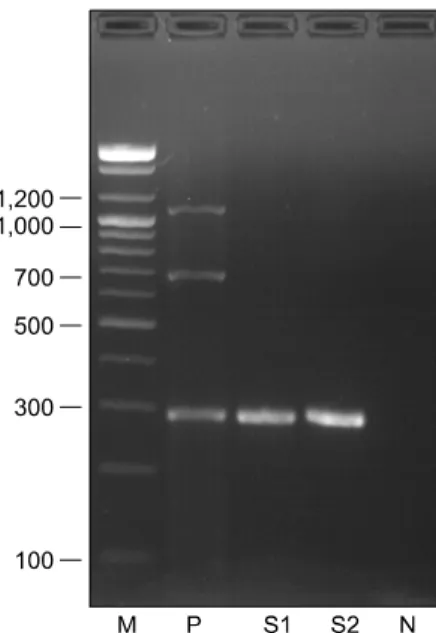
Fig. 1. Multiplex RT-PCR/PCR amplication of FHV-1, C. felis and FCV from the specimens (S1 and S2) collected from two cats. Molecular size standard markers (M) are shown as base pairs (bp) on the left for comparison. The positive control (P) ex- tracted from commercial vaccine strains shows three bands, and their sizes are 292 bp (for FHV), 673 bp (for FCV) and 1069 bp (for C. felis). S1 and S2 show positive reactions for FHV-1, and they are negative for FCV and C. felis. The negative control (N) is shown on the right.
C. felis. CalcapF (5'-TTCGGCCTTTTGTGTTCC-3') and CalcapR (5'-TTGAGAATTGAACACATCAATAGATC-3') amplify a 673-bp conserved region in the capsid protein gene of FCV.
Multiplex RT-PCR/PCR was performed according to a previous study [16]. Each 15 μl of reaction products was electrophoresed through a 1.5% agarose gel and the proteins were stained with ethidium bromide; the appro- priate molecular weight markers (100-bp DNA ladder;
Bioneer, Korea) are adjacent to them. The positive control included the extracted nucleic acid of the commercial strains in the vaccine and the negative control consisted of all the RT-PCR/PCR reagents except the nucleic acid;
these were included in each reaction.
When 78 clinically normal cats were examined, 49 (63%) were positive for FHV-1. Of the 40 male cats examined, FHV-1 was detected in 23 cats (58%) and 26 of the 38 female cats (68%) were positive to FHV-1. However, C.
felis and FCV were negative in all the specimens we obtained. The products resulting from amplification of FHV-1, C. felis and FCV in two specimens are shown in Fig. 1.
Many studies have reported on the prevalence of FHV-1, C. felis and FCV in clinically normal or abnormal cats [1-3,5,6,8,12,15,16]. There were various detection rates of FHV-1 according to the breeding sites, the countries and the cats’ clinical status. The prevalence of FHV-1 was ranged from 0 to 52% for clinically normal cats of a breeding cattery or shelter in Sweden [6], the USA [2, 11,15] and European countries [5]. The prevalence of FHV-1 for client-owned normal cats was 5.9% [10] and this was 12% [15] in the USA. The percentage of cats with diseases at a breeding cattery or shelter in European countries [5] and the USA [1] ranged from 0 to 41%. For client-owned abnormal cats, FHV-1 was detected in 4.5%
to 76.3% of the cats in Japan [3,9], the USA [2,3,10,15], Australia [16] and Italy [12]. Based on these findings, the FHV-1 positive rates of the shelter cats were generally higher than those of the client owned-cats or the breeding cattery cats. Especially, many shelter cats without diseases had a higher prevalence than did the clinically abnormal client-owned cats. We think that the results are due to that many shelter cats have been infected with FHV-1 and they remain subclinical carriers after recovery. At least 80% of infected cats remain latently infected and 29% of them shed virus spontaneously [4]. Thus, FHV-1 has been frequently detected in latently infected cats that are without clinical signs. Also, those cats that live in a colony like an animal shelter, an animal hospital and a multi-cat house- hold can be more frequently exposed to FHV-1.
Among the shelter cats around the world, those in Korea have the highest prevalence of FHV-1 (63%). This result may be due to some reasons. The first is the difference in the frequency and level of stressful events that cats are
exposed to in an animal shelter. Stress as simple as moving a cat into a new environment can convert a latent infection to an active infection in a few days [11]. Virus shedding continues for 1-2 weeks around 1 week after a stressful event [6]. Thus, in this study, cats may have the greatest risk of infection through more exposure to reactivated virus from carriers because the Korean housing enviro- nment may be more stressful than that in other countries.
The second reason is there is a high shedding rate for incoming cats at the time of first entry to the shelter.
However, in other study, the shedding rate was much lower than the rate after 1 week in the shelter [11]. To certify this possibility, it will be necessary to investigate the pro- portion of cats that already shed FHV-1 at the time they are relinquished.
It was previously reported that the prevalence of C. felis in clinically normal cats of a breeding cattery or shelter was only 3% in European countries [5]. For cats with diseases and that are in the same environment, the prevalence of C.
felis ranged from 0 to 10% in the USA [1] and European countries [5], whereas that of client owned abnormal cats was 11.5%, 20% and 59.1% in Australia [16], Italy [12]
and Japan [3], respectively. According to these previous
reports, clinically normal cats had a much lower pre-
valence of C. felis than that of abnormal cats. Unlike
FHV-1, those cats in a shelter or a breeding cattery had a
low detection rate of C. felis. These results indicate that the
Prevalence of FHV-1, FCV and C. felis in an animal shelter 209