Korean Circulation Journal
Print ISSN 1738-5520 • On-line ISSN 1738-5555
Introduction
HF is the leading cause of morbidity, mortality, and healthcare costs around the world. The number of HF patients is increasing worldwide, and its prevalence is expected to rise more steeply as the population ages. On the basis of data from the National Health and Nutrition Examination Survey (NHANES) 2009-2012, about 5.7 million (2.2%) people over the age of 20 years have HF and more than 550000 people are newly diagnosed with HF every year in the USA.
1)By 2030, the prevalence of HF will increase to 46%, affecting more than 8 million people, and total medical costs for HF patients are expected to increase from $20.9 billion to $53.1 billion.
1)2)In Japan, it is estimated that 1.0 million individuals have HF, and the number of Japanese outpatients with left ventricular (LV) dysfunction is predicted to gradually increase from 979000 in 2005 to 1.3 million by 2030.
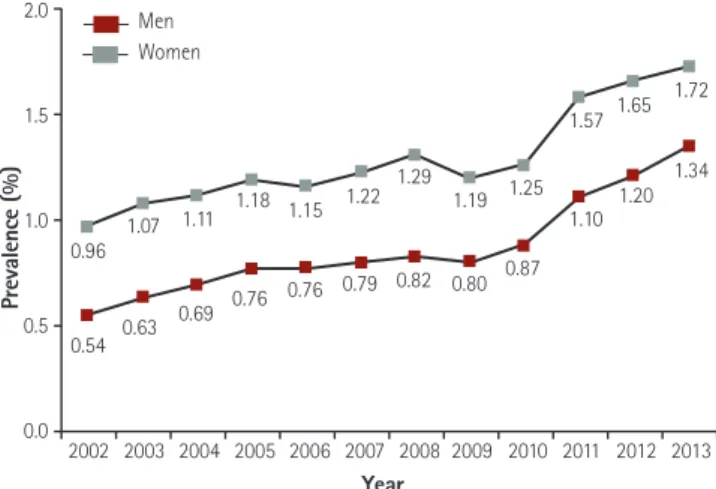
3)4)Therefore, we assume that the prevalence of HF in Korea is also increasing because of the westernization of lifestyle, rapid aging of
Epidemiology of Heart Failure in Korea: Present and Future
Jung Hoon Lee, MD 1 , Nam-Kyoo Lim, PhD 1 , Myeong-Chan Cho, MD 2 , and Hyun-Young Park, MD 1
1