
Studies on Fluid Inclusion and Pyrite Geochemistry in the Moisan Au-Ag Deposit, Haenam District, Korea
14
0
0
전체 글
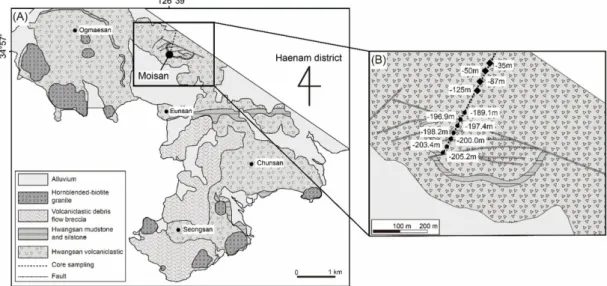
(2) 222. 1. 서. 박솔 · 서정훈 · 김창성 · 양윤석 · 오지혜 · 김종욱. 론. 천열수 광상은 고심도(paleo-depth) 약 1km 이내의 상대적으로 천부 환경에서 형성되는 열수광상으로서 (Henley, 1991; Lindgren, 1922) 주요한 자원으로는 금-은 혹은 구리-아연-납 등 비금속(base metal)이 있 다(Einaudi et al., 2003; Hedenquist, 1987; Simmons and Browne, 2000). 천열수 광상은 크게 지열 시스템 의 천수와 광화유체의 혼합으로 인한 중성의 유체와 관련되어있는 저유황형(low-sulfidation)과 화산 vent 인근의 산성의 마그마-열수 환경로 인한 고유황형(highsulfidation)으로 구분된다(Barton and Skinner, 1979; Hedenquist, 1987; Henley and Ellis, 1983; Ransome, 1907; White and Hedenquist, 1995). 세계적으로 알 려진 천열수 광상은 미국 캘리포니아의 McLaughlin, 미국 네바다의 Round Mountain, Goldfield, 미국 콜 로라도의 Summitville, 일본의 Hishikari, Iwato, 피지 의 Emperor, 뉴질랜드의 Golden Cross, 칠레의 El Indio, 그리고 필리핀의 Lepanto 등이 있다(Heald et al., 1987; White and Hedenquist, 1995). 천열수 광 상의 연대측정(Kelly et al., 1998), 광화 유체(Cooke and McPhail, 2001; Spycher and Reed, 1989), 대규 모 천열수 광상의 형성 조건(Moncada et al., 2019), 유체 포유물(Richards and Kerrich, 1993; Simpson et al., 2015; Zhai et al., 2018), 금-은 침전에 관한. 텔루륨-셀레늄의 작용(Kovalenker et al., 1997; Pals and Spry, 2003; So et al., 1995; Tombros et al., 2010)등 세계적으로 다양한 연구가 진행되어 왔다. 한반도의 백악기 대략 100 Ma에서 70Ma 시기의 천열수 광화 작용은 주향이동단층을 따라 이루어졌다고 제시되었고(Choi et al., 2001; Corbett and Leach, 1998; Zhang et al., 2003) 천부에 정치된 마그마 활 동과 함께 이루어졌으며, 특히 해남 유형의 천열수 금 -은 광상은 얕은 깊이의(약 0.5kbar) 낮은 온도의 유체 에(<300oC) 의해 만들어 진다고 제시되었다(Choi et al., 2005; Kim, 2011). 전남 해남군 황산면 부곡리 일대의 금광상들은 1995년 Ivanhoe Co. Ltd. 자회사 인 Korea Exploration Co. Ltd.에 의해 은산 광상의 광체를 대상으로 개발이 시작되었다. 2002년 순신개발 ㈜에서 인수하여 은산광체를 개발하다가 채진되고, 2006년부터 모이산 광체가 개발되었다. 2010년부터 대 우조선개발㈜에서 모이산 광체개발을 하였고(Moon et al., 2010) 2013년부터 썬시멘트㈜에서 개발 및 인근 진도 일대 가사도에서 발견된 금-은 광맥을 함께 개발 하고 있다. 한반도에 존재하는 금광상들 중 해남지역에 존재하 는 광상은 상대적으로 많은 연구가 이루어져 왔는데, 해남 일대의 지질(Lee and Lee, 1976), 열수변질작용 과 점토광상의 생성(Kim, 1992; Moon et al., 1990), 지구조환경 연구(Kang et al., 2011), 천열수 금광화. Fig. 1. (A) Geological map of the Haenam district, and (B) the Moisan Au-Ag deposit, and position and levels (meter below sea level; mbsl) of core sampling. Samples of -35m to -125m (mbsl) are collected from outcrop in the underground levels and samples from -189.1m to -205m (mbsl) are collected from the drill core..
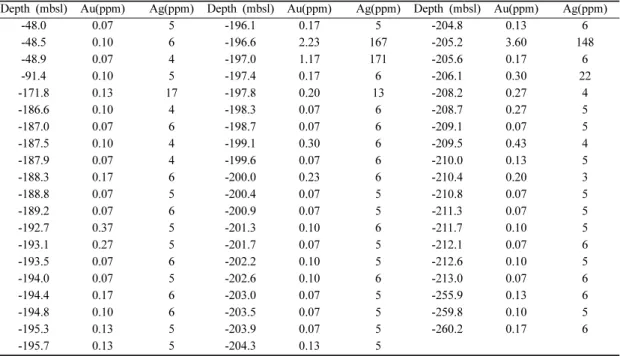
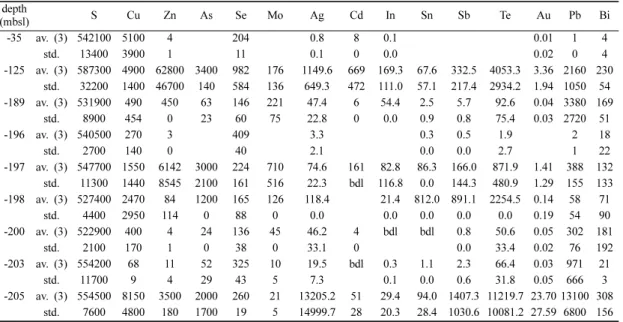
(3) 해남 모이산 금-은 광상의 유체포유물 및 황화물 지구화학 연구. 작용(Kim, 2011), 토양내 금 및 셀레늄 원소의 분포 (Kim et al., 2015; Yoon, 1995), 그리고 화산암 내 유리포유물 연구(Lee et al., 2009) 등 다양한 분야에 서 이루어져 왔지만, 기존의 연구에는 심도별 유체포 유물에 대한 체계적인 연구 사례가 보고된 바 없다. 해남 일대의 금-은 광상 중 모이산 광상은 해남군 황 산면 부곡리에 위치하고 있다(Fig. 1A). 이 지역의 금은 광화작용과 관련된 천열수 유체의 진화 및 금-은 광맥의 탐사인자 획득을 위하여, 우리는 모이산 광체 의 심도별 노두 및 코어 시료를 획득하여, 1) 석영맥 조직, 2) 변질양상 규명, 3) 유체포유물 연구, 그리고 4) 황화광물 지구화학 분석을 수행하였다. 모이산 시료의 조직 및 변질 양상을 관찰하고 유체포유물 연구를 통한 심도별 유체의 온도-염도 환경 변화 및 지구화학 분석 을 통한 황화광물의 성분 변화를 통해 해남지역 다른 금-은 광상의 탐사에도 적용할 수 있으리라 생각된다.. 2. 지질 개요 2.1. 광역 지질 해남 지역은 영동 광주 함몰대의 남서단에 위치하며 이 지역 일대의 지질은 중생대 환태평양 판의 섭입으 로 인한 배호분지(back-arc basin)내의 백악기말 화산 활동으로 인해 형성된 것으로 알려져 있다(Lee and Koh, 2010; Moon et al., 2010). 해남지역 금-은 광 상 일대는 기반암인 선캄브리아기의 편마암과 이에 관 입한 쥬라기 화강암인 산이 화강암과 그 위에 퇴적된 백악기 화산암 및 화산쇄설물로 구성된다. 백악기 퇴 적암은 화원층, 우항리층, 그리고 해남층으로 구성된다. 화원층은 안산암질의 화산쇄설물과 실트암, 우항리층은 세립질의 이암 및 실트암, 그리고 해남층은 석영안산 암질-유문암질 화산쇄설물로 구성된다(Bowden, 2007). 40. K/40Ar 연대측정을 통해 화원층에 협재하는 현무암 (103.4±2.5Ma), 우항리층에 협재된 안산암류(95.4±2.9Ma), 그리고 해남층의 황산응회암(83.9±1.4Ma) 의 연대가 보고되었다(Kim and Nagao, 1992). 해남층에 속하는 황산응회암층은 응회질 퇴적암류로 이루어지며, 용결응 회암, 라필리 응회암, 및 화산 각력암으로 구성되어 있 다(Koh, 2009). 황산응회암층은 산성암질 용결응회암과 응회질 퇴적암류가 교호하는데 이는 화산활동의 휴지 기에 퇴적작용이 여러 번 일어났음을 의미한다(Moon et al., 2010). 은산 및 모이산 광상 일대는 이러한 황 산 응회암층의 열수변질대가 분포한다(Moon et al.,. 223. 2010). 또한 주변의 성산(부곡), 옥매산 광상 에서는 명 반석 및 고령토가 산출된다. 2.2. 광상 개요 해남 모이산 광상은 백악기의 열수 활동에 의하여 만들어진 저유황형 천열수(low-sulfidation epithermal) 함 금-은 석영맥상 광상으로 알려져 왔다(Bowden, 2007; Choi et al., 2005). 최근에는 점토광물과 규화 변질대(silicification)와 석영-일라이트 변질대의 열수 변 질작용(Moon et al., 2010)에 따라 중간유황형 천열수 (Intermediate-sulfidation epithermal) 광상으로 인식된 다(Kim, 2011). 모이산 광상에 나타나는 금-은 광석의 조직은 천열수 광화작용이 맥 형성 및 각력화와 관련 하여 주로 발생하였다는 것을 지시한다(Bowden, 2007). 모이산 광상에는 여러 방향의 인장단열과 전단 단열이 발달하며 광체는 주로 서북서 또는 북서 방향 의 단층을 충진하는 세맥을 따라 발달한다(Koh, 2009). 모이산 광상은 N 60~75 W 방향의 석영맥 내 에 발달한다(Kim, 2011). 모이산 광상의 산소 안정 동 위원소 비(d18O)는 석영(7.9 ~ 10.1‰) 및 견운모(4.5 ~ 6.5‰)에서 측정되었으며(Kim and Kusakabe, 1993), 황화광물의 황동위원소 비(d34S)는 -1.7 ~ -0.6‰ 로 나타난다(Kim, 1992). 모이산 광상의 유체포유물 균질 화 온도는 132~318oC 로 나타난다(Bowden, 2007; Kim, 2011). 이는 광화유체가 마그마 열수와 천수와의 혼합으로 인해 생성되었음을 지시한다.. 3. 실험 및 분석 방법 (Methods) 석영맥 시료의 조직 및 변질 양상: 본 연구를 위하 여 갱내와 시추공에서 석영맥이 존재하고 모암과의 관 계가 잘 드러나는 시료를 채취하였다(Table 1). 심도별 (meter below sea-level) 갱내 시료 -35m, -50m -87m, 그리고 -125m 네 개와 시추공 시료 -189.1m, -196.9m, -197.4m, -198.2m, -200.0m, -203.4m, 그리고 -205.2m 일곱 개를 획득하였다(Figs. 1B and 2). 썬시멘트㈜의 시추공 자료에 의하면 금은 -205.2m에서 최대 품위 3.60ppm를 가지고, 은은 -197.0m에서 최대 품위 171ppm을 가진다(Table 2). 시료의 현미경 관찰 결과 석영맥의 모암인 응회암이 관찰되며, 석영맥은 모암을 따라 옥수(chalcedony), 황철석, 그리고 미립자 석영 (sugary quartz) 이 우세하며, 이후 자형의 정동 석영 (drusy quartz)으로 발달되는 경향을 보인다. 이러한.
(4) 224. 박솔 · 서정훈 · 김창성 · 양윤석 · 오지혜 · 김종욱. Table 1. Descriptions of collected vein samples in the Moisan Au-Ag deposit Deposit Method. Sample depth (mbsl). Ore mineral assemblage. Alteration type. Alteration mineral assemblage. Moisan outcrop. -35. py, te, cpy, sph. Phyllic Silicic. ill-qtz-py qtz. outcrop outcrop. -50 -87. py, te py. Silicic Phyllic Silicic. qtz ill-qtz-py qtz. outcrop core. -125 -189.1. py, te py. Silicic. qtz. core. -196.9. py, te. Phyllic. ill-qtz-py. Host rock. dacitic rhyolitic dacitic rhyolitic. core. -197.4. py, te. core. -198.2. py, te, cpy. core core. -200.0 -203.4. py, te py, te. core. -205.2. py, te, cpy. to tuff to tuff. dacitic to rhyolitic tuff dacitic to rhyolitic tuff. Silicic. qtz. Phyllic. ill-qtz-py. Silicic Silicic. qtz qtz. Textural features. brecciated texture of illite disturbed banded texture of quartz and pyrite growth: sugary quartz → drusy quartz growth: sugary quartz → drusy quartz collofrom texture banded texture of quartz and adularia growth: sugary quartz → drusy quartz collofrom texture. stockwork veinlet growth: pyrite → telluride ore → sugary quartz → drusy quartz growth: pyrite → telluride ore → sugary quartz → drusy quartz growth: pyrite → telluride ore → sugary quartz → drusy quartz growth: pyrite → telluride ore → sugary quartz → drusy quartz. Table 2. Au & Ag grades (fire assay) in the core data Depth (mbsl) -48.0 -48.5 -48.9 -91.4 -171.8 -186.6 -187.0 -187.5 -187.9 -188.3 -188.8 -189.2 -192.7 -193.1 -193.5 -194.0 -194.4 -194.8 -195.3 -195.7. Au(ppm) 0.07 0.10 0.07 0.10 0.13 0.10 0.07 0.10 0.07 0.17 0.07 0.07 0.37 0.27 0.07 0.07 0.17 0.10 0.13 0.13. Ag(ppm) 5 6 4 5 17 4 6 4 4 6 5 6 5 5 6 5 6 6 5 5. Depth (mbsl) -196.1 -196.6 -197.0 -197.4 -197.8 -198.3 -198.7 -199.1 -199.6 -200.0 -200.4 -200.9 -201.3 -201.7 -202.2 -202.6 -203.0 -203.5 -203.9 -204.3. Au(ppm) 0.17 2.23 1.17 0.17 0.20 0.07 0.07 0.30 0.07 0.23 0.07 0.07 0.10 0.07 0.10 0.10 0.07 0.07 0.07 0.13. Ag(ppm) 5 167 171 6 13 6 6 6 6 6 5 5 6 5 5 6 5 5 5 5. Depth (mbsl) -204.8 -205.2 -205.6 -206.1 -208.2 -208.7 -209.1 -209.5 -210.0 -210.4 -210.8 -211.3 -211.7 -212.1 -212.6 -213.0 -255.9 -259.8 -260.2. Au(ppm) 0.13 3.60 0.17 0.30 0.27 0.27 0.07 0.43 0.13 0.20 0.07 0.07 0.10 0.07 0.10 0.07 0.13 0.10 0.17. Ag(ppm) 6 148 6 22 4 5 5 4 5 3 5 5 5 6 5 6 6 5 6.
(5) 해남 모이산 금-은 광상의 유체포유물 및 황화물 지구화학 연구. 225. Fig. 2. Slab photographs of collected rocks from different levels (mbsl) in the Moisan Au-Ag deposit. Host rock is brecciated and generally sericite altered pyroclastic sedimentary rocks, and quartz and chalcedony veins are occurring with drusy or free-standing quartz in the latest stage of quartz vein and in the open or brecciated vugs. Quartz veins consist of paragenetically early chalcedony or fine-grained sugary quartz and later drusy quartz. Ore minerals are mainly massive pyrite and tellurides occur along the wall rock and predate the early chalcedony and predate the latest drusy quartz. Scale bars represent 5cm.. 석영맥 내 석영의 형성 순서는 깊이에 따라 큰 차이를 보이지 않는다. 일부 황철석은 telluride 광물들과 함께 관찰된다(Fig. 3). 석영맥은 일부 colloform 조직(-50m, -87m, -125m) 및 bladed quartz 조직(-205.2m)을 보 인다(Fig. 2). 모암에 나타나는 이차 변질 광물은 대부 분의 깊이에서 옥수 혹은 석영-일라이트(견운모) 등이 이 우세하게 나타난다(Table 1). 석영맥 내 유체포유물 양상: 모이산 광체의 깊이별 자형의 석영맥에서 나타나는 유체포유물군(fluid inclusion assemblage)를 관찰하고 microthermometry 실험을 진행하였다(Bodnar, 2003a; Goldstein, 2003; Goldstein and Reynolds, 1994). 석영 결정의 성장. 누대(growth zone)등 조직 관찰을 통하여 pseudosecondary fluid inclusion으로 이루어진 assemblage를 연구하였다 (Roedder and Bodnar, 1980; Shepherd et al., 1985). 모이산 석영맥에서 관찰되는 유체포유물은 대부분 수용액상 포유물(aqueous liquid-rich inclusion) 이며, 일부 천부에서는 수증기상 포유물(aqueous vapor-rich inclusion) 또한 관찰된다(Fig. 5). 유체포유 물의 크기는 약 5~20µm 정도로 다양하며, 수용액상 유체포유물의 기포(bubble)는 10~40vol% 범위로 나타 나지만, 대부분은 10~20vol%의 크기를 갖는다. X선 회절분석(XRD): 변질 광물을 확인하고자 변질 된 모암 위주로 11개의 시료의 파우더를 제작하였다..
(6) 226. 박솔 · 서정훈 · 김창성 · 양윤석 · 오지혜 · 김종욱. Fig. 3. Photomicrographs of thin sections were obtained from transmitted (A and C) and reflected (B and D) light microscopy. (A) and (B) are from samples from -50m (mbsl), and (C) and (D) are from samples from -125m (mbsl). cpy, py, te, qtz, and sph represent chalcopyrite, pyrite, telluride minerals, quartz, and sphalerite.. 파우더 시료는 인하대학교 표준분석연구원에 설치된 X-선 회절분석기 (X-Ray Diffractometer)를 이용하여 분석하였다. XPERT-PRO Diffractometer system을 사용하였으며, Cu-Kα radiation을 이용하여 스캔하였다. 스캔 범위는 5 ° ~ 90 °, 스캔 간격은 0.02 °로 설 정하였다. 전압은 40 KV, 전류는 30mA로 설정하였다. Divergence slit 은 1.52 mm로 고정하였다. Microthermometry: 유체포유물에 대한 microthermometry 실험은 인하대학교 자원지질연구실에 설치된 Linkam FTIR 600 heating-freezing stage를 이용하 여 진행하였다. 표준 합성 유체포유물(synthetic fluid inclusion)을 사용하여 기기를 보정하였고, 이에 사용된 표 준 합성 유체포유물은 CO2–bearing inclusion(-57.1oC). 과 H2O inclusion(0.0 및 374.1oC)이다. 유체포유물을 냉각 후 가열하여 얼음의 녹는점(Tm-ice)과 가열 후 하 나의 상으로 균질화 되는 온도(Th)를 측정하였다. 투명 한 자형의 석영이 관찰되는 시료 7개를 사용하여 양면 을 폴리싱한 칩(double-polished chip)을 제작하였다. 현미경 관찰을 통해 유체포유물군에 최소 2~3개의 실 험에 용이한 유체포유물이 있는지 확인하였다. 각 시 료로부터 총 65개의 유체포유물군에 대하여 실험하였. 다. 실험에서 얻어진 유체포유물의 염도(NaCl equiv. wt%)는 측정된 Tm-ice 로부터 계산하였으며(Bodnar and Vityk, 1994; Driesner and Heinrich, 2007), 유 체포유물군의 데이터는 평균값과 1 sigma 표준편차를 사용하여 보고하였다(Table 3). LA-ICP-MS: 황화광물 내 원소의 함량을 파악하기 위해 황철석이 관찰되는 9개의 깊이의 시료에서 해당 광물만을 분리, 폴리싱하여 시료를 준비하였다. 레이저 삭박 유도 결합 플라즈마 질량분석 (laser ablation ICPMS)은 한국해양과학기술원 심해저광물자원연구센터에 설치된 Agilent 7700X and a New Wave Research 193 nm의 기기로 분석을 수행하였다. 분석 원소로 S, Cu, Zn, As, Se, Mo, Ag, Cd, In, Sn, Sb, Te, Au, Pb, 그리고 Bi를 선정하였다. 각 분석 마다 60 초의 dwell time을 적용하였으며, 레이저 에너지 밀도는 6J/cm2,, 타격진동수(repetition rate)는 5 Hz로 설정하였다. 레 이저 빔의 직경은 분석할 황철석의 크기에 따라 40~80 µm로 변화를 주었다. 외부표준물은 황화광물 표준물질(standard reference material)인 MASS1과 STDGL3을 사용하였으며 황철석의 stoichiometric Fe 함량(46.55wt%)을 내부표준물로 사용하였다. 분석된.
(7) 해남 모이산 금-은 광상의 유체포유물 및 황화물 지구화학 연구. 227. Table 3. Results of fluid inclusion microthermometry Salinity (wt% Homogenization Salinity (wt% Homogenization Fluid inclusion NaCl.eqv) temperature (°C) NaCl.eqv) temperature (°C) assemblage av. std. av. std. av. std av. std. -35.0mbsl chip1 B30_1 0.13 0.08 261.7 5.5 -196.9mbsl chip1 B20_1 1.40 0.00 187.6 0.0 B30_2 0.18 0.00 253.9 18.8 B30_1 1.57 0.00 205.9 0.0 chip2 B10_1 0.35 0.18 148.5 4.7 B30_2 1.40 0.00 259.5 0.0 B30_1 0.18 0.00 155.2 4.6 B30_3 0.94 0.22 298.7 5.1 B30_2 0.76 0.16 230.2 0.1 B30_4 0.47 0.08 291.7 4.2 B40_1 0.66 0.62 258.7 34.1 B40_1 0.79 0.09 277.0 1.4 chip3 B20_1 0.76 0.36 268.7 3.8 chip2 B20_1 0.97 0.09 266.5 1.1 B70_1 0.47 0.08 376.0 4.3 B30_1 0.59 0.17 286.7 0.5 chip4 B20_1 0.38 0.11 175.1 3.8 B30_2 0.88 0.17 277.8 4.4 B30_1 0.27 0.09 266.6 26.7 chip3 B20_1 0.97 0.09 269.3 3.9 -50.0mbsl chip1 B10_2 1.22 0.00 287.1 0.0 B20_2 1.4 0.14 165.6 1.9 B20_1 0.18 0.00 199.1 0.0 B40_1 1.22 0.14 245.7 2.4 chip2 B20_1 0.18 0.00 248.5 0.0 B40_2 0.35 0.00 268.4 0.2 B40_1 0.18 0.00 243.6 0.0 -197.4mbsl chip1 B10_1 1.31 0.09 191.0 6.6 chip3 B10_1 0.22 0.08 154.2 3.6 B20_1 1.22 0.00 141.4 0.0 B20_1 0.88 0.25 165.5 6.9 B20_2 0.41 0.08 176.0 7.9 B20_2 0.88 0.31 174.4 2.9 B20_3 0.79 0.09 173.2 1.1 B20_3 1.05 0.20 163.1 7.8 B30_1 0.53 0.00 187.9 9.3 -125.0mbsl chip1 B10_1 2.24 0.00 240.8 0.0 B30_2 0.97 0.09 173.4 2.3 B10_2 1.05 0.01 163.3 0.1 B40_1 1.11 0.16 263.3 1.3 B10_3 1.82 0.05 229.0 43.0 -198.2mbsl chip1 B10_1 1.22 0.00 198.5 0.0 B20_1 0.70 0.00 199.4 21.1 chip2 B20_1 0.18 0.00 251.9 11.4 B30_1 0.30 0.08 247.9 1.7 B30_1 0.62 0.09 243.6 0.1 B30_3 0.53 0.18 216.3 55.9 chip3 B10_1 0.99 0.08 268.0 2.0 chip3 B20_1 0.53 0.00 208.4 0.0 chip4 B10_1 1.11 0.08 257.7 2.6 B30_2 1.40 0.00 236.0 0.5 -200mbsl chip1 B10_1 0.53 0.18 284.0 3.6 chip4 B20_1 0.7 0 187.4 0 B20_1 0.99 0.16 231.2 43.9 chip5 B20_1 0.27 0.09 384.4 3.6 B20_2 1.17 0.16 306.8 32.8 B60_1 0.18 0.00 223.8 5.4 B20_3 0.47 0.17 243.4 8.5 B20_4 1.22 0.00 261.9 11.2 B30_1 0.79 0.09 259.4 1.0 B30_2 0.53 0.00 255.4 0.0 B10_1 1.17 0.08 274.7 7.7 B10_2 0.97 0.09 256.4 1.8 B20_1 1.14 0.09 240.1 5.6 B20_2 1.40 0.00 289.1 1.4 Av. and std represent respectively averages and 1 sigma deviations calculated from single fluid inclusion microthermometry in the fluid inclusion assemblage. B20 and B30 represent aqueous inclusion with volume % of 20 and 30, respectively. Fluid inclusion assemblage. LA-ICP-MS 시그널 및 데이터는 SILLS 프로그램을 계산 및 정량화 하였다(Belousov et al., 2015; Guillong et al., 2008; Gunther et al., 1998; Heinrich et al., 2003)(Table 4).. 4. 결과 및 해석 석영맥 조직 및 변질 양상: 채취한 모이산 광체 시. 료는 1ppm 이상의 금을 포함한 심부의 고품위 금-은 구간(-189.1m 부터 -203m), 그리고 1ppm 미만의 금을 포함한 천부의 저품위 금-은 구간(-35m 에서 -125m) 으로 구분된다. 모이산의 석영맥은 대부분의 심도에서 모암에서부터 맥중심부까지 옥수, 황화/텔루루화 광물, 미립질의 석영(sugary quartz), 마지막으로 자형의 정 동 석영(drusy quartz) 순으로 발달되어 있다. 고품위 구간에서 황철석과 함께 텔루르화 광물의 양이 증가하.
(8) 228. 박솔 · 서정훈 · 김창성 · 양윤석 · 오지혜 · 김종욱. Table 4. Summary of LA-ICP-MS microanalysis (ppm) of for pyrite from the Moisan deposit depth (mbsl) -35 av. (3) std. -125 av. (3) std. -189 av. (3) std. -196 av. (3) std. -197 av. (3) std. -198 av. (3) std. -200 av. (3) std. -203 av. (3) std. -205 av. (3) std.. S 542100 13400 587300 32200 531900 8900 540500 2700 547700 11300 527400 4400 522900 2100 554200 11700 554500 7600. Cu. Zn. As. 5100 4 3900 1 4900 62800 3400 1400 46700 140 490 450 63 454 0 23 270 3 140 0 1550 6142 3000 1440 8545 2100 2470 84 1200 2950 114 0 400 4 24 170 1 0 68 11 52 9 4 29 8150 3500 2000 4800 180 1700. Se 204 11 982 584 146 60 409 40 224 161 165 88 136 38 325 43 260 19. Mo. 176 136 221 75. 710 516 126 0 45 0 10 5 21 5. Ag. Cd. In. 0.8 0.1 1149.6 649.3 47.4 22.8 3.3 2.1 74.6 22.3 118.4 0.0 46.2 33.1 19.5 7.3 13205.2 14999.7. 8 0 669 472 6 0. 0.1 0.0 169.3 111.0 54.4 0.0. 161 bdl. 4 0 bdl 51 28. Sn. 67.6 57.1 2.5 0.9 0.3 0.0 82.8 86.3 116.8 0.0 21.4 812.0 0.0 0.0 bdl bdl 0.3 0.1 29.4 20.3. Sb. 332.5 217.4 5.7 0.8 0.5 0.0 166.0 144.3 891.1 0.0 0.8 0.0 1.1 2.3 0.0 0.6 94.0 1407.3 28.4 1030.6. Te. 4053.3 2934.2 92.6 75.4 1.9 2.7 871.9 480.9 2254.5 0.0 50.6 33.4 66.4 31.8 11219.7 10081.2. Au. Pb. Bi. 0.01 0.02 3.36 1.94 0.04 0.03. 1 0 2160 1050 3380 2720 2 1 388 155 58 54 302 76 971 666 13100 6800. 4 4 230 54 169 51 18 22 132 133 71 90 181 192 21 3 308 156. 1.41 1.29 0.14 0.19 0.05 0.02 0.03 0.05 23.70 27.59. 3 points analysis of pyrite grains were used to calculate averages(av.) and standard deviations(std). bdl represents below detect limit.. Fig. 4. X-Ray Diffraction (XRD) patterns of the samples collected from the different levels (mbsl). Abbreviations: Q = quartz, I = illite.. 는 양상이 나타난다. 변질광물 관찰 및 XRD 분석 결 과 모든 깊이에서 옥수 및 일라이트가 확인되었으며 (Fig. 4), 이는 모든 깊이의 구간에서 열수에 의한 규 화작용(silicification) 및 장석 파괴 변질작용(feldspar destructive alteration)을 지시한다. 깊이별 금-은 품위. 와 석영 조직 및 변질 변화의 관련성은 낮아 보이나, 특이하게 고품위 구간 하부인 -205.2m 시료에서 열수 비등(boiling)의 조직적 증거인 bladed quartz (Fig. 2K) 가 관찰되어 이 분에서의 금-은 침전이 열수 비등현상 과 밀접한 관련성을 갖는 것으로 판단된다..
(9) 해남 모이산 금-은 광상의 유체포유물 및 황화물 지구화학 연구. 229. Fig. 5. Photomicrographs of the fluid inclusion assemblages. (A - F) are aqueous liquid-rich assemblages, and (G - I) are vapor inclusions assemblages. (A - B) are from drusy quartz at -35m (mbsl), (C) is from drusy quartz at -125m, (D) is from drusy quartz at -196.9m, (E) is from drusy quartz at -197.4m (F) is from drusy quartz at -197.4m, (G – I) are from drusy quartz at -50m. Scale bars represent 10µm.. 유체포유물 상분포 및 microthermometry 온도-염도 양상: 관찰되는 유체포유물의 상(phase)은 광상 형성 당시 광화유체의 온도-압력 환경을 지시한다. 모이산 광상의 대부분 깊이에서 유체포유물은 수용액상 (aqueous liquid-rich)으로 관찰되며(Fig. 5), 일부 저품 위 석영맥에서는 수증기상(aqueous vapor-rich) 포유물 이 관찰된다(Fig. 5). 수증기상 유체포유물의 존재는 유 체의 급격한 압력 감소로 인한 비등작용(boiling)이 일 어났음을 지시하지만, 탐사를 위한 심도별 수증기상 유 체포유물의 분포와 금-은 품위와의 관련성은 찾기 어 려웠다. 이는 천열수 금-은 광화작용시 비등작용이 중 요한 역할을 하였을 것이지만(Hedenquist et al., 2000; White and Hedenquist, 1995), 품위를 가리지 않고 다양한 깊이에서 나타나는 수증기상 유체포유물 을 모이산 광상의 탐사인자로 어려울 것으로 생각된다. 액상 유체포유물의 평균 균질화 온도는 253.5 oC이며 염도는 0.81 wt%이다. 깊이에 따른 유체 포유물의 균질 화 온도 범위는 천부의 저품위 구간에서 148.5~376.0 oC 그리고 심부의 고품위 구간에서 141.4~306.8 oC으로 큰 차이를 보이지 않았다. 측정된 Tm-ice로부터 획득한 염도는 저품위 구간에서 0.18~-2.24 wt% 그리고 고. Fig. 6. NaCl equivalent wt% salinities and °C homogenization temperatures of the Moisan aqueous assemblages are plotted in the model NaCl-H2O system (Driesner and Heinrich, 2007). Salinities, homogenization, and calculated minimum pressure (bars) in the assemblages from the shallower levels (higher than -125m) are comparable to that from the deeper levels (lower than -196.9m).. 품위구간에서 0.18~-1.57 wt%로 유사하였다(Figs. 6 and 9). 수용액상 유체포유물의 염도 및 균질화 온도를 이용해 H2O-NaCl 모델(Driesner and Heinrich, 2007).
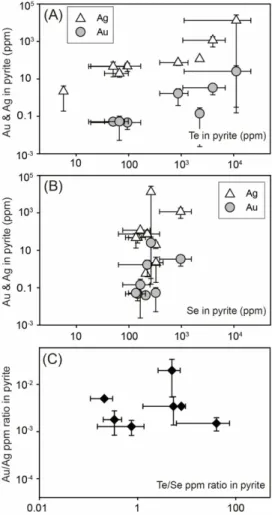
(10) 230. 박솔 · 서정훈 · 김창성 · 양윤석 · 오지혜 · 김종욱. 상의 최소 압력을 계산할 수 있다. 고품위 석영맥의 최 소 압력은 대략 50bar로 계산되며, 이는 hydrostatic 등 방 압력 상황으로 생각할 때 약 0.5km 정도로 계산된다. 고품위 석영맥에서 유체의 염도는 천부로 갈수록 넓 은 범위를 보이며, 저품위 석영맥에서는 천부의 유체 포유물이 낮은 염도의 경향을 보인다(Fig 9). 천열수 환경에서 열수의 염도는 유체의 비등 혹은 천수와의. 렷하지 않았다. 일부의 시료에서는 LA-ICP-MS 분석시 원소의 transient signal이 일정하거나 평탄하게 나타나 지 않았으며, 원소들 중 Zn, As, Ag, Sb, Au, 그리고 Bi 등 대부분의 원소들이 Te과 함께 불규칙적이며 포 유물 형태의 시그널을 보인다(Fig. 7). 황철석 내의 Te 함량 및 Te/Se 비율은 Au 및 Ag와 상관관계를 보이 나, 황철석 내의 Se 함량 및 Te/Se 비율은 Au 및. 혼합과 밀접히 관계된다(Cole and Drummond, 1986). 저염의 수증기상 분리작용은 상대적으로 액상 유체의 염도를 높게 만들 수 있다. 석영맥의 조직 예를 들어 bladed quartz 등은 열수의 비등을 지시한다. 또한 유 체포유물 중 수증기상 유체포유물의 존재 또한 열수의 비등을 지시한다. 이러한 증거들은 고품위 구간에서 열 수의 비등을 지시하고, 이러한 비등이 금-은 침전에 중 요한 역할을 하였음을 지시한다. 해남-진도 지역에 넓 게 분포하는 점토광물 광상들은 주로 천열수 환경과 관련된 열수의 비등작용으로 생성된 산성의 수증기에 의해 만들어졌다(Bowden 2007, Kim, 2011). 다양한 염도 범위는 낮은 염도를 가진 천수와 열수의 혼합에 의해서도 나타난다. 넓은 염도 범위를 가진 구간이 넓 은 범위의 균질화온도 구간과 대략 일치하는 것은 열 수의 상승과정에서 비등 외에 천수의 혼합이 있을 가 능성을 지시한다(Fig. 9). 천부에서 낮은 균질화 온도 및 염도를 보이는 것은 열수가 상승함에 따라 주변 천 수의 영향을 상대적으로 강하게 받았음을 지시한다. 황철석 성분 변화: 심도별 황철석의 성분 변화는 뚜. Fig. 7. Representative LA-ICP-MS transient signals of pyrite from –200 m (mbsl) samples showing Au, Ag, Te, and Se signals. Signals of Au, Ag, and Te represent that the elements are in the phase of mineral inclusion in the pyrite grain, while the signals of Se is concordant with Fe and S representing that Se are possibly substituted in the pyrite.. Fig. 8. Concentrations of (A) Te in pyrite versus Au & Ag. (B) Se in pyrite versus Au & Ag. (C) Te/Se ratio in pyrite versus Au/Ag ratio in pyrite. The Se, Te, Au, and Ag concentrations were obtained by using LA-ICP-MS microanalysis of pyrite in the Moisan quartz vein samples. More than 3 spots in the pyrite grains were measured, and its average and 1 sigma deviations were calculated for the plots and the error bars. Au and Ag in pyrite are showing a distinct positive correlation with Te concentrations, while Se does not show any correlation with Au and Ag. Such a correlative relationship between Au-Ag and Se-Te suggest that Au and Ag are mainly associated and precipitated with telluride phase..
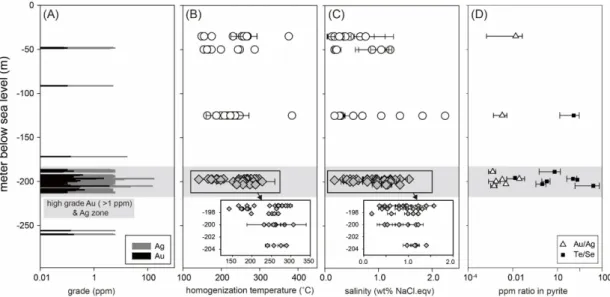
(11) 해남 모이산 금-은 광상의 유체포유물 및 황화물 지구화학 연구. 231. Fig. 9. Depth profiles of (A) Au and Ag grades, (B) Homogenization temperatures, and (C) salinities of fluid inclusion assemblages, and (D) Au/Ag & Te/Se ration in pyrite in the Moisan Au-Ag deposit. In the high Au (more than 1 ppm) grades intervals around -200m showing high temperatures and salinities at deeper samples and lower and somewhat variable temperatures and salinities at shallower samples. Fluids inclusions from samples shallower than -150m show variable homogenization temperatures and salinities. However, Au/Ag and Te/Se ratios in pyrites stay relatively invariable at different depth. These might suggest fluid cooling (possibly by mixing) or boiling (occurrence of vapor inclusions) at the interval of the high grade Au grade in the Moisan Au-Ag deposit.. Ag와 상관관계를 보이지 않았다(Fig. 8). 이는 황철석 내 텔루라이드 광물이 포유물 형태로 포함되어 있고, 이들이 주요한 함 금-은 광물임을 지시한다. 모이산 광 상에서 텔루라이드 및 에렉트럼이 주요한 함 금-은 광 물이라고 알려져 있다 (Kim, 2011). 황철석에 포함된 함 금-은 광물의 동정은 전자현미경 관찰 등 좀더 자 세한 암석기재가 뒷받침되어야 하지만, 본 연구의 결 과는 모이산 광상의 주요한 황화광물인 황철석에 치환 된 형태로 포함된 금-은이 존재하지 않음을 지시하고, 황철석에 포함된 금-은은 포획된 텔루라이드 및 에렉 트럼 포유물에 의한 것임을 또한 지시한다. Figure 9는 심도별 황철석 내 Te/Se 비율 그리고 Au/Ag 비율을 보여준다. Au/Ag(ppm ratio) 비율은 대 략 0.006으로 깊이에 따른 큰 상관관계를 보이지 않았 으며 저품위(Au/Ag=0.006±0.003) 및 고품위(Au/ Ag=0.006±0.005) 구간들에서도 큰 차이를 보이지 않 았다. Te/Se(ppm ratio) 비율은 값이 일정하지 않고 심도별 상관관계 또한 보이지 않는다. 황철석의 성분 결과를 종합하면 모이산 광상의 황철석 내 금-은은 대 부분 텔루라이드 광물 혹은 에렉트럼의 포유물로써 존 재하고, 이러한 함 금-은 포유물은 Se과 낮은 상관성 을 보이는 것으로 판단된다. 또한 포유물로 존재하는. “텔루라이드” 광물 내의 일정한 금-은 비율은 침전과 정에서의 금-은 분별작용이 일어나지 않았음을 의미하 고, 이는 심도별로 일정한 금-은 비율과도 일치한다. 모이산 광체 형성 및 하부의 금-은 광체 존재 가능 성: 유체포유물의 온도 및 염도 범위 및 그 분포를 고. Fig. 10. Schematic illustration of hydrothermal processes the Moisan Au-Ag mineralization and alunite-dickite deposition..
(12) 232. 박솔 · 서정훈 · 김창성 · 양윤석 · 오지혜 · 김종욱. 려하면(Fig. 6), 모이산 광체를 만든 함 금-은 열수는 온도 최대 약 350-400°C 그리고 염도 약 1.5wt% 인 것으로 추정된다(Fig. 10). 열수들은 기존에 형성된 구 조대를 따라 이동하며 석영맥을 만들었을 가능성이 높 다(Kim, 2011). 열수의 상승과정에서 열수 비등작용을 겪으면서 함 금은 광물을 침전시켰을 것으로 판단된다. 이 과정에서 황철석이 함께 침전되었으나, 대부분의 금 -은은 함 Te 광물상과 함께 독립적으로 혹은 황철석 내에 포유물로써 침전되었다. 이는 함 금-은 열수 내에 상당량의 텔루륨이 있음을 지시한다. 모이산 광상은 해 남지역의 다른 광상들과는 달리 금 광화작용에 텔루륨 이 관여하며 이는 모암의 산화 환원과 관련이 있으며, 이는 상대적으로 Se이 많이 관여된 인근의 은산 광상 과 차이를 보인다(Kim, 2011). 심도별 함 금은 포유광 물의 금-은 비율이 일정한 것은 침전시 금-은간 분별작 용이 일어나지 않았음을 지시하고, 금-은 비율을 연구 지역의 광상탐사 지시자로 활용하기 어렵다는 것을 의 미한다. 모이산 광상의 석영맥내 증기상 포유물의 존재는 강 한 비등작용이 열수 작용과 함께 나타났음을 지시하고, 이러한 열수의 비등은 강한 산성의 수증기를 생성하여 해남지역에 나타나는 명반석 및 고령토 광화작용에 영 향을 주었을 것이라 생각된다(Fig. 10). 열수 내 다양 한 염도 그리고 천부에서의 낮은 염도는 열수의 상승 과 함께 상당량의 천수의 혼합이 있었음을 지시한다. 연구지역에서 천수의 혼합이 금-은 침전에 미치는 영 향은 아직 불명확하다. 현재까지의 결과로 금-은 광체 가 심부에 존재할 가능성을 예측하기는 매우 어려우나, 심부의 열수가 다량의 금-은을 포함하고 있을 가능성 이 높을 것이기 때문에, 구조적으로 열수의 비등이 일 어나기 적합한 환경이 형성된 지점에서는 부분적으로 가능할 수도 있다. 따라서 연구 지역 광체조사를 위해 서는 심부 시추시료의 전단대 등 지질 구조 분석이 동 반되어야 할 것으로 판단된다.. 5. 결. 론. 석영맥의 조직 및 변질 양상, 그리고 열수의 특징은 광상학적으로 모이산 금-은 맥상 광상이 저유황형 혹 은 중간유황형 천열수 광상에 가깝다는 것을 지시한다. 모이상 광상의 형성은 유체의 상승에 의한 활발한 비 등작용에 의해 주로 형성되었다고 생각되며, 금-은 침 전은 함 금-은 및 Te 광물상 -텔루라이드 광물 혹은 에렉트럼-과 함께 일어난다고 생각된다. 유체의 염도. 및 균질화 온도 양상은 모이산 광상 열수작용에서 천 수의 혼합 또한 지시한다. 황철석 내의 금-은은 대부분 포유물 상태로 존재함을 알 수 있고, 황철석 구조의 치환에 의한 것은 미미함을 지시한다. 또한 모이산 금 -은 광화작용시 Se보다 Te이 중요한 역할을 한 것으로 확인된다. 심도별 함 금-은 광물상의 금-은 비율은 저품 위 및 고품위 구간에서 일정하게 나타나기에, 현재 데이 터로써는 광상 탐사에 중요한 인자로 사용되지 힘들다 는 것을 지시하나, 좀더 면밀한 추후 연구가 필요하다.. Acknowledgements 시추 및 갱내 시료의 채취를 도와준 썬시멘트㈜ 및 김봉주 박사님께 감사드립니다. 본 연구는 한국연구재 단 이공분야기초연구사업 (NRF-2019R1C1C1002588) 의 지원을 받아 수행되었습니다. 심사를 해 주신 익명 의 심사위원님들께 감사드립니다.. References Barton, P.B. and Skinner, B.J. (1979) Sulfide mineral stabilities: in Barnes, HL, ed., Geochemistry of hydrothermal ore deposits. 2nd ed.: New York, WileyInterscience, p.218-403. Belousov, I., Danyushevsky, L., Olin, P., Gilbert, S. and Thompson, J. (2015) STDGL3 - a new calibration standard for sulphide analysus by LA-ICP-MS. Goldschmidt 2015 Abstracts, A251. Bodnar, R.J. (2003a) Fluid Inclusions: Analysis and Interpretation. Mineral, Assoc. Canada, Short Course, v.32, p.1-8. Bodnar, R.J. and Vityk, M.O. (1994) Interpretation of microthermometric data for -NaCl fluid inclusions, In: Fluid Inclusions in Minerals: Methods and Applications Virginia Tech, Blacksburg, p.117-131. Bowden, C.D. (2007) Epithermal systems of the Seongsan district, South Korea an ivestigation on the geological setting and spatial and temporal relationship between high and low sulfidation systems. Unublished Ph.D. thesis, James Cook University, Australia, 334p. Choi, S.-G., Lee, D.-E., Pak, S.J., Choi, S.-H. and Kang, H.-S. (2001) Genetic Model of Mineral Exploration for the Korean Au-Ag Deposits: Mugeug Mineralized Area. Economic and Environmental Geology, v.34, n.5, p.423-435. Choi, S.-G., Ryu, I.-C., Pak, S.J., Wee, S.-M., Kim, C.S. and Park, M.-E. (2005) Cretaceous epithermal goldilver mineralization and geodynamic environment, Korea. Ore Geology Reviews, v.26, n.1-2, p.115-135. Cole, D.R. and Drummond, S.E. (1986) The effect of transport and boiling on Ag/Au ratios in hydrothermal solutions: a preliminary assessment and possible implications for the formation of epithermal precious-.
(13) 해남 모이산 금-은 광상의 유체포유물 및 황화물 지구화학 연구 metal ore deposits. Journal of Geochemical Exploration, v.25, p.45-79. Cooke, D.R. and McPhail, D.C. (2001) Epithermal Au-AgTe Mineralization, Acuan, Baguio District, Philipines: Numerical Simulations of Mineral Depostion. Economic Gelogy, v.96, p.109-131. Corbett, G.J. and Leach, T.M. (1998) Southwest Pacific Rim gold-copper systems: Structure, alteration and mineralization. Society of Economic Geologists Special Publication 6. Driesner, T. and Heinrich, C.A. (2007) The system H2O– NaCl. Part I: Correlation formulae for phase relations in temperature–pressure–composition space from 0 to 1000°C, 0 to 5000bar, and 0 to 1 XNaCl. Geochimica et Cosmochimica Acta, v.71, n.20, p.4880-4901. Einaudi, M.T., Hedenquist, J.W. and Inan, E.E. (2003) Sulfidation State of Fluids in Active and Extinct Hydrothermal Systems: Transitions from Porphyry to Epitermal Environments. Society of Economic Geologists Special Publication, v.10, p.285-313. Goldstein, R.H. (2003) Fluid Inclusions: Analysis and Interpretation. Mineralogical Association of Canada, p.9-53. Goldstein, R.H. and Reynolds, T.J. (1994) Systematics of fluid inclusions in diagenetic minerals. Society for Sedimentary Geology Short Course. Guillong, M., Meier, D.L., Allan, M.M., Heinrich, C.A. and Yardley, B.W.D. (2008) SILLS: a MATLAB-based program for the reduction of laser ablation ICP-MS data of homogeneous materials and inclusions. Mineralogical Association of Canada Short Course, v.40, p.328-333. Gunther, D., Audetat, A., Frischknecht, R. and Heinrich, C.A. (1998) Quantitative analysis of major, minor and trace elements in fluid inclusions using laser ablation– inductively coupled plasma mass spectrometry. Journal of Analytical Atomic Spectrometry, v.13, p.263-270. Heald, P., Foley, N.K. and Hayba, D.O. (1987) Comparative anatomy of volcanic-hosted epithermal deposits; acidsulfate and adularia-sericite types. Economic Geology, v.82, n.1, p.1-26. Hedenquist, J.W. (1987) Mineralization associated with volcanic-realted hydrothermal systems in the circum pacific Basin. In: Horn, M.K (Ed.), The 4th Cricum Pacific Conference of Energt and Mineral Resources, August 1987, Singapore, Transactions. American Association of Petroleum Geologist, p.513-524. Hedenquist, J.W., Arribas, R.A. and Gonzalez-Urien, E. (2000) Chapter 7 Exploration for Epithermal Gold Deposits. Reviews in Economic Geology, v.13, p.245277. Heinrich, C.A., Pettke, T., Halter, W.E., Aigner-Torres, M., Audétat, A., Günther, D., Hattendorf, B., Bleiner, D., Guillong, M. and Horn, I. (2003) Quantitative multi-element analysis of minerals, fluid and melt inclusions by laser-ablation inductively-coupled-plasma mass-spectrometry. Geochimica et Cosmochimica Acta, v.67, n.18, p.3473-3497. Henley, R.W. (1991) Epithermal gold deposits in volcanics terranes. Gold metallogeny and exploration: London, Blackie, p.133-164. Henley, R.W. and Ellis, A.J. (1983) Geothermal systems. 233. ancient and modern: a geochemical review. EarthScience Reviews, v.19, p.1-50. Kang, J.-H., Lee, D.-S., Ryoo, C.-R., Koh, S.-M. and Chi, S.-J. (2011) Geological Structure of the Moisan Epithermal Au-Ag Mineralized Zone, Haenam and its Tectonic Environment at the Time of the Mineralization. Economic and Environmental Geology, v.44, n.5, p.413-431. Kelly, K.D., Romberger, S.B., Beaty, D.W., Pontius, J.A., Snee, L.W., Stein, H.J. and Thompson, T.B. (1998) Geochemical and Geochronological Constraints on the Genesis of Au-Te Deposits at Cripple Creek, Colorado. Economic Gelogy, v.93, p.981-1012. Kim, C.S. (2011) Genesis of the Cretaceous Low-sulfidadtion Epithermal Au-Ag Deposit in the Haenam district, Repulic of Korea: Implication of Se tpye (Eunsan) and Te type (Moisan), 190 pp. Kim, I.J. (1992) Alteration Zoning, Mineral Assemblage and Geochemistry of the Hydrohtermal Clas Deposits Related to Cretacous Felsic Magmatism in the Haenam Area, Southwest Korea. Journal of Korean Institute of Mining Geology, v.25, n.4, p.397-416. Kim, I.J. and Kusakabe, M. (1993) Oxygen and Hydrogen Isotope Studies of the Hydrothermal Clay Deposits and Surrounded Rocks in the Haenam Area, Southwestern Part of the Korean Peninsula. Journal of Korean Institute of Mining Geology, v.26, n.1, p.11-20. Kim, I.J. and Nagao, K. (1992) K-Ar ages of the hydrothermal clay deposits and the surrounding igneous rock in Southwest Korea. The Journal of the Petrological Society of Korea, v.1, n.1, p.58-70. Kim, S.-O., Cheon, S.W., Park, G.-R. and Wang, S. (2015) Characterization of Selenium (Se) Distribution in Soils and Crops at Moi-san, Haenam. Economic and Environmental Geology, v.48, n.3, p.213-219. Koh, S.M. (2009) Technical development on the life cycle of the Haenam epithermal gold mineralized area and hydrothermal clay resources. Kovalenker, V.A., Safonov, Y.G., Naumov, V.B. and Rusinov, V.L. (1997) The Epithermal Gold-Telluride Kochbulak Deposit (Uzbekistan). Geology of Ore Deposits, v.39, p.107-128. Lee, D.S. and Lee, H.-Y. (1976) Geological and geochemical study on the rock sequences containing oily materials in southwestern coast area of Korea. Journal of Korean Institute of Mining Geology, v.9, p.45-74. Lee, G.J. and Koh, S.M. (2010) Geology and mineralization of the Moisan epitermal gold deposits in Haenam area, Jollanamdo. Petrological Society of Korea of Korea and Mineralogical Society of Korea. Lee, S., Yang, K., Jeon, B.G., Bak, G., Koh, S.M. and Seo, J.-R. (2009) Glass Inclusions in Quartz Phenocrysts of Tuff from Sunshin Au Mining Area, Haenam, Jeonnam. The Journal of the Petrological Society of Korea, v.18, n.4, p.337-384. Lindgren, W. (1922) A suggestion for the terminology of certain mineral deposits. Economic Gelogy, v.17, p.292-294. Moncada, D., Rimstidt, J.D. and Bodnar, R.J. (2019). How to form a giant epithermal precious metal deposit: Relationships between fluid flow rate, metal concentration of ore-forming fluids, duration of the ore-.
(14) 234. 박솔 · 서정훈 · 김창성 · 양윤석 · 오지혜 · 김종욱. forming process, and ore grade and tonnage. Ore Geology Reviews, 113. Moon, D.H., Koh, S.M. and Lee, G.J. (2010) Geochemistry of the Moisan Epithermal Gold-silver Deposit in Haenam Area. Economic and Environmental Geology, v.43, n.5, p.491-503. Moon, H.-S., Kim, Y.H., Kim, J.H. and You, J.H. (1990) KAr Ages of Alunite and Sericite in Altered Rocks, and Volcanic Rocks around the Haenam Area, Southwest Korea. Journal of Korean Institute of Mining Geology, v.23, n.2, p.135-141. Pals, D.W. and Spry, P.G. (2003) Telluride mineralogy of the low-sulfidation epithermal Emperor gold deposit, Vatukoula, Fiji. Mineralogy and Petrology, v.79, n.3-4, p.285-307. Ransome, F.L. (1907) The association of alunite with gold in the Goldfield district, Nevada. Economic Gelogy, v.2, p.667-692. Richards, J.P. and Kerrich, R. (1993) The Porgera Gold Mine, Papua New Guinea - Magmatic Hydrothermal to Epithermal Evolution of an Alkalic-type Precious Metal Deposit. Economic Gelogy, v.88, p.1017-1052. Roedder, E. and Bodnar, R.J. (1980) Geologic pressure determinations from fluid inclusion studies. Ann. Rev. Earth Planet. Science, v.8, p.263-301. Shepherd, T.J., Rankin, A.H. and Alderton, D.H. (1985) A Practical Guide to Fluid Inclusion Studies. Blackie and Sons, p.63-77. Simmons, S.F. and Browne, P.R.L. (2000) Hydrothermal Minerals and Precious Metals in the Broadlands-Ohaaki Geothermal System: Implications for Understanding Low-Sulfidation Epithermal Environments. Economic Gelogy, v.95, p.971-999. Simpson, M.P., Alinkas, S.S., Mauk, J.L. and Bodnar, R.J. (2015) Fluid Inclusion Chemistry of Adularia-Sericite Epithermal Au-Ag Deposits of the southern Hauraki. Goldfield, New Zealand. Economic Gelogy, v.110, p.763-789. So, C.-S., Dunchenko, V.Y., Yun, S.-T., Park, M.-E., Choi, S.-G. and Shelton, K.L. (1995) Te- and Se-Bearing Epithermal Au-Ag Mineralization, Prasolovskoye, Kunashir Island, Kuril Island Arc. Economic Gelogy, v.90, p.105-117. Spycher, N.F. and Reed, M.H. (1989) Evolution of a Broadlands-Type Epithermal Ore Fluid along Alternative P-T Paths: Implications for the Transport and Deposition of Base, Precious, and Volatile Metals. Economic Gelogy, v.84, p.328-359. Tombros, S., St. Seymour, K. and Wiliams-Jones, A.E. (2010) Controls on Tellurium in Base, Precious, and Telluride Minerals in the Panormos Bay Ag-Au-Te Deposits, Tinos Island, Cyclades, Greece. Economic Gelogy, v.105, p.1097-1111. White, N.C. and Hedenquist, J.W. (1995) Epithermal gold deposit: styles, characteristics and exploration. Economic Gelogy, v.23, n.1, p.9-13. Yoon, C.-H. (1995) Variation of Gold Content in Rocks and Minerals from the Seongsan and Ogmaesan Clay Deposits in the Haenam Area, Korea. Economic and Environmental Geology, v.28, n.6, p.571-577. Zhai, D., Williams-Jones, A.E., Liu, J., Tombros, S.F. and Cook, N.J. (2018) Mineralogical, Fluid Inclusion, and Multiple Isotope (H-O-S-Pb) Constraints on the Genesis of the Sandaowanzi Epithermal Au-Ag-Te Deposit, NE China. Economic Geology, v.113, n.6, p.1359-1382. Zhang, Y., Hobbs, B.E., Ord, A., Barnicoat, A., Zhao, C., Walshe, J.L. and Lin, G. (2003) The influence of faulting on host-rock permeability, fluid flow and ore genesis of gold deposits: a theoretical 2D numerical model. Journal of Geochemical Exploration, v.78-79, p.279-284..
(15)
수치

+4

관련 문서
A jet pump is a fluid carrying device which spouts fluid of high pressure from a driving engine pipe and absorbs fluid of high pressure whose pressure
Studies are on-going concerning the potential impact of the control rod material(Ag, In, Cd). In the containment, The equilibrium between iodine adsorption
1) It is applicable to both ideal fluid systems and viscous fluid systems involving friction and energy dissipation. 2) It is applicable to both compressible fluid
– Free Body Diagram : isolate half of the shell & fluid Free Body Diagram : isolate half of the shell & fluid – Tensile stress (σ) in the wall & fluid
KEY WORDS: Computational fluid dynamics 전산유체역학, Rogue wave 로그파, Numerical wave tank 수치수조, OpenFOAM 오픈폼... 라이브러리
n The magnitude of the buoyant force acting on a floating body in the fluid is equal to the weight of the fluid which is displaced by
1) If the fluid is real (viscous fluid) and if no energy is being added, then the energy line may never be horizontal or slope upward in the direction of flow.. 2) Vertical
Further, in this course, students will learn all the capabilities necessary for the modeling of the practical fluid phenomena in the river and for the analysis
