Korean J ournal of S oil S cience and F ertilizer
Short Communication https://doi.org/10.7745/KJSSF.2019.52.4.318 pISSN : 0367-6315 eISSN : 2288-2162
Evaluation of Replacement Ratio of Mixed Oilcake for Basal Application of Inorganic Fertilizers in Watermelon Cultivation at the Plastic Film House Soil
Myung Sook Kim*, Seong Jin Park, Sung Hyun Kim, Hyun Young Hwang, and Seok Cheol Kim1
Soil & Fertilizer Management Division, National Academy of Agricultural Science, Rural Development Administration, Wanju 55365, Korea
1Gyeonggi-do Agricultural Research and Extension Services, Hwaseong 18388, Korea
*Corresponding author: [email protected]
A B S T R A C T Received: July 15, 2019
Revised: October 22, 2019 Accepted: October 23, 2019
ORCID Myung Sook Kim
https://orcid.org/0000-0002-4382-0194
The objective of this study was analyzed the replacement ratio of mixed oil cakes(MC) for basal application of inorganic fertilizers. The fields were selected the plastic film house soils for watermelon cultivation. The MC were applied at 50(MC50+N50), 100(MC100), and 150(MC 150) % level of the basal amount of nitrogen fertilizer in soil testing recommendation. And these were compared to NPK treatment and -N(PK) treatment except nitrogen as inorganic fertilizer. The yields of watermelon in MC50+N50, MC100, and MC150 were similar to NPK treatment, but sugar contents as watermelon quality in MC50+N50, MC100, and MC150 were higher than NPK. In MC100 and MC150 treatments, nitrate nitrogen and electrical conductivity were lower than MC50+N50 treatment. Relative nitrogen efficiency of watermelon ranged 109 - 128%. These results suggest that MC application with the 100 - 150% level of nitrogen input as the basal dressing could be best to prevent a nutrient accumulation of soil and to increase the yield and commercial quality for watermelon.
Keywords: Mixed oil cake, Replacement ratio of inorganic fertilizer, Watermelon, Plastic film house soil Table. Changes in watermelon yield according to replacement ratio of basal amount of nitrogen fertilizer. ( ) mean relative yield of watermelon to NPK treatment. N, P, K, and MC mean nitrogen, phosphate, potash fertilizers, and mixed oil cakes, respectively.
Treatment Fruit weight
(g plant-1)
Sugar contents (Brix)
Weight of leaf, stem, and fruit (ton ha-1)
-N (PK) 5,312(78)b† 10.0b 45.1b
NPK 6,768(100)a 10.1b 58.0a
MC 50+N50 6,866(101)a 11.1a 58.6a
MC 100 6,963(103)a 11.5a 61.1a
MC 150 6,960(103)a 11.7a 63.7a
†Numbers with the same letter within a column are not significantly differed (Duncan’s test, p < 0.05).
Ⓒ The Korean Society of Soil Science and Fertilizer. This is an Open Access article distributed under the terms of the Creative Commons Attribution Non- Commercial License (http://creativecommons.org/licenses/by-nc/4.0) which permits unrestricted non-commercial use, distribution, and reproduction in any medium, provided the original work is properly cited.
Introduction
정부의 유기질비료 지원사업으로 공급되는 유기질비료로는 혼합유기질, 혼합유박, 유기복합이 있고, 유기질비료 는 대부분 친환경농업 또는 고속득 경제성 작물을 재배하는 농가에서 많이 사용하고 있다. 유기질비료의 경우, 질소 함량이 4% 정도로 높고, 질소는 유기 형태로 결합되어 있어서, 무기질비료에 비해 천천히 분해되는 특성이 있다 (Cho and Chang, 2007). 혼합유박에 대한 연구로는 시설재배지에서 단호박, 수박 재배 시 혼합유박 시용량이 토양환경과 작물 생산성에 미치는 영향 (Kim et al., 2009; Uhm et al., 2011; Kim et al., 2016; Kim et al., 2019) 등 양분공급 및 토 양환경개선 효과를 구명하려는 연구가 일부 이루어졌다. 특히, 시설수박 재배 시 혼합유박의 적정한 시용량은 화학비 료 (질소) 사용량 기준의 30 - 50%를 대체할 때 작물 수량의 증가 효과가 있었다고 발표하였다 (Uhm et al., 2011). 국 외에서 참깨 재배할 경우에 유기질비료를 밑거름으로 50%정도 대체하는 것이 적절하다고 하였고 (Verma et al., 2013), 담배 재배 시에 유기질 비료 투입으로 전분함량이 증대하는 효과가 있었다고 발표하였으며 (Song et al., 2016), 토마토 재배 시 유기질비료를 농경지에 투입하면 작물 수량이 증대한다고도 하였다 (Chaturvedi and Kumar, 2012).
유기질비료인 혼합유박의 합리적인 농경지 투입을 위해 혼합유박의 질소성분 함량뿐만 아니라 양분 이용율 등 주 요 요인들이 관여한다. 특히 화학비료를 대체할 경우 양분의 이용율이 중요한 인자가 될 수 있으며, 가장 대표적인 인 자는 질소 비효율이라고 할 수 있다. 질소비효율은 화학비료 (NPK) 시비구의 질소이용율에 대한 유기질비료 시비구 의 질소 이용율을 나타낸 것이다. 기존에 노지 밭조건에서 가축분퇴비 및 유기질비료 (혼합유박, 혼합유기질)의 질소 비효율에 대해 연구된 바 있으며, 대표적인 예로 돈분톱밥퇴비 68%, 계분톱밥퇴비 62%, 우분톱밥퇴비 27%인데 반 해, 유기질비료는 91%로 부숙유기질비료에 비해 높았다고 보고하였다 (Yun et al., 2011). 그러나, 시설재배에서 밑 거름 화학비료량을 유기질비료로 대체 하고자 할 경우 유기질 비료의 시용량 설정에 관한 연구는 매우 부족한 실정이다.
따라서, 본 연구에서는 시설과채류 중 수박을 공시하여 질소 밑거름 시비량을 혼합유박으로 전량 대체할 경우 합리 적 시용량을 평가하고자 수행하였다.
Materials and Methods
혼합유박의 화학비료 밑거름 대체량 평가 공시토양의 화학적 특성은 Table 1과 같고, 전기전도도는 적정수 준 (2.00 dS/m 이하, NAS, 2017)보다 약간 높은 수치 (2.58 dS/m)를 나타냈다. 처리구는 질소 결측구로 -N (PK) 처리 구, 표준시비 (N-P2O5-K= 138-49-87 kg ha-1)량을 시용한 NPK 처리구, 유기질비료로는 혼합유박 (MC)을 화학비료 (N)의 표준 밑거름 사용량 대비 50%, 100%, 150% 해당량으로 투입하였고 (MC50+N50, MC100, MC150), 총 5수 준에 3반복으로 실험하였다. 처리구별 면적은 59.25m2이고, 배치는 완전임의배치법으로 배치하였으며, 유기질비료 를 토양과 잘 혼합하여 14일이 경과한 후 (8월 18일)에 수박을 정식하여 11월 7일에 수확하였다. 공시토양시료는 재 료 처리 전과 수박 수확기에 각각 채토하여 분석하였으며, 수박 열매, 잎과 줄기는 수확기에 채취하여 총질소 함량을 분석하였다. 유기질비료 중 혼합유박의 T-N, P2O5, K2O의 함량은 비료 포장지에 4.0-2.0-1.0%였으나, 실제로 분석하 였을 때 4.3-2.0-1.8로 약간의 함량에서 차이가 있었다.
Table 1. Chemical properties of soils under study.
Soil pH EC OM Av.P2O5 Ex.K Ex.Ca Ex.Mg NO3-N
dSm-1 g kg-1 mg kg-1 cmolc kg-1 mg kg-1
Soil 1 6.4 2.58 20 535 0.60 7.9 2.9 104
Optimum range for water
melon cultivation† 6.0 - 6.5 ≤2.00 20 - 30 350 - 450 0.70 - 0.80 5.0 - 6.0 1.5 - 2.0 50 - 150
†NAS, 2017.
그리고 수박 재배 시 투입된 혼합유박에 대한 작물의 질소 비효율은 Eq. 1에 따라 계산하였다.
질소비효율 (%) = 유기질비료 시비구의 질소 이용율
× 100 (Eq. 1)
NPK 시비구의 질소 이용율
토양 및 식물체 분석 pH와 전기전도도 (EC)는 토양과 증류수의 비율을 1:5로 추출하여 측정하였고, 토양유기 물은 Tyurin법, 유효인산은 Lancaster법으로 720 nm에서 측정하였다. 치환성 양이온은 1 M NH4OAc (pH 7.0) 완충 용액으로 추출하여 유도결합 플라즈마 발광광도계 (ICP-OES, GBC)로 측정하였고, NO3-N와 NH4-N 함량은 2M KCl로 추출하여 원소자동분석기 (Bran+Luebbe)로 측정하였다. 수박의 T-N, P2O5, K2O 함량은 건조 후 분쇄하여 C/N 분석기로 측정하였다.
유기질비료 분석 총질소, 총인산, 총칼리, 총탄소 함량은 비료 품질검사 방법 및 시료채취기준에 따라, 총질소 는 황산 분해 후 킬달증류법에 따라 분석하였으며, 인산과 칼리 전량은 마이크로웨이브로 산 가수분해 후 ICP (GBC, Integra XL, Australia)로 각각 측정하였다 (RDA, 2016).
통계 분석 모든 데이터는 SAS 프로그램 (v. 9.2)으로 통계분석을 실시하였고, 시설토양에서 수박를 재배 시 혼 합유박의 화학비료 밑거름 사용 대체량과 토양화학성 변화를 비교하고자 ANOVA 분석을 실시하였으며, Duncan‘s test로 검정하였다.
Results and Discussion
혼합유박의 화학비료 밑거름 대체량 평가 시설수박의 수량을 NPK 처리구를 100으로 하고, 이것을 기준으 로 다른 처리구들의 수량을 상대적인 값으로 계산하여 비교하였다. NPK, MC50+N50, MC100, MC150 처리구간에 수박에 대한 과중과 총무게 (잎과 줄기 포함)는 통계적으로 유의한 차이가 없었으나, 이들 처리구와 -N (PK)처리구와 는 수박 과중에 대해 통계적인 차이가 인정되었다 (Table 2). 수박의 당도는 혼합유박 처리구와 NPK 및 -N (PK) 처리 구 사이에는 통계적인 차이가 있었으나, 혼합유박 처리구들간에는 통계적으로 유의적인 차이를 나타나지 않았다.
Uhm et al. (2011)은 혼합유박을 화학비료 밑거름량의 75 - 125%까지 대체가 가능하였고 나머지 양은 화학비료로 웃 거름을 투입할 것을 추천하였다. 본 실험에서는 화학비료 (N)의 밑거름량을 혼합유박으로 대체할 경우에 50 - 150%
까지 대체가 가능하다는 연구결과와 유사하였다.
Table 2. Changes of watermelon yield according to replacement ratio of basal amount of nitrogen fertilizer. ( ) mean relative yield of watermelon to NPK treatment. N, P, K, and MC mean nitrogen, phosphate, potash fertilizers, and mixed oil cakes, respectively.
Treatment Fruit weight
(g plant-1)
Sugar (Brix)
Weight of leaf, stem, and fruit (ton ha-1)
-N(PK) 5,312(78)b† 10.0b 45.1b
NPK 6,768(100)a 10.1b 58.0a
MC 50+N50 6,866(101)a 11.1a 58.6a
MC 100 6,963(103)a 11.5a 61.1a
MC 150 6,960(103)a 11.7a 63.7a
†Numbers with the same letter within a column are not significantly differed (Duncan’s test, p < 0.05).
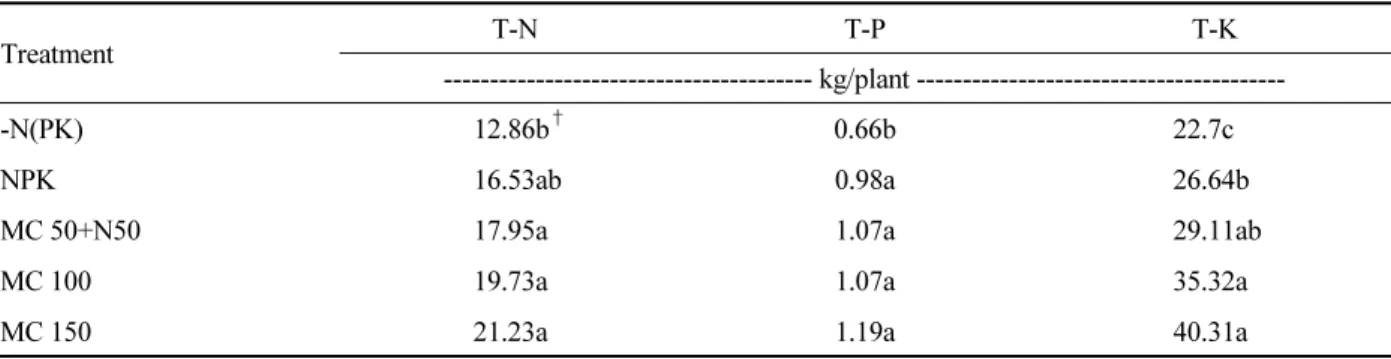
수박 열매의 총질소, 총인산, 총칼리 함량을 처리수준별로 비교하였다 (Table 3). 총질소 함량은 혼합유박 처리구들 (MC 50+N50, MC 100, MC 150)과 -N (PK) 처리구와는 통계적 유의한 차이가 있었으나, 혼합유박 처리구 (MC 50+N50, MC 100, MC 150)와 NPK 처리구와는 통계적으로 유의한 차이가 없었다. 수박의 총인산 함량은 혼합유박 처리구 (MC 50+N 50, MC 100, MC 150) 및 NPK 처리구와 질소질비료 결측구인 -N (PK) 처리구와는 통계적 차이 가 있었다. 총칼리 함량은 혼합유박 처리구들 (MC 100, MC 150)와 -N (PK), NPK 처리구와는 통계적 차이가 있었으 나, 혼합유박 (MC 50+N50 처리구와는 차이가 없는 것으로 나타났다. 수박은 총질소, 총칼리의 흡수량은 혼합유박 대체량이 증가할수록 증가하는 경향이었고, 혼합유박의 시용은 질소와 칼리의 공급력이 향상된다고 판단된다.
Table 3. Uptake amount and relative efficiency of nitrogen for watermelon. N, P, K, and MC mean nitrogen, phosphate, potash fertilizers, and mixed oil cakes, respectively.
Treatment T-N T-P T-K
--- kg/plant ---
-N(PK) 12.86b† 0.66b 22.7c
NPK 16.53ab 0.98a 26.64b
MC 50+N50 17.95a 1.07a 29.11ab
MC 100 19.73a 1.07a 35.32a
MC 150 21.23a 1.19a 40.31a
†Numbers with the same letter within a column are not significantly differed (Duncan’s test, p < 0.05).
그리고, 포장 조건에서 수박의 질소 비효율은 MC50+N50, MC100, MC150에서 각각 109, 119, 120%로 혼합유박 의 화학비료 밑거름 대체량이 증가함에 따라 증가하는 경향을 나타냈다.
Table 4. Relative efficiency of nitrogen for watermelon cultivated in plastic film house soil. N, P, K, and MC mean nitrogen, phosphate, potash fertilizers, and mixed oil cakes, respectively.
Treatment Relative efficiency of nitrogen (%)
-N(PK) -
NPK 100
MC 50+N50 109
MC 100 119
MC 150 128
혼합유박의 토양화학성에 미치는 영향 Table 5는 시설농가 포장에서 혼합유박을 50, 100, 150%로 처리한 후 수확기에 토양화학성의 변화를 나타내었다.
토양산도, 유기물, 유효인산은 모든 처리구에서 유의적인 차이가 없었다. 전기전도도는 혼합유박 비료의 화학비료 (N) 밑거름 대체율 100% (1.98 dSm-1), 150% (1.98 dSm-1) 처리구에서는 화학비료 (N) 밑거름 대체율 50% (2.65 dS m-1) 처리구와 유의적인 차이가 있었고 NPK 처리구와는 유의한 차이 (172 mg kg-1)가 없었다. 치환성 칼륨 함량은 혼 합유박 처리구에서 0.16 - 0.29 cmolc kg-1의 범위로 있었고, -N (PK), NPK 처리구는 0.30 - 0.32 cmolc kg-1로 혼합유 박 처리구보다 높게 나타났다. NO3-N 함량은 혼합유박 (MC 50 + N50, MC 100, MC 150) 처리구들과 유의적인 차이 (111 - 138 mg kg-1)는 없었고 NPK 처리구와는 큰 차이 (172 mg kg-1)를 나타냈다. NH4-N 함량은 혼합유박 150 처리 구가 다른 처리구보다 유의적으로 낮았으며, -N (PK), NPK, MC 50+N50, MC 100, MC 150처리구들 간에서는 유의 한 차이가 없었다.
이로부터 혼합유박 처리구들의 NO3-N, 전기전도도가 NPK 처리구보다 낮은 값을 나타냈기 때문에 혼합유박의 시 용은 토양의 양분증가 속도가 NPK 처리구보다 낮다고 판단된다. 본 연구와 유사하게 Eum et al. (2011)도 수박재배 시험에서 EC, NO3-N의 함량은 혼합유박 대체량이 높은 처리구에서 시험전과 비슷하거나 조금 낮은 경향을 나타내 므로, 양분집적의 우려가 적다고 발표하였고, 본 연구결과와 유사하다고 판단된다. 토양 양분의 잔류량을 고려할 때 화학비료 (N) 밑거름량을 혼합유박으로 대체할 경우에 100% - 150%까지 대체가 가능하다고 생각된다.
Table 5. Chemical properties of soils under after watermelon cultivation under plastic film horse. N, P, K, and MC mean nitrogen, phosphate, potash fertilizers, and mixed oil cakes, respectively.
Treatment pH
(1:5H2O)
EC OM Av.P2O5 Ex.K NO3-N NH4-N
dS/m g kg-1 mg kg-1 cmolc kg-1 mg kg-1
-N(PK) 6.5a† 1.82b 19a 511a 0.32a 104b 32a
NPK 6.5a 2.94a 18ab 533a 0.30a 172a 30ab
MC 50+N50 6.6a 2.65a 17ab 566a 0.19b 138ab 28ab
MC 100 6.7a 1.98b 18ab 536a 0.17b 111b 27ab
MC 150 6.6a 1.98b 18ab 503a 0.29a 111b 25b
Optimum range for
water melon cultivation 6.0 - 6.5 ≤2.00 20 - 30 350 - 450 0.70 - 0.80 50 - 150 -
†Numbers with the same letter within a column are not significantly differed (Duncan’s test, p < 0.05).
결론적으로 시설재배지에서 수박 재배 시 혼합유박의 투입은 지력을 유지하고, 작물생육에 충분한 질소를 함유하 고 있어, 무기질 질소 비료의 밑거름을 대체하는 비료로서 이용도가 높다가 판단된다.
Conclusions
시설토양에서 수박 재배 시 안정적인 수량 확보와 과다시비에 따른 환경오염을 방지하기 위해 혼합유박의 적정 추 천량 기준을 마련하고자 시험한 결과, 혼합유박의 화학비료 밑거름량 대체율은 표준비료 질소 밑거름량 (N=53.2 kg ha-1) 기준으로 투입할 때 수박의 수량과 품질 (당도)가 높고, 토양양분의 잔류정도가 적은 혼합유박의 화학비료 밑거 름 대체비율은 100% - 150%로 나타났다. 그리고 혼합유박의 질소비효율은 109 - 128% 범위에 있었으며, 혼합유박 의 투입비율이 증가할수록 수박의 질소비효율은 증가하였다. 유기질비료인 혼합유박으로 무기질비료의 질소 밑거름 량을 대체할 수 있으며, 수박 정식전에 질소 밑거름 기준으로 100 - 150%까지 투입하고, 나머지 양은 무기질비료를 공급하는 것이 적당하리라 생각된다.
Acknowledgement
This study was conducted by support of NAS research and development project (project number: PJ012623022019).
References
Chaturvedi, S. and A. Kumar. 2012. Bio-diesel waste as tailored organic fertilizer for improving yields and nutritive values of Lycopercicum esculatum (tomato) crop. J. Soil Sci. Plant Nutr. 12(4):801-810.
Cho, S.H. and K.W. Chang. 2007. Nitrogen mineralization of oil cakes according to chagnes in temperature, moisture, soil depth and soil texture. J. of KORRA. 15(1):149-158.
Kim, K.C., B.K, Ahn, H.G. Kim, and S.S. Jeong. 2012. Effect of expeller cake fertilizer application on soil properties and red mustard(Brassica Juncea L.) yield in soil of organic farm of plastic film greenhouse. J. Korean Soc. Soil Sci. Fert. 45(6):1022-1026.
Kim, Y.S., K,J. Lee, S.K, Shin, Y.S. Kim, I,K. Song, I.K. Kim, E.S. Kweon, S.Z, Ju, and D.M. Sa. 2009. Substitution of chemical fertilizers by application of oil cakes. Annual report of Chungcheongbuk-do Agricultural Research and Extension Services, pp. 489-500.
Kim, Y.S., S.W. Park, S.J. Noh, T.G. Jung, Y.M. Jeon, T.I. Kim, M.H. Kim, S.S. Lee, and K,J. Jeon. 2019.
Technological development of utilization of organic resources for the replacement of chemical fertilizers, Annual report of Chungcheongbuk-do Agricultural Research and Extension Services, pp. 489-500.
Lee, D.B., J.K. Sung, Y.J. Lee, S.B. Lee, Y.S. Song, and Y.M. Kim. 2017. Fertilizer recommendation for crop production, Rural Development Administration, pp. 60-163.
NAS. 2017. Fertilizer Recommendation for crops (revision). National Academy of Agricultural Science, RDA, Suwon, Korea.
Rural Development Administration (RDA). 2016. Quality inspection method and sampling standard for fertilizer. pp.
60-163.
Song, Z., J. Wang, M. Sun, J. Wu, C. Gong, and G. Liu. 2016. Effect of organic fertilizer application on starch changes in tobacco (Nicotiana tabacum L.) Leaves during maturation. J. Soil Sci. Plant Nutr. 62(2):173-179.
Uhm, M.J., E.J. Kim, S.Y. Jin, C.S. Kim, and J.M. Kim. 2016. Study on utilization of organic resources for environmental-friendly cultivation os sweet pumpkin in greenhouse, Annual report of Jeollabuk-do Agricultural Research and Extension Services, pp. 166-173.
Uhm, M.J., J.J. Noh, H.G. Chon, M.H. Seong, J.H. Lim, Y.K. Shin, and Y.J. Song. 2011. Effect of organic fertilizer application on growth and yield of Citrullus lanantus in plastic film house. Annual report of Jeollabuk-do Agricultural Research and Extension Services, pp. 299-206.
Verma, S., H.V. Singh, and R. Saxena. 2013. Relative performance of sesamum indicum) under organic, inorganic and intergrated nutrient management, Indian J. Agri. Sci. 83(2):143-149.
Yun, H.B., J.S. Lee, Y.J. Lee, R.Y. Kim, Y.S. Song, S.G. Han, and Y.B. Lee. 2011. Chinese cabbage growth effected by black vinyl mulching and organic fertilizer application in spring season. J. Korean Soc. Soil Sci. Fert.
44(6):1107-1111.