서 론 1.
연구 배경 및 목적 1.1
Structural Insulated Panels SIP SIP
SIP
114 , 165 SIP
, .
SIP
. (Edward, 2006; Borjen, 2008; ANSI/APA, 2008) ,
SIP ,
,
, SIP
DOI http://dx.doi.org/10.11004/kosacs.2013.4.1.033
구조용단열패널의 정적가력과 반복가력 성능 평가
나환선
1· 이현주
2· 최성모
3Performance Evaluation on Static Loading and Cyclic Loading for Structural Insulated Panels
Nah, Hwan-Seon
1· Lee, Hyeon-Ju
2· Choi, Sung-Mo
31
Principal Researcher, Korea Electric Power Corporation Research Institute, Daejon, Korea
2
Senior Researcher, Korea Electric Power Corporation Research Institute, Daejon, Korea
3
Professor, The University of Seoul, Department of Architectural Engineering
Abstract: Structural insulated panels, structurally performed panels consisting of a plastic insulation bonded between two structural panel facings, are one of emerging products with a viewpoint of its energy and construction efficiencies.
These components are applicable to fabricated wood structures. In Korea, there are few technical documents regulated structural performance and engineering criteria in domestic market. This study was conducted to identify fundamental performance of both monotonic load and quasi static cyclic load for SIPs in shear wall application. Static test results showed that maximum load was 44.3kN, allowable shear load was 6.1kN/m, shear stiffness was 1.23 MN/m, and ductility ratio was 3.6. Cyclic test was conducted by two kinds of specimens : single panel and double panels. Cyclic test results, which were equivalent to static test results, showed that maximum load was 45.42kN, allowable shear load was 6.3kN/m. Furthermore the accumulated energy dissipation capability for double panels was as 2.3 times as that for single panel. From performance of structural tests, it was recommended that the allowable shear load for panels was at least 6.1kN/m.
K ey Words: Structural Insulated Panel, Shear, Cyclic, Static, Displacement
주요어: 구조용단열패널 반복 정적 변위 전단 Corresponding author: Nah, Hwan-Seon
Korea Electric Power Corporation Research Institute, 105, Munji-Ro, Yusung-Gu, Daejon, 305-760, Korea Tel: +82-42-865-5221, Fax: +82-42-865-5944, E-mail: [email protected]
투고일 : 2012 년 12 월 20 일 / 수정일 : 2013 년 1 월 3 일 / 게재확정일 : 2013 년 1 월 25 일
. , ,
,
1 .(Nah, 2012)
연구 방법 및 범위 1.2
SIP ,
, SIP .
30%
SIP ,
.
.
6 ,
1.2×2.4m
2.4×2.4m .
, ,
,
- , ,
, ,
.
시험계획 2.재료 물성 및 시험방법 2.1
SIP 140
2 2 26kg/ .
11
. SIP 2011
9 . SIP
ASTM E72, ASTM D4761, ASTM E1803 KS F2273 .
. 시험체
2.2
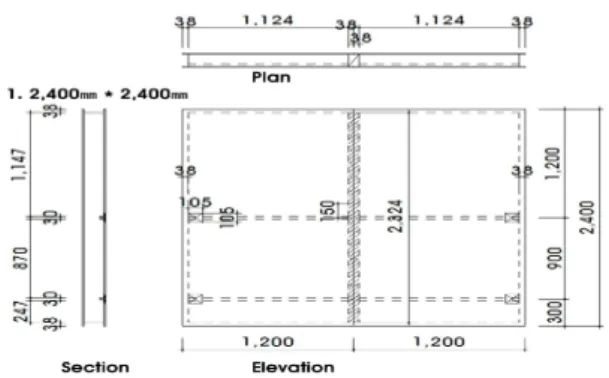
Fig. 1 38 .
Fig. 1 Dimension of Specimen
1.2m
50×152
150 8d
. 1.2×2.4m 2
Table 1 .
Table 1. Identification of Static Test Specimen
정적가력 방법 2.3
ASTM E72 .
,
90 N .
. 3
3.5kN, 7kN, 10.5 kN
. ,
100 .
,
KS F2273 3.5kN
5×10
-2/s .
반복가력 방법 2.4
, SIP
. ,
. Lam (1997)
2.4×7.2 m ,
, 1.2×2.4 m
100% .
, He(1998) 2 , 1
3 , 1
50%, 80%
. Krawinkler(2000) CUREE .
CUREE
. . ( ) Δ
80% (Δ
m) (1)
(Mosalam, 2008).
= 0.6
Δ Δ
m(1)
(1) ( ) Δ
Table 2
0.02Hz .
Δ Δ
Δ Δ Δ Δ Δ Δ Δ Δ Δ Δ Δ Δ Δ Δ Δ Δ
Table 2. Displacement Amplitude Schedule
Fig. 2 Cyclic Test Protocol Table 3
6 .
Instron 10
,
LVDT
20 64 /sec. .
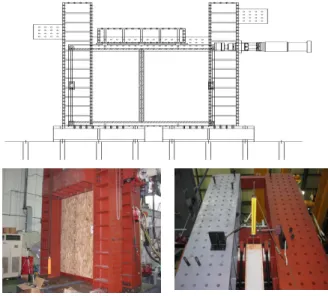
Fig. 3 .
Fig.3 Test Setup Table 3. Specimens for Cyclic Test
정적가력과 반복가력 시험결과 분석 3.
정적가력 시험결과 3.1
( ) Φ KS F 2273
(2) .
(2)
1 : ,
δ
, 2 : δ , , δ
3 : , , h:
, b: .
,
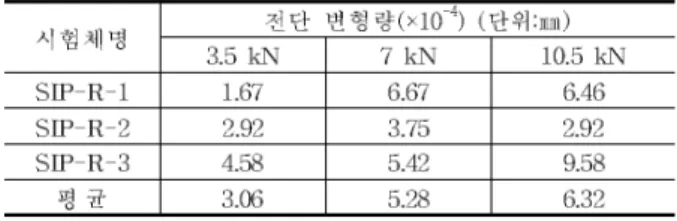
, (1) Table
4 .
3.5kN , 1.67 4.58
×10
-43.06×10
-4.
7.5kN, 10.5kN 2 , 3 ,
5.28×10
-4, 6.32×10
-4, 3.5kN ,
1.7 , 2.1 . 10.5kN
KS F 2273 1.5×10
-2.
Table 4. Shear Displacement dependent to Load
3
.
- Fig. 4 , -
1
, 2 ,
3
.
,
.
Fig. 4 Load-Displacement for Racking Shear Static Test
, Table 5 .
Table 5. Result for Racking Shear Static Test
, 44.3kN ,
64 . ( y) Δ
1/2 , 1.2×2.4m
9.82 (He, 1999). ,
2.4×2.4m
152 , 76 9.14, 12.87
(Durham, 2001).
18
150 .
, 2.4×2.4m ( 165
) 14.1 kN/m, 2.4×3.0 (
165 ) 14.4 kN/m .
18.4 kN/m 1.2
. 3
(2006) ,
(S
u) 6.1 kN/m . , (G') (P
maxH)/(2L Δ y)
1.23 MN/m .
1.05 1.38 (Durham, 2001).
(D) Δ Δ u/ y 3.6
.
반복가력 시험결과 3.2
1) SIPC-D
(SIPC-D-1) 11
+45.54 kN ,
, 16
. - Fig.5
.
Fig. 5 Load-Displacement for Specimen(SIPC-D-1) (SIPC-D-2)
+50.26 kN . 15
6.06 kN 12%
.
Fig. 6 Load-Displacement for Specimen(SIPC-D-2)
, 14
. 1/3
16.75 kN . -
Fig. 6 . (SIPC-D-3)
13 , 14
1/2 .
.
12 +40.46 kN .
SIP-D-2 10kN .
- Fig. 7 .
2) SIPC-B
(SIPC-B) 1 1,200
(SIPC-D) 2,400 1/2
. (SIPC-B-1) 15
. (SIPC-D)
57% +26.1kN , 11
24.42 . -25.54kN,
12 . -
Fig. 8 .
Fig. 7 Load-Displacement for Specimen (SIPC-D-3)
Fig. 8 Load-Displacement for Specimen (SIPC-B-1)
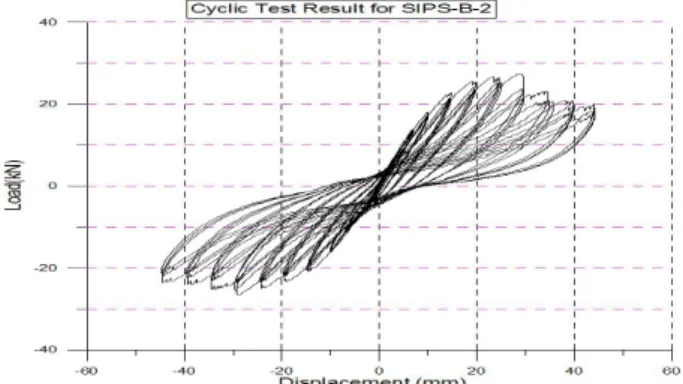
(SIPC-B-2) 15
, 12
+27.28kN, -26.52kN .
(SIPC-B-1) 4%
- Fig. 9 .
Fig. 9 Load-Displacement for Specimen (SIPC-B-2)
(SIPC-B-3) 15
, +27.32 kN, 13
. -24.32kN, 11
. 15 43.95
12kN
(SIPC-B-3) - Fig. 10 .
Fig. 10 Load-Displacement for Specimen (SIPC-B-3) 3)
(SIPC-D)
1 6 kN ,
(SIPS-D-3)
20% Table 6
.
Table 6. Synthetic Result for Specimen (SIPC-D)
, 1.2m
2.4m(1.2m+1.2m) ,
1.6 .
1/3 (He, 1999).
15.14kN,
6.3 kN/m .
3
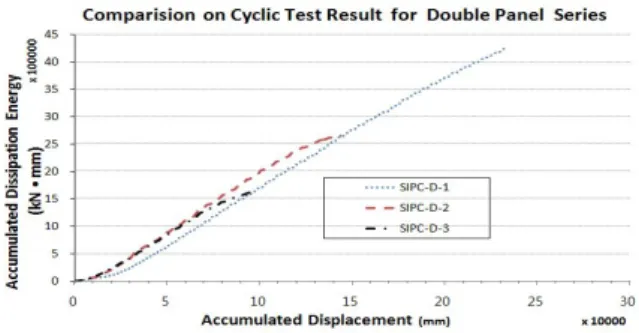
. (SIPC-D-1) 100%
, (SIPC-D-2)
(SIPC-D-3) 62%, 38%
Fig.11 .
2
,
,
, 0.68kN/m
.
Fig. 11 Accumulated Dissipation Energy (SIPC-D)
(SIPC-B) ,
(SIPC-D) 59% ,
61% , (SIPC-D)
71%, 69%
Table 7 .
(SIPC-B)
(SIPC-D) 18%
. 7.47 kN/m
.
Table 7. Synthetic Result for Specimen (SIPC-B)
1.2m (SIPC-B)
.
(SIPC-D) .
(SIPC-B-1) 100%
, (SIPC-B-2) (SIPC-B-3)
99%, 81% , Fig.
12 .
Fig. 12 Accumulated Dissipation Energy (SIPC-B)
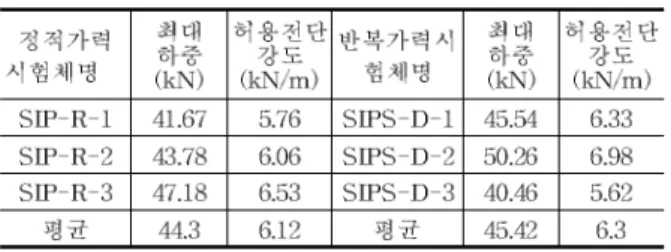
Table 8. Summary of Static Test Results and Cyclic Test results
(SIPC-B-1) (SIPC-D-1)
2.3 .
2.4m
(SIP-R) (SIPC-D)
44.3kN, 45.42kN 6.12kN, 6.30kN Table 8 ,
(Durham, 2001).
결 론 4.