Vol. 47, No. 2, pp. 191 - 195, 2006
The ionized calcium level in blood is known to be falsely decreased when self-prepared liquid heparin anticoagulant is used, due to dilution and binding effects. The effect of liquid heparin on the determination of ionized magnesium is not as well understood. We compared the effect of liquid sodium heparin on the determination of ionized calcium and magne- sium in 44 clinical samples using two types of user-prepared heparin syringes which differed in the amount of residual heparin from the BD PresetTM reference syringe. With the type 1 syringe, the liquid heparin was expelled once or twice such that some heparin could be left in the dead space at the syringe hub, while the liquid sodium heparin was thoroughly expelled from the type 2 syringe. The ionized magnesium lev- els obtained with the type 1 syringe were significantly lower than the reference value (by 0.068 mmol/L) (p < 0.0001), while the value obtained with the type 2 syringe differed less from the reference, by only 0.014 mmol/L (p < 0.0001). The heparin binding effect resulted in more negative bias in ionized magnesium (- 0.026 ± 0.032 mmol/L) than in ionized calcium (- 0.009 ± 0.042 mmol/L, p < 0.0001). In conclu- sion, we recommend using lyophilized, calcium-balanced, heparinized syringes for the determination of ionized magne- sium and ionized calcium due to the increased negative bias in ionized magnesium determinations. When user-prepared syringes are used, the thorough evacuation of heparin solution should be strictly prescribed.
Key Words: Calcium, heparin, ion, magnesium
INTRODUCTION
The ionized calcium level in blood is known to
be falsely decreased due to dilution and binding effects when self-prepared liquid heparin anticoa- gulants are used.
1The CSLI (Clinical and Labora- tory Standard Institute, formerly the National Committee for Clinical Laboratory Standards or NCCLS) recommends the use of lyophilized calcium-balanced heparin syringes
2for collecting specimens for ionized calcium measurement.
Although excess heparin has been suggested to affect ionized calcium levels,
3such an effect on the measurement of ionized magnesium has not been documented. Some commercial calcium-balanced heparin syringes have been reported to affect ionized magnesium levels, although the clinical significance was believed to be minimal.
4Liquid heparin may still be used for the determination of ionized calcium or magnesium by some clinical laboratories in developing countries due to bud- getary constraints. In this study, we set out to systematically determine the liquid heparin effect on both ionized calcium and magnesium in clini- cal samples by head-to-head comparison.
MATERIALS AND METHODS
Samples were obtained from the 44 patients to evaluate the effect of heparin on ionized magne- sium levels. Informed consent was obtained from the patients and the study protocol was approved by the institutional review board.
We made user-prepared syringes using sodium heparin, 1000 U/mL (Choongwae Pharma Corpo- ration, Seoul, Korea), which concentration was
Liquid Heparin Anticoagulant Produces More Negative Bias in the Determination of Ionized Magnesium than Ionized Calcium
Cheung Soo Shin,
1Chul Ho Chang,
1and Jeong-Ho Kim
21Departments of Anesthesiology and Pain Medicine, 2Laboratory Medicine, Yongdong Severance Hospital, Yonsei University College of Medicine, Seoul, Korea.
Received July 14, 2005 Accepted October 12, 2005
Reprint address: requests to Dr. Jeong-Ho Kim, Department of Laboratory Medicine, Yongdong Severance Hospital, Yonsei Uni- versity College of Medicine, Seoul 135-720, Korea. Tel: 82-2-2019- 3532, Fax: 82-2-3462-9483, E-mail: [email protected]
specially manufactured to reduce the heparin concentration for blood sampling and was lower than the common value prescribed for therapeutic heparinization. Heparin in the amount of 0.5 to 1.0 mL was drawn into a 2-mL syringe to coat the whole inner surface of the syringe, and was then expelled back into the original vial. Before and after coating the inner surface of the blood gas syringe with heparin, we tared the syringe on the electronic balance to calculate the amount of heparin solution remaining in the syringe after expulsion. The needle was then changed to one appropriate for collecting the sample. Two types of syringes which differed in their heparin coating protocols were compared to the reference syringe (lyophilized calcium balanced lithium heparin, BD Preset
TMsyringe, 30 I.U., BD, Franklin Lakes, NJ, USA) according to the behavioral pattern of the users as follows. With the type 1 syringe, heparin and air was ejected once or twice such that heparin may have been left in the dead space of syringe hub. In contrast, heparin and air were ejected methodically several times from the type 2 syringe until heparin was not detectable in either the syringe or the needle. Although bias may remain for the calcium balanced lithium heparin syringe compared to whole blood without anticoagulation,
4we used it as the reference.
Drawing 1.5 ml of whole arterial blood from each subject into each syringe, the samples were then recapped until analysis. Ionized calcium and mag- nesium were measured in all samples within 20 minutes after collection using Stat Profile M (Nova Biomedical, Waltham, MA, USA). The 'bias corrected by dilution effect' was calculated by subtracting the expected ion concentration from the actual value. The expected ion concentration was calculated as the ion concentration of the ref-
erence syringe multiplied by the following factor.
Factor = 1.5/(1.5 + V)
where '1.5' is the volume (mL) of whole blood drawn from the patient and 'V' is the volume (mL) of the liquid heparin remaining in the syringe.
We analyzed the agreement of the three kinds of blood gas syringes for both ionized calcium and magnesium by Passing and Bablok analysis, linear regression analysis, and Pearson correlation using Analyse-it software (Leeds, England, UK).
The bias of type 1 or 2 syringes was calculated against the calcium balanced lithium reference.
RESULTS
Table 1 shows that traces of heparin were found in user-prepared syringes, with type 2 syringes containing much less heparin than type 1.
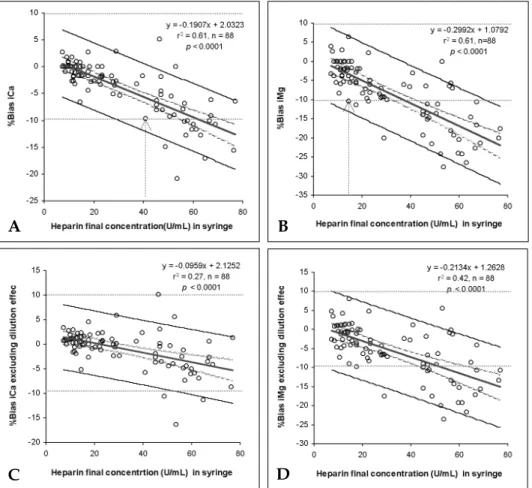
The type 1 syringe showed significant negative bias in both ionized calcium and magnesium levels (Table 2). However, the type 2 syringe, which contained less heparin, showed different results between the two tests; there was a sta- tistically significant negative mean bias (- 0.007 mmol/L) for ionized magnesium, but no signi- ficant mean bias (0.006 mmol/L) for ionized cal- cium (Table 2). The user-prepared heparinized syringes exhibited more than 10% negative bias above the level of 40 U/ml of heparin for ionized calcium (Fig. 1A), and above the level of 14 U/ml of heparin for ionized magnesium (Fig. 1B) with the user-prepared heparinized syringes. Table 3 shows that significant negative bias of the ionized magnesium compared to the ionized calcium could be observed if the dilution effect was excluded.
Table 1. The Mean Volume and Concentration of Heparin Remaining in a Blood Gas Syringe after Blood Drawing According to Syringe Type
Variable Type 1* syringe Type 2 syringe p value
Residual volume of heparin ( L)μ 75.5 ± 25.7 21.0 ± 6.7 < 0.0001
Final heparin concentration (U/mL) 47.7 ± 15.6 13.8 ± 4.3 < 0.0001
* T ype 1 syringe: heparin and air ejected once or twice such that the heparin could remain in the dead space of the syringe hub.
Type 2 syringe: heparin and air ejected carefully several times until no heparin was observed in either the syringe or the needle.
Volume of heparin solution that remained in syringes ( L).μ
Table 2. The Bias of Ionized Calcium and Ionized Magnesium Values Measured in Type 1 or Type 2 User-Prepared Syringes Compared to a Reference Type 3 Syringe Containing Calcium Balanced Lithium Heparin
Test item Bias Mean Bias (mmol/L) Range of Bias (mmol/L) *p value
Ionized
calcium Type 1 syringe 0.079 (- 0.098 to - 0.060) - 0.25 to 0.05 < 0.0001 Type 2 syringe - 0.010 (- 0.016 to - 0.004) - 0.08 to 0.03 < 0.005 Corrected bias of
type 2 syringe 0.006 (0.000 to 0.012) - 0.06 to 0.05 NS
Ionized
magnesium Type 1 syringe - 0.068 (- 0.079 to - 0.056) - 0.17 to 0.00 < 0.0001 Type 2 syringe - 0.014 (- 0.020 to - 0.009) - 0.05 to 0.02 < 0.0001 Corrected bias of
type 2 syringe - 0.007 (- 0.012 to - 0.002) - 0.04 to 0.02 < 0.01 Type 1 and Type 2 syringes were previously described in Table 1.
* p values were derived from a paired t-test between the observed and reference syringe (the commercially available blood gas
‘BD PresetTM syringe’).
Corrected bias for the dilution effect is described in the text, which represents only the heparin binding effect. The numbers in parentheses are the mean bias at the 95% confidence interval.
NS, ‘not significant’ (p > 0.05)
Fig. 1. The percent bias of ionized calcium or ionized magnesium according to the final heparin concentration in a user-prepared syringe. A: percent bias of ionized calcium. B: percent bias of ionized magnesium. C: percent bias of ionized calcium excluding the dilution effect. D: percent bias of ionized magnesium excluding the dilution effect.
A B
D
C
DISCUSSION
As the ionized fraction of magnesium is the biologically active part, its accurate determination is an important issue in critically ill patients.
5,6The CLSI recommends that whole blood determi- nations of ionized calcium be performed on speci- mens transferred into commercially available, ready-to-use syringes or capillaries anticoagulated with one of the modified preparations of heparin designed to minimize its effects on the ionized calcium.
3However, the performance of these syringes with ionized magnesium has not been documented. We found a clear reduction in mea- sured ionized magnesium levels with increasing concentrations of heparin in syringes, confirming previous reports.
2,7We postulate that ionized magnesium measurements are more greatly im- pacted by liquid heparin than ionized calcium values, as the absolute amount of ionized magne- sium is much less than that of ionized calcium.
We did not, however, confirm its mechanism. The maximum allowable heparin concentration in syringes was proposed to be 40 U/mL or 15 U/mL for ionized magnesium.
7,8For ionized calcium, the CLSI recommends that the calcium balanced heparin concentration should be 70 U/mL or less.
We found a greater than 10% negative bias above the clinical prescribed level of 40 U/mL of heparin for ionized calcium, and above the level of 14 U/
mL of heparin for ionized magnesium in user- prepared heparinized syringes, due to both dilu- tion and heparin binding effects. If the liquid heparin was deliberately and thoroughly expelled from the blood gas syringe, the mean bias in values did not exceed - 0.08 mmol/L for ionized calcium and - 0.05 mmol/L for ionized magne- sium, putting the values within a clinically accept- able range.
Although Chantler and Cox showed that self-
prepared heparinized syringes for measuring ionized magnesium and calcium were sufficiently close to dry balanced heparinized syringes to justify their use under economically constraining conditions,
9the protocol of thoroughly expelling the heparin solution should be mandated to mini- mize dilution and heparin binding effects.
In conclusion, we recommend using lyophilized calcium balanced heparinized syringes for the determination of ionized magnesium as well as ionized calcium, as we observed a greater nega- tive bias of ionized magnesium values compared with ionized calcium in the presence of residual heparin. In the case of using user-prepared syringes, a protocol for thorough evacuation of heparin solution should be standardized and mandated.
ACKNOWLEDGEMENTS
We thank Ms. Young Joo Kim and other mem- bers of the Department of Laboratory Medicine, Yongdong Severance Hospital for their excellent technical assistance.
REFERENCES
1. Sachs C, Rabouine P, Chaneac M, Kindermans C, Dechaux M. In vitro evaluation of a heparinized blood sampler for ionized calcium measurement. Ann Clin Biochem 1991;28:240-4.
2. National Committee for Clinical Laboratory Standards.
Ionized calcium determinations: precollection variables, specimen choice, collection, and handling; proposed guideline. NCCLS Document C31-A. Villonova, PA, NCCLS, 2001.
3. Ritter C, Ghahramani M, Marsoner HJ. More on the measurement of ionized magnesium in whole blood.
Scand J Clin Lab Invest Suppl 1996;224:275-80.
4. Toffaletti JG, Wildermann RF. The effects of heparin Table 3.Comparison of the Mean Bias of Ionized Calcium and Magnesium Measurements with Heparin Concentration
Effect Mean bias (mmol/L)
p value Ionized calcium Ionized magnesium
Heparin binding plus dilution - 0.044 ± 0.058 - 0.041 ± 0.04 NS
Heparin binding only - 0.009 ± 0.042 - 0.026 ± 0.032 < 0.0001
anticoagulants and fill volume in blood gas syringes on ionized calcium and magnesium measurements. Clin Chim Acta 2001;304:147-51.
5. Sanders GT, Huijgen HJ, Sanders R. Magnesium in disease: a review with special emphasis on the serum ionized magnesium. Clin Chem Lab Med 1999;37:1011- 33.
6. Huijgen HJ, Soesan M, Sanders R, Mairuhu WM, Kesecioglu J, Sanders GT. Magnesium levels in criti- cally ill patients. What should we measure? Am J Clin
Pathol 2000;114:688-95.
7. van Ingen HE, Huijgen HJ, Kok WT, Sanders GT.
Analytical evaluation of Kone Microlyte determination of ionized magnesium. Clin Chem 1994;40:52-5.
8. Maj-Zurawska M. Clinical findings on human blood with the KONE ISE for Mg2+. Scand J Clin Lab Invest Suppl 1994;217:69-76.
9. Chantler J, Cox DJ. Self-prepared heparinized syringes for measuring ionized magnesium in critical care patients. Br J Anaesth 1999;83:810-2.