INTRODUCTION
The management of neuropathic pain has been highlighted for
the treatment of degenerative spinal disease. Not only ischemia in nerve tissue but also a neuropathic pain mechanism was im- plicated in the genesis of leg pain in patients with degenerative spinal disease because compressed nerve roots exhibit edema, fibrosis, demyelination, and axonal degeneration of the in- volved neural element.1-3 Therefore, pharmacological treatment should be aimed at the management of the neuropathic com- ponent of pain for the effective treatment of degenerative spi- nal disease.4,5
For this treatment approach, proper assessment of the neu- ropathic pain component in degenerative spinal disease is im- perative, and discrimination or subcategorization according to the presence of neuropathic pain in patients with degenerative spinal disease is a prerequisite. Hitherto, several questionnaires have been used for the assessment of neuropathic pain, includ-
Validation of the Korean Version of the DN4 Diagnostic Questionnaire for Neuropathic Pain in Patients with Lumbar or Lumbar-Radicular Pain
Ho-Joong Kim1*, Joon-Hee Park2*, Didier Bouhassira3, Jae-Hoon Shin1, Bong-Soon Chang4, Choon-Ki Lee4, Chang Hyun Baek5, and Jin S. Yeom1
1Spine Center, Department of Orthopaedic Surgery, Seoul National University College of Medicine, Seoul National University Bundang Hospital, Seongnam;
2Department of Anesthesiology & Pain Medicine, Kangdong Sacred Heart Hospital, Hallym University College of Medicine, Seoul, Korea;
3Inserm U987, Ambroise Pare Hospital, Boulogne-Billancourt and UVSQ University, Versailles, France;
4Department of Orthopaedic Surgery, Seoul National University College of Medicine, Seoul National University Hospital, Seoul;
5Department of Mechanical and Control Engineering, The Cyber University of Korea, Seoul, Korea.
Purpose: To evaluate the diagnostic value of the Korean version of the Douleur Neuropathique 4 (DN4) questionnaire and to vali- date this questionnaire in terms of psychometric properties in patients with chronic pain due to degenerative spinal disease.
Materials and Methods: The Korean version of the DN4 questionnaire, which was translated and linguistically validated by the MAPI Research Group, was tested on 83 patients with lumbar or lumbar-radicular pain. Test-retest reliability was evaluated in a subsample of 40 patients who completed two assessments with an interval of 2 weeks. Nociceptive pain and neuropathic compo- nent pain were diagnosed in 40 and 43 patients, respectively.
Results: The Cronbach’s α coefficient of internal consistency was 0.819, and the test-retest intraclass correlation coefficient (3, 1) (95% confidence interval) was 0.813 (0.776–0.847) (n=40). The area under the receiver-operator characteristics curve was 0.953 (p<0.001), with 95% confidence interval between 0.869 and 0.990. The Korean version of the DN4 questionnaire showed a sensi- tivity of 100% and 87.1%, and a specificity of 88.2% and 94.1% at the cutoff value of 3/10 and 4/10, respectively, for discriminating neuropathic component pain.
Conclusion: The present study demonstrated the good discriminatory power of DN4 between nociceptive pain and neuropathic component pain in patients with lumbar or lumbar-radicular pain.
Key Words: Neuropathic pain, Korean language, Douleur Neuropathique 4 questionnaire, psychometric validation Yonsei Med J 2016 Mar;57(2):449-454
http://dx.doi.org/10.3349/ymj.2016.57.2.449 pISSN: 0513-5796 · eISSN: 1976-2437
Received: April 22, 2015 Revised: June 16, 2015 Accepted: July 17, 2015
Corresponding author: Dr. Jin S. Yeom, Spine Center, Department of Orthopae- dic Surgery, Seoul National University College of Medicine, Seoul National Uni- versity Bundang Hospital, 82 Gumi-ro 173 beon-gil, Bundang-gu, Seongnam 13620, Korea.
Tel: 82-31-787-7195, Fax: 82-31-787-4056, E-mail: [email protected]
*Ho-Joong Kim and Joon-Hee Park contributed equally to this work.
•The authors have no financial conflicts of interest.
© Copyright: Yonsei University College of Medicine 2016
This is an Open Access article distributed under the terms of the Creative Com- mons Attribution Non-Commercial License (http://creativecommons.org/licenses/
by-nc/3.0) which permits unrestricted non-commercial use, distribution, and repro- duction in any medium, provided the original work is properly cited.
ing the Leeds Assessment of Neuropathic Symptoms and Signs Pain Scale, the ID Pain, Neuropathic Pain, painDETECT, and Douleur Neuropathique 4 (DN4) questionnaires.6-10
The DN4 questionnaire was developed by the French Neuro- pathic Pain Group as a clinic-based instrument for identifying patients whose pain has a predominantly neuropathic mecha- nism,9,11 and was designed as an easy-to-use diagnostic ques- tionnaire and is composed of 10 “yes” or “no” items; seven items are related to pain quality (i.e., sensory and pain descrip- tors) based on interviews with patients, whereas three items are based on clinical examination and are related to the presence or absence of touch or pinprick hypoesthesia and tactile allo- dynia. The total score is calculated as the sum of all 10 items, and the cutoff value for the diagnosis of neuropathic pain is a total score of 4/10.9 The DN4 questionnaire has been shown to have very good sensitivity (83%) and specificity (90%) for the identification of chronic pain associated with a lesion in the nervous system (either peripheral or central).9,12
Nevertheless, to apply or use this assessment tool in non- English speaking countries, the questionnaires should undergo a standardized process of translation, cross-cultural adaptation, and psychometric validation in terms of its ability to take into account culture-specific conditions.13 The analysis of psycho- metric validation included reliability (internal consistency, in- ter-rater agreement) and validity (receiver operating charac- teristics curve) analysis. Even though the DN4 questionnaire has been translated linguistically,14 the psychometric validation of the Korean version of the DN4 questionnaires was not per- formed yet.11,12,15-17 We hypothesized that the present linguisti- cally validated DN4 would have good psychometric properties.
Therefore the objectives of this study were to evaluate the diag- nostic value of the Korean version of the DN4 questionnaire and to validate this questionnaire in terms of psychometric properties in patients with chronic pain due to degenerative spinal disease.
MATERIALS AND METHODS
Study design and patients
The study was approved by the hospital institutional review board. The study was designed as an observational, prospective collected data and retrospective analysis. All data, including the DN4 questionnaire results, were recorded as part of the routine care of patients with lumbar or lumbar-radicular pain due to degenerative lumbar disease. Therefore, we did not take the signed informed consent. The inclusion criteria were patients 1) from 35 to 85 years old: this age criterion was decided consider- ing the capability to understand the questionnaires; 2) visiting the outpatient’s facilities for chronic lumbar and/or lumbar-ra- dicular pain due to degenerative spinal disease; 3) with a pain duration of ≥3 months, because the present study dealt with chronic pain; 4) with moderate or severe pain intensity [scoring
4 or higher on the Visual Analogue Scale (VAS) for back or leg pain]; and 5) who are native Korean speakers.
The exclusion criteria were patients with other severe muscu- loskeletal pain, major comorbidity (e.g., malignant disorders or sepsis), fibromyalgia, headache or visceral pain, cognitive im- pairment or intellectual disability, and severe depression or psychosis. The study was carried out at the spine center of a ter- tiary-care teaching institution between November 2014 and January 2015. The Korean version of the DN4 questionnaire was used, which was translated and linguistically validated by the MAPI Research Group.18 The principal investigator who an expert in degenerative spinal disease and neuropathic pain, proposed the diagnosis of neuropathic component or nocicep- tive pain without the information from the DN4 questionnaire by using medical history taking and examination according to usual clinical practice. The diagnosis of the principal investiga- tor was considered the gold standard. Before this gold standard diagnosis, a research coordinator, blinded to the diagnosis pro- posed by the principal investigator, administered the DN4 ques- tionnaire. In addition, to investigate the test-retest reliability, a research coordinator administered the DN4 questionnaire for a second time in a subsample of 40 patients, 2 weeks after the first. For inter-rater reliability, the DN4 questionnaire was ad- ministered twice in a subsample of 30 patients by an another investigator. Between the two visits, patient underwent further radiological examinations such as plain X-ray and/or magnetic resonance image of lumbar spine. If necessary, patient took medications such as non-steroid anti-inflammatory drugs (NSAIDs) or acetaminophen.
Statistical analysis
Internal consistency was evaluated, by using the Cronbach’s α coefficient, to assess the contribution of each item to the con- cept measured by the questionnaire. Cronbach’s α was first as- sessed for the complete questionnaire; then, each item was re- moved to assess the independent contribution of each item to the measurement error of the instrument. For inter-rater reli- ability, the Cohen’s kappa coefficient was used to measure the agreement of the results obtained by two different raters for each item and for the total score of the DN4 questionnaire. The test-retest reliability was assessed by comparing the replies in the first and second administrations of the DN4 questionnaire in a subsample of subjects (n=40), by using the intraclass corre- lation coefficient (ICC). In addition, we calculated that a mini- mum sample of 88 patients would be required for the current study, with expected area under the curve (AUC) would be 0.7 and a ratio (negative/positive groups) of 1.5, based on an alpha of 0.05 and beta of 0.10. Receiver-operator characteristics (ROCs) analysis was done to assess the utility of the DN4 total score in distinguishing patients who had neuropathic component pain defined by the gold standard diagnosis of the principal investi- gator. The AUC and its 95% confidence intervals (CIs) for the ROC curve were calculated. The AUC is a measure of the diag-
nostic power of the test. An AUC of ≤0.60 is considered “nega- tive”; 0.61 to 0.80, “doubtful”; 0.81 to 0.90, “good”; and ≥0.91,
“very good.”17 This also determined and set the ideal cutoff to provide the best sensitivity and specificity values for the diag- nosis of neuropathic component pain and the determination of Youden’s index. All statistical analyses were performed by using the SPSS 20.0.0 statistics package (SPSS Inc., Chicago, IL, USA).
A value of p<0.05 was accepted as significant.
RESULTS
Descriptive data of participants
Between November 2014 and January 2015, 115 patients not previously examined by the principal investigator were evaluat- ed at the spine center of a tertiary-care teaching institution and were eligible candidates to participate in this study. Of the 115 patients, 83 who met the inclusion criteria were included. On the other hand, 32 patients were excluded from the study: 15 patients had pain of <3 months’ duration, 12 patients had other severe musculoskeletal pain and/or fibromyalgia, and 5 pa- tients had major depression. Nociceptive pain and neuropathic component pain were diagnosed in 40 and 43 patients, respec- tively. Table 1 shows the baseline demographic data and char- acteristics of patients in each of the study groups. There were no differences in demographic characteristics between the two groups. Patients with neuropathic component pain showed a statistically significantly higher VAS score for leg pain than pa- tients with nociceptive pain (p<0.001). The most common cause of nociceptive pain and neuropathic component pain was me- chanical low back pain (87.5%) and spinal stenosis (62.8%), re- spectively. The mean DN4 score differed significantly between the two groups (p<0.001) (Table 1). There was a significant cor- relation between the total DN4 score and the VAS score for leg pain (r=0.521, p<0.001).
Internal consistency, inter-rater reliability and test-retest reliability
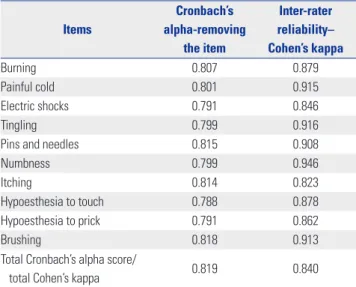
The Cronbach’s α coefficient of the internal consistency of the Korean version of the DN4 questionnaire, which measures the extent to which items of a scale represent a common underly- ing variable, was 0.819. The Cronbach’s α coefficients did not improve when each scale item was successively removed (val- ues ranging from 0.788 and 0.818), justifying the contribution of each item to the concept evaluated by the questionnaire (Table 2). As for inter-rater reliability, Cohen’s kappa coefficients for each item ranged from 0.823 to 0.946, and Cohen’s kappa coef- ficient for total DN4 score was 0.84 (Table 2). In an interval of 2 weeks, the test-retest ICC (3, 1) (95% CI) was 0.813 (0.776–0.847) (n=40). Test-retest coefficients >0.7 are generally accepted as sufficient, and coefficients >0.8 are considered as good.19 Psychometric validation
The AUC measured was 0.953 (p<0.001) with 95% CI between 0.869 and 0.990, and a standard error of 0.031 (Fig. 1). The result confirms the high discriminant power of the Korean version of the DN4 questionnaire. In the assessment of the suitability of the cutoff point, the sensitivity and specificity tests, as well as Youden’s index, indicated that 3 and 4 are the ideal cutoff val- ues for the sum of scores obtained in the items of the DN4 questionnaire. The cutoff point of 3 simultaneously represents a sensitivity of 100%, specificity of 88.2%, and Youden’s index of 0.882. Furthermore, the cutoff point of 4 simultaneously repre- sents a sensitivity of 87.1%, specificity of 94.1%, and Youden’s index of 0.812 (Fig. 1).
DISCUSSION
Study population
The present study demonstrated the good discriminatory pow- er of the linguistically validated Korean version of the DN4 ques- tionnaire, between nociceptive pain and neuropathic compo- Table 1. Descriptive Statistics of the Subjects in the Study
Nociceptive pain (40) Neuropathic component pain (43) p value
Age (yrs) 60.6±12.1 64.3±11.9 0.226
Female, n (%) 15 (75.0) 14 (70.0) 0.723
BMI (kg/cm2) 22.53±6.38 23.72±8.15 0.357
VAS for back pain 4.0±2.7 3.7±3.5 0.593
VAS for leg pain 2.7±2.5 6.5±2.8 <0.001
DN4 1.5 5.7 <0.001
Symptom duration (months) 6.7±3.2 5.5±5.1 0.423
Diagnosis Discogenic back pain: 35
Degenerative spondylosis: 5
Spinal stenosis: 27 Herniated lumbar disc: 5 Degenerative spondylolisthesis: 6 Spondylolytic spondylolisthesis: 5 BMI, body mass index; SD, standard deviation; VAS, Visual Analog Scale; DN4, Douleur Neuropathique 4.
Values are mean±SD.
nent pain in patients with lumbar or lumbar-radicular pain. It should be acknowledged that our study population included only patients with lumbar or lumbar-radicular pain due to de- generative lumbar disease. However, previous studies have shown that the neuropathic component of “mixed pain” has clinical characteristics similar to those of pure neuropathic pain.12,20 In addition, previous studies have also proved that the DN4 questionnaire has a high discriminatory power between neuropathic component pain and nociceptive pain in patients with mixed pain.12,16 Furthermore, almost all patients have spi- nal pathologies of neural elements such as nerve compression in the neuropathic component group, whereas all patients complained mechanical low back pain in the nociceptive group (Table 1). This result was consistent with a previous report re- garding the redefining and grading of neuropathic pain,21 sug- gesting that the lesion of somatosensory system was prerequi- site for diagnosis of neuropathic pain.
Internal consistency, inter-rater reliability and test-retest reliability
Table 2 shows the results of internal consistency of the instru- ment. Our results were slightly higher than that obtained with the other language versions of the DN4 questionnaire,11,12,15,16
underlining the importance of each questionnaire item. It is highly likely that this was due to the characteristic of partici- pants of having a single disease entity (i.e., lumbar or lumbar- radicular pain by degenerative spinal disease), whereas other previous studies dealt with various neuropathic diseases. How- ever, when each item was removed, no increases in the total Cronbach’s α coefficients were found in the present study (Ta- ble 2). Furthermore, inter-rater agreement was very good, show- ing the kappa coefficient ranging from 0.823 to 0.946.16
In this study, 40 patients completed the questionnaire twice with an interval of 2 weeks. Compared with the other language versions of DN4,11,12,16 the ICC (3, 1) of the Korean version of DN4
was slightly lower. This is likely due to longer interval, disease characteristics of the participants, and initiation of medica- tion during the interval. The longer interval is related to the deterioration of correlation coefficients.22 Furthermore, al- though degenerative spinal disease has the characteristics of chronic disease, its symptoms would have episodic and/or variable clinical manifestation during the natural course of the disease. In addition, the mediation of NSAIDs or acetamin- ophen for the assessment interval might relieve or change the patients’ symptom. Therefore, these would also attribute to the lower correlation coefficient.
Psychometric properties
Identification of neuropathic components is critical to the medical treatment of degenerative spinal disease because the therapeutic approach for these patients should be different from that for patients with only nociceptive pain.2,23,24 The pres- ent study showed that the Korean version of DN4 has excellent psychometric properties: we confirmed its high discriminative ability in patients with neuropathic component pain or noci- ceptive pain, with an AUC score of 0.953, a sensitivity of 100%
and 87.1%, and a specificity of 88.2% and 94.1% at the cutoff values of 3/10 and 4/10, respectively. This finding is consistent with previous studies with other languages,11,12,16 where the cut- off value for the DN4 questionnaire in most of them was estab- lished at 4/10. In the Dutch version of the DN4 questionnaire, 5/10 was considered as an ideal cutoff value.17 This disparity highlights the importance of analyzing the psychometric prop- erties of the screening questionnaires in different languages, in addition to the linguistic validations. The present study showed
Table 2. Cronbach’s Alpha to the Items of the Instrument Items
Cronbach’s alpha-removing
the item
Inter-rater reliability–
Cohen’s kappa
Burning 0.807 0.879
Painful cold 0.801 0.915
Electric shocks 0.791 0.846
Tingling 0.799 0.916
Pins and needles 0.815 0.908
Numbness 0.799 0.946
Itching 0.814 0.823
Hypoesthesia to touch 0.788 0.878
Hypoesthesia to prick 0.791 0.862
Brushing 0.818 0.913
Total Cronbach’s alpha score/
total Cohen’s kappa 0.819 0.840
Fig. 1. ROC curve and AUC for the total score of the DN4 questionnaire:
the figure shows the cut-off point of optimizing sensitivity and specificity values for discriminating between nociceptive pain and neuropathic component pain in patients with degenerative spinal disease. AUC, area under the curve; ROC, receiver operating characteristics; DN4, Douleur Neuropathique 4.
Cutoff=4.0
0.0 0.2 0.4 0.6 0.8 1.0 1-specificity
Sensitivity
1.0
0.8
0.6
0.4
0.2
0.0
two ideal cutoff values of 3/10 and 4/10. However, in view of the screening test, the cutoff value of 4/10 would be more ideal than 3/10, thus slightly differing from other validation finding.12,15,16 These discrepancies may be explained by the differences in study design. As noted earlier, the present study included only patients with lumbar or lumbar-radicular pain. These patients did not present pure neuropathic pain, but rather “mixed pain”
with a neuropathic component. Nonetheless, this study showed that the discriminatory ability of the Korean version of the DN4 questionnaire cannot be influenced by disease characteristics such as the mixed nature of pain. This also agrees with previous studies.12,16
Weakness and strength
First, as previously noted, the current study included patients with lumbar or lumbar-radicular pain for the validation of the DN4 questionnaire. This feature is unique to this study. Howev- er, because there are many kinds of diseases causing neuropath- ic pain that should be assessed with the validated DN4 ques- tionnaire, the narrow disease spectrum of the subjects such as degenerative lumbar disease is the main limitation of this study in view of generalizability. Furthermore, a recent study has re- ported redefinition and grading of neuropathic pain.21 Accord- ing to this grading system,21 the patients of the neuropathic component group in the present study would range from possi- ble to definite neuropathic pain. Recent studies have consis- tently emphasized the identification and treatment of neuro- pathic pain component for the treatment of degenerative spinal disease.2,23-26 In this perspective, the present study also high- lights possible or probable neuropathic pain of degenerative spinal disease. Second, it has not yet been determined whether the DN4 questionnaire can be used to detect possible or proba- ble neuropathic pain. However, since this study also demon- strated the successful implementation of the DN4 question- naire, it is highly possible that DN4 can be implemented for discriminating possible or probable neuropathic pain even in lumbar or lumbar-radicular pain due to degenerative spinal disease, which is more common in real clinical settings. Further- more, a previous study has also shown discriminating power for mixed pain.12 Finally, the gold standard decision of neuro- pathic pain by only one expert is an another limitation of this study. Most of the DN4 validation studies have used two experts to determine whether the pain was neuropathic/nociceptive or mixed.16,17
In conclusion, the current study demonstrated the good dis- criminatory power of the Korean version of DN4 between noci- ceptive pain and neuropathic component pain in patients with lumbar or lumbar-radicular pain due to degenerative lumbar spine disease.
ACKNOWLEDGEMENTS
This work (Grants No. C0248313) was supported by Business for
Cooperative R&D between Industry, Academy, and Research Institute funded Korea Small and Medium Business Adminis- tration in 2014.
REFERENCES
1. Sekiguchi M, Kikuchi S, Myers RR. Experimental spinal stenosis:
relationship between degree of cauda equina compression, neu- ropathology, and pain. Spine (Phila Pa 1976) 2004;29:1105-11.
2. Takahashi N, Arai I, Kayama S, Ichiji K, Fukuda H, Kaga T, et al.
Therapeutic efficacy of pregabalin in patients with leg symptoms due to lumbar spinal stenosis. Fukushima J Med Sci 2014;60:35-42.
3. Yaksi A, OzgÖnenel L, OzgÖnenel B. The efficiency of gabapentin therapy in patients with lumbar spinal stenosis. Spine (Phila Pa 1976) 2007;32:939-42.
4. Lee SY, Kim TH, Oh JK, Lee SJ, Park MS. Lumbar stenosis: a recent update by review of literature. Asian Spine J 2015;9:818-28.
5. Baliga S, Treon K, Craig NJ. Low back pain: current surgical ap- proaches. Asian Spine J 2015;9:645-57.
6. Bennett M. The LANSS Pain Scale: the Leeds assessment of neuro- pathic symptoms and signs. Pain 2001;92:147-57.
7. Portenoy R. Development and testing of a neuropathic pain screen- ing questionnaire: ID Pain. Curr Med Res Opin 2006;22:1555-65.
8. Krause SJ, Backonja MM. Development of a neuropathic pain ques- tionnaire. Clin J Pain 2003;19:306-14.
9. Bouhassira D, Attal N, Alchaar H, Boureau F, Brochet B, Bruxelle J, et al. Comparison of pain syndromes associated with nervous or somatic lesions and development of a new neuropathic pain di- agnostic questionnaire (DN4). Pain 2005;114:29-36.
10. Freynhagen R, Baron R, Gockel U, TÖlle TR. painDETECT: a new screening questionnaire to identify neuropathic components in patients with back pain. Curr Med Res Opin 2006;22:1911-20.
11. Harifi G, Ouilki I, El Bouchti I, Ouazar MA, Belkhou A, Younsi R, et al. Validity and reliability of the Arabic adapted version of the DN4 questionnaire (Douleur Neuropathique 4 questions) for differen- tial diagnosis of pain syndromes with a neuropathic or somatic component. Pain Pract 2011;11:139-47.
12. Perez C, Galvez R, Huelbes S, Insausti J, Bouhassira D, Diaz S, et al. Validity and reliability of the Spanish version of the DN4 (Dou- leur Neuropathique 4 questions) questionnaire for differential di- agnosis of pain syndromes associated to a neuropathic or somatic component. Health Qual Life Outcomes 2007;5:66.
13. Beaton DE, Bombardier C, Guillemin F, Ferraz MB. Guidelines for the process of cross-cultural adaptation of self-report measures.
Spine (Phila Pa 1976) 2000;25:3186-91.
14. Van Seventer R, Vos C, Meerding W, Mear I, Le Gal M, Bouhassira D, et al. Linguistic validation of the DN4 for use in international studies. Eur J Pain 2010;14:58-63.
15. Santos JG, Brito JO, de Andrade DC, Kaziyama VM, Ferreira KA, Souza I, et al. Translation to Portuguese and validation of the Dou- leur Neuropathique 4 questionnaire. J Pain 2010;11:484-90.
16. Sykioti P, Zis P, Vadalouca A, Siafaka I, Argyra E, Bouhassira D, et al. Validation of the Greek Version of the DN4 diagnostic question- naire for neuropathic pain. Pain Pract 2015;15:627-32.
17. van Seventer R, Vos C, Giezeman M, Meerding WJ, Arnould B, Reg- nault A, et al. Validation of the Dutch version of the DN4 diagnostic questionnaire for neuropathic pain. Pain Pract 2013;13:390-8.
18. Bouhassira D. Neuropathic Pain 4 Questions (DN4). [accessed on 2015 Feb 1]. Available at: http://www.proqolid.org/instruments/
neuropathic_pain_4_questions_dn4?fromSearch=yes&text=yes.
19. Lohr KN, Aaronson NK, Alonso J, Burnam MA, Patrick DL, Perrin EB, et al. Evaluating quality-of-life and health status instruments:
development of scientific review criteria. Clin Ther 1996;18:979-92.
20. Freynhagen R, Baron R, TÖlle T, Stemmler E, Gockel U, Stevens M, et al. Screening of neuropathic pain components in patients with chronic back pain associated with nerve root compression: a pro- spective observational pilot study (MIPORT). Curr Med Res Opin 2006;22:529-37.
21. Treede RD, Jensen TS, Campbell JN, Cruccu G, Dostrovsky JO, Griffin JW, et al. Neuropathic pain: redefinition and a grading sys- tem for clinical and research purposes. Neurology 2008;70:1630-5.
22. Miekisiak G, Kollataj M, Dobrogowski J, Kloc W, Libionka W, Ban- ach M, et al. Validation and cross-cultural adaptation of the Polish version of the Oswestry Disability Index. Spine (Phila Pa 1976) 2013;
38:E237-43.
23. Baron R, Freynhagen R, TÖlle TR, Cloutier C, Leon T, Murphy TK,
et al. The efficacy and safety of pregabalin in the treatment of neu- ropathic pain associated with chronic lumbosacral radiculopathy.
Pain 2010;150:420-7.
24. Kasimcan O, Kaptan H. Efficacy of gabapentin for radiculopathy caused by lumbar spinal stenosis and lumbar disk hernia. Neurol Med Chir (Tokyo) 2010;50:1070-3.
25. Kaye AD, Beuno FR, Katalenich B, Stell C, Liu H, Rosinia FA, et al.
The effects of gastroretentive gabapentin (Gralise®) on spinal ste- nosis patients with radicular pain. Pain Physician 2014;17:169-78.
26. Fishbain DA, Cole B, Lewis JE, Gao J. What is the evidence that neuropathic pain is present in chronic low back pain and soft tis- sue syndromes? An evidence-based structured review. Pain Med 2014;15:4-15.