Effect of frontal facial type and sex on preferred chin projection
Objective: To investigate the effects of frontal facial type (FFT) and sex on preferred chin projection (CP) in three-dimensional (3D) facial images. Methods:
Six 3D facial images were acquired using a 3D facial scanner (euryprosopic [Eury-FFT], mesoprosopic [Meso-FFT], and leptoprosopic [Lepto-FFT] for each sex). After normal CP in each 3D facial image was set to 10
oof the facial profile angle (glabella–subnasale-pogonion), CPs were morphed by gradations of 2
ofrom normal (moderately protrusive [6
o], slightly protrusive [8
o], slightly retrusive [12
o], and moderately retrusive [14
o]). Seventy-five dental students (48 men and 27 women) were asked to rate the CPs (6
o, 8
o, 10
o, 12
o, and 14
o) from the most to least preferred in each 3D image. Statistical analyses included the Kolmogorov-Smirnov test, Kruskal-Wallis test, and Bonferroni correction.
Results: No significant difference was observed in the distribution of preferred CP in the same FFT between male and female evaluators. In Meso-FFT, the normal CP was the most preferred without any sex difference. However, in Eury- FFT, the slightly protrusive CP was favored in male 3D images, but the normal CP was preferred in female 3D images. In Lepto-FFT, the normal CP was favored in male 3D images, whereas the slightly retrusive CP was favored in female 3D images. The mean preferred CP angle differed significantly according to FFT (Eury-FFT: male, 8.7
o, female, 9.9
o; Meso-FFT: male, 9.8
o, female, 10.7
o; Lepto- FFT: male, 10.8
o, female, 11.4
o; p < 0.001). Conclusions: Our findings might serve as guidelines for setting the preferred CP according to FFT and sex.
[Korean J Orthod 2017;47(2):108-117]
Key words: Three-dimensional facial images, Chin projection, Frontal facial type, Sex
Jin-Young Choi
a,bTaeyun Kim
aHyung-Mo Kim
cSang-Hoon Lee
dIl-sik Cho
eSeung-Hak Baek
b,fa
Department of Oral and Maxillofacial Surgery, School of Dentistry, Seoul National University, Seoul, Korea
b
Dental Research Institute, Seoul National University, Seoul, Korea
c
Department of Oral and Maxillofacial Surgery, Soonchunhyang University Bucheon Hospital, Bucheon, Korea
d
Private Practice, Busan, Korea
e
Private Practice, Pohang, Korea
f
Department of Orthodontics, School of Dentistry, Seoul National University, Seoul, Korea
Received May 31, 2016; Revised August 2, 2016; Accepted August 3, 2016.
Corresponding author: Seung-Hak Baek.
Professor, Department of Orthodontics, School of Dentistry, Dental Research Institute, Seoul National University, 101 Daehak-ro, Jongno-gu, Seoul 03080, Korea.
Tel +82-2-2072-3952 e-mail [email protected]
© 2017 The Korean Association of Orthodontists.
The authors report no commercial, proprietary, or financial interest in the products or companies described in this article.
This is an Open Access article distributed under the terms of the Creative Commons Attribution Non-Commercial License (http://creativecommons.org/licenses/by-nc/4.0) which permits unrestricted non-commercial use, distribution, and reproduction in any medium, provided the original work is properly cited.
pISSN 2234-7518 • eISSN 2005-372X
https://doi.org/10.4041/kjod.2017.47.2.108
INTRODUCTION
One of the main objectives of orthodontic treatment and/or orthognathic surgery is to improve facial harmony and beauty. Although the perception of these characteristics varies according to cultures, socioeconomic status, and era, clinicians have traditionally measured the distance, angulation, and proportion of hard and soft tissues to evaluate the facial type and profile.
1-8In terms of facial profile, the preferred chin projection has been well investigated because it has a strong impact on the harmony between the upper, middle, and lower face; the shape and contour of the lower lip; and the mentolabial sulcus.
5,6,9,10Although the chin can be placed in a normal position by orthognathic surgery, some patients prefer a slightly more retrusive or protrusive chin than a normal chin. The reasons for the difference in preferred chin projection among patients might be the following: first, the final goal of chin projection is different for clinicians and patients; and second, the effect of chin projection on frontal facial appearance has not been properly assessed.
The assessment of frontal facial type (FFT) is important because patients usually evaluate their face by using a mirror before and after orthodontic treatment and/or orthognathic surgery. The most commonly used index, which can describe the FFT, is the facial index.
4,11-15It represents the ratio between the height of the middle and lower face (soft-tissue nasion–soft-tissue gnathion) and the interzygomatic width (soft-tissue zy on the
right side–soft-tissue zy on the left side) (Figure 1), and is classified as euryprosopic, mesoprosopic, or leptoprosopic.
4,11,12,14,15Although numerous two-dimensional methods, including silhouettes, photographs, and digitally modified images, have been used to investigate the preferred chin projection,
2,16-19these methods have some
Zy'
N'
Sto'
Gn'
Zy'
Facial index =
Interzygomatic width (zy'-zy') Nasion' to gnathion' (N'-Gn')
Figure 1. Facial index represents the ratio between the height of the middle and lower face (soft-tissue nasion–
soft-tissue gnathion) and the interzygomatic width (soft- tissue zy on the right side–soft-tissue zy on the left side).
Table 1. Facial index
Variable Facial type
Euryprosopic Mesoprosopic Leptoprosopic Range of index
Male < 0.83 0.84−0.87 > 0.88
Female < 0.80 0.81−0.84 > 0.85
Actual indices of the six 3D images Male
Height of the middle and lower face 37.5 45 45
Interzyg-omatic width 46 52.5 47
Facial index 0.82 0.86 0.98
Female
Height of the middle and lower face 36 38.4 36.4
Interzy-gomatic width 45 44 40
Facial index 0.8 0.87 0.91
Facial index represents the ratio between the height of the middle and lower face (soft-tissue nasion–soft-tissue gnathion) and
the interzygomatic width (soft-tissue zy on the right side– soft-tissue zy on the left side), as described by Martin and Saller.
153D, Three dimensional.
limitations in terms of evaluating the esthetic chin position, such as unrealistic impression and distortion of the facial images.
5,20,21Recently three-dimensional (3D) morphing programs have been introduced to predict soft-tissue changes related to orthodontic treatment and/or orthognathic surgery.
22,23These 3D morphing techniques can modify the extent of chin projection without distorting images of facial areas, thereby resulting in a more realistic impression of diverse facial types and profiles.
The perception of facial harmony and beauty can also vary according to the occupation and age of the evaluators, sex and age of the subjects, as well as other conditions.
4,16-23Therefore, to avoid bias, the experimental conditions should be standardized as follows: 1) the occupation of the evaluators should be the same; 2) the age of the evaluators should preferably match that of the patients to reflect trends in society
(e.g., twenties and early thirties); 3) the same subjects should be evaluated by both male and female evaluators;
and 4) the facial images should be realistic despite the extent of modification of chin projection.
Although numerous previous studies have investigated the preferred chin projection in the profile view by using samples from various ethnicities and evaluators from different professions,
22-30few studies have explored the relationship between an esthetically preferred chin projection and FFT. Therefore, the purpose of this study was to investigate the effects of FFT and sex on esthetically preferred chin projection in 3D facial images, especially in the Korean population. The null hypothesis was that there would be no significant difference in esthetically preferred chin projection in terms of FFT and sex.
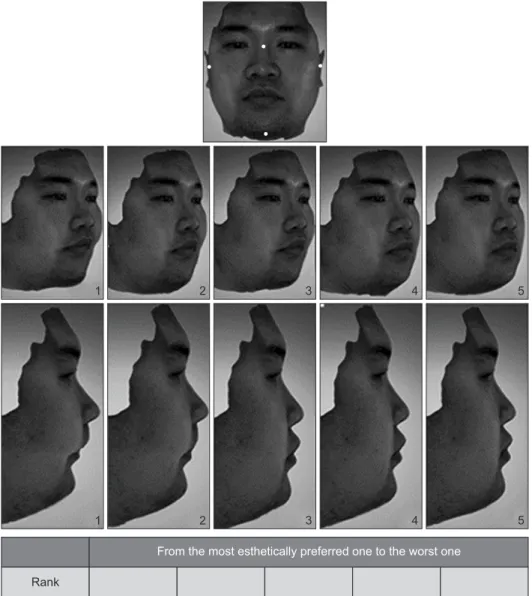
1 2 3 4 5
1 2 3 4 5
Rank
From the most esthetically preferred one to the worst one
Figure 2. Three-dimensional
(3D) facial scan images of a
man with an euryprosopic
facial type and modification
of the chin projection by
changing the facial profile
angle (glabella–subnasale-
pogonion) by gradations of
2
o(1, moderately retrusive
[14
o]; 2, slightly retrusive
[12
o]; 3, normal [10
o]; 4,
slightly protrusive [8
o]; and 5,
moderately protrusive [6
o]) by
using Morpheus 3D Aesthetic
Solution software (ver. 2.0,
Morpheus Co. Ltd., Seoul,
Korea).
MATERIALS AND METHODS
Determination of the FFT
The FFT was determined using the facial index, which is the ratio between the height of the middle and lower face (soft-tissue nasion–soft-tissue gnathion) and the interzygomatic width (soft-tissue zy on the right side–
soft-tissue zy on the left side).
14The facial indices in each sex are enumerated in Table 1 according to the Martin-Saller scale.
15Six 3D facial images (three of men and three of women with Class I skeletal and dental relationships; and with the following three FFTs for each sex: euryprosopic [Eury-FFT], mesoprosopic [meso-FFT], and leptoprosopic [lepto-FFT]) were acquired using a 3D facial optical scanner (Morpheus 3D scanner; Morpheus Co., Ltd., Seoul, Korea). Consent for using the 3D images was obtained from the subjects. The actual height of the middle and lower face, interzygomatic width, and facial indices of the six 3D facial images are enumerated in
Table 1.
Five types of chin projection in the three FFTs
Using the Morpheus 3D Aesthetic Solution software (ver.
2.0; Morpheus Co., Ltd.), the normal chin projection in each 3D facial image was set to 10
oof the soft- tissue facial profile angle (glabella–subnasale-pogonion) based on the findings of previous studies on Korean adult facial profiles.
6-8The chin projections were then morphed by gradations of 2
ofrom the normal projection (10
o) (moderately protrusive [6
o], slightly protrusive [8
o], slightly retrusive [12
o], and moderately retrusive [14
o]).
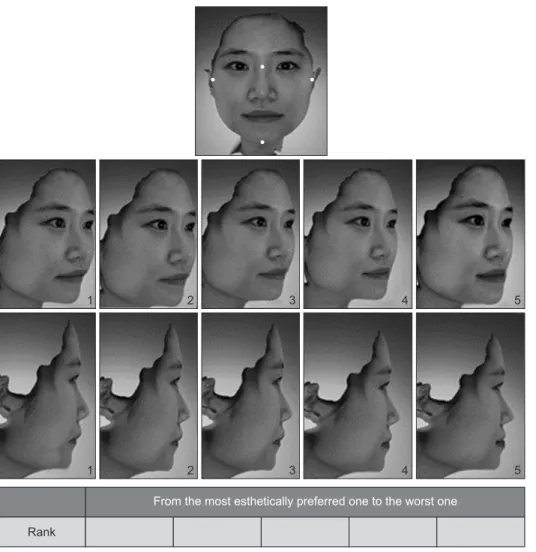
For each chin position, the survey participants were shown images in the 45
oangled and 90
olateral views (Figures 2–7).
Rating the preferred chin projection in the three FFTs The survey participants were 75 dental students from the School of Dentistry, Seoul National University, Seoul, Korea (48 men and 27 women; mean age, 28.9 ± 3.3
Rank
From the most esthetically preferred one to the worst one
11
2
2
3
3
4
4
5
5
Figure 3. Three-dimensional
facial scan images of a man
with a mesoprosopic facial
type and modification of the
chin projection as described
in the legend of Figure 2.
years), who were asked to rate the five chin projections (6
o, 8
o, 10
o, 12
o, and 14
o) from the most to least esthetically preferred in each 3D image. Consent for the use of the participants’ survey results was obtained.
Ethics declaration
This study was reviewed and approved by the Institutional Review Board of Seoul National University School of Dentistry, Seoul, Korea (S-D20140028).
Statistical analysis
The Kolmogorov-Smirnov test, Kruskal-Wallis test, and Bonferroni correction were performed for statistical analyses to determine the effect of FFT and sex on the preferred chin projection by using IBM SPSS Statistics for Windows ver. 21.0 (IBM Corp., Armonk, NY, USA). A value of p < 0.05 was considered statistically significant.
RESULTS
Comparison of the preferred chin projections according to the sex of the evaluators in each FFT
No significant difference was observed between
the male and female evaluators in the distribution of the preferred chin projections in each FFT (Table 2).
Therefore, the data were combined for further analysis.
Comparison of the preferred chin projections according to sex in each FFT
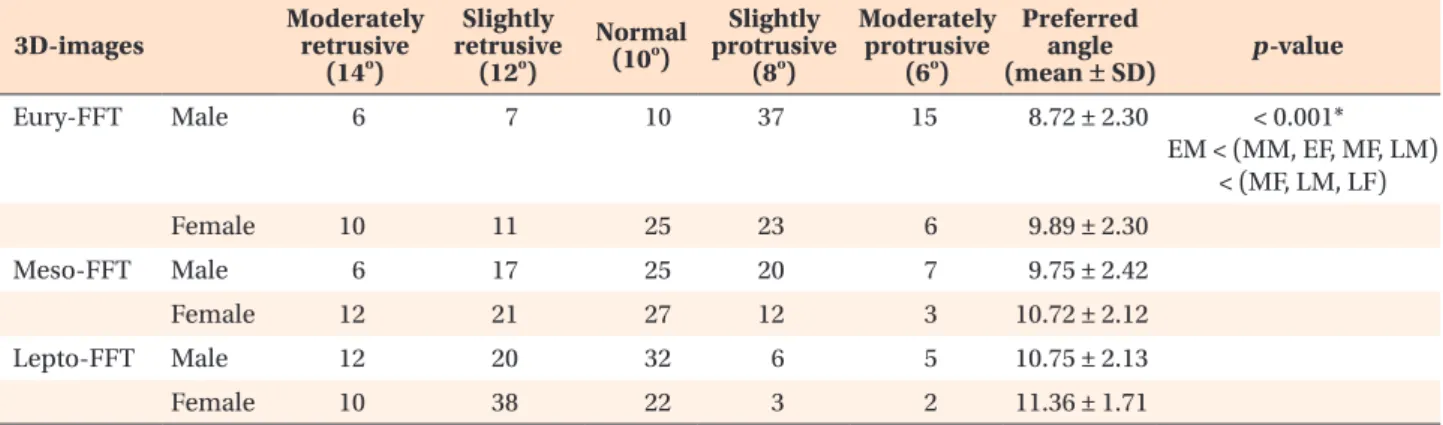
In Meso-FFT, the normal chin projection angle (10
o) was the most preferred without any sex difference (n
= 25/75 in male 3D images and n = 27/75 in female 3D images; Table 3). However, in Eury-FFT, the slightly protrusive chin projection angle (8
o) was favored in male 3D images (n = 37/75), but the normal chin projection angle (10
o) was preferred in female 3D images (n = 25/75) (Table 3). In Lepto-FFT, the normal chin projection angle (10
o) was favored in male 3D images (n
= 32/75), whereas the slightly retrusive chin projection angle (12
o) was favored in female 3D images (n = 38/75) (Table 3).
The means of the preferred CP angles in each FFT were as follows; Eury-FFT: male, 8.7
oand female, 9.9
o; Meso- FFT: male, 9.8
oand female, 10.7
o; and Lepto-FFT: male, 10.8
oand female, 11.4
o(Table 3). A significant difference was observed in the preferred CP angle according to FFT
Rank
From the most esthetically preferred one to the worst one
11
2
2
3
3
4
4
5
5
Figure 4. Three-dimensional
facial scan images of a man
with a leptoprosopic facial
type and modification of the
chin projection as described
in the legend of Figure 2.
(Eury-FFT male < [Meso-FFT male, Eury-FFT female, Meso-FFT female, Lepto-FFT male] < [Meso-FFT female, Lepto-FFT male, Lepto-FFT female]; p < 0.001; Table 3).
DISCUSSION
Several studies have investigated the preferred projection of the lip and chin in various ethnicities by using facial profiles.
7,18,19,22,23,31Coleman et al.
7reported that caucasian orthodontists and laypersons preferred a retrusive chin position in the normal profile. Based on their studies on Chinese participants, Soh et al.
18indicated that laypersons, dental students, and dental professionals preferred normal or bimaxillary retrusive facial profiles. Chong et al.
19also suggested that Chinese individuals preferred more retrusive chin positions than did Caucasian individuals. Similarly, Mantzikos
31reported that Japanese participants preferred normal, bimaxillary retrusion, bimaxillary protrusion, mandibular retrusion, and mandibular protrusion in the decreasing order of preference. On the basis of these studies, it can be assumed that a normal or slightly retrusive chin
projection is preferred in diverse ethnicities. However, few studies have assessed the relationship between FFTs and preferred chin projection. In this study, we found a significant difference in the distribution of preferred chin projection according to FFTs and sex (Eury-FFT male < [Meso-FFT male, Eury-FFT female, Meso-FFT female, Lepto-FFT male] < [Meso-FFT female, Lepto- FFT male, Lepto-FFT female]; p < 0.001; Table 3).
The age of the survey participants is an important factor in determining the preferred chin projection. Park et al.
32reported that young adults (20–39 years old;
mean age, 26 years) favored a straight facial profile, which was in accordance with the findings of this study. A normal chin projection (10
o) was preferred in most facial types except for a slightly protrusive chin projection in the Eury-FFT male (n = 37/75; mean preferred angle, 8.7
o) and a slightly retrusive chin projection in the Lepto-FFT female (n = 38/75; mean preferred angle, 11.4
o) (Table 3). These results might be attributed to the similar age of the survey participants in this study (mean age, 28.9 ± 3.3 years) and those in the study by Park et al.
32However, they demonstrated
1
1
2
2
3
3
4
4
5
5
Rank
From the most esthetically preferred one to the worst one
Figure 5. Three-dimensional
fa cial scan images of a wo man
with an euryprosopic fa cial
type and modification of the
chin projection as de scribed in
the legend of Figure 2.
that middle-aged (40–54 years; mean age, 47 years) as well as older individuals (55–70 years; mean age, 62 years) preferred a slightly retrusive chin as an esthetically pleasing one. In addition, Shimomura et al.
20suggested that as one’s age passes the thirties, one tends to prefer a slightly retrusive chin to a protrusive one. Therefore, future studies should include survey participants from various age groups.
The ratio between middle and lower facial height and interzygomatic width of the Eury-FFT was smaller than that of the Meso-FFT (less than 0.85 vs. between 0.85 and 0.89; Table 1). If the chin is retruded in the Eury- FFT, the interzygomatic width might be viewed as being relatively wider than that in the Meso-FFT. Therefore, a normal or slightly protrusive chin projection can be considered more esthetically acceptable than a retrusive chin projection. In the present study, a slightly protrusive chin projection (8
o) was considered the most esthetically suitable for Eury-FFT male 3D images (n = 37/75; Table 3) and the second most acceptable for female Eury-FFT 3D images (n = 23/75; Table 3).
The ratio between middle and lower facial height and interzygomatic width of the Lepto-FFT was greater than
that of the Meso-FFT (greater than 0.87 vs. between 0.84 and 0.87; Table 1). When the chin is protruded in the Lepto-FFT, the height from the soft-tissue nasion and soft-tissue gnathion can appear relatively longer because of the increased height of the lower third of the face. If the chin is retruded in the Lepto-FFT, the height of the lower face can appear shorter than its actual height and, as such, the retrusive chin projection may be preferred.
In the present study, a slightly retrusive chin (12
o) was the most preferred one for female Lepto-FFT 3D images (n = 38/75; Table 3) and the second most preferred for male Lepto-FFT 3D images (n = 20/72; Table 3).
Considering the specific relationships between FFT and sex is also very important. For example, in the male Eury-FFT 3D images, a slightly protrusive chin projection (8
o) was the most preferred (Eury-FFT male
< [Meso-FFT male, Lepto-FFT male]; p < 0.001; Table 3). This finding suggested that if orthognathic surgery or adjunctive esthetic surgery were planned for male patients with Class III relationships and a Eury-FFT, it would be better to establish a slightly protrusive chin projection, rather than a retrusive one, for ensuring the patient’s satisfaction with the esthetic facial change. In
Rank
From the most esthetically preferred one to the worst one
11
2
2
3
3
4
4
5
5
Figure 6. Three-dimensional
facial scan images of a wo-
man with a mesoprosopic
facial type and modification
of the chin projection as
described in the legend of
Figure 2.
addition, this finding may be related to a mature and responsible impression that is conveyed by a normal or slightly protrusive chin projection in males.
In the female Lepto-FFT 3D images, a slightly retrusive chin projection (12
o) was considered the most esthetically pleasing ([Eury-FFT female, Meso- FFT female] < [Meso-FFT female, Lepto-FFT female];
p < 0.001; Table 3). For female patients with Class II relationships and a Lepto-FFT, a slightly retrusive chin projection, rather than a protrusive one, might be an esthetically appropriate treatment goal. This finding may be related to a feminine facial impression that is conveyed by a slightly retrusive chin projection in females.
A limitation of this study is that the survey was completed only by young adults who were dental students. In addition, the number of male survey participants was almost double that of female participants, and this might have influenced the results. Therefore, future studies should include survey participants with various occupational backgrounds and
from different age groups with a similar proportion of sexes.
CONCLUSION
Since the preferred chin projection varied according to FFTs and sex, the null hypothesis was rejected.
These findings might serve as guidelines for setting the preferred chin projection according to FFT and sex.
ACKNOWLEDGEMENTS
We would like to thank the participants who provided 3D facial scan images and Seoul National University dental students for their valuable contributions to this study.
REFERENCES
1. Proffit WR, Phillips C, Douvartzidis N. A comparison of outcomes of orthodontic and surgical-orthodontic
1
1
2
2
3
3
4
4
5
5
Rank