INTRODUCTION
Sexual dysfunction refers to the difficulty that occurs during any stage of sexual response cycle that prevents an individual or a couple from experiencing satisfaction from normal sexual activity. Female sexual dysfunction (FSD) is a relatively com- mon disorder with a prevalence of 30–50%.1 During the meno- pausal transition, the risk of FSD increases, and the reported prevalence of sexual dysfunction in postmenopausal women ranges from 68-86% in various studies.2 In Korea, the frequen- cy of FSD also increases with age, with the reported preva- lence in middle-age women (≥40 years old) being 55–65%.3-5 The etiology of FSD can be multifactorial, and it can also be affected by various surgical or medical conditions. Gyneco- logic, physiologic, or pathologic conditions known to be asso-
Uterine Leiomyoma Is Associated with Female Sexual Dysfunction in Postmenopausal Women
Jae Hoon Chang1*, Dong Wook Shin2,3*, Myung Jae Jeon1,4, Hyeri Hong1, Sun Min Kim1,5, Ahreum An2,6, Ki Young Son2,7, Jin Ho Park2,6, Belong Cho2,6, Seul Ki Kim4,8, and Seung Mi Lee1,4
1Department of Obstetrics and Gynecology, Seoul National University Hospital, Seoul;
2Department of Family Medicine, Seoul National University College of Medicine, Seoul;
3Department of Family Medicine & Supportive Care Center, Samsung Medical Center, Sungkyunkwan University School of Medicine, Seoul;
4Department of Obstetrics and Gynecology, Seoul National University College of Medicine, Seoul;
5Department of Obstetrics and Gynecology, Seoul Metropolitan Government Seoul National University Boramae Medical Center, Seoul;
6Health Promotion Center, Seoul National University Hospital, Seoul;
7Department of Family Medicine, Asan Medical Center, Seoul;
8Department of Obstetrics and Gynecology, Seoul National University Bundang Hospital, Seongnam, Korea
Purpose: To determine the relationship between uterine leiomyoma and female sexual dysfunction (FSD) among premenopaus- al and postmenopausal women.
Materials and Methods: The study population consisted of consecutive women who underwent gynecologic screening tests, in- cluding transvaginal ultrasound, and completed the questionnaires on FSD. A total of 841 women were included from January 2010 to December 2011. FSD was defined as Female Sexual Function Index (FSFI) ≤26.55. The relationship between uterine leio- myoma and FSD were compared according to menopausal status.
Results: In premenopausal group (n=564), there were no differences in the frequency of FSD (55.0% vs. 58.8%, p=0.387) and total FSFI score. However, in postmenopausal group (n=277), women with uterine leiomyoma had a lower frequency of FSD than those without uterine leiomyoma (71.3% vs. 86.4%, p=0.003). This relationship between uterine leiomyoma and lower frequency of FSD in postmenopausal women remained significant after adjusting for confounding variables.
Conclusion: The relationship between uterine leiomyoma and FSD is different depending on the menopausal status.
Key Words: Sexual dysfunction, sexual behavior, leiomyoma, menopause, dyspareunia
pISSN: 0513-5796 · eISSN: 1976-2437
Received: January 9, 2019 Revised: June 19, 2019 Accepted: June 20, 2019
Co-corresponding authors: Seung Mi Lee, MD, PhD, Department of Obstetrics and Gynecology, Seoul National University College of Medicine, 101 Daehak-ro, Jongno-gu, Seoul 03080, Korea.
Tel: 82-2-870-2346, Fax: 82-2-831-2826, E-mail: [email protected] and Seul Ki Kim, MD, Department of Obstetrics and Gynecology, Seoul National Uni- versity Bundang Hospital, 82 Gumi-ro 173beon-gil, Bundang-gu, Seongnam 13620, Korea.
Tel: 82-31-787-7264, Fax: 82-31-787-4054, E-mail: [email protected]
*Jae Hoon Chang and Dong Wook Shin contributed equally to this work.
•The authors have no potential conflicts of interest to disclose.
© Copyright: Yonsei University College of Medicine 2019
This is an Open Access article distributed under the terms of the Creative Com- mons Attribution Non-Commercial License (https://creativecommons.org/licenses/
by-nc/4.0) which permits unrestricted non-commercial use, distribution, and repro- duction in any medium, provided the original work is properly cited.
Yonsei Med J 2019 Aug;60(8):791-795 https://doi.org/10.3349/ymj.2019.60.8.791
ciated with sexual dysfunction are pregnancy and delivery, menopause, infertility, pelvic floor dysfunction, urinary in- continence, gynecological cancer, and uterine leiomyoma.6-9
Uterine leiomyoma is also a common problem in gyneco- logic patients, with a lifetime prevalence estimated to be 25–
50%. Previous studies have shown impaired sexual function in the presence of uterine leiomyoma among premenopausal women.9,10 In the study by Ertunc, et al.,10 uterine leiomyoma was associated with sexual dysfunction, including impaired satisfaction and dyspareunia, and myomectomy was associat- ed with improved sexual function.
However, there is a paucity of information regarding the ef- fect of uterine leiomyoma on sexual dysfunction according to menopausal status. This is an important issue, considering that more women are reaching menopause with uterine leiomyo- ma rather than undergoing hysterectomy, as conservative treat- ment is the mainstay in the management of leiomyoma, and menopause itself can affect FSD.11 Additionally, it is well known that sexual dysfunction can result in lower quality of women’s life.12
The objective of this study was to determine the relation- ship between uterine leiomyoma and sexual dysfunction ac- cording to menopausal status. To address this issue, we deter- mined the relationship between uterine leiomyoma and sexual dysfunction in premenopausal and postmenopausal women.
MATERIALS AND METHODS
Subjects
In this retrospective cohort study, the study population con- sisted of consecutive women who underwent gynecologic screening tests, including transvaginal ultrasound, and com- pleted the questionnaires on female sexual function in the Center for Health Promotion and Optimal Aging at Seoul Na- tional University Hospital from January 2010 to December 2011. Subjects were excluded if they had a surgical history of hysterectomy. Women who were sexually inactive were also excluded, and sexual inactivity was defined as having sexual intercourse fewer than once per month. Since this study was a retrospective study based on medical records, informed con- sent was not obtained for this study, and the Institutional Re- view Board of Seoul National University Hospital approved the study (1102-041-351).
Assessment of patients
Two experienced gynecologists (S.M. Lee and S.M. Kim) per- formed gynecologic examination and transvaginal ultrasound with LOGIC E9 (GE Medical Systems Information Technolo- gies, GE Healthcare, Milwaukee, WI, USA). Diagnosis of uter- ine leiomyoma was made by ultrasound finding, defined as a mass of 0.5 cm or larger.13
Questionnaire
All subjects answered questions regarding socio-demograph- ic characteristics, and underwent detailed history taking and ultrasonography to determine both menopausal status and the presence or absence of uterine leiomyoma. Socio-demo- graphic characteristics included previous medical or surgical history, academic career, alcohol consumption, smoking hab- its, and individual household income. For academic career, subjects were divided by their highest completed schooling level. Smoking or alcohol consumption was divided into the following three subgroups: current, former, or never. Meno- pause was defined as the cessation of menses for at least 12 months that was not caused by pregnancy, breastfeeding, or other medical conditions.
Female sexual function was determined by the Korean ver- sion of Female Sexual Function Index (FSFI).14 FSFI is a well- structured questionnaire with 19 items that assess sexual functioning or problems in six domains (desire, arousal, lubri- cation, orgasm, satisfaction, and pain) during the past 4 weeks.
Scores of each domain range from 1 to 5 or 0 to 5, and the total score is obtained by the sum of the six domain scores multi- plied by the domain factor (0.3–0.6). The total score of FSFI ranges from 2 to 36, and FSD is defined as a total score of FSFI
≤26.55.15 Data analysis
Proportions were compared with Fisher’s exact test or chi- square test, and comparisons of continuous variables between groups were performed using either Mann-Whitney U test or Kruskal-Wallis test, as appropriate. Logistic regression was conducted for multivariate analysis. p-value <0.05 was con- sidered to be significant. SPSS version 20 software (IBM Corp., Armonk, NY, USA) was utilized.
A prior sample size calculation was performed to determine how many postmenopausal women would be needed to de- tect a change from 72% to 88% in the frequency of FSD in cas- es with and without uterine leiomyoma. We estimated that the average frequency of FSD would be 80% in postmeno- pausal women, based on previous reports.2,3 Assuming an es- timated ratio of 1:1 between those with and without uterine leiomyoma, we determined that we would require 220 post- menopausal women with 80% power and type 1 error of 5%, as well as 284 postmenopausal women with 90% power and type 1 error of 5%.
RESULTS
During the study period, a total of 968 women were approached consecutively. Among these women, 841 (87%) completed the questionnaire and were ultimately enrolled in the analysis;
564 women were premenopausal, and 277 were postmeno- pausal. On transvaginal ultrasound, uterine leiomyoma was
detected in 334 women (40%) overall; 40.1% (226/564) of pre- menopausal women and 39.0% (108/277) of postmenopausal women were affected.
Table 1 compares clinical characteristics according to the presence or absence of uterine leiomyoma in postmenopausal women. All parameters including mean age, body mass in- dex, parity, frequency of diabetes, hypertension, hormone re- placement therapy, smoking, alcohol consumption, and the level of education and income did not differ between the two groups.
Table 2 shows the characteristics of premenopausal women according to the presence or absence of uterine leiomyoma.
Women with uterine leiomyoma had significantly higher mean age and body mass index and significant lower height com- pared to those without uterine leiomyoma.
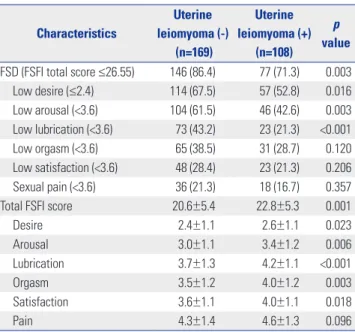
Table 3 demonstrates the relationship between FSD and uterine leiomyoma in postmenopausal women. Postmeno- pausal women with uterine leiomyoma had a lower frequency of FSD than those without uterine leiomyoma (frequency of FSD was 71.3% in women with leiomyoma vs. 86.4% in wom- en without leiomyoma, p=0.003), and those women also had
a lower frequency of sexual difficulties related to the desire, arousal, and lubrication domains. In addition, women with uterine leiomyoma had higher total FSFI scores, with higher scores in the desire, arousal, lubrication, orgasm, and satisfac- tion domains than those without uterine leiomyoma. The re- lationship between uterine leiomyoma and lower frequency of sexual dysfunction in postmenopausal women remained significant after adjustment for confounding variables (Table 4), which were chosen according to the differences between women with and without FSD in univariate analysis (p<0.2).
In premenopausal group, the frequency of FSD and total FSFI score did not significantly differ according to the presence or absence of uterine leiomyoma (Table 5). However, women with uterine leiomyoma had a higher frequency of sexual dif- ficulty in the satisfaction domain (11.9% vs. 6.2%, p=0.021) and lower mean pain score (5.3±0.9 vs. 5.1±1.0, p=0.046) than those without leiomyoma.
DISCUSSION
The principal finding of this study is that women with uterine leiomyoma had a lower frequency of FSD than those without Table 1. Characteristics of Postmenopausal Women according to the
Presence or Absence of Uterine Leiomyoma Characteristics
Uterine leiomyoma (-)
(n=169)
Uterine leiomyoma (+)
(n=108) p value
Age (yr) 55.0±5.0 55.0±5.0 0.959
BMI (kg/m2) 23.3±2.6 22.8±2.3 0.269
Married 152/154 (98.7) 98/104 (94.2) 0.064
Parity ≥1 166 (98.2) 104 (96.3) 0.437
Diabetes 6 (3.6) 6 (5.6) 0.547
Hypertension 35 (20.7) 20 (18.5) 0.758
HRT (current) 10 (5.9) 14 (13.0) 0.050
Smoking 0.908
Never 160 (94.7) 102 (94.4)
Former 5 (3.0) 4 (3.7)
Current 4 (2.4) 2 (1.9)
Alcohol consumption 0.104
Never 126 (74.6) 72 (66.7)
Former 9 (5.3) 3 (2.8)
Current 34 (20.1) 33 (30.6)
Education 0.718
≤Middle school graduate 33/165 (20.0) 19/106 (17.9)
≤High school graduate 67/165 (40.6) 40/106 (37.7)
≥College graduate 65/165 (39.4) 47/106 (44.3)
Income (KRW/month) 0.118
<2000000 12/152 (7.9) 11/93 (11.8) 2000000–6000000 89/152 (58.6) 42/93 (45.2)
≥6000000 51/152 (33.6) 40/93 (43.0)
BMI, body mass index; HRT, hormone replacement therapy; KRW, Korean Won.Values are given as a mean±SD or number (percentage).
Table 2. Characteristics of Premenopausal Women according to the Presence or Absence of Uterine Leiomyoma
Characteristics
Uterine leiomyoma (-)
(n=338)
Uterine leiomyoma (+)
(n=226) p value
Age (yr) 42.0±7.0 46.0±5.0 <0.001
BMI (kg/m2) 22.0±3.1 22.7±2.8 0.001
Married 291/326 (89.3) 202/216 (93.5) 0.095
Parity ≥1 292/335 (87.2) 202/224 (90.2) 0.346
Diabetes 5 (1.5) 3 (1.3) >0.990
Hypertension 18 (5.3) 20 (8.8) 0.123
Smoking 0.374
Never 305 (90.2) 205 (90.7)
Former 14 (4.1) 5 (2.2)
Current 19 (5.6) 16 (7.1)
Alcohol consumption 0.410
Never 160/338 (47.3) 98/225 (43.3)
Former 36/338 (10.7) 20/225 (8.8)
Current 142/338 (42.0) 107/225 (47.3)
Education 0.452
≤Middle school graduate 16/331 (4.8) 7/221 (3.2)
≤High school graduate 104/331 (31.4) 78/221 (35.3)
≥College graduate 211/331 (63.7) 136/221 (61.5)
Income (KRW/month) 0.002
<2000000 12/304 (3.9) 11/201 (5.5)
2000000–6000000 155/304 (51.0) 71/201 (35.3) ≥6000000 137/304 (45.1) 119/201 (59.2) BMI, body mass index; KRW, Korean Won.
Values are given as a mean±SD or number (percentage).
uterine leiomyoma in postmenopausal group. This relation- ship between uterine leiomyoma and lower frequency of sex- ual dysfunction in postmenopausal women remained signifi- cant after adjustment for confounding variables.
Why is uterine leiomyoma associated with a reduced risk of FSD in postmenopausal women? The different concentrations of estrogen may play a role in this association between leiomy- oma and FSD. Estrogen is important to sexual function, and decreasing estrogen levels are significantly associated with an increased prevalence of sexual dysfunction in postmenopaus- al women.16 Menopausal hormone therapy has been reported to improve sexual dysfunction in postmenopausal women,17 and dramatic decreases in estrogen among postmenopausal women is known to cause vulvovaginal atrophy, which can be the cause of dyspareunia.18 The association between uterine leiomyoma and estrogen has also been reported.19 The inci- dence of uterine leiomyoma is increased when women are ex- posed to high endogenous estrogen, which occurs with obesity or early menarche, whereas women with decreased estrogen exposure, which is associated with increased parity, have lower incidences of uterine leiomyoma.20 The prior use of hormone replacement therapy is associated with an increased risk of
uterine leiomyoma in postmenopausal women.21 In the study by Randell, et al.,21 postmenopausal women with leiomyoma had higher bone mineral density and lower risk of fracture than those without leiomyoma, and the authors suggested that this may be due to higher estrogen levels leading to both higher bone mineral density and the growth of leiomyoma.
According to these studies, it may be postulated that the pres- ence of uterine leiomyoma indicates a relatively higher level of endogenous estrogen in postmenopausal women, which in turn result in reduced risk of FSD. In the current study, we did not measure the endogenous estrogen level in the study pop- ulation, and this needs to be evaluated in further studies.
In the current study, we did not examine sex-related distress and partner factors that contribute to sexual function. Further studies may be needed to demonstrate the relationship be- tween sex-related distress and uterine leiomyoma, and to ad- just partner factors.
To the best of our knowledge, this is the first study to evalu- ate the relationship between FSD and uterine leiomyoma ac- cording to menopausal status, and we have demonstrated that the presence of uterine leiomyoma is associated with the risk of FSD in postmenopausal women.
AUTHOR CONTRIBUTIONS
Conceptualization: Seung Mi Lee. Data curation: Jae Hoon Chang, Dong Wook Shin, Hyeri Hong. Formal analysis: Jae Hoon Chang, Dong Wook Shin, Hyeri Hong, Sun Min Kim. Funding acquisition:
Seung Mi Lee. Investigation: Sun Min Kim, Seung Mi Lee. Methodol- ogy: Myung Jae Jeon, Hyeri Hong, Sun Min Kim, Ahreum An, Ki Young Son, Jin Ho Park, Belong Cho, Seul Ki Kim, Seung Mi Lee. Proj- ect administration: Seung Mi Lee. Resources: Sun Min Kim, Ahreum Table 3. Comparison of FSFI Scores in Postmenopausal Women ac-
cording to the Presence or Absence of Uterine Leiomyoma Characteristics
Uterine leiomyoma (-)
(n=169)
Uterine leiomyoma (+)
(n=108)
p value FSD (FSFI total score ≤26.55) 146 (86.4) 77 (71.3) 0.003 Low desire (≤2.4) 114 (67.5) 57 (52.8) 0.016 Low arousal (<3.6) 104 (61.5) 46 (42.6) 0.003 Low lubrication (<3.6) 73 (43.2) 23 (21.3) <0.001 Low orgasm (<3.6) 65 (38.5) 31 (28.7) 0.120 Low satisfaction (<3.6) 48 (28.4) 23 (21.3) 0.206 Sexual pain (<3.6) 36 (21.3) 18 (16.7) 0.357
Total FSFI score 20.6±5.4 22.8±5.3 0.001
Desire 2.4±1.1 2.6±1.1 0.023
Arousal 3.0±1.1 3.4±1.2 0.006
Lubrication 3.7±1.3 4.2±1.1 <0.001
Orgasm 3.5±1.2 4.0±1.2 0.003
Satisfaction 3.6±1.1 4.0±1.1 0.018
Pain 4.3±1.4 4.6±1.3 0.096
FSD, female sexual dysfunction; FSFI, Female Sexual Function Index.
Values are given as a number (percentage) or mean±SD.
Table 4. Relationship of Significant Variables in Female Sexual Dysfunction in Postmenopausal Women by Multiple Logistic Regression Analysis
Variables Adjusted OR 95% CI p value
Uterine leiomyoma 0.469 0.246–0.897 0.022
Married 3.700 0.849–16.117 0.081
HRT, current 0.707 0.249–2.009 0.516
Hypertension 1.556 0.638–3.792 0.331
HRT, hormone replacement therapy; OR, odds ratio; CI, confidence interval.
Table 5. Comparison of FSFI Scores in Premenopausal Women according to the Presence or Absence of Uterine Leiomyoma
Characteristics
Uterine leiomyoma (-)
(n=338)
Uterine leiomyoma (+)
(n=226)
p value FSD (FSFI total score ≤26.55) 186 (55.0) 133 (58.8) 0.387 Low desire (≤2.4) 138 (40.8) 100 (44.2) 0.435 Low arousal (<3.6) 90 (26.6) 69 (30.5) 0.340 Low lubrication (<3.6) 21 (6.2) 13 (5.8) 0.859 Low orgasm (<3.6) 48 (14.2) 43 (19.0) 0.131 Low satisfaction (<3.6) 21 (6.2) 27 (11.9) 0.021
Sexual pain (<3.6) 9 (2.7) 9 (4.0) 0.465
Total FSFI score 25.9±4.2 25.2±4.4 0.061
Desire 3.0±1.0 2.9±1.0 0.160
Arousal 3.9±1.0 3.8±1.0 0.082
Lubrication 4.9±0.9 4.9±0.9 0.646
Orgasm 4.3±1.1 4.2±1.1 0.182
Satisfaction 4.4±0.9 4.3±1.0 0.416
Pain 5.3±0.9 5.1±1.0 0.046
FSD, female sexual dysfunction; FSFI, Female Sexual Function Index.
Values are given as a number (percentage) or mean±SD.
An, Ki Young Son, Jin Ho Park, Belong Cho, Seung Mi Lee. Software:
Seul Ki Kim, Seung Mi Lee. Supervision: Myung Jae Jeon, Belong Cho, Seul Ki Kim, Seung Mi Lee. Validation: Seul Ki Kim, Seung Mi Lee.
Visualization: Seul Ki Kim, Seung Mi Lee. Writing—original draft: Jae Hoon Chang, Dong Wook Shin, Seul Ki Kim, Seung Mi Lee. Writing—
review & editing: Seul Ki Kim, Seung Mi Lee.
ORCID iDs
Jae Hoon Chang https://orcid.org/0000-0002-5482-3139 Dong Wook Shin https://orcid.org/0000-0001-8128-8920 Myung Jae Jeon https://orcid.org/0000-0001-5582-1488 Hyeri Hong https://orcid.org/0000-0002-4208-9942 Sun Min Kim https://orcid.org/0000-0002-3369-3937 Ahreum An https://orcid.org/0000-0002-2070-430X Ki Young Son https://orcid.org/0000-0003-1262-100X Jin Ho Park https://orcid.org/0000-0002-3942-6813 Belong Cho https://orcid.org/0000-0001-9558-689X Seul Ki Kim https://orcid.org/0000-0002-1647-6711 Seung Mi Lee https://orcid.org/0000-0002-2543-0408
REFERENCES
1. Srivastava R, Thakar R, Sultan A. Female sexual dysfunction in obstetrics and gynecology. Obstet Gynecol Surv 2008;63:527-37.
2. Sarrel PM. Sexuality and menopause. Obstet Gynecol 1990;75(4 Suppl):26S-30S.
3. Kim YH, Kim SM, Kim JJ, Cho IS, Jeon MJ. Does metabolic syn- drome impair sexual function in middle- to old-aged women? J Sex Med 2011;8:1123-30.
4. Choi J, Shin DW, Lee S, Jeon MJ, Kim SM, Cho B, et al. Dose-re- sponse relationship between cigarette smoking and female sexual dysfunction. Obstet Gynecol Sci 2015;58:302-8.
5. Hong H, Lee HJ, Kim SM, Jeon MJ, Shin DW, Choi HC, et al. Sub- clinical hypothyroidism is not a risk factor for female sexual dys- function in Korean middle-aged women. Thyroid 2015;25:784-8.
6. Keye WR Jr. Psychosexual responses to infertility. Clin Obstet Gy- necol 1984;27:760-6.
7. Salonia A, Zanni G, Nappi RE, Briganti A, Dehò F, Fabbri F, et al.
Sexual dysfunction is common in women with lower urinary tract symptoms and urinary incontinence: results of a cross-sectional
study. Eur Urol 2004;45:642-8.
8. Thranov I, Klee M. Sexuality among gynecologic cancer patients- -a cross-sectional study. Gynecol Oncol 1994;52:14-9.
9. Moshesh M, Olshan AF, Saldana T, Baird D. Examining the relation- ship between uterine fibroids and dyspareunia among premeno- pausal women in the United States. J Sex Med 2014;11:800-8.
10. Ertunc D, Uzun R, Tok EC, Doruk A, Dilek S. The effect of myoma uteri and myomectomy on sexual function. J Sex Med 2009;6:1032-8.
11. Singh SS, Belland L. Contemporary management of uterine fi- broids: focus on emerging medical treatments. Curr Med Res Opin 2015;31:1-12.
12. Schvartzman R, Bertotto A, Schvartzman L, Wender MC. Pelvic floor muscle activity, quality of life, and sexual function in peri- and recently postmenopausal women with and without dyspareunia:
a cross-sectional study. J Sex Marital Ther 2014;40:367-78.
13. Baird DD, Hill MC, Schectman JM, Hollis BW. Vitamin D and the risk of uterine fibroids. Epidemiology 2013;24:447-53.
14. Kim HY, So HS, Park KS, Jeong SJ, Lee JY, Ryu SB. Development of the Korean-version of Female Sexual Function Index (FSFI). Kor J Androl 2002;20:50-6.
15. Wiegel M, Meston C, Rosen R. The Female Sexual Function Index (FSFI): cross-validation and development of clinical cutoff scores.
J Sex Marital Ther 2005;31:1-20.
16. Dennerstein L, Randolph J, Taffe J, Dudley E, Burger H. Hormones, mood, sexuality, and the menopausal transition. Fertil Steril 2002;
77 Suppl 4:S42-8.
17. González M, Viáfara G, Caba F, Molina E. Sexual function, meno- pause and hormone replacement therapy (HRT). Maturitas 2004;
48:411-20.
18. Simon JA. Identifying and treating sexual dysfunction in post- menopausal women: the role of estrogen. J Womens Health (Larch- mt) 2011;20:1453-65.
19. Reed SD, Cushing-Haugen KL, Daling JR, Scholes D, Schwartz SM.
Postmenopausal estrogen and progestogen therapy and the risk of uterine leiomyomas. Menopause 2004;11:214-22.
20. Islam MS, Protic O, Stortoni P, Grechi G, Lamanna P, Petraglia F, et al. Complex networks of multiple factors in the pathogenesis of uterine leiomyoma. Fertil Steril 2013;100:178-93.
21. Randell KM, Honkanen RJ, Tuppurainen MT, Kröger H, Jurvelin JS, Saarikoski S. Fracture risk and bone density of peri- and early postmenopausal women with uterine leiomyomas. Maturitas 2006;53:333-42.