◈ 원 저 ◈
Glass dosimeter와 PCXMC Program을 이용한 소아피폭선량 측정 및 분석
김영은ㆍ이정화ㆍ홍선숙ㆍ이관섭 서울아산병원 영상의학팀
Measurement and Analysis of Pediatric Patient Exposure Dose Using Glass dosimeter and a PC-Based Monte Carlo Program
Young-Eun KimㆍSun-Suk HongㆍJeong-Hwa LeeㆍKwan-Seob Lee Department of Radiology, Asan Medical Center
2)
Abstract
Exposed dose of young child should be managed necessarily. Young child is more sensitive than adult of a Radioactivity, especially, and lives longer than adult. Must reduce exposed dose which follows The ALARA(As Low As Reasonably Achievable)rule is recommended by ICRP(International Commission on Radiological Protection)within diagnostic useful range. Therefore, We have to prepare Pediatric DRL(Diagnostic Reference Level) in Korea as soon as possible. Consequently, in this study, wish to estimate organ dose and effective dose using PCXMC Program(a PC-Based Monte Carlo Program), and measure ESD(Entrance surface dose)and organ dose using Glass dosimeter, and then compare with DRL which follows EC(European Commission)and NRPB(National Radiological Protection Board). Using glass dosimeter and PCXMC programs conforming to the International Committee for Radioactivity Prevention(ICRP)-103 tissue weighting factor based on the item before the organs contained in the Chest, Skull, Pelvis, Abdomen in the organ doses and effective dose and dose measurements were evaluated convenience. In a straightforward way to RANDO phantom inserted glass dosimeter(GD352M)by using the hospital pediatric protocol, and in a indirect way was PCXMC the program through a virtual simulation of organ doses and effective dose were calculated. The ESD in Chest PA is 0.076mGy which is slightly higher than the DRL of NRPB(UK) is 0.07mGy, and is lower than the DRL of EC(Europe) which is 0.1mGy. The ESD in Chest Lateral is 0.130mGy which is lower than the DRL of EC(Europe) is 0.2mGy.
The ESD in Skull PA is 0.423mGy which is 40 percent lower than the DRL of NRPB(UK) is 1.1mGy and
Received: September 14. 2012. 1st Revised: September 28. 2012. / 2nd Revised: October 19. 2012./ Accepted for Publication: October 26. 2012.
Corresponding Author: 김영은
(138-736) 서울시 송파구 서울아산병원길 86 영상의학팀 Tel: 02) 3010-4307 CP: 010-5099-0538
E-mail: [email protected]
is 28 percent lower than the DRL of EC(Europe) is 1.5mGy. The ESD in Skull Lateral is 0.478mGy which is half than the DRL of NRPB(UK) is 0.8mGy, is 40 percent lower than the DRL of EC(Europe) is 1mGy. The ESD in Pelvis AP is 0.293mGy which is half than the DRL of NRPB(UK) is 0.60mGy, is 30 percent lower than the DRL of EC(Europe)is 0.9mGy. Finally, the ESD in Abdomen AP is 0.223mGy which is half than the DRL of NRPB(UK) is 0.5mGy, and is 20 percent lower than the DRL of EC is 1.0mGy. The six kind of diagnostic radiological examination is generally lower than the DRL of NRPB(UK)and EC(Europe) except for Chest PA. Shouldn’t overlook the age, body, other factors.
Radiological technician must realize organ dose, effective dose, ESD when examining young child in hospital. That’s why young child is more sensitive than adult of a Radioactivity.
Key words : DRL, Organ dose, Effective dose, PCXMC
Ⅰ. 서 론
소아는 방사선에 대한 감수성이 어른보다 매우 높고, 피폭에 따른 영향을 오래 받으므로 피폭선량의 관리가 성인보다 중요하다. 연구에 따르면 일반 엑스선 촬영에 의해 소아 백혈병과 유방암의 위험이 증가될 수 있다고 한다. 특히 소아는 암이 발생 하기에 충분한 여명이 남 아 있는 것으로 생각되기 때문에 성인에 비해 보다 적극 적인 환자선량 감소 노력이 필요하다.1 소아 환자는 생후 수일 내의 환자부터 10세 미만의 환자까지 연령대가 다 양하고 연령대가 낮은 소아의 경우 성인과 같은 의사소 통을 기대하기 어려우며, 검사 진행 시 다양한 변수가 존재한다. 대부분 방사선 관계종사자들이 소아 피폭선량 관리에 관한 위험성과 필요성을 인지하면서도 간과하는 경우가 많은 실정이다.2 현재 국민의 삶의 질 향상과 더 불어 건강증진에 대한 관심이 높아짐에 따라 의료기관에 서 건강진단 및 진료를 위해 X-선 검사 횟수의 증가에 따른 방사선 피폭도 증가하고 있으나 검사 시 환자가 받 는 방사선량은 진료에서 환자가 얻는 이득이 크다는 특 수성 때문에 국제적으로도 선량한도를 정하고 있지 않 다.3 그러나 1965년 ICRP에서 권고한 ALARA As Low As Reasonably Achievable)원칙에 따라 진단적으로 유용한 범위 안에서 최대한 피폭을 줄이는 노력이 필수 적이다. 그러므로 소아는 성인보다도 환자선량의 참고준 위(Diagnostic Reference Level, DRL)의 마련이 시급하 다. 세계보건기구(World Health Organization, WHO), 국제원자력기구(International Atomic Energy Agency, IAEA)등의 국제기구가 1996년에 공동으로 전리방사선 의 방어를 위한 국제기본안전표준(International Basic Safety Standards)을 마련하였고,4 2003년에 국제방사 선방호위원회(International Commission on Radiolo-
gical Protection, ICRP)에서도 각 국가가 자국의 실정 에 맞는 환자선량의 참고준위를 마련하여 사용하도록 권고하였으며,5 2008년에는 진단방사선분야의 X선 검사 시에 환자의 방호최적화(optimization of protec- tion) 을 위해 DRL을 적용하도록 권고하고 있다.6 또한 유럽 위원회(European Commission, EC)와 영국국립방사선 방호위원회(National Radiological Protection Board, NRPB)에서는 소아 흉부, 두개골, 골반, 복부검사의 환 자선량을 나이에 따라 권고하고 있다.7,8 그러나 우리나 라는 성인의 환자선량에 대한 연구에 비해서 소아의 환 자선량에 대한 연구는 활발하지 않아 그 자료는 미비한 실정이다. 이에 본 연구는 Unfors Xi를 통해 입사표면 선량(Entrance Surface Dose: ESD)을 측정하였다. 또 한, 가상시뮬레이션인 PCXMC(PC-Based Monte Carlo Program) 프로그램을 사용하였는데 유리선량계를 이용 한 장기선량 측정은 환자의 검사 시 직접 측정 할 수 없다는 점과 팬텀을 이용할 경우 실험방법이 복잡하고 시간이 많이 걸리며 골수나 근육 등 International Committee for Radioactivity Prevention(ICRP)-103 에서 권고하는 조직 가중인자 항목에 대한 측정이 어렵 다.10 그러므로 PCXMC 프로그램을 이용하여 유리선량 계로 측정하기 어려운 장기선량과 유효선량을 측정하였 다. 측정한 피폭선량과 장기선량과 유효선량을 유럽위 원회(EC)와 영국국립방사선방호위원회(NRPB)의 DRL을 통해 비교한 결과를 보고하며, 의료피폭을 저감화할 수 있는 방법을 모색해 환자선량 관리를 수행하고자 한다.
Ⅱ. 실험기기 및 방법 1. 실험 장비 및 측정기기
⦁ Equipment : Definium 8000 (GE : USA)
⦁ Dosimeter: 1) Glass Dosimeter (Dose Ace) FGD- 1000(ASAHI TECHNO GLASS) 2) Unfors Xi multifunction meter
⦁ Element: GD352M(ASAHI TECHNO GLASS) with marking, Dose Range 0.01mGy-10Gy, range 15KeV-20MeV
⦁ Element Holder : Inserted Sn (ASAHI TECHNO GLASS)
⦁ PCXMC 20 : A pc-based Monte Carlo program (STUK-Radiation and Nuclear Safety Authority)
⦁ Phantom: 소아 5세 Atom Dosimetry Phantom 705-D (Height : 110cm , Weight : 19Kg)
2. 실험 방법
1) Glass dosimeter를 이용한 직접적인 방법 본원에서 시행하고 있는 소아 진단 방사선 검사 중 Chest PA, Lat, Skull AP, Lat, Pelvis AP, Abdomen AP를 표본의 대상으로 선택하고, 촬영조건은 본원에서 소아 일반촬영 검사 시 임상적으로 사용하고 있는 소아 protocol을 이용하였다. Stand bucky나 table bucky위 에 인체 phantom을 설치하고 입사표면선량을 구하기 위해 조사야 중심에 유리선량계 소자 5개를 각 검사부 위의 표면에 붙이고, 장기선량을 구하기 위해 해당 장 기의 중심부분에 유리소자를 5개를 삽입한 후 촬영하고 측정, 판독하였다. 이때 유리선량계를 통한 실험 측정 값의 신뢰성을 검증하기 위해 Unfors Xi meter를 유리 선량계 소자와 겹치지 않게 phantom에 부착하고 유리 선량계의 측정값을 비교하였다.9
2) PCXMC 프로그램을 이용한 장기선량 및 유효선 량 측정 방법
가상의 수학적 팬텀 상에 직접적인 방법과 동일한 parameter를 입력하여 Error를 최소화하였다. Rando phantom과 동일한 연령, 신장, 체중, Focus-skin Distance를 입력하고 조사야의 크기 또한 동일하게 입 력하였다. 촬영조건은 관전압, 관전류, 양극 각도, 고유 여과 두께를 입력하여 Simulation하고 Input dose value는 Unfors Xi meter를 팬텀 면 조사야 중앙부에 부착하여 얻은 Air-kerma(mGy)를 입력하여 해당 검사 부위의 장기선량 및 유효선량을 산출하였다.11
Ⅲ. 결 과
1. Glass dosimeter를 이용한 측정 방법
Glass dosimeter에 의해 얻은 입사표면선량과 장기 선량은 다음과 같다.(Table 1).
Position kVp mAs Speed ESD Organ dose
Chest PA 90 1 640 0.076 0.043
Chest Lat 90 2 0.13 0.078
Skull PA 70 6.3 500 0.423 0.232 Skull Lat 70 6.3 0.478 0.258
Pelvis AP 60 6.3 640 0.293 0.229 Abdomen AP 60 5 0.223 0.154
Table 1. The result of Entrance surface dose and Organ dose from Unfors Xi meter
(mGy)
2. PCXMC를 이용한 방법
PCXMC 프로그램에서 각 검사 별로 부위를 지정한 후 얻은 장기선량과 유효선량은 다음과 같다.
1) Chest PA
Chest PA
Bone marrow 0.016 Scapula 0.042
Breasts 0.083 Clavicle 0.199
Extrathoracic
airways 0.027 Ribs 0.157
Heart 0.060 Skin 0.019
Lungs 0.049 Spleen 0.029
Lymph nodes 0.030 Stomach 0.061 Esophagus 0.026 Small intestine 0.006 Salivary glands 0.004 Thymus 0.078
Upper Spine 0.055 Thyroid 0.069 Middle Spine 0.042 Effective Dose
ICRP60 0.029 Lower Spine 0.027 Effective Dose
ICRP103 0.036 Table 2. The result of organ dose and effective dose
from PCXMC in Chest PA examination
(mGy)
2) Chest Lat
Chest PA
Bone marrow 0.027 Scapula 0.727
Breasts 0.143 Clavicle 0.341
Extrathoracic
airways 0.047 Ribs 0.268
Heart 0.104 Skin 0.032
Lungs 0.084 Spleen 0.05
Lymph nodes 0.051 Stomach 0.104 Esophagus 0.044 Small intestine 0.011 Salivary glands 0.007 Thymus 0.133 Upper Spine 0.094 Thyroid 0.118 Middle Spine 0.073 Effective Dose
ICRP60 0.049
Lower Spine 0.046 Effective Dose
ICRP103 0.031 Table 3. The result of organ dose and effective dose
from PCXMC in Chest Lateral examination (mGy)
3) Skull PA
Skull PA
Bone marrow 0.046 Upper Spine 0.311 Brain 0.121 Middle Spine 0.047 Extrathoracic
airways 0.204 Lower Spine 0.018
Lymph nodes 0.077 Skin 0.079
Esophagus 0.032 Thymus 0.106
Salivary glands 0.004 Thyroid 0.527 Skull 0.568 Effective Dose
ICRP60 0.042 Oral mucosa 0.246 Effective Dose
ICRP103 0.044 Table 4. The result of organ dose and effective dose
from PCXMC in Skull PA examination (mGy)
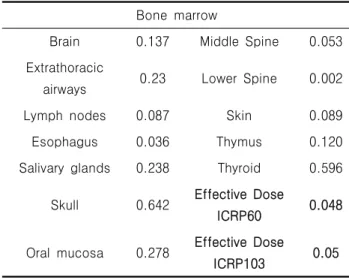
4) Skull Lat
Bone marrow
Brain 0.137 Middle Spine 0.053 Extrathoracic
airways 0.23 Lower Spine 0.002
Lymph nodes 0.087 Skin 0.089
Esophagus 0.036 Thymus 0.120
Salivary glands 0.238 Thyroid 0.596 Skull 0.642 Effective Dose
ICRP60 0.048 Oral mucosa 0.278 Effective Dose
ICRP103 0.05
Table 5. The result of organ dose and effective dose from PCXMC in Skull Lateral examination
(mGy)
5) Pelvis AP
Pelvis AP
Bone marrow 0.032 Prostate 0.211
Adrenals 0.011 Ovaries 0.147
Kidneys 0.024 Pelvis 0.229
Lymph nodes 0.053 Small intestine 0.14
Liver 0.031 Spleen 0.011
Pancreas 0.018 Testicles 0.394 Stomach 0.040 Urinary Bladder 0.229 Middle Spine 0.005 Uterus 0.178
Lower Spine 0.089 Colon 0.159
Upper leg bones 0.329 Gall Bladder 0.064 Middle leg bones 0.218 Effective Dose
ICRP60 0.100 Lower leg bones 0.001 Effective Dose
ICRP103 0.067 Table 6. The result of organ dose and effective dose
from PCXMC in Pelvis AP examination
(mGy)
6) Abdomen AP
Abdomen AP
Bone marrow 0.031 Prostate 0.097
Adrenals 0.039 Ovaries 0.065
Kidneys 0.038 Pelvis 0.178
Lymph nodes 0.080 Small intestine 0.119
Liver 0.031 Spleen 0.058
Pancreas 0.142 Testicles 0.216 Stomach 0.178 Urinary Bladder 0.160
Breasts 0.015 Uterus 0.142
Middle Spine 0.047 Colon 0.135 Lower Spine 0.107 Gall Bladder 0.151 Upper leg bones 0.100 Effective Dose
ICRP60 0.098 Middle leg bones 0.003 Effective Dose
ICRP103 0.084 Table 7. The result of organ dose and effective dose
from PCXMC in Abdomen AP examination (mGy)
3. 본원 진단방사선 검사에서의 ESD와 각 국 의 DRL의 비교
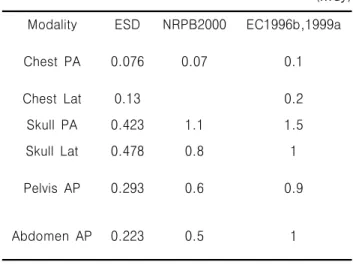
Chest PA의 경우 0.076mGy로 NRPB(UK)의 권고치 인 0.07mGy보다 조금 높았고, EC(Europe)의 권고치인 0.1mGy보다는 낮았다. Chest Lat의 경우 0.130mGy로 EC(Europe)의 권고치인 0.2mGy보다 낮게 나타났다.
Skull PA의 경우 0.423mGy로 NRPB(UK)의 권고치인 1.1mGy보다 40%낮게 나타났고, EC(Europe)의 권고치 인 1.5mGy보다 28%수준으로 낮게 나타났다. Skull Lat의 경우 0.478mGy로 NRPB(UK)의 권고치인 0.8mGy보다 절반 정도로 낮게 나타났고, EC(Europe) 의 권고치인 1mGy보다 40%낮게 나타났다. Pelvis AP 의 경우 0.293mGy로 NRPB(UK)의 권고치인 0.60mGy 보다 절반 정도로 낮게 나타났고, EC(Europe)의 권고 치인 0.9mGy보다 30%낮게 나타났다. Abdomen AP의 경우 0.223mGy로 NRPB(UK)의 권고치인 0.5mGy보다 절반 정도로 나타났고, EC의 권고치인 1.0mGy보다 20%정도로 낮게 나타났다(Table 3).
Modality ESD NRPB2000 EC1996b,1999a
Chest PA 0.076 0.07 0.1
Chest Lat 0.13 0.2
Skull PA 0.423 1.1 1.5
Skull Lat 0.478 0.8 1
Pelvis AP 0.293 0.6 0.9
Abdomen AP 0.223 0.5 1
Table 8. Comparison of diagnostic reference level in Chest PA, Lat, Skull PA, Lat, Pelvis AP, Abdomen AP
(mGy)
Ⅳ. 고 찰
전리 방사선 피폭에 의한 암유발의 위험은 소아가 성 인보다 크므로 소아의 피폭선량은 가능한 최소화시켜야 하며, 방사선사로써 방호최적화를 위해 X선 검사 시의 환자선량을 정확히 파악하는 일이 중요하다. 소아의 환 자선량에 대한 연구가 외국에서는 활발하지만, 우리나 라에서는 2009년 12월에 식품의약품안전평가원에 제출 된 용역보고서 외에는 소아 X선 검사시의 환자선량에 대한 자료는 거의 없다.12 국제원자력기구(IAEA)의 소 아검사 시 권고사항을 살펴보면, 검사 시 촬영자세를 고정하여 재촬영 감소와 조사영역의 최소화로 인한 조 사선량 감소, 관전압을 높이고, 관전류를 낮추어 노출 시간 감소로 인한 조사선량 감소, 산란선 제거를 위한 그리드 제거 및 소아환자용 AEC 설계 등 불필요한 방 사선 피폭으로부터 보호해야 한다고 권고하고 있다3).
소아는 체구가 성인보다 작기 때문에 산란선의 영향을 거의 받지 않는다. 그러므로 본 연구에서는 table- bucky 검사, 특히 복부와 골반 검사 시 그리드를 사용 하지 않았고, 검사 조건을 최대한 줄이기 위해 감도 (Speed)를 최대한으로 높였다. 또한 소아검사 시 갑상 선, 골수, 소아 생식선 등은 진단에 필요한 영상 정보 를 얻기 위해 최소한 낮은 방사선을 이용하는 것은 물 론이고, 방사선 차폐를 꼭 시행해야 한다. 그리고 가능 하면 조사부위를 제한하고 소아 신체에 맞게 방사선량 을 조절 해야 한다.13,14
본 연구에서는 PCXMC Program을 사용하여 ICRP- 103에서 제시한 장기들에 부합되는 선량 측정이 가능하 고 이에 따라 정확한 유효선량 값을 산출할 수 있었다.
또한 본 연구에서는 다른 나라의 DRL보다는 전반적 으로 선량이 낮게 나왔다. 하지만 방사선에 대한 감수 성이 높은 장기들이 많이 포함되기 때문에 DRL보다 선 량이 낮게 측정되더라도 지속적인 저감화 노력이 필요 하다고 사료된다. 이것은 관전압, AEC의 감도, 필터의 조합을 통해 조정할 수 있는데, 본 연구의 제한점 으로 는 정해진 조건과 감도를 이용해서만 실험을 했기 때문 에 다른 부가적인 요소를 추가한 실험을 고려해야 한다 고 생각한다.
Ⅴ. 결 론
본 실험을 통해 본원의 진단 방사선 검사로 인한 환 자의 피폭선량을 측정하여 다음과 같은 결론을 얻었다.
6개 항목으로 분류된 방사선 검사에서의 ESD는 전반적 으로 낮게 나타났으나, Chest PA 검사에서 NRPB(UK) 권고선량보다 약간 초과하여 측정되었다. 선량이 다른 나라의 DRL보다 낮게 측정되어도 체격이나 연령 등 개 인차에 따라 ESD가 달라지는 것을 고려해야 한다. 특 히 소아는 방사선에 민감한 점을 고려하여 PCXMC 프 로그램을 이용하여 좀더 정확하게 장기선량, 유효선량 을 파악하고 적극적으로 방사선 피폭을 최소화 하기 위 해 지속적으로 노력해야 하겠다.
참고문헌
1. 구현우: 소아 흉부촬영에서의 환자선량 권고량 마련 을 위한 연구, 방사 선 안전관리 용역연구개발과제, 09142방사선509, 식품의약품안전평가원, 한국의료영 상품질관리원, 2009
2. 구현우: 소아 CT: 방사선량에 대한 이해와 경상기법 의 최적화, 대한영상의학회지, 52, 1-5, 2005 3. 소아 방사선 촬영을 위한 기술정보: 방사선안전관리
시리즈 No.22,1-2,2010
4. IAEA: Safety Series No,115, International Basic Safety Standards for Protection against Ioniz- ing Radiation and for the Safety of Radiation Sources, 1996
5. ICRP: Radiation and your Patient: A Guide for Medical Practitioners, Annals of the ICRP Supporting porting Guidance 2, Pergamon Press, Oxford, 2001
6. ICRP: The 2007 Recommendations of the Inter- national Commission on Radiological Protection, ICRP Publication 103, 2007
7. EC(Pediatric): European Guidelines on Quality Criteria for Diagnostic Images in Pediatrics, EUR 16261 EN, 1996
8. NRPB(Pediatric): Reference Doses and Patient Size in Pediatric Radiology, NRPB-R318, 2000 9. 김재인 외, Glass dosimeter를 이용한 환자피폭선량
에 관한 분석, 서울특별시 방사선사회, 2009
10. 최원근 외, A PC-Based Monte Carlo Program과 유리선량계를 이용한 장기선량 및 유효선량 평가, 대한영상의학기술학회, 6(1), 131-138, 2009
11. 장성원 외, 전 척추 전ㆍ후 후ㆍ전 방향 촬영 시 PC-Based Monte Carlo Program과 유리선량계를 이용한 장기선량 및 유효선량 평가
12. 신귀순 외, 소아 흉부촬영 시 나이와 체격에 따른 입사피부선량, 대한방사선과학회, 2010
13. 대한영상의학회 소아 방사선 피폭 : 식약청, www.radiologyinfo.or.kr
14. Radiation Health Newsletter: 식품의약품안정청 통권 52,14(3),Sep,2008