Long-and Short-term Relationship between Human Resources Expenditure and Management
Performance in South Korea
-focusing on Public District General Hospitals-
Jeongwon Park
*, ***, Heesoo Yoon
*, Mankyu Choi
*, **, ***†*
Department of Public Health Science, Graduate School, College of Health Science, Korea University, Anam-ro, Seongbuk-gu, Seoul, South Korea
**
Department of Health Policy & Management, College of Health Science, Korea University, Anam-ro, Seongbuk-gu, Seoul, South Korea
***
BK21 Four R&E Center for Learning Health Systems; Transdisciplinary Major in Learning Health Systems, Graduate School, Korea University, Seoul, South Korea
1)
<Abstract>
인적자원관리비용과 경영성과에 대한 장·단기 효과분석
박정원
*, ***, 윤희수
*, 최만규
*, **, ***†*
고려대학교 일반대학원 보건과학과,
**고려대학교 보건정책관리학부,
***고려대학교 4단계 BK21 러닝헬스시스템 융합사업단
Purposes: 우리나라 공공의료기관들의 경영실적 보고에 따르면 대부분의 공공의료기관들이 만성적자로 인한 경영난 문 제를 겪고 있는 실정이다. 이는 공공의료서비스 제공 등이 주요 원인이겠지만 그럼에도 공공의료기관들의 경영효율화 문제는 지속적으로 지적되고 있음은 공공연한 사실이다. 이에 본 연구는 고정비 성격이 강한 인적자원관리비용과 경영 성과 간의 관계를 분석하여 공공의료기관의 경영성과 개선을 위한 경영적 함의를 제공하고자 하였다.
Methodology: 분석자료는 2014년부터 2019년까지 39개 지역거점 공공병원의 재무자료를 이용하였고, STATA SE 12.0 을 사용하여 다중회귀분석과 패널회귀분석을 실시하였다.
Findings: 다중회귀분석을 통한 단면연구 결과에서는 인건비가 높을수록 경영성과가 높은 경향을(2014년 의료수 익:1.523/ 2015년 의료수익: 2.002, 의료수익의료이익률: 0.002/ 2016년 의료수익: 1.223) 보였으나 패널회귀분석 을 통한 종단연구 결과에서는 복리후생비가 높을수록 경영성과가 의미있게 높은 경향을(의료수익: 3.232582/ 의료수 익의료이익률: 0.0014502) 보였다. 이는 인건비는 경영성과에 단기적인 효과가 있는 반면 복리후생비는 경영성과에 장기적인 효과가 있음을 반영하는 것이라고 볼 수 있다.
Practical Implication: 본 연구는 이러한 결과를 기반으로 장기적인 효과가 있는 복리후생비의 중요성을 제시하고, 공공의 료기관의 경영성과에 영향을 미치는 인건비와 복리후생비의 특성 파악을 통하여 효과적인 인적자원관리방법을 위한 경 영적 함의를 도출하였다는 점에서 의의가 있겠다.
Keywords: 패널 분석, 지역거점 공공병원, 경영성과, 인적자원관리비용, 고정효과, 랜덤효과
* 투고일자 : 2021년 07월 29일, 수정일자 : 2021년 09월 22일, 게재확정일자 : 2021년 09월 23일
‡ 교신저자 : 최만규( [email protected])
Ⅰ. Introduction
1. Background of the study
South Korea has recently become a model of infectious disease prevention and control after its COVID-19 response attracted global attention.
Despite the increased recognition of public health institutions, there is still a shortage of beds and workforce[1]. According to the Public Medical Act, public medical institutions are established and operated by a public body, which is selected by the state, local government, or through a presidential decree to provide health care service[2]. Public medical institutions have been established to carry out services that are difficult for private medical institutions to provide, such as caring for vulnerable groups (medical care patients) and those affected by disasters and infectious diseases, which need a prompt response.
As the prolonged COVID-19 outbreak has proven that public medical institutions can quickly react to crises, social interest in public medical institutions is increasing. Despite this, they have less than 10% of the total number of hospital beds in South Korea; however, 80% of inpatients with COVID-19 got treatment in public medical institution [3]. Furthermore, public medical institutions have a low competitiveness and have low financial independence due to deficits in operation [4]. The deficits in operation are caused by obsolete facilities and equipment, the failure to secure an adequate workforce, and the government remaining passive about expenditures [5]. In fact, the proportion of public expenditure allotted to the current health expenditure (CHE) in South Korea is 59.9% as of 2018, which is lower than the OECD average of 73.7% [6]. In addition, there are the combined problems of maladjustment brought about by a rapidly changing health care system
and the loss of management efficiency due to the rise in labor costs, which account for a considerable part of expenditures [7]. Human resource management expenditures are inevitably high owing to the provision of face-to-face medical services.
Nonetheless, the chronic deficit in public medical institutions is severe compared to the state of private medical institutions.
Deficits faced by the regional public hospitals and Red Cross hospitals are serious as these are representative of public medical institutions in South Korea. Regional public hospitals were established as charity hospitals in 1910. These were changed to municipal and provincial medical institutions in 1925, then went through a local public company system in 1982. The responsibility for these hospitals was transferred from under the Ministry of the Interior and Safety to the Ministry of Health and Welfare in 2005. However, direct management is still under the local government [8]. According to the「Public Medical Act」, public district general hospitals and regional public hospitals are in charge of providing medical service for vulnerable groups that have difficulty accessing private medical institutions [9]. However, regional public hospitals are mainly located in small and medium-sized cities, rather than metropolitan cities where the management conditions and social and economic infrastructure are well-organized. If these medical institutions are not competitive, profitability declines and eventually the management conditions deteriorate. This is a recurring problem [10]. There was an average deficit of 2.5 billion Korean Won (KRW) per regional public hospital in 2012. Moreover, only half of the 34 regional public hospitals nationwide recorded a surplus in 2020 [6, 11]. A solution must be found to address the deficit being experienced by public medical institutions.
Furthermore, it is necessary to predict the factors
that affect management performance.
2. Significance of the study
The financial difficulty due to chronic deficit in public medical institutions may be resolved by the support of the central government. However, it is also necessary to modernize the facilities and equipment, secure an outstanding workforce, and apply effective human resource management methods as solutions to exorbitant human resource management expenditures. Human resource management in medical institutions must secure an adequate workforce and provide them with proper education and training to achieve the medical institution organizationʼs purpose [12]. The level of education, work experience, and the quality and quantity of competition in human resources affects individual performance. These factors lead to organizational rewards beyond the individual level [13]. High performance work practices that provide incentives and a wide range of education and training for capable workforce training were implemented. These have been found to positively affect corporate management perfor- mance, such as reducing employee turnover [14].
Furthermore, professionals from various fields work in the medical institution organization.
Therefore, it is classified as a labor-intensive industry. Due to these characteristics, compared to other industrial organizations, a medical institution's source of organizational competitiveness lies in the availability and preservation of a capable workforce [15]. Furthermore, effective human resource management is essential for a high-quality health care system [16]. According to a study that analyzed the relationship between human resources and the quality of medical service, when the ratio of nursing hours provided by a regular nurse is larger than that of a contractual nurse, this had a positive effect on the patient's recovery[17]. These research results showed that human resources are
important in determining the quality of medical services. Especially, the medical institutions need to strengthen the control systems of infectious diseases to overcome the crisis due to the infection diseases by invest in Human Resource Management.
Given that the medical workers are one of the most important factors to beat the infectious diseases, continuous investment in Human Resource Management with enough budget should be guaranteed [18]. Therefore, it is important for research on human resource management methods to make an impact on the management perfor- mance of medical institutions.
Expenditures on education, training, and medical care serve to develop human resources since human resources and the employeeʼs knowledge, technology, and experience cannot be physically separated [13]. In other words, human resource management expenditures are the 'changing to resource' cost, which is necessary to secure and develop a workforce that is necessary for an organization. These human resource management expenditures are essential costs in achieving and developing the organization's goals, and not simply another expense. Human resource management expenditures are invested on medical institution organization under the premise that human resources have value as ʻʻassetsʼʼ. After making an investment, the effect is not immediately noticeable. Among the human resource management expenditures, employee benefits are investments in human assets besides wages. As time passed, employee benefits were found to have improved the worker's proficiency and helped boost it motivation to work, showing that it is possible to continuously and improve the management performance of a company [19].
Furthermore, Jong-Hyun and colleagues (2010)
argued that systematic management of labor costs,
which accounts for a large proportion (about 50%)
of the cost, affects the profitability of medical institutions[20]. According to the Korea Health Industry Development Institute's 2016 hospital management analysis report, the ratio of labor costs to medical revenue for medical institutions in South Korea was 43.8% for private medical institutions and 46% for public medical institutions, based on the average of the total hospital beds. In contrast, the ratio of administrative expenses to medical revenue including employee benefits was 21% for private medical institutions and 26% for public medical institutions[21]. Even upon considering that medical institutions are labor intensive industries, the proportions of labor costs are very high compared to the employee benefits with investment characteristics. Therefore, labor costs and employee benefits should be considered together to find an effective human resource management method for improving management performance. Furthermore, analysis from a long-term point of view is required since the effects of investing in human resource management may arise belatedly.
Ⅱ. Theoretical background
1. Literature Reviews
1) Short-term Relationship between Human Expenditure and Management Performance Majority of the previous studies that analyzed the relationship between human resource management expenditures such as labor cost and employee benefits were conducted as cross- sectional studies. Vermeeren et al. [22] argued that the human resource management of medical institutions has a direct effect on financial performance, and that the more efficient human
resource management is, the higher the net profit.
Cho[23] analyzed that the impact of human resource management expenditures on the management performance of medical corporations located in Busan, Ulsan, and Gyeongnam and suggested that as labor costs of medical institutions increase, the medical revenue also increases. It was also suggested that employee benefits have a positive impact on management performance in the overall period analysis and regional analysis. Cho[24] studied the effect of human resource management expenditures on medical institution's medical revenue in national university hospitals and found that the higher the intensity of labor cost, education, and employee benefits is, the higher the medical revenue of the medical institutions. Gile et al. [25] argued that rewards such as salaries and incentives for human resources have a positive effect on management performance.
However, an increase in medical revenue does not mean an increase in profit. Therefore, it is necessary to analyze the previous studies that used other variables besides medical revenue to find out the effect on profits. Park et al. [26] analyzed factors related to the profitability of medical institutions by using the operating margin as a measurement index of profitability. Operating margins are indicators of remaining pure medical net profit after deducting medical expenses from the medical revenues gained through the operation of medical institutions. Among the production cost indicators related to profitability, the lower the indicators of labor cost ratio and the management cost ratio are, the higher the profitability is.
Furthermore, Choi and Hwang[27] analyzed
determinant factors affecting cost behavior and
operating margin, focusing on private university
hospitals, and found that labor costs had a
negative impact on operating margin.
2) Long-term Relationship between Human Expenditure and Management Performance Some studies have analyzed this relationship from a long-term point of view. Yoo [28] analyzed the factors affecting the publicity and financial performance of regional public hospitals and argued that the higher the labor cost per adjusted patient is, the higher the operating margin as a measurement index of management performance is. Kim[29] analyzed factors of social responsibility in a regional public hospital using panel data. The result showed that employee benefits have a positive effect on social responsibility activities by improving organizational commitment and job satisfaction. Kim[30] analyzed the factors affecting the profitability of medical institutions and found that the labor ratio and material ratio have a negative effect on the operating margin and ordinary income to total assets of medical institutions.
Many previous studies have analyzed the effect of human resource management expenditures on the management performance using cross- sectional studies. However, there is a limit to demonstrate how human resource management expenditures affect management performance just by analyzing a short-term effect owing to the characteristic of human resource management expenditures that which takes investment effect belatedly. Therefore, in order to demonstrate a causal relationship between the expenditures of human resource management and management performance of medical institutions, it is essential to analyze this relationship over the long-term.
There are very few research studies that have been conducted for this purpose. In addition, when medical expenses exceed medical revenue, it is difficult to establish profit. The total medical revenue of 32 public medical institutions in 2019 was 1 trillion 29.5 billion KRW, but medical
expenses amounted to 1 trillion 166.4 billion KRW, which was higher than medical revenue, resulting in medical losses of 136.9 billion KRW and ordinary losses of 1.5 billion KRW [31]. Therefore, not only the medical revenue should be considered;
the operating margin and its various aspects must also be considered.
Therefore, this study aims to demonstrate the long-term and short-term effects of human resource management expenditures on the management performance of medical institutions in Korea by analyzing relevant documents such as financial statements and government reports.
3) Objective of the study
The specific objectives of this study are as follows:
First, this study aims to identify the relationship between the human resource management expen- ditures and management performance of public district general hospitals in South Korea from a short-term and long-term point of view.
Second, this study aims to analyze charac- teristics such as labor costs and employee benefits and how these affect the management performance.
Third, this study aims to provide implications for the establishment of effective human resource management methods.
Ⅲ. Methods
1. Materials and samples
Public medical institutions can be generally classified into national university hospitals, regional public hospitals, and Red Cross hospitals.
This study focused on regional public hospitals and
Red Cross hospitals, excluding national university
hospitals since these have large financial capacities
compared to regional public hospitals and Red Cross hospitals. Furthermore, several studies have already analyzed the impact of human resource management expenditures on management performance in national university hospitals. On the other hand, there is almost no research that analyzes this relationship in both regional public hospitals and Red Cross hospitals together, making this study significant. Labor costs and employee benefits are used as measurement indices of human resource management expenditures, while medical revenue and operating margin are used as measurement indices of management performance.
This study analyzes the short-term effects and long-term effects of human resource management expenditures on the management performance of public district general hospitals.
This study analyzed the balance sheets and the budget documents which were from each of medical institution's web pages, public medical statistics reports in national medical center's web page, and public district general hospital evaluation reports from 2014 to 2019 by Ministry of Health and Welfare. There are 35 regional public hospitals and 6 Red Cross hospitals among South Korea's public district general hospitals. In this study, the Seongnam Citizens Medical Center and Yeongju Red Cross hospital were excluded from the sample because these only opened in 2018.
2. Variables
1) Dependent variables
Table I provides detailed definitions of the variables used in this study. In this study, medical revenue and operating margin were used as measurement indices of management performance in medical institutions. Medical revenue consists of revenue gained from inpatients, outpatient, and other sources except for non-patient revenue.
Medical revenue in inpatients and outpatients consists of revenue gained from patient with national health insurance, patient with medical aid, patient with car insurance, patient with industrial accident compensation insurance, and others. Other sources of medical revenue included those from medical examinations, meal services, medical revenue in proof. Operating margin is defined as the net profit obtained by subtracting medical expenses from medical revenue achieved through medical treatment which is original purpose of medical institutions. Therefore, profits generated from sources other than treating a patient, such as those from philanthropic contributions, endowment revenue, government subsidies, and investment income are excluded [32]. This was done to evaluate the profits gained solely through the practical operation of medical institutions. Operating margin is calculated by dividing medical income by medical revenue.
2) Independent variables
Human resource management expenditures were
the independent variables in this study. Labor
costs and employee benefits were used as
measurement indices of human resource management
expenditures. Labor costs are expenses paid as
compensation of work regardless of title, such as
basic salary or a service allowance. The total labor
cost of a medical institution consists of salary,
allowance, and retirement benefits. Salary includes
monthly flat-rate allowances such as basic salary
and a service allowance. The scale of labor costs
differs depending on the medical subject and
department. Furthermore, the salary step system
is adapted in paying for labor costs. In this study,
the total labor costs of doctor such as medical
specialists, general practitioners, nurses, pharmacists,
medical technicians (including medical record
administrator and nutritionists), office job,
technical work, hired jobs, and other employees were analyzed by dividing the number of employees.
Employee benefits refer to the sum of the amount paid for the purpose of employee welfare.
Employee benefits in South Korea are categorized as legal employee benefits or non-obligatory employee benefits. Legal employee benefits provided by all medical institutions include national pension, national health insurance, employment insurance, and industrial accident compensation insurance. Non-obligatory employee benefits are employee benefits that companies selectively provide to employee. In general, additional welfare benefits include assistance of school expenses for children, a night watch allowance, expenditure for congratulations and condolences, get-together costs, and medical examination costs. The types and amounts of non-obligatory employee benefits differ according to the medical institution.
Employee benefits are given as part of a strategy to recruit competent human resources which largely depends on the medical institution [33].
3) Control variables
There are seven control variables in this study as follows: opening period, type of designation of emergency medical treatment, type of establish- ment, number of operational hospital beds, location, teaching status, and public district general hospitals evaluation grade. All control variables were presented in the form of dummy variables except for the opening period, which is a continuous variable. The type of designation of emergency medical treatment were assigned values of 0 for institutions, 1 for centers, and 2 for non-designation. The types of establishment were assigned values of 0 for regional public hospital and 1 for the Red Cross hospital. As for the number of operational hospital beds, which was used to represent the size of the medical institutions, this variable was assigned a value of 0 for less than 300 beds and 1 for more than 300 beds. Location was assigned values of 0 for small and medium-sized cities, 1 for metropolitan, and 2 for gun, while teaching status was assigned values
Division Variables Definition
Dependent variables Medical revenue Unit(year, 1,000 KRW)
Operating margin Unit(year, %)
Independent variables Labor cost Unit(year, 1,000 KRW)
Employee benefits Unit(year, 1,000 KRW)
Control variables Operating period Unit (year)
Type of designation of emergency medical treatment Institutions Centers Non-designation
Type of establishment Regional Public Hospital
Red Cross Hospital Number of operational hospital beds Less than 300 beds
More than 300 beds
Location Small and medium-sized cities
Metropolitan Gun
Teaching status Intern Training
Non-training
Public District General Hospitals evaluation grade Any other grade than A The grade of A
<표 1> Definition of variables
of 0 for training and 1 for non-training. The Public District General Hospitals evaluation grade conducted by the Ministry of Health and Welfare was assigned a value of 0 for receiving any other grade than A and 1 for receiving a grade of A.
Public District General Hospitals evaluation grades are graded from A to D. A grade is 80 points or m ore, B grade is 70 points or more, C grade is 60 points or more, and D grade is less than 60 points.
The evaluation criteria for regional base public district general hospitals are composed of four evaluation domains: high-quality medical care, public health and medical services, rational operation, and responsible operation. We included the Public District General Hospitals evaluation grade as A or the others (B, C, D), because it was measured by a dichotomous variable in the original data, '2019 Public District General Hospital Evaluationʼ; coded as A or others.
3. Analysis procedure and Methods
The main objective of this study is to analyze the effect of human resource management expen- ditures on management performance over the long term. After conducting a cross-sectional study similar to previous studies, a longitudinal study was conducted using the same data. The data used in the analysis of the study includes balance panel data with the same data coverage period for each individual and no time gap. First, a descriptive statistical analysis was conducted to determine the frequencies, percentages, means, and standard deviation of each variable, followed by the cross-sectional and longitudinal studies. SPSS (Version 25.0) was used for data handling, and the STATA SE (Version 12.0) program was used for statistical analysis of the study. The procedures and methods followed for the cross-sectional and longitudinal studies are as follows.
In the cross-sectional study, multiple analysis was conducted on a year-on-year basis to determine how the human resource management expenditures affected the management performance of each year. In the longitudinal study, panel regression analysis was conducted using six-year (2014 from to 2019) panel data to identify how changes in human resource management expenditures had an effect on management performance over time. Panel regression analysis used a linear regression model, presented as a fixed effect model and a random effect model.
Afterwards, the optimal model was determined through the Hausman test. In the panel regression analysis using the fixed-effects model, time- invariant variables that did not change with time (e.g., type of establishment) were automatically omitted from the analysis [34].
Ⅳ. Results
1. Distribution according to the characteristics of the target medical institution
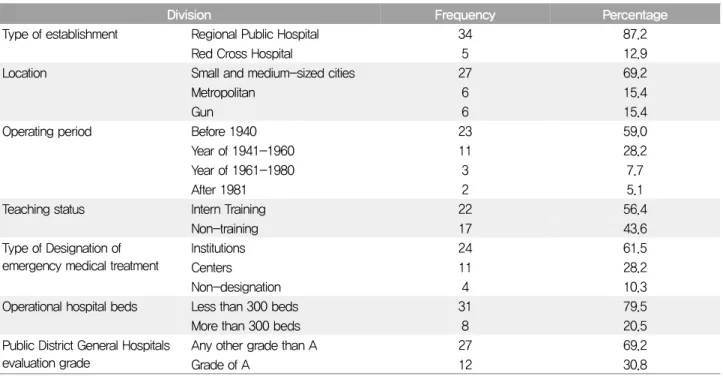
The distribution according to the characteristics
of the public medical institutions to be analyzed is
shown in Table II. There are 34 regional public
hospitals and 5 Red Cross hospitals in South
Korea. According to the descriptive statistical
analysis according to location, 69.2% of these
hospitals were located in small and medium-sized
cities, while 15.4% were located in metropolitan
cities and the remaining in districts. In terms of
the opening period, 23 of the medical institutions
were established before 1940 (59.0%), meaning
around two-thirds of the public district general
hospitals had been in operation for over 70 years.
2. General characteristics of the analysis target
The general characteristics of the target medical institution to be analyzed are shown in Table III.
Upon comparing the averages of variables of human resource management expenditures, labor costs were the highest, followed by employee benefits. The mean labor cost was 56,918,000 KRW, whereas the mean cost of employee benefits was 5,205,000 KRW, which was relatively smaller.
3. Annual average of variables
Table IV shows the changes in averages of variables by year. Medical revenue continued to increase from 2014 to 2019. Expenditure on labor costs and employee benefits also increased steadily. Among the measurement indices of management performance, medical revenue ranged from a minimum of about 83,430,000 KRW to a maximum of about 94,954,000 KRW, and the operating margin ranged from a minimum of about -19% to a maximum of about -12%. Among the measurement index of human resource manage-
Division Frequency Percentage
Type of establishment Regional Public Hospital 34 87.2
Red Cross Hospital 5 12.9
Location Small and medium-sized cities 27 69.2
Metropolitan 6 15.4
Gun 6 15.4
Operating period Before 1940 23 59.0
Year of 1941-1960 11 28.2
Year of 1961-1980 3 7.7
After 1981 2 5.1
Teaching status Intern Training 22 56.4
Non-training 17 43.6
Type of Designation of emergency medical treatment
Institutions 24 61.5
Centers 11 28.2
Non-designation 4 10.3
Operational hospital beds Less than 300 beds 31 79.5
More than 300 beds 8 20.5
Public District General Hospitals evaluation grade
Any other grade than A 27 69.2
Grade of A 12 30.8
<표 2> Distribution according to the characteristics of the target medical institution
Variables(Unit) Mean Std.Dev Min Max
Dependent variable
Medical Revenue per employee (thousand KRW)
88,513 18,451 27,050 151,134
Operating Margin per employee (%)
-14 17 -128 89
Independent variable
Labor costs per employee (thousand KRW)
56,918 11,940 6,220 89,962
Employee benefits per employee (thousand KRW)
5,205 1,477 199 9,083
<표 3> Descriptive statistics analysis of variables
(n=39)
ment expenditures, labor costs ranged from a minimum of about 54,019,000 KRW to a maximum of about 59,279,000 KRW. Employee benefits ranged from a minimum of about 4,719,000 KRW to a maximum of about 6,165,000 KRW.
4. Impact of human resource management expenditures on the management performance
1) Result of annual multiple regression analysis Table V shows the results of annual multiple regression analysis from 2014 to 2019 to confirm the effect of human resource management expenditures on management performance. In the case of multiple regression analyses, all VIF values for determining the extent of multi-collinearity were less than 10, indicating no multi-collinearity.
The results of annual multiple regression analysis on medical revenue showed that labor costs had a significant effect on medical revenue (P<0.001) in 2014, 2015, and 2016. If labor cost increases by 1 thousand KRW, medical revenue increases by 1523 KRW. Furthermore, employee benefits had a significant effect on medical revenue in 2014, 2019 (P<0.01). The results of annual multiple regression analysis showed that labor costs had a significant effect on operating margin in 2015. If the labor cost increases by 1 thousand KRW, the operating margin increases by approximately 0.002%p.
2) Result of panel regression analysis from 2014 to 2019
Table VI shows the results of a longitudinal study performed through panel regression analysis.
The relationship between human resource management expenditures and management performance is significant from a long-term point of view. The result of the panel regression analysis on medical revenue showed that employee benefits were significant (P<0.001) in a fixed-effect model. In the random-effect model, both the labor costs (P<0.05) and the employee benefits were significant (P<0.001). As a result of the Hausman test, the fixed-effect model was adopted. The employee benefits had a significant positive effect on medical revenue. If employee benefits increase by 1 thousand KRW, medical revenue increases by 3232 KRW. The results of panel regression analysis on operating margin show that there were no significant variables in the fixed-effect model. On the other hand, in the random-effect model, the employee benefits were significant (P<0.05). As a result of the Hausman test, the random-effect model was adopted. Employee benefits had a significant positive relationship with the operating margin. If employee benefits increase by 1 thousand KRW, the operating margin increases by approximately 0.0015%p.
Year Medical revenue
(thousand KRW) Operating Margin(%) Labor costs (thousand KRW)
Employee benefits (thousand KRW)
2014 84,409 -16 54,019 4,941
2015 83,430 -19 54,400 4,719
2016 87,158 -12 56,456 4,785
2017 89,182 -14 58,809 5,155
2018 91,943 -12 59,279 5,461
2019 94,954 -14 58,543 6,165
Average 88,513 -14 56,918 5,205
<표 4> Annual average of variables
Ⅴ. Discussion and Conclusion
Recently, the role of the public in providing medical treatment has received increasing attention. However, the chronic deficit in public medical institutions is also intensifying. This may
be attributed to weakened competitiveness due to the facilities and equipment being obsolete, the lack of medical personnel, high costs compared to low medical revenue, and continuous burdens of debt. Regional public hospital and Red Cross hospitals are important for the provision of lasting
Variable Medical Revenue
(thousand KRW) Operating Margin(%)
2014 Labor costs 1.523***
(4.77)
0.000 (0.19)
Employee benefits 3.582**
(2.92)
0.003 (1.75)
Constant -24800 -36.796
Adj R-squared 0.6958 0.1149
2015 Labor costs 2.002***
(5.36)
0.002*
(2.27)
Employee benefits 0.507
(0.27)
-0.002 (-0.64)
Constant -36700 -108.588***
Adj R-squared 0.7424 0.2634
2016 Labor costs 1.223***
(3.94)
0.000 (0.22)
Employee benefits 0.232
(0.17)
0.000 (0.01)
Constant 3662.372 -40.558
Adj R-squared 0.6739 0.1342
2017 Labor costs 0.415
(1.47)
-0.000 (-0.42)
Employee benefits 2.204
(0.70)
-0.001 (-0.22)
Constant 38169.368* -16.377
Adj R-squared 0.3601 0.1505
2018 Labor costs 0.322
(1.68)
0.000 (0.14)
Employee benefits 3.185
(1.75)
0.004 (1.45)
Constant 45227.303** -25.447
Adj R-squared 0.5622 0.0448
2019 Labor costs 0.140
(0.64)
0.000 (0.50)
Employee benefits 6.134**
(3.35)
0.002 (0.96)
Constant 49316.599** -33.038*
Adj R-squared 0.5744 0.2990
Note. Control variables: Operating period, Type of designation of emergency medical treatment, Type of establishment, Number of operational hospital beds, Location, Teaching status, Public District General Hospitals evaluation grade.
*p < .05, ** p < .01, *** p < .001
The value in () represents the Standard Error (SE)
<표 5> Annual multiple regression analysis (cross-sectional study)
public medical treatment, which have a role in the preemptive response to infectious diseases affecting the local community and providing medical treatment to vulnerable groups. Therefore, it is necessary to find solutions to improve management conditions by efficiently utilizing
human resources. This study analyzed the short-term effect and long-term effects of human resource management expenditures of public medical institutions on management performance by analyzing financial statements such as budget documents and balance sheets of public medical
Variables Fixed-effect Random-effect
Coefficient S.E Coefficient S.E
Panel regression analysis on the medical revenue
Labor costs 0.0989491 0.0558278 0.1308151 0.0573234*
Employee benefits 3.232582 0.5869248*** 4.08904 0.5478287***
Type of establishment - 34032.97 6081.872***
Teaching status -4014.828 2297.203 -2949.932 2139.557
Operating period 1431.571 338.4134*** 201.9551 74.65306**
Location (Metropolitan) - -16419.15 5635.12**
Location (District) 76200.73 27658.68** -4899.457 5457.87
Designation of emergency medical treatment center
-2205.609 3656.665 1753.773 2832.241
Non-designation of Emergency medical treatment
-3709.487 4420.071 -7330.013 3995.085
Public District General Hospitals evaluation grade
3528.203 1836.814 4897.465 1821.443**
Number of Operational hospital beds 2530.35 3524.191 2622.656 3156.696
Constant -59586.26 30031.23* 47800000 7124465***
R-squared 0.4440 42487.42
Panel regression analysis on the operating margin
Labor costs 0.0000791 0.0000783 0.0000832 0.0000771
Employee benefits 0.0010928 0.0008232 0.0014502 0.0007318*
Type of establishment - 23.66045 7.252313**
Teaching status -5.205231 3.222117 -5.14655 2.811449
Operating period 0.683116 0.4746674 0.2466281 0.0892344**
Location (Metropolitan) - -19.90249 6.683866**
Location (District) -6.180005 38.79478 -11.81792 6.470243
Designation of emergency medical treatment center
4.831747 5.128933 4.304477 3.590755
Non-designation of Emergency medical treatment
-8.383878 6.199707 -9.612541 5.203441
Public District General Hospitals evaluation grade
0.2115731 2.576364 0.6345777 2.444212
Number of Operational hospital beds 6.95863 4.943123 5.4307 4.100948
Constant -78.55051 42.12259 -44.01068 8.97244***
R-squared 0.2309 0.2130
Note. Control variables: Operating period, Type of designation of emergency medical treatment, Type of establishment, Number of operational hospital beds, Location, Teaching status, Public District General Hospitals evaluation grade.
*p < .05, ** p < .01, *** p < .001 S.E represents Standard Error.