DOI:http://dx.doi.org/10.15205/kschs.2015.3.1.290
Family Caregivers of Korean Patients on Ventilators at Home:
A Penomenological Study
Ki-Ryeon Kim1, Young-Soon Kim2 4)
1Department of Nursing, Masan University
2Department of Nursing, Busan Institude of Science and Technology (Received January 19, 2015 :Revised January 25, 2015 :Accepted January 30, 2015) Abstract
Purpose. This study aimed to explore family caregivers’ experiences with ventilator-dependent patients at home.
Methods. The number of patients using mechanical ventilators at home is expected to increase and family caregivers must be able to care for them. However, few studies focus on the experiences of family caregivers. We conducted in-depth interviews with 11 family caregivers who cared for a ventilator-dependent patient at home in South Korea. Data were analyzed using phenomenological method of enquiry.
Results. Statements generated from the interviews on the meaning of the family caregiver’s experiences were organized into 27 themes, 5 theme clusters, and 2 categories. The theme clusters included endurance under the burden situation, role strain as a caregiver, separation from others, trying to find coping methods, and oriental ethnical customs. Family caregivers of patients using domestic mechanical ventilators need systematic education and emotional support to cope with the challenges of managing ventilator equipment and learning new ways of communicating with patients on the ventilators.
Conclusion. These findings may contribute to family caregivers’ knowledge and competence, thereby allowing them to better support their ventilator-dependent family members.
Key Words: Family Caregiver, Home Care, Mechanical Ventilator, Qualitative Research
Corresponding Author : [email protected]
1. Introduction
With the development of medical technology in Europe, America, and Australia, the number of patients using medical ventilators at home has increased rapidly. Furthermore, the number of patients receiving home care is increasing, and the number of patients using mechanical ventilators at home is expected to rise with the average life expectancy and the number of patients with chronic respiratory insufficiency¹⁾.
It is therefore necessary to understand the impact of using medical ventilators at home. Mechanical ventilators have been found to lengthen the lives of patients with chronic obstructive pulmonary disease, restrictive pulmonary disease, and neuromuscular disease. They have also been found to improve the nutritional status and quality of life of patients, decrease medical expenditures2), shorten the duration of hospitaliz- ation3), and be more economical than treating patients in the hospital4).
Family caregivers of patients with mechanical ventilators are required to have complex skills in patient management. However, family members only anticipate the simple role of a caregiver.
Hence, they start to care for their patients with little information, experiencing physical and mental challenges, along with sacrifices and overwhelming responsibility5). The number of patients using mechanical ventilators at home is increasing in South Korea, yet little is known about the types of patients who use them, their methods of use, or how problems are managed.
Visiting nurses teach content such as circuit and instrument sterilization, inspiration methods, management of tracheotomy tubes, oxygen therapy, and evaluation of pulse and respiration rates. Teaching occurs either whenever the nurse visits or prior to hospital discharge (in which case it can be taught by nurses, the ventilator’s
manufacturer, doctors, or nutritionists).
Unfortunately, some caregivers never receive this information before the patient is discharged1). Previous studies on the home use of mechanical ventilators in South Korea have focused on the actual condition of the patients2), their nursing needs⁶⁾. However, to date, there are no published studies on of the practical experiences of family caregivers of patients using domestic mechanical ventilators.
The aims of this study were to record and analyze actual experiences of family caregivers of patients on mechanical ventilators at home and to write reference literature for domestic ventilator patients and their families.
2. Methods
Research design
This investigation was a qualitative study. An inductive approach to data collection by in-depth interviews was used in this study and the data were analyzed using the phenomenological analysis methodology. The purpose of phenomenology is to investigate the meaning and essence of the experience on the specific situation⁸⁾.
The study was approved by the institutional review board (IRB) of Pusan National University Hospital (E-2013016).
Sample
We explained the purpose of this study to 12 family caregivers who were assigned to a home-visiting nurse from P University Hospital.
The caregivers were selected from a group of patients listed as having domestic mechanical ventilators in South Korea.
Data collection and analysis
We received a list of recommended participants
able to cooperate with interviewing. Data collection was performed through interviews in the participant’s house during visits from the home visiting nurses. Each interview was audio-taped and the time spent for each interview was 31–40 minutes. The period of data collection was between February 1stand March 31st, 2013.
The interview questions were open-ended, and began with general topics of conversation. An example of a question was, ‘Would you tell us your experience of caring for a patient who must use a mechanical ventilator at home?’ The questions became increasingly more specific as the interview progressed, thereby allowing participants to tell us their experience as domestic mechanical ventilator caregivers.
3. Results
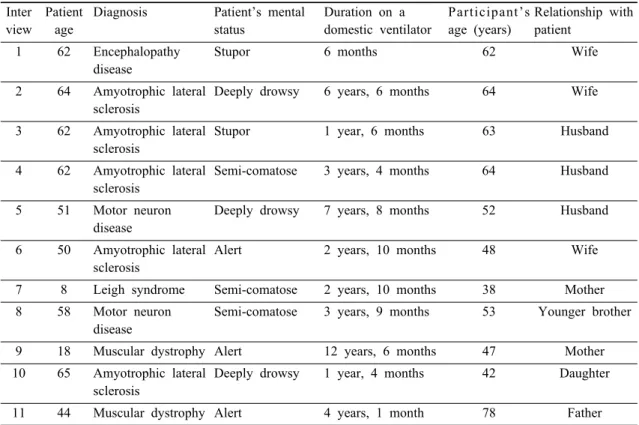
The total number of participants in this study was 11, with ages ranging from 42 to 78 years.
Participants' relationship roles with the patients were as follows: 3 wives, 3 husbands, 2 mothers, 1 father, 1 daughter, and 1 younger brother. The duration of using mechanical ventilators at home ranged from 6 months to 12.5 years, and the level of consciousness of the patients ranged from alert to semi-comatose (Table 1).
Thirty-two descriptive expressions about the caregiving experiences of the families were extracted and categorized into 5 theme clusters using the Colaizzi phenomenological analysis methodology (Table 2).
The themes clusters were: 1. Endurance under the burden situation 2. Role strain as a caregiver 3. Separation from others 4. Trying to find coping methods 5. Oriental ethnical customs.
The description of the participant responses are as follows.
1. Endurance under the burden situation Family caregivers of patients using domestic ventilators suffer sleep disturbance during care.
They also endure the daily burden an unbalanced life style and anxiety due to the possibility of mechanical problems with domestic ventilators or power blackouts.
1) Lack of sleep
The greatest inconvenience is that I can’t sleep comfortably because I have to listen carefully. I need to have a night’s sleep because I have been suctioning continuously and wiping (the patient's) saliva during my sleep time.
2) Chronic fatigue
Nobody can help me even if I am burned out.
3) Giving a bath which is difficult to manage It is difficult to wash the patient because the ventilator is plugged in, and when I wash the patient’s hair or give a bath, I have to separate all the ventilator tubing; that is the most difficult part of bathing.
4) Difficulty holding an Ambu bag
One emergency situation lasted for a long time and I had to squeeze the Ambu bag for 1–
2 hours before a mechanical ventilator mechanic arrived, and this area (pointing to her arm) ached (for some time afterwards).
5) Getting injured
I bathed the patient continuously by myself for 1–2 hours and eventually tore a muscle in my arm.
6) Worried
At first, I really only looked at the machine.
At night, three of us would take turns listening to the machine, fearing it would shut down
Inter view
Patient age
Diagnosis Patient’s mental status
Duration on a domestic ventilator
Participant’s age (years)
Relationship with patient
1 62 Encephalopathy disease
Stupor 6 months 62 Wife
2 64 Amyotrophic lateral sclerosis
Deeply drowsy 6 years, 6 months 64 Wife
3 62 Amyotrophic lateral sclerosis
Stupor 1 year, 6 months 63 Husband
4 62 Amyotrophic lateral sclerosis
Semi-comatose 3 years, 4 months 64 Husband
5 51 Motor neuron disease
Deeply drowsy 7 years, 8 months 52 Husband
6 50 Amyotrophic lateral sclerosis
Alert 2 years, 10 months 48 Wife
7 8 Leigh syndrome Semi-comatose 2 years, 10 months 38 Mother
8 58 Motor neuron disease
Semi-comatose 3 years, 9 months 53 Younger brother
9 18 Muscular dystrophy Alert 12 years, 6 months 47 Mother
10 65 Amyotrophic lateral sclerosis
Deeply drowsy 1 year, 4 months 42 Daughter
11 44 Muscular dystrophy Alert 4 years, 1 month 78 Father
Table 1. General Characteristics of Patients and Participants (N = 11)
Theme Theme cluster Category
Lack of sleep
Endurance under the burden situation
The situation is a burden
Chronic fatigue
Giving a bath which is out of control Difficulty holding an a Ambu bag Getting injured
Worried
Uncontrollable stress Economic burden Communication obstacles
Role strain as a
caregiver Using the senses
Restlessness or worry Tension
Feeling irritated
Estrangement from others
Separation from others
Cold treatment by others No help from anyone
Getting and giving information
Trying to find coping methods
Duty as a family Considerate home visiting nurse and mechanical ventilator manufacturers
Trying to find a suitable communication methods Exposing our situation to the outside world Support from family
Oriental ethical
customs Controlling my mind
Responsibility for the patient Being bound to patients Affection for family Positive attitude
Table 2. Results of the Colaizzi method analysis
while the others slept deeply. There's no solution, like I said earlier. There is always the possibility of a shutdown happening.
7) Uncontrollable stress
In the beginning, for several months, the patient couldn’t stand it, and I banged my head on the wall, and cried and made an uproar… At first, when it became very stressful, my chest ached and my stomach ached, to the point that I couldn’t bear it.
8) Economic burden
The price of medicine and injections are mostly not covered by insurance. There’s no night caregiver, and if there is, I’m worried because I don’t have the money.
2. Role strain as a caregiver
Caregivers suffer from role strain due to communication problems with patients and having to handle domestic ventilator problems.
1) Communication obstacles
The patient cannot move at all, but if one (the patient) could at least say something, we could communicate with each other a lot.
2) Using the senses
Because the patient can’t talk or communicate, I’m very sensitive to his/her physical changes.
His/her pulse rates are different when the patient is asleep, awake, uncomfortable, and in pain.
3) Restlessness or worry
I am worried about the sound from the machine…There’s no particular method of intervention when an emergency situation breaks out.
4) Tension
The most frightening thing is a blackout. It is especially frightening because houses with mechanical ventilators don't have generators. So, that’s the most difficult.
At first, I was half-asleep and half-awake when lying down to sleep, and this has continued until now. I can't sleep deeply and am always nervous so all of my muscles are tense.
5) Feeling irritated
When the patient pats me several times in the morning to wake me up, I get irritated. How can I be irritated when I see my child lying like that, having walked, and now just lying there? I was very irritated and even had a tantrum.
3. Separation from others
Participants reported experiencing separation from others because they have no time to meet and communicate with others due to 24-hour care-giving for patients.
1) Estrangement from others
I have gone to temple for a few decades, but I can't anymore. I’ve been estranged from my brothers, sisters, and relatives. The problem is that my relations with others have been broken.
2) Cold treatment by others
When I go out, I feel uneasy about leaving him alone at home. So I'd like to go out with him. But people aren’t favorable of it. They blame me for bringing a sick patient that carries a mechanical ventilator. They don't understand why I should be with him always.
3) No help from anyone
Caring at home is too hard for me. The worse thing is that there's no one who can help me.
4. Trying to find coping methods
Participants get information and try to find methods within their families and by talking to other families to solve caregiving problems.
They also need to get help from home visiting nurses and ask others for help by exposing their situation to the outside world.
1) Getting and giving information
I talk with other family caregivers by phone to share useful information with them.
2) Considerate home visiting nurses and mechanical ventilator manufacturers Anyway, I receive lots of help from the home visiting nurse more than from any others.
3) Trying to find suitable communication methods
I tried to use body language in the beginning, and then writing several times and that was a step (forwards). We did it with writing and then the patient couldn't use his/her hands anymore;
so then we communicated with our eyes, to make it easier. That doesn’t work so we try to use our senses to note (what the patient wants/needs) after having accumulated experience.
4) Exposing our situation to the outside world I just exposed it to the outside, and I opened my home. Since then, neighbors have helped us.
When we faced a power failure, they came to fix it. Besides, residents of the apartment (building) where we live gave us a hand in many ways. Our family’s situation has been known to almost everyone around us. Now I don't care what they think.
5. Oriental ethnical customs
Participants feel responsible for the patients
under their care because the participants think that other care givers cannot take care of the patients with as much love as their families and that patient condition may deteriorate rapidly while being looked after by others. This is due to the ethical belief that all of the patients should be cared for by family care givers.
1) Support from family
Family members help us by taking turns.
2) Controlling my mind
There's no other way. I can't help becoming overwhelmed myself. I have to be patient with myself.
3) Responsibility for the patient
The sick kid is my family because he was born from me. Therefore, caring for that kid is not a punishment that I'm forced to take, but a responsibility that I naturally have to take as his mother.
4) Being bound to patients
I can't avert my eyes from the patient because when I do the patient faces death.
5) Affection for family
The patient is pathetic. That’s my feeling these days. It seems that he’s still alive because of me. But sometimes, I think it might be better for the patient to pass away. Anyway, I'm living in that way.
6) attitude
Unlike cancer, this disease can be well managed over a long period if only conditions for the management are satisfied. I think it seems that the patient can survive for many years only if he is well cared for in a clean, hygienic environment.
4. Discussion
Family caregivers experienced a range of physical and mental burdens while caring for patients on mechanical ventilators. Particularly, they endured a lack of sleep by having to monitor the patient for almost 24 hours a day.
They felt scared when bathing the patient and holding the Ambu bag during an emergency. It was very difficult for them to assume responsibilities by themselves when they were alone. They developed chronic fatigue that, in turn, caused them to develop physical illnesses.
When they became irritated with the patient, they felt worried, anxious, tense, fearful, and guilty. It is urgent to establish social support systems to help these families because they have too many physical and mental burdens in caring for these patients 24 hours/day by themselves.
Smith2) and Ji-Ming3) reported similar results.
The caregivers said that caring for the patients by themselves was the most difficult aspect of the role, adding that they wanted someone who could substitute for them, even for a short time.
Research on role adaptation by the families of patients using artificial ventilation systems found that they were at risk of becoming overwhelmed, depressed, and exhausted if they felt worried, anxious, lonely, and fearful when caring for the patient.
Participants of this study reported that they often failed to cope effectively with emergencies, including detachment of the respiratory tubes, alarms sounding from the ventilation system, and the shutdown of the system due to power failures. In a survey of patients on ventilators, Song YE found that their ratings of the need for nursing care in case of emergencies was higher (4.46 ± 0.67 points on average). Among the reasons for emergency nursing, the treatment of airway obstruction
(4.84 ± 0.55) was the most frequently needed, followed by measures for coping with power failure (4.84 ± 0.55) and for preventing a shutdown of the ventilation system (4.68 ± 0.47). Smith3) found that patients wanted nursing care in case of an emergency involving the mechanical ventilator more than they desired a nurse’s knowledge of pathology and the disease process. Ahn1) surveyed 29 caregivers of patients on a ventilation system at home. Their survey found that most of the caregivers spent 24 hours/a day caring for the patients; 3 caregivers never received prior education about how to use the artificial ventilation system and connect the respiratory tubes to the patient; and 2 caregivers never received education about how to perform suction. Caregivers reported that when they faced problems providing care at home, they called for help from home nurses in most cases.
They added that home nurses are very important because they can educate caregivers who have no specialized knowledge of care, and allow patients to contact physicians indirectly. Thus, caregivers who care for patients must receive information about coping with emergencies at home, before patients requiring ventilators are discharged from the hospital.
The participants of this study reported being estranged from other family members and acquaintances, and coldly treated by others, and feeling that the government and current social welfare system were irrational. Our findings are supported by the results of Ahn1). Therefore, more attention and support from physicians, nurses, and health policy makers is vitally important.
Participants in this study reported barely enduring their situations with a sense of responsibility and love for family, although they would like help from others. Tzu-Ting and Ji-Ming3) found that family caregivers accepted
their sick parents at their homes because they saw it as their responsibility as offspring.
Furthermore, social resources, including praise and encouragement from others, energized them.
With strong family affection and a strong sense of duty and responsibility as offspring, they adapted to the caregiver role with the assumption that it is natural to care for sick parents at home.
This study documented how difficult it is to care for patients with serious illnesses at home who require a mechanical ventilator. Caregivers urgently need educational programs from hospitals and manufacturers of the ventilation device to help them use the ventilators, and social systems to ensure that they can provide appropriate care in the home. We believe that the study’s results are important for understanding the experiences of families of patients using mechanical ventilators in South Korea, and for assisting them in providing care in the home.
One of the limitations of this study is that families were recruited from one specialized hospital in S. Korea through the home visiting nurse responsible for patient care.
5. Conclusion
This investigation was a phenomenological study designed to explore individuals’
experiences in caring for a family member who requires a domestic mechanical ventilator. The participants reported experiencing considerable burden in caring for the patient, such as an extreme lack of sleep, chronic fatigue, and stress. Participants also identified one of the major problems as the shutdown of the ventilator due to a sudden power or machine failure. Moreover, they could not cope with such situations because they had little or no
knowledge about how to use the ventilation system. They reported barely enduring their daily responsibilities without the help and support of other family members, people around them, or society.
According to our results, the following recommendations may help families and patients cope with their unique challenges. First, systematic studies are needed on the situations faced by family caregivers of patients using a ventilation system at home. Second, pre-discharge educational programs should be developed and provided to the users of mechanical ventilators. Third, caregivers operating mechanical ventilators should be supported by a service system including physicians, home nurses, medical equipment manufacturers, and social workers. Fourth, local governments, health authorities, and the government should collaborate to provide social welfare services that can be truly effective and efficient for patients relying on mechanical ventilators, and their families.
There is an urgent need to recognize and accurately understand the difficulties that family caregivers encounter in working with patients who use mechanical ventilators at home.
Establishing a social welfare system to provide appropriate assistance to the families and conducting research is needed to identify other variables and their effects on these healthcare providers.
Acknowledgements
This work was financially supported by the Masan University Research Fund in February 2013. The authors received no specific grant from any funding agency in the public, commercial, or not-for-profit sectors.
Conflicts of interest
The authors have no conflicts of interest to declare.
Ethical approval
The study protocol was approved by the institutional review board of Pusan National University Hospital (E-2013016).
Manuscript Writing: ¹
Family caregivers of Korean patients on ventilators at home : a phenomenological study.
References
1. Ahn JJ, Lee KM, Shim TS, et al. Survey of current status of the patients with home ventilator in Seoul and Kyunggi Province.
Tuberculosis and Respiratory Diseases 2000;
49: 624–632.
2. Smith CE, Mayer LS, Perkins SB, Gerald K, Pingleton SK. Caregiver learning needs and
reactions to managing home mechanical ventilation. Heart Lung 1994; 23: 157.
3. Tzu-Ting H, Ji-Ming P. Role adaption of family caregivers for ventilator-dependent patients: transition from respiratory care ward to home. JCN, 2010; 19: 1686–1694.
4. Sevick M, Bradham DD. Economic value of caregiver effort in maintaining long-term ventilator-assisted individuals at home. Heart Lung 1997; 26: 148–157.
5. Scott LD, Arslaman-Engoren C. Caring for survivors of prolonged mechanical ventilation.
Home Health Care Management and Practice 2002; 14: 122–128.
6. Kim MH, Kim HS, Park JD. Factor influencing readmission of home ventilator - assisted children. CHNR, 2012; 18: 9–18.
7. Song YE. Nursing needs of the patient on home ventilator. Unpublished master's thesis.
Seoul. Ewha Womans University, 2003. P.
1-48.
8. Kim BH, Kim GJ, Park IS et al. Comparison of Phenomenological Research Methodology : Focused on Giorgi, Colaizzi, Van Kaam Methods JKAN 1999; 29: 1208-1220.