I. Introduction
Dissolution is an important concept widely represented at various levels from elementary school to college. Despite repeated changes made to science textbooks to keep in line with shifts in the official curriculum of elementary, middle, and high schools, the concept of dissolution has always been presented to students. Nevertheless, it was found that the students at all levels have much difficulty in understanding this phenomenon (Noh & Jeon, 1996;
Kang et al., 1996; Park et al., 1996; Kang et al., 2000; Paik, 2000). Lee et al. (1996) reported that the students felt it most difficult to understand dissolution occurring in the diffusion of gases, diffusion of liquids, dissolution of chalk powder, and eruption phenomenon. They suggested that students had diffi- culty in understanding dissolution as the attraction between solvent and solute molecules.
Many researchers (Abraham & Williamson, 1994;
Anderson & Berkheimer, 1988; Park et al., 1996) have concluded, in studies on the preconceptions and change in conceptions of students, that students have many misconceptions because they interpret the phenomenon of dissolution based upon what they can see, but without any understanding of the micro conceptions related to solvents and solutes. These misconceptions are due to insufficient explanations, confusing expressions in science textbooks, ambiguity regarding the chemical theory related to dissolution, the difficulty of explaining the phenomenon, and the amount of required terminology (Abraham, 1992;
Blanco & Prieto, 1997; Ebenezer & Gaskell, 1995;
Kang et al., 1998; Kim et, al., 2000).
Most of the above mentioned studies have focused on students’ conceptions or on classification of misconceptions. However, Strike and Posner (1992) pointed out that it is more important to understand the causes of misconceptions than to know the features of the misconceptions themselves. Jones et
7 th -12 th Grade Students, Pre-service Teachers and Science Teachers’
Views on the Dissolution of Salt in a Liquid
Jeong-ae Won Dae-Hun Kang Seoung-Hey Paik
*Daejeon Maebong Elementary School, Junghwa High School, Korea National University of Education Abstract: In this study, a survey was conducted of students in grades 7 through 12, student teachers enrolled in their senior year at teachers’ colleges, and science teachers. Subjects were surveyed on their conceptions of phenomenon related with dissolution, saturation, and extraction. The models and analogies used by student teachers and science teachers to explain dissolution were sought. The highest percentage of students thought of dissolution as a phenomenon in which particles broke into the spaces between other particles. The models or analogies used by the highest percentage of science teachers were similar. They generally conceived of dissolution phenomenon through what we call the ‘space conception’. A conception of dissolution phenomenon as ‘hydration through attraction of solvent and solute’ was held by more student teachers than science teachers;
there were some differences, however, according to their academic background. The percentage of teachers professing this view decreased when they attempted to explain the process of extraction of matter in a solution after other matter had dissolved or after the solution was cooled, indicating that the ‘hydration’ conception was not firmly established in the student teachers’ cognition. Therefore, it can be inferred that the conceptions of dissolution as ‘hydration’ were transformed into the conceptions of dissolution as ‘space’ after teaching dissolution phenomenon as practicing teachers. This finding should be considered in teacher-training courses.
Key words: Secondary school students, science teacher, pre-service science teacher, dissolution conception, analogy, teaching model, teacher training course
*Corresponding author: Seoung-Hey Paik ([email protected])
**Received on 20 September 2006, Accepted on 30 November 2007
al. (2000) also stated that attention should be focused not on the classification of preconceptions or misconceptions but, instead, on curricular revision.
To know and alleviate the problems occurring in the classrooms, the study of science teachers and the science textbook contents should be done in con- junction with the study of students’ misconceptions.
In particular, there is a need for studies on the conceptions of student teachers according to their majors(physics education, chemistry education, biology education, and earth education, etc.) as these may be passed on to students in the future because they might teach science in middle school regardless of their majors. Moreover, it is necessary to study the problems of analogies and models used by the student teachers and teachers when explaining dissolution because there are many studies related to the effects of teachers on students’ understanding(Kang et al., 2004; Paik & Cho, 2005; Paik & Shin, 2005; Park et al., 2006). Even when teachers hold scientifically sound conceptions of dissolution, misconceptions can occur amongst students because of the analogies or models used by the teachers (Duit, 1991; Harrison &
Treagust, 1993). These results must be considered in the training of teachers.
II. Instrument and Sample
1. Instrument
Data were collected by pen and pencil question- naire sheets designed for this study. The questionnaire consists of six items: two items related to dissolution phenomena, two items related to saturated solutions, and two items related to solubility. The items are either multiple choice questions or a request to give an explanation of the phenomenon through drawing of a diagram or writing.
The items related to dissolution phenomena consisted of an item that attempted to determine how students conceived of dissolution phenomenon and an item used to determine the models or analogies of the dissolution concept used by respondents. The items related to saturated solution consisted of an item to determine how students conceived of the types of saturated solution and an item related to the reason of volume reduction after two materials mixed. The
items related to solubility consisted of an item to determine how students conceived of interaction between solutes and an item related to the calculation of solubility change according to temperature change when two kinds of solutes dissolved in a solution.
The questionnaire sheets developed were pre-tested on some students and revised based on the results.
The validity of the questionnaire sheets was ex- amined by one professional science educator and four science teachers. The following are examples of the items.
2. Explain the process of dissolving salt in water with analogies or models.
(Open ended question)
5. What happens when dissolve solute B in saturated solution of 50 ℃ with solute A?
(Multiple choice questions)
① Solute B doesn’t dissolve in the solution.
② Solute B dissolves in the solution as same amount of in pure water of 50℃.
③ Solute B dissolves in the solution as amount of solute A extracted.
④ Solute B may dissolve more or less than solubility.
⑤ The others(Please write here
)
The time for solving this sheet was 40 minutes.
Marking of the sheets and the classification of response types were immediately carried out by the researchers. When it was hard to decide the subjects’
conceptions by written outcomes, interviews were conducted by the researchers.
To reduce the possible influence of researcher’s
bias on analysis of the responses of the questionnaire
sheets, cross-checking was conduced by researchers
and two other science teachers who had master’s
degrees in science education. The data analysis was
based on a previous study (Kang et al., 2004). If the
results of the analysis were inconsistent, the criteria
of analysis were discussed again for a more objective
judgment.
2. Participants
The students studied were enrolled in grades 7 through 12, with the exception of grade 8. The omission of grade 8 is the limit of this research, but should not present a problem in finding tendencies of the students by grade based on the data.
The students were selected from each one class of two middle schools and three academic high schools in Seoul schools located near the place of researchers’
work places. Student teachers were selected conside- ring their majors from a teacher’s college in Chungju.
Student teachers were analyzed according to their
Table 1Student respondents (Unit: person)
Grade 7th 9th 10th 11th 12th Number of
respondents 72 86 81 86 104
Table 2
Student teachers and science teachers (Unit: person)
Major
Student teachers
Science teachers Physics Chemistry Biology Earth
Science Number of
respondents 15 20 13 19 45
majors. Forty-five middle and high school science teachers were selected from a graduate course of chemistry education at a university located in Chungju.
Thirty-two of them were teachers of middle school and thirteen were teachers of high school. Tables 1 and 2 display the number of respondents by grade or academic major.
III. Results and Discussion
1. Conceptions of Dissolution
Three types of thinking about dissolution were analyzed. In the questionnaire, the example of a solute of dissolution was salt. The three response types were: ‘salt particles are surrounded by water particles’, ‘salt particles fit into the holes between the water particles’, and ‘salt particles become small’ etc.
The response ‘salt particles are surrounded by water particles’ was classified as the ‘Dissolution as Hydration’ concept. As presented in theoretical background, this type of thinking belongs to the scientific conception. The response type of ‘salt particles insert into the holes between the water particles’ was classified as the ‘Dissolution as Hole between particles’ concept. This type of thinking is probably due to confusion of dissolution with diffusion
Table 3The students’ conceptions on dissolution Respondent number/Total number (%)
Response types Grade
7th 9th 10th 11th 12th
Hydration* 0/72 (0.0) 5/86 (5.8) 14/81 (17.3) 22/86 (25.6) 30/104 (28.8) Hole 54/72 (75.0) 66/86 (76.7) 54/81 (66.7) 44/86 (51.2) 70/104 (67.3)
Macro scope 8/72 (11.1) 11/86 (12.8) 6/81 (7.5) 3/86 (3.5) 4/104 (3.8)
Others 10/72 (13.9) 4/86 (4.7) 7/81 (8.5) 17/86 (19.7) 0/104 (0.0)
Total 72/72 (100.0) 86/86 (100.0) 81/81 (100.0) 86/86 (100.0) 104/104 (100.0)
* Scientific conception Table 4
Conceptions of student teachers and science teachers on dissolution Respondent number/Total number (%)
Response types Major of student teachers
Science teachers
Physics Chemistry Biology Earth science
Hydration* 13/15 (86.7) 15/20 (75.0) 10/13 (76.9) 5/19 (26.3) 21/45 (46.7)
Hole 0/15 (0.0) 2/20 (10.0) 3/13 (23.1) 12/19 (63.2) 20/45 (44.4)
Macro scope 0/15 (0.0) 0/20 (0.0) 0/13 (0.0) 0/19 (0.0) 1/45 (2.2)
Others 2/15 (13.3) 3/20 (15.0) 0/13 (0.0) 2/19 (10.6) 3/45 (6.7)
Total 15/15 (100.0) 20/20 (100.0) 13/13 (100.0) 19/19 (100.0) 45/45 (100.0)
*Scientific conception
as pointed out in the theoretical background. The response ‘salt particles become small’ does not include the microscopic particle view of dissolution pheno- mena. This type was classified into ‘Dissolution as macroscopic observation’.
The classification of the students’ conceptions is shown in Table 3, while those of the student teachers’
and science teachers’ are shown in Table 4.
The higher the grade of the students, the higher the percentage was of students holding the scientific conception of ‘Dissolution as Hydration’ and the percentage of conceptions of ‘Dissolution as macro- scopic observation’ reduced gradually according to grade. It could infer that science education can influence their students’ conceptions. However, the percentage of students holding the ‘Dissolution as Hole’ conception does not reduce according to the grade and the highest percentage among three types of thinking. This means that students’ conceptions were not corrected by science education, and that research is needed on effective teaching methods for changing students’ conceptions.
The conceptions of student teachers differ according to their majors. Most student teachers with physics, chemistry, or biology majors have the ‘Dissolution as
Hydration’ concept. However, most student teachers with earth science as their major have the ‘Dis- solution as Hole’ conception, which explains the dissolution phenomenon as solute particles fitting into holes between solvent particles.
The science teachers hold both types of thinking,
‘Dissolution as Hydration’ conception and ‘Disso- lution as Hole’ conception, evenly. This means that science teachers have a less scientific conception than student teachers. The cause of this requires further research. We can infer that science teachers’ un- scientific thinking can influence their students when they teach the dissolution phenomena.
2. Thinking on saturated solution
The three conceptions of saturated solution held by students, student teachers, and science teachers are related to their conceptions of dissolution. The question is ‘Why can’t salt dissolve any more in a saturated salt solution?’ The response types were:
‘because there is no water particle to surround the salt particles’, ‘because the holes between water particles are already filled with other salt particles’,
‘because the size of the salt cannot become any
Table 5Conceptions of the students on the saturated solution Respondent number/Total number (%)
Response types Grade
7th 9th 10th 11th 12th
Hydration* 2/72 (2.8) 8/86 (9.3) 10/81 (12.3) 20/86 (23.3) 22/104 (21.2) Hole 48/72 (66.7) 70/86 (81.4) 63/81 (77.8) 46/86 (53.5) 66/104 (63.5)
Macro scope 8/72 (11.1) 7/86 (8.2) 3/81 (3.7) 6/86 (7.0) 13/104 (12.5)
Others 14/72 (19.4) 1/86 (1.1) 5/81 (6.2) 14/86 (16.2) 3/104 (2.8)
Total 72/72 (100.0) 86/86 (100.0) 81/81 (100.0) 86/86 (100.0) 104/104 (100.0)
*Scientific conception Table 6
Conceptions of student teachers and science teachers on the saturated solution Respondent number/Total number (%)
Response types Major of student teachers
Science teachers
Physics Chemistry Biology Earth science
Hydration* 10/15 (66.7) 9/20 (45.0) 10/13 (76.9) 3/19 (15.8) 14/45 (31.1)
Hole 2/15 (13.3) 2/20 (10.0) 3/13 (23.1) 14/19 (73.7) 23/45 (51.1)
Macro scope 0/15 (0.0) 0/20 (0.0) 0/13 (0.0) 1/19 (5.3) 0/45 (0.0)
Others 3/15 (20.0) 9/20 (45.0) 0/13 (0.0) 1/19 (5.3) 8/45 (17.8)
Total 15/15 (100.0) 20/20 (100.0) 13/13 (100.0) 19/19 (100.0) 45/45 (100.0)
*Scientific conception
smaller’ etc. The first response type was classified into the conception of ‘Hydration’. The second type is classified into the conception of ‘Hole’. The third type is classified into Macroscopic observation (‘Macro scope’). The classification results of the students’
conceptions are presented in Table 5. The classifi- cation results of the student teachers’ and science teachers’ conceptions are presented in Table 6.
The higher the grade of the students is, the higher the percentage of scientific conception tends to be.
However, the percentage of students classified as holding the ‘Hole’ conception is the highest. This percentage does not reduce according to grade. This means that students’ conceptions were not corrected by science education, and that research is needed on effective teaching methods for changing students’
conceptions.
As with the results for dissolution, the conceptions of student teachers differ according to their majors.
Most of the student teachers with physics, chemistry, or biology majors are classified as having held the
‘Hydration’ conception of saturated solution. How- ever, the student teachers with earth science majors mainly are classified as having held the ‘Hole’
conception. The similarity of the two results (Table 4 and Table 6) adds weight to the suggestion that conceptions vary according to the major of the student teachers.
The student teachers of the four kinds of major will teach dissolution phenomena to middle school students in the future; it can be inferred that the
student teachers’ thoughts of dissolution might influ- ence their students.
3. Conceptions on the phenomenon of dissolving a solute in a solution saturated with another solute When we asked ‘what would be happen when we dissolve sugar in the solution saturated with salt?’, the responses of this question were classified into four types. The first type of response was that sugar would not dissolve. The second type of response was that the amount of sugar that would be dissolved is the same as the amount of salt that was extracted.
The third type of response was that sugar would dissolve in a saturated solution as much as in pure water regardless of the salt in the solution. This type of response is related to the basic hypothesis of the solubility calculation represented in ‘Explanation of saturated solution in science textbooks’ in the theoretical background. This type of thinking does not consider the interactions of mixed particles in the solutions.
The fourth type of thinking was that sugar might dissolve more or less than the solubility in pure water. This type of thinking can be classified as a scientific conception because this answer is right when we consider the interaction between solutes and solvent particles. The percentage of students’ concep- tions according to grade is presented in Table 7.
The conception held by the highest percentage of subjects is the first type, which sugar does not
Table 7The conceptions of the students on dissolving a solute in the saturated solution with another solute
Respondent number/Total number (%)
Response types Grade
7th 9th 10th 11th 12th
The other solute doesn’t
dissolve. 20/72 (27.8) 33/86 (38.4) 40/81 (49.4) 11/86 (12.8) 36/104 (34.7) The other solute dissolves as
much as the solute of saturated solution is extracted.
20/72 (27.8) 13/86 (15.1) 11/81 (13.6) 16/86 (18.6) 30/104 (28.8)
The other solute dissolves as
much as the solubility. 14/72 (19.4) 25/86 (29.1) 5/81 (6.2) 12/86 (14.0) 20/104 (19.2) The other solute dissolves
more or less.* 2/72 (2.8) 12/86 (14.0) 20/81 (24.6) 21/86 (24.4) 12/104 (11.5) Others 16/72 (22.2) 3/86 (3.4) 5/81 (6.2) 26/86 (30.2) 6/104 (5.8)
Total 72/72 (100.0) 86/86 (100.0) 81/81 (100.0) 86/86 (100.0) 104/104 (100.0)
*Scientific conception
dissolve in a saturated solution. This conception is unscientific because there is no consideration of particle interaction. The conception that ‘the other solute dissolves in a quantity equal to that amount of the solute of the saturated solution that is extracted’
is also unscientific for the same reason.
The conception that ‘the other solute dissolves as much as the solubility’ regardless of the salt already dissolved is the basic hypothesis of the problem of
‘the separation of mixture by solubility’. Only 18%
of the students held this conception. The conception that ‘the other solute dissolves more or less’ is a scientific conception related to hydration. Only 15%
of the students studied held this type of conception.
The percentage of 10
thand 11
thgrade students holding this conception is higher than the percentage that of 7
thand 9
thgrade students; therefore, educational efforts need to correct students’ alternative conceptions to scientific conceptions.
The percentages of student teachers’ conceptions on the dissolving of a solute in the saturated solution are presented according to major in Table 8.
The highest percentage of student teachers holding the scientific conception that the other solute dissolved more or less in the saturated solution was found amongst the student teachers majoring in chemistry.
The majority of student teachers with physics, biology, and earth science majors held unscientific conceptions.
Of the student teachers majoring in physics, 33.3%
thought that the amount of the other solute that
dissolved would the same as the amount of the solute that was extracted from the solution. 33.3% of that group thought that the other solute would dissolve as much as the solute solubility regardless of salt in saturated solution. 38.5% of student teachers who major in biology and most of the science teachers also held that conception; this conception is the basic hypothesis embedded in the solubility problems in science textbooks, and indicates that student teachers and science teachers are seriously affected on their thoughts by science textbooks.
31.5% of the student teachers majoring in earth sciences thought that the other solute would not dissolve. Therefore, the student teachers’ conceptions differ according to their major. However, the reason for these differences was not found in this research.
Further research is needed to find the difference of teachers’ thoughts by their majors.
4. Models or analogies of dissolution used by student teachers and science teachers
To teach students dissolution phenomena, it is necessary to use models or analogies because the students need to understand the movement of unseen particles. Although teachers know the concept of dissolution scientifically, they may pass misconcep- tions on to students through the models or analogies they use. Therefore, it is necessary to investigate the models of dissolution used by student teachers and science teachers if we want to understand the cause
Table 8The conceptions of the student teachers and science teachers on the dissolving of a solute in the saturated solution
with other solute Respondent number/Total number (%)
Response types Major of student teachers Science
teachers Physics Chemistry Biology Earth science
The other solute doesn’t dissolve. 2/15 (13.3) 1/20 (5.0) 0/13 (0.0) 6/19 (31.5) 2/45 (4.4) The other solute dissolves as much
as the solute of saturated solution is extracted.
5/15 (33.3) 2/20 (10.0) 3/13 (23.1) 4/19 (21.1) 2/45 (4.4)
The other solute dissolves as much
as the solubility. 5/15 (33.3) 2/20 (10.0) 5/13 (38.5) 1/19 (5.2) 30/45 (66.7) The other solute dissolves more or
less.* 1/15 (6.8) 14/20 (70.0) 4/13 (30.7) 4/19 (21.1) 8/45 (17.8)
Others 2/15 (13.3) 1/20 (5.0) 1/13 (7.7) 4/19 (21.1) 3/45 (6.7)
Total 15/15 (100.0) 20/20 (100.0) 13/13 (100.0) 19/19 (100.0) 45/45 (100.0)
of students’ diverse conceptions of dissolution phe- nomena.
The models used by student teachers and science teachers to explain dissolution phenomena were divided into two: one is related to the conception of
‘hydration’ considering the interaction of particles in
Fig. 2 An example using the ‘hydration’ model and the analogy of interaction between the interaction of particles and personal attraction: “Women are attracted by a handsome man, and men are attracted by a pretty woman”.
Fig. 3 An example using both the ‘hydration’ model and the analogy of interaction between particles: The interaction between particles is expressed in arrows and is compared to the magnet that draws substance of magnetic property.
Fig. 4 An example using ‘hole’ model and the analogy of the holes made by different sizes of particles:
“A solvent dissolves in a solute as sand fills holes between pieces of gravel”.
Fig. 5 An example using ‘hole’ model: “Salts dissolve in water because salt particles fill holes between water molecules”.
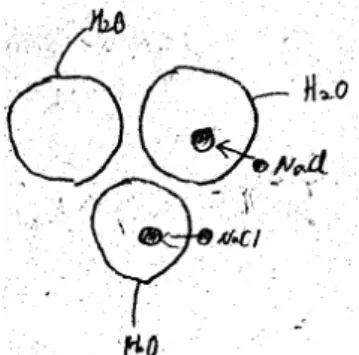
Fig. 6 This model expresses dissolution phenomena as diffusion phenomena: “Salt particles diffuse into water molecules”. This kind of expression was classified as ‘other’ category in Table 11.
Fig. 7 This model expresses salt dissolution in water as NaCl particles are included into water molecules.
a solution (Fig. 2 & Fig. 3); the other is related to the conception of ‘hole’ considering the size difference between particles in a solution (Fig. 4 & Fig. 5).
Also, some confused dissolution phenomena with diffusion phenomena as in Fig. 6.
A few student teachers thought that the solute particles were included in the solvent particles as in Fig. 7.
The models and analogies used by the student
teachers and science teachers were classified into three types as shown in Table 11.
A high percentage of student teachers whose majors are physics, chemistry, or biology used models or analogies that described dissolution in terms of the interaction between particles including the hydration concept. However, a high percentage of practicing science teachers and of student teachers whose major is earth science used models or analogies of disso- lution related to holes filling particles. This tendency is similar to that shown in Table 4, which means that student teachers and science teachers use models or analogies as their conceptions.
IV. Implications for Teaching and Learning
This study investigated the conceptions of disso- lution, saturation, and the extraction of solutes from solutions that were held by students from grades 7 through 12 grade, student teachers of science, and science teachers. Also, the analogies or models used by the student teachers and science teachers to explain the dissolution phenomena were investigated.
The result of this study shows that many students thought of solute dissolution as solute particles breaking into the holes between solvent particles. A higher percentage of science teachers used models or analogies related to the ‘hole’ conception than to any other type. Therefore, it is necessary for the student teachers to recognize this problem through teacher training courses and to develop effective teaching models or analogies to prevent students’ misconcep- tions.
The student teachers mainly held scientific con-
conceptions than student teachers. The analogies or models used by the student teachers and science teachers were related to their conceptions of disso- lution, saturation, and extraction of solutes. If we connect these results, it can be inferred that student teachers’ thoughts of dissolution might be changed after they become practicing science teachers due to the analogies or models they use to explain the dissolution phenomena. If it is possible, teacher- training courses should focus on recognition of the coordinate conceptions soaked into models or analogies used for explanation of scientific phenomena.
The characteristics of student teachers’ thoughts according to major might be considered, too. The student teachers whose major is earth science will teach dissolution phenomena as much as the student teachers majoring in physics, chemistry, or biology.
If their thoughts about dissolution differ, their students may become confused or misinformed.
From the results of this study, we conclude that student teachers’ scientific conceptions related to dissolution are not firm because their thoughts related to saturation or extraction of solute phenomena were not scientific. They could not relate their scientific thinking of dissolution to other situations consistently.
These problems were also found in science textbooks that were used in science classes. Both the models or analogies and the calculation problems used in science textbooks might arouse misconceptions related to dissolution phenomena. The problems of science text- books contributing to the formation of misconceptions of students were pointed out in the previous studies (Abraham, 1992; Blanco & Prieto, 1997; Duit, 1991;
Kang et al., 1998; Kim et al., 2000). If we fail to relieve student teachers and science teachers from the misconceptions identified by this research, they will
Table 11Conceptions of student teachers and science teachers on the models and analogies of dissolution
Respondent number/Total number (%)
Response types Major of student teachers
Science teachers
Physics Chemistry Biology Earth science
Hydration* 10/15 (66.7) 13/20 (65.0) 11/13 (84.6) 3/19 (15.8) 9/45 (20.0)
Hole 2/15 (13.3) 3/20 (15.0) 2/13 (15.4) 1419 (73.7) 22/45 (48.9)
Others 3/15 (20.0) 4/20 (15.0) 0/13 (0.0) 219 (10.5) 14/45 (31.2)
Total 15/15 (100.0) 20/20 (100.0) 13/13 (100.0) 19/19 (100.0) 45/45 (100.0)
*Scientific conception