eISSN 2288-7407
수소동위원소 저장 계량 장치 특성 연구
김연진1,2ㆍ정광진1,2ㆍ구대서2ㆍ박종철2ㆍ전민구2ㆍ윤세훈3ㆍ정흥석1,2†
1
과학기술연합대학원대학교,
2한국원자력연구원,
3국가핵융합연구소 ITER한국사업단
Characteristics of a Hydrogen Isotope Storage and Accountancy System
YEANJIN KIM
1,2, KWANGJIN JUNG
1,2, DAESEO GOO
2, JONGCHUL PARK
2, MIN-GU JEON
2, SEI-HUN YUN
3, HONGSUK CHUNG
1,2†1
Korea University of Science and Technology, Gajeongro 217, Yuseong, Daejeon, 34113, Korea
2
KAERI, 989-111 Deadeokdaero, Yuseong, Daejeon 34057, Korea
3
NFRI, 113 Gwahakro, Yuseong, Deajeon 34133, Korea
Abstract >> Global energy shortage problem is expected to increase driven by strong energy demand growth from developing countries. Nuclear fusion power offers the prospect of an almost infinite source of energy for future generations. Hydrogen isotope storage and delivery system is a important subsystem of a nuclear fusion fuel cycle.
Metal hydride is a method of the high-density storage of hydrogen isotope. For the safety storage of hydrogen isotope, depleted uranium (DU) has been widely proposed. But DU needs a safe test because It is a radioactive substance. The authors studied a small-scale DU bed and a medium-scale DU bed for the safety test. And then we made a large-scale DU bed and stored hydrogen isotopes in the bed. Before the hydriding/dehydriding, we tested it’s heating and cooling properties and carried out an activation procedure. As a result, Reaction rate of DU-H
2is more rapid than the other metal hydride ZrCo. Through the successful storage result of our large bed, the development possibility of the hydrogen isotope storage technology seems promising.
Key words : Metal hydride(금속수소화물), Hydriding(수소화, 흡장), Dehydriding(탈수소화, 탈장), DU(감손우라 늄), Hydrogen isotope(수소동위원소), Nuclear fusion(핵융합)
†Corresponding author : [email protected]
Received : 2015.9.23 in revised form: 2015.12.9 Accepted : 2015.12.30 Copyright ⓒ 2015 KHNES
Nomenclature
DU : depleted uranium H
2: hydrogen
HMI : Human Machine Interface SDS : Storage and Delivery System U : uranium
UH
3: uranium hydride
PG : pressure gauge VG : vacuum gauge TC : thermo couple
RTD : resistance temperature detector TMP: turbo molecular pump RP : rotary pump
PT : pressure transmitter HT : heater
SV : set value
PV : process value
HE : heat exchanger
Fig. 1 DU Bed Hydriding and dehydriding system
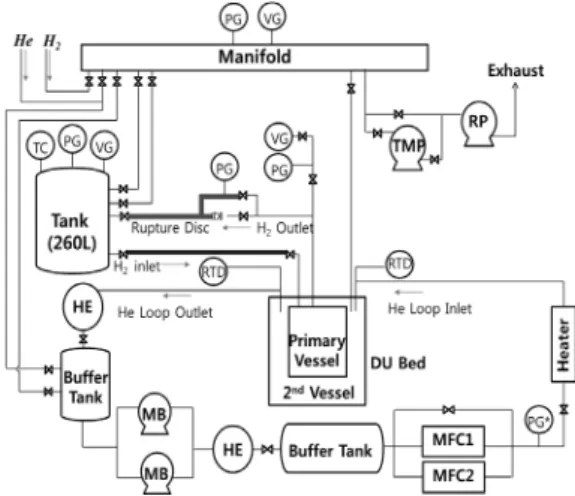
Fig. 2 storage and delivery system schematic diagram
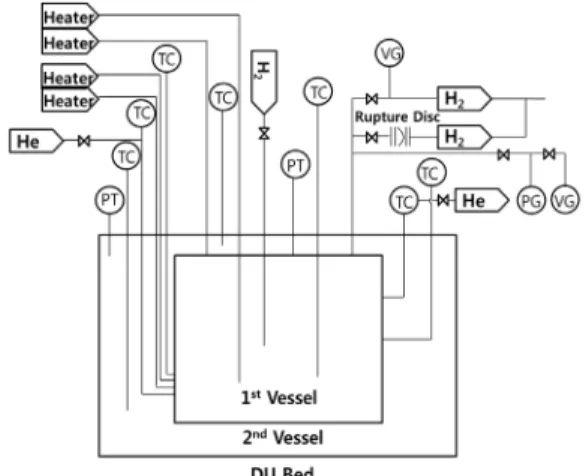
Fig. 3 DU Bed schematic diagram
1. 서 론
세계 경제 규모의 확대에 따라 에너지 수요량은 지 속적으로 증가하고 있다. 하지만, 우리나라는 대부분의 에너지원을 수입에 의존하기 때문에 차세대 에너지원 개발이 시급하다. 그 중 핵융합 에너지는 차세대 에너 지원으로서 수소동위원소인 중수소와 삼중수소를 연 료로 사용한다. 때문에, 원활한 핵융합 발전을 위해 핵 융합 연료를 빠르고 안정적으로 저장 할 수 있는 수소 동위원소 저장장치의 개발이 요구되어왔다
1-18). 핵융합 발전에서는 금속 저장재에 수소동위원소를 화학적으로 흡장하여 안정적인 상태의 금속수소화물로 만드는 수소 저장방법을 사용한다. 수소저장금속으로는 DU를 사용 한다. DU는 다른 금속인 ZrCo에 비해 반응성이 높고 고온에서 불균일화가 일어나지 않기 때문이다
1-17). 본 논문에서는 흡장 및 탈장 실험에 앞서 안정성과 정확성 을 확보하기 위한 대형 DU 베드의 특성평가 및 시운전 을 다룬다
2,5,12).
2. 실험준비
2.1 실험장비
수소 흡·탈장 장비는 대형 DU 베드, 260 L 탱크, 로 타리 펌프, 터보분자펌프, 매니폴드, DAQ 및 인베드열 량계로 구성되며, 이는 Fig. 1과 같다. 1893.75 g의 DU
가 저장재로 사용되었다.
Fig. 2 와 Fig. 3은 각각 전체 수소 흡·탈장 장비모식 도와 DU 베드의 모식도이다.
2.2 베드 시스템 흡·탈장 라인 체적 계산