1)
†To whom correspondence should be addressed.
National Institute of Agricultural Sciences, RDA E-mail: [email protected]
시설원예단지의 친환경적 조성을 위한 생태계서비스 기능 및 가중치 산정
손진관・공민재・신유경
*・ 윤성욱・강동현・박민정・이시영†
농촌진흥청 국립농업과학원 농업공학부
*농촌진흥청 국립농업과학원 농업환경부
A Function and Weight Selection of Ecosystem Service Function for the Eco-friendly Protected Horticulture Complex in Agricultural Landscape
SON, Jinkwan・KONG Minjae・SHIN Yukung
*・YUN Sungwook・KANG Donghyeon・Park Minjung・LEE Siyoung Dept. of Agricultural Engineering, National Institute of Agricultural Sciences, RDA,
*
Dept. of Agricultural Environment, National Institute of Agricultural Sciences, RDA
(Received : 29 September 2017, Revised: 13 November 2017, Accepted: 13 November 2017)요 약
농업, 농촌경관은 다양한 생태계서비스 기능이 있지만 시설원예단지 개발은 환경보전에 대한 고려사항이 없어 단지를 조성 시 필요한 생태계서비스 기능 우선순위 분석을 실시하였다. 시설원예단지의 친환경적 조성을 위한 생태계서비스 기능 및 가중치 산정 방법은 총 3단계에 걸쳐서 진행되었다. 1차 조사결과 17개 기능을 개선방안으로 선정 하였고, 2 차 조사에서 5개 기능을 제외 한 12개 기능이 선정되었다. 최종적으로 1. 수질정화 대책, 2. 지하수함양 방안, 3. 지표 수저장 공간, 4. 홍수조절 대책, 5. 식생다양성 공간, 6. 탄소배출 저감 방안, 7. 수서곤충 서식 공간, 8. 양서파충류 서식 공간, 9. 경관 및 폐기물 대책, 10. 조류 서식 공간, 11. 열섬완화 방안, 12. 체험/생태교육 방안 순으로 고려할 것을 제안하였다. 기능 향상방법으로 수질정화 대책을 위해 수처리 시설의 구조, 유량, 용량, 유속, 배치, 형태 등 공학 적 세밀한 접근과 계획을 제안하고 수질정화 식물인 벼, 부들, 줄, 부레옥잠, 물상추 등의 투입을 고려할 것을 제시했으 며, 지하수ㅤ함양 대책을 위해 개발면적의 7-10%를 저류지 투입으로 제안하였다. 지표수 저장 공간과 홍수조절 대책 을 위해 우리나라 실정에 맞는 저류지 및 저장시설 구조 개발을 제시했으며, 탄소배출 저감과 열섬완화 방안을 위한 녹지공간을 확보를 제안하였다. 생물다양성관 관련된 식생다양성, 수서곤충, 양서파충류 서식을 위한 서식처와 양액배 출 관리를 제안하고 경관개선을 위한 녹지확보, 습지조성, 체험교육을 위한 시설투입을 거론하였다. 연구결과는 시설원 예단지의 개선방안으로 활용하고 새로운 단지 개발에 있어 정책결정 자료로 활용 할 것을 제안했으며, 이러한 연구를 지속시켜 국가 생물다양성 및 국토환경보전, 지속가능한 농업에 이바지하길 기대하였다.
핵심용어 : 농업경관, 비닐온실, 유리온실, 다원적기능, 지속가능, 친환경
Abstract
Agricultural landscape has many ecosystem service functions. However, the development of the horticulture complex has no consideration for environmental conservation. Therefore, we analyzed the priorities of ecosystem service functions required for the composition. The study was conducted in three stages. As a result of the first survey, 17 functions were selected to be improved. In the second survey, 12 functions were selected excluding 5 functions. Finally, 1. Measures for water purification, 2.
Groundwater recharge plan, 3. Surface water storage space, 4. Flood control measures, 5. Vegetation diversity space, 6. Carbon emission reduction plan, 7. Aquatic insect habitat space, 8. Amphibian reptiles 9. Landscape and Waste Management, 10. Bird Species Space, 11. Heat Island Mitigation Plan, 12. Experience / Ecological Education Plan. We proposed the structure, capacity, flow rate, arrangement and form of the water treatment facility to improve water quality by improving the function. We proposed a reservoir space of 7-10% for groundwater recharge. The development of reservoir and storage facilities suitable for the Korean situation is suggested for the surface water storage and flood control measures. And proposed to secure a green space for the climate cycle. Proposed habitat and nutrient discharge management for biodiversity. We propose green area development and wetland development to improve the landscape, and put into the facilities for experiential education. The results of the research can be utilized for the development and improvement of the horticultural complex.
Key words : Agricultural Landscape, Greenhouse, Multifunctionality, Sustainable, Eco-friendly
1. 서 론
생태계서비스라 함은 공급(Provisioning), 조절(Regulating), 지원(Supporting), 문화(Culture) 등 생태계가 인간에 미치 는 직간접적인 영향을 의미하는 것으로 인간이 생태계로부 터 받는 이익 또는 혜택으로 정의할 수 있다(Millennium Ecosystems Assessment, 2005; Kim, 2011). 다양한 생태 계의 유형 중 농업, 농촌경관 즉 농업생태계는 작물생산, 토양비옥도 조절, 탄소고정, 유기물 유지․교환, 경관제공․창 출, 문화적 가치 등 다양한 생태계서비스 기능을 갖는다 (Tscharntke et al., 2005; Antle and Stoorvogel, 2006;
Food and Agriculture Organization, 2008; Porter et al., 2009; Ribaudo et al., 2010). 하지만 농업이 영위되면서 서식지의 악화, 산란지 오염, 생물다양성 감소, 침식, 침전, 온실 가스 배출과 환경 독성 물질 방출 등 다양한 부정적 영향을 미치는 것으로 알려져 있다(Power, 2010). 실제로 농업으로 인한 염류집적, 질소와 인의 배출 등은 이동을 통해 하천, 하구, 강, 습지 등의 생물다양성 및 생산성에 부정적 영 향을 미치는 결과로 초래된다(Williams, 2001; Millennium Ecosystems Assessment, 2005; Comprehensive Assessment of Water Management in Agriculture, 2007).
한편, 우리나라의 농업․농촌은 각종 FTA와 가격하락, 평 균연령 상승 등 많은 위기에 직면해 있고 이런 위기를 극복 하기 위해 다양한 방법이 시도되고 있다(Son et al. 2015).
그 중 시설원예산업을 통한 농산물 생산은 높은 농가소득 으로 전국적으로 다양한 형태의 유리온실과 비닐하우스가 운영되고 있다. 하지만 최근 시설원예산업에 있어 단지개발 방향은 대규모, 에너지 고효율 등에 집중되고 있어 농업 생 태계 및 생물다양성, 지속가능한 농업환경 보전에 대한 고 려사항은 찾아보기 힘들다. 관련 연구 또한 냉난방 등 환경 조절(Kim et al., 2017), 에너지 효율(Kim et al. 2016), 안 정성(Yum and Lee, 2017), 양액(Choi et al. 2017) 등 농 작물 생산에 초점이 이루어져 있어 친환경, 생태적 온실단 지 조성에 대한 연구는 찾아보기 힘들다.
시설원예단지 조성에 따른 농촌의 환경, 생태에 대한 문 제점은 다양하게 거론 할 수 있지만 앞서 거론 한 바와 같 이 작물생산에 초점이 이루어져 있어 환경, 생태와 관련된 연구는 최근 들어 시작되었다. Kong et al.(2017)은 시설원 예단지 조성에 따라 논에 비해 지하수함양은 최대 99% 이 상 저감된다고 발표했으며, 생물다양성과 관련된 분야로는 식생, 곤충 등에서도 시설원예단지 조성에 따라 종다양성이 떨어지는 것을 확인하였다(Son et al. 2016a; Son et al.
2016b). 이 외에도 농촌 폐비닐의 미수거로 인한 방치량이 전국적으로 88만ton에 달하는가 하면(MOE, 2012), 농촌 특유의 자연적이고 긍정적인 경관이 시설원예단지가 조성 되어 매우 부정적 이미지로 변화되었다는 연구결과도 제시 되었다(Kong et al. 2017).
따라서 시설원예단지를 농업․농촌 생태계에서 보다 친환경․
생태적으로 조성 할 필요가 있다고 판단된다. 이에 본 연구는
농촌경관에 분포하는 시설원예단지를 조성할 때 어떠한 생태 계서비스 기능을 우선적으로 고려할지 중요도 분석을 통해 알아보고자 한다. 이러한 연구 결과는 현재 시설원예단지의 개선방안으로 활용하는가 하면, 대규모 시설원예단지 조성 시 정책입안 및 예산배정의 기초 자료로 활용 할 수 있으며, 친환경적 시설원예단지 조성을 통해 국가 생물다양성 및 국 토환경보전에 이바지 할 수 있을 것으로 기대한다.
2. 조사 및 분석방법
농촌지역 시설원예단지의 친환경적 조성을 위한 생태계 서비스 기능 및 가중치 산정 방법은 총 3단계에 걸쳐서 진 행되었다. 먼저 1단계는 선행연구(Costanza et al. 1997;
Daily, 1999; Millennium Ecosystems Assessment, 2005;
De Groot et al., 2010; TEEB, 2010; Ramsar, 2014;
Son, 2014; A.G. Power, 2010; Rhee and Shin, 2003;
Kim and Oh, 2003; Kong et al., 2013) 분석을 통해 시설 원예단지 조성 시 기능이 저하 될 것으로 판단되는 농업경 관의 대표 생태계서비스 기능을 평가하여 총 17개 기능을 선정 한 바 있다(Son et al., 2015). 본 연구에서는 앞선 연 구에서 제시 된 17개 기능에 대해 시설원예단지 조성 시 고려해야 할 생태계서비스 기능에 대해 질문하고(Likert, 2 차), 최종 선정 된 총 12개 기능에 대해 기능별 중요도를 질문하여 기능별 중요도를 산출하였다(AHP, 3차).
2.1 질문에 사용 할 생태계서비스 기능 선정
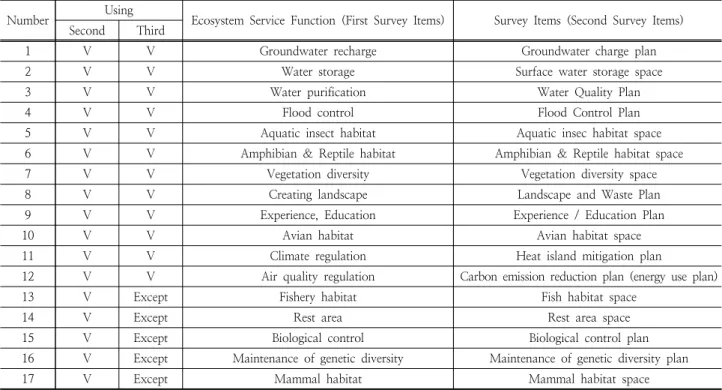
2차 조사 인 시설원예단지 조성 시 고려해야 할 생태계서 비스 기능에 대한 질문 항목(기능)은 2015년 발표된 1차 조사결과(Son et al., 2015)에서 도출 된 수자원함양 (Groundwater recharge), 지표수저장(Water storage), 양서 파충류 서식처(Amphibian & Reptile habitat), 수서곤충 서식처(Aquatic insect habitat), 홍수조절(Flood control), 수질 정화(Water purification), 조류 서식처(Avian habitat), 경관 창출(Creating landscape), 식생다양성(Vegetation diversity), 체험/생태교육(Experience, Education), 생물학적 방재 (Biological control), 어류 서식처(Fishery habitat), 기후순 화(Climate regulation), 포유류 서식처(Mammal habitat), 대기정화(Air quality regulation), 유전적 다양성 보존 (Maintenance of genetic diversity), 휴식제공(Rest area)기 능 등 총 17개 기능을 선정하고 평가에 사용하였다. 평가는 시설원예단지 조성 시 고려할 생태계서비스 기능에 대해 5 점리커트(1, 2, 3, 4, 5)로 질문하고 평가항목은 1차 조사 결과와 주관적 의견을 반영하여 기능을 방안으로 수정하여 Table 1과 같이 구성하였다.
3차 조사는 앞서 평가 된 17개 기능 중 시설원예단지 조성 고려사항에 포함시킬 상위 12개 기능을 선정하여 평가에 활 용하였다. 설문 전 12개 모든 기능은 Table 2와 같이 기능 투입의 필요성을 설명하고 웹 설문 중에도 확인할 수 있도록 기능 아래 설명을 제시 한 상태에서 평가를 실시하였다.
Table 1. The expert research items on the ecosystem service functions(First, Second)
Number Using
Ecosystem Service Function (First Survey Items) Survey Items (Second Survey Items) Second Third
1 V V Groundwater recharge Groundwater charge plan
2 V V Water storage Surface water storage space
3 V V Water purification Water Quality Plan
4 V V Flood control Flood Control Plan
5 V V Aquatic insect habitat Aquatic insec habitat space
6 V V Amphibian & Reptile habitat Amphibian & Reptile habitat space
7 V V Vegetation diversity Vegetation diversity space
8 V V Creating landscape Landscape and Waste Plan
9 V V Experience, Education Experience / Education Plan
10 V V Avian habitat Avian habitat space
11 V V Climate regulation Heat island mitigation plan
12 V V Air quality regulation Carbon emission reduction plan (energy use plan)
13 V Except Fishery habitat Fish habitat space
14 V Except Rest area Rest area space
15 V Except Biological control Biological control plan
16 V Except Maintenance of genetic diversity Maintenance of genetic diversity plan
17 V Except Mammal habitat Mammal habitat space
Table 2. The expert research items and on the ecosystem service functions(Third)
Survey Items (Third) Necessity of Function for Eco-friendly Protected Horticulture Complex
Groundwater charge plan Paddy fields have a large amount of groundwater recharge. However, the facility horticulture complex is an impervious areas. Artificial groundwater recharge facilities(reservoirs, infiltration trenches, etc.) are required.
Surface water storage space
Paddy fields are rich in surface water storage. However, the protected horticulture complex composition can not store surface water. Surface water storage is required for the protected horticulture complex.
Water Quality Plan
Paddy fields are excellent for water purification. However, the composition of protected horticulture complex can not be purified. In addition, the nutrient solution of the protected horticulture complex causes water pollution.
Flood Control Plan
Paddy fields have excellent flood control functions. However, the composition of the protected horticulture complex can not be flood controlled. In addition, rainwater is released quickly due to the impervious space of the protected horticulture complex.
Aquatic insec habitat space
Paddy fields have high aquatic insect-diversity. However, the composition of the protected horticulture complex makes the habitat disappear. Ecological wetlands and habitat spaces are needed for the aquatic insect diversity.
Amphibian & Reptile habitat space
Paddy fields have high amphibian & reptile diversity. However, the composition of the protected horticulture complex makes the habitat disappear. Ecological wetlands and habitat spaces are needed for the amphibian
& reptile diversity.
Vegetation diversity space Paddy fields have high Vegetation diversity. However, the composition of the protected horticulture complex makes the habitat disappear. Ecological wetlands and habitat spaces are needed for the vegetation diversity.
Landscape and Waste Plan
Paddy fields are highly effective in creating landscapes. However, the composition of the protected horticulture complex makes the effect disappear. Improper landscapes such as waste vinyl, waste and oil tanks should be improved.
Experience / Education Plan
Rural-experience in protected horticulture complex can increase the economic value. It is necessary to secure programs and educational space.
Avian habitat space Paddy fields have high avian diversity. However, the composition of the protected horticulture complex makes the habitat disappear. Ecological wetlands and habitat spaces are needed for the avian diversity.
Heat island mitigation plan
Paddy fields have a high climate regulation effect. However, the composition of the protected horticulture complex makes the heat island. It is necessary to reduce heat island such as green space etc..
Carbon emission reduction plan (energy use plan)
Paddy fields have a high air quality regulation effect. However, the composition of the protected horticulture complex makes the carbon emission space. It is necessary to reduce carbon emission such as green space etc..
2.2 전문가 응답자 현황
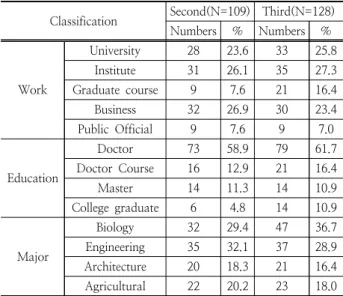
설문에 응답한 전문가의 인적사항은 Table 3과 같이 2차 조사에서 109명, 3차 조사에서 128명이 참여하였다. 전문가의 직업유형을 살펴보면 2차 조사에서 교직(University) 28명 (23.6%), 연구직(Institute) 31명(26.1%), 일반기업(Business) 32명(26.9%), 대학원 과정(Graduate course) 9명(7.6%), 공 무원(Public Official) 9명(7.6%) 등이 참여했으며, 3차 조사에 서도 2차 조사와 비슷한 비율의 분포로 회신되었다.
Table 3. The general information of respondent
Classification Second(N=109) Third(N=128)
Numbers % Numbers %
Work
University 28 23.6 33 25.8
Institute 31 26.1 35 27.3
Graduate course 9 7.6 21 16.4
Business 32 26.9 30 23.4
Public Official 9 7.6 9 7.0
Education
Doctor 73 58.9 79 61.7
Doctor Course 16 12.9 21 16.4
Master 14 11.3 14 10.9
College graduate 6 4.8 14 10.9
Major
Biology 32 29.4 47 36.7
Engineering 35 32.1 37 28.9
Architecture 20 18.3 21 16.4
Agricultural 22 20.2 23 18.0
전공분야는 경우 2차 조사에서는 생물(Biology, 생태포함) 가 32명(29.4%), 공학(Engineering, 기계포함) 35명(32.1%), 건축(Architecture, 토목포함) 20명(18.3%), 농업 (Agricultural, 원예포함) 22명(20.2%) 분야에서 응답했고 3 차 조사에서는 생물․생태 분야의 전문가가 가장 많은 47명이 응답했고 공학․기계(37명, 36.7%), 농업환경 및 원예(23명, 18.0%), 건축․토목(21명, 16.4%) 분야의 순으로 취합되었다.
2.3 전문가 조사 및 분석방법
2차 조사는 2015년 08월 한국습지학회, 한국환경복원기 술학회, 한국생물조절학회 회원에 설문지를 메일로 발송하 여 회신 받았으며, 3차 조사는 2017년 08월 동일 학회 회 원에 안내메일을 발송하여 제작된 웹페이지에서 평가를 진 행하도록 하였다.
수집된 자료는 Excel을 이용하여 자료를 정리하고 SPSS (WIN 19.0) 프로그램을 이용하여 전문분야 집단별 차이를 알아보기 위해 T-test분석을 실시하였다.
3. 결과 및 고찰
3.1 시설원예단지 조성 시 고려 기능에 대한 전문가 조사 (2차 조사)
1단계에서 도출된 19가지의 시설원예단지 조성 시 기
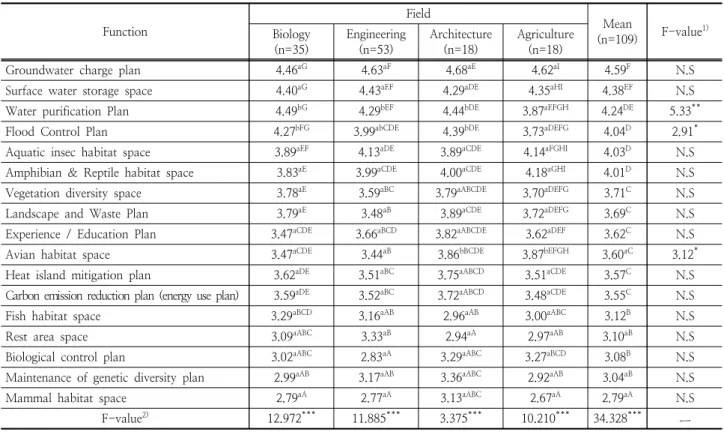
능저하가 우려되는 고려기능 중 필요성이 언급 된 17개 기 능에 대해 2차 조사에서 기능 개선이 필요한 정도를 재 질 문 하였다. 생물, 공학, 건축, 농업 전문가 109명이 각 기 능에 대한 중요도를 5점 리커트(Likert) 척도로 평가하였 으며, 17가지 기능을 분석한 결과 평균 2.79∼4.59로 1차 조사 결과에 비해 상위 기능은 점수가 올라가고 하위 기능 은 점수가 낮아지는 경향으로 분석되었다.
항목(기능) 별 평가결과는 지하수충전 대책이 4.59으로 가장 높게 분석되었다. 다음으로는 지표수저장 공간(Water storage; 4.38), 수질정화 대책(Water purification; 4.24), 홍수조절 대책 (Flood control; 4.04), 수서곤충 서식 공간 (Aquatic insect habitat; 4.03), 양서파충류 서식 공간 (Amphibian & Reptile habitat; 4.01), 식생다양성 공간 (Vegetation diversity; 3.71), 경관 및 폐기물 대책 (Creating landscape; 3.69), 조류 서식 공간(Avian habitat; 3.62), 열섬완화 방안(Climate regulation; 3.60), 체험/생태교육 방안(Experience, Education; 3.57), 탄소배 출 저감 방안(Air quality regulation; 3.55), 어류 서식처 공간(Fishery habitat; 3.12), 휴식제공 공간(Rest area;
3.10), 생물학적 방재 방안(Biological control; 3.08), 유전 적 다양성 보존 대책(Maintenance of genetic diversity;
3.04), 포유류 서식처 공간(Mammal habitat; 2.79)의 순으 로 중요도가 높은 것으로 분석되었다(Table 3).
고려순위는 차이분석을 통해 4.59~4.24점 3개 기능을 1 순위, 4.04~4.01점 까지 3개 기능을 2순위, 3.71~3.55점 6개 기능을 3순위로 구분하고 어류 서식처 공간(3.12), 휴 식제공 공간(3.10), 생물학적 방재 방안(3.08), 유전적 다 양성 보존 대책(3.04), 포유류 서식처 공간(2.79) 등 5개 기 능은 평가점수가 낮아 고려대상에서 제외하였다. 전문분야 별 차이는 2015년 실시한 1차 조사에서 6개 기능에서 전문 가 집단별 큰 차이가 있었는데 2차 조사에서는 수질정화 대책, 홍수조절 대책, 열섬완화방안 등 총 3개 기능에서 크 지 않은 의견차이로 1차 조사보다 의견이 좁혀졌다고 할 수 있다.
3.2. 시설원예단지 조성 시 고려 기능에 대한 전문가 조사 (3차 조사)
1~2단계에서 도출된 12가지의 시설원예단지 조성 시 개 선이 필요한 기능에 대해 항목 간 중요도와 우선순위를 알 아보기 위해 AHP(Analytic Hierarchy Process) 쌍대비교 를 3차 조사에서 실시하였다.
분석결과 시설원예단지의 친환경적 조성을 위한 고려기 능을 1. 수질정화 대책(0.119), 2. 지하수함양 방안(0.100), 3. 지표수저장 공간(0.098), 4. 홍수조절 대책 (0.095), 5.
식생다양성 공간(0.088), 6. 탄소배출 저감 방안(0.083), 7.
수서곤충 서식 공간(0.078), 8. 양서파충류 서식 공간 (0.076), 9. 경관 및 폐기물 대책(0.070), 10. 조류 서식 공 간(0.069), 11. 열섬완화 방안(0.067), 12. 체험/생태교육 방안(0.058) 순으로 고려해야 할 것으로 판단하였다.
Table 4. The considerations importance of ecosystem function at horticulture complex design(Second)
FunctionField
Mean
(n=109) F-value1) Biology
(n=35)
Engineering (n=53)
Architecture (n=18)
Agriculture (n=18)
Groundwater charge plan 4.46aG 4.63aF 4.68aE 4.62aI 4.59F N.S
Surface water storage space 4.40aG 4.43aEF 4.29aDE 4.35aHI 4.38EF N.S
Water purification Plan 4.49bG 4.29bEF 4.44bDE 3.87aEFGH 4.24DE 5.33**
Flood Control Plan 4.27bFG 3.99abCDE 4.39bDE 3.73aDEFG 4.04D 2.91*
Aquatic insec habitat space 3.89aEF 4.13aDE 3.89aCDE 4.14aFGHI 4.03D N.S
Amphibian & Reptile habitat space 3.83aE 3.99aCDE 4.00aCDE 4.18aGHI 4.01D N.S
Vegetation diversity space 3.78aE 3.59aBC 3.79aABCDE 3.70aDEFG 3.71C N.S
Landscape and Waste Plan 3.79aE 3.48aB 3.89aCDE 3.72aDEFG 3.69C N.S
Experience / Education Plan 3.47aCDE 3.66aBCD 3.82aABCDE 3.62aDEF 3.62C N.S
Avian habitat space 3.47aCDE 3.44aB 3.86bBCDE 3.87bEFGH 3.60aC 3.12*
Heat island mitigation plan 3.62aDE 3.51aBC 3.75aABCD 3.51aCDE 3.57C N.S
Carbon emission reduction plan (energy use plan) 3.59aDE 3.52aBC 3.72aABCD 3.48aCDE 3.55C N.S
Fish habitat space 3.29aBCD 3.16aAB 2.96aAB 3.00aABC 3.12B N.S
Rest area space 3.09aABC 3.33aB 2.94aA 2.97aAB 3.10aB N.S
Biological control plan 3.02aABC 2.83aA 3.29aABC 3.27aBCD 3.08B N.S
Maintenance of genetic diversity plan 2.99aAB 3.17aAB 3.36aABC 2.92aAB 3.04aB N.S
Mammal habitat space 2.79aA 2.77aA 3.13aABC 2.67aA 2.79aA N.S
F-value2) 12.972*** 11.885*** 3.375*** 10.210*** 34.328*** ㅡ
* Test result is statistically significant at the P = 0.5 level( * ),P = 0.01 level( ** ), 0.001 level( *** ); NS = Not significant result., Duncan : width a<b<c…, length A<B<C…,
1) The result is according field types, Lower case letters., 2) The result is according ecosystem function, Capital letters.
Table 5. The consider rankings according importance evaluation
FunctionFirst1) (Likert) Second (Likert) Third (AHP)
Average
(n=124) Ranking Grade Average
(n=109) Ranking Grade Importance
(n=128) Ranking Grade
Water purification 3.86 6 1 4.24 3 1 0.119 1 1
Groundwater recharge 4.13 1 1 4.59 1 1 0.100 2 1
Water storage 4.05 2 1 4.38 2 1 0.098 3 1
Flood control 3.87 5 1 4.04 4 2 0.095 4 1
Vegetation diversity 3.71 9 2 3.71 7 3 0.088 5 2
Air quality regulation 3.25 15 3 3.55 12 3 0.083 6 2
Aquatic insect habitat 3.92 4 1 4.03 5 2 0.078 7 2
Amphibian & Reptile habitat 3.96 3 1 4.01 6 2 0.076 8 2
Creating landscape 3.74 8 2 3.69 8 3 0.070 9 3
Avian habitat 3.76 7 2 3.62 9 3 0.069 10 3
Climate regulation 3.30 13 3 3.60 10 3 0.067 11 3
Experience, Education 3.69 10 2 3.57 11 3 0.058 12 4
Fishery habitat 3.42 12 3 3.12 13 Except - - -
Rest area 3.14 17 3 3.10 14 Except - - -
Biological control 3.48 11 3 3.08 15 Except - - -
Maintenance of genetic diversity 3.25 16 3 3.04 16 Except - - -
Mammal habitat 3.30 14 3 2.79 17 Except - - -
Maintenance of soil fertility 3.03 18 Except - - - -
Reducing soil erosion 2.98 19 Except - - - -
F-test2) 6.185*** 34.328*** -
* 1) Son et al.(2015), Expert survey result 2): Test result is statistically significant at the P = 0.001 level( *** )
고려등급은 1순위 4개 기능, 2순위 4개 기능, 3~4순위 4 개 기능으로 구분하고 본 연구결과는 향후 친환경 미래형 시설원예단지 조성모델 개발 시 투입 기능 및 요소의 반영 정도를 파악하는데 활용 가능하다고 판단된다. Table 5에 는 1~3차 조사에 대한 중요 평가내용에 대해 요약하여 기 입하였다.
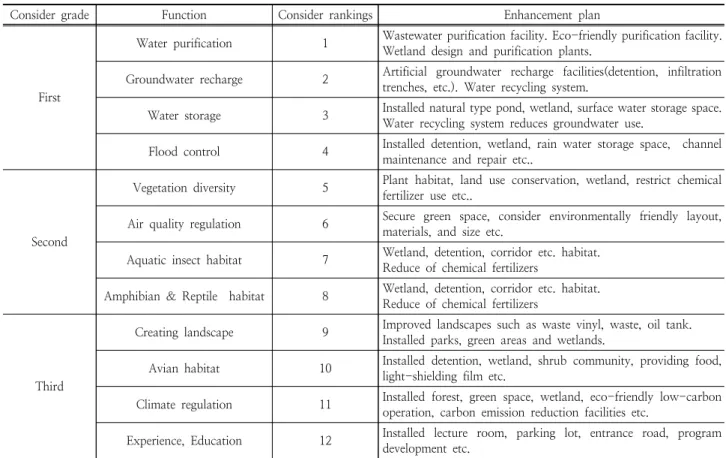
3.3 연구결과를 반영 한 시설원예단지 조성방향 설정 3차례 전문가 조사를 거쳐 최종적으로 12개 기능이 중요 도 순서대로 선정되었다. 선정 된 1개 생태계서비스 기능을 향상시킬 수 있는 개선방법은 2차 조사에서 주관적으로 질 문 한 결과를 반영하여 Table 6과 같이 조성방향을 설정하 였다.
수질정화 대책(Water purification)은 양액배출을 정화하 는 수처리 시설 및 친환경 정화시설 도입을 제안하였는데, 인공습지에서 BOD, SS, TN, TP가 55.9~76.4% 정화효율 이 있는 것으로 분석되었으므로 구조, 유량, 용량, 유속, 배 치, 형태 등 공학적 세밀한 접근과 계획이 필요하다고 판단 된다(Byeon, 2006). 수질정화 식물로는 벼, 부들, 줄, 부레 옥잠, 물상추 등이 연구를 통해 정화효능이 인정되어 이를 투입 고려할 필요가 있다(Kim et al. 2007).
지하수햠양 대책(Groundwater recharge)으로는 저류지, 침투트렌치와 같은 지하수의 인공함양 시설이 필요하며, 양액 순환시스템으로 지하수 사용량을 줄일 필요성을 언급하였다.
지하수함양을 위한 저류지 규모산정은 Lee et al.(2016)의 연구
에서 개발면적의 7-10%를 제안하였으므로 시설원예단지 개 발에 있어 불투수 면적을 고려해 계획에 반영해야 한다.
지표수 저장공간(Water storage) 및 홍수조절(Flood control) 대책은 강우유출을 저감시킬 수 있도록 자연형 저 류지 및 습지를 도입하고, 시설에서 물을 사용 할 수 있도 록 인공적인 지표수 저장 공간 도입이 제안되었다. 저류지 및 습지는 다른 기능의 고려함과 동시에 시설에서 물을 사 용 할 수 있는 수질확보방안이 검토되어야 하며, 인공시설 은 Storage lagoon, Storage tank, 연결수로 등 Irrigation
& Water Engineering(2016)의 사례를 바탕으로 우리나라 실정에 맞는 구조가 개발되어야 한다.
탄소배출 저감을 위한 에너지사용 대책(Air quality regulation)과 대기조절 기능 향상을 위한 열섬완화 방안 (Climate regulation)은 녹지공간을 확보하는 방법을 최우 선으로 거론하고 시설원예의 친환경 저탄소 운영과 탄소 저감 시설을 설치할 것을 제안하였다. 녹지공간은 냉각효과 와 바람길 등 외부공간의 열 환경을 개선하는 효과가 있으 므로 CFD 시뮬레이션과 같은 방법으로 효과를 테스트한 후 계획에 투입 할 필요가 있다(Cho and Ahn, 2006;
Nam, 2008; Seo, 2007; Seo, 2009; Kim et al. 2012) 생물다양성관 관련된 분야로는 식생다양성 공간(Vegetation diversity) 창출을 위해 식물식재 공간과 생태습지 투입을 제안 하였다. 같은 맥락으로 수서곤충 서식처(Aquatic insect habitat) 및 등 양서파충류 서식처(Amphibian & Reptile habitat)도 서식공간 확보와 Under pass형 이동통로 확보 등이
Table 6. The ecosystem services enhancement plan of eco-friendly protected horticulture complex
Consider grade Function Consider rankings Enhancement plan
First
Water purification 1 Wastewater purification facility. Eco-friendly purification facility.
Wetland design and purification plants.
Groundwater recharge 2 Artificial groundwater recharge facilities(detention, infiltration trenches, etc.). Water recycling system.
Water storage 3 Installed natural type pond, wetland, surface water storage space.
Water recycling system reduces groundwater use.
Flood control 4 Installed detention, wetland, rain water storage space, channel maintenance and repair etc..
Second
Vegetation diversity 5 Plant habitat, land use conservation, wetland, restrict chemical fertilizer use etc..
Air quality regulation 6 Secure green space, consider environmentally friendly layout, materials, and size etc.
Aquatic insect habitat 7 Wetland, detention, corridor etc. habitat.
Reduce of chemical fertilizers
Amphibian & Reptile habitat 8 Wetland, detention, corridor etc. habitat.
Reduce of chemical fertilizers
Third
Creating landscape 9 Improved landscapes such as waste vinyl, waste, oil tank.
Installed parks, green areas and wetlands.
Avian habitat 10 Installed detention, wetland, shrub community, providing food, light-shielding film etc.
Climate regulation 11 Installed forest, green space, wetland, eco-friendly low-carbon operation, carbon emission reduction facilities etc.
Experience, Education 12 Installed lecture room, parking lot, entrance road, program development etc.
고려 될 수 있다(Seoul Women`s University, 2010). 화학비료 사용이 생물의 다양성과 군집에 큰 영향을 미치는 연구결과가 있으므로(Han et al., 2016), 시설원예단지에서 발생하는 양액 및 화학비료의 외부유출을 관리하고 저감 할 수 있는 공간구성 을 계획해야 한다.
시설원예단지의 경관개선방안(Creating landscape)으로 는 인공 구조물과 폐비닐 수거, 폐기물 처리 공간 확보, 유 류탱크 색상개선 등 경관을 개선하고 공원, 녹지확보, 습지 조성 등이 필요하며, Kong et al.(2017)의 연구결과에서 제 시한 일본과 네델란드 경관을 목표로 개선방향을 설정해야 한다고 판단된다.
조류의 서식(Avian habitat)을 위해서는 서식공간 확보와 습지조성, 관목조성 등이 필요하며, 체험 및 교육 (Experience, Education)은 생태공원의 시설요소(Lee and Kim, 2013)인 주차장 등의 교통시설, 편의시설, 강의실과 같은 주요 프로그램 시설, 관광정보 시설 등을 고려 할 필 요가 있다고 판단된다.
4. 결 론
농업, 농촌경관은 다양한 생태계서비스 기능이 있지만 농 업이 영위되면서 생기는 부정적 영향도 고려해야 한다. 우 리나라의 시설원예 산업은 높은 농가소득을 창출했다. 하지 만 시설원예단지 개발은 환경보전에 대한 고려사항이 없고 환경적으로도 다양한 문제점이 거론되고 있다. 따라서 시설 원예단지를 조성 시 생태계서비스 기능을 우선적으로 고려 할지 중요도 분석을 실시하였다.
시설원예단지의 친환경적 조성을 위한 생태계서비스 기 능 및 가중치 산정 방법으로는 총 3단계에 걸쳐서 진행되 었다. 먼저 1단계는 19기능 제시-17 기능 선정, 2단계는 17기능 제시-12기능 선정으로 진행되었다. 최종 선정 된 총 12개 기능에 대해 기능별 중요도를 질문하여 기능별 중 요도를 3자 조사에서 산출하였다.
1차 조사결과(Son et al., 2015)에서 도출 된 총 17개 기능 을 개선방안으로 수정하여 2차 조사에서 기능 개선이 필요한 정도를 재 질문 하였다. 17가지 기능은 평균 2.79∼4.59로 지하수충전 대책이 4.59으로 가장 높고 지표수저장 공간, 수 질정화 대책, 홍수조절 대책, 수서곤충 서식 공간, 양서파충 류 서식 공간, 식생다양성 공간, 경관 및 폐기물 대책, 조류 서식 공간, 열섬완화 방안, 체험/생태교육 방안, 탄소배출 저감 방안 순으로 분석되었다. 차이분석을 통해 어류 서식처 공간(3.12), 휴식제공 공간(3.10), 생물학적 방재 방안(3.08), 유전적 다양성 보존 대책(3.04), 포유류 서식처 공간(2.79) 등 5개 기능은 고려대상에서 제외하였다.
1~2단계에서 도출된 12가지 개선이 필요한 기능을 중요 도 분석한 결과 1. 수질정화 대책, 2. 지하수함양 방안, 3.
지표수저장 공간, 4. 홍수조절 대책, 5. 식생다양성 공간, 6. 탄소배출 저감 방안, 7. 수서곤충 서식 공간, 8. 양서파 충류 서식 공간, 9. 경관 및 폐기물 대책, 10. 조류 서식 공
간, 11. 열섬완화 방안, 12. 체험/생태교육 방안 순으로 고 려할 것을 제안하였다.
기능 향상방법으로 수질정화 대책을 위해 수처리 시설의 구조, 유량, 용량, 유속, 배치, 형태 등 공학적 세밀한 접근 과 계획을 제안하고 수질정화 식물인 벼, 부들, 줄, 부레옥 잠, 물상추 등의 투입을 고려할 것을 제시했으며, 지하수ㅤ 함양 대책을 위해 개발면적의 7-10%를 저류지 투입으로 제안하였다. 지표수 저장공간과 홍수조절 대책을 위해 우리 나라 실정에 맞는 저류지 및 저장시설 구조 개발을 제시했 으며, 탄소배출 저감과 열섬완화 방안을 위한 녹지공간을 확보를 제안하였다. 생물다양성관 관련된 식생다양성, 수서 곤충, 양서파충류 서식을 위한 서식처와 양액배출 관리를 제안하고 경관개선을 위한 녹지확보, 습지조성, 체험교육을 위한 시설투입을 거론하였다.
연구결과는 시설원예단지의 개선방안으로 활용하고 새로 운 단지 개발에 있어 정책결정 자료로 활용 할 것을 제안했 으며, 이러한 연구를 지속시켜 국가 생물다양성 및 국토환 경보전, 지속가능한 농업에 이바지하길 기대하였다.
사 사
연구는 2017년도 농촌진흥청 국립농업과학원 농업과학기 술 연구개발사업(PJ010894)의 지원에 의해 이루어진 것임.
References
Antle, JM and Stoorvogel, JJ (2006). Predicting the supply of ecosystem services from agriculture,
American Journal of Agricultural Economics
, 88, pp. 1174.1180.Byeon, WI (2006). A Study on Constructed Wetland Ecological Park Design with Multiple-cell FWS Layout : Focus on Structural Design of Sustainable Structured Wetland Biotope(SSB) Park,
J. of the Korea Society of Environmental Restoration Technology
, 9(5), pp.1-9. [Korean Literature]Cho, HG and Ahn, TW (2006). Exploring Relationships between Urban Tree Plantings and Microclimate Amelioration,
J. of Korean institute of landscape architecture
, 34(5), pp. 70-75. [Korean Literature]Choi, GL, Rhee HC, Yeo, KH, Lee SC, Kang, NJ and Choi, HG (2017).
Protected horticulture and plant factory
, 26(1), pp. 1-6. [Korean Literature]Comprehensive Assessment of Water Management in Agriculture (CAWMA) (2007).
Water for Food, Water for Life: A Comprehensive Assessment of Water Management in Agriculture,
Earthscan and International Water Management Institute, London and Colombo.Costanza, R, D’Arge, R, Groot, RS, Farber, S, Grasso, M, Hannon, B, Limburg, K, Naeem, S, O’Neill, RV,
Paruelo, J, Raskin, RG, Sutton, P, and van den Belt, M (1997). The value of the world’s ecosystem services and natural capital,
Nature
387, pp. 253-260.Daily, GC. (1999). Developing a scientific basis for managing Earth’s life support systems,
Conservation Ecolosy,
3(2), pp. 14.De Groot, RS, Alkemade, R, Braat, L, Hein. L, and Willemen, L (2010). Challenges in integrating the concept of ecosystem services and values in landscape planning, management and decision making,
Ecological Complexity
, 7, pp. 260-272.Food and Agriculture Organization (FAO) (2008).
Scoping Agriculture–etland Interactions, Towards a Sustainable Multiple-Response Strategy
. FAO Water Reports, pp.33.
Han, MS, Kim, MH, Bang, HS, Jung, MP, Kang, KK, Na, YE and Lee, DB (2010). Effects of agricultural farming systems on Misgurnus mizolepis populations,
Korean Journal of Soil Science and Fertilizer
, 43(s1), pp. 335.[Korean Literature]
Irrigation & Water Engineering (IWE) (2016).
http://www.lsirrigation.co.uk/.
Kim, CS, Ko, JY, Lee, JS, Park, ST, Ku, YC and Kang, HW (2007). Selection of Aquatic Plants Having High Uptake Ability of Pollutants in Raw Sewage Treatment,
The Korean Society of Environmental Agriculture
, 26(1), pp. 25-35. [Korean Literature]Kim, HM, Kim, YJ and Hwang, SJ (2016). Optimum Wattage and Installation Height of Nano-Carbon Fiber Infrared Heating Lamp for Heating Energy Saving in Plug Seedling Production Greenhouse in Winter Season,
Protected horticulture and plant factory
, 25(4), pp.302-307. [Korean Literature]
Kim, JE (2011). Ecosystem services and environmental policies on islands,
J. of the Island Culture
, 37, pp.267-281.
Kim, JH, Son, WD and Yoon, YH (2012). Prediction of Effect on Outside Thermal Environment of Building and Green Space Arrangement by Computational Fluid Dynamic,
J. of the Environmental Sciences,
21(1), pp.69-81. [Korean Literature]
Kim, SJ, Bok, GJ, Lee, GI and Park, JS (2017). Growth Characteristics of Lettuce under Different Frequency of Pulse Lighting and RGB Ratio of LEDs,
Protected horticulture and plant factory
, 26(2), pp. 123-132.[Korean Literature]
Kim, SS and Oh, SI (2003). Valuation of The Multifunctionality of Agriculture,
J. of Korea rural economic institute
, 26(2), pp.47-58. [Korean Literature]Kong, KS, Lee, CL, and Lee, MH (2013). Evaluating
Multifunctionalaity of Rice-Farming as regards Cliamate Change,
J. of Korean Agricultural Management and Policy
, 40(2), pp. 352-380. [Korean Literature]Kong, MJ, Lee SY, Kang DH, Park, MJ, Yun, SW, Shin, JH, and Son, JK (2017). A Study on the Image Evaluation for the Improvement of the Landscape of Horticultural Complex in Rural Area,
Protected Horticulture and Plant Factory
, 26(2), pp. 78-86. [Korean Literature]Lee, KC and Kim, NJ (2013). An Visiting Environmental Assessment and Countermeasures for Ecological Park of Sun.Cheon Bay : Focused on a Universal Design Principle,
Korean journal of environment and ecology,
27(6), pp. 777-793. [Korean Literature]Lee, MS (2013).
Development and Application of Assessment Model for Urban Green Ecosystem Services : Focusing on Urban Cemeteries in Seoul
, Doctorate thesis, Graduate School of Dongkook University, Seoul, Korea. [Korean Literature]Lee, OJ, Jang, SH, Kim, HT and Kim, SD (2016). Size Determination Method of Bio-Retention Cells for Mimicking Natural Flow Duration Curves.
J. of Wetlands Research
, 18(4), pp. 424-431. [Korean Literature]Millennium Ecosystems Assessment (MEA) (2005).
Ecosystems and Human Well-Being: Synthesis
. Island Press, Washington, DC. [Korean Literature]Ministry of Environment (MOE) (2012).
Research on appropriate management of rural waste
. [Korean Literature]Nam, JW (2008).
A study of outdoor thermal environment in apartment complex by actual measurement and CFD simulation,
Marster`s Thesis, Yonsei University, Seoul, Korea. [Korean Literature]Porter, J, Costanza, R, Sandhu, H, Sigsgaard, L, and Wratten, S (2009). The value of producing food, energy, and ecosystem services within an agro-ecosystem.
AMBIO:
A Journal of the Human Environment
, 38, pp. 186–93.Power, AG (2010). Ecosystem services and agriculture:
tradeoffs and synergies.
Philosophical Transactions of the Royal Society B: Biological Sciences
, 365(1554), pp. 2959–971.Power, AG (2010). Ecosystem services and agriculture:
tradeoffs and synergies,
Phil. Trans. R. Soc. B,
pp.2959-2971.
Ramsar Convention Secretariat (RCS) (2014). Ramsar Convention Manual.
Rhee, SY and Shin, YK (2003). Articles : Multi-functionality development of Rice Terrace by Local Residents Participation.
Korean Journal of Agricultural
Management and Policy
, 30(4), pp. 688-700. [KoreanLiterature]
Ribaudo, M, Greene, C, Hansen, L and Hellerstein, D (2010).
Ecosystem services from agriculture: steps for expanding markets.
Ecological Economics
, 69, pp. 2085–2092.Seo, AS (2009).
Planning Apartment Complexes to Preserve Wind Corridor
, Marster`s Thesis, Hanyang University, Seoul, Korea. [Korean Literature]Seo, EC (2007). A Study on the Mitigation Policies for Urban Heat Island,
J. of the Korea Institute of Ecological Architecture and Environment
, 7(2), pp. 17-23.[Korean Literature]
Seoul Women`s University (2010).
Development of Conservation and Restoration Techniques According to Biotop type
. Seoul Women`s University. [Korean Literature]Son, JK (2014).
The Functional Selection for the Assessment of Ecosystem Service at Pond Wetland in Agricultural Landscape,
Doctorate thesis, Dankook University, Cheonan-si, Korea. [Korean Literature]Son, JK, Kong, MJ, Kang, DH and Lee, SY (2015). A study on the improvement of Ecosystem Service Function for the Protected Horticulture Complex in Agricultural Landscape,
J. of the Korean Society of Rural Planning
, 21(4), pp. 45-53. [Korean Literature]TEEB (2010).
The economics of ecosystems and Biodiversity: A synthesis of the approach
, conclusions and recommendations of TEEB, Progress Press, Malta.Tscharntke, T, Klein, AM, Kruess, A, Steffan-Dewenter, I, and Thies, C (2005). Landscape perspectives on agricultural intensification and biodiversity –ecosystem service management.
Ecology Letters
, 8, pp. 857–874.Williams, WD (2001). Anthropogenic salinisation of inland waters.
Hydrobiologia
, 466, pp. 329–337.Yum, SH and Lee, WB (2017). Evaluation of Structural Stability of Plastic Greenhouses with Steel Spiral Piles on Reclaimed Lands,