저궤도 위성 네트워크의 동적 토폴로지 해석 및 모델링
Analysis and Modelling of Dynamically Variable Topology of Low Earth Orbit Satellite Networks
바제닌*, 가민호**
Vazhenin N. A.*, Min-Ho Ka**
Abstract
Recently, significant interest is shown to creation rather inexpensive global systems communications on base of Low-Earth-Orbit Satellite Networks (LEOSN). One of problems of design and creation LEOSN is development of the stream control methods and estimation it's efficiency in such networks.
The given problem is complicated, that the topology of the satellite networks varies in time. It essentially hinders the analytical decision of the given problem. An effective way of overcoming of these difficulties is simulation modeling. For realization of research experiments on learning the information streams routing algorithms in LEOSN a special program complex SANET was developed.
In the given paper principles of development of LEOSN simulation models and architecture of the manager by the process of a simulation modeling of the unit are considered. Methods of promotion of modeling time and architecture of a simulator complex offered in the article allow to boost essentially efficiency of simulation analysis and to ensure simulation modeling of the satellite networks consisting of several hundreds space vehicles.
Key words : Satellite, Networks, Topology, Simulation, Model, Information Streams, Routing
* 모스크바항공대학교 (Moscow Aviation Instutute, Department of Flying Vehicles Radio Electronic Systems)
** 한국산업기술대학교 전자공학과 (Department of Electronic Engineering, Korea Polytechnic University)
․논문번호 : 2004-2-9
․접수일자 : 2004년 11월 4일
I. Introduction
Number of such factors, as dynamic change of the LEOSN topology, necessity of the registration of parameters and algorithms of onboard antenna systems scanning and etc. reduce in impossibility of application for the analysis and designing such
unique and complex systems purely of analytical methods. Accordingly, the main method of a researchof the control algorithms and probability - temporary characteristics of LEOSN becomes a method of a simulation modeling.
Considered program complex allows to develop
simulation models for a research of a broad circle
of problems, connected to designing of batch
satellite radio networks [1-4]. In particular, simulation models for a research of the probability - temporary characteristics of LEOSN of various configurations in case of application adapted to conditions of dynamic topology of various methods of routing (centralized, decentralized and zone) were developed. The offered architecture ensures development of simulation models practically of any complexity, permitting adequately to investigate problems of the most various character, for example: a research of a network ballistic configuration influence for the probability - temporary characteristics of the information delivery at application of various methods handle of information streams on a network layer; a research of the control algorithms by onboard systems in real-time mode and etc.
Ⅱ. Basic Definition of the Requirements at Development of LEOSN Simulation Model
The development of simulation model begins with representation of the hardware system as a formalized generalized model, thus, it is supposed, that the researched system in each instant can be circumscribed by the graph,
Go= {
D, Pd, F} where:
D
= {
di} is the set of units of the graph, such, that
D=
V∪
L, where
V= {
vi} and
L= {
li} are the set, accordingly, nodes and arcs of the graph;
Pd
= {
p(
di) } is the set of states of tops and arcs of the graph;
F
(
li,j) =
vi&
vjis imaging of incidence and adjacency of units of the graph.
To each object of the system (objects of the system can be as satellites, so ground fixed or mobile servers) node of the graph
Gois put in
correspondence, to data links there correspond arcs of a graph, and the topology of the system is set as a matrix A of connectivity dimensionality
n×
n, where
n- number of objects of the system.
The unit of a matrix of connectivity
ai,jis equal 0 (or ∞, that is determined by concrete algorithm) in case there is not connection from
iobject to
jobject or
ai,j≠
ri,j, where
ri,j- some weight of an arc, connecting nodes
iand
j. In common case
ri,j≠
rji.
Because of formalized generalized model of the system transition to a model in terms of Queuing Theory (QT) is carried out. For representation of a system model in QT terms is used event principle of model time promoting organization. It is supposed, that in a model arise and various events from a defined set are treated. Each event is characterized by the type and time of approach.
During processing events the promoting of model time is not produced.
For the description of various events in a model concept of transact is entered. Transact is a program equivalent of an event, thus, the amount of types of transacts in a model corresponds to an amount of types of events in the system. Each class of transact has as a minimum the following set of attributes: the type, model time of activation, priority and number of event section, to which is directed given transact. Objects of a model, realizing generation, processing and destructing of transacts, are named as Event Section.
Thus, it is possible to define a structure of objects of the LEOSN simulation model:
§ to tops of the graph
GoEvent Section, simulating objects of the hardware system, are put in correspondence;
§ arcs of the graph
Go(the data links of the
hardware system) are simulated by the object the
Environment;
§ the matrix of connectivity of the graph in each moment of model time is formed by the object Topology;
For realization of common organization of interaction of all objects of a model during a simulation modeling the specialized object the Monitor is entered.
On a final stage, for a model, circumscribed in QT terms, program implementation on a programming language of a high level C++ with use of the object-oriented methodology of designing and programming [5] is developed.
Ⅲ. Main Principles of a Simulation Modeling Process Organization
The process of a LEOSN simulation modeling can be divided into the following stages:
§ Generation of a model.
§ Initialization of a model.
§ Simulation modeling.
§ Modeling completion.
At the first stage of operation the program complex produces generation of Event Sections according to a specific configuration of the system.
Further, at a stage of initialization of a model, all necessary initial installations are executed and operation (current topology is formed, generators of transacts are initialized, "mechanisms" of scanning of antennas are started and etc.).
After successful execution of a stage of initialization of a model begins will be executed the main process of a simulation modeling - generation and processing of transacts.
The continuous process of a simulation modeling can conditionally be divided into cycles, connected to processing by the model Monitor transacts, have identical time of activation, i.e. as one step during operation of a model it is possible
to consider change of value of model time. Each step of simulation has different from previous step duration on time, the duration of step is determined by an amount in the list of events of transacts with identical time of activation.
Purely the process of a simulation modeling is executed by the model Monitor so long as on any step a condition of a termination of simulation will not be executed.
At modeling completion stage of a model operation is necessary for successful termination programs, as a whole should be executed.
IV. Architecture of the Simulation Model
4.1. Information model
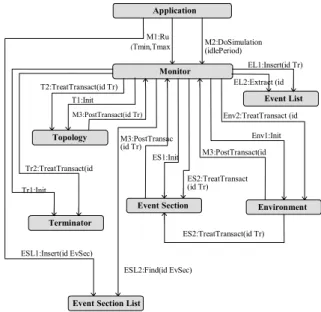
The information model of the LEOSN simulation model is represented on Fig. 1, live in a structure of a model the objects execute the following functions.
Application
Monitor
Event Section List Event Section Topology
Environment M1:Ru
n (Tmin,Tmax )
M2:DoSimulation (idlePeriod)
ESL2:Find(id EvSec) T1:Init
ES1:Init
Env1:Init Event List EL2:Extract (id
EL1:Insert(id Tr) T2:TreatTransact(id Tr)
ES2:TreatTransact (id Tr)
Env2:TreatTransact (id
M3:PostTransact(id
ES2:TreatTransact(id Tr) Terminator
Tr2:TreatTransact(id Tr1:Init
M3:PostTransact(id Tr)
M3:PostTransac (id Tr)
ESL1:Insert(id EvSec)
Fig. 1. An information model of the LEOSN simulation model.
Monitor there is the object, organizing the
process of a simulation modeling, thus Monitor executes a control of a simulation termination condition (in various models this condition can be also various, for example: the simulation termination condition can correspond to reaching by model time of final simulation time or installation of a fixed mode of simulation), will organize the process of transmission of transacts between objects EventSections and promoting of model time. The transacts acting at the Monitor are placed in the EventList object in ascending order of activation time and decrease of their priorities thus, on top of the Event List it appear of transact have minimum time of activation and maximum priority, in case there are the transacts with identical attributes, such transacts are placed FIFO.
EventSection List there is the object, realizing organization of storage and access to the objects EventSection, which are placed in the dynamic array by way of indexing. The access to copies of the Event Section object is carried out under their numbers, appropriate to the model address of the network node.
Environment of the object simulating is environment of data transfer between network nodes. The transmission of transacts to the Environment object is carried out the Monitor object outside of support of objects Event Section.
The algorithm of transacts processing in the Environment object is developed particularly for each model. In particular, the Environment object can simulate interferences of a data link, to check up conditions of the system objects radio visibility in view of the antenna patterns.
Topology is the object forming a matrix of connectivity of the network because of mutual radio visibility of the system objects, appropriate to current model time.
Terminator is the object realizing the special
procedure of a transact destruction.
4.2. Model of the LEOSN Simulation Model Objects Interaction
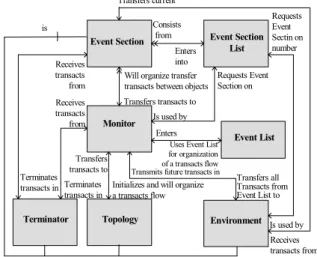
The diagram of the LEOSN simulation model objects interaction is represented on Fig. 2.
Event List Monitor
Topology Event Section
Environment Event Section
List
Transfers transacts to
Consists from
Enters into
Is used by
Transfers all Transacts from Event List to Transfers current
transacts to is
Terminator
Requests Event Sectin on number Receives
transacts from Receives transacts from
Enters
Is used by Receives transacts from Requests Event Section on number Will organize transfer transacts between objects
Initializes and will organize a transacts flow Terminates
transacts in Terminates transacts in
Transmits future transacts in Uses Event List for organization of a transacts flow Transfers transacts to
Fig. 2. The diagram of the LEOSN simulation model objects interaction.
The Application object represents on the objects interaction diagram. There are working at a time schedule control by a model. At a stage of model generation the Application object forms models of LEOSN nodes because of the base Event Section class and places them in the Event Section List object, generating an event: ESL1:
Insert (id EvSec). In case of successful model creation completion, the Application generates an event M1: Run (Tmin, Tmax), which starts the Monitor. Parameters of an event M1 are values of maximum and minimum time of simulation. After this Application generates an event M2:
DoSimulation (idlePeriod), passing the control the
Monitor object.
V. The Monitor of Simulation Model
Set of states and events of the Monitor is represented by a model of the Monitor states (Fig.
3.).
1.Start Set Tmod = Tmin, Tmax = Tmax, Generates M4:Init
2.Initialization
3. Simulation To establish limit of model time of continuous work Tend = Tmod + idlePeriod;
WHILE (Tmod < Tend) { Generates М6:Simulate }
To check up a condition of the ending of modeling:
If the condition is executed, generates M5:TerminatModel.
6. Destruction 4. Transmission of
Transacts
M4:Init
M1:Run(Tmin, Tmax)
Generates:
T1:Init, Env1:Init,Tr1:Init;
For all objects Event Section Generates ES1:Init;
To extract from Event List next Transact and to establish Model time.
M2:DoSimulation (idlePeriod) M2:DoSimulation
(idlePeriod) M6:Simulate
To transmit to the Environment transacts, having identical time of activation.
Generates: EL2:Extract(Tr), Env2:TreatTransact(Tr).
To establish new Tmod.
5. Processing To check up correctness of transact and to transmit it to Generates EL1:Insert(Tr).
M3:PostTransact(id Tr)
M2:DoSimulatio (idlePeriod)
M3:PostTransact(id Tr)
M2:DoSimulation (idlePeriod)
M5:TerminateModel
To destroy a model.
Simulation
Fig. 3. Model of the Monitor states.
Life cycle of the Monitor begins at a stage of a model initialization, which there correspond states of the Monitor 1 and 2. In a state Start the Monitor installs values of model time and time of a simulation termination equal accordingly to minimum and maximum times, read out from the file of a configuration and passes in the state Initialization. In this state the Monitor sequentially initializes all objects of a model generating appropriate events. Then current transact requests at the Event List object (at this time the Event List should already contain some set of transacts:
transacts of initial topology, transacts of start of generators and etc.) and install model time equal to time of activation of an obtained transact.
The stage of a simulation modeling is realized by the Monitor in states 3, 4 and 5. In a state the Simulation is carried out regulation of continuous
operation duration, that it is necessary for maintaining a multitask mode Windows.
Monitor passes in a state Simulation at obtaining of an event M2: DoSimulation (idlePeriod), which by value idlePeriod sets an interval of model time of continuous operation. The new value of model time, placed after returning from a state Transmission of Current Transacts, is compared to a specific interval of simulation and depending on from an outcome of matching an event M6 is generated: Simulate, or condition of a simulation termination is checked up. If the condition of a simulation termination is executed, an event M5 is generated: TerminateModel.
Immediately the model operation is carried out in a state Transmission of Current Transacts, in which Monitor passes after obtaining an event M6: Simulate. The Monitor sequentially extracts transacts from the Event List and transmits their to Environment generating an event Env2:
TreatTransact (Tr). The cycle of transacts transmission proceeds so long as time of transacts activation obtained from the Event List uniformly.
If the time of the next transact activation differs from time of the previous transact activation, the transact transmission ceases. In an extremity of a cycle the Monitor installs new value of model time, equal to last transact activation time obtained from Event List.
In a state Transact Processing the Monitor passes at obtaining of an event M3: PostTransact (id Tr) from any object of a model, parameter of an event the identifier of an transact is. The obtained transact is checked up on correctness (i.e.
it is necessary to check up identifier and transact activation time, which is not less model time) and is transmitted in the Event List, for that an event EL1 is generated: Insert (id Tr).
By the last state of the object life cycle the
Monitor is a state Destruction. In this state the
Monitor destructs all transacts from the Event List and form sequentially for all model objects of an event xx: Terminate.
VI. Example a Research LEOSN with a Wave Method of Routing
With the purpose of demonstrating possibilities of the developed software, an example it is possible to reduce outcomes of a research of the simulation model of LEOSN with a wave method of routing in view of the control algorithms by onboard antenna systems.
We shall assume that the researched system consists of a ground source of the information and space segments. The space segment of the network consists of space vehicle, each of which can execute functions both addressee, and retranslates of the information. It is necessary to investigate influence of the period space scanning value by onboard antenna systems on time of a construction and lifetime of the route, and also on number of flyovers in the route between a ground source and arbitrary satellite - addressee of the information.
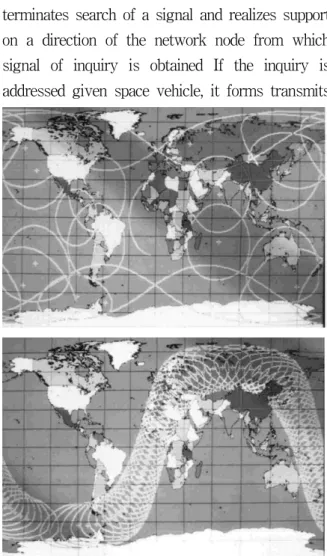
The example of results visualization of calculation under satellite points and cover zones for constellation of satellites is represented in Figure 4.
We shall consider a generalized model of the system. Is admissible, that a ground source forms and radiates inquiry, with casual periods between inquiries, on installation of the route, addressed one of space vehicle, a space segment system component distributed on the uniform law. The inquiry is radiated in space by the antenna system, have the broad directional diagram. The whole space vehicle produces continuous scanning of space by the narrow directional diagram antennas.
Each space vehicle, accepting a signal of inquiry terminates search of a signal and realizes support on a direction of the network node from which signal of inquiry is obtained If the inquiry is addressed given space vehicle, it forms transmits
Fig. 4. Construction under satellite points and cover zones for satellite constellation.
the message on reaching the addressee. Otherwise, space vehicle hops an obtained signal. In case of inquiry signal reception termination, for example because of termination of mutual visibility, the space vehicle passes in a state of search. The receipt on reaching the addressee through some hops reaches a ground source of the information, which fixes a construction of the route.
From the considered above generalized model of
the system transition to a model in terms of
queuing theory is carried out. Forthis purpose
because of the analysis of a LEOSN generalized
model final set of events is determined. For
0 0,1 0,2 0,3 0,4 0,5 0,6 0,7 0,8 0,9 1
0.01 12 24 36 48
15 sec.
60 sec.
240 sec.
Probability
Time, sec.
0 0,02 0,04 0,06 0,08 0,1 0,12 0,14 0,16
24,6 82,3 140 198 255 313 371 428 486 544
15 sec.
60 sec.
240 sec.
Probability
Time, sec.
example, the process of inquiry signal reception on installation of the route by a knot is considered as two events, appropriate to the beginning and a termination of reception of a signal. If in a model it is necessary to take into account various variants termination of a signal reception, reducing to various consequences, it is necessary to consider appropriate number of types of events.
According to functionality for each type of an event and as a node appropriate classes are developed. For example, for the given model it is necessary to develop two EventSection classes, appropriate to a ground source of the information and space node.
It is acceptable that the researched system has the following configuration: (i) the ground source of the information is located in a point with geographical coordinates of 370 east longitudes and 560 northern latitudes and (ii) the satellite network of retranslates and addressees of the information consists from 36 satellites, on 6 on 6 orbits with the height 1500 km., uniformly distributed on a longitude of an ascending node with inclination 90
o. Each space vehicle has 5 antennas - one fixed antenna with the broad directional diagram, directed on the Earth and four antennas with the narrow directional diagrams and limited sectors of scanning, directed under right angles the friend to the friend in a plane, tangent to a surface of the Earth in a point of an occurrence space vehicle. It is admissible, that all radio systems have distance of operation about 10000 km.
Obtained results allow adequately to estimate influence to the characteristics of the route and processes of its installation and deduction of such parameters of radio systems, as distance of operation and period of scanning.
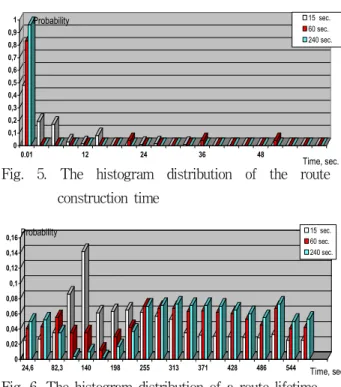
From the analysis of a route construction time
distributions (Fig. 5) it is visible that in all cases, except for one, over 98 % of the area of distribution it is concentrated up to 1 sec. It speaks a high degree of connectivity of a network. For a scanning period 15 sec distribution has almost exponential form and a mean comparable to a scanning period. With reduction of a scanning period the probability of construction of long routes is magnified. Time of construction of a route is accordingly magnified also.
Distribution of a route lifetime (Fig. 6), as one would expect, in the certain degree does not depend on a scanning period and is determined by a distance of operation and the dimensions of radio systems scanning sectors.
Distribution of the route flyovers number (Fig.
7) has also the exponential form. Its dispersion essentially decreases with magnifying of a scanning period.
Fig. 5. The histogram distribution of the route construction time
Fig. 6. The histogram distribution of a route lifetime Fig. 7. The histogram distribution of the route flyovers number
0 0,1 0,2 0,3 0,4 0,5 0,6 0,7 0,8 0,9 1
1 2 3 4 5 6 7 8 9 10 11 12 13 14
15 sec.
60 sec.
240 sec.
Probability
Number of hop
VII. Conclusion
A developed program complex allows to decide the tasks of designing of ballistic configurations of satellite networks and researches of the new control algorithms by information streams and criterions of an evaluation of their efficiency in networks with varying topology. The reduced example of the rather simple system shows necessity of solution of all of the new tasks in the field of a research and designing of satellite networks with dynamically varying topology.
References
[1] Vazhenin N.A., Volkovskiy A.C. Program complex for simulation analysis of the satellite information network with dynamic varying topology. /Theses of reports of the All-Russia scientific-technological conference
" I n f o r m a t i o n - t e l e c o m m u n i c a t i o n technologies", Sochi, September, 19-26, 2004 - M.: Publishing house MEI (TU), 2004. - pp. 67-68.
[2] Handle of information streams in satellite radio networks /VazheninN.A., Galanternik U.M., Tamarcin V.M, Uskov D.V. - Publ.
MAI, 1993.
[3] Reliability and survival of satellite information networks /VazheninN.A., Galanternik U.M., Lyarsky S.V., Mazepa R.B.- Publ. NIITP, 1992.
[4] Simulation modeling satellite radio networks / VazheninN.A., Galanternik U.M., Caplunov
A.A. etc. - Publ. NIITP, 1993.
[5] G. Booch. Object-Oriented Analysis and Design with Applications. - Publ. Pearson Education, 1993.
Vazhenin N. A.
1980년: Moscow Aviation Institute (Ph.D)
~ 2003년 11월: Moscow Aviation Institute, Faculty of the Flying Vehicles Radioelectronic Systems, Department of Data Transmission and Remote Control 띠ectronic Systems, professor
2003년 11월~현재 : 한국산업기술대학교 연구교수 관심분야 :Radiolocation and Radionavigation
가 민 호(賈敏皓, Min-Ho Ka)
1989년 2월 : 연세대학교 전자공 학과(학사)
1991년 8월 : 연세대학교 전자공 학과(석사)
1997년 2월 : 모스크바에너지공대 전자공학과(박사) 1997년 5월~2000년 6월 : 국방과 학연구소 선임연구원
2000년 7월~2002년 2월 : 연세대학교 연구교수
2002년 3월~현재 : 한국산업기술대학교 전자공학과 교수 관심분야 : 레이다 공학, 위치정보획득 시스템, UWB 등