Fiber post의 Relining 방법과 시멘트 유형에 따른 Push-out Bond Strength의 비교
전북대학교 치의학전문대학원 치과보존학 교실
강현영․조소연․유미경․이광원․김경아
근관치료된 치아의 수복에서 fiber post 크기와 포스트 공간의 직경이 일치하지 않은 경우, 포스트 공간은 두꺼운 레진 시멘트로 채워지게 된다. 레진 시멘트가 두꺼워지면 시멘트 내에 기포가 형성되어 포스트 분리가 발생되기 쉽다. 이런 문제점을 해결하기 위한 방법은 composit resin을 이용하여 fiber post를 relining하는 것이다. 이렇게 형성된 해부학적 포스트는 포스트 공간에 잘 적합하고 시멘트의 두께를 감소시킨다. 이 연구의 목적은 relining 과정과 임상 과정의 간소화를 위해 사용되고 있는 luting agents 종류에 따른 fiber post의 push-out 결합 강도를 평가 하는 것이다. 42개의 발치된 치아는 6개의 그룹(n=7)으로 나누어졌다. (A1: relined fiber post를 Luxacore/all-bond 2 로 합착, A2: non-relined fiber post를 Luxacore/all-bond 2로 합착. B1: relined fiber post를 Calibra/XP-bond로 합착.
B2: non-relined fiber post를 Calibra/XP-bond로 합착. C1: relined fiber post를 RelyX Unicem으로 합착. C2: non-relined fiber post를 RelyX Unicem으로 합착.) Push-out 결합 강도는 relining procedure와 cement type의 상호작용에 의해 영 향을 받는 것으로 나타났다. relined fiber post 그룹이 non-relined fiber post 그룹보다 더 높은 결합 강도를 가지며 fiber post relining 과정은 결합강도에 유의한 영향을 가진다.(p<0.05) Luting agent에 따라 모든 그룹에서 RelyX Unicem의 결합강도가 Luxacore/All-bond 2와 Calibra/XP bond에 의한 것보다 유의하게 더 높았다.(p<0.05) 주요어: Fiber post, Relining 과정, Push-out 결합 강도, Self-adhesive cement, Core material
(
구강회복응용과학지 2011:27(3):253~265)
서 론
Fiber-reinforced composite post(FRC)는 주조 포 스트와 코어 그리고 금속 dowel을 대체하기 위한 방법으로써 과도한 치질 상실을 가진 근관치료 된 치아의 수복을 위해 1990년대 초에 소개되었 다.
8)Fiber post는 금속 포스트보다 많은 장점들
교신저자:
김경아
전북대학교 치과대학 보존학 교실 및 전북대학교 임상의학연구소 561-756, 전북 전주시 덕진구 덕진동 1가 664-14 대한민국, Fax:+82-063-250-2129, E-mail: [email protected]
을 가지고 있다. 탄성 계수가 상아질과 유사하며
그것으로 인해 단단한 포스트에 의해 발생하는
높은 응력을 예방할 수 있으며 치근 파절 위험을
감소시킬 수 있다.
18,19)게다가 fiber post의 유리한
물리적 그리고 심미적 특징들에 의해 빛이 포스
트를 통해 투과할 수 있으며 포스트 공간에서 접
착 재료의 광중합을 허용한다.
12)포스트와 코어 수복물의 실패는 포스트의 파 절 또는 휘어짐, 유지 상실, 코어의 파절 그리고 치근파절에 의해 발생한다.
9,22)그러나 임상 연구 에서 실패의 가장 일반적인 원인이 금속 또는 주 조 포스트에서 발생하는 것처럼 치근파절이 아 닌 de-bonding이라는 것을 나타냈다. De-bonding 은 대부분 바람직한 “ferrule effect”의 결손 또는 과잉의 두꺼운 시멘트 층의 존재 시 발생하는 것 같다.
10,16)임상적으로 포스트 제조사에 의해 제공된 크 기에 적합한 drill의 사용은 근관벽에 포스트의 좋은 적합을 허용함에도 불구하고 견치, 하악 소 구치와 같이 몇몇 근관은 타원형 단면을 가지는 반면에 포스트는 원형을 나타내어 포스트 공간 을 부가적으로 더 형성해주어야 한다.
1,7)게다가 우식 이환, 외상, 치수 질환 그리고 의원성 사고 에 의해 확대된 근관은 근관벽에 fiber post의 적 합성을 떨어뜨린다.
1)이런 임상 케이스들에서 포스트가 잘 적합되 지 않는다면 특히 치관부 부위에서, 레진 시멘트 층은 과도하게 두꺼워지며 내부에 기포가 존재 하게 된다. 이런 이유로 인해 de-bonding의 소인 을 만든다.
16)이런 문제를 극복하기 위한 방법들에는 컴포 짓 레진을 사용하여 포스트 공간 내의 시멘트 두 께를 줄이는 방법들이 있다. 첫 번째는 근관내 상아질 벽의 두께를 컴포짓 레진의 적층 충전으 로 증가시켜 포스트 공간이 가지는 높은 C-factor 를 감소시키고 시멘트 공간을 줄이는 방법이다.
그러나 이 방법은 근관의 근단부에서 컴포짓 레 진의 광활성이 어렵다는 단점을 가지고 있
다.
18,23)두 번째는 컴포짓 레진으로 fiber post를
relining하는 것이다. 이런 개별적인 해부학적 포 스트는 근관 벽에 포스트의 적합성을 향상시키 고 레진 시멘트의 두께를 감소시킨다.
1,16,17)또한 fiber post의 유지와 누출 때문에 포스트 접착 과정은 수복 과정에서 중요한 단계이다.
18)최근 임상 과정의 간소화 때문에, 포스트 접착과 잇따른 코어 형성을 위한 한 종류의 컴포짓 레진
사용과 상아질에 adhesive system의 과정이 필요 없는 self-adhesive resin cement인 RelyX unicem의 사용이 소개되어 많이 사용되고 있다.
2)그러므로 이 연구의 목적은 relining 과정과 임 상 과정의 간소화를 위해 사용되고 있는 luting agents 종류에 따른 fiber post의 push-out 결합 강 도를 평가하는 것이다. 귀무가설은 fiber post의 relining 과정과 시멘트 종류는 push-out 결합 강 도에 영향을 미치지 않는다는 것이다.
연구재료 및 방법
총 42개의 최근 발치된 단근치가 이 연구를 위 해 사용되었다. 치아들은 상악 전치, 측절치, 상 악 견치, 하악 소구치로 이루어져 있으며 치주 병소에 의하거나 교정치료를 위해 발치된 치아 들이다. 근첨이 완전히 발달되었으며 균열, 우식, 파절, 흡수성 결함, 이전에 근관치료를 받거나 금관 수복이 되어 있는 치아들은 배제하였다. 치 근 표면에 잔존 골이나 연조직, 치석이 제거되었 으며 0.02% sodium azide(NaN
3. Duksan pure chemical co.,LTD., Korea) 용액에 저장되었다.
1. 시편 준비
각각의 치아는 아크릴 블록에 삽입되고 치아
장축에 수직으로 주수하에서 저속 diamond saw
로(Isomet, Buehler.LTD., Lake Bluff, IL, USA) 치
관부를 제거하여 치근의 길이를 15mm로 일정하
게 하였다. #10 K-file(MANI, Japan)이 근단공에
서 보일 때까지 근관 내로 삽입하여 apical
patency를 확인하고 근단공과 일치되는 길이에서
1mm를 뺀 길이를 작업장으로 하였다. 근관은
Profile(Dentsply Maillerfer, Ballaigues, Switzerland)
을 300rpm의 속도에서 사용하여 제조사의 지시
에 따라 crown-down 방법으로 근관 성형하고 근
첨에서 #40/.06 파일로 마무리 하였다. 각각의 근
관은 기구 조작 사이에 5ml NaOCl(3%)로 세척하
고 3ml 17% EDTA(pH=7.08)와 saline을 이용하여
세척되었다. 모든 근관은 소독된 paper point로 건조 후 0.06 taper #40 GP cone(Diadent, Chonguj, Korea)과 sealer(AH plus, Dentsply Maillerfer, Tulsa, OK, German)를 이용하여 warm vertical compaction 방법으로 충전하였다. 근관치료 완료 후 근관 입구는 임시 수복용 재료로(Caviton, GC Co., Tokyo, Japan) 수복된 후 근관 충전용 재료들 이 경화되도록 37℃, 100% 습도하에서 1주일간 보관되었다. 준비된 치근은 6개의 그룹(n=7)으로 나누어져 실험하였다.
근관은 Luxapost
Ⓡsystem(∅ 1.375mm, DMG, Hamburg, Germany)의 제조사에 의해 제공된 저 속 드릴로 주수하에서 10mm의 깊이로 확대 후 5ml NaOCl(3%)와 3ml EDTA(17%)로 세척하여 paper point로 건조하였다. relined fiber post 그룹 들의 근관은 microbrush를 이용하여 근관내 수용 성 분리제(super-bond SEP, SUN MEDICAL, Japan)를 도포한 후 공기로 건조시켜 준비한다.
fiber post에 composite resin(Filtek Z250, 3M ESPE) 을 이장한 후 근관내에 삽입하고 20초간 광중합 하며 relined fiber post를 근관내에서 제거한 후 부 가적으로 20초간 광중합 한다. 근관으로부터 분 리제를 제거하기 위해 5-20초간 푸른색이 사라질 때까지 철저히 수세 후 건조시키며 relined fiber post 또한 분리제 제거를 위해 수세하여 건조시 켜 준비한다. 모든 시편들은 표준화된 과정에서 한명의 임상가에 의해 준비되었으며 6개의 실험 군의 분포는 Table Ⅰ에서 보여준다.
Luxacore+all-bond2 (three step bonding:
all-bond2+pre-bond
Calibra+XP bond (etch and rinse system:
XP bond +self cure activator) Unicem
Relined fiber post A1 B1 C1
Non-relined fiber post A2 B2 C2
Table Ⅰ. Distribution of the 6 experimental group(n=7) according to the relining procedure of fiber post and cement type
2. Post luting Procedure
각각의 포스트는(21개의 relined fiber post와 21 개의 non-relined fiber post(Luxapost)) 합착 전에 포스트 표면 전처리를 시행하지 않았으며 두 가 지의 resin cement와 한 가지의 core material로 합 착되었다.
1) Resin core material과 Three-step adhesive system A그룹에 사용된 resin core material은 이중 중 합 형태로 자동 혼합 장치로 제공되는 Luxacore
Ⓡ(blue, DMG, Hamburg, Germany)이며 adhesive system은 All-bond 2
Ⓡ(Bisco. Schaumburg, USA) 를 사용하였다. 먼저 포스트 공간을 37% 인산을 이용하여 15초간 산부식한 후 수세 및 건조 시키 고 Primer A와 B를 1:1로 혼합하여 포스트 공간 에 5회 도포하며 과량의 primer는 부드러운 공기 건조와 paper point를 이용하여 제거되었다.
bonding agent와 pre-bond를 1:1로 혼합하여 이중 중합 형태로 포스트 공간에 microbrush를 이용하 여 도포한 후 과량의 bonding agent는 paper point 로 제거 한 후 LED 중합기(600mW/㎠ output, DEMI, Kerr, USA)로 20초간 광중합 되었다. 모든 case에서 일회용 팁으로 형성된 포스트 공간 내 로 Luxacore를 적용하였으며 relined fiber post와 non-relined fiber post 표면에도 적용하여 포스트 공간 내로 위치시킨 후 LED 중합기(600mW/㎠
output,)로 60초간 광중합 시행하였다.
2) Dual cure resin cement와 etch and rinse adhesive system
B 그룹에 사용된 레진 시멘트는 Calibra
TM(Dentsply Detrey, Germany)이며 adhesive system은 XP bond
TM(Dentsply Detrey, Germany)와 Self cure activator(Dentsply Caulk, USA)를 혼합하여 사용하 였다. 포스트 공간을 37% 인산으로 15초간 산부 식 후 수세 및 건조를 시킨다. XP bond와 Self cure activator를 1:1로 혼합하여 이중 중합 형태로 microbrush를 이용하여 포스트 공간에 도포 후 과 잉의 bonding agent는 건조 및 paper point로 제거 후 20초간 LED 중합기로(600mW/㎠ output, DEMI, Kerr, USA) 광중합 시행하였다. Calibra의 base와 catalyst를 1:1로 혼합하여 이중 중합 형태 로 일회용 needle tube(AccuDose, Centrix, USA)를 이용하여 포스트 공간과 relined fiber post와 non-relined fiber post 표면에도 적용한 후 포스트 공간 내로 위치시킨 후 60초간 광중합 시행하였 다.
3) Self-adhesive resin cement
C 그룹에 사용한 레진 시멘트는 self-adhesive luting cement인 RelyX
TMUnicem Aplicap
TM(3M ESPE, USA)으로 포스트 공간에 adhesive system 처리 없이 resin cement 단독으로 사용하며 캡슐 형태로 제공되어 기계를 통해 15초 동안 자동 혼 합되며 캡슐에 부착되는 일회용 팁을 통하여 포 스트 공간으로 레진 시멘트를 용이하게 적용한 다. 자가 중합으로 사용가능하지만 본 실험에서 는 이중 중합 형태로 사용하여 포스트를 위치시 킨 후 LED 중합기(600mW/㎠ output,)로 60초간 광중합 시행하였다.
각각 실험군에 사용된 합착 시멘트와 접착제 그리고 실험 재료들의 화학적 성분은 Table Ⅱ에 요약되었다.
합착 후에 각각의 치아들은 push-out test전에 37℃ 증류수에서 24시간 동안 보관되었다.
3. Push-out bond strength test
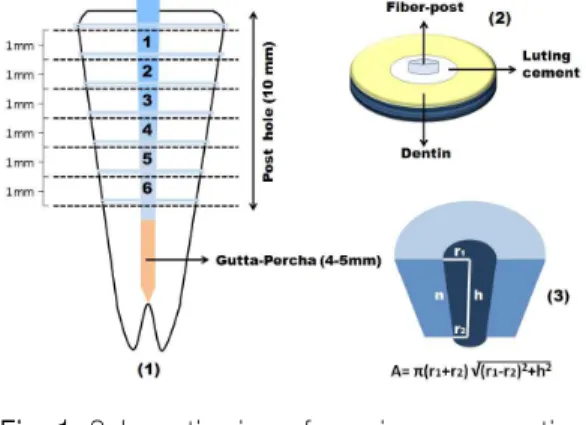
fiber post와 luting materials 사이 결합강도를 평가하기 위해 각각의 치아는 아크릴 블록에 삽 입되고 주수하에서 치아 장축에 수직으로 저속 diamond saw(Isomet, Buehler, USA)를 이용하여 1mm의 두께로 6개의 시편으로 나누어졌다.(치관 부, 중간, 근단부; Fig 1). 첫 두 개의 시편은 형성 된 포스트 공간의 치관부를 나타내고 다음 두 개 의 시편은 중간부, 그리고 마지막 두 개는 근단 부를 나타낸다. 시편을 절단하는 동안 깨지거나 실패한 것은 없었으며 모든 시편들(252개의 시 편들)의 push-out 결합강도가 측정되었다. 각각의 시편의 치관부는 유성 마커로 표시되었으며 디 지털 측정기를 통해 정확한 두께가 측정되었다.
Fig. 1. Schematic view of specimen preparation for push-out test
⑴ specimen section into six 1mm-thick post-dentin section.(cervical, medium, and apical);
⑵ Slices after section;
⑶ Area of post-dentin interface as
determined using the formula of the
surface area of a frustrum:radii of top
and bottom surfaces of post along with
the height of the slice(h=1mm)
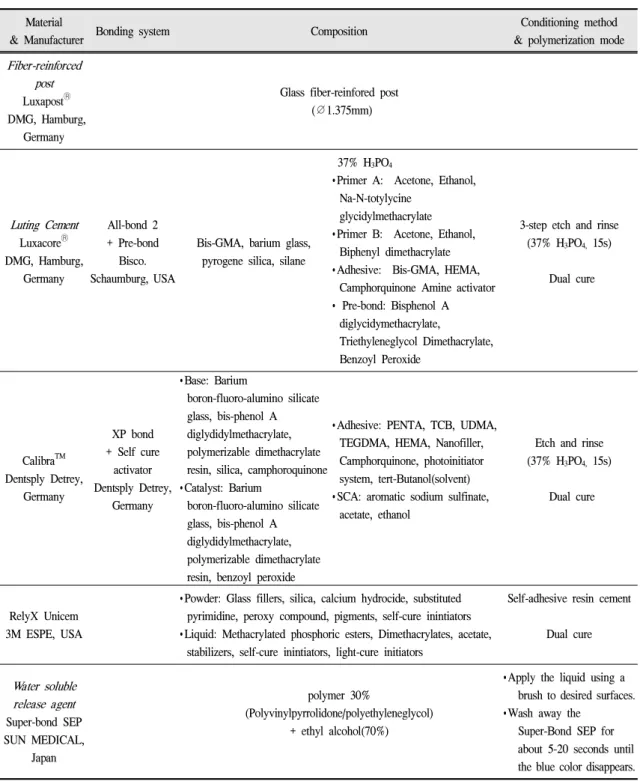
Material
& Manufacturer Bonding system Composition Conditioning method
& polymerization mode
Fiber-reinforced
post
LuxapostⓇ DMG, Hamburg,Germany
Glass fiber-reinfored post (∅1.375mm)
Luting Cement
LuxacoreⓇ DMG, Hamburg,Germany
All-bond 2 + Pre-bond Bisco.
Schaumburg, USA
Bis-GMA, barium glass, pyrogene silica, silane
37% H3PO4
•Primer A: Acetone, Ethanol, Na-N-totylycine
glycidylmethacrylate
•Primer B: Acetone, Ethanol, Biphenyl dimethacrylate
•Adhesive: Bis-GMA, HEMA, Camphorquinone Amine activator
• Pre-bond: Bisphenol A diglycidymethacrylate,
Triethyleneglycol Dimethacrylate, Benzoyl Peroxide
3-step etch and rinse (37% H3PO4, 15s)
Dual cure
CalibraTM Dentsply Detrey,
Germany
XP bond + Self cure
activator Dentsply Detrey,
Germany
•Base: Barium
boron-fluoro-alumino silicate glass, bis-phenol A diglydidylmethacrylate, polymerizable dimethacrylate resin, silica, camphoroquinone
•Catalyst: Barium
boron-fluoro-alumino silicate glass, bis-phenol A diglydidylmethacrylate, polymerizable dimethacrylate resin, benzoyl peroxide
•Adhesive: PENTA, TCB, UDMA, TEGDMA, HEMA, Nanofiller, Camphorquinone, photoinitiator system, tert-Butanol(solvent)
•SCA: aromatic sodium sulfinate, acetate, ethanol
Etch and rinse (37% H3PO4, 15s)
Dual cure
RelyX Unicem 3M ESPE, USA
•Powder: Glass fillers, silica, calcium hydrocide, substituted pyrimidine, peroxy compound, pigments, self-cure inintiators
•Liquid: Methacrylated phosphoric esters, Dimethacrylates, acetate, stabilizers, self-cure inintiators, light-cure initiators
Self-adhesive resin cement Dual cure
Water soluble release agent
Super-bond SEP SUN MEDICAL,Japan
polymer 30%
(Polyvinylpyrrolidone/polyethyleneglycol) + ethyl alcohol(70%)
•Apply the liquid using a brush to desired surfaces.
•Wash away the Super-Bond SEP for about 5-20 seconds until the blue color disappears.
Table Ⅱ. Compositions and application modes of the materials used in this study
Fig. 2. Diagram for push-out test device
각각의 시편은 맞춤 제작된 push-out jig에 cyanoacrylate adhesive(Zapit
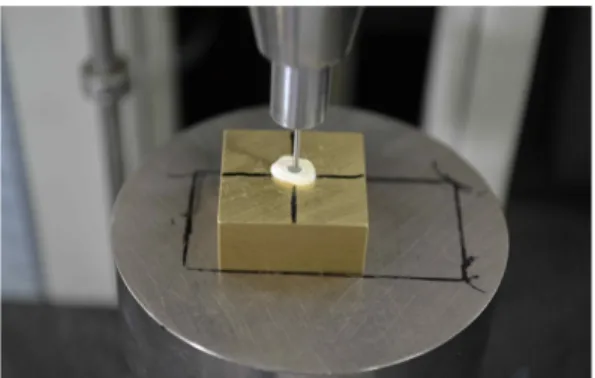
Ⓡ,Dental Ventures of America Inc, USA)를 이용하여 치관부 면이 jig와 맞닿도록 위치시킨 후 포스트를 jig hole의 중심 에 위치시켜 부착하였다.(Fig. 2) Universal testing machine(Instron 5569, USA)에 맞춤 제작된 실린 더 형태의 plugger(직경 0.8mm)를 부착한 후 포 스트의 중심에 위치시키지만 접촉하지 않은 상 태로 고정하였으며 포스트가 분리될 때가지 근 단부에서 치관부 방향으로 crosshead speed 0.5 mm/min로 압축력을 적용하였다.(Fig. 3) plugger tip은 근관벽주위에 응력 없이 오직 부하를 포스 트에 접촉시켰다. 최대 실패 부하값은(N) 포스트 절편의 접착 면적을 고려하여 MPa로 환산되었 다.
; Debonding stress=Debonding force(N)/A [A=∏(r
1+r
2)
(r 1-r 2)2+h2] {∏=3.14, r1:치관부 포스트 반지름, r2: 근단부 포스트 반지름, h: 절편의 두께}
4. Microscopic evaluation of the fracture modes
Push-out 결합 강도의 평가 후에 각각의 분리 된 시편들은 실패 유형을 결정하기 위해 10배율 의 stereomicroscope(OPMI Pro Dent, ZEISS, Germany)로 검사 하였다. 실패 유형은 5가지로 분류되었다. ⑴ 상아질과 luting cement 사이의
Fig. 3. Push-out test with customized jig
adhesive failure ⑵ post와 luting cement 사이의 adhesive failure ⑶ luting cement내의 cohesive failure ⑷ Mixed failure ⑸ 치아파절, 포스트 파절 등의 발생으로 평가할 수 없는 failure. 각각의 실 패 유형은 30배율로 SEM상을 관찰하였다.
5. Statistical Analysis
Push-out 결합 강도 데이터들은 요약되었으며 데이터들은 SPSS16.0 software를 사용하여 분석 되었다. 95%의 신뢰도에서 3-way ANOVA로 근 관 위치, luting cement, relining 유무에 따른 push-out 결합강도 데이터들을 분석하였고 relined와 non-relined fiber post 각각의 그룹에서 근관 위치와 luting agent에 따라 2-way ANOVA 로 분석되었다. Post hoc test는 Scheffe multiple comparison test를 사용하여 수행되었다. 결과들 은 p값이 0.05보다 작다면 유의한 것으로 간주되 었다. (p<0.05)
결 과
1. Push-out bond strength
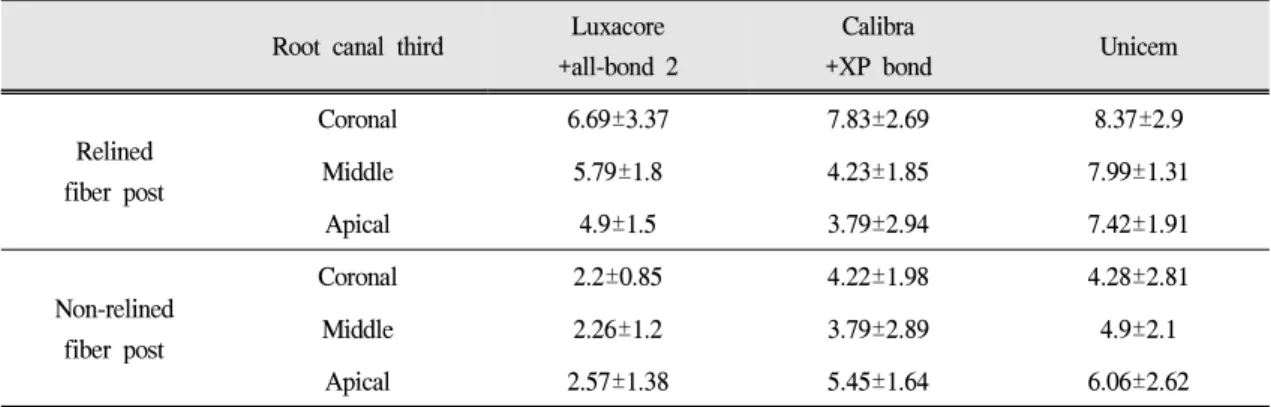
Relined group과 non-relined group에서 각각의
luting agent에 따라 근관의 세부분에서 post가 분
리된 평균 결합강도(MPa)와 표준편차가 Table
Root canal third Luxacore +all-bond 2
Calibra
+XP bond Unicem
Relined fiber post
Coronal 6.69±3.37 7.83±2.69 8.37±2.9
Middle 5.79±1.8 4.23±1.85 7.99±1.31
Apical 4.9±1.5 3.79±2.94 7.42±1.91
Non-relined fiber post
Coronal 2.2±0.85 4.22±1.98 4.28±2.81
Middle 2.26±1.2 3.79±2.89 4.9±2.1
Apical 2.57±1.38 5.45±1.64 6.06±2.62
Table Ⅲ. Mean push-out bond strengths(MPa) and standard deviation according to different root thirds and Luting agents
Ⅲ과 Fig. 4, 5에 요약되었다. relined fiber post 그 룹이 non-relined fiber post 그룹보다 더 높은 결합 강도를 가지며 post relining의 유무는 결합강도에 유의한 영향을 가진다.(p<0.05) Luting agent에 따 라 모든 그룹에서 RelyX Unicem의 결합강도가 Luxacore/All-bond 2와 Calibra/XP bond에 의한 것 보다 유의하게 더 높았다.(p<0.05) Luxacore/All- bond 2와 Calibra/XP bond의 결합강도는 통계적 으로 유의성 있는 차이가 없었다. 각각의 그룹별 근관의 위치에 따른 결합 강도 차이는 모든 위치 에서 유의성 있는 차이가 없었다.(p>0.05) 유의하 게 가장 높은 결합강도는 relined fiber post를 RelyX Unicem으로 합착된 것의 조합에서 측정되 었다.(p<0.05)
Fig. 4. Mean push-out bond strength of relined fiber post groups
2. Failure mode analysis
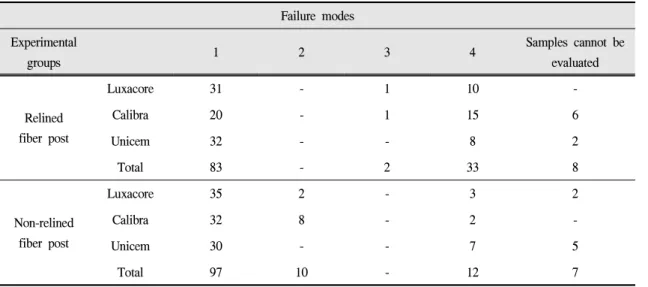
Push-out test 후 252개 시편의 미세 현미경 분 석은 대부분 luting cement와 상아질 사이에서 adhesive failure를 나타냈다.(relined fiber post group n=83, non-relined fiber post group n=97) (Table Ⅳ) 이 연구에서 relined fiber post 그룹에 서 luting agent와 relined post 사이의 adhesive 실 패는 발생하지 않았으며 fiber post와 relined resin 사이의 분리도 발생되지 않았다. 또한 non-relined group에서는 luting cement 내 cohesive 실패가 발 생되지 않았다. relined fiber post 그룹에서 8개의 시편 그리고 non-relined fiber post 그룹에서 7개 의 시편은 push-out test 동안에 상아질 절편의 파
Fig. 5. Mean push-out bond strength of non-
relined fiber post groups
Failure modes Experimental
groups 1 2 3 4 Samples cannot be
evaluated
Relined fiber post
Luxacore 31 - 1 10 -
Calibra 20 - 1 15 6
Unicem 32 - - 8 2
Total 83 - 2 33 8
Non-relined fiber post
Luxacore 35 2 - 3 2
Calibra 32 8 - 2 -
Unicem 30 - - 7 5
Total 97 10 - 12 7
1. Adhesive failure dentin and luting cement; 2. Adhesive failure between luting cement and fiber post;
3. Cohesive failure within the luting cement; 4. Mixes failure
Table Ⅳ. Distribution of the failure modes following the push-out test
절이 발생하였으며 시편 상실을 보여 이번 연구 결과에서 제외되었다. 실패 유형의 SEM(x30)상 을 관찰하였으며 Fig. 6은 adhesive failure와 mixed failure를 보여준다.
Fig. 6. Scanning electron microscopy(SEM) photographs of failed specimens: ⅰ) Specimen which failed adhesively between root dentin and luting cement; ⅱ) Specimen which failed adhesively between post and cement; ⅲ) Specimen representive of mixed failure, where indicates visible remnants of luting cement.(original magnification x 30; bar:2mm)
총괄 및 고안
Fiber post와 상아질 사이의 결합강도 측정을
위한 여러 가지 방법들이 있다. 예를 들어
microtensile test, push-out test, modified push-out
test 그리고 pull-out test등이 있다. 이전 연구들에 서 push-out 검사가 결합 계면에 더 적은 응력을 나타낸다고 보고하였으며 fiber post에 관한 결합 강도를 평가하기 위한 더 유용한 방법이라고 제
안했다.
3,13)Push-out 자료들은 더 낮은 결합강도
를 나타내는 경향이 있으며 이것은 Goracci et al 과 일치한다. Goracci et al은 post-root 결합의 상 대적인 약함을 고려하여 push-out 검사는 전통적 그리고 변형된 미세인장강도 검사와 비교시 근 관 상아질의 fiber post 결합을 측정하는데 가장 정확하고 신뢰성 있는 방법처럼 보인다고 보고
했다.
3,24)비록 push-out 결합강도가 낮음에도 불
구하고 그것들의 변이성은 다른 방법들과 비교 시 높게 나타난다. 그러므로 push-out 검사는 근 관에서 fiber post의 유지를 평가하는데 모래시계 형태의 시편을 이용한 microtensile 검사보다 더 신뢰성 있으며 오역되지 않는다.
13)이런 이유로 이 방법은 현재 연구에서 선호되었으며 마찰 효 과가 push-out model을 사용한 fiber post의 결합 강도에 기여하는 것으로 추측된다.
14,24)비록 pull-out test 또한 마찰 저항력을 가짐에도 불구 하고 압축력 하에서는 post 절편의 Poisson's expansion과 관련하여 push-out test가 더 타당하 다.
3,15)이 연구에서 Luxapost
Ⓡsystem(∅ 1.375mm, DMG, Hamburg, Germany)의 push-out 결합 강도 는 relining procedure와 cement type의 상호작용에 의해 영향을 받는 것으로 나타났으며 relined fiber post 그룹이 non-relined fiber post 그룹보다 더 높은 결합 강도를 가지며 fiber post relining 과 정은 결합강도에 유의한 영향을 가진다.(p<0.05) Luting agent에 따라 모든 그룹에서 RelyX Unicem의 결합강도가 Luxacore/All-bond 2와 Calibra/XP bond에 의한 것보다 유의하게 더 높았 다.(p<0.05) 특히 relined fiber post를 RelyX Unicem(3M ESPE, USA)으로 접착한 그룹에서 push-out 결합 강도가 가장 높게 나타났다. 이 연 구에 제시된 fiber post의 relining 과정과 시멘트 종류가 push-out 결합 강도에 영향을 미치지 않
는다는 귀무가설은 성립되지 않았다.
Fiber post의 relining procedure의 주요 목적은 레진 시멘트 층의 두께를 줄이는 것이다.
1)포스트 공간의 시멘트 두께에 따른 D'Arcangelo et al의 연구에 의하면 시멘트 층이 과도하게 두꺼워졌을 때(cement 두께:0.5mm일 때) pull-out resistance의 감소를 나타냈고 시멘트 두께가 0.1-0.3mm일 때 높은 결합강도를 나타냈으며 통계적으로 유의한 차이는 없었다.
4)접착된 fiber post의 변위에 저항 하는 주요 인자는 활주 마찰력이다.
1,14)마찰은 접 촉에 의해 발생하기 때문에 레진 시멘트와 근관 상아질의 근접한 접촉은 fiber post의 유지를 향상 시키는 것으로 추측된다.
5)Relined fiber post는 근관의 해부학적 형태를 재현하여 좋은 적합성을 나타내며 접착시 압력 을 증가시키며 증가된 압력에 의해 수분 흡수와 기포 생성을 억제하여 더 좋은 포스트와 시멘트 그리고 상아질 사이의 접촉이 형성되어 더 높은 활주 마찰 유지력을 발생시킨다.
1,25)Cement 내의 기포는 균열 또는 post의 분리를 유발한다. 이런 기포들은 여러 가지 요인에 의해 형성된다. 외인 성과 내인성 수분 그리고 시멘트 적합 방법에 따 라 형성될 수 있다. 먼저 외인성 수분은 근관치 료 후 포스트 접착을 위해 산부식 후 수세를 하 지만 완벽한 건조를 할 수 없어 근관에 남아있게 되며 또한 산부식으로 인해 넓어진 상아세관에 잔류하여 기포를 발생시킨다. 내인성 수분은 접 착제의 광중합 후에 이 접착제가 반투막으로 작 용하여 상아세관액이 레진 시멘트와 접착제 사 이 계면으로 방출되어 기포를 형성한다. 이렇게 형성된 기포에 의해 상아질과 시멘트사이 결합 의 분리가 발생된다. 시멘트 적용 방법에 따라 lentulo spiral을 사용하거나 일회용 팁을 이용하 여 최대한 포스트 공간 내로 주입시 기포의 생성 을 감소시킬 수 있다.
1,4,24)Grandini et al에 의한 연구에서 소위 해부학적
포스트라 불리는 relined fiber post의 SEM 평가에
서 근단부를 제외하고, 대조군인 전통적인 방법
으로 포스트를 접착한 그룹에서 보다 유의하게
레진 시멘트 두께의 감소를 보고하였으며 이로 인해 예상되는 장점들을 다음과 같이 기술하였 다. 먼저 시멘트의 두께가 더 얇고 일정하게 유 지; 접착 재료 내에 결합을 약하게 하는 기포의 형성이 적어짐; 상대적으로 얇은 시멘트 두께에 서 발생하는 중합 응력 또한 최소로 된다.
16)사용된 luting agent에 대한 고려시, 실험 결과 All-bond 2/ Luxacore와XP-bond/Calibra의 결합강 도는 유의한 차가 없었으며 RelyX Unicem과의 결 합강도는 유의한 차이가 있었다. 이것은 Putignano et al이 코어 형성 재료인 Unifil Core (GC; Tokyo, Japan)로 DT Light posts의 합착은 상 응된 레진 시멘트(Calibra)와 비교시 결합강도에 서 유의한 차이를 나타내지 않는다는 보고와 일 치한다.
21)그러나 임상에서 코어 재료의 사용에 대한 주요 장점은 임상 과정의 용이성이다. 그것 은 포스트 합착과 함께 코어수복까지 한 단계로 마무리 할 수 있어 시간이 절약되며 서로 다른 접 착제와 레진 시멘트 사이의 부조화를 방지한다.
24)이런 결과가 나타난 것은 Relyx Unicem은 접 착제가 필요 없는 self-adhesive cement로 hydroxiapatite에서 칼슘과 좋은 상호작용을 가져 기계적 성질을 향상시켰다.
11,25)게다가 viscoelastic한 특징 때문에 낮은 수축을 나타내며 근관벽에 더 나은 긴밀한 접촉을 형성하여 더 높 은 마찰 저항력을 유도하였으며
6,25)근관내 적용 시 제조사에서 제공되는 일회용 팁을 이용하여 적용하였기 때문에 근단부까지 적용하기가 용이 한 점도 실험결과에 영향을 미친 것으로 사료된 다. Luxacore와 Calibra는 각각 3단계, 2단계 접착 제를 사용하였으며 이중 중합 형태로 사용하기 위해 all-bond-2와 XP-bond에 제조사의 지시에 의 해 각각 pre-bond와 self-cure activator를 혼합하였 다. 실험과정 중 all-bond 2에 pre-bond 혼합 후 setting time이 짧아 과잉의 접착제를 제거하는 과 정 중에 중합이 발생하여 균일한 접착제 층이 형 성되지 않은 점과 calibra의 수동 혼합 후 근관에 적용하였기 때문에 cement 내에 더 많은 기포에 의해 Relyx Unicem보다 더 낮은 결합 강도가 나
타난 것으로 생각된다.
또한 각각의 그룹별로 근관의 위치에 따른 push-out 결합강도는 통계적으로 유의한 차이는 없지만 측정된 값들을 살펴보면 relined fiber post 그룹들에서는 치관부에서 근단부 1/3으로 갈수 록 더 낮은 결합강도를 나타냈다. 몇몇 저자들은 치관부에서 근단부로 갈수록 결합 강도의 유의 한 감소를 감지했는데 이것은 근관 상아질의 다 양한 부위 사이에 세관의 방향과 세관의 밀도에 의한 형태학적 차이에 의해 설명될 수 있다.
9,20)그러나 non-relined fiber post 그룹에서는 치관부 1/3에서보다 근단부 1/3에서 더 높은 결합강도의 값을 나타냈으며 relined fiber post 그룹들과 반대 되는 경향의 push-out 결합 강도가 측정되었다.
이것은 근단부로 갈수록 fiber post가 근관내에 잘 적합하기 때문에 치관부에서 보다 더 마찰 유 지력이 작용한 것으로 추측된다.
실패 형태의 분석은 대부분 상아질과 luting agent의 사이에 발생하였으며 fiber post와 c컴포 짓 레진 사이의 분리는 발생하지 않았다. 이것은 fiber post의 기질과 컴포짓 레진의 기질이 동일 한 Bis-GMA를 바탕으로 하고 있어 두 재료사이 의 친화성에 의한 것이다.
16)이 연구의 조건 하에서 fiber post의 relining 과 정과 시멘트 종류사이의 상호작용은 결합 강도 에 유의한 영향을 미친다고 결론내릴 수 있다.
즉 포스트 공간에서 결합강도를 증가시키기 위
해서는 resin cement의 두께를 줄여 fiber post와
상아질 사이의 마찰 유지력을 증가시켜야 한다
는 것을 제시한다. 그러나 relining 과정에서 수용
성 분리제를 근관내에 도포하였으며 이것이 완
전히 수세되어 제거되었다고 판단할 수 없다. 상
아세관내에 남아있는 분리제가 결합강도에 영향
을 미칠 수 있다는 것 또한 고려해야 한다. 임상
적인 관점에서 이것을 고려한다면 간접법으로
인상 채득 후 석고 모델상에서 fiber post relining
을 시행할 수 있으나 전통적인 방법으로 fiber
post를 합착하는 것보다 더 많은 과정이 필요하
다. 이 방법은 fiber post의 적합성과 유지를 향상
시켜주는 가능성이 있으므로 더 많은 임상 조건 하에서 연구가 필요하다.
결 론
이 연구 결과에 기초하여, 근관치료 된 치아의 fiber post 합착시 결합강도 증가에 대하여 다음 과 같은 결론을 얻었다.
1. 포스트 공간이 넓을 때, 전통적인 방법에 비하 여 컴포짓 레진으로 fiber post를 relining 하여 적합성을 향상시켜 레진 시멘트의 두께를 줄 이는 방법은 push-out 결합 강도를 증가시켰다.
2. Luting agent 종류에 따른 결합강도는 광중합 되는 깊이를 고려하여 이중 중합 형태의 접착 제와 luting agents(Luxacore/All-bond 2+Pre- bond, Calibra/XP-bond+self-cure activator)를 사 용하는 것보다 self-etch cement인 RelyX Unicem을 사용하였 때 push-out 결합 강도가 증가하였다.
3. 근관의 위치에 따른 push-out 결합강도는 유의 한 차이를 나타내지 않았으며 대부분 시멘트 와 상아질 사이의 결합 실패 형태를 나타냈다.
참 고 문 헌
1. Andre Luis Faria e silva. Celso de Freitas Pedrosa- Filho, Murilo de Sousa Menezes. Effect of Relining on fiber post retention to root canal. J Appl Oral Sci.
2009;17(6):600-4.
2. Ayes D. Kececi, B.Ureyen Kaya, Necdet Adanir.
Micro push-out bond strengths of four fiber- reinforced composite post systems and 2 luting materials. Oral Surg Oral Med Oral Pathol Oral Radiol Endod 2008;105:121-8.
3. Carina Strano Castellan, paulo César de Freitas Santos -Filho, Paulo Vincius Soares, Carlos José soares, Paulo Eduardo Capel Cardoso. Mearsuring Bond Strength between fiber post and root dentin: A Comparison of different tests. J Adhes Dent 2010;1-9.
4. Camillo D'Arcangelo, Marco Cinelli, Francesco De
Angelis, Maurizio D'Amario. The effect of resin cement film thickness on the pullout strength of a fiber reinforced post system. J Prosthet Dent 2007;
98:193-98.
5. Cury AH, Goracci C, Navarro MFL, Carvalho RM, Sadek FT, Tay FR Effect of hygroscopi expansion on the push-out resistance of glass ionomer-based cements used for the luting of glass fiber post. J Endod. 2006;32:537-40
6. Dauviller BS, Feilzer AJ, De Gee AJ. Visco-elastic parameters of dental restorative materials during setting. J Dent Res 2000;79::818-23
7. De-Deus G, Murad C, Paciornik S et al. The effect of the canal-filled area on the bacterial leakage of oval-shaped canals. Int Endod J. 2008;41:183-90.
8. Emre MuMCU, Ugur ERDEMIR, Fulya Toksoy TOPCU. Comparison of micro push-out bond strengths of two fiber posts luted using simplified adhesive approaches, Dental Materials Journal 2010;28(3):286-96.
9. Ferrari M, Mannocci F, Vichi A, Cagidiaco MC, Mjör IA. Bonding to root canal: structural characteristics of the substrate. Am J Dent 2000;13:255-60.
10. Ferrari M, Vichi A, Maannocci F, Mason PN.
Retrospetive study of clinical behavior of several types of fiber posts. Am J Dent 2000;13:B15-B18.
11. Gerth HU, Dammaschke T, Züchner H. Chemical analysis and bonding reaction of Relyx Unicem and Bific Composite-a comparative study. Dent Mater 2006;22:934-41
12. Gokhan Akgungor, Begum Akkayan. Influence of dentin bonding agents and polymerization modes on the bond sterength between translucent fiber posts and three dentin regions within a post space. J Prosthet Dent 2006;95:368-78.
13. Goracci C, Tavarse AU, Fabianelli A, Monticelli F, Raffaelli O, Cardoso PC, Tay F, Ferrari M. The adhesion between fiber posts and root canal walla:
Comparision between microtensile and push-out bond strength measurements. Eur J Oral Sci 2004;112:
353-61.
14. Goracci C, Fabianelli A, Sadek FT, Papacchini F, Tay
FR, Ferrari M. the contribution of friction to the
dislocation resistance of bonded fiber posts. J Endod 2005;32:608-12
15. Goracci. C, Grandini S, Bossu M, Bertelli E, Ferrari M. Laboratory assessment of the retentive potential of adhesive posts: a review. J Dent 2007;35:827-35.
16. Grandini S, Goracci C, Monticelli F, Borracchini A, Ferrari M. SEM evaluation of the cement layer thickness after luting two different posts. J Adhes Dent 2005;7:235-40.
17. Grandini S, Sapio S, Simonetti M. Use of anatomic post and core for reconstructiong an endodontically treated tooth: a case report. J Adhes Dent. 2003;5(3):
243-7
18. Leontine A. Jongsma, Peter B. Bolhuis et al. Benefits of a two-step cementation procedure for prefabricated fiber posts. J Adhes Dent 2010;12:55-62.
19. Mannocci F, Innocenti M, Ferrari M, Watson TF.
Confocal and scanning electron microscopic study of teeth restored with fiber post, metal post, and composite resins. J Endod 1999;25:789-94.
20. Mjör IA, Smith MR, Ferrari M, Mannocci F. The structure of dentine in the apical lregion of human teeth. Int Endod J 2001;34:346-53.
21. Putignano A, Poderi G, Cerutti A, Cury A, Monticelli F, Goracci C, Ferrari M. An in vitro study on the adhesion of quartz fiber posts to radicular dentin. J Adhes Dent 2007;9:463-67
22. Qualtrough AJ, Chandler NP, Purton DG. A comparision of the retention of tooth-colored posts.
Quintessence Int 2003:34:199-201.
23. Roberts HW, Leonard DL, Vandewalle KS et al. The effect of a translucent post on resin composite depth cure. Dent Mater. 2004;20:617-22
24. Tina Rödig, Anne Kathrin Nusime, Frank Konietschke, Thomas Attin. Effects of different luting agents on bond strengths of fiber-reinforced composite posts to root canal dentin. J Adhes Dent 2010;12:197-205.
25. Vanessa Cruz Macedo, André Luis Faria e silva, Luis Roberto Marcondes Martins. Effect of cement type, relining procedure and length of cementation on pullout bond strength of fiber posts. J Endod 2010;
:1-4.
Comparison of Push-out Bond Strengths According to Relining Procedure and Cement Type on Fiber Post
Hyun-Young Kang, So-Yeun Cho, Mi-Kyung Yu, Kwang-Won Lee, Kyoung-A Kim Dept. of Conservative Dentistry, Chonbuk National University
When restoring endodontically treated teeth is the mismatch between fiber post size and post space diameter, the resin cement layer is excessively thick in post space and voids are likely to form in it, thus predisposing to de-bonding. The method to overcome this problem is to reline the fiber post with composite resin. This individual anatomic post improves the adaptation of post to root walls and decreases the resin cement thickness. The purpose of this in vivo study was to evaluate the push-out bond strength of fiber post according to relining procedure and luting agents type used for simplicity of clinical procedure. Forty-two extracted teeth were divides into six groups.(n=7) A1: relined fiber post cemented with Luxacore/all-bons 2, A2: non-relined fiber post cemented with Luxacore/all-bond2, B1: relinind fiber post cemented with Calibra/XP-bond, B2: non-relined fiber post cemented with Calibra/XP-bond, C1: relined fiber post cemented with RelyX Unicem, C2: non-relined fiber post cemented with RelyX Unicem
Push-out bond strength was affected by interaction between relining procedure and luting agent type. Relined fiber post presented higher push-out bond strength value than non-relined fiber post and statically significant differences(p<0.05) Cementation with RelyX Unicem showed significantly higher bond strength than other luting agents(p<0.05)
Key words: Fiber post, relining procedure, push-out bond strength, self-adhesive cement, core material
Correspondence to : Kyoung-A Kim
Department of Conservative Dentistry & Research Institute of Clinical Medicine.
Chonbuk National University 664-14 Dukjin-Dong, Dukjin-gu, jeonju, 561-756, Korea Fax:+82-063-250-2129, E-mail: [email protected]