Challenges of EIA: EIA in Environmentally Sound Sustainable Development*
Yong Chung**
Professor in Environmental Health, Yonsei University, Seoul,
The Founding President of KSEIA (Korean Society of Environmental Impact Assessment)**
(Manuscript received 13 June 2007; accepted 21 June 2007)
환경영향평가의 도전: 환경적으로 건전한 지속가능발전에서의 환경영향평가*
정 용**
연세대학교 의과대학 예방의학교실, 한국환경영향평가 학회 고문**
(2007년 6월 13일 접수, 2007년 6월 21일 승인)
Abstract
세계적으로 환경적으로 건전한 지속가능한 발전을 위한 수단인 환경영향평가는 지역과 국가의 경 제사회적 특성과 어울려서 발전하고 있다. 특히 한국에서는 개발과 그로 인한 환경오염을 사전에 저 감시키기 위한 수단으로, 환경부, 지속가능발전위원회를 중심으로 법개정, 새로운 제도와 기법의 도 입을 지속적으로 추진하고 있다. 환경영향평가는 생태영향평가, 사회영향평가, 누적영향평가, 전략 환경평가, 환경위해성평가를 통합하는 방향으로 진행되고 있으며, 한 국가의 문제뿐 아니라 국경간 의 문제에 직면하고 있다. 환경영향평가는 사업뿐 아니라 정책을 포함하는, 국가의 공간계획과 자원 관리를 환경영향평가 과정에 통합하여야 할 것이다.
Corresponding Author: Yong Chung, Professor in Environmental Health, Yonsei University, Seoul E-mail: [email protected]
* 이 글은 서울에서 2007년 6월 3일부터 9일까지 개최한 27차국제영향평가학회(IAIA) 기조연설(6월 5일)에서 발표한 내용임.
총 설
I. Introduction
Sustainable development has emerged as a key concept concerned to link environmental, econom- ic and social objects. The World Conservation Strategy (IUCN 1980) presented sustainable devel- opment (SD) as a strategic approach to integrate conservation and development, and emphasised
“the maintenance of essential ecological processes and life-support systems, the preservation of genetic diversity, and the sustainable utilization of species and ecosystems”, with the overall aim of achieving “sustainable development through the conservation of living resources”.
Our Common Future (WCED 1987) stressed that the development must meet human needs
but not foreclose the environmental and socio- economic options of present and future genera- tions.
The agenda for institutional and legal reform put forward by the Brundland Commission encompassed several priority areas for interna- tional and national action. It made general rec- ommendations to encourage more informed deci- sion-making, including strengthening institutional capabilities and responsibilities in resource man- agement and environmental assessment, and sug- gested more effective approaches to deep with scientific uncertainty.
In the declaration of the 1992 Conference on Environment and Development (UNCED), Conventions and Agenda 21, considerable emphasis was placed in the potential ability of Environmental Assessment (EA) to help achieve more sustainable forms of development.
Specifically, principle 17 of the Rio Declaration states that “Environmental impact assessment, as a national instrument, shall be undertaken for proposed activities that are likely to have signifi- cant adverse impacts on the environment and are subject to a decision of a competent national authority”, many chapters in Agenda 21 refer to problems encountered in the application of Environmental Assessment (EA) and emphasize the need to strengthen methodologies, procedures and institutional capabilities.
Agenda 21 and the Rio Declaration focus on the need for effective EA processesand call for an informed and practical response to integration of environment and decision making in support of sustainable development, As a result, they impose new demands on environmental assess- ment.
This note considers sustainability in Korea con-
cerned with environmental destruction and pollu- tion and how evolving and improved EA process can provide a framework to operationalise sus- tainable development.
And the note reviews some of the approaches in EA and environmental management that can support the practical application of more sustain- able development.
II. Sustainability in a Korean Context
Sustainable development in Korea has been defined largely in terms of making ‘well-being society’. It’s concerned with the UNCED declara- tion of ESSD since 1992. Agenda 21 was a blue- print for making development socially, economi- cally and environmentally sustainable. But there had been a general lack of policies aimed to change economic management so that the demand for unsustainable economic activities might be reduced.
The integration of environmental and econom- ic policiesstill remains a major challenge for Korea as they contemplate progress towards sus- tainable development.
As a result, of UNCED Summit, signatory nations to Agenda 21 were requested to develop national sustainable development strategies (NSDSs) and submit these to the Commission on Sustainable Development (CSD).
The development of national plans in Korea was begun in 1990 when the Ministry of Environment was established and the integrated plans for ESSD was proposed by the Presidential Commission on Sustainable Development (PCSD) which was established in 2000, at the beginning of the new Millennium to the call of this genera- tion. In order to devise new development strate-
gies considering the needs of future generations, PCSD has presented integration policies of econo- my, society and environment including the plans for a sustainable national land and nature man- agement system, formulation of sustainable ener- gy and industry policy and construction of an implementation system of national and regional sustainable development.
Since the launch of the Participatory Government in 2003, the PCSD has set the mid and long-term policy direction in the area of sus- tainable development and the Commission’s poli- cy adversary function to President has been sig- nificantly reinforced as a ‘Commission for National Task’ that the drives forward a core national task. On the World Environment Day in June 4, 2005, an advanced nation achieving bal- anced development of economy, society and environment was declared as a nation vision.
On October 31, 2006, PCSD marked an impor- tant milestone in the pursuit of a sustainable soci- ety by developing and presenting two important tools of national sustainable development, name-
ly, the National Strategy for Sustainable Development and National Sustainable Development indicators. PCSD is a governance structure where civil society,business, people and governmental participate all together .It also serves as an open channel for reflecting people’s opinions in the implementation and policy devel- opment.
In seeking the long-term goal of sustainable development, five key sectors were identified by the commission for particular attentionover the next decade (Nature/Land, Water, Energy/
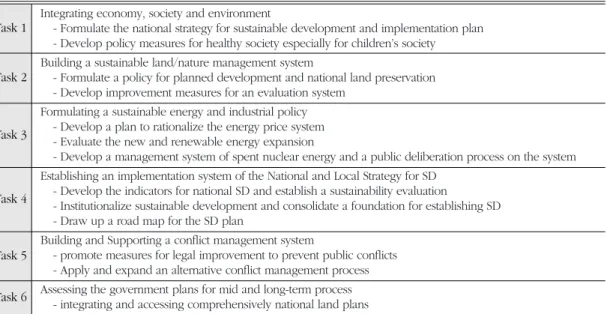
Industry, Social Conflict Management and international cooperation) and priorities for action were drawn up (Table 1).
The importance of these tasks may be based upon the capability building for the goal of Sustainable Development (Table 2).
National Strategy for Sustainable Development (NSSD) is initiated by PCSD and implemented by 22, all governmentaldepartments. Thos strate- gy is a direct response to the next generations which will work towards the goals of Sustainable
Table 1. Priority Fields of Policy Task Task 1 Integrating economy, society and environment
- Formulate the national strategy for sustainable development and implementation plan - Develop policy measures for healthy society especially for children’s society Building a sustainable land/nature management system
- Formulate a policy for planned development and national land preservation - Develop improvement measures for an evaluation system
Formulating a sustainable energy and industrial policy - Develop a plan to rationalize the energy price system - Evaluate the new and renewable energy expansion
- Develop a management system of spent nuclear energy and a public deliberation process on the system Establishing an implementation system of the National and Local Strategy for SD
- Develop the indicators for national SD and establish a sustainability evaluation
- Institutionalize sustainable development and consolidate a foundation for establishing SD - Draw up a road map for the SD plan
Building and Supporting a conflict management system
- promote measures for legal improvement to prevent public conflicts - Apply and expand an alternative conflict management process Assessing the government plans for mid and long-term process
- integrating and accessing comprehensively national land plans Task 1
Task 2
Task 3
Task 4
Task 5
Task 6
Development. The identification of environmental impacts, particularly in relation to health and quality of life; and the environment plans have a environmental role in working towards these goals. It is therefore quit sure that EA (Environmental assessment) will roll more explic- itly into the sustainable development paradigm, creating procedural and methodological chal- lenges to the EA process.
III. Extending the Concept of
Environmental Impact Assessment
In its thirty five years, EA has evolved from a project and technically based,reactive process to encompass mainly physical and ecological impacts (First generation EA 1970 - 1992). Since Rio UNCED in 1992, the concept of social and economic-sustainable development in environ- mental sustainability has been introduced into EIA (Second generation EA, period for introduc- ing SD concept into EIA, 1992 - 2000).
It now operates in wider frame of reference, accommodating activities beyond the Firstand Second generation levels (Third generation, EA period for practice implementation of SD into EIA, 2002-).
The third generation of EA might be more involving SD for the next generation.
Conventional EA tend to focus on a limited range of projects and activities. Many develop- ment decisions and resource management prac- tices escape any form of assessment, even though their collective impact may be greater than that of individual large-scale and hazardous facilities.
In order to more fully meet with the needs of sustainable development, EA needs to take account of the expanding scope of environmental management and the changing perception of environmental issues. The traditional view had been to consider environmental problems such as pollution in terms of their immediate origins in economic industrial activities and their effects, largely interpreted in biological or physical terms.
In a more extended view, the origins of pollu- tion are being traced back to patterns of social behavior and organizationwhich created the demand for economic activity in the first place.
Environmental effects are also being defined as more than just ecological demand and nuisance to incorporate quality of life issues and human health.
The predictions of environmental impacts needs to be extended beyond physical/biological Table 2. Goal of tasks for SD
Yr Tasks 2005 2010 Unit
Water resources 7.737 8.368 ⅹ106m
Ratio of Green Zone 9.7 11.0 %
Protection area for coastal zone 14.8 20.0 %
Risky population by air pollution 351 176 ⅹ104
Organic agro-product 4.4 10.0 %
Chemical pesticides consumption 376 260 Kg/ha
Renewal wastes in industries 77 80 %
Increasing energy efficiency 0.359 0.29 TOE/103$
CO2 emission 0.88 0.77 m3/103$
Protect desertification 7 20 ⅹ108\
Tasks Yr 2005 2010 Unit
considerations and deal more with human health and quality of life issues if the principles of sus- tainable development are to be more fully in which this is being achieved is through the incor- poration of environmental risk into EA.
IV. Challengesof EA/EIA
The ultimate of EA/EIA is for the achievement of sustainable development. There are now many approaches, some of which are suggested below that can be identified which would appear to support practical application of more sustainable forms of development.
1. Establishing and Emphasizing the Ecological Framework
The achievement of sustainable development requires a synoptic ecosystem approach. That relates to understanding the dynamics of natural variability and the effects of human intervention of key indicators of biodiversity and productivity (Sadler, 1990).
This framework encompasses an improved approach to environmental impact assessment.
Based on the results of a thorough review of Canadian experience in EA (Beanlands and Duinker, 1983), this approach urges adherence to basic ecologicalconcepts within a clear, scientific approach. Specifically, this requires the identifica- tion of study boundaries, quantification of data, analysis based in modeling, results that provide predictions, and careful design of a study strate- gy incorporating a commitment to monitoring.
To ensure these requirements committees of experts advise agencies on scientific matters relat- ed to impact assessment. Within this context the framework focuses on Valued Ecosystem Components (VEC), which are the environmental
attributes considered by society to be important in project decisions. Identified through a scoping exercise with public involvement the VEC guide the conceptualization and design of the assess- ment.
2. Predictive Statements by modeling
This is an approach which describes the major biophysicaland social processes that connect a development activity with its potential environ- mentaleffects. It provides a focusing mechanism for environmental research of all kinds, but espe- cially for systematic and testable predictions in EA. The impact hypothesis itself consists of the linking of potential development impacts to an individual VEC through the use of simulation models or other means of making connections like statistical analysis or experimental work.
Although the impact hypothesis approach essentially remains oriented to the single project EA, it provides a common framework for a com- parison of projects. As a well-defined framework with an explicit mechanism for prediction and an emphasis on monitoring, it provides decision makers with a firm basis for learning and adapta- tion. The adaptive capability of the approach is complemented by its strong emphasis on systems analysis. Modeling and testing of impacthypothe- ses in a multi-interest workshop situation facili- tates an interactive process and provides a greater opportunity for filling a range of human needs than does the expert, biophysical bias of the eco- logical framework. It, of course, would be impor- tant for the validation of models as possible.
3. Cumulative Assessment
The concept of cumulative effects, of the incre- mental reduction and erosion of the integrity of
natural systems from interactions of multiple activities, provides a perspective to redirect impact analysis to deal with the driving causes of unsustainable development.
Cumulative effects take a variety of forms, including frequent and repetitive or high density impacts on a single environmental medium; syn- ergistic effects from multiple sources a single environmentalmedium; impacts resulting some distance from the source; and secondary impacts resulting from a primary activity. Methods of cumulative effects assessment (CEA), attempt to analysis and predict the potential for a range of effects, accumulating from actions over space and time, using techniques such as matrices, causal- analysis, and systems modeling. An explicit attempt to analysis and monitor cumulative changes at a regional or national scale lends itself to the establishment ofnotional ecological thresh- olds or carrying capabilities. Like impact assess- ment audits, CEA is a direct response to per- ceived deficiencies in conventional approaches to EA. CEA takes EA beyond the project level to programme and policy level concerns. The effect is to broaden the spatial and temporal scope of EA, making it more comprehensive and interdis- ciplinary in approach, and integrating it with impact monitoring and management systems.
4. Strategic Environmental Appraisal
Since its inception on the early 1970s, EA has been largely applied to project authorizationand therefore occurred late in the planning process.
Despite the utility of project level EA, such as improvements in project design and planning, there have been deficiencies which arise from only focusing at this level of the planning process. Examples of difficulties include the
assessment of indirect impacts and no detailed analysis of project alternatives because they were ruled out at an early stage of planning. Perhaps the most significant deficiency has been in the assessment of cumulative impacts arising from a number of different projects within the same geo- graphical area or within the same economic sec- tor. Sustainable development objectives cannot be achieved through this piecemeal approach to EA.
There is a growing recognition that environmen- tal assessment could be used to greater advan- tage if it were utilized in the evaluation of poli- cies, plans and programmes (PPP). This process has been variously described as Strategic Environmental Assessment or, alternatively pro- grammatic EA. With the meaning, the preferred expression is now strategic Environmental Appraisal (SEA).
SEA may be described as the process of evalu- ating the likely significant environmental conse- quences of proposed policy, plan or programme before it is approved. To date, actual experience of using SEA has been limited to a small number of countries and states including the USA, Australia, New Zealand and the Netherlands and aid agencies such as the World Bank. Now, there is now an emerging interest to introduce this form of environmental assessment in the evalua- tion of government development plan in Korea (2006).
SEA can help introduce consideration of envi- ronmental issues at an earlier stage in the plan- ning process andthereby contribute to the formu- lation of environmentally-sustainable policies.
Other benefits include:
encourage consideration of alternatives which may be ruled out or ignored in pro- ject-EA
assist in selecting appropriate sites projects subsequently subject to EA
highlight and anticipate potential environ- mental problems, thus facilitate long-range environmental planning
facilitate a more effective assessment of cumulative, indirect, synergistic, delayed, regional, transboundary or global impacts reduce the time and effort required for pro- ject EA by identifying issues, initiating base- line studies and assembling data at an earli- er stage (by implementing SEA, some project EAs may not be needed)
enable an assessment of the environmental effects of policies which may not be translat- ed into specific projects
5. Environmental Risk Assessment
Environmental risk assessment is an evolving and, in comparison with EIA, a fledgling, disci- pline. On the one hand, as the found of experi- ence in its use increase, a number of methodolog- ical challenges have emerged, which need to be addressed in order to increase its effectiveness.
On theother hand, the insights that risk assess- ment can offer over conventional impact assess- ment tools have also been an international drive to extend the scope of application. These aspects are examined below.
The Risk Assessment has yet to be formally consolidated within the EIA process, especially in Korea. Now it is true where the absence of a community wide prescriptive requirement or guidance an the circumstances which a risk assessment should be conducted and the each of a commonmethodological framework has result- ed in generally and hoc approach to risk assess- ment in the contest of an EIA.
Risk assessment is unique amongst impact assessment techniques in that the process can explicitly incorporate variability and uncertainty throughout the assessment process. Risk assess- ment can span the impacts associated with an extreme occurrence to the evaluation of non cata- strophic impacts. Hitherto, environmental risk assessment has been applied in EIA almost exclu- sively to toxicological problems concerning human health and ecological damage (Y.Chung, 1992-98).
Consistency of application is an essential pre- requisite for any impact assessment tool. As was indicated in the USA, risk assessment has gener- ally developed in an ad hoc manner, with little agreement in even the definition of the term. In countries where a common regulatory framework has not been developed, it is rarely possible to compare the results of risk assessments undertak- en by different practitioners. Standardization of risk assessment protocols, with clear guidance on issues such as the construction of exposure sce- narios and toxicological assessment (particularly for carcinogens and for mixtures of chemicals), is seen as vital for the successful application of the process. The tools for risk assessment, namely the fate and transport models and the extensive data- base required to operate the models, also need to be developed, validated and made readily avail- able, together with guidance and case studies illustrating their use.
Whilemost risk assessment protocols include a formal requirement for the analysis and reporting of uncertainty, in practice a significant number of assessments either ignore its existence or fail to account for uncertainty in an explicit and trans- parent manner (Bartell & Biddinger 1995, Colombo et al. 1996). As a result confidence in
the risk assessment process has been eroded, leading some commentators to question the value of such an approach. The perception is either that the outcome of a risk assessment is so uncertain as to be meaningless or that the process can be, and often is, manipulated to the will of the asses- sor in order to obtain a preferred result. While these possibilities undoubtedly can and do occur, they should be regarded more as examples of misuse of the flexibility of the risk assessment process than as manifestations of an inherently flawed concept. Probabilistic expressions of uncertainty can be built into the risk assessment process with the ready availability of software tools based on Monte Carlo simulation (Ferguson
& Denner 1993; Golder Associates 1996), but reg- ulators have hitherto been predisposed towards single number, clear-cut expressions of risk and of criteria for ‘safe’ or ‘acceptable’ limits for com- pliance purposes, since they are more easily applied and understood. Rather than increasing confidence in a decision, an explicit acknowledge- ment of uncertainty tends to undermine public confidence in regulators and the regulatory process (Johnston & Slovic 1995). The lack of a framework within which to conduct risk-based decision-making has precluded the wider accep- tance of a tool which explicitly and overtly sets out the uncertainties of an impact assessment.
Another aspect of risk assessment which has been subject to continuing development has been in the area of risk-cost-benefit analysis. In order to link the assessment of an adverse effect to an assessment of benefits and costs, it is necessary to develop and to apply cost and damage functions (Crouch & Wilson 1982). This is a contentious area of research, but is essential for balanced decision-making. Risk assessment provides a con-
duit between environmental impact and environ- mental valuation/economics. This approach has been taken on a sectoral and macro environmen- tal scale, for example in examining the environ- mental and economic effects of energy use (European Commission 1995) and in the context of LCA (powell et al, 1995; Craighill & Powell 1996), but its application to project-specific impacts has been relatively limited. Massmann and Freeze (1987) provide an example of risk- cost-benefit optimization of engineering alterna- tives for site remediation. Cost-benefit analysis applied, for example, in the context of the CER- CLA and SARA regulations in the USA is gener- ally limited to an examination of risks relative to a single criterion for ‘acceptability’, rather than exploring the continuum of effects from low dose to high dose. Furthermore, while damage and cost functions are available for the effects of pol- lutants on human health, these have yet to be developed for EIA.
6. Social Impact Assessment (SIA)
SIA is an established discipline with a body of theory, a methodology and experienced profes- sionals. It is very important that only appropri- ately qualified and experienced SIA professionals conduct SIAs. There have been too many situa- tions where SIAs have been conducted by charla- tans. The risks associated with inappropriate con- sultants arenot only a poor study, and possibly a wrong decision, but potentially increased social impacts as a result of their meddling. Regulatory agencies need to insist that consulting firms uti- lize appropriately trained staff.
Around the world, the potential value of SIA is not fully recognized by regulatory agencies and governments. These groups need to be
momentum to ensure that the requirement to undertake SIA (and EIA generally) when appro- priate is enshrined in relevantlegislation. At the same time, the SIA discipline and communities- need to appreciate that while it may provide valuable informationabout a project, it cannot decide (except in extreme cases) on whether a project should go ahead or specify the required mitigation measures. These are political questions which need to be decided by governments through a participatory process. Nevertheless, SIA must not be distracted by the electioneering strategies engaged in by political parties (such as horse-trading and ‘pork barrelling’) which distort the assessment, siting and planning process. SIA and EIA need to be fully integrated into the planning process.
It is vital to appreciate that there is not one homogeneouscommunity. The social impacts of any project will differentially affect the social groups comprising society. Some groups are well able to defend their own interests other groups, particularly vulnerable or ‘at-risk’ groups, are less able. SIA professionals have a special obligation to ensure that the interests of disadvantaged groups are protected. They also need to ensure that they appreciate the gendered basis of many impacts and that they consider the differing impacts and interests of women as well as men (Jiggins 1995; Slocum et al. 1995; Sachs 1996;
Verloo & Roggeband 1996; Visvanathan et al.
1997). SIA needs to ensure that it does not become a vehicle by which those already empowered within society can force their inter- ests over those less able to defend themselves. If impacts on local communities have primacy over broader social values, then the disadvantaged will always be exploited. All sectors of the com-
munity need to take their share of the impact.
SIA should not assume naively that impact assessment processes will always lead to mutual- ly agreeable negotiated outcomes. The political nature of vested interests and the uncompromis- ing nature of many people’s morals and values means that outcomes that are satisfactory to everyone are not likely to occur in the majority of situations. This needs to be accepted and understood. It means that SIA professionals (and developers and agencies) need to be aware of the possibility of conflict, and they need to be versed in conflict management processed. Nevertheless, the potential for SIA to reduce disharmony and to lead to better decision-making is clear.
Because stress or anxiety about the future is a major impact associated with development, the impact assessment process should be focused on stress reduction. Where appropriate, affected citi- zens need to be given the opportunity to vent their anger, to be heard and to have a say in the processes that affect their lives. Stress is usually caused by too little information and/or uncer- tainty. The more people are involved in the process and the more they know about experi- ence and, potentially, the lower the impacts and, some would argue, the more likely they are to approve of the development.Even though fear may be misplaced, it is still important to view it as a legitimate, valid and real (social) impact of a development proposal or project, and not simply as a figment of the public’s imagination.
SIA needs to be understood as a process for- managing change, and for involving the commu- nity in that process, not simply as a time-specific comment about what might happen in the future. As other environmental professionals move towards recognizing the importance of
environmental assessment (EA).
A generic approach to development planning and management that encompasses both project- level environmental impact assessment (EIA), concerned primarily with analyzing and mitigat- ing the adverse effects of development proposals, and strategic environmental assessment (SEA) of polices, plans and programs (Sadler 1995), per- hapsthe discipline interested in the analysis of social impacts should become known as social assessment (SA), defined as a generic approach to understanding the social aspects involved in development planning and management.
7. EIA at the international Level
It is very important to consider the transna- tional and multilateral dimensionsof EIA.
Transboundary environmental impacts provide one of the most challenging assessment issues, not only in relation to the development and application of appropriate prediction and evalua- tion methods, but more fundamentally to the need for legal and procedural systems which can ensure that the interrelationships between eco- nomic activities and their regional and global impacts one firstly recognized and then assessed.
UN Economic Commission for Europe (ECE) Convention onEnvironmental Impact Assessment in Transboundary Contex elaborated the EIA convention under the auspices of ECE, and was adopted at Espoo in Finland 25 Feb. 1991. It was signed by 29 european countries for transbound- ary impact by 17 activities, not included ‘global warming’ etc.
“Global warming’ is the most critical issue for living world as well as human beings.
V. Conclusions
Sustainable development represents a synthesis of concerns about development and the environ- ment. In the meeting of the present, the ability of future generations to meet their own needs must not be compromised.
‘It is development itself, not the environmental base, which must be sustain’ These documents illustrate key principles and guidelines strategies (NSDS) and international cooperation for EIA.
EIA should be employed and improved to pro- mote sustainability assurance and to facilitate sig- nificance criteria and integrate EIA and spatial planning and resource management with chal- lenges.
References
J.Ashley Nixon & Brian D. Clark, Environmental Impact Assessment and Sustainable Development, 1994, International Seminar for celebrating the 22nd world Environmental Day, June 5, 1994, Seoul.
Ministry of Environment, 2005, White paper on Environmental protection.
Presidential Commission on Sustainable Development, Korea, 2006, A National Vision for Sustainable Development.
Sadler, B., 1990, An Operational Perspective on Sustainable Development: P. Jacobs and B. Sadler (Eds), Sustainable Development and Environmental Assessment: Perspectives in planning for a Common Future, Canadian Environmental Assessment Research Council, Hull, Canada.
Sadler, B., 1994b, Perspectives in issues of environmental assessment effectiveness,
14th WHO International Seminar onEnvironmental Assessment, CEMP, Aberdeen 1993.
Sandler, B., 1994, International Study of the Effectiveness of Environmental Assessment: Proposed Framework, Federal Environmental Assessment Review Office, Canada.
UNCED, 1992, agenda 21, Rio de Janeiro.
Judith Petts (editor), 1991, Handbook of
Environmental Impact Assessment (Vol.
I, II).
Chung, Y., Health risk assessment of environmental pollutants, (1992-94, Water pollutants, 1995-97, Air pollutants), Ministry of Environment, Korea.
최종원고채택 07. 06. 25