
3. Diversity of Miocene fossil Acer from the Pohang Basin, Korea
19
0
0
전체 글
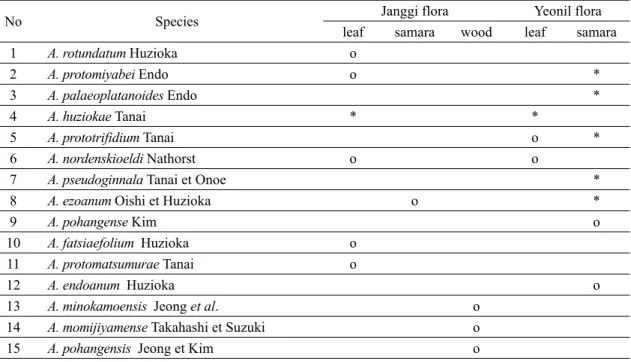
(2) 388. 김종헌․남기수․전영석. Table 1. Fossil species of Acer recognized in this study and accepted from the previous works in the Janggi and Yeonil floras (*: new occurrence in this study). No 1 2 3 4 5 6 7 8 9 10 11 12 13 14 15. Species A. rotundatum Huzioka A. protomiyabei Endo A. palaeoplatanoides Endo A. huziokae Tanai A. prototrifidium Tanai A. nordenskioeldi Nathorst A. pseudoginnala Tanai et Onoe A. ezoanum Oishi et Huzioka A. pohangense Kim A. fatsiaefolium Huzioka A. protomatsumurae Tanai A. endoanum Huzioka A. minokamoensis Jeong et al. A. momijiyamense Takahashi et Suzuki A. pohangensis Jeong et Kim. 있지 않다(Tanai, 1983). Shilo (1979)는 러시아의 사 할린 지역에 분포하는 고제3기의 팔레오세에서 처음 화석 단풍나무속의 잎을 보고했지만 그 시대가 정확 하지 않다는 지적도 있다(Tanai, 1983). 일반적으로 화석 잎을 비롯한 열매, 씨, 목재는 세계 각지의 팔레 오세부터 올리고세까지 많이 알려져 있으며, 이들의 화석 기록은 Boulter et al. (1996)에 의해 상세히 정리 되기도 하였다. 화석 단풍나무속의 잎과 열매는 제3 기 동안에 동아시아, 유럽 및 북아메리카 지역에서 가장 흔하게 산출되며 북아메리카에서 적어도 91종, 유럽에서 40종, 중동의 아르메니아에서 18종, 그리 고 동아시아에서 35종 이상의 화석종이 각각 알려졌 으며(Suzuki, 1963; Tanai, 1983; Wolfe and Tanai, 1987; Gabrielyan and Kovar-Eder, 2011), 한반도 의 제3기 식물군에서도 23종이 기재 되었다(표 3). 단풍나무속 식물의 화분 화석은 올리고세에서 처음 보고되었다(Piel, 1971), 그리고 이들의 꽃과 화석 목 재도 제3기층에서 산출되고 있지만 잎에 비해 매우 드문 편이다. 화석 목재는 현재도 세계 각지의 제3기 층에서 새로운 종이 계속 발견되고 있다(Akkemik et al., 2016). 한반도에서의 신생대 화석 목재는 포항 지역의 장기층군에서 유일하게 3종(2종의 미결정종. leaf o o. Janggi flora samara wood. Yeonil flora leaf samara * *. *. * o o. o. * * * o. o o o. o o o o. 미포함)이 알려져 있다(Kim et al., 2008; Jeong et al., 2009; Lim et al., 2010; Park and Kim, 2010), 포항 지역의 장기층군에서 산출된 3종의 화석 목재는 화 석 잎, 열매와 함께 한반도에 서식했던 단풍나무속의 개체들을 복원하는 데 중요한 기초 자료가 될 것으 로 판단된다. 이 연구에서는 최근까지 축적된 새로운 고식물학 적 지식에 근거하여 북한에서 보고된 일부 종들에 대한 재검토와 함께 포항 지역에 분포하는 포항 분 지의 장기층군과 연일층군에서 새로이 발견된 화석 단풍나무속의 잎과 열매를 중심으로 형태적 특징에 의해 분류하고 이들의 다양성에 대하여 고찰해 보고 자 한다.. 2. 선행 연구 한반도에서 단풍나무속 식물에 대한 화석 기록은, Kanehara (1936)가 포항 지역의 연일층군과 그리고 Endo (1938a, 1938b)가 북한의 명천층군과 고건원 탄 전에서 각각 보고한 화석 목록에서 찾아볼 수 있지만, 체계적인 연구는 Huzioka (1943)에 의해 처음 이루어 졌다. 그는 생이가래속(Salvinia), 피나무속(Tilia), 버즘.
(3) 포항 분지에서 산출된 마이오세 화석 단풍나무속의 종다양성. 나무속(Platanus)의 화석과 함께 단풍나무속(Acer) 2종 의 신종을 포함하여 7종을 보고하였다. 이어서 Endo (1950, 1951, 1953), Huzioka (1954a, 1954b, 1972), Chun (1982), Tanai (1983), Ablaev et al. (1993), Lim et al. (1994) 및 Kim (2008)에 의해 추가적인 연구가 이루어졌다. Huzioka (1943)의 연구 이후 최근에 이 르기까지 한반도의 신생대 화석 식물의 연구는 양적 으로 그다지 많지 않고, 그것도 대부분 외국 연구자 들에 의해 이루어졌다. 한편, Tanai (1983)는 1970년 대 초까지 한반도의 제3기층에서 기재된 모든 화석 단풍나무의 종을 재검토하여 17종으로 정리하였다. 그 이후 현재까지 한반도의 북한의 제3기층에서 8종 (Ablaev et al., 1993; Lim et al., 1994), 그리고 포항 지역에서 1종이 추가되었다(Kim, 2008).. 3. 재료 및 연구 방법 현생 단풍나무과는 무환자나무목에 독립된 과로 있었지만, 최근 APGIII (2017)에서는 단풍나무과와 칠엽수과를 모두 무환자나무과에 포함시키고, 하위 분류군의 칠엽수아과에 단풍나무속을 두고 있다. 그 러나 세계식물명인(IPNI, 2017)과 국가표준식물목록 (KPNIC, 2017)에서는 아직도 무환자나무목에 단풍 나무과를 독립된 과로 두고 있다. 여기에서는 APGIII 의 분류안을 따라 무환자나무과로 표기했다. 무환자 나무과는 화석종과 현생종 모두를 포함한다. 현생 단풍나무속의 분류는 화기(花器)의 구조적 특징에 의한 화식도, 화분립의 외부형태, 잎의 외부 형태와 해부학적 특징, 열매의 형태, 단풍 색채, 소지 (小枝)와 동아(冬芽)의 형태, 엽흔의 형태 탁엽의 형 태적 특징 등의 여러 가지 방법을 이용하여 종을 분 류한다(Ogata, 1967; Park and Kim, 1984). 본 연구 에서 장기층군과 연일층군에서 채집된 단풍나무속 표본은 30여 점이며, 열매는 50여 점에 이른다. 열매 는 모두 분리된 상태로 산출되었다. 채집된 화석 잎의 경우 외부 형태의 특징만이 종 을 식별할 수 있는 유일한 기준이다. 따라서 이 연구 에서는 보존 상태가 좋은 표본만을 선별하여 잎의 모양, 엽맥, 열편의 수와 모양, 열편이 갈라진 정도, 엽선의 모양, 엽저의 모양, 엽연에 거치의 유무, 잎의 길이 및 너비 등을 계측하여 정리하고 문헌적 연구 를 통해서 종의 분류를 하였다. 잎에 대한 기재 용어. 389. 는 Ko (1991)과 Lee (2006)을 따랐다. 열매의 형태적 특징에 관한 기술은 Tanai (1983), Gabrielyan and Kovar-Eder (2011) 및 Zhang et al. (2013)에 상세히 언급되어 있지만, 여기에서는 Tanai (1983)의 기술 을 따랐다. 열매는 크기, 형태, 씨의 두께, 엽맥의 특 징, 씨 부착흔의 길이, 두 날개의 부착 각 등을 계측 하여 종을 분류하였다. 이 연구에 사용된 화석 단풍 나무속 표본은 모두 공주대학교 표본실에 보관되어 있다.. 4. 연구 지역의 지질과 시대 한반도에 분포하는 신생대 제3기층은 포항 분지 를 비롯하여 주로 동해안 부근을 따라서 소규모로 산 재하고, 서해안 지역에는 북한의 봉산, 안주, 신의주 등지에 소규모로 발달한다(Kim, 1987; Jo and Pak, 1996). 포항 분지의 지질은 Tateiwa (1924)에 의해 처 음 조사되었다. 그는 제3기 퇴적층을 하부의 장기통 과 상부의 연일통으로 구분하였고, 장기통은 다시 장 기층군과 범곡리층군으로 세분하였다. Kim et al. (1975) 및 Kim and Yoon (1982)은 제3기 퇴적층을 하부로부터 장기층군, 범곡리층군, 연일층군으로 구 분하였으나, Kim (1984)은 범곡리층군을 장기층군 의 최상부층으로 간주하고 두 층군을 합쳐 양북층군 과 연일층군으로 구분하였다. Yoon (1998)은 양남 분지의 제3기 퇴적층을 하부로부터 범곡리층군, 장 기층군 및 연일층군으로 구분하였지만, 범곡리층군 을 최하위로 놓았다. 장기층군의 층서 구분은 Kim et al. (1975)의 층서 구분을 따랐다. 화석 단풍나무속 표본은 모두 금광 동층에서 채집되었다. 금광동층은 하부 장기층군에 속하며 금광동 지역에만 분포하고 그 층의 두께는 약 70 m에 달한다. Tateiwa (1924)에 의해 처음 금 광동셰일로 명명되었으나 Kim et al. (1975)에 의해 금광동층으로 변경되었다. 금광동층은 주로 박판상 담회색의 셰일로 구성되어 있으며, 많은 화석 식물과 어류 등이 산출된다(Huzioka, 1972; Kim and Choi, 2008; Paik et al., 2010). 금광동 지역의 지질도와 화 석 산지는 그림 1과 같다. 연일층군은 Tateiwa (1924)의 연구 이후 국내의 여러 연구자들에 의해 층서적 연구가 수행되었지만 층명과 층서 구분은 조금씩 서로 다르다(Um et al.,.
(4) 390. 김종헌․남기수․전영석. Fig. 1. Geological map of the Janggi area (Kim et al., 1975) and fossil locality.. Fig. 2. Geological map of the Pohang Basin (Um et al., 1964) and fossil locality..
(5) 포항 분지에서 산출된 마이오세 화석 단풍나무속의 종다양성. 1964; Yoon, 1975; Yun, 1986; Kim, 1987). 이 연구 에서는 Um et al. (1964)의 층서 분류를 따랐다. Um et al. (1964)에 의하면, 연일층군은 6개 층으로 세분되 지만 연구 지역에는 4개 층이 분포한다. 화석 단풍나 무속의 잎과 열매는 연일층군의 상부층인 두호층에 서 채집되었다. 그림 2는 연구 지역의 지질도와 화석 산지를 나타낸다. 고생물학적 자료에 기초한 장기층군의 지질시 대는 일반적으로 전기 마이오세로 추정되고 있지만 (Huzioka, 1972; Kim et al., 1975; Takahashi and Kim, 1979; Bong, 1981; Jeong et al., 2009), 올리고 세의 견해도 있다(Chun, 1982). 그리고 연일층군은 대체로 중기에서 후기 마이오세로 보고 있지만(Bong, 1981; Chun, 1982; Yoon, 1982; Choi et al., 1984; Yun, 1986; Yamanoi, 1992; Chung and Choi, 1993), 전기 마이오세에서 중기 마이오세라는 견해도 있다 (Kim, 1990; Yun et al., 1991; Yi, 1992). 화산암의 절 대연대 측정에 의한 장기층군의 연대는 19.92∼22.05 Ma, 연일층군의 연대는 15 Ma 이다(Lee et al., 1992). 이들은 화석 연대와 대체로 일치한다.. 5. 연구 결과 장기층군과 연일층군에서 산출된 화석 단풍나무 속은 기존에 알려진 종과 현재의 연구로 확인된 종 을 합하면 표 1과 같이 총 15종이다. 그중에서 장기 식물군과 연일식물군은 각각 10종과 9종으로 구성 되며, 4종이 두 식물군에 공통이다. 단 기존의 연구 에서 장기층군과 연일층군의 화석 기록 중에 표본번 호와 산출장소의 기록은 있으나, 잎 또는 열매로 명 시되지 않은 것은 제외하였다.. Systematic descriptions Family Sapindaceae Jussieu 1789 Genus Acer L. 1753 Acer ezoanum Oishi et Huzioka 1972 Fig. 3a Acer ezoanum Oishi et Huzioka: Huzioka, 1972, p. 63 Acer protomiyabei Endo: 1950, p. 15, pl. 3, Fig. 11 Material: KNU-20150620 (samara). 391. Description: This species is represented by a single samara. The samara is 3.3 cm long and 1.1 cm wide (the length to wide ratio is 3.0), and it is oblong in outline. The wing is broader in the middle, gradually narrowing towards the base. The apex of wing is rounded. The outer margin is gradually curved and the inner margin is convex, which then narrows through the contact scar of the seed. The veins are not numerous, branch dichotomously more than three times, and curve inwards. The seed is thick and ellipsoidal in shape (1.2 cm long and 0.7 cm wide). The contact scar is distinct (0.6 cm long). The angles between the outer margin and the contact scar is less than 25°. Occurrence and distribution in the Korean Peninsula: This species is found in the Duho Formation of the Yeonil Group. This species was recorded in the Tertiary strata, Japan (Tanai, 1983). Remarks: The present samara is similar to that of Acer ezoanum, which was originally described by Oishi and Huzioka (1943) from the Cenozoic strata of Hokkaido, Japan, particularly with regard to the ellipsoidal seed. Later, this species was redescribed in detail by Tanai (1983). However, the two forms differ in terms of a few minor characteristics: in the present samara, the veins are not numerous and the angles of 25° between the outer margin and contact scar is considerably larger than that (less than 10°) of the Japanese samara. These minor differences can be used to differentiate between the Korean and Japanese samaras. A. ezoanum is easily distinguished from other species of Acer by its wing and ellipsoidal seed, as recorded in the Tertiary strata in East Asia. Acer huziokae Tanai 1983 Fig. 3b-3e Acer huziokae Tanai: 1983, p. 326, pl. 11, Fig. 2 Materials: KNU-20150704128, 20150509, 20150510, 20150511 (leaves).
(6) 392. 김종헌․남기수․전영석. Description: This species is characterized by the number of leaves. Each leaf is trilobed, variable in size, and usually 3 cm long and 4 cm wide. The leaf margins are entire. The lobes are trigonal to narrowly trigonal and separated by a broadly opened obtuse sinus; the central lobe is slightly larger than the laterals. The leaf apex of each lobe is acuminate to attenuate, sometimes accompanied by a caudate tip. There are three primary veins; they are strong, radiate from the base, and enter the. lobe apex. There are more than 6 pairs of secondary veins, arising suboppositely from the primaries at angles of around 30°-40°, gently curving upward and then ending at the margin. The tertiary veins and fine veinlets are not preserved. Occurrence and distribution in the Korean Peninsula: This species is found in the Keumkwangdong Formation of the Janggi Group, the Duho Formation of the Yeonil Group. This species was recorded from the Miocene to the Pliocene in East Asia. Fig. 3. Acer species from the Duho and the Keumkwangdong formations. a. Acer ezoanum Oishi et Huzioka. Duho Formation, KNU-20150620, b-e. Acer huziokae Tanai. b. Keumkwangdong Formation, KNU- 20150704128, c. Duho Formation, KNU-20150509, d. Duho Formation, KNU-20150510, e. Duho Formation, KNU-20150511, f-i. Acer nordenskioeldi Nathorst. f. Duho Formation, KNU-20150502, g. Duho Formation, KNU-20150506, h. Duho Formation, KNU-20150507, i. Duho Formation, KNU-20150508..
(7) 포항 분지에서 산출된 마이오세 화석 단풍나무속의 종다양성. (Tanai, 1972). Remarks: The present leaves are characterized by trilobed leaves with entire margins. These characteristics agree well with those of the original leaves of Acer huziokae described by Tanai (1983) from the Tertiary strata in Japan. The leaves of A. huziokae are similar in shape to those of A. prototrifidium defined by Tanai (1983) from the Late Miocene Tatsumitoge Formation, Japan. However, the later form is distinguished from the former by the presence of minute teeth. Acer nordenskioeldi Nathorst 1883 Fig. 3f-3i Acer sp.: Huzioka, 1943, p. 135, pl. 25, Fig. 1 Acer nordenskioeldi Nathorst: Huzioka, 1972, p. 64 Materials: KNU-20150502, 20150506, 20150507, 20150508 (leaves) Description: The leaves are palmately 7 lobed, 4-6 cm long and 5-7 cm wide. The leaf margins are finely to coarsely serrate by an acute sinus and each lobe is deeply dissected. The leaf is attenuate with a caudate tip at the apex, and the basal pair of lobes is smaller than the other lobes. The primary veins are stout, palmately emerging from the base, nearly straight, and ending lobe apex. The secondary veins are distinct, opposite to subopposite, occur in more than 7 pairs, diverge from the primaries at angles of 40°-70°, gently curve up, and enter the teeth. The tertiary veins are fine, arising from the secondaries at wide angles. They are further subdivided and connected to the neighboring veins, forming small square to pentagonal meshes. The fine veinlets are not preserved. The petiole is partially preserved. Occurrence and distributionin in the Korean Peninsula: The species occurs in the Duho Formation of the Yeonil Group. This species has been known in the Tongcheon, Yongdong, and Hamjindong floras in North Korea (Tanai, 1983).. 393. Remarks: As stated previously by Tanai (1983), the leaves have been referred to as Acer nordenskioeldi Nathorst from the Neogene of East Asia by various authors. The leaves’ lobation, lobe shape, and marginal serration take many forms. According to Tanai (1983), the leaves of A. nordenskioeldi Nathorst are 5-7 lobed and are finely to coarsely serrate at the margin. Each of its teeth is often accompanied by one or two subsidiary minute teeth on its basal side. The fine veinlets branch three or four times in quadrangular to pentagonal meshes, as presented in Tanai (1976). Although the present leaves do now show any fine venation characteristics and subsidiary teeth at the margins, they are referable to A. nordenskioeldi Nathorst (see Tanai, 1983) in terms of the number of lobes and the presence of marginal teeth. A. nordenskioeldi Nathorst is similar to A. protomatsumurae in leaf form, originally described by Tanai (1983) from the Late Miocene Tatsumitoge Formation in Japan, but the latter form is distinguished from the former by its distinct double-serrate margin with acute sinus. As indicated previously by Tanai (1983), some leaves of A. nordenskioeldi Nathorst also show a double-serrate margin, but their principal teeth are not as conspicuous as in A. protomatsumurae Tanai. Also, A. nordenskioeldi Nathorst was recorded in the Miocene strata in Japan and China (Inst. Bot. and Inst. Geol. & Palaeont., 1978; Tanai, 1983). Acer palaeoplatanoides Endo 1950 Fig. 4a Acer palaeoplatanoides Endo: 1950, p. 11, pl. 3, Figs. 1, 9 Acer palaeoplatanoides Endo: Huzioka, 1972, p. 65, pl. 8, Figs. 9, 9a Material: KNU-20150621 (samara) Description: This species is represented by a single samara. The samara is 2 cm long and 0.6 cm wide (the length to width ratio is 3.3), and is.
(8) 394. 김종헌․남기수․전영석. oblong in outline. The wing is broader in the middle, gradually narrowing towards the base. The apex of wing is rounded. The outer margin is straight and the inner margin is gently convex, which then narrows toward the contact scar of the seed. The veins are numerous, dichotomously branching, and curving inwards. The seed is thick, semicircular, and 4 mm in diameter. The contact scar is distinct and 0.5 cm long. The angle between the outer margin and contact scar is 50°. Occurrence and distribution in the Korean Peninsula: The species occurs in the Duho Formation of the Yeonil Group. This species was recorded in the Kilju and Hamjindong in North Korea (Tanai, 1972). Remarks: The present samara is characterized. by its semicircular seed and angles of 50° between the outer margin of the wing and the contact scar. These characteristics are similar to those of Acer palaeoplatanoides from the Hamjindong Formation in North Korea in terms of size and form, as described by Endo (1950). However, according to Tanai (1983), the angle between the outer margin of the wing and the contact scar of A. palaeoplatanoides is 60°-90°. Although the present samara shows some variations, it is referable to A. palaeoplatanoides. Acer protomiyabei Endo 1950 Fig. 4b, 4c. Fig. 4. Acer species from the Duho and the Keumkwangdong formations. a. Acer palaeoplatanoides Endo. Duho Formation, KNU-20150621, b-c Acer protomiyabei Endo. b. Duho Formation, KNU-20150031, c. Keumkwangdong Formation, KNU-20150704115, d-e. Acer prototrifidium Tanai. d. Duho Formation, KNU-20150622, e. Duho Formation, KNU-20150623..
(9) 포항 분지에서 산출된 마이오세 화석 단풍나무속의 종다양성. Acer sp.: Huzioka, 1943, p. 136, pl. 23, Fig. 5, pl. 25, Fig. 4 Acer protomiyabei Endo: 1950, p. 13, pl. 3, Figs, 5, 8 Acer meisenense Endo: 1950, p. 12, pl. 3, Fig. 4 Acer miyabei Maxim.: Lim et al., 1994, p. 150, pl. 80, Fig. 7 Materials: KNU-20150704115 (leaf), KNU-20150031 (samara) Description: This species is represented by a single leaf and samara. The leaf is partially preserved, pentagonal in outline, palmately 5 lobed, and more than 9 cm long and 12 cm wide (the length to width ratio is 0.75). The lobes are separated by a broadly opened sinus; the central lobe is slightly larger than the laterals, the middle and upper lobes are oblong in outline and abruptly acuminate at apex, while the basal pair of lobes is shorter than the adjacent laterals and acute at the apex. The leaf margins are slightly dentate, having two to three pairs of dentate teeth. The leaf base is broadly caudate. There are five primary veins, and they are weak, curve slightly, radiate from the base, entire the lobe apex. The secondary veins have 5-7 pairs in each lobe, are opposite to subopposite, and arise from the secondary at angles of 30°-50°. They are nearly straight or gently curve up, and some of them enter the marginal teeth. The fine veinlets are not preserved. The samara is oblong in outline, slightly falcate, and 1.8 cm long and 0.6 cm wide, with a length to width ratio of 3. The wing is rounded at the apex. The outer margin is slightly incurved, and the inner margin is gently convex. The veins are numerous, dichotomizing more than three times, and curving inward. The seed is large in comparison with wing size, orbiculate, bulging outward beyond the width of the wing, and 1.3 cm long and 1 cm wide. The contact scar is distinct and 0.5 cm long, and the angle between the outer margin and the contact scar is 45°. Occurrence and distribution in the Korean Peninsula:. 395. This species occurs in the Keumkwangdong Formation of the Janggi Group and the Duho Formation of the Yeonil Group. This species has been known in the Yongdong and Hamjindong floras in North Korea (Tanai, 1972). Remarks: Acer protomiyabei was established by Endo (1950) from the Miocene of the Tongcheon Coal-mine in Gangwon-do based on a single samara, and later, it was redescribed in detail by Tanai (1983). The present leaf and samara agree well with those of A. protomiyabei described by Endo. As mentioned previously by Tanai (1983), the epithet ‘protomiyabei’ has nomenclature priority for Miocene leaves and samaras that are related to the extant A. miyabei. Acer prototrifidium Tanai 1952 Fig. 4d, 4e, Fig. 5a-5f Acer trifidium Thook and Arn.: Kanehara, 1936, p. 83 Acer prototrifidium Tanai: 1952, p. 234, pl. 22, Fig. 13 Acer prototrifidium Tanai: Huzioka, 1972, p. 66 Acer trilobatum tricuspidatum Heer: Lim et al., 1994, p. 150, pl. 80, Fig. 8 Materials: KNU-20150622, 20150623 (leaves), 20150 704116, 201550624, 20150625, 20150503, 20150504, 20150505 (samaras) Description: This species is represented by the number of leaves and samaras. The leaves are palmately trilobed, and the leaf is 6.5 cm long and 7.1 cm wide with a length to width ratio of 0.9. The leaf base is broadly obtuse. The margins are remotely serrate with minute teeth. The lobes are trigonal to narrowly trigonal, separated by a broadly opened sinus; the central lobes are nearly the same as or slightly larger than the laterals. The apex of each lobe is attenuate, often with a long and caudate tip. There are three primary veins. They are stout, radiate from the base, are nearly straight, and enter the apex. The secon-.
(10) 396. 김종헌․남기수․전영석. dary veins are distinct, with more than 6 pairs, opposite to subopposite, diverging from the primaries at about 40°-50°, and curving up near the margin. In the toothed leaves, the secondaries end directly in the teeth or fork near the margin, with one entering the teeth and the another joining the super-adjacent secondary. In the entire margined lobes, the secondaries form large loops just near the margin. The fine veinlets are not preserved. Samaras are quite variable in shape, have an oblanceolate outline in general, are 1.5-2 cm long and 0.5-0.6 cm wide, and have a length to width ratio of 3-3.3. The wing is broader in the upper middle part, narrows slightly towards the base, and is rounded at the apex. The outer margin is. nearly straight or slightly concave, and the inner margin is broadly convex, reaching the contact scar of the seed. The veins are fine, numerous, dichotomize more than three times, and curve gently inward. The seed is thin, flattened, suborbicular, and 3.3 mm long and 1.7 mm wide. The contact line of the seed is distinct and 5 mm long. The angle between the outer margin of the wing and the contact scar of the seed is 37°-40°. Occurrence and distribution in the Korean Peninsula: This species occurs in the Keumkwangdong Formation of the Janggi Group, the Duho Formation of the Yeonil Group. This species was recorded in Tongcheon, Gungshim and Hamjindong, North Korea, and was also widely distributed in East Asia during the Late Oligocene to Early Pliocene (Tanai, 1972).. Fig. 5. Acer species from the Duho and the Keumkwangdong formations. a-f. Acer prototrifidium Tanai. a. Duho Formation, KNU-20150704116, b. Duho Formation, KNU-20150624, c. Duho Formation, KNU-20150625, d. Duho Formation, KNU-20150503, e. Duho Formation, KNU-20150504, f. Duho Formation, KNU-20150505, g. Acer pseudoginnala Tanai et Onoe, Duho Formation, KNU-20150501, Figs. h-j. Acer rotundatum Huzioka. h. Keumkwangdong Formation, KNU-20150704122, i. Keumkwangdong Formation, KNU-20150704123, j. Keumkwangdong Formation, KNU- 20150704125..
(11) 포항 분지에서 산출된 마이오세 화석 단풍나무속의 종다양성. Remarks: The characteristics of the present leaves and samaras mentioned above agree well with those of Acer prototrifidium Tanai established by Tanai (1952) from the Miocene Yeonil Group, Korea. As mentioned by Tanai (1983), the trilobed leaves of A. prototrifidium are often confused with the toothed leaves of A. trilobatum (Sternberg) Braun, but the latter form is distinguished from the former by larger double-serrate teeth and absence of a fimbrial vein. A. prototrifidium closely resembles A. huziokae in terms of the number of lobes, as described by Tanai (1983) from the Late Miocene Tatsumitoge Formation, Japan, but the latter form is characterized by its trilobed leaves with entire margins. Acer pseudoginnala Tanai et Onoe 1972 Fig. 5g Acer sp.: Huzioka, 1943, p. 137, pl. 24, Fig. 8 Acer pseudoginnala Tanai et Onoe: Huzioka, 1972, p. 66 Material: KNU-20150501 (samara) Description: This species is represented by a single samara. The samara is 4 cm long and 1.2 cm wide (the length to width ration is 3.3), and broad oblanceolate in shape. The wing is broader in the middle and rapidly narrows towards the seed. The apex of the wing is rounded. The outer margin is straight and the inner margin is obliquely convex near the apex, then narrowing toward the contact scar of the seed. The seed is thick, semicircular, and 0.4 cm in diameter. The veins are numerous, dichotomously branching, and curving inwards. The contact scar is distinct and 1 cm long. The angle between the outer margin and the contact scar is 12°. Occurrence and distribution in the Korean Peninsula: This species occurs in the Duho Formation of the Yeonil Group. This species was recorded in Paekdong, North Korea. Remarks: Acer pseudoginnala was originally de-. 397. scribed by Tanai and Onoe (1959) based on a single well-preserved samara from the Paleogene Shichiku Formation, Fukushima Prefecture, Japan. The present specimen is characterized by its broad wing and small angles (12°) between the outer margin and the contact scar. These characteristics agree well with those of A. pseudoginnala, as described by Tanai and Suzuki (1960) and Tanai (1983). A. pseudoginnala is similar to the extant A. ginnala Maxim. A. pseudoginnala commonly occurs in the Tertiary outcrops in East Asia. A. pseudoginnala is similar to A. protodistylum in shape and size, as originally described by Endo (1950) from the Paleogene deposits of the Fushun Coalfield, China, based on a single samara. However, as noted previously by Tanai (1983), the latter form is characterized by a small seed, slightly slender oblanceolate wings, and angle of 26° between the outer margin of the wing and the contact scar of the seed. Acer rotundatum Huzioka 1943 Fig. 5h-5j Acer rotundatum Huzioka: 1943, p. 129, pl. 24, Figs. 1-3; pl. 25, Fig. 2 Acer subpictum Saporta: Huzioka, 1943, p. 129, pl. 24, Figs, 4-6; pl. 25, Fig. 3 Acer pictum Thunb.: Lim et al., 1994, p. 149, pl. 79, Fig. 2 Acer subpictum Saporta: Lim et al., 1994, p. 149, pl. 79, Figs. 1, 4-7; pl. 80, Fig. 1 Acer kotchkoriensis Kutuzkina: Lim et al., 1994, p. 150, pl. 80, Figs. 2, 3 Materials: KNU-20150704122, 20150704123, 2015 0704125 (leaves) Description: This species is characterized by the number of leaves. The leaves are petiolate. The lamina is semi-orbicular in outline, about 7-8 cm long and 6-8 cm wide, and palmately 5-7 lobed. The lobes are lanceolate with an acute to acuminate, and sometimes, a caudate apex. The.
(12) 398. 김종헌․남기수․전영석. lobe margins are entire. The sinus is broadly trigonal, obtuse, or round at the bottom. There are 5-7 primary veins, which are straight and lie at an angle of 27°-40° to each other. The secondary veins diverge from the primaries at angles of 50°-60°, curve up slightly, and entire the margin. The fine veinlets are not preserved. The leaf base is rounded and slightly cordate. Occurrence and distribution in the Korean Peninsula: This species occurs in the Keumkwangdong Formation of the Janggi Group. This species was recorded in the Myeongcheon, Yongdong, Kilju, and Hamjindong in North Korea. Remarks: Acer rotundatum was established by Huzioka (1943) from the Miocene strata in Korea as having 5-lobed and entire-margined leaves with a rounded base and a caudate tip. Later, this species was supplemented with well-preserved samaras from the Neogene strata in East Asia (Tanai, 1983). According to Tanai (1983), this species is characterized by 5-7 lobed leaves with entire margins and caudate acuminate apices. Although the lobes of the present leaves show some variations in number and size, their characteristics agree well with those of the original leaves of A. rotundatum Huzioka. This species is commonly found in the Neogene strata in East Asia (Tanai, 1983). A. subpictum Saporta, described by Huzioka (1943), is synnonymous with A. rotundatum Huzioka according to Tanai (1983). Furthermore, Lim et al. (1994) also reported the characteristics of A. pictum Thunb. and A. subpictum Saporta from the Middle Miocene strata of Kilju and Tongcheon, respectively, in North Korea. The former species is characterized by its 5-lobed leaves with entire margins, while the latter is symbolized by its 7-lobed leaves with entire margins. According to Tanai (1983), those characteristics agree well with those of A. rotundatum Huzioka. Thus, we include the two species of Lim et al. (1994) in A. rotundatum Huzioka.. 6. 토 의 Huzioka (1943)가 북한 지역의 제3기층에서 기 재한 Acer rotundatum과 A. subpictum의 공통점은 엽연에 거치가 없다는 점이며, 두 종을 쉽게 식별할 수 있는 유일한 기준은 열편의 수이다. 전자는 엽신 이 5개로 갈라지지만 후자는 7개로 나누어진다. Tanai (1983)는 열편의 수에 차이가 나는 것은 변이 에 기인한 것으로 보고 후자를 전자에 포함시켰다. 뿐만 아니라 Tanai (1983)의 A. rotundatum의 동종 이명 목록에는 동아시아에서 보고된 A. subpictum 을 비롯한 16종 이상이 포함되어 있다. 이와 같은 경 우는 Lim et al. (1994)이 북한의 제3기층에서 보고 한 8종의 화석 단풍나무에서도 찾아볼 수 있다. 첫째, Lim et al. (1994)이 보고한 Acer pictum과 A. subpictum은 도판 사진과 기재에 의하면, 두 종의 잎의 크기에는 약간의 차이가 있지만, 전자는 열편 이 5개이고 후자가 7개라는 점을 제외하면 두 종은 모두 엽연에 거치가 없다는 점이 공통이다. 이러한 특징들은 Tanai (1983)가 보고한 A. rotundatum과 형태적으로 매우 비슷하다. 따라서 두 종의 열편 수 의 차이를 변이에 의한 것이라고 본다면 A. rotundatum과 유사종이거나 같은 종으로 볼 수 있다. 또한 A. kotchkoriensis로 기재된 잎은 소형이면서 열편이 5개이고 하부 1쌍의 열편이 상당히 작으며 전연의 특징을 갖는다. 하부 1쌍의 열편이 작은 것은 잎이 소형이기 때문일 수도 있다. 단지 잎의 특징만을 고 려한다면 Lim et al. (1994)의 분류가 타당할 수도 있 지만 잎의 크기에 변이가 있다는 점을 고려하면 A. rotundatum에 더 근연이라고 판단된다. A. rotundatum은 포항 지역의 연일층군에서 흔하게 산출되는 화석의 하나이며, 신제3기의 마이오세와 플라이오세 동안에 동아시아에도 널리 분포하였다(Tanai, 1983). 둘째, Lim et al. (1994)이 현생종인 일본당단풍 (A. japonicum)과 같은 것으로 기재한 A. japonicum 의 잎은 열편의 수와 엽연에 복거치가 있는 특징으 로부터 판단하면, Tanai and Onoe (1959)가 일본의 제3기층에서 신종으로 기재한 A. protojaponicum에 형태적으로 매우 비슷하다. 따라서 전자를 화석종의 변종으로 기재하는 것이 분류체계에 맞을 것으로 판 단된다. 이종은 한반도에서 북한의 함진동식물군에 서 유일하게 알려져 있다(Huzioka, 1972)..
(13) 포항 분지에서 산출된 마이오세 화석 단풍나무속의 종다양성. 셋째, Lim et al. (1994)이 3개의 열편과 가는 거치 를 갖는 잎에 대해 A. trilobatum tricuspidatum 로 기 재한 종은 그들의 기재와 사진으로 판단하면, Tanai (1983)가 상세히 재기재한 A. prototrifidium의 특징 들과 대체로 일치한다. A. prototrifidium은 동아시아 의 올리고세 후기부터 플라이오세 초기까지 알려져 있으며, 포항 분지의 연일층군과 북한 지역의 제3기 층이 분포하는 궁심과 통천에서도 산출이 알려져 있 다(Huzioka, 1972). 넷째, Lim et al. (1994)이 기재한 A. cf. negundo의 잎은 Tanai (1961)가 일본의 제3기층에서 현생의 네 군도단풍(A. negundo)과 비슷한 잎에 대해 A. protonegundo로 기재한 것과 형태적으로 매우 비슷하다. 전자는 적어도 후자와 유사종이거나 같은 종으로 볼 수 있다. 현생의 네군도단풍은 북아메리카가 원산지 이며 다른 단풍나무의 잎과 달리 소엽이 보통 3∼5 개가 모여 장상으로 배열되지만, 때로는 7∼9개가 되는 경우도 있다. 잎은 난형 또는 피침상 장타원형 이고 엽연에 큰 거치가 있다(Lee, 2006). A. protonegundo는 신제3기의 마이오세 초기와 중기에 걸쳐 산출되며, 북한 지역의 용동 식물군에서 유일하게 알려졌다(Huzioka, 1943; Tanai, 1983). 다섯째, Acer miyabei는 일본의 제3기층에서 산출 된 열매에 기초하여 Endo (1950)가 명명한 종이며 후에 잎 화석이 추가되면서 Tanai (1983)에 의해 A. protomiyabei로 종명이 변경되었다. Lim et al. (1994) 이 북한의 함진동에서 산출한 열매에 의해 기재한 A. miyabei는 형태적으로 A. protomiyabei와 매우 비 슷하다. 이 종은 주로 동아시아의 마이오세 지층에 서 산출되며, 한반도에서는 포항 지역의 장기 및 연 일 식물군과 북한 지역의 통천 및 용동 식물군에서 기재되었다(Huzioka, 1972). 여섯째, Lim et al. (1994)이 한 개의 열매 화석에 기초하여 기재한 A. cf. palaeodiabolicum은 기재와 사진으로 보는 한 A. palaeodiabolicum과 약간 다르 다. 이종은 Endo (1950)가 처음 일본의 제3기층에서 명명한 종이다. Tanai (1983)에 의하면, 이 종의 가 장 큰 특징 중의 하나는 두 날개가 붙었던 접촉면과 날개 외연과의 각이 8°-17°의 범위에 있는데 반해, A. cf. palaeodiabolicum의 시과는 45°로서 두 시과 간에 각의 차이가 너무 크다. 이 차이가 종의 차이에 의한 것인지 아니면 변이에 의한 것인지 판단하기 어렵다.. 399. 45°에 비슷한 각을 갖는 열매는 A. rotundatum (30°-45°), A. prototrifidium (30°-40°), A. protojaponicum (55°-90°) 이 있지만 날개 크기와 형태가 서로 다르다. 아마 이 들 중의 어느 것의 변이라고 생각되지만 더 좋은 화 석 표본이 발견될 때까지 A. cf. palaeodiabolicum으 로 두는 것이 타당하다고 판단된다. 한편, Acer palaeoplatanoides는 Endo (1950)가 북 한 지역의 함진동에서 산출된 화석 단풍나무 잎에 근거하여 설립한 종이며 포항 분지의 연일층군에서 도 산출되고 있다. 이 종은 동아시아의 신제3기의 마 이오세 지층에서 많이 산출되고 있다(Tanai, 1983). A. huziokae는 포항 분지의 장기층군과 연일층군에 서 처음 산출되었다. 이 종은 동아시아의 신제3기의 마이오세에서 플라이오세까지 산출이 알려져 있다 (Tanai, 1983). A. nordenskioeldi는 동아시아의 마이 오세에서 플라이오세에 걸쳐 많이 산출되며, 한반도 의 모든 3기 식물군에 공통적으로 산출되는 종이다 (Tanai, 1983). A. pohangense는 Kim (2008)이 연일 층군에서 열매 화석에 의해 명명한 종이며 큰 날개 와 종자를 갖는다. 이종은 현재까지 동아시아에서 유일하게 연일층군에서만 산출되고 있다. 위에서 논의한 바와 같이 Lim et al. (1994)이 북한 지역의 제3기층에서 보고한 8종의 단풍나무에 사용 된 종명들은 Tanai (1983)가 동아시아에서 기록된 모든 단풍나무 종을 재정리하기 이전에 자주 사용되 던 종명이 대부분이다. 그 이유는 아마도 Lim et al. (1994)의 문헌에 Tanai (1983)의 논문이 없는 점으 로 미루어 보아 그의 논문을 참고하지 못했기 때문 으로 생각된다. 형태적 특징에 근거한 종의 분류는 흔히 오동정(誤同定)이 수반될 수 있고 불필요한 종 의 증가를 야기하므로 신중한 접근이 필요하다. 또 한, 이번의 연구를 통해서 장기층군과 연일층군에서 8종의 화석 단풍나무를 확인했지만 세부적으로 보 면 아직도 불명한 점이 많다. 그것은 포항 분지뿐만 아니라 한반도에서 산출된 잎과 열매의 대부분이 인 상화석으로 보존되어 형태적 특징만이 유일한 분류 기준이 되기 때문이다. 잎은 동일종에 속하는 것이 라도 잎의 크기, 엽형 및 엽연에 형태상의 변이가 많 고, 그리고 종이 달라도 잎의 전체적 특징은 서로 비 슷한 것들이 많이 존재하기 때문에 육안으로 구분하 기 어렵다(Tanai, 1983). 또한 열매에서도 같은 종이 라 해도 날개의 크기와 형태에 다양한 변이가 있다.
(14) 400. 김종헌․남기수․전영석. 는 것이 최근 Zhang et al. (2013)의 연구로부터 확인 되었다. Zhang et al. (2013)은 8종의 현생종의 열매 에 나타나는 변이를 조사하고, 동일종이라도 서식지 가 다르면 열매의 크기와 형태가 다르게 나타나며, 한 종당 적어도 서로 다른 8가지의 변이가 있음을 확 인하였다. 이와 같은 변이가 나타나는 원인은 서식 장소가 다르면 그에 따라 기후나 환경 조건이 달라 지기 때문으로 해석되고 있다(Zhang et al., 2013). 뿐 만 아니라, Zhang et al. (2013)이 제시한 8 종별로 작 은 것에서부터 큰 것까지 이어지는 8가지 형태의 열 매에 대해 두 날개가 붙었던 접촉면과 날개 외연과의 각을 측정해 보면 종마다 각이 변하는 범위에 어떤 규칙성이 나타나지 않는다. 큰 표본에서 각이 더 작 게 나타나기도 하고 어떤 것은 작은 표본에서 각이 더 크게 나타나기도 한다. 따라서 지금까지 화석 열 매의 분류에 자주 사용되어 왔던 이 방법은 절대적 으로 신뢰할 수 있는 기준이 아니라는 결론에 이른 다. 이것에 대해 Zhang et al. (2013)은 종 내에 형태 적 다양성을 갖는 화석의 경우 1종 또는 극소수의 종에 속할 수 있다는 점을 고려해야 한다고 강조하고 있다. 위와 같은 관점에서 보면, 한반도에서 잎이나 열 매의 형태적 특징에 의해 기재된 19종에는 당연히 동일종의 변이가 상당수 포함되어 있을 가능성이 크 기 때문에 실제 서식했던 종수는 그보다 훨씬 더 적 었을 것으로 추정된다. 그러나 화석의 경우에는 변이 의 유무를 판단하는데 한계가 있고, 또한 그것을 명 확하게 확인할 수 있는 방법도 별로 없다. 이런 이유 로 화석 식물의 분류는 연구자에 따라 조금씩 의견 을 달리하기도 한다. 따라서 화석의 경우 보다 정확한 종 분류를 위해서는 잎의 형태적 특징뿐만 아니라 표 피 구조의 특징도 추가할 필요성이 있다 . 유기물 이 보존되어 있는 압착화된 시료는 슐츠법[Schulzes’ maceration method, Harris (1926)]을 이용하여 처 리하고 슬라이드를 만들어 현미경으로 식물체의 표 피 조직을 관찰하면 비교적 종을 정확하게 분류할 수 있다(Kim and Kimura, 1987). 이와 같은 방법을 이 용하여 최근 중국 동북부의 신제3기층에서 Acer rotundatum의 표피 세포가 밝혀진 바가 있다(KovarEder and Sun, 2009). 한반도에서도 일부이기는 하 지만 포항층에서 압착화된 화석이 발견되고 있으며, 그중 일부는 표피 구조가 잘 보존된 것도 있다(Ee, 1982). 그러나 이러한 표본들을 많이 찾아내는 것은. 현실적으로 어렵다는 문제점이 있다. Kim et al. (2008)이 언급한 바와 같이 식물 유체 는 대부분 운반과 퇴적작용을 거쳐 화석화되는 과정 에서 한 개체가 각 기관이나 부위가 분리된 상태로 이동되어 서로 다른 퇴적층 내에 화석으로 보존된 다. 따라서 이들 화석이 발견되면 같은 개체이면서 도 기관별로 또는 부위별로 서로 다른 학명을 갖게 된다. 이와 같은 관점에서 보면, 장기층군에서 단풍 나무속의 잎과 열매로 기재된 종들은 당연히 화석 목재와 같은 개체에 속하는 것이 있을 것으로 생각 되지만 유기적으로 연결되어 나타나지 않는 한 같은 개체라고 판단할 수 있는 증거는 없다. 어쨌든 포항 분지에서 확인된 화석 단풍나무속 식물은 화석 목재 를 포함하여 총 15종에 이른다. 이것은 Huzioka (1972) 가 장기층군과 연일층군에서 보고한 6종에 비하면 종수가 비약적으로 증가된 것을 알 수 있다. 장기식물군은 식물군의 조성에 의해 냉온대 기후 에서 번성하였고, 연일식물군은 온난한 기후 내지 온난습윤한 온대 기후(Huzioka, 1972; Chun et al., 1983) 또는 온대 내지 아열대 기후에서 번성한 것으 로 추정되고 있다(Chung and Choi, 1993). 장기식 물군은 일본 동북 지방에 분포하는 전기 마이오세의 Aniai형 식물군에 대비되고 있는데, 후자는 온대 또 는 냉온대성 낙엽광엽수를 주체로 하며 이에 침엽수 가 혼합되어 있다(Tanai, 1961; Huzioka, 1972). 그 리고 연일식물군은 주로 난온대 내지 아열대성 식물 이 주체를 이루며, 일본의 같은 지역에 분포하는 중 기 마이오세의 Dajima형 식물군에 대비되고 있다 (Huzioka, 1972; Kim et al., 1975). 그러나, 최근 Lim et al. (2010)의 연구에 의하면, 장기층군의 하부함탄 층과 금광동층은 Aniai형 식물군에 속하지만, 상부 함탄층의 화석목재는 연일식물군과 마찬가지로 일 본의 Dajima형 식물군에 속한다. 그 이유는, 하부함 탄층의 화석 목재에는 상록수가 없지만, 상부함탄층 의 목재에는 상록수가 상당히 존재하기 때문이다. 이 것은 Jeong et al. (2009)이 언급한 바와 같이, 연일식 물군의 출현 이전에 기후가 온대 내지 아열대로 변 했음을 의미한다. 표 2는 장기층군과 연일층군의 단풍나무속 식물 (화석 목재 제외)을 일본의 Aniai형 식물군 및 Dajima형 식물군에 비교한 것이다. 장기식물군의 7종은 Aniai 형 식물군과 4종의 공통종이, 연일식물군의 9종은.
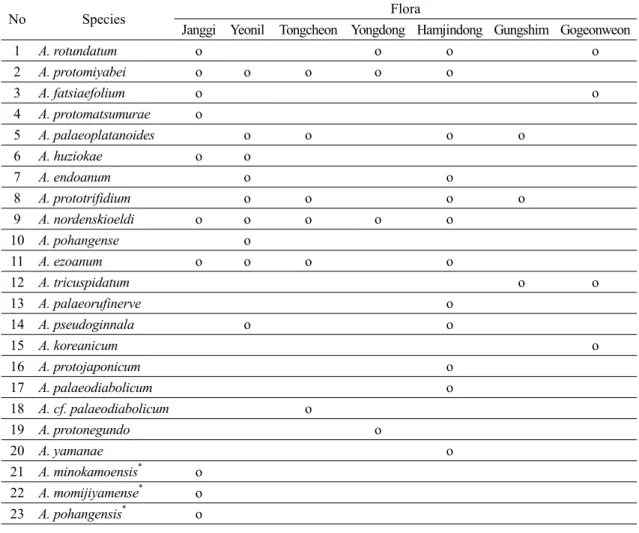
(15) 401. 포항 분지에서 산출된 마이오세 화석 단풍나무속의 종다양성. Table 2. Common species of Acer between Miocene strata of Korean and Japan. No 1 2 3 4 5 6 7 8 9 10 11 12. Species A. rotundatum Huzioka A. protomiyabei Endo A. palaeoplatanoides Endo A. huziokae Tanai A. prototrifidium Tanai A. nordenskioeldi Nathorst A. pseudoginnala Tanai et Onoe A. ezoanum Oishi et Huzioka A. pohangense Kim A. fatsiaefolium Huzioka A. protomatsumurae Tanai A. endoanum Huzioka. Dajima형 식물군과 7종의 공통종이 각각 존재하는 것으로부터 유사성이 크다는 것을 알 수 있다. 또한, 장기식물군에서 기재된 종들의 대부분은 Aniai형 식물군과 Dajima형 식물군에서 산출되고 있다. 이 것은 마이오세 동안에 기후의 변화가 종의 분포나 다양성에 그다지 큰 영향을 주지 않았다는 것을 의 미하기도 한다. Tanai (1972)는 동아시아에서 기재 된 단풍나무속 식물을 이용하여 진화계통과 산출 시 대를 나타냈지만, 장기층군과 연일층군의 단풍나무 속 종들은 산출시대가 겹치는 것들이 많기 때문에 세부적으로 분대하는 것은 곤란하다. 한편, 한반도의 제 3기층에서 기존에 보고된 화석 종에 이번의 연구에서 새로 확인된 종들을 추가하면 표 3과 같이 총 23종에 이른다. 종수로 보면 7개 식 물군 중에서 북한의 길주-명천 지역의 함진동식물군 이 12종으로 가장 많고 10종을 갖는 포항 지역의 장 기식물군이 그 다음이다. 7개 식물군 중에서 장기식 물군과 용동식물군의 시대는 전기 마이오세, 함진동 식물군을 비롯한 나머지 식물군은 모두 중기 마이오 세로 알려져 있다(Huzioka, 1972). 그러나 그 후의 연구에 의하면, 길주-명천 지역의 용동식물군과 강 원도의 통천식물군의 시대는 각각 올리고세와 후기 마이오세이다(Jo and Pak, 1996). 위에 기술한 내용 을 정리해 보면, 한반도의 전기 마이오세 동안에 지 속된 냉온대 기후 하에서는 포항 지역은 북한 지역. Korea Janggi flora o o. Japan Aniai type o o o. o o o o o o. o o. Korea Yeonil flora o o o o o o o o. o o. Japan Dajima type o o o o o o o o. o. o. 보다 단풍나무속 식물이 번성하는데 더 적합한 환경 이었지만, 그 후에 난온대 내지 아열대 기후로 변하 면서 단풍나무속 식물이 고위도 지역에서 더 번성한 것으로 추정된다. 제3기에 번성한 종래의 단풍나무과는 발전을 거듭 하여 현재 북반구 전 지역에 디프테로니아속(Dipteronia) 과 단풍나무속(Acer)에 207종의 현생종이 분포하고 있다(van Gelderen et al., 2005). 디프테로니아속은 2종으로 구성되지만, 나머지 종은 모두 단풍나무속 에 속한다(Ko, 1991; Lee and Lee, 1991). 단풍나무 속의 대부분은 북반구의 온대 지역에 널리 분포하지 만 일부는 열대 지역의 산악 지대에도 분포한다 (Tayler et al., 2009). 또한, 장기층군에서 산출된 단 풍나무속 화석 목재의 횡단면에 연륜이 뚜렷하게 나타 난다(Kim et al., 2008; Jeong et al., 2009; Lim et al., 2010; Park and Kim, 2010). 단풍나무속 식물의 분 포와 화석 목재만을 고려한다면, 한반도에서 전기 마이오세 식물군들은 계절성이 뚜렷한 온대 기후 하 에서 번성했으며, 이러한 기후는 중기 마이오세까지 지속되었을 것으로 추정된다.. 7. 결 론 장기층군과 연일층군에서 산출된 화석 단풍나무 의 잎과 열매는 8종으로 분류되었다. 그 중에서 6종.
(16) 402. 김종헌․남기수․전영석. Table 3. Fossil species of Acer recognized in this study and accepted from the previous works in the Tertiary strata * of Korea ( : fossil woods). No. Species. 1 2 3 4 5 6 7 8 9 10 11 12 13 14 15 16 17 18 19 20 21 22 23. A. rotundatum A. protomiyabei A. fatsiaefolium A. protomatsumurae A. palaeoplatanoides A. huziokae A. endoanum A. prototrifidium A. nordenskioeldi A. pohangense A. ezoanum A. tricuspidatum A. palaeorufinerve A. pseudoginnala A. koreanicum A. protojaponicum A. palaeodiabolicum A. cf. palaeodiabolicum A. protonegundo A. yamanae A. minokamoensis* A. momijiyamense* A. pohangensis*. Janggi Yeonil o o o o o o o o o o o o o o o. Flora Tongcheon Yongdong Hamjindong Gungshim Gogeonweon o o o o o o o o. o. o. o o. o o o. o. o. o. o o. o. o o. o. o o o o o o o o o. 이 장기층군 또는 연일층군에서 처음 산출되었다. 장기식물군과 연일식물군의 화석 단풍나무속 식물 은 각각 10종과 9종으로 구성된다. 한반도에서 화석 단풍나무속의 종다양성은 제3기의 7개 식물군 중에 서 함진동식물군이 가장 높고, 장기식물군이 그 다 음으로 높다. 전기 마이오세 동안에 지속된 냉온대 기후 하에서는 포항 지역이 북한 지역보다 단풍나무 속 식물이 번성하는데 더 적합한 환경이었지만, 그 후에 기후가 따뜻해지면서 단풍나무속 식물이 고위 도 지역에서 더 번성한 것으로 추정된다.. 사 사 본 논문이 나오기까지 논문을 심사해주고 내용의. 미비점에 대하여 상세한 지적과 건설적인 비평을 주 신 전희영 박사님과 익명의 심사위원에게 깊은 감사 를 드립니다. REFERENCES Ablaev, A.G., Sin, E.U., Vassiliev, I.G. and Lu, Z.M., 1993, Miocene of the North Korea and the South Primorye (beds with Engelhardia). FEB RAN, 1-140 (in Russian). Akkemik, Ü., Arslan, M., Poole, I., Tosun, S., Köse, N., Kiliç, N.K. and Aydin, A., 2016, Silicified woods from two previously undescribed Early Miocene forest sites near Seben, northwest Turkey. Review of Palaeobotany and Palynology, 235, 31-50. APGIII, 2017, http://en.wikipedia.org/wiki (March 10, 2017)..
(17) 포항 분지에서 산출된 마이오세 화석 단풍나무속의 종다양성. Bong, P.Y., 1981, Palynology of the Janggi area. Report of Geoscience, Mining Resources, 10, 7-16. Boulter, M.C., Benfield, H.C., Fisher, H.C., Gee, D.A. and Lhotak, M., 1996, The evolution and global migration of the Aceraceae. Philosophical Transaction of the Royal Society, London, 351B, 589-603. Choi, D.K., Bong, P.Y. and Kim, B.K., 1984, Tasmanitids from Idong and Pohang (Miocene) Formations for Korea. Journal of the Geological Society of Korea, 20, 215-221. Chun, H.Y., 1982, Plant fossils from the Tertiary Pohang Sedimentary Basin, Korea. Korea Institute of Energy and Resources, 14, 7-23 (in Korean with English abstract). Chun, H.Y., Lee, H.Y., Bong, P.Y. and Baek, I.S., 1983, Synthetic research of geology of Korea. Korea Institute of Energy and Resources, 7-29 (in Korean with English abstract). Chung, C.H. and Choi, D.K., 1993, Paleoclimatic implication of palynoflora from the Yeonil Group (Miocene), Pohang area, Korea. Journal Paleontological Society of Korea, 9, 143-154 (in Korean with English abstract). Ee, I.-H., 1982, A study on the Neogene Tertiary Yeonil plant fossils from Pohang Formation, Korea. MS thesis, Kyungpook National University Graduate School of Education, Daegu, 53 p (in Korean with English abstract). Endo, S., 1938a, Cenozoic plants from Tyosen (Korea) I. Journal of Geological Society of Japan, 45, 85-90 (in Japanese with English abstract). Endo, S., 1938b, Cenozoic plants from Tyosen (Korea) II. Journal of Geological Society of Japan, 45, 326-328 (in Japanese with English abstract). Endo, S., 1950, On the fossil Acer from Japan, Korea and South Manchuria. Short paper, IGPS, no. 1, 11-17, pl. 3. Endo, S., 1951, Notes on some Tertiary plants from Tyosen (Korea), II. Transactions and Proceedings of Palaeontological Society of Japan, N.S., no. 3, 67-74, pls. 5-6. Endo, S., 1953, Notes on the Cainozoic plants of East Asia. Kumamoto Journal of Science, Series B., no. 4, 1-9, pls. 1-4. Gabrielyan, I. and Kovar-Eder, J., 2011, The genus Acer from the Lower/Middle Pleistocene Sisian Formation, Syunik region, South Armenia. Review of Palaeobotany and Palynology, 165, 11-134. Harris, T.M., 1926, The Rhaetic flora of Scoresby Sound, East Greenland. Meddelelser Om Gronland, 68, 45-148, pls. 1-13. Huzioka, K., 1943, Notes on some Tertiary plants from Tyosen (Korea), I. Journal of Faculty of Science, Hokkaido Imperial University, Series 4, 7, 117-141, pls.. 403. 21-25. Huzioka, K., 1954a, Notes on some Tertiary plants from Tyosen (Korea). III Transactions & Proceedings of Palaeontological Society of Japan, N.S., no. 13, 117-123, pl. 13. Huzioka, K., 1954b, Notes on some Tertiary plants from Tyosen (Korea). III Transactions & Proceedings of Palaeontological Society of Japan, N.S., no. 15, 195-200, pl. 25. Huzioka, K., 1972, The Tertiary floras of Korea. Journal of Mining College, Akita University, Ser. A, 5, 1-83. Institute of Botany and Institute and Palaeontology of Academy Sinica, 1978, Cenozoic plants from China. Fossil plants of China, 3, 232 p., Science Press, Beijing, 149 pls (in Chinese). IPNI, 2017, http://ipni.org (March 10, 2017). Jeong, E.K., Kim, K., Suzuki, M. and Kim, J.W., 2009, Fossil woods from the Lower Coal-bearing Formation of the Janggi Group (Early Miocene) in the Pohang Basin. Review of Paleobotany and Palynology, 153, 124-138. Jo, I.W. and Pak, U., 1996, Cenozoic Erathem. in Paek, R.J., Kang, H.G., and Jon, G.P. (eds.), Geology of Korea. Foreign Languages Books Publishing House, Pyeongyang, DPR of Korea, 189-226. Kanehara, K., 1936, On the geological study of the northern part of Yeonil district, Kyeongsangbug-do, Korea. Journal of Geological Society of Japan, 43, 73-103 (in Japanese). Kim, B.K., 1984, Cenozoic biostratigraphy of South Korea. Palaeogeography, Palaeoclimatology, Palaeoecology, 46, 85-96. Kim, B.K., 1987, Cenozoic Erathem. in Lee, D.S. (ed.), Geology of Korea. Geological Society of Korea, 202-221. Kim, B.K., Cheong, C.H. and Kim, S.J., 1975, Stratigraphic studies on the Lignite-bearing strata distributed in the Yeonil district, North Gyeongsang-do, Korea. Journal of the Geological Society of Korea, 11, 240-252 (in Korean with English abstract). Kim, B.K. and Yoon, S., 1982, Cenozoic erathem. in publishing committee on the commemorative volume of the retirement of professor Kim Ok Joon (ed.), Geology and Mineral Resources of Korea. Alumini Association of Geology Department of Yonsei University, Seoul, Korea, 133-154. Kim, J.H., 2008, A new species of Acer samaras from the Miocene Yeonil Group in the Pohang Basin, Korea. Geoscience Journal, 12, 331-336. Kim, J.H. and Choi, S.I., 2008, Discussion on the Metasequoia fossils from the Miocene Keumkwangdong Formation of the Janggi Group, Korea. Journal of the Korean Earth.
(18) 404. 김종헌․남기수․전영석. Science Society, 29, 319-327 (in Korean with English abstract). Kim, J.H. and Kimura, T., 1987, Cuticle of Sagenopteris (Caytoniales), an extinct gymnospermous plant, first observed in Japan. Proceeding of Japan Academy, 63B, (6), 179-182. Kim, K., Jeong, E.-K., Sun, B.-Y. and Lee, J., 2008, New record of fossil woods from the Janggi Group in Pohang, Korea. Journal of the Paleontological Society of Korea, 24, 135-147 (in Korean with English abstract). Kim, W.H., 1990, Significance of Early to Middle Miocene planktonic foraminiferal biostratigraphy of the E-core in the Pohang basin, Korea. Journal of the Paleontological Society of Korea, 6, 144-164. Ko, K.S., 1991, Taxonomy of vascular plants. Saemunsa, Seoul, Korea, 648 p. Kovar-Eder, J. and Sun, G., 2009, The Neogene flora from Badaogou of Changbai, NE China-Most similar living relative of selected taxa and relations to the European record. Review of Palaeobotany and Palynology, 158, 1-13. KPNIC, 2017, http://nature.go.kr/kpni/index.do (March 10, 2017). Lee, H.K., Moon, H.S., Min, K.D., Kim, I.S., Yun, H.S. and Itaya, T., 1992, Paleomagnetism, stratigraphy and geologic structure of the Tertiary Pohang and Changgi Basins; K-Ar ages for the volcanic rocks. Journal of Korean Institute Mining Geology, 25, 337-349 (in Korean with English abstract). Lee, T.B., 2006, Coloured flora of Korea. Hyangmoon Publishing Co., Seoul, Korea, 914 p. Lee, Y.S. and Lee, S.T., 1991, Modern plant taxonomy. Useong Publishing Co., Seoul, 509 p. Lim, J.D., Jeong, E.K., Kim, K., Suzuki, M., Paik, I.S. and Kim, H.M., 2010, Miocene woods of the Janggi Basin in Korea: Implications for paleofloral changes. Geosciences Journal, 14, 11-22. Lim, K.H., Jang, C.B., Kwon, J.R., Lee, H.W., Lee, H.S., Kim, C.G. and Park, J.N., 1994, The Fossils of Chosen 3. Science Engineering Press, Pyongyang, North Korea, 223 p., pls. 1-96 (in Korean). Ogata, K., 1967, A systematic study of the genus Acer. Bulletin of Tokyo University of Forest, no. 6, 1-99. Oishi, S. and Huzioka, K., 1943, Studies on the Cenozoic plants of Hokkaido and Karahuto. V. Tertiary Acers from Hokkaido and Karahuto. Journal of Faculty of Science, Hokkaido University, Ser. 4, 7, 81-101, pls. 9-14. Paik, I.S., Kang, H.C., Kim, H.J., Lee, H.I., Kim, K. and Jeong, E.-K., 2010, The Geumgwangdong Formation of the Janggi Group, Pohang area: Stratigraphy, occurrence, and fossil leaf deposits. Journal of the Geological. Society of Korea, 46, 535-552 (in Korean with English abstract). Park, K.W. and Kim, S.S., 1984, A morphological and anatomical study on the leaves of the genus Acer in Korea. Journal of Korean Forestry Society, 64, 52-63 (in Korean with English abstract). Park, N.T. and Kim, J.H., 2010, Paleoenvironmental factor on the fossil woods from the Lower and Upper coalbearing Formations of the Janggi Group (Miocene) of Korea. Journal of the Korean Earth Science Society, 31, 573-583 (in Korean with English abstract). Piel, K.M., 1971, Palynology of Oligocene sediments from central British Columbia. Canada Journal of Botany, 49, 1885-1920. Shilo, N.A., 1979, Continental Tertiary of Northeast Asia (Stratigraphy, correlation, paleoclimate). Publishing House, NAUKA, 230 p (in Russian). Suzuki, N., 1963, Late Tertiary maples from northern Hokkaido, Japan. Journal of Faculty of Science, Hokkaido University, Series 4, 11, 683-693, pls. 1-5. Takahashi, K. and Kim, B.K., 1979, Palynology of the Miocene formations in the Yeongil Bay District, Korea. Paleontographica, Abt. B., 170, 1-80. Tanai, T., 1952, Notes a propose de quelques plantes fossils dans le groupe d'ennichi (Yongil) du Corée MéridionaleI. Transactions & Proceedings of Palaeontological Society of Japan, N.S., no. 8, 231-236, pl. 22. Tanai, T., 1961, Neogene floral change in Japan. Journal of Faculty of Science, Hokkaido University, Series 4, 11, 119-398, pls. 1-32. Tanai, T., 1972, Tertiary history of vegetation in Japan. In Graham, A. (ed.), Floristic and paleofloristics of Asia and eastern North America, Elsvier Amsterdam, 235-255. Tanai, T., 1976, The revision of the Pliocene Mogi flora described by Nathorst (1883) and Florin (1920). Journal of Faculty of Science, Hokkaido Imperial University, Series 4, 17, 277-346. Tanai, T., 1983, Revisions of Tertiary Acer from East Asia. Journal of Faculty of Science, Hokkaido University, Series 4, 20, 291-390. Tanai, T. and Onoe, T., 1959, A Miocene flora from the northern part of the Joban coal field, Japan. Bulletin of the Geological Survey of Japan, 10, 1-24. Tanai, T. and Suzuki, K., 1960, Miocene maples from southwestern Hokkaido, Japan. Journal of Faculty of Science, Hokkaido University, Series 4, 10, 551-570. Tateiwa, I., 1924, Tertiary plants from Ennichi and Choki, N. Keisho-do. Journal of Chosen National History and Society, No. 1, 36 p (in Japanese). Taylor, T.N., Taylor, E.L. and Krings, M., 2009, Paleobotany. The biology and evolution of fossil plants. Second edi-.
(19) 포항 분지에서 산출된 마이오세 화석 단풍나무속의 종다양성. tion, Elsevier, 1230 p. Um, S.H., Lee, D.W. and Bak, B.S., 1964, Explanatory text of the geological map of Pohang sheet. Geological Survey of Korea, Seoul, Korea, 17 p (in Korean with English abstract). van Gelderen, D.M., de Jong, P.C., Oterdoom, H.J. and Dudley, T.R., 2005, Maples of the world. Oregon, Timber Press, 478 p. Wolfe, J.A. and Tanai, T., 1987, Systematics, phylogeny, and distribution of Acer (Maples) in the Cenozoic of western North America. Journal of Faculty Science, Hokkaido University, Series IV, 22, 1-246. Yamanoi, T., 1992, The palyno-flora of Early Middle Miocene sediments in the Pohang and Yangnam Basin, Korea. In Ishizaki, K. and Saito, T. (eds.), Centenary of Japanese Micropaleontology, Terra Scientific Publishing Cpmpany, Tokyo, Japan. 473-480. Yi, S., 1992, Miocene calcareous nannoplankton from the Pohang basin, Korea. Ph.D. thesis, Chungnam National University, 119 p. Yoon, S., 1975, Geology and Palaeontology of the Tertiary Pohang District, Korea, part 1. Geology. Journal of the Geological Society of Korea, 11, 187-214.. 405. Yoon, S., 1982, Tertiary stratigraphy of the Eoil Basin. Journal of the Geological Society of Korea, 18, 173-180. Yoon, S., 1998, Cenozoic erathem. in geological society of Korea (ed.), geology of Korea. Sigma Press, Seoul, Korea, 274-321. Yun, H., 1986, Emended stratigraphy of the Miocene Formation in the Pohang Basin, part 1. Journal of Palaeontological Society of Korea, 2, 54-69. Yun, H., Min, K.D., Moon, H.K. and Yi, S.S., 1991, Biostratigraphic, and tephrochronological study for the correlation of Tertiary formations in southern part of Korea: Regional tectonics and its stratigraphical implication in the Pohang Basin. Journal of Palaeontological Society of Korea, 7, 1-12. Zhang, Y.-J., Zhu, H., Chen, W.-Y. and Zhou, Z.-K., 2013, Intraspecific variation in samara morphology of Acer and its implication in fossil identification. Plant Diversity and Resources, 35, 295-302 (in Chinese).. ━━━━━━━━━━━━━━━━━━━━━━━━ Received : February 9, 2017 Revised : April 17, 2017 Accepted : May 8, 2017.
(20)
수치


+4


관련 문서
지질학회지 제 52권 제 1호, p 31 50, (2016년 2월) J Geol Soc Korea, v 52, no 1, p 31 50, (February 2016) DOI http //dx doi org/10 14770/jgsk 2016 52 1 31 ISSN 0435 4036 (Print)
지질학회지 제 53권 제 4호, p 581 596, (2017년 8월) J Geol Soc Korea, v 53, no 4, p 581 596, (August 2017) DOI http //dx doi org/10 14770/jgsk 2017 53 4 581 ISSN 0435 4036
지질학회지 제 52권 제 6호, p 775 798, (2016년 12월) J Geol Soc Korea, v 52, no 6, p 775 798, (December 2016) DOI http //dx doi org/10 14770/jgsk 2016 52 6 775 ISSN 0435
5.
Deformation features and history of the Yangsan Fault Zone in the Eonyang-Gyeongju area, SE Korea
지질학회지 제 53권 제 1호, p 95 114, (2017년 2월) J Geol Soc Korea, v 53, no 1, p 95 114, (February 2017) DOI http //dx doi org/10 14770/jgsk 2017 53 1 95 ISSN 0435 4036
지질학회지 제 53권 제 1호, p 173 191, (2017년 2월) J Geol Soc Korea, v 53, no 1, p 173 191, (February 2017) DOI http //dx doi org/10 14770/jgsk 2017 53 1 173 ISSN 0435 4036
지질학회지 제 53권 제 3호, p 447 465, (2017년 6월) J Geol Soc Korea, v 53, no 3, p 447 465, (June 2017) DOI http //dx doi org/10 14770/jgsk 2017 53 3 447 ISSN 0435 4036
지질학회지 제 53권 제 6호, p 845 862, (2017년 12월) J Geol Soc Korea, v 53, no 6, p 845 862, (December 2017) DOI http //dx doi org/10 14770/jgsk 2017 53 6 845 ISSN 0435
지질학회지 제 55권 제 3호, p 291 313, (2019년 6월) J Geol Soc Korea, v 55, no 3, p 291 313, (June 2019) DOI http //dx doi org/10 14770/jgsk 2019 55 3 291 ISSN 0435 4036
