Journal of Internet Computing and Services(JICS) 2017. Aug.: 18(4): 19-25 19 ABSTRACT
In this paper, we designed and implemented IoT sensors based badminton motion analysis and training system that can be readily used by badminton players with PC. Unlike the traditional badminton training system which uses signals of the flags by coach, the proposed electronic training system used IoT sensors to automatically detect and analysis the motions for badminton players. The proposed badminton motion analysis and training system has the advantage with low power, because it communicates with the program through BLE communication. The badminton motion analysis system automatically measures the training time according to the player's movement, so it is possible to collect objective result data with less errors than the conventional flag signal based method by coach. In this paper, training data of 5 athletes were collected and it provides the feedback function through the visualization of each section of the training results by the players which can enable the effective training. For the weakness section of each player, the coach and the player can selectively and repeatedly perform the training function with the proposed training system. Based on this, it is possible to perform the repeated training on weakness sections and they can improve the response speed for these sections.
Continuous research is expected to be able to compare more various players' agility and physical fitness.
☞ keyword : Badminton Training, Motion Analysis System, IoT Sensor, Agility Test, U-Art Communication
1. Introduction
Badminton players basically require high agility and cardiopulmonary endurance. The common measures of agility, side-step or round-trip running, are not suitable to accurately measure the agility required for badminton.
Generally, badminton players generally move very fast. In addition, for the precise agility measurement of badminton player, a plurality of moving target points must be arranged,
1Department of Computer Science, Soonchunhyang University, Asan, 336-745, Korea.
2Department of Sports Medicine, Soonchunhyang University, Asan, 336-745, Korea.
3 Department of Computer Science, University of South Dakota, South Dakota, U.S.A.
4 Department of Computer Software Engineering, Soonchunhyang University, Asan, 336-745, Korea.
* Corresponding author ([email protected])
[Received 23 May 2017, Reviewed 25 May 2017(R2 7 June 2017), Accepted 5 July 2017]
☆ This research was supported by the MSIT(Ministry of Science and ICT), Korea, under the ITRC(Information Technology Research Center) support program(IITP-2017-2014-0-00720-002) supervised by the IITP(Institute for Information &
communications Technology Promotion).
☆ This work was supported by the Soonchunhyang University Research Fund.
and the target point must be pointed at random.
Unfortunately, there is currently no automatic system that can accurately measure such badminton agility. The conventional badminton agility training method is to set up 8 flags and to make a round trip according to the coach's instructions. In this training method, the coach judges the swing by looking directly at the eye and measures the time with the stopwatch.
Therefore, it is difficult to maintain the reliability of test due to a subjective inspection. In this paper, we aim to measure objective and precise badminton agility by applying the latest IoT(Internet of Things) techniques. In Section 2, we describe the related researches to agility measurement. Section 3 presents the design of proposed system, section 4 introduces the results of proposed system and the experimental environment and results. Section 5 describes conclusions and future research.
2. Related Work
Agility is considered to be one of most critical factors that players must have in various sports[1-2]. Agility in badminton is an important factor in reaching the shuttlecock through accurate footwork. The agility training method used in soccer, rugby, or football is to move repeatedly in a
(Figure 1) Traditional Badminton Training System
(Figure 2) The Proposed Badminton Motion Analysis and Training System
(Figure 3) The Implemented Controller straight line, or touch a cone placed on the floor. However,
in badminton, it is not possible to improve the speed of the reaction by only repeating the agility training for the short interval. Therefore, in addition to the above-mentioned methods, the traditional agility training method in the badminton repeatedly rounds the badminton court and then measures the agility through the round trip time to specific locations. However, this method can cause errors because the coach measures very short time through stopwatch, so it is difficult to evaluate it accurately.
In general, the procedures used to measure the physical fitness and agility of badminton players are as follows. First, the player is in the center of the badminton court. The flags are set on eight directions such as east, west, south, north and each diagonal direction on the basis of the player, and the order of the target flag is randomly called by the coach.
The player is in the center and quickly rushes and touches to the position of the flag which is called by the coach and then returns to the center. At this time, the coach measures the round trip time through the stopwatch and records the agility and physical fitness of the player. This traditional training method measures the changes in velocity and thus helps to know the instantaneous reaction rates. However, it is difficult to improve the direct cognitive ability of the player and to improve the decision about the motion[3-5].
3. Badminton Motion Analysis and Training System
3.1 Design of Badminton Motion Analysis and training System
The proposed badminton motion analysis and training system is designed by base on the traditional training procedure
and utilizes the recent IoT technology to automatically detect the correct motion of player. The hardware of proposed system consists of two parts, a controller and a training system. The training system consists of eight sensors with aluminum poles.
The eight aluminum poles are located in the east, west, south, north, and diagonals of the player. Each aluminum pole with sensor which consists of an IR (Infrared) sensor, a BLE communication module, an LED (Light Emitting Diode) module, and detachable battery pack is installed to use the power.
An IR sensor is attached to the top and bottom of each aluminum pole to determine the swings of player. The LED module is covered with an opaque cover to prevent the light from leaking to increase the visibility. Each pole transmits the status of IR sensor and LED module to the controller through BLE communication. The controller consists of a BLE communication module and a USB terminal that connects to the PC[6-7].
The BLE communication module receives the sensor data which are broadcasted from eight poles and sends commands to each pole from the PC. The USB terminal is connected to the PC and can transmit or receive data through the serial communication.
(Figure 4) Communication Flow of the Proposed Motion Analysis and Training System
(Figure 5) The Flow of Time Measurement of Swing Reaction
(Table 1) Communication Protocol of Data Frame
STX Data0 Data1 BCC ETX
0x02 * * * 0x03
(Table 2) Communication Frame(Controller to PC)
Data0 Data1
Bit7 F1 P1
Bit6 F2 P2
Bit5 F3 Dummy = 0
Bit4 B1 Dummy = 0
Bit3 B2 Dummy = 0
Bit2 B3 Dummy = 0
Bit1 M1 Dummy = 0
Bit0 M2 Dummy = 0
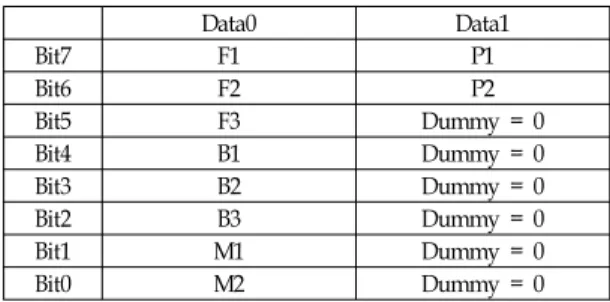
Table 1 and Table 2 show the communication protocol of the proposed system. The controller scans the data of 8 sensors every 10 ms through BLE communication and continuously transmits the current state to the connected PC through serial communication. The PC can turn on the LED light of desired pole through the data communication protocol in the Table 1.
The data frame includes STX (Start of Text) indicating the start of the frame, 10 bytes containing information of each sensor, BCC (Block Check Character) for detecting and
3.3 Reaction Time Measurement
The proposed training system measures the reaction time of player through the flow as shown in Fig 5. The player must be in the center of court to start the proposed motion analysis and training system, and the LED light is randomly on from the one of eight poles and the time measurement is started. When the swing data is received to PC from the corresponding sensor of pole, the time measurement of swing reaction is finished and the LED light is turned off.
In order to increase the efficiency of the Badminton training, the proposed system measures the time taken to return from each pole to the central position and the time taken to return from each zone(top-bottom and left-right zone) to the central position. The time taken for each pole is divided into two parts: the time taken for moving from center to the pole where the LED light is on and swing and the time taken for returning to the center after the LED is turned off. These two times are added together to calculate and stored as the final time taken for each pole. The sections of proposed training system are divided as shown in Figure 6 which are top-bottom and left-right zone, and each pole belongs to two zones. The time for each zone is calculated using the previously mentioned time taken for each pole, and is used as an index to measure the reaction time and agility for the top-bottom and left-right zone.
(Figure 6) The top-bottom and left-right zone of proposed system
4. Badminton Motion Analysis and Training System
4.1 Implementation Result
The proposed badminton motion analysis and training system is designed and implemented to operate in Windows based environment. In order to enhance the convenience of users, WFA (Windows Form Application) based on C# is used for implementation. In addition, we used MySQL to store the measurement result data of the training, and used the OxyPlot Library to show the stored data using Pie, Line, and Bar graphs in C# WFA[15]. Table 3 shows the environment of the proposed system.
(Table 3) The system Environment of Proposed Badminton Motion Analysis and Training System
Operating System Windows 10 Pro
RAM 16 GB
CPU Intel i7-3770K
Language & Library C#, OxyPlot
DBMS MySQL
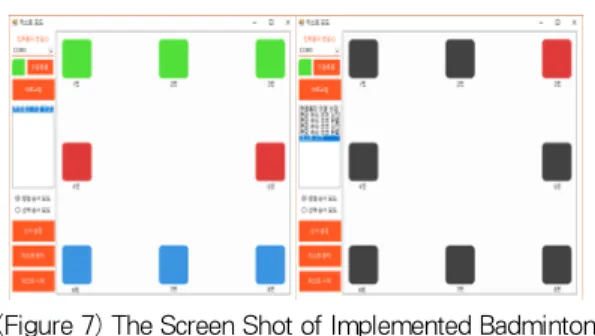
Figures 7 and 8 show the implementation results of the badminton motion analysis and training system designed in this paper. Figure 7 shows the entire UI of training mode and it is designed and implemented to show the current status of serial port and the training progress in one screen.
(Figure 7) The Screen Shot of Implemented Badminton Training Mode
(Figure 8) The Visualization of Measurement Results by Each Pole and Zone
Figure 8 shows the time taken for each column and zone using the bar graph format and is designed and implemented so that a weak section can be grasped at a glance by the length of the bar graph.
4.2 Experimental Environment and Result
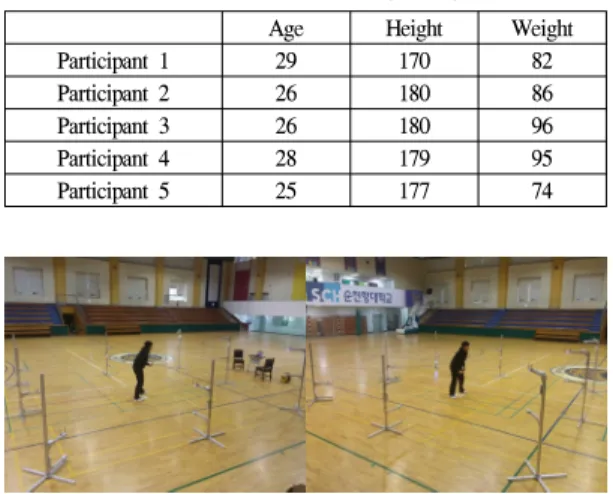
To verify the accuracy of implemented badminton motion analysis and training system, we compared the time taken with the traditional badminton training system(time measurement with stopwatch). The experimental test was carried out for the students of badminton club in physical education in Soonchunhyang University. Table 4 shows the details of participating students in the experiment test. Since
(Figure 9) Training experiment execution environment
(Figure 10) Time Comparison by Proposed Method and by Traditional Method
agility and response rate are highly affected by physical state of participants, the body weight and height were shown in Table 4.
In this experimental test, the measurement was performed and counted as once when the participant visits all of eight senor poles randomly. Five participants measured these experiments 10 times and compared the total time taken for each training. Figure 9 shows the experimental environment of proposed badminton motion analysis and training system.
Figure 10 compares the time taken automatically by the proposed sensor based method and the time taken by the conventional method. The experimental results show that the time taken by the proposed system in this paper is slightly faster than the conventional method.
accuracy by measuring the frames per second(FPS) of the video.
5. Conclusion
In this paper, we design and implement the sensor based badminton motion analysis and training system by applying the traditional agility training procedure. Since the proposed method can provide the objective numerical evaluation and visualization by the sensors which is different from the existing training method, we believe that it can help the users to improve their agility and physical ability improvement.
For the further study, we will add the genetic algorithm to automatically train the weakness areas for each player. In addition, the proposed system will be used to improve the agility of various badminton players, and the results will be measured to investigate whether the agility is improved.
Reference
[1] Young, B. Warren, M. H. Mcdowell, and J. Bentley,
“Specificity of sprint and agility training methods,” The Journal of Strength & Conditioning Research Vol. 15, no.
3, 2001, pp. 315-319.
https://www.ncbi.nlm.nih.gov/pubmed/11710657 [2] Gabbett, Tim, and D. Benton. "Reactive agility of rugby
league players," Journal of Science and Medicine in Sport Vol. 12, no. 1, 2009, pp. 212-214.
http://dx.doi.org/10.1016/j.jsams.2007.08.011
[3] Frederick, Dayang, Omar, Hasan, Kamaruzaman, Izwyn Zulkapri, "BADMINTON: SPECIFIC MOVEMENT AGILITY TESTING SYSTEM," In Movement, Health Exercise (MoHE) Conference, 2014. pp. 10.
[4] Sheppard, M. Jeremy, and B. Warren, "Agility literature review: Classifications, training and testing," Journal of sports sciences Vol. 24, no. 9, 2006, pp. 919-932.
http://dx.doi.org/10.1080/02640410500457109 [5] D. Cabello, J. González-Badillo, "Analysis of the
characteristics of competitive badminton," British journal of sports medicine, Vol. 37, no. 1, 2003, pp. 62-66.
http://dx.doi.org/10.1136/bjsm.37.1.62
[6] M. Bae, D. Cho, "Design and implementation of automatic attendance check system using BLE beacon,"
International Journal of Multimedia and Ubiquitous Engineering Vol. 10, no. 10, 2015, pp. 177-186.
http://dx.doi.org/10.14257/ijmue.2015.10.10.19 [7] N. Newman, "Apple iBeacon technology briefing,"
Journal of Direct, Data and Digital Marketing Practice Vol. 15, no. 3, 2014, pp. 222-225.
http://dx.doi.org/10.1057/dddmp.2014.7
[8] T. Kim, J. Kim, J. Lee, "Design and Implementation of the JAVA Serial Communication Program to Control the Industrial Digital Indicator," Journal of Korea Multimedia Society, Vol. 14, no. 6, 2011, pp.794-801.
http://dx.doi.org/10.9717/kmms.2011.14.6.794 [9] S. Hyun, H. Jeong, S. Choi, “Hybrid Spray and Wait
Routing Protocol in DTN”, Journal of Internet Computing and Services (JICS), Vol. 15, no. 3, 2014, pp. 53-62.
http://dx.doi.org/10.7472/jksii.2014.15.3.53
[10] S. So, M. Park, S. Park, J. Lee, B. Kim, D. Kim, M. Shin, D. Chang, H. Lee, “Delay Tolerant Network Routing
Algorithm based on the Mobility Pattern of Mobile Nodes,” IEEK, Vol. 46, no. 4, 2009, pp.13-28
http://dx.doi.org/10.1007/978-3-642-14891-0_25 [11] Y. Fang, X. Chen, “Design and simulation of UART
serial communication module based on VHDL,”
Intelligent Systems and Applications on IEEE (ISA), 2011, pp. 1-4.
http://dx.doi.org/10.1109/ISA.2011.5873448
[12] H. Hua, B. Feng, “Design and Simulation of UART Serial Communication Module Based on Verilog-HDL,”
Computer and Modernization, Vol. 8, 2008
http://en.cnki.com.cn/Article_en/CJFDTOTAL-JYXH2 00808003.htm
[13] C. Kim, J. Ahn, “Hybrid Delegate-based Group Communication Protocol For Overlapped Groups,”
Journal of Internet Computing and Services (JICS), Vol.
11, no. 4, 2010, pp. 11-22.
http://dx.doi.org/10.1007/978-3-642-16444-6_25 [14] M. Kim, S. Cho, H. Choo, “WSN Data Dissemination
Protocol by N-hop Access Guarantee Backbone,” Journal of Internet Computing and Services (JICS), Vol. 10, no.
1, 2009, pp. 43-50.
http://jksii.or.kr/upload/1/630_1.pdf [15] Oxyplot Library, http://www.oxyplot.org/
Jin-Wook Choi
2016 B.S in Department of Sport Medicine, Soonchunhyang Univ., Asan, Korea
2016~Present: M.S degree in Sprots Medicine, Graduate school of Soonchunhyang Univ., Asan, Korea Research Interests: Exercise Physiology, Sports Medicine
E-mail : [email protected]
Chul-Hyun Kim
1994 B.S in Department of Physical Education, Korea National Sport Univ., Seoul, Korea
2001 M.S in Department of Exercise Physiology and Biochemistry, Korea National Sport Univ., Seoul, Korea 2004 Ph.D in Department of Sport Medicine, Korea National Sport Univ., Seoul, Korea
2013~Present: Professor, Department of Sports Medicine, Soonchunhyang Univ., Korea Research Interests: Exercise Physiology, Sports Medicine, Body composition
E-mail : [email protected]
Ah Young Lee
2006 M.S in Computer Science and Engineering , University of Colorado, U.S.A.
2011 Ph.D in Computer Science and Engineering , University of Colorado, U.S.A.
2016~Present: Assistant Professor, Department of Computer Science University of South Dakota Research Interests: Mobile/Sensor Wireless Networks, Software Defined Networking, Computer Networks E-mail : [email protected]
Min Hong
1995 B.S in Computer Science, Soonchunhyang Univ., Asan, Korea 2001 M.S in Computer Science, University of Colorado at Boulder., U.S.A.
2005 Ph.D in Bio Informatics, University of Colorado at Denver., U.S.A.
2006~Present: Professor, Department of Computer Software Engineering, Soonchunhyang Univ., Korea Research Interests: Computer Graphics, Dynamic Simulation, Bio Informatics, Computer Vision E-mail : [email protected]