• 검색 결과가 없습니다.

Phosphate removal using novel combined Fe-Mn-Si oxide adsorbent

N/A
N/A
Protected

Academic year: 2021

Share "Phosphate removal using novel combined Fe-Mn-Si oxide adsorbent"

Copied!
9
0
0

로드 중.... (전체 텍스트 보기)

전체 글

(1)

1. Introduction

Waste containing phosphate is produced in large quantities in the industrial produc- tion of materials such as fertilizers, deter-

gents, food and drinks and the smelting and refining of various metals. These phosphate byproducts are discharged into municipal and industrial water effluent streams, af- fecting surface-water quality via the well- known process of eutrophication (Galarneau and Gehr, 1997; Karageorgiou et al ., 2007).

Phosphate removal using novel combined Fe-Mn-Si oxide adsorbent

Fe-Mn-Si 산화물을 이용한 인제거 흡착연구
Minsoo Maeng·Haegyun Lee·Seok Dockko *

맹민수·이해균·독고석

*

Dept. of Civil and Environ. Eng., Dankook Univ.

Abstract : The removal of phosphate from surface water is becoming increasingly vital to prevent problems such as eutrophi- cation, particularly near urban areas. Recent requirements to reduce high concentrations of phosphate rely on physicochemical methods and adsorbents that must be effective even under strict conditions. The phosphate removal efficiencies of two adsor- bents, Fe-Mn-Si oxide and Fe-Mn oxide, were investigated and the data used to compare kinetics and isotherm models. The maximum adsorption capacities of the two adsorbents were 47.8 and 35.5 mg-PO

43-

/g, respectively. Adsorptions in both cases were highly pH dependent; i.e., when the pH increased from 3 to 9, the average adsorption capacities of the two adsorbents decreased approximately 32.7 % and 20.3 %, respectively. The Freundlich isotherm model fitted the adsorption of Fe-Mn-Si oxide more closely than did the Langmuir model. Additionally, anionic solutions decreased adsorption because of competition with the anions in the adsorbing phosphate. Although affected by the presence of competing anions or a humic substance, Fe-Mn-Si oxide has better adsorption capacity than Fe-Mn oxide.

요약문 : 국내 하수처리장 인 방류기준이 강화되어 다양한 방법의 인 제거기술이 적용되고 있다. 흡착은 비교적 간단하면서 효과적으 로 인을 제거할 수 있다. 본 연구에서는 흡착제인 Fe-Mn-Si oxide와 Fe-Mn oxide을 개발하여, 인 제거효율을 검토하였으며 이 흡착제 에 대하여 Kinetic과 Isotherm모델을 비교하였다. 두 흡착제의 최대흡착양은 각각 47.8, 35.5 mg-PO

43-

/g이었고, 이들은 낮은 pH에서 효과적으로 흡착하였다. Freundlish isotherm 모델이 Langmuir 모델보다 Fe-Mn-Si oxide의 흡착에 더 적합했다. 이온성 용액은 인이 흡착되는 과정에서 음이온들과 경쟁관계로 흡착능이 감소되었다. 비록 음이온과 humic물질들로부터 흡착에 영향을 받지만 Fe-Mn-Si oxide는 Fe-Mn oxide보다 흡착능이 크게 나타났다.

Key words : adsorbent, Fe-Mn-Si, Freundlich, Langmuir, phosphate, physicochemical 주제어 : 흡착제, Fe-Mn-Si, Freundlich, Langmuir, 인, 물리화학

•Received 26 September 2013, revised 14 October 2013, accepted 15 October 2013.

* Corresponding author: Tel : 041-550-3516 E-mail : [email protected]

(2)

removal of phosphate employing various technologies has been investigated using physical (Clark et al ., 1997; Omoike and Vanloon, 1999), chemical (Ruixia et al ., 2002) and biological (Stensel, 1991) meth- ods. However, chemical precipitation and biological removal have distinct disadvan- tages. Adsorption methods, on the other hand, have long been preferred owing to their low cost, effective treatment of di- lute solutions of phosphates and excellent adsorption capacity (Zhang et al ., 2009).

Beginning in 2012, the maximum discharge limit of total phosphorous in Korea was tightened from 2.0 to 0.2 mg/L. Inefficient conventional treatments cannot achieve this new requirement. However, the adoption of physicochemical processes using adsor- bents will be advocated by environmental engineers and water facility operators be- cause of their low cost and high efficiency.

Different types of low-cost, high-capacity materials have long been used to remove phosphate, such as granulated coal ash (Asaoka and Yamamoto, 2010), red mud (Liu et al ., 2007; Zhao et al ., 2009; Yue et al ., 2010) and lanthanum-doped vesu- vianite (Li et al ., 2009). Researchers have investigated ferric manganese oxide as an adsorbent for phosphate and arsenic re- moval (Zhang et al ., 2007, 2009). Current interest in phosphate adsorbents stems from phosphorus and arsenic both belong- ing to periodic group V and thus possess- ing similar chemical properties (Gao and Mucci, 2003). As a result, a recent pub- lication studying silica-containing iron oxide as an adsorbent for arsenic removal

(Fe) oxide could enhance its phosphate ad- sorption capacity (Zeng, 2003).

This research investigates the phosphate adsorption capacities of Fe-Mn-Si and Fe-Mn oxides and compares their per- formance via data analysis. The purpose of this study is to report the improvement in adsorption performance when inorganic silicon is added to ferric manganese oxide adsorbent.

2. Methods 2.1 Materials

Adsorbents were synthesized using a precipitation method and the chemicals potassium permanganate (KMnO

4

), fer- rous sulfate heptahydrate (FeSO

4

·7H

2

O) and ferric chloride (FeCl

3

) with and with- out added silicon dioxide anhydrous (SiO

2

).

Phosphate solutions were prepared by dis- solving potassium dihydrogen orthophos- phate (KH

2

PO

4

), manufactured by J. T.

Baker (USA); the pH was adjusted using solutions of NaOH and/or HNO

3

(Duksan Chemical).

2.2 Adsorbent preparation

In the laboratory, Si was added to fer-

ric manganese oxide employing a copre-

cipitation process. Ferric chloride (FeCl

3

,

7.31 g) was dissolved in 200 mL of dis-

tilled water. Ferrous sulfate heptahydrate

(FeSO

4

·7H

2

O, 12.51 g) and anhydrous sil-

icon dioxide (SiO

2

, 18 g) were then added

to this solution. Potassium permanganate

(KMnO

4

, 2.37 g) solution was prepared by

dissolving KMnO

4

in 200 mL of distilled

(3)

water. The iron and silicon were added to the potassium permanganate solution dur- ing vigorous stirring and the pH was ad- justed to approximately 4-5 with the ad- dition of 1 M NaOH solution. The solution was then stirred continuously for 1 hour.

The precipitate formed at room temper- ature over the next 4 hours; finally, the precipitate was separated from the liquid portion. The sedimentation-containing li- quor was then dried at 90 ℃ for 12 hours.

The dried adsorbent, having a dark-brown color, was powdered and stored in a desic- cator for later use. Fe-Mn-Si oxide was thus obtained. When anhydrous silicon di- oxide was not added in the process, Fe- Mn binary oxide was produced.

2.3 Solution preparation

Synthetic water was prepared by add- ing Na

2

HPO

4

·7H

2

O to distilled water. To investigate the effect of anions such as Cl

-

and SO

42-

on the process of adsorption, 1 mM sodium chloride (NaCl) solution and 10 mM sodium sulfate (Na

2

SO

4

) solution were prepared.

2.4 Apparatus

Ion chromatography (Metrohm, 881 Compact IC) was employed to determine the phosphate concentration throughout the experiment. A zeta potential analyz- er (Zeta-Meter, USA) was used to mea- sure the electrokinetic characteristics of the adsorbents. The surface morphology and adsorption capacity were measured employing scanning electron microscopy (SEM) and a batch experiment.

2.5 Experimental procedure

2.5.1 Zeta potential and SEM analysis

The zeta potentials of Fe-Mn-Si and Fe-Mn adsorbents were analyzed with a zeta potential analyzer under different pH conditions. The background electrolyte of the solutions was 100 mg/L NaCl to main- tain constant ionic strength. SEM was employed to analyze the Fe-Mn-Si oxide before and after reaction with phosphate solution having a concentration of 35 mg PO

43-

/L for a contact time of 10 min.

2.5.2 Adsorption kinetics and isotherms

Adsorption kinetics experiments were carried out using phosphate solutions with concentrations of 35 mg PO

43-

/L at room temperature (25 ℃±1 ℃). Quantities of 0.2 g of each adsorbent were added to a 1 L beaker and a 10 mL sample was taken at 5, 10, 20 and 30 min and 1, 2, 4, 8 and 24 hrs. All solutions were mixed with a magnetic stirrer at an agitation speed of 140 rpm throughout the reaction. The pH was adjusted to 4.5±1. The samples were then passed through a 0.45 μm filter be- fore analyzing the phosphate residual. In the isotherm experiments, 5, 10, 20, 30, 40, 50, 60, 70, 80 and 90 mg quantities of each adsorbent were placed with phos- phate solutions of 35 mg-PO

43-

/L in 50 mL vials. The vials were shaken for 24 hrs at a speed of 140 rpm.

2.5.3 Effect of pH, coexisting anions and des- orption

The effect of coexisting anions, namely

(4)

ent pH values by adding 1 mM NaCl and 10 mM Na

2

SO

4

, respectively. The contact time was 5 min for each 2 g/L dose of ad- sorbent. In the study of desorption, the absorbents were saturated with 35 mg- PO

43-

/L solution for 24 hrs. The amount of adsorbed phosphate was calculated by measuring the supernatant of the solution.

The saturated adsorbents were filled with 0.001, 0.01 and 0.1 M NaOH, 10 mM NaCl, 10 mM Na

2

SO

4

and 4 mg/L humic acid so- lutions. The solutions were stirred for 30 min at a speed of 140 rpm. Finally, the desorbed amount of phosphate was cal- culated by subtracting the residual phos- phate from the initially adsorbed amount of phosphate.

2.6 Analytical methods

2.6.1 Langmuir and Freundlich isotherm models By applying the experimental data to Langmuir and Freundlich models, it is possible to determine the adsorption ca- pacity of Fe-Mn-Si and Fe-Mn oxides in different concentrations of phosphate so- lution (Gao and Mucci, 2003; Zeng, 2003

; Elzinga and Sparks, 2007). Model equa- tions are given below.

Freundlich model: q

e

= K

F

C

e1/n

(1) Here, q

e

is the amount of phosphate ad- sorbed per gram of adsorbent (mg/g); C

e

is the total phosphate concentration of the solution (mg-PO

43-

/L); the Freundlich constant K

F

reflects the adsorption capac- ity of the adsorbent; and the experimental constant n represents the adsorption ca- pacity of the adsorbent. n is a heteroge-

more heterogeneous surface.

Langmuir model: q

e

= q

m

K

L

C

e

/1 + K

L

C

e

(2) Here, the factors q

e

and C

e

have been previously noted; K

L

is the equilibrium adsorption constant describing the affin- ity of binding sites (L/mg); and q

m

is the maximum amount of the phosphate per unit weight of adsorbent.

2.6.2 Pseudo second-order model

The adsorption rate can be calculated from the duration of the adsorption pro- cess and analyzed using the pseudo sec- ond-order models of adsorption kinetics (Ho, 2006; Lindegren and Persson, 2010).

Pseudo second-order model :

q

t

= k

2

q

e2

t /(1 + k

2

q

e

t ) (3) Here, q

t

is the amount of adsorbate sorbed on the sorbent surface at time t (mg/g); k

1

is the first-order rate constant of sorption (g/mg/min); k

2

is the second-order rate constant of sorption (g/mg/min); q

e

is the amount of adsorbate removed from aque- ous solution at equilibrium (mg/g); and t is the reaction time (min).

3. Results and discussion 3.1 Zeta potential

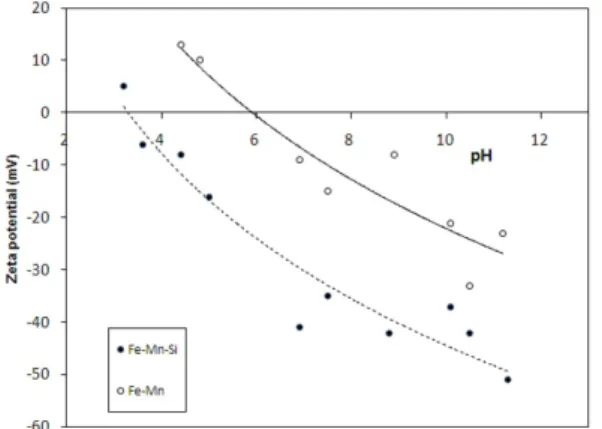
The zeta potentials of Fe-Mn-Si and

Fe-Mn oxides under different pH condi-

tions decreased with increasing pH. As

shown in Fig. 1, the zero point of charges

(pH

zpc

) of Fe-Mn-Si and Fe-Mn were about

3.3±0.2 and 6.0±0.2, respectively. The

negative charge of Fe-Mn-Si adsorbent

(5)

is due to the Si-OH structure (Manning and Goldberg, 1997). Specific adsorption of phosphate as an anion makes the surface of oxides more negatively charged, which shifts the isoelectric point of the adsorbent to a lower pH value (Hsia et al ., 1994).

3.2 Adsorption kinetics

The kinetics of adsorption using equa- tions (1), (2), (3) were determined from the contact time of the adsorption process for different initial phosphate concentrations.

Results of the pseudo second-order model fit are shown in Fig. 2 together with the experiment kinetics results.

The initial phosphate concentrations were 35 mg/L and the initial pH value of the solution was 4.5. In the first 2 hrs, 70 % of the equilibrium adsorption capac- ity was achieved in the case of Fe-Mn-Si oxide. The adsorption capacity of Fe-Mn-

Si oxide was higher than that of Fe-Mn oxide. To calculate the rate of adsorption analytically, pseudo second-order models were employed using experimental data of phosphate adsorption (Ho, 2006). The pseudo second-order model fit the experi- mental data well with a high correlation coefficient of 0.935-0.998. All parameter values used in developing the pseudo sec- ond-order models are listed in Table 1.

3.3 Adsorption isotherm

The adsorption isotherms considering the effects of the equilibrium concentra- tion on the adsorption capacity are shown in Fig. 3. Data were analyzed using Freun- dlich and Langmuir isotherm models. The results and parameters of these models are given in Table 1. The Freundlich model fits the experimental data of the Fe-Mn-Si and Fe-Mn oxides well with relatively high

Table 1. Parameters of pseudo second-order, Freundlich and Langmuir models for the adsorption of phosphate Fig. 1. Zeta potentials of Fe-Mn-Si and Fe-Mn oxides.

Fig. 2. Pseudo second-order model fits of experiment kinetics data for Fe-Mn-Si and Fe-Mn oxide adsorbents.

Oxide type Pseudo second-order model Freundlich model Langmuir model q

e

(mg/g) k

2

(g/mg/min) R

2

1/n K

F

(L/mg) R

2

q

m

(mg/g) K

L

(L/mg) R

2

Fe-Mn-Si 35.9 0.000652 0.998 0.266 21.860 0.949 47.849 0.791 0.929

Fe-Mn 29.7 0.000196 0.935 0.246 17.855 0.977 35.460 0.949 0.825

(6)

correlation coefficients ( R

2

) of 0.949 and 0.977, respectively. The maximum capac- ity of this adsorbent was 47.8 mg-PO

43-

/L, which was derived from the Langmuir model. The Freundlich model can be well applied to solids with heterogeneous sur- face properties. On the other hand, the fit of Fe-Mn adsorption had a poor correla- tion value ( R

2

= 0.825). Previous research has shown that the maximum adsorption capacity of Fe-Mn oxide is 33.2 mg-PO

43-

/L at a pH of 5.6±1 (Zhang et al ., 2009).

Consequently, Fe-Mn-Si has greater ad- sorption capacity than Fe-Mn oxide.

3.4 Effects of pH and coexisting anions on ad- sorption

on the two adsorbents are shown in Fig.

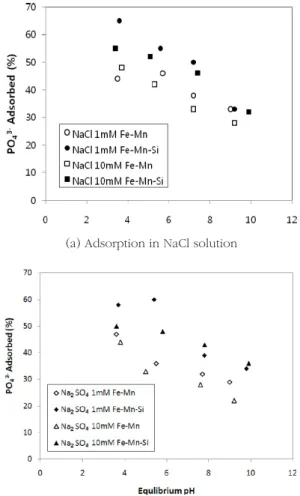
4. It is clear that when the solution pH increases, the phosphate adsorption by both adsorbents decreases. Similarly, both Fe-Mn-Si and Fe-Mn oxides have great- er adsorption capacity at low pH than at high pH. The explanation is that at high pH, the adsorbent surface becomes more negatively charged, increasing the repul- sion between the phosphate cation and the adsorbent surface (Lindegren and Persson, 2010). Moreover, the ionic solution con- centration also affects adsorption.

Fig. 3. Isotherms of phosphate adsorption by Fe-Mn-Si and Fe- Mn oxides.

(a) Adsorption in NaCl solution

(b) Adsorption in Na

2

SO

4

solution

Fig. 4. Effects of pH and coexisting anions on the adsorption of

Fe-Mn-Si and Fe-Mn oxides.

(7)

Adsorption decreased slightly at a high concentration of coexisting anions, but it increased at low concentrations. The co- existing anions exerted less influence on the adsorption on Fe-Mn-Si oxide, allow- ing greater adsorption than was observed for Fe-Mn oxide. It is clear that a change in ionic strength from 1 to 10 mM played a role in decreasing the adsorption of phos- phate. However, the valence of anions had little effect on the adsorption. This agrees with the finding that the phosphate ions strongly adsorbed at specific sites are rarely exchangeable even in a solution with a large excess of coexisting ions (Zhang et al ., 2009). In inner-sphere complexes of adsorbent, the surface hydroxyl groups act as σ-donor ligands, which increase the electron density of the coordinated met- al ion (Stumm, 1992). The adsorption of these anions was suppressed with weakly adsorbing anions such as Cl

-

and SO

42-

, as these electrolytes also formed outer- sphere complexes through electrostatic forces. These anions that were adsorbed by the inner-sphere association either showed little sensitivity to ionic strength or responded to higher ionic strength with greater adsorption. The binding of a metal ion by surface ligands is strongly pH-de- pendent as shown in Fig. 4.

3.5 Desorption

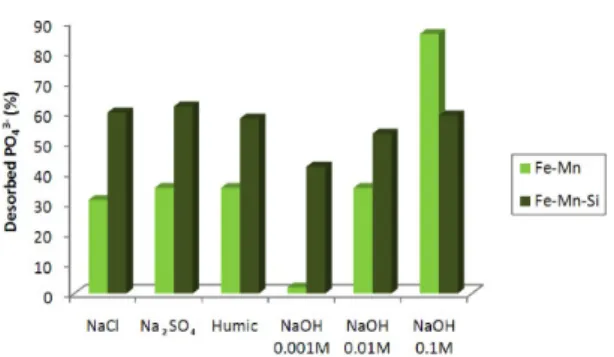
Desorption was carried out using three different concentrations of alkaline solu- tions, two different anions and an organic substance. The percentage of desorbed phosphate is shown in Fig. 5. With the

addition of NaOH, alkaline solution con- centrations of 0.001, 0.01 and 0.1 M were created. The Fe-Mn-Si oxide and Fe-Mn oxide were then added to these three alka- line solutions. It is clear that the amount of phosphate desorption increased with an increase in alkalinity. The amount of phosphate desorbed by the Fe-Mn-Si ox- ide and Fe-Mn oxide was found to increase from 42 % to 59 % and from 2 % to 86 % as the solution concentrations increased from 0.001 to 0.1 M, respectively. The effect of the alkaline solutions on the desorption process was relatively weak for Fe-Mn-Si oxide but strong for Fe-Mn oxide. Fur- thermore, when adding the adsorbents to phosphates in the presence of the mono/

divalent anions and organic substance, the desorption of phosphate approached that achieved in alkaline solutions. These re- sults show that the phosphate-loaded Fe- Mn oxide can be more easily desorbed than Fe-Mn-Si oxide in NaOH solution. This means that Fe-Mn oxide has the potential to be used as a regenerated adsorbent for phosphate removal.

Fig. 5. Desorption performance after adsorption of phosphate

by Fe-Mn-Si and Fe-Mn oxide adsorbents depending on

the concentration of alkaline solution, anions and addi-

tion of an organic substance.

(8)

tained by SEM is shown in Fig. 6(a, b). The figure illustrates the difference in mor- phology between these two adsorbents be- fore and after phosphate adsorption. The image of the Fe

-

Mn-Si adsorbent shows that the adsorbent consisted of many small particles having porous structures and rough surfaces. After phosphate adsorp- tion, the morphology was not significantly different.

4. Conclusion

In a comparative study of two new ad- sorbents, the addition of inorganic silicon to Fe-Mn oxide was shown to improve adsorption performance. The adsorption of both adsorbents was affected directly by pH: the adsorption capacity increased at low pH but decreased at high pH. In- vestigation revealed that a change in ionic strength from 1 to 10 mM decreased the adsorption of phosphate. However, the valence of anions had little effect on the adsorption. The isotherm of the Freundlich model predicted the adsorption of Fe- Mn-Si better than the Langmuir model. A pseudo second-order model is suitable for analyzing the adsorption kinetics. Anionic solutions and a humic substance decreased adsorption through competition between

the adsorption of phosphate. Although af- fected by the presence of competing an- ions or a humic substance, Fe-Mn-Si oxide has better adsorption capacity than Fe-Mn oxide.

Acknowledgements

This research was supported through the National Research Foundation of Korea (NRF) funded by the Ministry of Educa- tion, Science and Technology (013-2011- 1-D00071) and partly funded by a grant from the Eco-Innovation (Gbest) Project.

References

Asaoka S. and Yamamoto T. (2010). Characteris- tic of phosphorus adsorption onto granu- lated coal ash in seawater. Marine Pollu- tion Bulletin, 60(8), 1188-1192.

Clark T ., Stephenson T. and Pearse P. A. (1997).

Phosphorus removal by chemical precipi- tation in biological aerated filter. Water Research, 31, 2557-2563.

Elzinga E. J. and Sparks D. L. (2007). Phosphorus adsorption onto hematite: an in situ ATR- FTIR investigation of effects of pH and loading level on the mode of phosphorus surface complexation. Journal of Colloid and Interface Science, 308, 53-70.

Galarn eau E. and Gehr R. (1997). Phosphorus re- moval from wastewaters: experimental and theoretical support for alternative mecha- nisms. Water Research, 31, 328-338.

Gao Y. and Mucci A. (2003). Individual and com- petitive adsorption of phosphorus and ar- senate on goethite in artificial seawater.

Chemical Geology, 199, 91-109.

Ho Y. S. (2006). Review of second-order models for adsorption system. Journal of Hazard- ous Materials, 136, 681-689.

Karage orgiou K., Paschalis M. and Anastassakis G. N. (2007). Removal of phosphorus spe- Fig. 6. SEM morphology of Fe-Mn-Si oxide (a) before and (b)

after phosphate adsorption.

(9)

cies from solution by adsorption onto cal- cite used as natural adsorbent. Journal of Hazardous Materials, 39, 447-452.

Li H., Ru J., Yin W., Liu X., Wang J. and Zhang W. (2009). Removal of phosphorus from polluted water by lanthanum doped vesu- vianite. Journal of Hazardous Materials, 168, 326-330.

Lindeg ren M. and Persson P. (2010). Competitive adsorption involving phosphorus and ben- zenecarboxylic acids on goethite - effect of molecular structures. Journal of Colloid and Interface Science, 343, 263-270.

Liu C. J., Li Y. Z., Luan Z. K., Chen Z. Y., Zhang Z. G. and Jia Z. P. (2007). Adsorption re- moval of phosphorus from aqueous solu- tion by active red mud. Journal of Envi- ronmental Science, 19, 1166-1170.

Omoik e A. I. and Vanloon G. W. (1999). Removal of phosphorus and organic matter remov- al by alum during wastewater treatment.

Water Research, 33, 3617-3627.

Ruixia L., Jinlong G. and Hongxiao T. J. (2002).

Adsorption of fluoride, phosphate, and ar- senate ions on a new type of ion exchange fiber. Journal of Colloid and Interface Sci- ence, 248, 268-274.

Yue Q. , Zhao Y., Li Q., Li W., Gao B., Han S., Qi Y. and Yu H. (2010). Research on the char- acteristics of red mud granular adsorbents (RMGA) for phosphorus removal. Journal of Hazardous Materials, 176, 741-748.

Zeng L . (2003). A method for preparing silica- containing iron (III) oxide adsorbents for arsenic removal. Water Research, 37, 4351-4358.

Zhang G., Qu J., Liu H., Liu R. and Wu R. (2007).

Preparation and evaluation of a novel Fe/

Mn binary oxide adsorbent for effective arsenite removal. Water Research, 41, 1921-1928.

Zhang G., Liu H., Liu R. and Qu J. (2009). Re- moval of phosphorus from water by a Fe/

Mn binary oxide adsorbent. Journal of Col- loid and Interface Science, 335, 168-174.

Zhao Y ., Wang J., Luan Z., Peng X., Liang Z.

and Shi L. (2009). Removal of phospho-

rus from aqueous solution by red mud us-

ing factorial design. Journal of Hazardous

Materials, 165, 1193-1199.

수치

Fig. 2.  Pseudo second-order model fits of experiment kinetics  data for Fe-Mn-Si and Fe-Mn oxide adsorbents.
Fig. 4.  Effects of pH and coexisting anions on the adsorption of  Fe-Mn-Si and Fe-Mn oxides.
Fig. 5.  Desorption  performance  after  adsorption  of  phosphate  by Fe-Mn-Si and Fe-Mn oxide adsorbents depending on  the concentration of alkaline solution, anions and  addi-tion of an organic substance.

참조

관련 문서