321
인도네시아 서부자바 땅긍(Tanggueng)지역 열수광상의 지질, 유체포유물 및 황동위원소 연구
이재호*·김인준 한국지질자원연구원
인도네시아 반둥시(Bandung)의 남서부에 위치하는 땅긍(Tanggueng)지역의 금 및 비철금속(base-metal)의 광화작용은 Jampang Formation(올리고신-마이오신)의 결정질 및 암편질 응회암의 열극을 충진한 천열수성 맥상광체로 Celak, Cilangkap, Cigodobras 및 Pasirbedil 등의 주요 4개 석영맥으로 구성된다. 주요 광석광물로는 황철석, 황동석, 섬아연석, 방연석 및 반동 석 등이 산출된다. 광화작용과 관련된 열수변질작용은 규화작용이 지배적이며, 견운모화(phyllic), 점토화(argillic) 및 산점상 의 황철석을 포함하는 프로필리틱화작용(propylitic)이 관찰된다. 관찰되는 맥석광물은 스멕타이트-일라이트의 혼합층광물, 녹 니석, 견운모 및 카올리나이트 등이다. 광석광물의 침전은 0.0~8.3 wt. %의 상당염농도를 갖는 광화유체로부터 약 340oC에 서 약 190oC에 걸쳐 진행되었다. 상대적인 고염농도의 유체는 (1) 기상 유체포유물의 존재로부터 확인된 비등현상과 (2) 황 동위원소연구 결과로부터 열수 유체내 마그마 유체의 혼합으로 기인된 것으로 사료된다. 광화작용시의 압력은 약 120~200 bar 로 추정되며, 이는 열수계가 정암압에서 정수압 환경으로 전이되었음을 지시하여 주고 광화심도가 약 750~1,200 m에 해당 됨을 나타낸다. 유체포유물의 균질화온도와 공생관계로부터 추정된 온도를 적용하여 계산된 열수 유체내 H2S의 δ34S값은 - 0.2~1.8‰로서, 이는 광화유체내 황의 기원이 마그마임을 지시한다.
주요어 : 천열수 광상, 변질작용, 광화작용, 유체포유물, 황동위원소
The epithermal gold and base metal deposit of the Tanggeung district of West Java consists of four major veins(Celak, Cigodobras, Cilangkap and Pasirbedil) with NS to N10o~20oE and N75oW strikes. The veins occur within fractures cutting the crystal and lithic tuff of Jampang Formation(Oligo-Miocene) in and around the Mt. Subang of the western Java, Indo- nesia. The ore mineralization is characterized by the occurrence of pyrite, sphalerite, galena, chalcopyrite, and small amounts of bornite and Fe-oxides. Hydrothermal alteration, associated with the mineralization, was dominantly silicified and envel- oped by the phyllitic(sericitic), argillic and propylitic alteration containing the disseminated pyrite. Gangue minerals consist of interstratified smectite-illite, chlorite, sericite, and minor kaolinite. The presence of vapor-rich fluid inclusions in quartz veins suggests that boiling occurred locally throughout ore deposition. Fluid inclusion studies suggest that the ore fluid evolved from initial high temperatures(≈340oC) to later lower temperatures(≈190oC). Salinities range from 0.0 to 8.3 wt per- cent NaCl equiv. The relatively high increase in salinity(up to 8.3 wt percent NaCl equiv) might be explained by a local boil- ing and by a participation of magmatic fluids, supported by the sulfur isotope results. Evidence of fluid boiling suggests that the pressure decreased from 200 bars to 120bars. This corresponds to the depths of approximately 750 to 1,2 00m in a hydro- thermal system that changed from lithostatic to hydrostatic conditions. Using homogenization temperatures and paragenetic constraints, the calculated δ34S values of H2S in ore fluid are -0.2 to 1.8permil close to the 0permil isotopic value of mag- matic sulfur.
Key words : Epithermal deposit, alteration, mineralization, fluid inclusion, sulfur isotope
*Corresponding author: [email protected]
322 Jae-Ho Lee and In-Joon Kim
1. INTRODUCTION
The primary gold mining began in Indonesia in 1899. Almost all of the total gold production came from epithermal gold deposits hosted by volcanics.
The appropriate geological setting of the Indo- nesian island arcs which is situated at the con- vergence of three lithospheric plates and is largely covered by Tertiary volcanic rocks, is one of the most promising areas for epithermal gold deposits (Sunarya, 1989).
The tectonic framework of Indonesia is com- plicated due to the interaction of the Eurasian, the Indian-Australian, and the Pacific plates. The plate tectonic theory has been largely applied in mineral exploration following the postulations put forward among others by Katili(1974). The convergent plate boundaries along continental margins and island arc are potential for epithermal gold dep- osition.
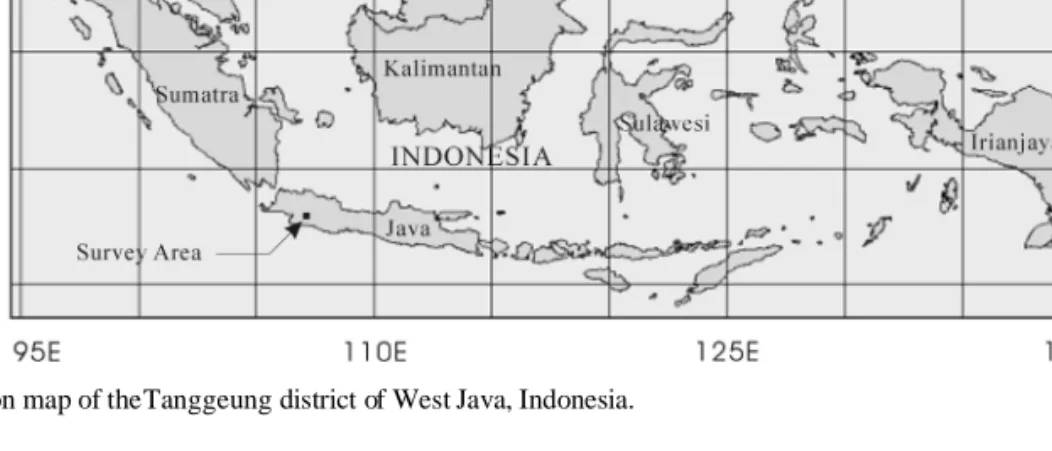
Gold- and base metal-bearing quartz veins have been found recently in the Tanggeung district of West Java, Indonesia(Fig. 1 and 2). Exploration have undertaken by the Directorate of Mineral Resources Inventory(DMRI) in cooperation with PT Aneka Tambang under the assistance of France. Based on the modern epithermal concept, the exploration target areas were gold in the unex- plored volcanic terrains.
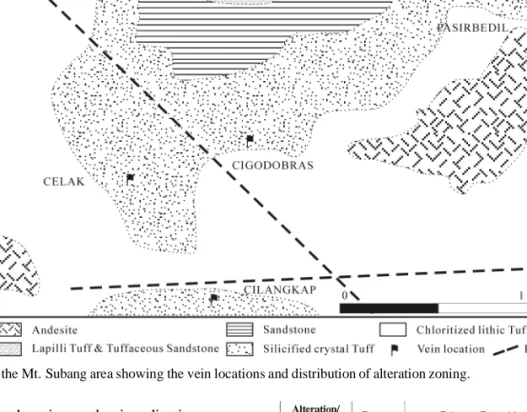
Most of the hydrothermal veins in the district occur mainly in southern margin of Mt. Subang : Celak, Cigodobras, Cilangkap and Pasirbedil. The hydrothermal veins are primarily gold deposit, but they are also associated with base-metal miner-
alization. The veins occur within the crystal and lithic tuff of Jampang Formation(Oligo-Miocene).
The purpose of this paper is to elucidate the nature of the vein mineralization in and around Mt.
Subang. Thus, fluid inclusion and stable isotope studies of vein minerals were undertaken to deter- mine the nature, pressure and temperature condi- tions, and the source of sulfur in the hydrothermal fluids.
2. GEOLOGY
The geology of Indonesia is characterized by many factors such as subduction zone complexes, magmatic arc rocks associated with plate tectonics, the arc granite and volcanic rocks, and the related metamorphic rocks. The environments of sediment deposition have also varied from continental to abyssal deposits. Volcanism of Indonesia is a major phenomenon accompanying the structural evolu- tion of the earth's crust. A number of orogenic belts can be distinguished ranging in ages from Pale- ozoic to Recent, each of which is accompanied by intrusions and extrusions of igneous rocks of var- ious ages. The igneous rocks can be classified into as follows; pre-orogenic igneous rock of Atlantic character, geo-synclinal ophiolites, geo-anticlinal Pacific rocks, late orogenic varieties of Mediter- ranean character, and post-orogenic olivine-basaltic extrusions(Hamilton, 1979).
The geology of the Tanggeung district comprises Cenozoic sedimentary rocks such as tuffaceous sandstone, mudstone, volcanic breccia, pyroclastic rocks, andesite and Quaternary talus deposit(Fig. 2).
Fig. 1. Location map of the Tanggeung district of West Java, Indonesia.
Sandstone Formation has a well-developed bed- ding plane, and predominantly composed of un- consolidated tuffaceous sandstone, mudstone, cal- careous mudstone, conglomerate with subordi- nary crystal tuff, pumiceous tuff. Tuff Formation is distributed in the northern, eastern areas and near Ankola village. The Formation is composed of unconsolidated, well bedded tuff or crystal tuff with intercalated pumiceous breccia and breccia, sandstone. Volcanic breccia is characterized by andesitic breccia, tuffaceous breccia, lapilli tuff intercalated with sandstone and mudstone. The Formation is distributed in the northeastern part of Pasirangin, the eastern and western parts of Tanggeung and nearby Ankola village. Andesite is widely distributed in the district with a small intrusive. Andesites are divided into three major
mode of occurrence in the district; boulder type andesite with onion structure in soil, massive type andesite and andesite with well-developed sheet- ing structure. Andesite contains phenocrysts of randomly oriented orthopyroxene, clinopyroxene and plagioclase and matrix of mainly plagioclase.
According to geochemical classification, it be- longs to basaltic andesite and andesite. The ore mineralization in the district is likely to be asso- ciated with andesite(Kim et al., 2002).
The geology of the study area comprises the crys- tal and lithic tuff of the Jampang Formation(Oligo- Miocene), sandstone of the Cimandiri Forma- tion(Miocene), lapilli tuff and tuffaceous sandstone of the Lower Bentang Formation(Pliocene), and younger andesite(Fig. 3). In the study area, two E- W and NNW-trending faults seem to have cut and Fig. 2. Generalized geological map of the Tanggeung district of West Java, Indonesia.
324 Jae-Ho Lee and In-Joon Kim
displaced the alteration and mineralization zones.
3. HYDROTHERMAL MINERALIZATION AND ALTERATION
Gold- and base metal-bearing quartz veins occur mainly in southern margin of Mt. Subang : Celak, Cigodobras, Cilangkap and Pasirbedil(Fig. 3). The hydrothermal veins fill the fault-related fractures in the crystal and lithic tuff of Jampang Formation (Oligo-Miocene). The veins strike NS to N10o~20o E and N75oW, and dip steeply and vary in width from 0.1 to 3.0 m. The quartz veins show the same textural varieties(massive, brecciated, crustiform, colloform, comb and open vuggy) and paragenetic mineral assemblages. The quartz textures in veins may reflect evidence about mineralization pro- cesses in epithermal systems(Bobis et al., 1995;
Dong et al., 1995; Fig. 6).
Quartz veins were analyzed using an Atomic Absorption Spectrometer, and the estimated ore grades are; 40 to 14,000 ppb Au, 1 to 2,000 ppm Ag, 20 to 1,900 ppm Cu, 7 to 40,000 ppm Pb, and 10 to 5,500 ppm Zn. The contents of gold in Celak and Cigodobras veins show higher grades than the other ones.
The veins contain dominantly pyrite, chalcopy- rite, sphalerite, galena, and minor bornite(Fig. 4 and 5). Pyrite, one of the dominant sulfides, is ubiquitous as fine to coarse crystalline aggregates.
It occurs mainly as subhedral to euhedral dis- seminated grains and locally is concentrated in massive veinlets(up to 2 mm) near vein margins.
Fig. 3. Map of the Mt. Subang area showing the vein locations and distribution of alteration zoning.
Fig. 4. Generalized paragenetic sequence of alteration and ore minerals.
Fine euhedral grains common disseminated in the host rocks. Highly brecciated fragments of pyrite are commonly cemented by chalcopyrite and galena. Chalcopyrite, the most dominant copper mineral in the veins, mainly occurs as masses with an irregular outline and as medium to fine-grained disseminates. It also occurs as anhedral grains intergrown with pyrite and sphalerite. Sphalerite usually occurs as anhedral masses throughout the veins and is closely intergrown with chalcopyrite and galena. Bornite occurs mostly as intermediate alteration phase of chalcopyrite. It may represent impurities within original chalcopyrite.
The presence of gold is detected just by an Atomic Absorption Spectrometer.
Goethite and covellite occur as alteration pro- duct. Goethite replaced mainly hematite and galena.
Covellite mainly replaced along grain margins of chalcopyrite.
The hydrothermal alteration in the study area is characterized by a silica zone generally enveloped by a clay-pyrite halo. The clay minerals detected include smectite-illite, chlorite, sericite, and minor kaolinite. Quartz veins are associated with the silicified, phyllic(sericitic) and the argillic over-
printing propylitic rock. Based on the alteration patterns, quartz textures and mineral association (quartz-sericite-sulfides), it is believed that the sys- tem of mineralization is probably a low-sulphi- dation epithermal type. Although alunite is found in some of the area, it appears to be a near-surface supergene occurrence, unrelated to the primary hydrothermal system.
4. FLUID INCLUSIONS
Roedder(1984) suggested criteria for distin- guishing between the three origins of inclusions (primary, secondary, and pseudo-secondary inclu- sions). We have focused our studies on the primary fluid inclusions which are large enough to observe under an ordinary petrographic microscope.
The measurements are from primary inclusions (5-60µm, mainly 5-15µm), which exhibit an oval to rectangular plan shape or lie along growth zones (Fig. 6). The dominant inclusion type is two-phase (liquid plus vapor), with vapor bubbles occupying 20 to 30 vol. percent of the inclusions. A few sam- ples also contain vapor-rich inclusions(>60 vol.
percent). No traces of gas hydrates were observed Fig. 5. Photomicrographs of ore minerals showing the paragenetic sequence. (A) Disseminated euhedral pyrite(PY) in matrix of quartz. (B) Sphalerite(SP) exsolved with chalcopyrite(CP) is intergrown with pyrite. (C) Early pyrite grains replaced and cemented by chalcopyrite, and supergene covellite(CV). (D) Chalcopyrite coexisting with bornite(BN) and galena(GN). Bar scale equals 0.1mm.
326 Jae-Ho Lee and In-Joon Kim
during the freezing of inclusions, indicating that CO2 concentrations are below that required to form clathrates(≤0.85 molal; Hedenquist and Henley, 1985). No daughter minerals were observed. The primary inclusions are mainly irregular to rectan- gular or negative crystal shaped in form. Small inclusions gave more consistent homogenization temperatures than large and irregular-shaped inclu- sions, as commonly observed for fluid inclusions in epithermal quartz by Bodnar et al.(1985).
Microthermometric measurements were performed on a FLUID Inc. gas-flow heating-freezing system.
The temperature uncertainty in the range of homog- enization temperatures(Th) is ±1.0oC whereas at the
melting point of ice(Tm) the uncertainty is±0.2oC.
Analytical studies with the heating-freezing stage were carried out on quartz-hosted fluid inclusions from vein samples. Th and Tm values were determined for fluid inclusions >5µm in size from polished sec- tions.
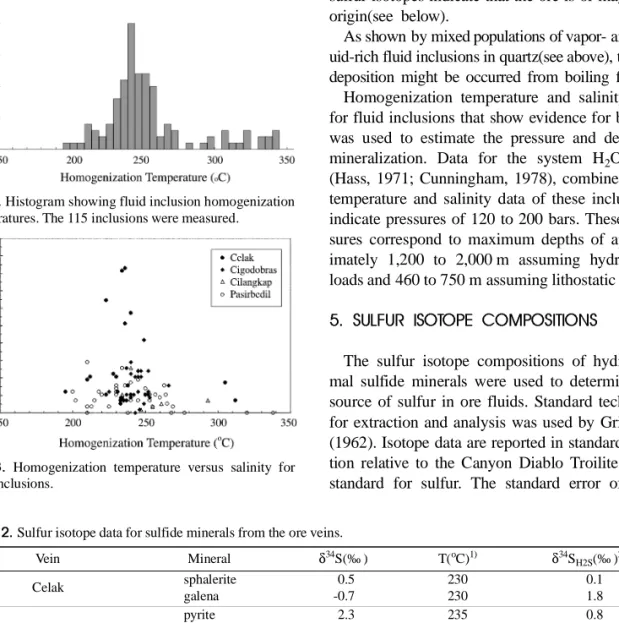
The homogenization temperatures(Th) of fluid inclusions for the mineralization are shown as the integrated histogram: Celak, 195o to 305oC; Cigodo- bras, 225o to 316oC; Cilangkap, 224o to 293oC;
Pasirbedil, 200o to 338oC(Table 1 and Fig. 7). There is no distinct differences in Th among these veins.
Base-metal and gold mineralization most likely occurred at≈240oC.
Fig. 6. Photomicrographs showing mineralogical and fluid inclusion textures in quartz. (A) Colloform texture quartz showing growth zone defined dark band. (B) Euhedral quartz crystal showing growth zone defined dark band. (C) Comb texture quartz with primary fluid inclusions. (D) Enlargement of portion of (C) showing variable liquid to vapor ratios. Bar scale equals 0.1 mm.
Table 1. Microthermometric results from fluid inclusions.
Vein
Heating results Freezing results
N*
Homogenization temperature intervals(oC)
Mean homogenization temperature(oC)
N
Salinity intervals (wt % NaCl equiv)
Mean salinities (wt % NaCl equiv) Celak
Cigodobras Cilangkap Pasirbedil
26 31 16 42
195-305 225-316 224-293 200-338
236 244 240 243
18 31 6 42
0.70-8.28 0.00-4.18 0.18-2.57 0.00-2.57
2.88 1.41 0.90 0.91
*N=number of measurements
boiling). (2) The second explanation is since the sulfur isotopes indicate that the ore is of magmatic origin(see below).
As shown by mixed populations of vapor- and liq- uid-rich fluid inclusions in quartz(see above), the ore deposition might be occurred from boiling fluids.
Homogenization temperature and salinity data for fluid inclusions that show evidence for boiling was used to estimate the pressure and depth of mineralization. Data for the system H2O-NaCl (Hass, 1971; Cunningham, 1978), combined with temperature and salinity data of these inclusions, indicate pressures of 120 to 200 bars. These pres- sures correspond to maximum depths of approx- imately 1,200 to 2,000 m assuming hydrostatic loads and 460 to 750 m assuming lithostatic loads.
5. SULFUR ISOTOPE COMPOSITIONS
The sulfur isotope compositions of hydrother- mal sulfide minerals were used to determine the source of sulfur in ore fluids. Standard technique for extraction and analysis was used by Grinenko (1962). Isotope data are reported in standard nota- tion relative to the Canyon Diablo Troilite(CDT) standard for sulfur. The standard error of each Fig. 7. Histogram showing fluid inclusion homogenization
temperatures. The 115 inclusions were measured.
Table 2. Sulfur isotope data for sulfide minerals from the ore veins.
Vein Mineral δ34S(‰ ) T(oC)1) δ34SH2S(‰ )2)
Celak sphalerite
galena
0.5 -0.7
230 230
0.1 1.8
Cilangkap
pyrite pyrite sphalerite
2.3 3.1 1.8
235 210 210
0.8 1.4 1.4
Cigodobras pyrite 1.3 245 -0.2
1)Based on fluid inclusion temperatures and paragenetic constraints.
2)Calculated using the sulfur isotope fractionation equations in Ohmoto and Rye (1979).
Fig. 8. Homogenization temperature versus salinity for fluid inclusions.
328 Jae-Ho Lee and In-Joon Kim
analysis is approximately ±0.2 ‰ for S.
Sulfur isotope analyses were performed on six sul- fides from the Celak, Cigodobras and Cilangkap veins. Sulfur isotope compositions in pyrite, sphaler- ite and galena have a narrow range of values between -0.7 to 3.1 permil(Table 2).
Assuming the temperatures based on fluid inclu- sions and paragenetic constraints, the δ34S values of aqueous H2S were calculated using the frac- tionation factors of Ohmoto and Rye(1979). The δ34SH2S values range from -0.2 to 1.8 permil, which is very close to the 0 permil isotopic value of magmatic sulfur. The magmatic origin of the sulfur might result either from a direct contribution from magmatic volatiles or from leaching of mag- matic sulfides from volcanic rocks or sedimentary rocks derived from a volcanic sources.
6. CONCLUSION
The hydrothermal vein deposit comprises four major veins and occurs in the fracture within the crystal and lithic tuff of Jampang Formation(Oligo- Miocene). The wall-rock alteration associated with the ore mineralization is characterized by a silica zone generally enveloped by a clay(smectite-illite, chlorite, sericite, and minor kaolinite)-pyrite halo.
Fluid inclusion evidence suggests that the ore mineralization most likely occurred at ≈240oC from the fluid with salinity of <8. 3wt percent NaCl equiv. Fluid inclusions with evidence of boiling indicate that the ore mineralization occurred at the depths of approximately 750 to 1,200 m under the pressure conditions changed from lithostatic to hydrostatic regimes.
The high increase in fluid inclusion salinities(up to 8. 3wt percent NaCl equiv) and the sulfur isotope results(δ34SH2S= -0.2 to 1.8 permil) could be caused by a local boiling and by a contribution of exsolved magmatic fluids to the hydrothermal fluids.
ACKNOWLEDGMENT
This study was supported by the project “Geo- logical Survey of the Southern part of the Band- ung, Indonesia” of MOCIE.
REFERENCES
Bobis, R.E., Jaireth, S. and Morrison, G.W. (1995) The anat- omy of a Carboniferous epithermal ore shoot at Pajingo, Queensland: Setting, zoning, alteration, and fluid con- ditions. Economic Geology, v. 90, p. 1776-1798.
Bodnar, R.J., Burnham, C.W. and Sterner, S.M. (1985) Syn- thetic fluid inclusions in natural quartz: III. Determi- nation of phase equilibrium properties in the system H2O-NaCl to 1000 and 1500 bars. Geochimica et Cos- mochimica Acta, v. 49, p. 1861-1873.
Cunningham, C.G. (1978) Pressure gradients and boiling as mechanisms for localizing ore in porphyry systems. U.
S. Geol. Survey J. Research, v. 6, p. 745-754.
Dong, G., Morrison, G.W. and Jaireth, S. (1995) Quartz tex- tures in epithermal veins, Queensland-classification, ori- gin, and implication. Economic Geology, v. 90, p. 1841- 1856.
Grinenko, V.A. (1962) Preparation of sulfur dioxide for iso- topic analysis. Zeitschrift Neorganosche Khimii, v. 7, p.
2478-2483.
Haas, F.M. (1971) Determination of fluid inclusion com- positions by sequential freezing. Economic Geology, v.
80, p. 1436-1439.
Hamilton, W. (1979) Tectonics of the Indonesian region.
USGS Prof. Paper 1078, p. 345.
Hedenquist, J.W. and Henley, R.W. (1985) The importance of CO2 on freezing point measurements of fluid inclu- sions: Evidence from active geothermal and implica- tions for epithermal ore deposition. Economic geology, v. 80, p. 1370-1406.
Katili, J.A. (1974) Geological Environment of The Indo- nesian Mineral Deposits. A Plate Tectonic Approach, Publikasi Teknik-Seri Geologi Ekonomi no. 7, Geolog- ical Survey of Indonesia.
Kim, I.J., Seo, J.R. Hong, S.S. Lee, J.H. Lee, S.R. Kim, B.C. Kee, W.S. and Song, K.Y. (2002) Geological Sur- vey of the Southern Part of the Bandung, Indonesia.
KR-02(C)-07, p. 1-166.
Ohmoto, H. and Rye, R.O. (1979) Isotopes of sulfur and carbon. In Barnes, H.L. (ed.) Geochemistry of hydro- thermal ore deposits. New York, Wiley Intersci., p. 687- 737.
Roedder, E. (1984) Fluid Inclusions. Review in Mineralogy, v. 12, 644p.
Simmons, S.F. (1989) Evolution of brines of magmatic (?) and meteoric origin in arc-related geothermal systems:
Examples from the Fresnillo Ag-Pb-Zn district, Mexico and Broadlands, New Zealand. IAVCEI continental magmatism: New Mexico Bureau of Mines and Mineral Resources Bulletin, v. 131, p. 243.
Sunarya, Y. (1989) Overview of gold exploration and exploi- tation in Indonesia. Indonesian Association of Geology Journal, v. 12, p. 345-357.
2003년 6월 27일 원고접수, 2003년 8월 19일 게재승인.