OFDM 기반 무선 센서 망에서 에너지 제한을 고려한 복잡도 낮은 비트 할당 알고리즘
정회원 오 승 열*, 고 현 목*, 권 순 목*, 종신회원 김 치 하*
Low Complexity Bit Loading Algorithm with Power-constraint for OFDM-based Wireless Sensor Communication
Seoungyoul Oh*, Hyeonmok Ko*, Soonmok Kwon*Regular Members, Cheeha Kim* Lifelong Member
요 약
직교 주파수 분할 다중(OFDM) 기법은 현재 무선 통신에서 가장 중요한 전송 기술 중 하나로 여겨지고 있다.
OFDM은 장애가 심한 무선 환경에서 적응 능력이 뛰어나기 때문에 애드 혹(Ad Hoc), 메시(Mesh) 및 센서 네트 워크 환경에 이용되기 적합하다. 그러나, OFDM에서 비트 할당과 관련된 기존 연구는 센서 네트워크에서 요구되 는 에너지 효율성 및 낮은 계산 복잡도가 충분히 고려되지 않았다. 본 논문은 주파수 선택적 페이딩 채널 (Frequency Selective Fading Channel) 환경 하에서 에너지 제한을 고려하며, 낮은 계산 복잡도를 가지는 비트 할 당 기법을 제시한다. 이 기법은 피드백 채널을 이용해 수집한 채널 상태 정보를 이용하여 에너지 제한에 맞는 비 트 할당 방법을 찾는 적응적(Adaptive) 방법이다. 시뮬레이션을 통하여 성능을 분석한 결과, 본 기법은 매우 낮은 계산 복잡도를 가지지만 계산 복잡도가 높은 최적화 기법과 성능 차이가 거의 없다는 점을 확인하였다.
Key Words : Adaptive bit loading, OFDM, Energy constraint in transmission, Wireless sensor network
ABSTRACT
Orthogonal frequency division multiplexing (OFDM) has been investigated as an enabling technology for future wireless communications such as ad hoc, mesh and sensor networks. However, prior works on bit-loading lack consideration of the constraints on energy and computing facility in sensor networks. In this paper, we suggest an adaptive bit allocation algorithm for a frequency selective fading channel environment which exploits channel state information obtained through a feedback channel. The proposed algorithm significantly reduces computational complexity and satisfies the power budget. Also, its throughput is comparable to the optimum solution. Simulation results support the claim stated.
※ “This research was supported by the MKE(The Ministry of Knowledge Economy), Korea, under the ITRC(Information Technology Research Center) support program supervised by the NIPA(National IT Industry Promotion Agency” (NIPA-2009-C1090-0902-0004)
* Department of Computer Science and Engineering, Pohang University of Science and Technology (POSTECH), {ohsy, felix, smok80, chkim}@postech.ac.kr
논문번호:#KICS2009-11-560, 접수일자:2009년 11월 3일, 최종논문접수일자 : 2009년 12월 15일
Ⅰ. Introduction
Orthogonal frequency division multiplexing (OFDM) has been adopted in many wireless
communication standards, and has been intensively studied as an enabling technology for future wireless communications[1], [2]. OFDM divides the available channel bandwidth into multiple
sub-channels that are mutually orthogonal. Because these sub-channels do not interfere with each other, channels can be utilized efficiently. In OFDM, the inter-symbol interference can be practically eliminated by introducing a guard interval between consecutive symbols. Because of that robustness, OFDM is considered as a key enabling technology for wireless ad hoc, mesh, and sensor networks where the wireless environment is generally assumed to be harsh and unreliable.
Currently, most OFDM-based systems employ a conventional multi-carrier modulation that uses the same signal constellation size for all sub-channels.
However, the performance of these systems was easily disturbed by unsteady sub-channel states.
Hence, several bit loading algorithms have been proposed to improve the system-wide throughput by dynamically modifying the modulation scheme according to channel state information (CSI).
According to performance metrics and system constraints, the bit loading algorithms can be categorized as follows.
1) Algorithms that minimize the average BER while satisfying target throughput or power constraint[8].
2) Algorithms that minimize the transmission power while satisfying target throughput or BER constraint[6], [9].
3) Algorithms that maximize the system throughput while satisfying power or BER constraint[5],
[7], [13], [14]
.
In this work, we focus on the third category. In addition to the throughput, researchers in this field also consider practical issues, and computational overhead. Because of the high computational complexity of the optimal algorithms[13], [14], several heuristics have been proposed to compromise the optimality for lower complexity[11]. However, these schemes lack the consideration of the relation between channel condition and currently allocated power of each sub-channel, resulting in intolerable throughput loss. This paper bridges the gap between the problems considered in [13] [14], and [11].
Considering the constraints of battery power and
computational facility of the devices which will be used in wireless sensor networks, we propose a novel bit loading algorithm which reduces computational complexity, satisfies the power budget and shows throughput comparable to the optimal solution.
To accomplish this goal, our algorithm exploits the ceil power, which is defined as the additional power that is required to increase allocated bit in a sub-channel. Introducing the ceil power simplifies computation of the number of bits loaded in each sub-channel. Meanwhile, by effectively using the information of currently allocated power, the computed number of bits allocated in each sub-channel is not much different from that of the optimal algorithm. Therefore, the throughput of our algorithm is comparable to the optimal algorithm.
The remainder of this paper is organized as follows. In Section Ⅱ, we present related works on adaptive power allocation algorithms. In Section Ⅲ, our system model is introduced. Section Ⅳ describes our proposed algorithm, and Section Ⅴ presents performance evaluations. Section Ⅵ draws conclusions.
Ⅱ. Related Works
Bit loading algorithm has been studied in OFDM-based systems[6]-[14]. The basic idea of the adaptive bit loading algorithm is that more bits should be allocated to the sub-channel in good condition. On the contrary, fewer bits should be allocated to the sub-channel in bad condition.
Leke and Cioffi [6] proposed an algorithm to obtain constant uniform power allocation across all sub-channels. In the algorithm, SNR of all sub-channels are computed for unit input energy, and then the sub-channels with SNR values below a certain threshold are turned off. And then the total energy budget is assigned to all turned-on channels using optimal water-filling distribution[9] which uses channel capacity approximation to compute the number of allocated bits in all sub-channels guaranteeing the target bit rate.
Fischer et al. [8] formulated the bit error
probability, using the relationship between the signal constellation size and the bit error rate which is presented in [3]. According to [3], the bit error probability of BPSK is approximated as:
, (1)
where BERi and SNRi are bit error rate and signal-to-noise ratio for i-th sub-channel, respectively. The bit error probability of Rectangular QAM, such as 4-QAM, 16-QAM is
, (2)
where Mi is the signal constellation size of sub-channel i. Fischer et al. [8] assumed that BER is constant for all sub-channels and proposed an algorithm which allocates bit and power to each sub-channel to minimize the average BER.
Bit-removal algorithm was proposed to maximize throughput[13], [14]. This algorithm assigns the largest signal constellation size to all sub-channels, and then computes the transmission power. If the transmission power is above the pre-defined power budget, it finds with sub-channels which the worst performance and reduces the signal constellation size of this sub-channel. This process (finding and reducing) is repeated until the total transmission power becomes less than the pre-defined power budget. The bit-removal algorithm is the optimal solution for system throughput. However, it has too much computational complexity to be used in practical systems.
Chow et al. [11] proposed an algorithm for bit loading to reduce the computational complexity. A brief description of Chow’s algorithm is as follows.
First, the channel gain to noise ratio of all sub-channels is arranged in descending order. Then the algorithm takes the worst channel’s power and allocates this equally to the other sub-channels which show better channel gain. If the total bit rate is improved by this reallocation, this process is repeated (i.e. the next worst channel will be
deprived of its power). Chow’s algorithm shows light overhead. However, it suffers large throughput loss because the difference between the sub-channels’ conditions is ignored. That is, when the power, which is taken from the worst channel, is reallocated to the other sub-channels with better condition, all these sub-channels are allocated with the same amount of power.
In this paper, our goal is to design a novel bit loading algorithm, the computational complexity of which is as small as Chow’s algorithm and the throughput of which is comparable to the bit-removal algorithm.
Ⅲ. System Model
OFDM-based systems divide the available bandwidth into a set of N orthogonal sub-channels, with feedback information. The number of bits for each sub-channel i according to SNR is calculated with following equation[3]:
(3)
where bi denotes the number of bits for i-th sub-channel, CNRi is the gain-to-noise ratio of sub-channel i (in dB), Pi denotes the power, and Γ denotes the SNR Gap (in dB) which represents how far the system is from the Shannon channel capacity model[3] and is defined as:
(4)
where SER is symbol error rate. We use the Rayleigh fading channel model. Our system has a point-to-point link which consists of a transmitter and receiver pair.
That is called the single user OFDM-based system.
For dynamic modification of bit allocation, we assume that the transmitter can obtain the channel information using a training signal which is known to the receiver via a feedback channel. Minn et al. [10]
addressed optimal training signals in AWGN.
Fig. 1. An example of the proposed bit loading algorithm The process for obtaining CSI is described as
follows. The transmitter sends a pre-defined training signal on a specific sub-channel, and then the receiver performs channel estimation.
The received signal is compared with the pre-defined training signal which is already known to the receiver.
Then, the estimated CSI is fed back by the receiver.
Ⅳ. Proposed Algorithm
In this section, we describe our bit loading algorithm.
The pseudo-code of the algorithm is presented after the informal description.
By Shannon's capacity formula, the allocated bit of sub-channels is calculated as a real number. However, the transmitter hardware will only send integer portion of the resultant number of bits. For example, if the capacity of a sub-channel is calculated to 3.8 bits with a given power budget, only 3 bits can actually be loaded for transmission. Here, the energy which constitutes 0.8 bits in this sub-channel is wasted.
We focus on this wasted energy. When the power is reallocated in our algorithm, the ceil power is considered. The ceil power of a sub-channel is defined as the additional power that is required to increase allocated bit in the transmitter hardware. For example, suppose that 1.8 bits was calculated for a sub-channel.
If we can get more power that can transmit 0.2 bits, we can load 2 bits to that sub-channel. We define the power that allows for transmitting 0.2 bits at that sub-channel as ceil power and those 0.2 bits as ceil bits. The ceil power is calculated as:
(5)
where Cbi denotes the ceil bit of sub-channel i, and CNRi is the channel gain to noise ratio of sub-channel i.
Now, we describe our algorithm with an example.
Figure 1 (a) shows a wireless communication channel with five sub-channels. We assume that total power budget is 3.125 × 10⁻⁶W. All sub-channels are allocated with the same power(0.625 × 10⁻⁶W) and the allocated bits are computed by equation (3). From this initial
state, our algorithm performs following steps:
First, sub-channels are arranged in increasing order of allocated bits. We find that the sub-channel 1 is in the worst condition.
Second, before reallocating the power of sub-channel 1 to the other sub-channels, we compute the ceil power.
Third, the power of sub-channel 1 is reallocated to other sub-channels. Two rules are used in this process.
- The sub-channel with smaller ceil power is allocated first. In the example, thus, the allocation order of sub-channels is 2, 5, 4, and 3.
- The total power budget should not be exceeded. In the example, because of this rule, only the sub-channel 2 and 5 are allocated with additional power.
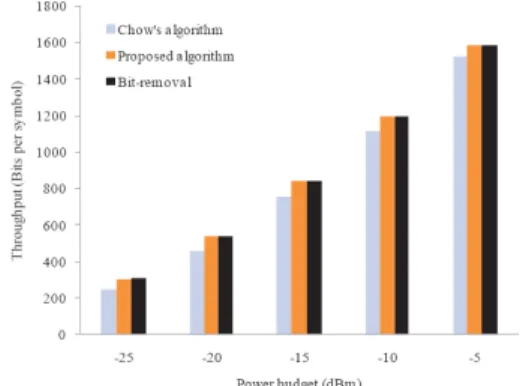
Fig. 3. Overall throughput of bit loading algorithms with various numbers of power budget (number of sub-channels
= 256)
Fig. 2. Overall throughput of bit loading algorithms with various numbers of sub-channels (power budget = -20 dBm)
The power reallocation policy derived with these rules is shown in Figure 1 (d). The sub-channel 1 gives up its power and sub-channel 2 and 5 are allocated additional power. By this reallocation, the number of total transmitted bits is increased by 2.
This reallocation process is repeated while it is possible to increase transmitted bits. Note that there is unused energy budget after the reallocation process. In the example, the remaining energy is 0.315×10⁻⁶W.
This energy can be used in next iteration of power reallocation.
Algorithm 1 shows the pseudo-code of our proposed scheme.
Ⅴ. Performance Evaluation
5.1 Simulation Set Up
The performance of the proposed algorithm is compared with the bit-removal and Chow's algorithm, which consider the power budget constraint. These schemes are regarded as the best solutions for throughput and light computational overhead, respec- tively. We compare the throughput and computation time of our proposed algorithm to Chow's algorithm and bit-removal with various numbers of sub-channels.
We assume that the available signal constellation sizes are 2, 4, 16, 64, and 128 in this simulation.
According to the signal constellation size, the available modulation schemes are BPSK, 4-QAM, 16-QAM, 64-QAM, and 128-QAM. The channel model we used in this simulation is the Rayleigh fading channel. For practical channel modeling, each sub-channel operates under a different channel state.
In this case, we use the power budget with -20 dBm.
Second, we also perform the throughput and computation time comparison of our proposed algorithm against Chow's algorithm and bit-removal with various values of power budget. In this case, we use 256 sub-channels.
Simulations are repeated 10,000 times under different channel conditions and the results are averaged.
5.2 Simulation Result
Figure 2 shows the overall throughput of various bit
loading algorithms measured with different number of sub-channels. Here, the number of sub-channels varies from 32 to 512. Result shows that the throughput of our scheme is not far from the optimal. In case the number of sub-channels is 256, which is used in the standard of wireless communication systems.
The throughput of our algorithm is 99.6% of the optimal bit-removal algorithm while the throughput of Chow's algorithm is 84% of the optimal.
Figure 3 shows the overall throughput of various bit loading algorithms measured with different energy budgets. Here the number of sub-channels is fixed to 256. Our algorithm shows near-optimal throughput.
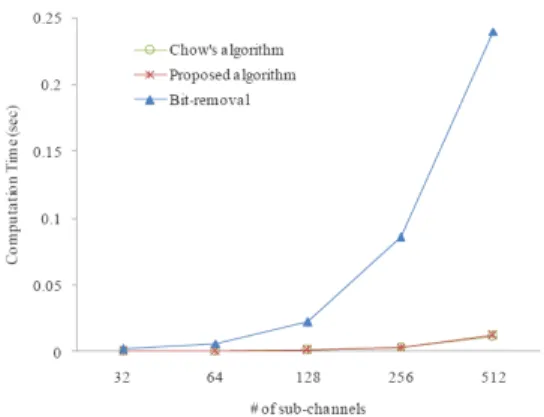
Figure 4 shows the computational complexity of bit loading algorithms with different number of sub-channels. Simulations are repeated 10,000 times
Fig. 4. Computation time of bit loading algorithms with various number of sub-channels (power budget = -20 dBm)
and the results are averaged. The complexity is measured in time required to allocate bits to sub-channels.
The results show that the complexity of our algorithm is comparable to the lightweight Chow's algorithm. In case the number of sub-channels is 256, the computation time is 117.2 % of the Chow's algorithm while the computation time of bit-removal algorithm is 2965.5 % of the Chow's algorithm.
The results of the throughput with number of sub-channels as 256, is shown in Figure 4. Our algorithm outperforms in terms of throughput compared to Chow's algorithm in all power budget values. Maxcount of chow's is 10. Our algorithm is similar to Chow's. Maxcount of our algorithm is no more than 12. It will suffice for real communication systems. However, throughput of our algorithm is a lot larger than Chow's.
As shown by the above analysis, our algorithm maximizes throughput with significantly reduced complexity while satisfying power budget requirements. This complexity is reasonable for the wireless sensor networks and enhances the throughput.
Ⅵ. Conclusion
For future applications of wireless sensor networks, both the low complexity and high throughput should be pursued. With our algorithm, wireless interfaces can effectively support those demands. In this paper, we dealt with the problem of bit allocation for
point-to-point wireless links and proposed a novel bit loading algorithm which reduces computational complexity while showing throughput comparable to the high-cost solution. To achieve this, we introduced the ceil power concept, which is used in power reallocation process.
We demonstrated that the proposed scheme has outstanding performance when compared to other schemes in terms of time complexity and throughput.
Complexity of our algorithm is reasonable for practical sensor network systems and the throughput is
comparable to that of the optimal solution.
References
[1] A Multicarrier Primer. ANSI Contribution T1E1.4/91-157, Nov. 1991
[2] Very-High-Bit-Rate Digital Subscriber Line (VDSL) Metallic Interface: Part 1: Functional Requirements and Common Specification. Part 3: Technical Specification of a Multi-Carrier Modulation Transceiver. ANSI Contribution T1E1.4/2000-013R1, 2000-009R3.
[3] J. G. Proakis, Communication Systems Engineering, 2nd ed. Prentice-Hall, 2002 [4] ‘IEEE Std. 802.11a: Wireless LAN medium
access control (MAC) and physical layer (PHY) specifications: high-spped physical layer in the 5 GHz band’, 1999.
[5] B. Fox, “Discrete optimization via marginal analysis,” Manage. Sci., Vol.13, No.3, pp.210- 216, Nov. 1966.
[6] A. Leke and J. M. Cioffi, ”A maximum rate loading algorithm for discrete multitone modulation systems,” in Proc. IEEE Global Telecommunications Conf., Phoenix, AZ, 1997, Vol.3, pp.1514-1518.
[7] A.M. Wyglinski, F. Labeau, and P. Kabal, ”Bit loading with BERconstraint for multicarrier systems,” IEEE Trans. Wirel. Commun., 2005, vol 4, No.4, pp.1383 - 1387.
[8] R. Fischer, ”A new loading algorithm for discrete multitone modulation,” in Proc. IEEE Global Telecommunications Conf., pp.724-728m March. 1996, London, IK.
[9] J. Campello ”Practical bit loading for DMT,”
in Proc. IEEE Int. Conf. Communications, Vancouber, Canada, 1999, col.2, pp.801-905 [10] H.Minn and S.Xing, ”An optimal training signal
structure for frequency offset esimation,” IEEE Trans. Commun., Vol.53, No.3, pp.343-355, Feb. 2005
[11] P.S. Chow, J.M. Cioffi, and J.A.C. Bingham,
“A practical discrete multitone transceiver loading algorithm for data transmission over spectrally shaped channels,” IEEE Trans.
Commun., Vol.43, No.3, pp.773-775, Feb. 1995.
[12] “Theoretical postulation of PLC channel model,”
tech, rep., OPERA, 2005.
[13] A. Fasano, G. Di Blasio, E. Baccarelli, and M.
Biagi, ”Optimal discrete bit loading for DMT based constrained multicarrier systems,” in Proc. IEEE ISIT, Jul. 2002, p. 243.
[14] E. Baccarelli and M. Biagi, ”Optimal integer bit-loading for multicarrier ADSL systems subject to spectral-compatibility limits,” Signal Process., Vol.84, pp.729?741, Apr. 2004.
오 승 열 (Seoungyoul Oh) 정회원
2006년 2월 숭실대학교 정보통 신전자공학과 졸업
2006년 3월~현재 POSTECH 컴퓨터공학 박사과정
<관심분야> OFDM, Wireless Communications, Cognitive Radio
고 현 목 (Hyeonmok Ko) 정회원
2007년 2월 홍익대학교 컴퓨터 공학과 졸업
2007년 3월~현재 POSTECH 컴퓨터공학 박사과정
<관심분야> OFDM, Wireless Communications, Cognitive Radio
권 순 목 (Soonmok Kwon) 정회원
2003년 9월 POSTECH 컴퓨터 공학과 졸업
2003년 9월~현재 POSTECH 컴퓨터공학 박사과정
<관심분야> Wireless Sensor Networks, Future Internet, Cognitive Radio
김 치 하 (Cheeha Kim) 종신회원 1984년 M.S. in Computer Sci- ence, University of Maryland, College Park, USA
1986년 Ph.D. in Computer Sci- ence, University of Maryland, College Park, USA
<관심분야> Computer Communi- cation, Mobile Computing, Sensor Networks, Cognitive Radio