韓藥作誌(Korean J. Medicinal Crop Sci.) 18(5) : 311 − 314 (2010)
311
HPLC를 이용한 지치중의 부위별 Luteolin 정량
한 샘·박준언·이설림·목소연·김혜민·이정민·안영희·이상현†
중앙대학교 식물응용과학과
Determination of Luteolin in the Different Parts of Lithospermum erythrorhizon by HPLC
Saem Han, Jun Yeon Park, Sul Lim Lee, So Youn Mok, Hye Min Kim, Jeong Min Lee, Young Hee Ahn and Sang Hyun Lee
†Department of Applied Plant Science, Chung-Ang University, Anseong 456-756, Korea.
ABSTRACT : The content of luteolin in the different parts of Lithospermum erythrorhizon was determined by high performance liquid chromatography (HPLC). Luteolin was quantified by a reverse-phase column with gradient solvent program (water : ACN = 90 : 10 to 77 : 23 for 60 min). UV detection was conducted at 330 ㎚ . The content of luteolin was measured in the seeds (0.28 ㎎ /g), stems (0.30 ㎎ /g), and roots (0.16 ㎎ /g) of L. erythrorhizon . The presence of luteolin in Lithospermum species is important in agricultural crop production for increasing the amounts of clinically available medicine and health supplements.
Key Words : Lithospermum erythrorhizon , Boraginaceae, Quantitative Analysis, Luteolin
INTRODUCTION
The genus Lithospermum , which is perennial plant belonging to the Boraginaceae family, distributed in Korea, Japan, and China. Among the genus, three species such as L. erythrorhizon , L. arvense , and L. zollingeri are spontaneously grown in Korea. Traditionally, the red pigments in L.
erythrorhizon roots have been used as a dye for staining fabrics and food colorants (Lee et al ., 2000). Also, it has been used medicinally for wounds (Touno et al ., 2005), burns, and haemorrhoids (Tabata et al ., 1974).
Many studies have shown that Lithospermum species exhibits a variety of pharmacological activities such as anti- tumor, anti-fungal, anti-HIV (Han et al ., 2008), anti- inflammatory (Kang et al ., 1998), anti-microbial, immunos- timulating, and contraceptive (Shen et al. , 2002). The extracts from L. erythrorhizon are reported to have antioxidant and antitumor effects (Yingming et al. , 2004). The plant has been widely used as various materials in Korea. The color components of L. erythrorhizon roots such as deoxyshikonin, acetylshikonin, isobutylshikonin, isovalerylshikonin, tetracrylshi-
konin, and propionylshikonin (Cho et al ., 1999; Morimoto et al ., 1965; Hwang et al. , 2002; Zhang et al ., 2002) are reported to various effects (Chen et al ., 2003; Ishida and Sakaguchi, 2007; Kim et al. , 2006; Kuroda et al. , 1997;
Yamasaki et al ., 1993; You et al. , 2000).
In previous papers, we reported the isolation of compounds such as two sterols, two phenolics, and an alkaloid from the plant (Park et al ., 2009a; Park et al ., 2009b). Among them, luteolin, a flavonoid, was isolated for the first time from L. erythrorhizon . It is clear that luteolin plays a role in suppressing the protein expression of iNOS and COX-2, two critical inducible enzymes responsible for the production of nitric oxide PGE
2(Hu and Kitts, 2004). Therefore, the determination of the part-specific preponderance of luteolin in L. erythrorhizon was performed by HPLC.
MATERIALS AND METHODS
1. Plant materials
The seeds, stems, and roots of L. erythrorhizon were collected from Jeongseon (Oct. 2007), Gangwon Province,
†
Corresponding author: (Phone) +82-31-670-4688 (E-mail) [email protected]
Received 2010 August 11 / 1st Revised 2010 October 8 / 2nd Revised 2010 October 11 / Accepted 2010 October 13
한 샘·박준언·이설림·목소연·김혜민·이정민·안영희·이상현
312
Korea. The plant is verified by Prof. Young-Hee Ahn, Chung-Ang University, Korea.
2. Instruments and reagents
The mass spectrometry (MS) was measured with a Jeol JMS-AX505WA mass spectrometer (Japan).
1H- and
13C- nuclear magnetic resonance (NMR) spectra were recorded with a Bruker AVANCE 300 NMR spectrometer (Germany) in DMSO using TMS as an internal standard. HPLC chromatograms were recorded with a GILSON 305 system pump with a GILSON 188 system UV/VIS detector (France). Water and ACN used in this research were of HPLC grade, and all other reagents were of analytical grade.
3. Preparation of luteolin
The air-dried whole seeds of L. erythrorhizon (4,695 g) were ground into powder and extracted with MeOH (1,000
㎖ × 3) under reflux. The MeOH extract was suspended in water, and then fractionated successively with equal volumes of n -hexane, CHCl
3, EtOAc, and n -BuOH (yield: 230, 9, 4, and 23 g, respectively). Among them, a portion of the n - BuOH fraction (10.0 g) was chromatographed on a silica gel column (No. 7734, 6 × 80 ㎝ ) using a stepwise gradient of CHCl
3and MeOH solvent system to yielded 11 sub-fractions.
Luteolin was isolated from the sub-fr. 7 (60% MeOH) after recrystallization with MeOH.
Luteolin: Yellow powder; R
f=0.56 (CHCl
3:MeOH=8:2);
EI-MS m/z 286 [M]
+(100), 258 (12.2), 153 (18.5), 134 (6.8), 129 (9.4);
1H-NMR (300 MHz, DMSO) δ
H12.98 (1H, s, 5-OH), 10.44 (1H, s, 7-OH), 9.70 (1H, s, 3'-OH), 9.41 (1H, s, 4'-OH), 7.43 (1H, dd, J = 8.0, 2.0 Hz, H-6'), 7.39 (1H, d, J = 2.0 Hz, H-2'), 6.90 (1H, d, J = 8.0 Hz, H- 5'), 6.67 (1H, s, H-3), 6.44 (1H, d, J = 2.0 Hz, H-8), 6.19 (1H, d, J = 2.0 Hz, H-6);
13C-NMR (75 MHz, DMSO) δ
C181.6 (C-4), 164.1 (C-7), 163.9 (C-2), 161.4 (C-5), 157.3 (C-9), 149.7 (C-4'), 145.7 (C-3'), 121.5 (C-6'), 119.0 (C-1'), 116.0 (C-5'), 113.7 (C-2'), 104.3 (C-10), 102.9 (C-3), 98.8 (C-8), 93.8 (C-6).
4. Sample preparation
For the quantitative analysis of luteolin in different parts of L. erythrorhizon , each 60.0 g was minced. The seeds, stems, and roots of L. erythrorhizon were extracted with
methanol under reflux and removed to yielded crude extracts. The resultant solution was filtered through Whatman 0.45 ㎛ PVDF syringe filter (Cat No. 6779, USA) prior to HPLC.
5. HPLC condition
Qualitative and quantitative analysis of luteolin was performed using a HPLC system. Determination was achieved on a reversed phase column (Watchers 100 ODS, 4.6 × 250
㎜ , 5 ㎛ , Daiso, Japan) and gradient solvent system (water : ACN) was employed as the mobile phase. The elution program was 90 : 10 initially, increased in linear gradients to 77 : 23 for 60 min. The flow rate was kept constant at 1.0
㎖ /min and the peaks were identified using UV absorbance at 330 nm. Injection volume is 20 ㎕ of the prepared methanol solutions. All solvents for HPLC analysis were degassed before use. HPLC analyses were done in triplicates.
6. Calibration
The standard stock solution (1 ㎎ /300 ㎕ ) of luteolin isolated the seeds of L. erythrorhizon was prepared in MeOH, and blended with same solvent. This solution was diminished of content to 50% to different concentration. The luteolin levels were ascertained by comparing the integrated peak areas of the individual compounds with that of a standard curve prepared from the corresponding standards.
The calibration functions are calculated with peak area (Y), concentration (X, ㎎ / ㎕ ), and mean values (n = 4).
RESULTS AND DISCUSSION
A chromatographic separation of the MeOH extract from
the seeds of L. erythrorhizon led to the isolation of luteolin
(Fig. 1). In a previous paper, the presence of luteolin in
the seeds of L. erythrorhizon was identified by NMR and
MS spectroscopy (Park et al ., 2009b). The typical flavonoid
signals were identified in the
1H-NMR spectrum. The
singlet at δ 12.98 and 10.44 showed the aromatic 5-OH
and 7-OH of the flavonoid A-ring. The proton signals at δ
6.90 (dd, J = 8.0 Hz, H-5'), 7.39 (d, J = 2.0 Hz, H-2') and
7.43 (d, J = 8.0, 2.0 Hz, H-6') showed the ABX splitting
type of the flavonoid B-ring. The
13C-NMR spectrum
showed C = O at δ 181.6. It showed molecular ion peak at
m/z 286 [M]
+in the EI-MS, which expect to a molecular
formula of C
15H
10O
6. Accordingly, the structure was
지치중의 부위별 Luteolin 정량
313
elucidated as luteolin by comparing its spectral data in the literature (Park et al ., 2009b; Ternai and Markham, 1976).
Luteolin was a common constituent in Taraxacum and Citrus species (Jung et al ., 2008; Elisa et al ., 2007).
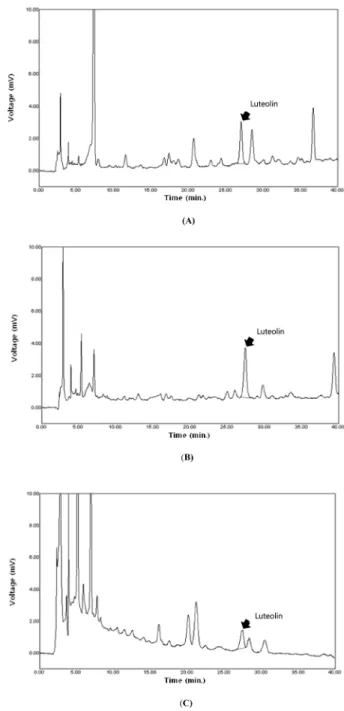
However, there have been no reports on the determination of luteolin in Lithospermum species. The content of part- specific preponderance of luteolin in L. erythrorhizon was determined by HPLC. The standard curve for luteolin is Y=321645.0982X − 9.3906 ( r
2=0.9997) (Fig. 2). Luteolin was shown at the retention time 27.2 min. The retention time of the expected peak of luteolin in L. erythrorhizon was the same as that of the standard compound. Table 1 shows that
luteolin was detected in the seeds (0.28 mg/g), stems (0.30
㎎ /g), and roots (0.16 ㎎ /g) of L. erythrorhizon . In particular, the content of luteolin in the stems and seeds were two times more than that of the roots.
Luteolin plays a key inhibitor of N -acetyltransferase as a growth factor of Helicobacter pylori (Chung et al ., 2001), and the inhibition of PAR-2 and -4 dependent inflammation (Lee et al. , 2007). The presence of luteolin in Lithospermum
Fig. 1.
Structure of luteolin from
L. erythrorhizon.
Fig. 2.
Calibration curve for luteolin (X axis,
㎍/20
㎕; Y axis, Area).
Table 1
. Content of luteolin in seeds, stems, and roots of
L.erythrorhizon
.
Samples Content (
㎎/g)
Seeds 0.277 ± 0.078*
Stems 0.297 ± 0.042
Roots 0.162 ± 0.100
*Data are given as the mean ± S.D. (n = 3) in mg/g dried samples.
Fig. 3.
HPLC chromatograms of the seeds (
A), stems (
B), and
roots (
C) of
L. erythrorhizon.
한 샘·박준언·이설림·목소연·김혜민·이정민·안영희·이상현
314